DANE SMITH ’58 A Diplomat’s Great Gift to His Alma Mater They we were revolutionaries in, then refugees from, apartheid-torn South Africa. In hiding in Botswana, Temba Maqubela and his wife, Vuyelwa (“Vuvu“), newly married, had secured teaching jobs—Temba in Maru-A-Pula School, where the diplomatic corps, among others, sent their children. One day a student of Temba’s asked him to write a letter of recommendation to a boarding “academy” in the United States. “Why do you want to go to a military school?” Temba asked Nita Smith. Her diplomat father was being transferred to another African country without a high school. She would have to finish high school back in the states, and PA had educated her father. It was the first time Temba Maqubela was to encounter the name Phillips Academy. He was to learn how unmilitary the “academy” actually was.
Temba and Vuvu were living in a “safe house,” Smith remembers, and life was tough for them. They feared armed raids from across the border by soldiers of the South African government; their lives were frequently in danger. So the young family had applied for resettlement in the United States—a slow, complicated bureaucratic process that had to be worked through the U.S. Mission. Smith kept a careful eye on the proceedings.
Neil Evans
Nita’s father, Dane Smith, was the deputy chief of mission at the U.S. Embassy in Botswana at the time, the winter of 1986. His family had gotten to know the Maqubelas through Smith’s wife, Judy, who taught school with Vuvu. They had become friends, sharing South African meals and family events, such as the birth of the Maqubela’s first-born. “They were classy people and popular teachers,” Smith recalls, ”very gifted, warm, and enthusiastic.” Judy Smith remembers also their seriousness, loyalty, and strength.
At Andover, Temba would begin a legacy that continues to change the lives of generations of students. He was one of the first black or Latino faculty members to become department chair and to rise to a senior administrative position as dean of faculty. He served as director of the (MS)2 summer outreach program and then went on to spearhead the development of the ACE Scholars Program (see page 29) and the evolving Global Perspectives Group. Vuvu found time to return to teaching, first at the Pike School in Andover and now at PA as an English instructor, while raising the family’s three sons—Kanyi ’03, Pumi ’06, and Tebs ’11. Meanwhile, Dane and Judy Smith were continuing their work in Africa. In their nearly 20 years on the continent, Dane would serve the U.S. Department of State in Botswana, Sudan, Guinea, Liberia, and Senegal, having first served as Peace Corps volunteers in Eritrea, then part of Ethiopia. In 1990 Smith was named U.S. ambassador to Guinea, a country entering the throes of political and economic reform. Five years later he was appointed special presidential envoy for Liberia—working with West African leaders, Western governments, and the U.N. in an effort to wrap up the Liberian Civil War. He played a role in the forging of the Abuja Agreement that temporarily ended that war and set the stage for elections. He subsequently became ambassador to Senegal and hosted President Clinton during his historic 1998 visit to Africa. Retiring from State in 1999, Smith became president of the National Peace Corps Association, the alumni and service organization of the Peace Corps. After four years, he moved on to become the senior associate at the Center for Strategic and International Studies and an adjunct professor at American University, teaching “peace-building in Africa” and “U.S. experiments in peace-building.” He is the author of several books, including the just-published U.S. Peacefare: Organizing American Peace-Building Operations.
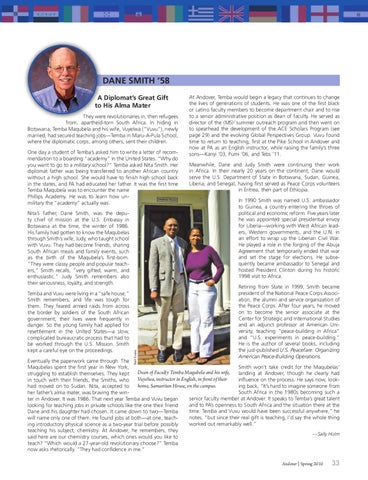
Eventually the paperwork came through. The Smith won’t take credit for the Maqubelas’ Maqubelas spent the first year in New York, Dean of Faculty Temba Maqubela and his wife, landing at Andover, though he clearly had struggling to establish themselves. They kept Vuyelwa, instructor in English, in front of their influence on the process. He says now, lookin touch with their friends, the Smiths, who home, Samaritan House, on the campus. ing back, “It’s hard to imagine someone from had moved on to Sudan. Nita, accepted to South Africa in the 1980s becoming such a her father’s alma mater, was braving the winsenior faculty member at Andover. It speaks to Temba’s great talent ter in Andover. It was 1986. That next year Temba and Vuvu began and to PA’s openness to South Africa and the situation there at the looking for teaching jobs in private schools like the one their friend time. Temba and Vuvu would have been successful anywhere,” he Dane and his daughter had chosen. It came down to two—Temba notes, “but since their real gift is teaching, I’d say the whole thing will name only one of them. He found jobs at both—at one, teachworked out remarkably well.” ing introductory physical science as a two-year trial before possibly teaching his subject, chemistry. At Andover, he remembers, they —Sally Holm said here are our chemistry courses, which ones would you like to teach? “Which would a 27-year-old revolutionary choose?” Temba now asks rhetorically. “They had confidence in me.” Andover | Spring 2010
33