PROGRAM NOTES expands in the central slow movement. But by the final movement the rhythmic energy wins the day, and at one point Josh even plays with a guitar pick. This is, after all, the same fellow who played arrangements of Led Zeppelin at Town Hall, so I had to send him out with a bang. For his part, Roman expresses deep admiration for this work. “Like a lot of Mason’s music,” he says, “the Cello Concerto has a fresh sound, as well as a distinctly American character with its sense of modernism, openness and optimism. It has a lyrical feel, with all these beautiful little touches like glissandi that make it fun to play. There’s a blues influence in the harmonies, but you can also hear his experience with electronic music in the score, as there’s a feeling of pulse in the rhythms, a driving beat. And the openness in his harmonies reflects the openness of his personality as a musician. He’s exploratory and optimistic, open to collaboration and to possibilities.”
Symphony—he hung his hat at no fewer than four addresses. On the other hand, this was not Beethoven’s whole life. Like many modern urbanites, he drew important sustenance from the city—in his case, Vienna—but complained incessantly about its inconveniences. He enjoyed escaping to the suburban parks and countryside when he was able, and he spent his summers mostly in rural areas surrounding Vienna, which is why he found himself installed in the village of Heiligenstadt in the summer of 1808. Sometimes he went farther afield, dropping in at the country residences of well-to-do friends in Hungary or visiting spas in Bohemia. “How delighted I shall be to ramble for a while through bushes, woods, under trees, through grass, and around rocks,” he wrote in 1810 to Therese Malfatti (a future object of his affections), looking forward “with childish excitement” to a getaway a year after the Sixth Symphony was published. “No one can love the country as much as I do. For surely woods, trees, and rocks produce the echo which man desires to hear.”
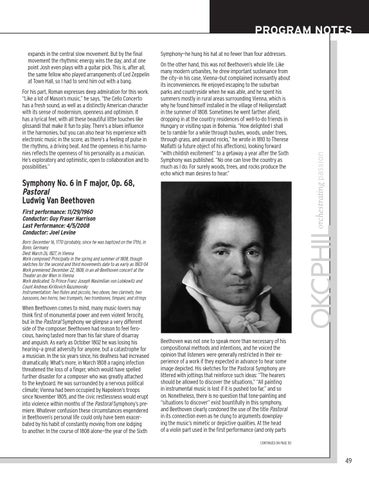
Symphony No. 6 in F major, Op. 68, Pastoral Ludwig Van Beethoven First performance: 11/29/1960 Conductor: Guy Fraser Harrison Last Performance: 4/5/2008 Conductor: Joel Levine Born: December 16, 1770 (probably, since he was baptized on the 17th), in Bonn, Germany Died: March 26, 1827, in Vienna Work composed: Principally in the spring and summer of 1808, though sketches for the second and third movements date to as early as 1803-04 Work premiered: December 22, 1808, in an all-Beethoven concert at the Theater an der Wien in Vienna Work dedicated: To Prince Franz Joseph Maximilian von Lobkowitz and Count Andreas Kirillovich Razumovsky Instrumentation: Two flutes and piccolo, two oboes, two clarinets, two bassoons, two horns, two trumpets, two trombones, timpani, and strings
When Beethoven comes to mind, many music-lovers may think first of monumental power and even violent ferocity, but in the Pastoral Symphony we glimpse a very different side of the composer. Beethoven had reason to feel ferocious, having tasted more than his fair share of disarray and anguish. As early as October 1802 he was losing his hearing—a great adversity for anyone, but a catastrophe for a musician. In the six years since, his deafness had increased dramatically. What’s more, in March 1808 a raging infection threatened the loss of a finger, which would have spelled further disaster for a composer who was greatly attached to the keyboard. He was surrounded by a nervous political climate; Vienna had been occupied by Napoleon’s troops since November 1805, and the civic restlessness would erupt into violence within months of the Pastoral Symphony’s premiere. Whatever confusion these circumstances engendered in Beethoven’s personal life could only have been exacerbated by his habit of constantly moving from one lodging to another. In the course of 1808 alone—the year of the Sixth
Beethoven was not one to speak more than necessary of his compositional methods and intentions, and he voiced the opinion that listeners were generally restricted in their experience of a work if they expected in advance to hear some image depicted. His sketches for the Pastoral Symphony are littered with jottings that reinforce such ideas: “The hearers should be allowed to discover the situations,” “All painting in instrumental music is lost if it is pushed too far,” and so on. Nonetheless, there is no question that tone-painting and “situations to discover” exist bountifully in this symphony, and Beethoven clearly condoned the use of the title Pastoral in its connection even as he clung to arguments downplaying the music’s mimetic or depictive qualities. At the head of a violin part used in the first performance (and only parts CONTINUED ON PAGE 50
49