PRIMATE WARS {BY AL HOFF}
THE BIG SICK IS A HYBRIDIZED ROM-COM THAT IS THIS SUMMER’S WINNING FEATURE
We’re already beset with harbingers of our demise — from antibiotic-resistant superbugs to rising oceans — so judge for yourself the entertainment value in seeing humans take another beating. Men make their last stand in War for the Planet of the Apes, director Matt Reeves’ conclusion to the re-booted Planet of the Apes prequel trilogy. In Rise of the Planet of the Apes (2011), we learned of bio-engineered supersmart apes, who escaped from captivity. Then, in Dawn of the Planet of the Apes (2014), many humans succumbed to a deadly virus, while the apes, living in the woods, got organized. Now just a few obstacles stand in the way of their goal: a planet of the apes!
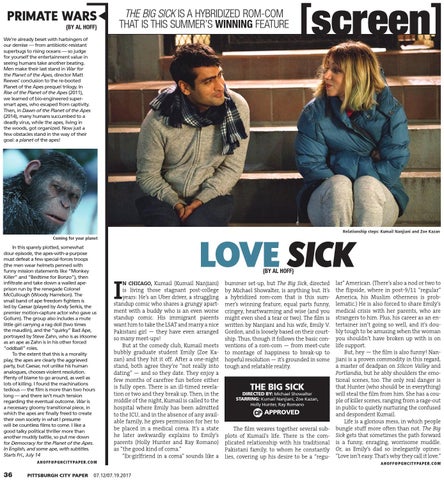
Relationship steps: Kumail Nanjiani and Zoe Kazan Coming for your planet
In this sparely plotted, somewhat dour episode, the apes-with-a-purpose must defeat a few special-forces troops (the men wear helmets penned with funny mission statements like “Monkey Killer” and “Bedtime for Bonzo”), then infiltrate and take down a walled apeprison run by the renegade Colonel McCullough (Woody Harrelson). The small band of ape freedom fighters is led by Caesar (played by Andy Serkis, the premier motion-capture actor who gave us Gollum). The group also includes a mute little girl carrying a rag doll (two times the maudlin), and the “quirky” Bad Ape, portrayed by Steve Zahn, who is as irksome as an ape as Zahn is in his other forced “oddball” roles. To the extent that this is a morality play, the apes are clearly the aggrieved party, but Caesar, not unlike his human analogues, chooses violent resolution. Plenty of blame to go around, as well as lots of killing. I found the machinations tedious — the film is more than two hours long — and there isn’t much tension regarding the eventual outcome. War is a necessary gloomy transitional piece, in which the apes are finally freed to create their own society in what I presume will be countless films to come. I like a good talky political thriller more than another muddy battle, so put me down for Democracy for the Planet of the Apes. In English, and some ape, with subtitles. Starts Fri., July 14
LOVE SICK {BY AL HOFF}
I
N CHICAGO, Kumail (Kumail Nanjiani) is living those stagnant post-college years: He’s an Uber driver, a struggling standup comic who shares a grungy apartment with a buddy who is an even worse standup comic. His immigrant parents want him to take the LSAT and marry a nice Pakistani girl — they have even arranged so many meet-ups! But at the comedy club, Kumail meets bubbly graduate student Emily (Zoe Kazan) and they hit it off. After a one-night stand, both agree they’re “not really into dating” — and so they date. They enjoy a few months of carefree fun before either is fully open. There is an ill-timed revelation or two and they break up. Then, in the middle of the night, Kumail is called to the hospital where Emily has been admitted to the ICU, and in the absence of any available family, he gives permission for her to be placed in a medical coma. It’s a state he later awkwardly explains to Emily’s parents (Holly Hunter and Ray Romano) as “the good kind of coma.” “Ex-girlfriend in a coma” sounds like a
AHOFF@PGHCITYPAPER.COM
36
PITTSBURGH CITY PAPER
07.12/07.19.2017
bummer set-up, but The Big Sick, directed by Michael Showalter, is anything but. It’s a hybridized rom-com that is this summer’s winning feature, equal parts funny, cringey, heartwarming and wise (and you might even shed a tear or two). The film is written by Nanjiani and his wife, Emily V. Gordon, and is loosely based on their courtship. Thus, though it follows the basic conventions of a rom-com — from meet-cute to montage of happiness to break-up to hopeful resolution — it’s grounded in some tough and relatable reality.
THE BIG SICK DIRECTED BY: Michael Showalter STARRING: Kumail Nanjiani, Zoe Kazan, Holly Hunter, Ray Romano
CP APPROVED The film weaves together several subplots of Kumail’s life. There is the complicated relationship with his traditional Pakistani family, to whom he constantly lies, covering up his desire to be a “regu-
lar” American. (There’s also a nod or two to the flipside, where in post-9/11 “regular” America, his Muslim otherness is problematic.) He is also forced to share Emily’s medical crisis with her parents, who are strangers to him. Plus, his career as an entertainer isn’t going so well, and it’s doubly tough to be amusing when the woman you shouldn’t have broken up with is on life support. But, hey — the film is also funny! Nanjiani is a proven commodity in this regard, a master of deadpan on Silicon Valley and Portlandia, but he ably shoulders the emotional scenes, too. The only real danger is that Hunter (who should be in everything) will steal the film from him. She has a couple of killer scenes, ranging from a rage-out in public to quietly nurturing the confused and despondent Kumail. Life is a glorious mess, in which people bungle stuff more often than not. The Big Sick gets that sometimes the path forward is a funny, enraging, worrisome muddle. Or, as Emily’s dad so inelegantly opines: “Love isn’t easy. That’s why they call it love.” A H OF F @ P G HC I T Y PA P E R. C OM