RREESSEEAARRCCHH SSTTUUDDYY
CITY DIVIDED, CONTINUED FROM PG. 06
Borderline Pe r s o n a l i t y D i s o r d e r The University of Pittsburgh and UPMC are seeking men and women ages 18 to 45 to take part in a research study of borderline personality disorder. To participate, you must have symptoms of the disorder, which may include: troubled personal relationships, chronic feelings of emptiness or boredom, difficulty controlling anger or frustration, mood swings, self-destructive or impulsive behaviors, or history of self-inflicted pain or injury. Participants are interviewed about their moods, behaviors, and personality traits and will be compensated up to $125 upon completion of the interviews. Some participants may also undergo an fMRI scan. There is no cost for this procedure. Participants are compensated $50 upon completion of the fMRI. For more information, call 412-246-5367.
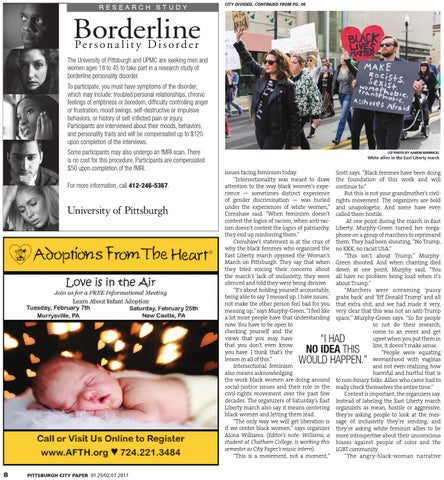
{CP PHOTO BY AARON WARNICK}
White allies in the East Liberty march
issues facing feminism today. “Intersectionality was meant to draw attention to the way black women’s experience — sometimes distinct experience of gender discrimination — was buried under the experiences of white women,” Crenshaw said. “When feminism doesn’t contest the logics of racism, when anti-racism doesn’t contest the logics of patriarchy, they end up reinforcing them.” Crenshaw’s statement is at the crux of why the black femmes who organized the East Liberty march opposed the Woman’s March on Pittsburgh. They say that when they tried voicing their concerns about the march’s lack of inclusivity, they were silenced and told they were being divisive. “It’s about holding yourself accountable, being able to say ‘I messed up, I have issues,’ not make the other person feel bad for you messing up,” says Murphy-Green. “I feel like a lot more people have that understanding now. You have to be open to checking yourself and the views that you may have that you don’t even know you have. I think that’s the lesson in all of this.” Intersectional feminism also means acknowledging the work black women are doing around social-justice issues and their role in the civil-rights movement over the past few decades. The organizers of Saturday’s East Liberty march also say it means centering black women and letting them lead. “The only way we will get liberation is if we center black women,” says organizer Alona Williams. (Editor’s note: Williams, a student at Chatham College, is working this semester as City Paper’s music intern). “This is a movement, not a moment,”
Scott says. “Black femmes have been doing the foundation of this work and will continue to.” But this is not your grandmother’s civilrights movement. The organizers are bold and unapologetic. And some have even called them hostile. At one point during the march in East Liberty, Murphy-Green turned her megaphone on a group of marchers to reprimand them. They had been shouting, “No Trump, no KKK, no racist USA.” “This isn’t about Trump,” MurphyGreen shouted. And when chanting died down at one point, Murphy said, “You all have no problem being loud when it’s about Trump.” “Marchers were screaming ‘pussy grabs back’ and ‘Eff Donald Trump’ and all that extra shit, and we had made it very, very clear that this was not an anti-Trump space,” Murphy-Green says. “So for people to not do their research, come to an event and get upset when you put them in line, it doesn’t make sense. “People were equating womanhood with vaginas and not even realizing how harmful and hurtful that is to non-binary folks. Allies who came had to really check themselves the entire time.” Context is important, the organizers say. Instead of labeling the East Liberty march organizers as mean, hostile or aggressive, they’re asking people to look at the message of inclusivity they’re sending, and they’re asking white feminist allies to be more introspective about their unconscious biases against people of color and the LGBT community. “The angry-black-woman narrative
“I HAD NO IDEA THIS WOULD HAPPEN.”
8
PITTSBURGH CITY PAPER 01.25/02.01.2017