[DANCE]
WAYWARD MINDS
“THIS WAS A REQUIREMENT, NOT A CHOICE.”
There are journeys in life, and then there are journeys of being. Jil Stifel and Ben Sota’s new work, WaywardLand, explores the idea that we’re on a journey in our human evolution. The 55-muinute abstract work combines circus, dance and physical theater, says Sota, 34, artistic director of the Zany Umbrella Circus. WaywardLand, part of The New Hazlett Theater’s Community Supported Art Performance Series, follows several “conversational threads.” One is the idea that we now live at a junction between the analog age and the digital age, and that a similar transition is happening inside our DNA, as we move from predominantly primal selves to the evolved beings of a digital and technological era. That idea of transformation is manifested in the work, with Sota, dancer/ choreographer Stifel and dancers Taylor Knight and Anna Thompson appearing at times as minotaurs, by donning bull’s-head masks created by artist Blaine Siegel. Stifel, 36, is a former dancer with Attack Theatre. In a solo in WaywardLand, she says, she plays with the idea of her DNA being on a percentage meter, moving between 100 percent human and 100 percent minotaur, and to points in between. The trick, she says, is portraying both beings proportionately in her dancing. This idea of someone’s DNA shifting between human and animal comes and goes throughout the nonlinear work, says Stifel. Another big theme, says Stifel, is our yearning as humans to constantly explore new places, and the perils we run into doing so. Set to music by David Bernabo, the work explores its themes by using what Sota describes as slow-moving, alternative takes on familiar circus acts. Acts include: stiltwalking; tightrope-walking without a wire; a trapeze act, used as a metaphor; and a duet by Stifel and Sota on a German wheel, an apparatus consisting of two large rings joined by a set of parallel bars, which performers stand inside to roll around a space. While the themes explored in the work might sound a bit heady, Sota says he and Stifel have a sense of humor about WaywardLand, and that the work contains plenty of whimsical moments and circus-like spectacle to go with its somewhat esoteric motivations. INFO@PGHCITYPAPER.COM
JIL STIFEL AND BEN SOTA present WAYWARDLAND 8 p.m. Thu., Feb. 12. $20-25. New Hazlett Theater, 6 Allegheny Square, North Side. 412-320-4610 or www.newhazletttheater.org N E W S
+
A scene from WaywardLand {PHOTO COURTESY OF NICOLE JAROCK}
{BY STEVE SUCATO}
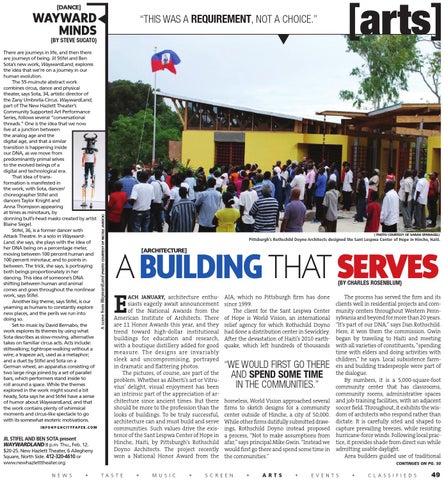
{ PHOTO COURTESY OF SARAH SPANAGEL}
Pittsburgh’s Rothschild Doyno Architects designed the Sant Lespwa Center of Hope in Hinche, Haiti.
A BUILDING THAT SERVES [ARCHITECTURE]
{BY CHARLES ROSENBLUM}
E
ACH JANUARY, architecture enthusiasts eagerly await announcement of the National Awards from the American Institute of Architects. There are 11 Honor Awards this year, and they trend toward high-dollar institutional buildings for education and research, with a boutique distillery added for good measure. The designs are invariably sleek and uncompromising, portrayed in dramatic and flattering photos. The pictures, of course, are part of the problem. Whether as Alberti’s art or Vitruvius’ delight, visual enjoyment has been an intrinsic part of the appreciation of architecture since ancient times. But there should be more to the profession than the looks of buildings. To be truly successful, architecture can and must build and serve communities. Such values drive the existence of the Sant Lespwa Center of Hope in Hinche, Haiti, by Pittsburgh’s Rothschild Doyno Architects. The project recently won a National Honor Award from the
AIA, which no Pittsburgh firm has done since 1999. The client for the Sant Lespwa Center of Hope is World Vision, an international relief agency for which Rothschild Doyno had done a distribution center in Sewickley. After the devastation of Haiti’s 2010 earthquake, which left hundreds of thousands
“WE WOULD FIRST GO THERE AND SPEND SOME TIME IN THE COMMUNITIES.” homeless, World Vision approached several firms to sketch designs for a community center outside of Hinche, a city of 50,000. While other firms dutifully submitted drawings, Rothschild Doyno instead proposed a process, “Not to make assumptions from afar,” says principal Mike Gwin. “Instead we would first go there and spend some time in the communities.”
The process has served the firm and its clients well in residential projects and community centers throughout Western Pennsylvania and beyond for more than 20 years. “It’s part of our DNA,” says Dan Rothschild. Here, it won them the commission. Gwin began by traveling to Haiti and meeting with all varieties of constituents, “spending time with elders and doing activities with children,” he says. Local subsistence farmers and building tradespeople were part of the dialogue. By numbers, it is a 5,000-square-foot community center that has classrooms, community rooms, administrative spaces and job-training facilities, with an adjacent soccer field. Throughout, it exhibits the wisdom of architects who respond rather than dictate. It is carefully sited and shaped to capture prevailing breezes, while resisting hurricane-force winds. Following local practice, it provides shade from direct sun while admitting usable daylight. Area builders guided use of traditional CONTINUES ON PG. 50
TA S T E
+
M U S I C
+
S C R E E N
+
A R T S
+
E V E N T S
+
C L A S S I F I E D S
49