© Can Stock Photo/steffstarr
BARKS from the Guild Issue 33 / November 2018 BARKSfromtheGuild.com
PET CARE Industry Standards and Regulation
FELINE Multicat Households and Sociality EQUINE Friends and Social Relationships
CANINE Dogs on the Road
CANINE The HumanDog Bond
AVIAN The Eductional Turkey Vulture
BEHAVIOR Common Myths about Rabbits
Is 'Maybe' Addictive?
Dopamine, anticipation, and reinforcement schedules: The essential roles they all play in training
PLUS: A FULL REPORT FROM PPG AUSTRALIA’S 2018 SYDNEY SUMMIT Published by the Pet Professional Guild
“ Fa Fame(US) me(US) and and I love love our our BrilliantK9 BrilliantK9 Harness! Harness! This T his harness harness keeps keeps her her safe safe and and comfortable comfo ortable getting getting in in and and out out of of the the ring ring plus plus it’s it’s very easy to put on and take off.” - Jessica JJessiica Ajoux Ajjjoux
F nd Find Fi nd out ou out wh why hy tthe he To Topp Per Performance fo for orrmance Dogs Proudly PProud roudllly y Wear W Weaar BrilliantK9 • Design Design • Allows Allows reduce reduce • Handm Handm
Use cou Use coupon coupon code code PPG PPG for ffor your your 15% 1 5% me member member discount! discount! www.BrillliantK9.com www www.BrillliantK9 .Bri .com
BARKS from the Guild
Published by the Pet Professional Guild 9122 Kenton Road, Wesley Chapel, Florida 33545, USA Tel: +1-844-462-6473 petprofessionalguild.com barksfromtheguild.com facebook.com/BARKSfromtheGuild Editor-in-Chief Susan Nilson barkseditor@petprofessionalguild.com
Images © Can Stock Photo: canstockphoto.com (unless otherwise credited; uncredited images belong to Pet Professional Guild)
Pet Professional Guild Steering Committee Kelly Fahey, Paula Garber, Kelly Lee, Debra Millikan, Susan Nilson, Louise Stapleton-Frappell, Angelica Steinker, Niki Tudge
BARKS from the Guild Published bi-monthly, BARKS from the Guild presents a collection of valuable business and technical articles as well as reviews and news stories pertinent to our industry. BARKS is the official publication of the Pet Professional Guild.
Submissions BARKS encourages the submission of original written materials. Please contact the Editor-in-Chief for contributor guidelines prior to sending manuscripts or see: barksfromtheguild.com/article-and-content-submission-policy-procedures Please submit all contributions via our submission form at: petprofessionalguild.com/bftgcontent
Letters to the Editor To comment on an author’s work, or to let PPG know what topics you would like to see more of, contact the Editor-in-Chief via email putting BARKS in the subject line of your email. BARKS reserves the right to edit for length, grammar and clarity.
Subscriptions and Distribution BARKS is a digital publication. Print copies are available by monthly subscription. Register at barksfromtheguild.com/subscribe. Please contact Rebekah King at membership@petprofessionalguild.com for all subscription and distribution-related enquiries. Advertising Please contact Kelly Fahey at kelly@petprofessionalguild.com to obtain a copy of rates, ad specifications, format requirements and deadlines. Advertising information is also available at petprofessionalguild.com/advertisinginBARKS
Pet Professional Guild does not endorse or guarantee any products, services or vendors mentioned in BARKS, nor can it be responsible for problems with vendors or their products and services. Pet Professional Guild reserves the right to reject, at its discretion, any advertising.
To be in any way affiliated with the Pet Professional Guild, all members must adhere to a strict code of conduct. Pet Professional Guild members understand force-free to mean that no pain, force or fear and no shock, choke or prong are ever employed to train or care for a pet.
© All rights reserved. No part of this publication may be reproduced, distributed, or transmitted in any form or by any means, including photocopying, recording, or other electronic or mechanical methods, without the prior written permission of the Pet Professional Guild, except in the case of brief quotations embodied in critical reviews and certain other noncommercial uses permitted by copyright law. For permission requests, please email: barkseditor@petprofessionalguild.com.
P
from the editor
PG held its first ever Australia summit at the end of July and the event, hailed an overwhelming success by those in attendance, played host to multiple talents and industry leaders who presented on a wide variety of topics pertinent to today’s pet professional. In her opening address, PPG Australia president Barbara Hodel spoke of the challenges force-free pet professionals may face as they work to engineer change in the industry and reminded attendees that those are the times we need to “turn to our fellow professionals and friends to share knowledge and support each other,” and that “events like the summit are a great place to foster these relationships.” If the photos are anything to go by, this was achieved in spades in Sydney. You can read our full report from the event on pages 10-17. Meanwhile, our Cover Story this month asks the rather provocative question, ‘Is “maybe” addictive?’ and goes on to discuss dopamine, anticipation and reinforcement schedules in training and the combined impact they have on its efficacy. As professional trainers are already aware, dopamine has many functions and is released into the brain when animals expect and/or receive a reward, thereby motivating them to repeat an action. Although one may expect dopamine levels to rise upon receipt of a reinforcer, some studies have shown that increases are not necessarily directly related to the reinforcer, but, rather, that it is the anticipation of the reinforcer that causes dopamine levels to spike. What does this all mean for our training? What really excites or inhibits dopamine neurons and what causes little or no response? Read our Cover Story for all the answers...”maybe.” Elsewhere in the issue, we have our usual range of articles based on the unique insights and experiences of PPG members, this month encompassing topics such as rescuing dogs from overseas and how to address any ensuing behavior problems, traveling on the road and camping with dogs, dealing with canine car sickness, and bonding (or not) with your dog. In other species, our Feline section examines sociality and multicat households and the cat’s ability to live in groups vs. as a solitary species, while, on a similar theme, our Equine section examines horses living individually vs. in a group, and how to improve welfare by allowing them to choose their own friends. Our Avian section features the very special tale of Willoughby the turkey vulture who started out trying to charge at and bite her caretaker and is now, through the power of applied behavior analysis and positive reinforcement, an educator of the most unique kind. We also bust some more bunny myths in our Behavior section, including the commonly held misconceptions that rabbits are easy pets, cheap to keep, and enjoy being picked up and cuddled. In our Pet Care section, we once again look into the lack of regulation and standards in the pet industry, what this means for pet owners and those new to the field, and what is available to animal behavior interns in New York City in terms of sites where they can gain practical experience. You may (or may not) be surprised. We also present a cleaning protocol essential for boarding and day care facilities while, rounding out the issue, our Business and Consulting sections examine how to effectively conduct training lessons with clients and, all importantly, prepare your business for the holiday season. It is hard to believe that this will be our final issue of the year. If you have not had a chance yet, do check out our new BARKS from the Guild website (barksfromtheguild.com), which showcases just a few of our favorite articles, past and present, and is also the new home of the BARKS Blog and BARKS Podcasts which are now all located on one, easy-to-access media platform. You can also subscribe to the print edition of BARKS and to the BARKS Blog there, and stay up-to-date with general industry news, such as the recent shock collar ban in the United Kingdom, as well as any new scientific studies that capture our interest.
BARKS from the Guild/November 2018
n Susan Nilso
3
contents 6 10 18 26 28 32 34 36 40 43 46 50 52 54 57 58 61
4
N EWS
An update of all the latest developments at PPG, plus upcoming podcasts, webinars and workshops
E MBRACING
THE
F ORCE -F REE APPROACH
Petra Edwards, Sarah Fourge, Barbara Hodel, Tracy Taylor, and Jude Tuttleby report from PPG Australia’s inaugural summit, held in Sydney at the end of July
I S “M AYBE ” ADDICTIVE ?
Louise Stapleton-Frappell examines the roles of dopamine, anticipation, and reinforcement schedules and the roles they play in training
B EHAVIORAL R EHABILITATION
OF
M ULTINATIONAL C ANINES
Anna Bradley investigates rescuing dogs from abroad and how to best address common behavior issues
D OGS
ON THE
R OAD
Diane Garrod presents 10 tips for fun, safe, and successful RV or car travel and camping with dogs
T RAVEL R EWARDS
18 26
28
Sheelah Gullion explores the efficacy of tools and methods available to help reluctant canine passengers
FAILURE
TO
B OND
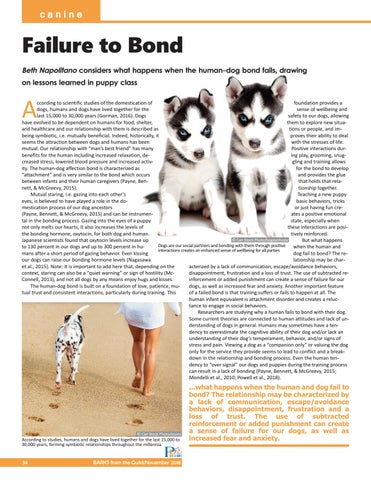
Beth Napolitano considers what happens when the human-dog bond fails, drawing on lessons learned in puppy class
F RIENDS , F OES
OR
S OMETHING
IN
B ET WEEN ?
Paula Garber discusses feline sociality and considerations for cats in multicat households
S OCIAL R EL ATIONSHIPS
IN THE
D OMESTIC HORSE
Kathie Gregory examines ways of catering to a group of horses without compromising the individual
36
O UR G REATEST T EACHERS
Lara Joseph relates the tale of Willoughby the turkey vulture who went from charging at her and trying to bite her, to becoming an educator of the most unique kind
B UNNY M YTHS BUSTED
Emily Cassell addresses commonly held misconceptions about rabbit behavior and care and provides practical solutions to ensure a bunny’s basic needs are met
U NDERSTANDING A NIMALS
34
Frania Shelley-Grielen discusses education for pet care technician students and her personal experiences of internship sites in New York City
H EALTH
AND
HYGIENE
Lauri Bowen-Vaccare discusses health issues and the importance of a proper cleaning protocol in day care and boarding facilities
A PRACTICAL TEACHING METHOD
Niki Tudge explains how to effectively conduct training lessons with clients
A SK
THE
E XPERTS : P REPARING
FOR THE
40
H OLIDAY S EASON
Veronica Boutelle of dog*biz responds to your business and marketing questions
52
P ROFILE : P RACTICING E MOTIONAL I NTELLIGENCE
Featuring Stephanie Peters of Plucky Paws, LLC in Ames, Iowa
B OOK R EVIEW : W HERE C HALLENGES B ECOME O PPORTUNITIES
Breanna Norris reviews Pepper Becoming: The Journey of an Unwanted Dog and the Man Who Wanted Her by John D. Visconti
BARKS from the Guild/November 2018
43
46
news
PPG Launches Let’s Celebrate +R Photo/Video Competition
P
PG has marked November 17, 2018 as the International Day of Advocacy to celebrate the first anniversary of the official launch of its international advocacy initiative, the Shock-Free Coalition (shockfree.org). The focal point of the celebration will be Let's Celebrate +R, a photo and video competition where pet professionals and enthusiasts can showcase the best of positive reinforcement-based pet training and education. Let's Celebrate +R will run from seven days prior to seven days post November 17. Entry will be via both PPG's North America/International (petprofessionalguild.com/Lets-Celebrate-Plus-R) and Europe (ppgbi.com/Lets-Celebrate-+R) websites with prizes issued to the winners selected from submissions to both sites. To participate in the International Day of Advocacy 2018, competition entrants have to take a photo and/or make a short video and submit it to one of the Let's Celebrate +R competition categories. There are three categories in both photos and videos, including Best Pet(s) and Handler Team, Best Group Photo, Best Pet and Child Interaction Photo, Most Creative Complex Training Video, Best Educational Video, and Best Volunteering Video. Winners and runners-up from each category will have the opportunity to win prizes to include pro-
fessional training and behavior books and DVDs, free PPG junior membership, an entry to the DogNostics Dog Training Certificate program, and a 12-month subscription to PPG educational webinars. The winners from each of the six categories will then be forwarded to the final judging category, Best Overall Entry. The prize for the winner in the US/International category is a free entry ticket, including gala dinner, to PPG's Canine Aggression and Bite Prevention Education Seminar in Portland, Oregon on April 26-28, 2019. The prize for the winner in the Europe category is a free entry ticket to Woof in Nottingham, England on February 9-12, 2019 hosted by Domesticated Manners and Chirag Patel. Entries will be judged by a private panel using an objective criterion. "We invite pet professionals and enthusiasts from all over the world to participate in Let's Celebrate +R," said PPG president and founder, Niki Tudge. "The goal of the competition is to help educate and advocate for the use of positive reinforcement and force-free training and pet care methods worldwide as we work to build a broad movement committed to eliminating electric shock devices from the supply and demand chain worldwide."
PPG Responds to UK Shock Collar Ban
PPG Responds to Joint IAABC, APDT and CCPDT Code of Ethics
P
PG has announced its support for the Government of the United Kingdom’s decision to implement a nationwide ban on the use of remote control electric shock collars for the training, management, and care for pets. Further, PPG is in full agreement with the U.K. Kennel Club (2018) that “the use of electric shock collars as a training method has a long term negative welfare impact on dogs.” In its response, PPG said: “There is a growing body of peer-reviewed, scientific research that shows, whether discussing dogs, humans, dolphins or elephants, that electric shock as a form of training to teach or correct a behavior is ineffective at best, and physically and psychologically damaging at worst. States renowned board certified animal behaviorist and veterinarian, Dr. Karen Overall (2005): ‘There are now terrific scientific and research data that show the harm that shock collars can do behaviorally.’ It is PPG’s view that pets need to be well-socialized and mentally and physically healthy if a productive and safe relationship for all members of their family and the public at large is to be ensured. As such, PPG urges all parties involved in determining new legislation to focus first on education, operational standards and modern, humane methods. Government has a responsibility to implement effective public health measures that increase the information available to the public and decision makers, protect people from harm, promote health, and create environments that support healthy behaviors (Friedman, 2010).” Read the full response and download as a member PDF: ppgbi.com/Open-Letter-Response-To-The-UK -Decision-to-Ban-Shock-Collars. 6
BARKS from the Guild/November 2018
I
n its official response to the announcement on September 11, 2018 by the International Association of Animal Behavior Consultants (IAABC), the Association of Professional Dog Trainers (APDT), and the Certification Council for Professional Dog Trainers (CCPDT) that they have combined to adopt a unified Code of Conduct, a Code of Ethics and Standards of Practice for professional animal behavior consultants and trainers, PPG acknowledged the efforts of all those who participated in the development and recognized the initial steps made jointly by those organizations. However, PPG has also called on fellow industry professionals and associations to take a firmer stance on specific equipment and approaches and encouraged all organizations to embrace the vast body of scientific research that details the many advantages of positive training methods, and publicly say “no” to any technique that causes pain or fear – including those administered via equipment that delivers electric shock. While PPG “commends the initial move made jointly by the IAABC, APDT and CCPDT, [it] proposes an alternative first step: that electric shock is taken off the table once and for all. If the IAABC, APDT and CCPDT will agree on that as a foundation, other tools and methods that function by causing pain and fear can consequently be addressed...The time to achieve this is now, and it is our duty to shape the future.” Read PPG’s full response: petprofessionalguild.com/Pet-Professional-Guild-Response-To-Joint-Industry-Code-of-Conduct.
PPG Names August Project Trade Ambassador
C
ongratulations to Janis Crary of All About The Dog (allaboutthedog.us) in Indiana, USA for collecting one choke collar and one pinch collar (see photo, below) and who is Project Trade Ambassador for August 2018.
Project Trade (projecttrade.org) is an opt-in program for PPG members that has been designed to create incentives for pet owners to seek professionals who will exchange aversive training and pet care equipment for alternative, more appropriate tools, training, and educational support.
PPG Appoints Mary Richards as Equine Committee Chair
T
he PPG Equine Committee has appointed Mary Richards (pictured, left) as its new chair, effective immediately. Richards holds a bachelor’s in psychology and has completed several other programs focusing on equine management, including behavior, welfare and nutrition. She has over two decades of professional experience training animals in a variety of environments, ranging from zoos to large animal facilities. She owns and operates The Enriched Equine (enrichedequine.com) in Orlando, Florida and is also a zoological manager at a large equine facility in Orlando with more than 80 horses and ponies where she works closely with the facility's staff on training and enrichment programs. PPG would like to thank outgoing chair Michelle Martiya for all her hard work and continued support.
news
PPG Announces Junior Membership, Accreditation Program
P
PG has launched a junior membership program to help educate the next generation of pet professionals in the application and practice of humane, scientifically sound training methods. As such, membership is now open to children, teenagers and young adults in order to help them learn and understand the fundamentals of pet care, behavior and training, and give them an insight into the possibility of working with animals in a force-free, fear-free manner. The new PPG junior memberships have been divided into three categories: Category One - Provisional Junior Basic (age group 8-12 years); Category Two - Provisional Junior Advanced (age group 13-17 years); and Category Three - Provisional Apprentice (age group 18-20 years). Benefits of junior membership include individual member certificates and badges, access to the junior member area of the PPG (petprofessionalguild.com/Junior-Members) and PPG British Isles (PPGBI) websites (ppgbi.com/Junior-Members), member discussion board, a listing in the Junior Membership Directory, a free e-book A Kid's Comprehensive Guide to Speaking Dog by PPG founder and president, Niki Tudge, participation in the Annual Training Deed Challenge, free registration to participate in PPG's Pet Dog Ambassador program, free credentialing via the Pet Professional Accreditation Board, and a junior membership study guide. In addition, all junior members are required to sign a pledge stating that the animal's welfare is their priority, that they will protect the physical, emotional and environmental wellbeing of the animal, and must only use tools and equipment in a manner that reflects PPG's Guiding Principles. These state that pain, force, and fear will never be used in the training, care or management of any animal. The annual membership fee for junior members is just $20. As a special introductory offer, PPG is offering free first year junior memberships for the first 20 applicants on both its North America/international and British Isles websites via discount codes X3QPTC6L and 0D6W5OXO respectively. "We are very aware that the next generation of pet professionals is at a point in their lives where we can help educate them to understand and apply results-based, science-based, force-free training and pet care," said PPG founder and president, Niki Tudge. "This will help consolidate the giant steps forward the force-free training movement has made and continues to make, based on the growing body of scientific study and research that supports the use of a constructional approach where operant behaviors are built and problematic emotional reactions are changed via positive reinforcement and counterconditioning protocols, as opposed to outdated, aversive methods that rely on fear, pain and intimidation to stop behavior and have no place in the 21st century."
P
New PPG Membership Cards
PG membership cards are now available. If you login to the PPG website from the home page (petprofessionalguild.com) and click on your login name, you will see a drop down menu for view profile. From here you can view Billy Foster your membership card and download it as a PNG or a PDF file for printing. BARKS from the Guild/November 2018
7
news
First Free Ticket Winner for Portland, 2019
P
PG and co-host Doggone Safe (doggonesafe.com) have announced the winner of the first free ticket to their Canine Aggression Safety and Education Seminar (petprofessionalguild.com/2019-Portland), taking place at the Crowne Plaza hotel in Portland, Oregon on April 26-28, 2019, and extend their congratulations to Cecelia Sumner! Entrants were invited to share a post about the event on Facebook and/or Twitter, with a winner then randomly selected. At the time of going to press, PPG was hosting a writers’ competition with the selected entry also winning a free ticket to Portland 2019. Further competitions are to be announced in due course. At the event, attendees will have access to all-day general sessions supported by an afternoon specialty track. Presentation sessions include: The neuroscience of aggression; Functionally analyzing aggression; Behavior modification standard operating procedures; Resource guarding; Insights on managing clients through canine aggression; Learn about dog bite safety; Liability concerns and issues; Bite facts and fiction; and How to implement and market effective dog bite safety programs. A speciality feline track featuring multiple topics related to the various types of feline aggression will also feature. Presenters include Dr. Lisa Radosta, Dr. Nathan Hall, Dr. Ilana Reisner, Dr. Lynn Honeckman, Chirag Patel, Judy Luther, Pat Miller, David Pearsall, Niki Tudge, Paula Garber, Francine Miller, Tabitha Kucera, and Beth Adelman.
PPG Hosts Inaugural “Day of Fun”
P
PG held its first ever day of free education and fun for Florida-based PPG members and DogSmiths on Sunday, September 16, 2018 at its headquarters in Tampa. The schedule included presentations by PPG president, Niki Tudge, local veterinarian, Dr. Lynn Honeckman, and Tampa-based dog trainer and behavior consultant, Angelica Steinker. Attendees with dogs (see photo, above) took part in a group training session for an afternoon of fun competitions, including agility. “The event was a resounding success and from it came the idea to host more of these events across the membership as they ensure that we network and learn from each other, have fun, and have access to a support system to help us all in our businesses,” said PPG president, Niki Tudge. If you are interested in hosting a regular PPG member networking day in your area, please review the blueprint (petprofessionalguild .com/PPG-Networking-Hosts) then complete the short form so we have you in our database and can communicate directly with you. We will feature a full report on the Florida event in the January 2019 edition of BARKS. 8
BARKS BARKS from from thethe Guild/November Guild/January 2018
Transfer Your Credential to PPAB
I
f you have an existing and recognized pet industry credential through an independent third party, you can now transfer that credential and sport a professional credential, via PPG’s credentialing arm, The Pet Professional Accreditation Board (credentialingboard.com), that supports PPG’s Guiding Principles, showing that you believe shock, choke, prong, pain, fear and force are completely unnecessary in the training, care and management of pets. You retain your existing credential too – it’s a winwin! See graphic below for more details and also: credentialingboard .com/Transferring-Your-Credential.
BARKS Podcasts: Schedule
news Wednesday, December 5, 2018 - 1 p.m. EST Guest: Dr. Jean Dodds. Topic: An article regarding vaccinations that was inaccurately attributed to Dr. Dodds has been circulating. Dr. Dodds will review the article, rebut statements and correct the vaccination protocol. Register to listen live: register.gotowebinar.com/register/4119350392872309505
Recent Podcasts:
Thursday, November 8, 2018 - 1 p.m. EST Guest: Jean Donaldson. Topic: Donaldson’s PPG Webinar It’s Mine! – Object Guarder Cases Studies: Two DS/CC and a DRI (broadcasting December 11, 2018, see Webinars, below, for details) which will present three case studies of resource guarders — two resolved using desensitization and counterconditioning and one resolved using differential reinforcement. Register to listen live: attendee.gotowebinar.com/register/1279198609624530689 Note: schedule is correct at time of going to press but is subject to change
August 1, 2018: David Shade, United States military veteran discusses his article, The Best I Can Be (BARKS from the Guild, November 2017, pp. 30-31, available at: bit.ly/2NJjV8j), which details how he started out using aversive methods, how his boxer puppy, Lulu, saved his life twice, and how he became the force-free trainer he is today: bit.ly/2xHG6RW.
September 11, 2018: Morag Heirs discusses her article, Fast and Furious (BARKS from the Guild, March 2018, pp. 34-37, available at: bit.ly/2zAr6a5), about training deaf dogs to participate in dog sports such as canicross and flyball, as well as living with and training a deaf dog: bit.ly/2zzXM3A
Tuesday, October 2, 2018: Jane Bowers discusses Assessing and Interpreting Dog Behaviour, a course for law enforcement personnel and others who meet unfamiliar dogs in the course of their duties: youtube.com/watch?v=lB_aDpYN028 Find and listen to all earlier BARKS Podcasts: barksfromtheguild.com/category/podcast.
Earn Your CEUs via PPG’s Webinars, Workshops and Educational Summits! Webinars
Is Loose Lead Walking a Self-Control Behavior? - Presented by Sian Ryan Tuesday, November 13, 2018 - 1 p.m. (EST) petprofessionalguild.com/event-2892968
Service Dog Owner Training - Is this the path for you? - Presented by Sharon Wachsler Monday, December 3, 2018 1 p.m. (EST) petprofessionalguild.com/event-2983619 "It's Mine!" - Object Guarder Cases Studies: Two DS/CC and a DRI Presented by Jean Donaldson Tuesday, December 11, 2018 1 p.m. (EST) petprofessionalguild.co.uk/event-3073638
Educational Summits
PPG Canine Aggression and Safety Education Seminar 2019 (Portland, Oregon) (see also ad on back cover) Friday, April 26, 2019 - Noon Sunday, April 28, 2019 - 5 p.m. petprofessionalguild.com/2019-Portland • Details of all upcoming summits: petprofessionalguild.com/Educational-Summits
Residential Workshops
Behavior Geeks - Fine Tune Your Training Skills In a New Context and Learn To Scientifically Track Your Training Progress with Niki Tudge (Tampa, Florida) Saturday, February 9, 2019 - 9 a.m. (EST) Sunday, February 10, 2019 - 6 p.m. (EST) petprofessionalguild.com/February-2019-Tune-Up-Your-Skills
Successfully Train and Compete in The Show Ring - Learn The Knowledge and Skills You Need to Compete or Teach a Professional Curriculum with Vicki Ronchette, supported by Niki Tudge (Tampa, Florida) (see also ad on p.46) Saturday, September 21, 2019 - 9 a.m. (EDT) Sunday, September 22, 2019 - 4 p.m. (EDT) petprofessionalguild.com/event-2688824 Communication, Interaction, Arousal and Problematic Behaviors with Craig Ogilvie (Tampa, Florida) (see also ad on p.25) Saturday, October 12, 2019 - 9 a.m. (EDT) Sunday, October 13, 2019 - 4 p.m. (EDT) petprofessionalguild.com/event-3053427 • Details of all upcoming workshops: petprofessionalguild.com/Workshops.
Note: All dates and times are correct at time of going to press but are subject to change. Please check website for an updated list of all live webinars, as well as discounted and on-demand webinars: petprofessionalguild.com/educational-resources BARKS from the Guild/November 2018
9
summit
Embracing the Force-Free Approach
P
PPG Australia president Barbara Hodel reports on her opening address at PPG’s inaugural
Australian summit, held in Sydney at the end of July PG marked another milestone at the end of July by hosting its first ever Australian summit at the Bankstown Sports Center in Sydney. As PPG Australia president, I was privileged to deliver the opening address, in which I welcomed both attendees and a number of key international speakers, including globally recognized canine behavior expert and PPGBI special counsel member Chirag Patel, guide dog trainer Michele Pouliot, and applied animal behaviorist Kathy Sdao, who are based in both the United Kingdom (Patel) and United States (Sdao and Pouliot). They were joined by a select group of Australian pet behavior, pet care and training specialists, including Dr. Kat Gregory, Louise Ginman, Louise Newman, Alexis Davison, and Laura Ryder, in what was a mix of lectures and applied behavior analysis workshops. It was a pleasure and honor to be hosting PPG Australia’s inaugural summit on behalf of PPG president Niki Tudge, and although she was not in attendance, she addressed the audience via a video introducing PPG and encouraging attendees to support the vision of a force-free world for all pets. Niki talked about the tripod of positive training: art, science and relationship and the difference it makes to all of us. She also encouraged us to lead by example, let the results talk for themselves and promote what we love. However, to bring on change we sometimes face an uphill battle and that is when we need to turn to our fellow professionals and friends to share knowledge and support each other. Events like the summit are a great place to foster these relationships. I would like to thank and praise the line-up of international and Australian speakers, and the feedback we got from attendees showed how well-received and thoroughly appreciated they were. In my opening address, I also talked about one missing link PPG Australia could and should address in the near future, in my opinion. So far we have not been able to involve many breeders who embrace a forcefree approach. There is also a distinct lack of breeders who actually breed pet dogs: dogs who are bred to cope with an increasingly complex and demanding environment. Puppies who are resilient, outgoing and happy companions need to be bred from mothers who have a stressfree pregnancy and are able to raise their puppies in a loving family en-
A
vironment with appropriate early exposure and socialization. I do not have the magic solution, but I am a registered breeder with Dogs New South Wales and have successfully bred German short-haired pointers for a family environment. There are ways of breeding pet dogs, but we have a long way to go and I do think getting breeders to embrace a force-free approach and join PPG Australia is a great way to start making the world a better place for dogs. To close, I would once again like to thank all the presenters, vendors, sponsors, committee members and participants who attended and joined forces to make the event such a wonderful success. n
Chat, Chuckle and Learn Private Dinner: Hosted by Chirag Patel
s has now become customary at PPG summits, the event opened with a private dinner and presentation, with Chirag Patel (pictured right, standing) as the guest speaker in Sydney. Patel discussed the importance of participation over compliance, reminding the audience that “animals don’t come with a contract and promises; much of this is in our minds.” He also presented a simple version of dominance and pack theory: “One - we are not the same species,” he said. “Two we already control the majority of our dogs’ lives in terms of food, drink, sex, social attention, access to toys, play, etc. And three, popular dominance theory has no relevance in how we live with our animals or care for them under human care.” Rather, Patel said, we should be empowering learners and designing training protocols that enable the animal to have control, choice and a way to say ‘no,’ or ‘I need a break.’”
10
BARKS from the Guild/November 2018
PPG Australia president Barbara Hodel kicks off proceedings, emphasizing the need for professionals to work together and support each other as they face the challenges of achieving change in the industry
Snapshots from Sydney
International speakers (left to right) Chirag Patel, Kathy Sdao and Michele Pouliot arrive to register
Some of the PPG Australia committee members at the summit gala dinner: (left to right) Rhonda Sclanders, Louise Newman, Barbara Hodel, Cara Lukins, Sarah Fourge, and Stephanie McColl with attendee Nicola Brown
A group of the PPG Australia Sydney summit speakers (clockwise from back left): Chirag Patel, Kathy Sdao, Alexis Davison, Louise Newman, Louise Ginman, Dr. Kat Gregory and Laura Ryder
(Left to right) Kathy Sdao, Chirag Patel and Dr. Kat Gregory host a panel discussion on Modern Research: its Application and Applicability to Practitioners
PPG Australia president Barbara Hodel (right) introduces first presenter, Kathy Sdao
summit
PPG Australia president Barbara Hodel (left) with guest speaker, Dr. Kat Gregory
Kate Denman from Adelaide, South Australia was the first person to register at the summit
BARKS from the Guild/November 2018
11
summit
Reassessing, Re-Evaluating and Removing Labels
Petra Edwards relishes the challenges posed in Chirag Patel’s Sydney presentation,
I
Common Ideas in Dog Training – Questioning the Obvious have attended many conferences, workshops, seminars and webinars over the years presented by some incredibly knowledgeable, inspiring and wonderfully experienced trainers from all over the world. Each time I come away with new insight into the practical application of behavior change processes, better understanding of concepts, and re-enthused to do better with the animals and people I work with. I was expecting Australia’s first PPG summit to be no different. I was wrong. The reality far exceeded my expectations, not only because of the amazing quality of speakers, presenting on useful and thought-provoking topics not solely focused on animals but how we deal with our clients as well, but mostly because of Chirag Patel’s presentation Common Ideas in Dog Training: Questioning the Obvious. Like many of us, I have been training for many years, and over that time my skill set and knowledge has evolved drastically. I look back at what I was doing 10 years ago, five years ago, two years ago and cringe at some of the ways I approached behavior change and some of the information I gave my clients, even though it was all reward-based. Which is fine – we all need to evolve with the times. But are we all really evolving as quickly as we can? Are we actively seeking opportunities to learn and practice new things? I have never been given cause to reassess my approach to training so completely, the way that I was challenged by Patel’s talk on reassessing some of the common ideas in dog training. Specifically, what I really valued about this presentation was Patel’s approach to sharing information. There was no “this is how it must be done,” or judgment surrounding skill or experience level that I am sure we have all been on the receiving (or giving?) end of. Instead, Patel simply encouraged us to continue to reassess the way we teach. Just because an approach to behavior change sounds common sense, uses predominantly positive reinforcement, or has given us success in the past does not mean we can rest on our laurels in our commitment to increasing the welfare of the animals (and people) we work with. Rather, Patel suggests we constantly re-evaluate and question where the information is coming from and how we apply it. Patel cited two common examples of behaviors we train often – “leave it” and loose leash walking – to highlight his perspective. He discussed the importance of removing labels from our training wherever we can, or at least operationalizing them if we cannot. This is something most of us have heard previously; we don’t like to label dogs as “bad” or “naughty.” For some reason it had never occurred to me that we also similarly label the behaviors we teach, such as “self-control” exercises or polite manners. Like negative labels may impact negatively on the relationship between guardian and their dog, these training labels may have a similar effect if the dog is lacking those skills. How do guardians feel if their dog doesn’t have self-control? Let’s get better then at redefining what self-control or a “leave it” exercise looks like. After all, these are simply constructs we throw around to describe behavior assuming they mean the same to everyone. Patel suggests that if we focus on behavior specifically, it is easier for us and guardians to better define criteria and identify where improvement is needed. For example, what is “leave it,” really? For many of us, we train the dog to back away from an object they want by withholding access to it. But do they need to look at us? Can they just stand still and not move forward? Are we not training those behaviors already where “leave it” is just a form of proofing under different circumstances?
Reassessing
The second thing I loved about Patel’s presentation was the need to reassess how we train. Specifically, how necessary is it for the dog to feel frustration in 12
BARKS from the Guild/November 2018
Chirag Patel challenged attendees to reassess their approach to dog training to constantly re-evaluate the welfare of the animals they work with
our approach to common exercises like “leave it” or loose leash walking? For loose leash walking, many of us use an approach whereby we positively reinforce the dog for being in the “right” spot with a loose leash (Patel used the phrase, “when the leash is smiling”) and stop when the dog pulls. The latter essentially puts a dog on an extinction trial where previously reinforced behavior (pulling gains access to new smells) is now no longer being reinforced. We may feel like we are doing a great job by reinforcing the dog for a “smiling” leash, but how quickly does that behavior increase in frequency in the future? Many approaches to teaching “leave it” also utilize an extinction approach where ‘mugging’ a wanted object no longer gains the dog access to it. He questioned how useful purposefully causing frustration in our training program with clients and their dogs is. What association is the dog building with their guardian during an extinction process? For loose leash walking, Patel suggests a different approach in a safe environment with the longest leash possible (32 feet is preferable) in order to increase the dog’s access to the environment as he needs. Any time the dog checks in with the guardian, positively reinforce by throwing a treat to where the dog is, and then shape the behavior of coming in and walking nicely through successive approximations. This approach reduces frustration, increases access to scents and provides the dog with the choice to reconnect with their guardian without creating a yo-yo (treat-grab-and-lunge-back-towhat-you-were-doing) behavior. I have since tried this approach in classes. We sometimes use 6½-foot leashes, and sometimes 32-foot-leashes depending on space and which dogs are present. There is less frustration observed in dogs and their guardians who are no longer expecting behavior to occur just because that is what should happen when attached by the leash. There is less talking at dogs and more watching dogs for the choices they make, and more choice from the dogs to focus on guardians in the presence of environmental distractions. It looks much calmer overall. I need more time and practice to tweak it but am so pleased with the results. Some dogs and guardians need more assistance initially to ensure a high rate of reinforcement for check-ins, and others pick it up straight away (as with any exercise we teach). Changing our behavior from tried and tested ways to teach exercises can be a huge step out of our comfort zone, but I encourage you to give it a shot with your dogs and in your classes. You may be pleasantly surprised. I love that Patel’s presentation not only challenged the way I think about behavior, but encouraged me to continue to reassess how and why I teach the way I do. n
summit
Creativity and Collaboration
Sarah Fourge and Tracy Taylor present some of the many highlights from Kathy Sdao and
T
Dr. Kat Gregory’s presentations at the Sydney summit eaching is a performance skill, said Kathy Sdao in her presentation, Making Classes Memorable, and, as dog trainers, it will help us if we can be “entertaining” to engage our audience as we are educating them. Using metaphors, analogies, parables, acronyms, alliterations, puns and catchy phrases can all help our message “stick” with our clients. Sometimes knowledge may be a curse; we have so much and so much experience as trainers that we forget what it was like in the beginning as a new learner. Think about what your mentors told you and ask yourself, “What has stuck?” Who was your favorite school teacher? We all had one. Often they were the ones who made learning and being in the classroom fun. They might say things in a funny kind of way, or demonstrate using fun props, but above all they taught us something in an engaging, non-threatening way. Sdao asked, “Why should animal training be any different?” and challenged her audience to be more creative and innovative in the way we present our teaching material to our human learners. While we may often find ourselves pressured for time, this can be even more reason to come up with catchy, memorable ways to teach our clients the techniques they have come to learn.
The Power of Premack
Can you remember attending your first dog training class, or industry conference, or even the first time you read a book about animal training? Did it seem a bit daunting or overwhelming? For many of our clients, particularly those who are first-time pet owners, this is how they feel when they first come into contact with us. But don’t we all remember the prompt for the Premack Principle: “If you eat your vegetables you can have dessert?” Why? Simply because it is accessible and memorable. So get your training friends together, or call a family meeting, and brainstorm some fun and original ways to present your next class, because if our clients remember it, they will be more likely to do it. Sdao also posed the question, “Have we forgotten the power of Premack?” It is easy to become too reliant on food as a reinforcer when in fact we are surrounded by endless alternatives that we could be using instead to reinforce desired behaviors. The key, according to Sdao, is paying attention to the animal you are training and he will tell you what is most reinforcing for him in that moment. Where is he looking? What
A
Kathy Sdao encouraged trainers to pay attention to the animal in front of them at any given time and let him tell them what is reinforcing for him at that precise moment
is he smelling? What is he hearing? What has caught his interest? Whether he is trying to escape, gain access to a space, following his nose, or seeking interaction with another animal, if you make that reward contingent on him demonstrating the behavior you ask for, then he can get what he really wants. Of course, the reward cannot come at the cost of his safety, or that of another animal’s (human or nonhuman), but paying with the currency your animal values most highly in that moment is going to get you better results more reliably and more effectively. Next time you are working with an animal that could take or leave your tasty food offering, then, take a moment to re-read the situation and remember the power of Premack. Sdao also reminded us to apply behavior science to ourselves and our interactions with people, not just to our animals. We are all aware that social media is not always that social, and allows us to instantly bring out our worst. But are we “just venting” or are we practicing hate? Do the comments we receive in support actually reinforce our behavior of “just venting?” Instead, can we remove the labels, listen, be nonjudgmental, and alternatively find a behavior we can reinforce and shape others to achieve a better outcome? n
Dr. Kat Gregory: Training for Collaboration – Medical and Husbandry Procedures
ccording to Dr. Kat Gregory (pictured, right), collaboration is the key, and animals who feel like they have a choice and can say “no” perform better in medical and husbandry procedures. When thinking about training pet dogs for veterinary procedures, there are some foundation behaviors that are very helpful, including targeting and a chin rest. However, it is important to work on calm and duration as a vet cannot always work as fast as you would like or expect. It is therefore important to set the stage to make the procedure as comfortable as possible. Always continue to practice, don’t be complacent that a behavior is “trained” and will “always work,” Gregory said, adding that, with any training or procedure, every little moment counts and it all goes into your deposits with that animal. “Throughout the ‘zoo industry’ there is a focus on employing positive reinforcement in training collaborative behaviors,” said Gregory. “At its best this training enhances a powerful bond between people and animals – built on a foundation of trust. My challenge to the ‘domestic’ animal training world – let’s apply the same “courtesy” to the animals who sleep at our feet, i.e. the animals who are integral family members. Let’s teach them to be voluntary participants in their own care. The potential positives are myriad.”
BARKS from the Guild/November 2018
13
summit
Business Tips and Back Chaining
Petra Edwards, Sarah Fourge and Jude Tuttleby wrap up the remaining sessions from July’s
I
Sydney summit
n addition to how informative and easy it was to understand Michele Pouliot’s session on Back Chaining Behavior Sequences for Superior Performance, the audience loved how Pouliot got the crowd involved with some hands-on back chaining training. Attendees were able to practice on each other by asking for separate behaviors that then ended up being a back chained sequence which was a lot of fun. One major takeaway from the session was to remember that, sometimes, less is more. There are times when focusing on fewer behaviors to chain makes more sense, including if the behaviors are completely new to the handler or dog, or if you are asking for physically difficult behaviors. Did you know a freestyle performance can have 40-80 behaviors? There are days where we might struggle to remember where we put our keys, and yet these dogs are remembering massive numbers of behaviors for their performances. Pouliot began by presenting the back chaining basics: • Only back chain fully trained behaviors. • Start with the last behavior in the sequence. • Reward ONLY the final behavior each repetition. • Add behaviors one at a time with reps (two-three) of that chain. • Time cue for next behaviors AS the learner is finishing the behavior. • As the number of behaviors increase – increase reward amount. • Informally set up the learner in the appropriate starting position for each back chain repetition. She then explained that back chaining creates: • More repetitions of the final and latter behaviors in the chain. • The end behavior becomes a strongly desired goal. • Increased duration performance towards a goal. • Confidence increases as the learner gets closer to the last behavior. • The learner listening for specific cues: a) Process triggers: anticipation of next behavior. b) Skipping to the last behavior. “Effective back chaining creates a confident, reliable and enthusiastic performance,” said Pouliot.
I
During her session, Michele Pouliot (above) gave attendees the opportunity to experience learning via back chaining (below)
Alexis Davison: Simple Things You Can Do To Make More Dollars and Help More Dogs
n her session, Simple Things You Can Do To Make More Dollars and Help More Dogs, Alexis Davison of dogbiz (pictured, left) discussed the importance of working on your business as well as working in it. Working on your business includes setting and updating rates and policies, marketing and time management, while working in your business includes working with dogs, reviewing behavior cases and client interaction. Davison explained that it is common for professional trainers to feel guilty because of a sense of obligation to help dogs and/or the fact that they get paid to do so, as well as fearful of losing the opportunity to help and/or be rejected. “In short, we love dogs too much,” she said. “We need a perspective shift. It’s not who you are that holds you back, but who you think you aren’t.” While our goals may well include helping as many dogs as possible, achieving the best training outcomes, and positively impacting the dog-client relationship, we also need to focus on the goals for ourselves, such as financial sustainability, personal satisfaction and work/life balance. Challenges include poor sales, unfinished or poorly resolved cases, low class turnout and program retention, marketing, and, most fundamentally, juggling it all. Davison outlined a host of potential solutions and, ultimately, reminded us that: “We are professionals with a valuable knowledge and skill set,” something that it can’t hurt for many of us to hear from time to time.
14
BARKS from the Guild/November 2018
summit
Louise Ginman: It is important to remember our dogs do not have to be perfect
Louise Newman: Examining client data to retain clients and keep a steady workflow
Laura Ryder: Behavior is often brought up as a “throwaway” comment as the client is leaving the vet
Distress during veterinary consults or any other necessary handling severely inhibits the welfare of many pet dogs, and developing a focus on this in your classes can be a great way to build relationships with local veterinary clinics. This not only helps guardians...but can also reinforce to the veterinary staff that guardians are capable of taking responsibility for their dog’s handling.
Know Better, Do Better
We all have experience with our clients repeating behavior advice received from a veterinarian or nurse that might not fit in with our understanding of how behavior works. Laura Ryder’s presentation was great for any trainer that works out of a veterinary clinic for puppy school, classes or consults. She beautifully highlighted the challenges faced by veterinary staff in a practice setting when discussing behavior appropriately with clients in consults when time is limited and last minute questions or concerns can make it difficult to have satisfactory discussions. Often, behavior is brought up as a “throwaway” comment as the client is walking out the door. Any individual staff member’s experience and formal education surrounding behavior and training will also influence their response, as will the overall culture of the clinic. Veterinarians already have so much to keep on top of in their cross-species fields of medicine that keeping up-to-date on training and behavior can certainly be a challenge. But, “if we know better, we do better,” which is how Ryder emphasized the unique niche trainers can fill and where our skills and experience are invaluable to veterinary clinics. As trainers, some of the things we can provide are: • Training programs for new staff. • Videos on low stress handling for dogs and cats. • Informal lunch time presentations to veterinary staff (supply the pizza – building relationships over food is essential and a great way to ensure all the staff will attend!). • Discounted rates for those veterinary staff to attend your classes (if they know what you offer, how you work with clients and how successful your approach is with their own dog, they will be more likely to contact you with questions and refer clients to you). • Resources and handouts to give their clients. • Offer joint first aid seminars with the clinic. You can discuss body language, trigger stacking, husbandry training skills, and building calm and confidence amongst distractions. A veterinary technician can then chat about first aid. Ryder also discussed what we offer in classes specifically. By providing training for simple husbandry exercises in class we can also help build guardians’ confidence around handling their dog(s) and provide
them with real life skills to take back to the veterinary clinic to use with veterinary staff during consults. Distress during veterinary consults or any other necessary handling severely inhibits the welfare of many pet dogs, and developing a focus on this in your classes can be a great way to build relationships with local veterinary clinics. This not only helps guardians work on behaviors that are equally as important as loose leash walking or recall, but can also reinforce to the veterinary staff that guardians are capable of taking responsibility for their dog’s handling in a consult, and that there are other approaches to handling that may be more effective long-term, despite any time costs short-term.
Hard Times
Sometimes, as trainers, we forget how emotional it can be dealing with the dogs we live with every day, and that neither we nor our dogs have to be perfect by any means. Louise Ginman’s session focused on her dog Sekara and the early years of raising her – the good times, the hard times and the really hard times. About how, as a trainer, Ginman knew what to look for in a puppy and how to set them up, yet found herself picking a puppy that did not fit any of the rational criteria that we recommend people use when doing so. It was a talk that brought tears to one’s eyes – for the hard times they have been through, the good times they found, and for the love that this relationship became. Ginman helped the audience understand that it is okay to ask for help and guidance and that we all go through times where we need to sit back, tell ourselves it will be fine, and then work out what we need to do to make it so.
Compliance and Support
What’s more important, quality or quantity? We have often heard from business experts that it is easier to get business from existing clients than to continually have to gain new clients. Louise Newman looked into whether she could keep a steady flow of work and keep clients coming back so she dove deeper into her client data and found she had not retained all her clients. This was a very interesting and honest presentation about Newman’s own business during which she shared the changes she made to help her clients have more choice, become more motivated and be successful. n BARKS from the Guild/November 2018
15
summit
PPG Australia Summit: In Pictures Sponsors and Vendors
Busy Paws
Red Light Therapy
Black Dog Wear
Pods 4 Pets
Pets Need A Life Too
Pet Perspective
Pet Calmer
Pet Behaviour Vet
Loyalty Pet Treats
Kong
Get Up And Gallop
dogbiz
A big thank you to all our sponsors and vendors for your support!
APDT Australia
16
PPG Australia
BARKS from the Guild/November 2018
Attendees
Prize Winners
summit
(Center, left) PPG Australia committee member Louise Newman (left) and PPG Australia president Barbara Hodel hosted the summit prize giving at the gala dinner (top and bottom)
Delegates traveled from all over Australia to attend PPG Australia’s inaugural summit: (top) New South Wales, (center) Northern Territory, South Australia, Western Australia and Queensland, (bottom, left) Tasmania and (bottom, right) Victoria
Become Your Community’s Dog Bite Safety Expert Keeping K eeping futur futuree generations generrations atio ations safe safe
Dog Bite Safety Educator
BARKS from the Guild/November 2018
17
cover
Is “Maybe” Addictive?
Louise Stapleton-Frappell examines the roles of dopamine, anticipation, and reinforcement
schedules and the essential roles they combine to play in the efficacy of your training
T
© Can Stock Photo/damedeeso
Although dopamine has “an accepted role” in reward processing, there has been “considerable debate over the role of phasic dopamine activity in processing non-rewarding events,” according to Bromberg-Martin, Matsumoto & Hikosaka (2010)
he monoamine neurotransmitter dopamine plays several important roles in the brain and the body, affecting emotions, movements and sensations of pleasure and pain. It also plays a role in many functions, such as memory, lactation, attention, sleep regulation, arousal, motivation, and movement (Berndt, 2002). Dopamine neurons are concentrated in several areas of the brain, the largest being the substantia nigra and ventral tegmental area in the midbrain. Other areas include the hypothalamus, olfactory bulb, and retina. Dopamine from the substantia nigra helps begin movements and speech – deficiencies play a role in disorders such as Parkinson’s disease – while dopamine from the ventral tegmental area is released into the brain when animals expect or receive a reward, helping them “change 18
BARKS from the Guild/November 2018
their behaviors in ways that will help them attain more of the rewarding item or experience.”(Brookshire, 2017). Dopamine motivates animals to repeat an action. Also, drugs such as cocaine, nicotine and heroin cause dopamine levels to spike and can lead to addiction as the user seeks out the “reward.” In operant conditioning, behavioral responses that are positively reinforced increase in frequency, intensity or duration. The cue is given, the response occurs, reinforcement follows and the loop is repeated. One would perhaps expect dopamine levels to rise upon receipt of the reinforcer. But do they? Some studies have shown that increases in dopamine are not, in fact, directly related to the reinforcer. Rather, it is the anticipation of the reinforcer that causes dopamine levels to spike. Although dopamine sig-
cover
nals may well be activated during the consumption of a tasty meal, they are often activated to the same or even higher extent, before the food has even been tasted. In their paper, “What is the Role of Dopamine in Reward: Hedonic Impact, Reward Learning, or Incentive Salience?,” Berridge and Robinson (1998) cite a number of studies that point towards the activation of dopamine not being directly related to pleasure and happiness, but about the pursuit of pleasure, and the anticipation of the reward. They cite Simansky, Bourbonais and Smith (1985) who “found that hypothalamic DOPAC/dopamine ratios were increased by conditioned stimuli that ordinarily preceded a meal as much as by the meal itself” and Blackburn, Phillips, Jakubovic and Fibiger (1989) who “showed that nucleus accumbens DOPAC/dopamine ratios were more highly elevated by conditioned stimuli for food presented alone, without food itself, than by the unexpected opportunity to eat.” Amongst several others, they also cite electrophysiological studies by Schultz, Ljungberg and Apicella (1992) that have shown “dopamine neurons discharge in response to conditioned stimuli predictive of food rewards to a greater extent than when animals actually eat the food (i.e., before they presumably experience the pleasurable taste of food)…Schultz (1992, p. 134) concluded ‘that dopamine neurons respond specifically to salient stimuli that have alerting, arousing and attention-grabbing properties’.” (Berridge & Robinson, 1998). Sapolsky (2011) compares dopamine levels in monkeys and humans, arguing that, in both: "Dopamine is not about pleasure, it's about the anticipation of pleasure." Meanwhile, Bressan and Crippa (2005) state that “although the role of dopamine in the reward process was classically associated with the ability to experience pleasure, recent data suggest a more motivational role.” Berridge and Robinson (1998) also cite studies by Wilson, Nomikos, Collu and Fibiger (1995) and Wise et al. (1995) that have not found anticipatory dopamine activation but found it only on obtention of the reinforcer: “By contrast, several microdialysis studies have failed to find anticipatory dopamine activation, instead finding it only when the food or heroin reward was actually obtained.” They state: “For example, Wilson et al. reported that dopamine in dialysate increased during the act of eating, but not following mere placement in a location predictive of food.” (Berridge & Robinson, 1998).
© Can Stock Photo/damedeeso
Rewarding vs. Non-Rewarding
There are many questions we can pose regarding dopamine and rewards. For example, does the increase in dopamine always relate to a desired consequence stimulus? Although dopamine has “an accepted role” in reward processing, there has been “considerable debate over the role of phasic dopamine activity in processing non-rewarding events.” (Bromberg-Martin, Matsumoto & Hikosaka, 2010). BrombergMartin et al. (2010) refer to studies by Schultz (1998, 2007) and Ungless (2004) that “suggest dopamine neuron phasic responses primarily encode reward-related events” and by Redgrave, Prescott and Gurney (1999); Horvitz (2000); Di Chiara (2002); Joseph, Datla and Young
With clients, although I want them to place food reinforcement on an intermittent schedule, I still recommend using a continuous, fixed schedule of reinforcement in which every instance of the behavior is reinforced. I never actually ask my clients to place behaviors on an “intermittent” schedule. What I do instead is recommend the use of variable reinforcers (rather than suggesting they withhold reinforcement). Why would I do this?
© Can Stock Photo/damedeeso
© Can Stock Photo/damedeeso
Studies have shown that increases in dopamine are not necessarily directly related to the reinforcer, but the anticipation of the reinforcer that causes levels to spike
BARKS from the Guild/November 2018
19
cover
Sapolsky (2011) states that higher dopamine levels are recorded with intermittent schedules than with continuous ones. Could this be why behaviors placed on intermittent schedules of reinforcement are more resistant to extinction than those that receive reinforcement on a continuous schedule? (2003); Pezze and Feldon (2004); Lisman and Grace (2005); and Redgrave and Gurney (2006) that “suggest that dopamine neurons transmit additional non-reward signals related to surprising, novel, salient, and even aversive experiences.” (Bromberg-Martin, Matsumoto & Hikosaka, 2010). Does the predictability of the reinforcer influence dopamine release? Schultz, Dayan and Montague’s studies (1997) showed that dopamine responses are a “reward prediction error,” reporting the difference between the reward that is received and the reward that is predicted to occur. If a reward is larger than predicted, dopamine neurons are strongly excited (positive prediction error). If a reward is smaller than predicted or fails to occur when expected, dopamine neurons are phasically inhibited (negative prediction error) and if a reward is cued in advance so that its size is predictable, dopamine neurons have little or no response (zero prediction error). The same principle holds for dopamine responses to sensory cues that provide new information about future rewards (Bromberg-Martin, Matsumoto & Hikosaka, 2010). Do increases in dopamine correspond to the reliable expectation of the reinforcer being delivered after every stimulus response? Sapolsky (2011) states that higher dopamine levels are recorded with intermittent schedules than with continuous ones. Could this be why behaviors placed on intermittent schedules of reinforcement are more resistant to extinction than those that receive reinforcement on a continuous schedule?
Reinforcement Schedules
A reinforcement schedule refers to the frequency and manner in which a response is reinforced. Continuous reinforcement is a fixed schedule where each correct behavior is reinforced. Intermittent schedules of reinforcement include ratio schedules and interval schedules. Ratio schedules are based on a set number of responses given prior to reinforcement. When using interval schedules, reinforcement is delivered following the first exhibited response after a set amount of time has passed. Both ratio and interval schedules can be fixed or variable. Fixed schedules are based on a set number of responses or a set passage of time whereas with variable schedules, reinforcement occurs after a seemingly unpredictable number of responses or passage of time (Pierce & Cheney, 2004). A reinforcement schedule that is less well-known and often confused with interval schedules is the fixed or variable duration schedule (see Figure 1, page 21). Duration schedules differ from interval schedules in that, with interval schedules, the first response after the interval of time has passed is reinforced; whereas when employing duration schedules, the reinforcer is given if the behavior has been engaged in continuously or repeatedly for the specified period of time. The behavior occurs for the entire time period to be reinforced (Burch & Bailey, 1999, p.41). When first teaching a behavior, a continuous schedule of reinforcement (CRF), i.e. reinforcing every correct response, should be employed as, initially, behavior needs dense schedules of reinforcement. The reinforcement of each operant response leads to a rapid increase in the rate of both response and acquisition of the behavior. Once a behavior is fluent, placing the behavior on an intermittent schedule of reinforcement (i.e. when reinforcement is not administered for each behavioral response) helps to make the behavior more resistant to extinction and keep the learner “addicted” to the game. “Behaviors maintained on a CRF schedule are less resilient than those maintained on intermittent schedules, meaning that they extinguish more rapidly when reinforcement is not forthcoming.” (O’Heare, 2017, p. 50).
© Can Stock Photo/LeonidAndronov
© Can Stock Photo/koldunova_anna
20
BARKS from the Guild/November 2018
Dopamine (molecule, above) from the ventral tegmental area is released into the brain when animals expect or receive a reward, helping them “change their behaviors in ways that will help them attain more of the rewarding item or experience,” according to Brookshire (2017)
cover
and I am now employing a VR-3, in which reinforcement is delivered after an average number of three responses. After doing this, I work on the duration of the behavior and I build up to a VD-20sec, in which reinforcement is delivered after the sit behavior has occurred continuously around the average of 20 seconds. Once I have worked on both the number of repetitions of the behavior (the ratio) and the duration of the behavior, I begin to add them together. Perhaps I employ a fixed ratio schedule along with a fixed duration schedule in which I cue sit, wait for 10 seconds, release, cue sit, wait for 10 seconds and deliver the reinforcer. I am using a FR-2 and a FD-10secs. Or am I? I also want the behaviors I teach to engender a positive emotional response and be frustration-free and I want to maintain clear communication with my learner. I often use a bridging stimulus such as the word “good.” Suppose I say the word “good” after the first 10-second occurrence of the behavior. The word “good” has previously been conditioned as a secondary reinforcer. I Figure 1: A reinforcement schedule that is less well-known and often confused with interval have not therefore used an intermittent schedule schedules is the fixed or variable duration schedule of reinforcement, I have used a continuous schedule but a “variable” reinforcer. Real Life I also sometimes reinforce the final behavior in a teaching session with a different reinforcer to the one I have used throughout the sesIn real life, behavior is not usually reinforced every time it occurs. The sion. For example, perhaps I am working on the duration of sit and dog may not find tasty scraps in the garbage can every time he knocks it calmly reinforcing with small pieces of chicken but I then reinforce the over, but he will still continue to pull it over on the off chance his gamfinal repetition with my learner’s favorite game of tug. Remember ble might pay off. Intermittent reinforcement economizes on time and Schultz, Dayan & Montague (1997): if a reward is larger than predicted, reinforcers as well as delaying the effects of satiation. Large amounts of dopamine neurons are strongly excited. Our lesson has thus ended with behavior can be obtained using very little reinforcement on an intermita prolonged, memorable, highly reinforcing game. tent schedule. Think about the person playing on a slot machine and how they continue to gamble, putting more and more money into the machine, as they are certain that the gamble will eventually pay off and they will hit the jackpot. This is a good example of a variable ratio schedule of reinforcement. A cautionary note: If reinforcement is thinned too quickly, signs of extinction may begin to occur with a slowing down of the response rate and inconsistency in the quality of the responses. It would seem to make sense that since we want the behaviors we teach to be resistant to extinction, once a behavior can reliably be elicited, we should quickly place it on an intermittent schedule of reinforcement. This is not however, usually as straightforward as choosing one particular schedule. I will often employ complex schedules in which I make use of multiple schedules simultaneously. Let me give you an example. My learner can reliably sit when cued. I have switched to a variable ratio schedule
I like clear communication. Delivery of the reinforcer lets the learner know that they carried out the correct response. Non-delivery of the reinforcer communicates that the learner needs to try again. Remember that one of the advantages of intermittent reinforcement is that it helps delay the effects of satiation. Satiation is not going to occur if you vary the reinforcer. An intermittent schedule of reinforcement can lead to frustration, confusion and a break down in this clear communication between teacher and learner.
© Can Stock Photo/ra2studio
According to O’Heare (2017), behaviors maintained on a continuous schedule of reinforcement are “less resilient than those maintained on intermittent schedules, meaning that they extinguish more rapidly when reinforcement is not forthcoming;” indeed, in real life, continuous reinforcement is extremely rare
BARKS from the Guild/November 2018
21
cover
I would also make good use of classical conditioning and use yummy treats to condition the words “good girl” or “good boy” as appropriate. These words of praise are highly likely to be used in the dog’s future home and will hopefully, occasionally be followed by a treat, social approval, a game or a life reward. The words “good girl” or “good boy” serve as a secondary reinforcer and this secondary reinforcer is placed on an intermittent schedule of reinforcement, meaning that its reinforcement value is preserved. With clients, although I want them to place food reinforcement on an intermittent schedule, I still recommend using a continuous, fixed schedule of reinforcement in which every instance of the behavior is reinforced. I never actually ask my clients to place behaviors on an “intermittent” schedule. What I do instead is recommend the use of variable reinforcers (rather than suggesting they withhold reinforcement). Why would I do this? Firstly, I can almost guarantee that if I told many of my students that they only needed to occasionally reinforce a behavior, most of them would stop reinforcing with a primary reinforcer and only occasionally, if ever, reinforce with a secondary one. The behaviors previously taught could therefore easily undergo extinction. Even though I ask my students to use a continuous schedule of reinforcement, I am in no doubt that the majority actually only reinforce on an intermittent schedule. Secondly, I like clear communication. Delivery of the reinforcer lets the learner know that they carried out the correct response. Non-delivery of the reinforcer communicates that the learner needs to try again. Remember that one of the advantages of intermittent reinforcement is that it helps delay the effects of satiation. Satiation is not going to occur if you vary the reinforcer. An intermittent schedule of reinforcement can lead to frustration, confusion and a breakdown in this clear communication between teacher and learner. Let me give you a practical example of a continuous schedule of variable reinforcers. The dog reliably sits on cue. You no longer need to (nor should you) offer a food reinforcer every time you ask the dog to sit. To do so would probably mean that the dog might choose to ignore the sit cue if a food reinforcer were not available and the behavior of sitting when cued would become less reliable. Remember, behaviors maintained on a continuous reinforcement schedule are less resilient than those maintained on intermittent schedules. If reinforcement has not been gradually thinned, non-delivery of the reinforcer after a continuous schedule could mean that sitting when cued might be replaced by another “problematic” behavior which does offer the dog reinforcement (for example jumping). Offering a yummy food reinforcer on an intermittent schedule of reinforcement will, however, help to maintain the fluency of response to your cue. When not offering a food reinforcer, you might choose to praise the dog, throw a ball for the dog to chase, pet the dog, ask the dog to carry out another behavior which has been conditioned as a secondary reinforcer, ask the dog to carry out another behavior for which you will offer a primary reinforcer, or reinforce with a “life reward” such as opening the door so that the dog can go outside or greet a friend, etc.
Good Odds
Frustration, confusion and extinction of the behavior has thereby been avoided and clear communication maintained. There may still be a “gamble” as to what reinforcer will be earned, but as long as the odds 22
BARKS from the Guild/November 2018
© Can Stock Photo/Farinosa
For reliable behaviors, trainers can implement multiple schedules of reinforcement simultaneously to engender a positive emotional response, avoid frustration and to maintain clear communication with their learner
Remember, behaviors maintained on a continuous reinforcement schedule are less resilient than those maintained on intermittent schedules. If reinforcement has not been gradually thinned, non-delivery of the reinforcer after a continuous schedule could mean that sitting when cued might be replaced by another “problematic” behavior which does offer the dog reinforcement (for example jumping).
cover
Perhaps I need my learner to be more stoic in the face of lack of reinforcement. Frustration and uncertainty may well be part of that learner’s future or even present situation and I need to teach him how to cope so that, although he may experience some stress, he does not experience distress. An example might be in a shelter situation when I don’t know who a dog will eventually be adopted to or whether that person will have any knowledge of reinforcement. are good ones and the antecedents and consequences stack in the right way, the learner will continue to be “addicted” to the training game and carry out the desired behaviors. Remember, some studies have shown that increases in dopamine are not directly related to the reinforcer, but, rather, to the anticipation of the reinforcer. We have thus maintained that anticipation. I do, however, advise against using a continuous schedule of variable reinforcers when circumstances dictate that this may be detrimental to the learner and the future resiliency of the behaviors I have taught that learner. Perhaps I need my learner to be more stoic in the face of lack of reinforcement. Frustration and uncertainty may well be part of that learner’s future or even present situation and I need to teach him how to cope so that, although he may experience some stress, he does not experience distress. An example might be in a shelter situation when I don’t know who a dog will eventually be adopted to or whether that person will have any knowledge of reinforcement. In these circumstances, I advise quickly placing learned behaviors on an intermittent schedule of reinforcement. A variable ratio schedule in which the ratio is gradually stretched to increase the number of behavioral responses required for reinforcement to be provided, is advisable. I would also make good use of classical conditioning and use yummy treats to condition the words “good girl” or “good boy” as appropriate. These words of praise are highly likely to be used in the dog’s future home and will hopefully, occasionally be followed by a treat, social approval, a game or a life reward. The words “good girl” or “good boy” serve as a secondary reinforcer and this secondary reinforcer is placed on an intermittent schedule of reinforcement, meaning that its reinforcement value is preserved. To answer the question posed in the title of this article, “Is ‘maybe’ addictive?”, I would simply have to say, “perhaps.” After all, I am one of
BARKS from the Guild
© Can Stock Photo/ksuksa
Studies show that if a reward is larger than predicted, dopamine neurons are strongly excited, but if it is smaller than predicted or fails to occur when expected, dopamine neurons are phasically inhibited; if a reward is cued in advance so its size is predictable, dopamine neurons have little or no response
© Can Stock Photo/damedeeso
Dopamine plays several important roles in the brain and the body, affecting emotions, movements and sensations of pleasure and pain; it also plays a role in functions such as memory, lactation, attention, sleep regulation, arousal, movement and motivation to repeat an action
BARKS from the Guild is the 64-page bi-monthly pet industry trade magazine published by the Pet Professional Guild, available to Pet Professional Guild Australia members, supporters and the general public online (and in print, by monthly subscription). Widely read by pet industry professionals and pet owners alike, BARKS covers a vast range of topics encompassing animal behavior, pet care, training, education, industry trends, business AND MUCH MORE! If you would like to reach your target audience, BARKS is the perfect vehicle to achieve that goal. To contribute an article, please contact the editor, Susan Nilson: barkseditor@petprofessionalguild.com To advertise, please contact Kelly Fahey: Kelly@petprofessionalguild.com BARKS from the Guild/November 2018
23
cover
those people that will have a couple of tries on a slot machine and, win or lose, will walk away. I play with a set amount of money and don’t continue to dip into my wallet. Once that money is gone, I leave. If I win, I also leave and take my winnings with me. I am not going to gamble with the chance of losing what I have just won. What if that slot machine predictably paid out on a continuous schedule with the same amount each time? Would I keep playing? It would depend on the “value” of the reinforcer, as a higher value would definitely keep me going much longer than a lower value. A variable amount? Yes, I am sure I would keep playing in the hope of a big win as long as the level did not drop too low. Another example would be the fact that I like to know that I am going to get paid for my work. I don’t need to wonder as to whether I will get paid or not. I might not know what I am going to eat for dinner but I have to admit to preferring the certainty of knowing that I am going to eat. I also happen to like it when someone says thank you for something I have done for them. I find it slightly annoying when they don’t. “Maybe” may well be addictive but I prefer predictability, certainty, please, thank you, and a check in the bank at the end of every month, the higher the amount the better, as that enables me to buy all those other variable reinforcers! Finally, remember, dopamine may spike due to the anticipation of the reinforcer and/or receipt of the reinforcer, but if a reinforcer is not received the dopamine neurons are phasically inhibited. Another thing
References
Berndt, T. J. (2002). Friendship quality and social development. Current Directions in Psychological Science (11) 7-10. Available at: bit.ly/2wVQMLH Berridge, K.C. & Robinson, E. (1998). What is the role of dopamine in reward: hedonic impact, reward learning, or incentive salience? Brain Research Reviews (28) 3 309-369. Available at: bit.ly/2NtuEmk Blackburn, J.R., Phillips, A.G., Jakubovic, A., & Fibiger, H.C. (1989). Dopamine and preparatory behavior: II A neurochemical analysis. Behavioral Neuroscience 103 (1) 15-23. Available at: bit.ly/2Cx62Vk Bressan, R. A., & Crippa, J. A. (2005). The role of dopamine in reward and pleasure behaviour – review of data from preclinical research. Acta Psychiatrica Scandinavica (111) s427 14-21. Available at: bit.ly/2NtLEbP Bromberg-Martin, E., Matsumoto M., & Hikosaka, O. (2010). Dopamine in Motivational Control: Rewarding, Aversive, and Alerting. Neuron (68) 5 815-834. Available at: bit.ly/2Qiy3TE Brookshire, B. (2017). Explainer: What is dopamine? Science News for Students. Available at: bit.ly/2Nrru2o Burch, M.R., & Bailey, J.S. (1999). How Dogs Learn. New York, NY: Howell Book House Ljungberg, T., Apicella, P., & Schultz, W. (1992). Responses of monkey dopamine neurons during learning of behavioral reactions. Journal of Neurophysiology (67) 1 145–163. Available at: bit.ly/2NrrIXi O’Heare, J. (2017). The Science and Technology of Dog Training. Ottawa, Canada: BehaveTech Publishing Pierce, W.D. & Cheney, C.D. (2004). Behavior Analysis and Learning (3rd edn.). New York, NY: Routledge Sapolsky, R. [Video File] (2011, March 2). Are Humans Just Another Primate? Available at: bit.ly/2MefuMN Sapolsky, R. [Video File] (2011, March 2). Dopamine Jackpot! Sapolsky on the Science of Pleasure. Available at: bit.ly/2O1Hc1j Schultz, W. (1992). Activity of dopamine neurons in the behaving primate. Seminars in Neuroscience (4) 2 129-138. Available at: bit.ly/2M8d7vb Schultz, W., Dayan, P., & Montague, P.R. (1997). A neural substrate of prediction and reward. Science 14 (275) 5306 1593-1599. Available at: bit.ly/2oRQZf9 Simansky, K.J., Bourbonais, K.A., & Smith, G.P. (1985). Food-related stimuli increase the ratio of 3,4-dihydroxyphenylacetic acid to dopamine in the hypothalamus. Pharmacology Biochemistry and Behavior (23) 2 253-258. Available at: bit.ly/2oU0Ykk Wilson, C., Nomikos, G.G., Collu, M., & Fibiger, H.C. (1995). Dopamin24
BARKS from the Guild/November 2018
to bear in mind is that although continuous reinforcement schedules offer little resistance to extinction, you don’t need to worry as in real life continuous reinforcement is extremely rare. I guarantee you will occasionally ask a dog to sit and not reinforce his or her effort and I also guarantee that someone will sometimes ask you to do something and you will receive absolutely no reinforcement for carrying out that task. n Louise Stapleton-Frappell BA (Hons) PCBC-A PCT-A CTDI CAP3 CWRI DN-FSG1 DN-CPCT2 is a professional canine behavior consultant, accredited through PPAB. She is also a certified trick dog and fun scent games instructor, a certified whistle recall instructor and a Pet Dog Ambassador instructor and assessor who owns and operates The DogSmith of Estepona, Spain (dogsmith.com/dogsmithestepona). She works hard to promote a positive image of the "bully" breeds and advocate against Breed Specific Legislation in favor of breed neutral laws. Her Staffordshire bull terrier, Jambo (facebook.com/StaffyChampion) is a trick dog champion, the first of his breed to earn the title. She is also the author and instructor of the DogNostics TrickMeister Titles and the DogNostics Dog Training Program. She is a PPG and PPBGI steering committee member, PPGBI membership manager, Doggone Safe regional coordinator (Spain) and steering committee member, co-presenter of the PPG World Service radio show and faculty member of DogNostics Career Center.
ergic correlates of motivated behavior: importance of drive. Journal of Neuroscience (15) 7 5169–5178. Available at: bit.ly/2Nwl2XR Wise, R.A., Newton, P., Leeb, K., Burnette, B., Pocock, D., & Justice Jr., J.B. (1995). Fluctuations in nucleus accumbens dopamine concentration during intravenous cocaine self-administration in rats. Psychopharmacology (120) 1 10–20. Available at: bit.ly/2N3J1OU
Resources
Di Chiara, G. (2002). Nucleus accumbens shell and core dopamine: Differential role in behavior and addiction. Behavioural Brain Research (137) 1–2 75-114. Available at: bit.ly/2CNhBrR Horvitz, J.C. (2000). Mesolimbocortical and nigrostriatal dopamine responses to salient non-reward events. Neuroscience 96 4 651-656. Available at: bit.ly/2O1iazb Joseph, M.H., Datla, K., & Young, A.M. (2003). The interpretation of the measurement of nucleus accumbens dopamine by in vivo dialysis: The kick, the craving or the cognition? Neuroscience & Biobehavioral Reviews (27) 6 527-541. Available at: bit.ly/2wUESm8 Lisman, J.E., & Grace, A.A. (2005). The hippocampal-VTA loop: Controlling the entry of information into long-term memory. Neuron (46) 5 703-713. Available at: bit.ly/2MW005v Neuroscientifically Challenged [Video File]. (2018, April 27). 2-Minute Neuroscience: Dopamine. Available at: bit.ly/2NAxENT Pezze, M.A., & Feldon, J. (2004). Mesolimbic dopaminergic pathways in fear conditioning. Progress in Neurobiology (74) 5 301-320. Available at: bit.ly/2oTXr5G Phillips, A.G., Ahn, S., & Howland, J.G. (2003). Amygdalar control of the mesocorticolimbic dopamine system: Parallel pathways to motivated behavior. Neuroscience & Biobehavioral Reviews (27) 6 543-554. Available at: bit.ly/2wYrqNh Redgrave, P., & Gurney, K. (2006). The short-latency dopamine signal: A role in discovering novel actions? Nature Reviews Neuroscience (7) 967–975. Available at: go.nature.com/2oRMbqg Redgrave, P., Prescott, T.J., & Gurney, K. (1999). Is the short-latency dopamine response too short to signal reward error? Trends in Neurosciences (22) 4 146-151. Available at: bit.ly/2N2R8v1 Schultz, W. (1998). Predictive reward signal of dopamine neurons. Journal of Neurophysiology (80) 1 1-27. Available at: bit.ly/2CD5LQZ Schultz, W. (2007). Multiple dopamine functions at different time courses. Annual Review of Neuroscience (30) 259-288. Available at: bit.ly/2wT2SVU Ungless, M.A. (2004) Dopamine: The salient issue. Trends in Neurosciences (27) 12 702-706. Available at: bit.ly/2wT31IW
For the FIRST Time in the US! A Two-Day Event in Florida October 12 - 13, 2019
Craig Ogilvie, creator of the hugely successful ‘Interactive Play System’ program.
uild The Association for Force-Free Pet Professionals
CCommunication, ommunication, IInteraction, nteraction, AArousal rousal & PProblematic roblematic BBehaviors ehaviors – A PPractical ractical Guide to to Understanding, Understanding erstanding g,, Implementing Implem and Overcoming Overcoming CEUS: PP PPAB=12, AB=12, CCPDT CCPDT (pending), IAABC (pending) W Working ork ing Spots & A Auditor uditor Spots A Available vailable The The DogSmith T Training raining C Center enter & D N tii Career C C T F FL DogNostics Center, Tampa, Register Now
PetProfessionalGuild.com/Event-3053427
canine
Behavioral Rehabilitation of Multinational Canines
Anna Bradley investigates the issue of rescuing dogs from abroad, and, based on her own
I
experience, highlights common behavior issues and how new owners can best address them n July, I posted Multinational Canine Behaviour Modification on the BARKS Blog, concerning rescue dogs from overseas and the range of behavioral issues they may struggle with. As I was writing that piece, I wished that I had more space and time to explore the issue. Combined with that, I recently welcomed two more multinational canine clients to my behavior practice – so, here we have the product of that will to expand the subject!
Where do these multinational rescues come from?
My behavior practice is based in the United Kingdom, so I am very much providing a British perspective and perhaps also localized one (northern U.K.). Over the last five years, I have witnessed a dramatic increase in owners requesting behavioral assistance for dogs from African countries, Russia, USA, India, Afghanistan and many European countries, predominantly Spain and Romania. The vast majority of these dogs are imported into the U.K. by animal charities dedicated to assisting small animals (dogs and cats) from abroad. However, some of my clients have embarked upon their own rescues too.
What is the lure of rescuing from abroad?
I think this is quite a contentious issue. Certainly when the topic of rescuing from abroad is raised, it’s often not long before a debate about rehoming U.K. national dogs versus internationals ensues. It is a valid argument. After all, there are thousands of dogs in rehoming centers in the U.K. and while official statistics are unavailable, several exposés in the national press have suggested that many healthy dogs are destroyed simply due to overcrowding or behavioral issues and lack of time to address them. Nevertheless, no one can deny the plight of the dogs from abroad with their utterly heartbreaking stories. Some of them have suffered the most unimaginable abuse and pain yet retain their trust in humanity. I truly do not know how some of the dogs I have assisted have survived and adapted after enduring the barbarity they have. So the issue is never one of worth, or whether one dog is more worthy of saving than another, because all dogs are. I think, then, it becomes more to do with how affiliated we personally feel to the plight of that individual.
What issues may these dogs have?
I have met some of these wonderful dogs who just seem to arrive in the U.K. after traveling thousands of miles, spending time in a foster home, transitioning to life in a new home, a new environment, and a new absolutely everything and just fit. It’s incredible. On the other hand, many dogs that I see do have, at minimum, some transitory issues during adjustment. It’s hardly surprising, it is such a crazy, Herculean acclimatization. Common issues include: • Complete withdrawal. • Fears and phobias of everyday sights, sounds and objects we take for granted, people and other animals. • Overarousal, e.g. becoming completely overcome by the sight of other dogs and people. • Acting inappropriately to praise or greetings or during play. 26
BARKS from the Guild/November 2018
© Can Stock Photo/vdovichenko
Time to settle and adjust, quiet and calm, and establishing a routine is an first important step for any newly-adopted dog
• Generalized anxiety, nervous of advances, touches, voice, making day-to-day contact very difficult. • Reactivity, possessiveness with objects or food, or acting inappropriately and seemingly aggressively with other people or dogs. • Excessive vocalization. • No house training. • Difficult to walk on a leash. Fortunately, most of the owners I meet are fantastic and truly understand that taking on one of these special and fabulous dogs is a commitment and that there may well be a few bumps in the road. Sometimes, however, that understanding is absent, sadly, and instead there is a kind of fantasy of Utopia. I often say to owners of these dogs: “Think of them as adult pups. You are replaying socialization. You have missed that critical sensitive period up to 14 weeks when you would have taken your new friend out to see the world, start the basics, build your foundations, and meet conspecifics. Sometimes for these multinationals, their life has been hard. They may have been strays or street dogs, or have lived in a country which has very different attitudes to dogs than your own. You are now playing catch-up and while you can never undo what has happened to your dog, you can assist with the hardships.” In my experience, these dogs often have strong territorial drives – they may have been used to fighting their corner and living in groups. They may not be especially keen on relinquishing items or anyone going near their food. We can hardly blame them. No one will have taught them otherwise and many of them may have had to scavenge for food, or fight for it among others while on the verge of starvation. Again, in my experience, very often, walking nicely and adapting socially with other dogs is cited as another issue. Sometimes the dogs are simply incredibly frustrated. Maybe they just want to join in and play
The thing about overarousal and reactivity is that it’s very easy to become stressed when your dog is firing off at something. I work on teaching owners to read their dog’s subtle body language so that they can tell when he is becoming alert or stressed just before they react and this way they can add in a new response which is then positively reinforced and stops the dog’s stress levels rising. but don't know how. There's nothing “bad” or “wrong” about what they are doing, they just don't know any other way. And why should they? They haven't grown up in an environment where they could learn these skills, nor have they had the opportunity to do so through doggy socialization or play groups. Overarousal can also be a pretty big deal. Some dogs find that everything is overstimulating. This is a brand new environment, traffic, smells, bright lights, dogs, people, etc. When everything is different from before, sometimes it’s just too much. The combination may cause sensory overload and a massive trigger stacking response. Indeed, I see a lot of dogs displaying much vocalization and reactivity at multiple triggers, which can be embarrassing for their new owners.
Dealing with hope, expectation and reality
Hope, expectation and reality are crucial aspects to address at the outset. All owners have big hopes and that is great. No matter how severe a behavioral issue, I will always look for the positive, but at the same time you have to be realistic. I often find that multinational rehomers who have pronounced issues progress well, aided enormously by the commitment of their owners. I personally find that it is better to expect improvement over a longer duration with short remedial sessions. This way everything is fun and there is no stress.
Helping these dogs
Time to settle and adjust, quiet and calm, and establishing a routine is the first important step, especially for dogs who are very stressed. Trying to provide a den area in a calm corner, reducing noise, moving slowly, talking quietly and stroking your dog very softly (if he enjoys touch – not all dogs will, especially at the outset before you have built up your trust account with them) will all help, i.e. no hurried and rushed movements. I use a lot of calming music to good effect. Increasing enrichment – mental and physical, just giving your dog something to do and think
best of Bringing the stry to u d the pet in nd share a chat, chuckle BARKS Podcasts is the international e-radio web-casting arm of PPG, showcasing global news and views on force-free pet care. Join hosts Niki Tudge and Louise Stapleton and their special guests every month!
barksfromtheguild.com/podcasts
canine
about is also a good starting point. For dogs who are especially overaroused, I would work on self-control and impulse control exercises which positively reward him for not being rushed and hurried but just settling and relaxing. I would also teach the owner how to stay settled and calm too. The thing about overarousal and reactivity is that it’s very easy to become stressed when your dog is firing off at something. I work on teaching owners to read their dog’s subtle body language so that they can tell when he is becoming alert or stressed just before they react. This way, they can add in a new response which is then positively reinforced and stops the dog’s stress levels rising. Desensitization and counterconditioning are, meanwhile, very valuable tools for both overarousal and treating fear and anxiety. When executed correctly, they can quickly help in alleviating such issues. Finally, while there is no doubt that behavioral rehabilitation of multinational dogs may not be a quick fix (as is true, frankly, for all dogs), it is surely is a very rewarding one and I certainly find it immensely reinforcing to assist in the process. n
Resources
Bradley, A. (2018, July). Multinational Canine Behaviour Modification. BARKS Blog. Available at: bit.ly/2CXmIpr
Anna Francesca Bradley MSc BSc (Hons) is a United Kingdomebased provisional clinical, certified IAABC animal behavior consultant and ABTC accredited behavior consultant. She owns Perfect Pawz! Training and Behavior Practice (perfectpawz.co.uk) in Hexham, Northumberland, where the aim is always to create and restore happy relationships between dog and owner in a relaxed way, using methods based on sound scientific principles, which are both force-free and fun.
Make More Money with Your Pet Business With DogSmith services you get a fast, easy way to increase your income almost immediately! Add DogSmith pet care and training systems to your business and get an incredible boost in your income and more time doing what you love. Contact The DogSmith today to learn how your business can benefit from our decades of real-world business experience, proven support programs, extensive knowledgebase of best practices and instant brand recognition. To get more time and more money in your life contact us now.
Grow Your Business Today! Call 1.888.DogSmith (364-7648) or visit www.DogSmith.com for your FREE consultation.
BARKS from the Guild/November 2018
27
canine
Dogs on the Road
Diane Garrod presents 10 tips for fun, safe and successful RV or car travel and camping
with dogs
T
© Can Stock Photo/ChristinLola
© Can Stock Photo/foryouinf
Travelers are advised to call ahead and check if RV parks, campsites and other facilities are dog-friendly
Some RV parks offer sections of beach where dogs can run off leash, while others may have very limited facilities, if any at all
raveling with pets, especially dogs, is becoming increasingly popular and many places now cater to people with dogs. Recently, a new passion has emerged: traveling by RV with one’s canine companions and working at one’s business while on the road. Traveling by RV can certainly present unique challenges, but the tips below are honed from years of traveling by car and staying in hotels. In my business, I spend a good deal of time helping people acclimate their dogs to traveling successfully in cars, boats, airplanes, cruise ships and RVs. As a result, our own dogs are good travelers. Traveling in a home on wheels can be a disaster, however, without thorough planning. Any trip can be a full sensory overload for a dog with new smells to explore, wildlife to avoid, and evening jaunts in new environments. Before inviting your dog or other animals to travel with you, then, an acclimation period is necessary. Short successful trips will show how much fun it can and will be for everyone. Everything, the vehicle, the site, all should equal fun. Here are 10 tips and some personal stories to illustrate the importance of preparation:
out of cupboards or from under storage areas. You will learn along the way, of course, but if you are more aware before leaving, your dogs will be more confident going along for the ride. For instance, we learned the hard way. Our cooler came rolling out from under bed storage and stopped directly before our older dog Kody Bear lying on a mat in the hallway. We secured it with a blanket under the wheels to prevent movement and rolling, but he still kept looking over his shoulder and moved from what had been previously a safe spot. Making sure items are secure and as quiet as possible is key to helping them adjust without fearing the journey. We acclimated our dogs by taking them out one at a time initially. We just let them sit in the RV with us and get used to the smells and the new home experience, much like moving to a new place. We started with our older dog, then the middle dog, then the last dog. Then we did a static acclimation with two dogs at a time and then brought all three in and just chilled. Each had their favorite spots right away. True to form, Kody Bear wanted to be on the floor near to us, Valor chose the couch, and Skye would vary between his crate under the booth table to lying down between the cab seats on his bed, rotating that spot with Kody. Then we took one at a time on a drive around the block and then all three, so we had four block rides. Luckily for us, all were acclimating well and so we were ready to have them watch us load their stuff. We loaded their beds, a set of toys, balls, collars, harnesses, leashes, food bowls, water bowls and blankets for couch and bed. Now we had generated some excitement with the canine crew about the whole idea. There are several RV Facebook groups to help with many different aspects of traveling with your dogs (see Resources on page 31).
#1: Prepare - Acclimate and Teach
Before heading out, prepare how you will teach (acclimate) your dog to tolerate and accept riding in a home moving at the equivalent of a level four earthquake, jostling down a noisy highway. The stress of this alone can make the journey challenging and take away the fun for human and animal. Assume nothing as your best dog could be your worst traveler, and your worst dog, your best traveler. The experience is as new to them as it is for you. Look at the journey from your dog’s perspective, as they can hear things much louder than you and see the slightest of movements. The more secure the ride is, the better. Make sure drawers don’t slide out, shades don’t jangle against windows, and items don’t catapult 28
BARKS from the Guild/November 2018
#2: Pack Wisely
Now it is time to pack the dog’s stuff. Make sure their scent is on it so they start to feel at home. They should have familiar items and anything
they have in the home, duplicated for on the road. Really take time to think about what you will pack. Make a list, check it twice. Ask yourself questions. • Do you have enough of your pet’s medications for the trip? • Do you have proof of rabies and vaccinations? Some states and parks require this, as well as travel into Canada or Mexico. Many will not check, but this is no excuse not to be prepared. It is handy too for on-the-road emergencies. • Do you have photos of your pets in case they get separated from you? Do they have tags, microchips? Use a tag with the RV lot number or hotel room written on it. • Do you have your veterinarian’s phone numbers and emergency phone numbers with you or entered into your cell phone contact list? Often veterinarians have colleagues in the area you are traveling to that can help in case of emergencies. On our maiden voyage, our older dog Kody, aged 141⁄2, had an episode that required an emergency phone call to his Langley, Washington, veterinarian, while we were in Coos Bay, Oregon. She recommended a nearby veterinarian clinic and gave me the number to call on the spot. Although no one was available to care for Kody at that moment, they then gave me the number of a traveling vet, who would if needed, come to the RV park we were in. Luckily, we didn’t have to go further than inquiries, but had the peace of mind that if we needed to go further with care, we could have done so. See Resources (page 31) for a checklist of what to pack. Being prepared will take a lot of stress out of traveling with your dogs. A good idea would be to laminate the pet supplies checklist. Meanwhile, for the travel geek in all of us, there are plenty of additional fun items to make life with dogs on-the-road easier (all found on Amazon or similar), including an outdoor shower for dogs to spray them down and wash off the mud; a Go-Pro harness, i.e. a video camera attached to a specialized harness so you can view the world through your dog’s eyes; a canine life vest for walks near beaches and rivers, or on the water; an LED harness for night walks. Our dogs have LED dangling lights on their collars and we have head flashlights to help us see where we are going. Wearing a reflective vest is also good for the human end of the leash. We also take along canine backpacks for longer hiking trips.
#3: Plan a Dog-Friendly Trip
Research: There is some real planning that goes into traveling with your dogs and not all places are dog-friendly. To be able to hike with, walk, and enjoy your dogs will take planning and mindfulness. Consider where you are going and call ahead to make sure they are dog friendly. Do they have dog walk areas? Are they off leash, on leash or a combination? Do they have dog potty areas? How big are the dog park areas? Become familiar with park rules, hotel rules and other dog friendly requirements. On our RV maiden voyage, we stayed in one park on the Oregon coast with amazing off leash ocean beach access for dogs. In our second stop, in Silverton, Oregon, what the park had said was an amazing dog park run, was a small fenced in area that was confining. Check ahead to avoid inconvenience. Safety on the Road: For safety purposes, it must be decided how you will contain your dog as you travel. What will you use? Seat belts? Crates? Cab barriers? The last thing you want with a big motorhome or other vehicle heading down a highway is a dog or cat that ends up near your feet or on your lap. We had an incident on our maiden RV voyage. We had been driving a long time and needed to pull into an overnight spot, so we chose Safeway RV parking. These are handy for just sleeping. One of our dogs can get anxious when I am not around and a simple bathroom run resulted in the passenger side seatbelt being chewed. Lesson learned. The positive end to this story is that now we will be putting in color coordinated seat belts to match our décor, along with seat covers. Taking a positive
canine
Traveling in a home on wheels can be a disaster without thorough planning. Any trip can be a full sensory overload for a dog with new smells to explore, wildlife to avoid, and evening jaunts in new environments. Before inviting your dog or other animals to travel with you, then, an acclimation period is necessary. attitude on any travel excursion will save on stress and when travel doesn’t go the way you want it to. Medications and Alternatives: Some dogs have Trazadone prescribed to help with car sickness or anxiety. There are other prescription medications to help, such as Clomicalm or Prozac, to use with any behavior modification needed. Make sure other daily medications are filled before leaving. If mosquitos are in the area, then heartworm medication is a good preventative care. If there are ticks in the area, then having a tick removal plan in place is needed to avoid health issues. Prescription refills done ahead of time can save big headaches down the road. Protection is the key word from fleas, ticks, mosquitos, wildlife bites and more. Prevention is worth a pound of cure on the road. Daily checks for all of the above-mentioned bugs is important, such as a tick check. For us, a check outdoors, plus a thorough brushing and cleaning off in an outdoor shower is routine before entering motorhome. This keeps creepy crawlies from entering our on-the-road home, keeps dogs healthy and clean, and keeps shedding indoors to a minimum. There are other anti-anxiety alternatives to help with anxiety such as a Thundershirt, anxiety chews, CBC paste or oil, pheromone spray (Adaptil) and rescue remedy, calming music, calming caps, Pet Naturals of Vermont’s calming stress reduction chews and more (see also Travel Rewards on page 32).
#4: Stick to the Dogs’ Regular Routine as Closely as Possible
Routine is important to many dogs. Feeding times should stay the same and the types of food the dogs are used to served in familiar food bowls or enrichment feeding options. Water bowls and bottled water or a jug filled with water from home is preferred for traveling. Keep the water bowl fresh and clear indoors and out. Dump outdoor water before coming indoors, and keep bowls refreshed and fully supervised outdoors.
Photo © Diane Garrod
Some RV parks allow fencing such as exercise pens near RVs so dogs who can be trusted and supervised behind these barriers have their own little play yard
BARKS from the Guild/November 2018
29
canine
Photo © Diane Garrod
Photo © Diane Garrod
Photo © Diane Garrod
Author Diane Garrod’s dogs select their favorite spots in the RV both when stationary and on the move with Skye choosing booth seating (left), Valor and Skye lying comfortably in “their” spot choice (center), and Valor enjoying looking out of the window from the couch (right)
If you are raw feeding, make sure the food is kept frozen or refrigerated. Options such as dehydrated or packaged raw are good defaults. Make feeding enjoyable for your dog and easy for you. If your refrigerator/freezer goes out while traveling in RV, which we experienced in our second location, then raw feeding packaging will become a mess. Be prepared and have a cooler and ice on hand for emergencies. Sanitary storage is critical as you do not want to attract flies, ants, rodents or other wildlife on a trip. Part of the fun of travel is exploring. Add in regular walks and hikes as well as play and enrichment activities. Make sure the dogs get lots of rest interspersed with all the activity.
#5: RV Park, Resort, Campground and Hotel Restrictions
Make sure pets are welcome. RV parks often allow two dogs and others are charged a small fee, such as $2 to $5. Be honest with the park about other pets, such as cats, parrots etc. Many parks have dangerous dog restrictions. Sometimes there are size restrictions as well. To date, for my three, two Belgian Tervurens and one mini Australian shepherd, plus one parrot, we have not had a problem. Simply, know before you go.
#6: Keep Your Dog(s) on a Leash
Avoid dogs who are not sticking to the rules of the road. Dogs should be on leash except in off leash approved areas. Some RV parks allow fencing near RVs, such as exercise pens, etc., and dogs who can be trusted and supervised behind these barriers have the benefit of having their own play yard. Supervision is a must at all times.
#7: Leaving Your Dog While You Are Away – What Do You Do?
Mostly, taking our dogs with us when we explore is the reason we take them on the road with us in the first place, but there will be times when dogs aren’t allowed, or certain activities do not include Fido. If a dog has separation anxiety or even if he is a nervous dog who barks at everything, it is not wise to leave him alone in a motorhome, trailer, or car. A dog who is used to that scene should have attention paid to comfort, water, air conditioning on, cooler weather only and a comfortable sleeping place. In an RV or car, the interior can heat up quickly and a dog should never be left in a hot vehicle. You can leave air conditioning on and use the ventilation systems to your advantage. Other options are to call ahead of time and book a positive day care or boarding facility, or hire a pet sitter. One place near Sequim, Washington where we will be staying with our fur family offers a pet sitting service. Of course, use good judgement and make sure the staff are trustworthy, able to follow explicit instructions and have experience. My requirements are positive reinforcement only, experience with herding breeds, and attention to my preferences for what to do and how to do it.
#8: Care for Your Pets
Photo © Diane Garrod
A canine life vest is recommended for walks near beaches and rivers, and a must for on the water
30
BARKS from the Guild/November 2018
Look at the environment. What are the dogs walking on? What is the temperature outdoors? Are there burrs or pickers they could step on or pick up? Take along good grooming tools, everyone will be happier as a result. Allow for an adjustment period. Taking your fur family into new environments should be fun and stress-free, but allowing them to adjust to that environment is key to eventually becoming travel savvy and easing quickly into new situations and environments. Look at the world around you like a dog sees it. Pick up after your pets. Carry potty bags and make sure dog(s) are comfortable where they potty and their routine is adhered to, as mentioned above. Evaluate waste and make adjustments in their day, stress levels, foods, routine etc. A pet peeve for me is seeing waste that was
Before heading out, prepare how you will teach (acclimate) your dog to tolerate and accept riding in a home moving at the equivalent of a level four earthquake, jostling down a noisy highway. The stress of this alone can make the journey challenging and take away the fun for human and animal. Assume nothing as your best dog could be your worst traveler, and your worst dog, your best traveler. not picked up, or a dog who is uncomfortable in the weather, or his routine. When in public, make sure the area is left as spotless as when you arrived. This practice is also good for everyone’s health. Be respectful of others always.
#9: Be Prepared When Hiking, Walking, or Taking Dogs to Dog Friendly Places
Make sure to carry a portable water bowl and water supply, waste bags, proper positive equipment (harness, leash, tags), paw protection, wildlife preparation, and snacks. Keep dogs safe near roads, on trails, near water, and near other people and animals. RV parks generally require a 6-foot or shorter lead. Never use a tie out/tether unless the dog is accustomed to it and never use it unsupervised. My preference is the exercise pen configuration mentioned previously. Otherwise the dogs are on leash and close to us.
#10: Have Fun
Research dog-friendly activities to do in each location, dog-friendly
canine
hikes and off leash experiences, as well as dog-friendly restaurants, parks, and events. Make sure all the dog’s needs are met, so each time out will become easier and easier in every respect. Making sure tips 1-9 are in place will be the insurance required to have fun with dogs on the road. Road trips can and should be a great socialization experience, a bonding and relationship-building experience between dogs and guardians, and also a way to save money on pet care in the home. Taking dogs traveling with you means being prepared, and being prepared means having fun. n
Resources
Preparing & Packing for a Pet Friendly Road Trip (Checklist): blog.gopetfriendly.com/travel-tips-more/road-trip-tips RV and Camping with Dogs: facebook.com/groups/1879839369005362 RV Pets: facebook.com/RVpets RV Road Dogs: facebook.com/rvroaddogs Through a Dog’s Ear Calming Music: icalmpet.com/for-dogs /icalmdog/icalmdog-music-programs Thundershirt: thundershirt.com Tires and Tails RV Dogs Group - RVing with Pets: facebook.com /group /tiresandtails Two Dogs, an RV and the Open Road: facebook.com/groups /270523206718613/about
Diane Garrod PCT-A CA1 BSc is a certified American Treibball Association instructor, and a judge, charter member and marketing chair for the National Association of Treibball Enthusiasts. She is also the owner of Canine Transformations (caninetlc.com) based in Langley, Washington, where she conducts Treibball workshops, classes and private consults.
PÂˆÂťsžsĂˆÂ˜ÂąÂŤ PÂˆÂťsžs Âť sĂˆÂ˜ÂąÂŤ ÂŤĂœÂ˜ÂˆĂˆĂ?Ă?
'R \RX ZDQW WR ZRUN DV DQ $QLPDO +\GURWKHUDSLVW" *(7 48$/,),(' 72 :25. $6 $1 $1,0$/ +<'527+(5$3,67
If you have a love and passion for animals and their wellbeing, and some experience/handling or working with animals, this could be a great new career for you! If you have a love and passion for animals and their wellbeing, and some experience/ handling or working with animals, this could be a great new career for you. There is a great deal of flexibility in a Canine Hydrotherapy career. You could begin working in a company or set up your own business. Depending on your client base, your hours are likely to be very flexible and can be managed on a full-time or part-time basis.
What is is Animal Hydrotherapy?: Hydrotherapists hydrotherapy techniques There a great deal ofAnimal flexibility in auseCanine to help animals with rehabilitation needs to recover from injury or as part of pain Hydrotherapy career. You could begin working in a management or even as a type of exercise for animals with mobility issues. An company or setsession up your own business. Depending Animal Hydrotherapy is commonly required as a form of rehabilitation or major surgery. Vets will refer animals a registered onfollowing yourinjury, client base, your hours aretolikely to animal be very hydrotherapist, who will review their case before creating a suitable course of flexible can be a full-time or parttreatment.and Hydrotherapy is a managed fantastic way toon gradually improve the strength and conditioning following surgery, or an injury, as it is low-impact. time basis.
Animal Jobs is an Animal low impact form ofDirect exercise, there is aapproved lower risk of injury. It is also a great stress-busting activity,training which can help improve and overall will circulation and reduce Hydrotherapy centre assist you joint and muscle pain. every step of the way.The theory elements of To work as a registered Animal Hydrotherapist, you must successfully complete these courses includes subjects such as; the the ABC Awards Level 3 Diploma course in Hydrotherapy for Small Animals. management conditions hydrotherapy, Animal Jobs Direct of is anmedical approved Animal Hydrotherapy in training centre and will assist animal you every step of the way.anatomy The theory elements these courses includes small first aid, and ofphysiology for subjects such as; the management of medical conditions in hydrotherapy, small small and& physiology water management. animalanimals, first aid, anatomy for small animals and water management.
9 / 9 /
9 Ă™ 9 Ă™
PÂ˜Â’ÂŤ Ă?Âť ĂˆÂąÂ„sĂ? ‘¹ž ‘¹ ÂąĂ?ž ÂŤ Ă‚ÂˆÂ¤Â‘ Âťs ÂˆÂ„Ăˇ ÂąÂŤÂ¤Â˜ ÂąÂŤÂ¤Â˜ÂŤÂˆ – ÂąĂ?ÂžĂ‚Âˆ ĂˆÂą ¤ˆsž –¹× „¹’ Ă‚ ĂˆÂą ĂˆÂžÂˆsĂˆ Ă?ÂąĂ?ž „¹’ sÂŤĂœÂ˜Âˆ Ă‚ÂˆÂťsžsĂˆÂ˜ÂąÂŤ sÂŤĂœÂ˜ÂˆĂˆĂ?Ăš
Hydrotherapy can also be used to help animals that need to lose weight. As it is a
Oxfordshire or Newcastle. Animal Jobs Direct works in partnership with Woozelbears Hydrotherapy to offer regulated Our Animal Hydrotherapy courses are also available to international students as the assessments can be donequalifications by video link. animal hydrotherapy available to When you have completed Our one of these regulated qualifications, you can seek study worldwide! Animal Hydrotherapy employment as an Animal Hydrotherapist (register with our Job Board for the courses are also available to international latest vacancies, or contact Animal Hydrotherapy centres near where you live students as the assessments can beHydrotherapy done business! with your CV). Or alternatively, set up your own Animal us on 0208 6269646 or visit our website for more information. byContact video link.
UUsÂ˘Âˆ sÂ˘Âˆ êè ?‘‘ Iž¹ª¹ ÂąÂ„ÂˆĂś UP& UP& ĂŞ
0 0
(ZRKTGU 1QXGODGT (ZR ZRKTGU 1QXGODGT
The practical training for the Level 3 courses can be undertaken either in
For information Forfurther further information contactus us contact 0208 onon+44 (0)6269 208646 6269 646
ZZZ DQLPDO MRE FR XN
, YCU HGGNKPI KPETGFKDN[ QXGTYJ YJGNOGF D[ VJG COQWPV QH , YCU HGGNKPI KPETGFKDN[ QXGTYJGNOGF D[ VJG COQWPV QH KPHQ HQTTO OCVKQP CDQWV UGRCTCVKQP CPZKGV[ QP VJG YGD , FKFPĹŠV KPHQTOCVKQP CDQWV UGRCTCVKQP CPZKGV[ QP VJG YGD , FKFPĹŠV MPQY YJ Y GTG VQ DGIKP <QWT EQWTTUG JQYGXGT QHH HHGTGF F C MPQY YJGTG VQ DGIKP <QWT EQWTUG JQYGXGT QHHGTGF C R C CPF UEKGPVKHK HKE CRRTQCEJ P CHVGT J VQ VTGCVKPI 6$ CPF TCEVKECN RTCEVKECN CPF UEKGPVKHKE CRRTQCEJ VQ VTGCVKPI 6$ CPF CHVGT CMKPI KV K , HGNV EQPHK HKFGPV VJCV , EQWNF UVCTV O[ QYP YP VTCKPKPI VVCMKPI KV , HGNV EQPHKFGPV VJCV , EQWNF UVCTV O[ QYP VTCKPKPI YKKVJ VJG Y G TTKKIJV VQQNU YKVJ VJG TKIJV VQQNU 1CVCNKG & 1CVCNKG &
ZZZZ PDOHQDGHPDUWLQL FRP ZZ ZZ Z Z P PDOHQDGHPDUWLQL FRP BARKS from the Guild/November 2018
31
canine
Travel Rewards
Sheelah Gullion explores the range and efficacy of tools and methods available on the
M
market to help the reluctant canine passenger and keep them safe any dogs absolutely love to take a ride in the car. Fur flowing in the breeze, mouth in a loose, open smile and nasal nares flaring to take in all the scents from an open window is the classic image of a dog loving life as he rides along with his humans. Surprisingly, however, there are some dogs who would really rather just skip the trip altogether. In one survey of more than 900 dog owners (Mariti et al., 2012), almost one quarter of the dogs involved responded negatively to car transport. Sometimes the reason for this is simple. Say a dog were a passenger in a vehicle that was involved in a traffic accident (large or small). This might trigger distress and anxiety around getting into and/or riding in the car in the future. If the dog suffers from motion sickness and feels nauseous in the car that could also be why. Or, it could be something as simple as the only time the dog enters the car is to go to the vet, and after a few trips like that, he refuses to hop in. Sometimes, though, the answer can be more complicated. Perhaps the pup was unwittingly taken for a ride during a phase in his development that is often referred to as a fear period. Maybe we have no idea whatsoever what the trigger is, if there even was one. It is actually not absolutely necessary to know what the trigger might be, although if it is something physical, like motion sickness, there are steps you may take to alleviate those symptoms before you begin to work on counterconditioning. Some puppies and young dogs with motion sickness can outgrow the problem but may still have anxiety directed towards vehicles because they once made them feel ill. (Breton, 2009). In my own dealings with anxiety in dogs, I offer an alternative approach to that taken by Nanan (see Canine Car Anxiety, BARKS from the Guild, September 2018, pp. 22-25) in that I have always taken a “might help, can’t hurt” approach to certain tools or aids. There is scant reliable information out there to make a definitive case either way so in the meantime, I will present the items I have collected to date, some of which might work for one dog but not another. Sometimes they will not alleviate anxiety completely, but may reduce its severity.
External Aids
There is no shortage of new tools that promise to help relieve stress or anxiety in dogs out there, but the only way to really know if they will work is trial and error. Make sure you do your research too. As with anything new and potentially stimulating to a dog, items should be tried out in the home setting when the dog is calm and there are few distractions. Once the dog is comfortable with the aid, it can be introduced in the setting of the vehicle. Pressure Wraps: There are a lot of new pressure wraps on the market and examples of DIY versions can be found on YouTube as well.
Say a dog were a passenger in a vehicle that was involved in a traffic accident (large or small). This might trigger distress and anxiety around getting into and/or riding in the car in the future. If the dog suffers from motion sickness and feels nauseous in the car that could also be why. Or, it could be something as simple as the only time the dog enters the car is to go to the vet, and after a few trips like that, he refuses to hop in. 32
BARKS from the Guild/November 2018
© Can Stock Photo/AndreyPopov
To keep dogs safe in the car, they should be habituated to an appropriate restraint device such as seat belt harness or crate
Audio Recordings: Everything from classical music to nature sounds have been proposed as being able to help dogs calm down. They come in the form of CDs and even collars with a tiny attached speaker that plays music you might expect to hear in a spa. Calming Masks: Covering the eyes reduces the visual stimulus, but may increase motion sickness and/or cause more stress, anxiety or frustration. Some of these masks do not block vision, but reduce the dog’s ability to see only in shapes and shadows. Sprays, Plug-ins and Collars: Here I am referring to those items that put something into the air. The most widely known of these items is dogappeasing pheromone (DAP) and is available in all three forms. But there is a seemingly endless array of sprays containing flower essences, essential oils, spices, and herbs, either individually or in myriad combinations. Again, the science isn’t definitive by any means and it is important to note that some liquid potpourri products and essential oils are toxic (both ingestion and skin exposure) to dogs, “including oil of cinnamon, citrus, pennyroyal, peppermint, pine, sweet birch, tea tree (melaleuca), wintergreen, and ylang ylang” (Flint & Brutlag, 2015) and, consequently, owners are encouraged to exercise great caution. According to my research, the only ingredient that seems to have been studied much is lavender (Bradshaw et al., 1998; Wells, 2006).
Internal Aids
The medications that a veterinarian might prescribe are not discussed here (again, see Canine Car Anxiety, BARKS from the Guild, September 2018, pp. 22-25). Options for calming aids you might give your pet before a road trip include a lot of similar products like those that come in the sprays. Most are meant to be ingested, either directly in food or water, or indirectly by applying the product to the dog’s skin and allowing the active ingredients to be absorbed. As with the external aids, anything used should be first tried out in a familiar environment when the dog is not stressed or anxious to ensure no negative response occurs before trying it in the presence of the trigger—in this case, the vehicle. Whether any of these extra bells and whistles work for a given dog, the next step will be helping the dog return to the vehicle via a structured training protocol. Some dogs generalize their fears to the garage and the
canine
garage doors, so depending on the severity of the case, you might not be able to start right at the car.
Safety First
There is one other critical point to make in an article about dogs riding comfortably in cars and that concerns restraint. The image I described at the top of this article may have had you picturing a dog with his head out of the window. But restrained dogs can enjoy the wind in their fur just as much as they would if they had their heads out the windows. According to the car industry, the average American can expect to have three to four car accidents during their lifetime (Toups, 2011). A survey by the American Automobile Association found that 56 percent of dog owners took their pets for a ride at least once a month (Vallet, 2013). We also hear stories of dogs who have run off and gone missing after an accident. Taken altogether, it is essential, then, to consider your pup’s safety inside your vehicle. The Center for Pet Safety is a non-profit research and consumer advocacy organization dedicated to companion animal and consumer safety. They test harnesses, carriers, and crates designed to be used in vehicles using special crash test dogs that closely mimic the bodies of small, medium and large dogs. They have not tested all products—not even close—but all test results are available through the website, whether they passed testing or not. There are also plenty of photos and videos on the site that will make you think twice about dogs riding unrestrained in vehicles. Puppy owners, meanwhile, should habituate their pups to a seat belt harness or other appropriate restraint device as early as possible in the pup’s life. Older pets can also be conditioned to being restrained in a car or other vehicle. For adult dogs who dislike riding in the car, getting used to wearing a seatbelt or being restrained in a carrier or crate may be even more difficult. The key is to take the process as slowly as possible, building a solid history of your pup comfortably hopping into the car and getting buckled in before you ever pull out of the driveway. n
References
Bradshaw, R.H., Marchant, J. N., Meredith, M. J., & Broom, D. M. (1998). Effects of lavender straw on stress and travel sickness in pigs. Journal of Alternative and Complementary Medicine 4 (3) 271-5. Available at: bit.ly/2pcOcxv Breton, A. (2009). Peer Reviewed – Preventing Motion Sickness in Dogs. Veterinary Technician Journal 30 (7). Available at: bit.ly/2xcJYdK Flint, C., & Brutlag, A. (2015). Essential Oil and Liquid Potpourri Poisoning in Dogs. Available at: bit.ly/2pcFQWE Mariti, C., Ricci, E., Mengoli, M., Zilocchi, M., Sighieri, C., & Gazzano, A. (2012). Survey of travel-related problems in dogs. Veterinary Record 170 (21) 542. Available at: bit.ly/2xnnwOe Toups, D. (2011, July 27). How many times will you crash your car? Forbes Moneybuilder. Available at: bit.ly/2xeHgnN Vallet, M. (2013, January 28). Pets and car insurance. Carinsurance.com. Available at: bit.ly/2NkNs88 Wells, D. L. (2006, September). Aromatherapy for travel-induced excitement in dogs. Journal of the American Veterinary Medical Association (229) 6 964-967. Available at: bit.ly/2oYarXo
Resources
Center for Pet Safety: bit.ly/2OrN1p1 Gandia Estellés, M., & Mills, D.S. (2006). Signs of travel-related problems in dogs and their response to treatment with dog-appeasing pheromone. Veterinary Record (159) 5 143-8. Available at: bit.ly/2NLy4kh King, C., Buffington, L., Smith, T.J., & Grandin, T. (2014). The effect of a pressure wrap (ThunderShirt) on heart rate and behavior in canines diagnosed with anxiety disorder. Journal of Veterinary Behavior 9 (5) 215-21. Available at: bit.ly/2NKWmei Nanan, L. (2018, September). Canine Car Anxiety. BARKS from the Guild (32) 22-25. Available at: bit.ly/2D1bEHM Nielsen, B. (ed.) (2017). Olfaction in Animal Behaviour and Welfare. Wallingford, England: CAB International.
Sheelah Gullion CPDT-KA is an AKC Star Puppy and Canine Good Citizen Evaluator. She is interested in all facets of dog training and is currently focused on learning more about nosework and tracking with her three-year-old Rhodesian ridgeback, Jabu. She recently joined the training team at SmartyPup! (smartypup.com) in San Francisco, California as a day school and class trainer. BARKS from the Guild/November 2018
33
canine
Failure to Bond
Beth Napolitano considers what happens when the human-dog bond fails, drawing
A
on lessons learned in puppy class
ccording to scientific studies of the domestication of foundation provides a dogs, humans and dogs have lived together for the sense of wellbeing and last 15,000 to 30,000 years (Gorman, 2016). Dogs safety to our dogs, allowing have evolved to be dependent on humans for food, shelter, them to explore new situaand healthcare and our relationship with them is described as tions or people, and imbeing symbiotic, i.e. mutually beneficial. Indeed, historically, it proves their ability to deal seems the attraction between dogs and humans has been with the stresses of life. mutual. Our relationship with “man’s best friend” has many Positive interactions durbenefits for the human including increased relaxation, deing play, grooming, snugcreased stress, lowered blood pressure and increased activgling and training allows ity. The human-dog affection bond is characterized as for the bond to develop “attachment” and is very similar to the bond which occurs and provides the glue between infants and their human caregivers (Payne, Benthat holds that relanett, & McGreevy, 2015). tionship together. Mutual staring, i.e. gazing into each other’s Teaching a new puppy eyes, is believed to have played a role in the dobasic behaviors, tricks mestication process of our dog ancestors or just having fun cre(Payne, Bennett, & McGreevy, 2015) and can be instrumenates a positive emotional tal in the bonding process. Gazing into the eyes of a puppy state, especially when not only melts our hearts, it also increases the levels of these interactions are posithe bonding hormone, oxytocin, for both dog and human. tively reinforced. © Can Stock Photo/bogdanhoda Japanese scientists found that oxytocin levels increase up But what happens Dogs are our social partners and bonding with them through positive to 130 percent in our dogs and up to 300 percent in huwhen the human and interactions creates an enhanced sense of wellbeing for all parties mans after a short period of gazing behavior. Even kissing dog fail to bond? The reour dogs can raise our bonding hormone levels (Nagasawa lationship may be charet al., 2015). Note: It is important to add here that, depending on the acterized by a lack of communication, escape/avoidance behaviors, context, staring can also be a “quiet warning” or sign of hostility (Mcdisappointment, frustration and a loss of trust. The use of subtracted reConnell, 2013), and not all dogs by any means enjoy hugs and kisses. inforcement or added punishment can create a sense of failure for our The human-dog bond is built on a foundation of love, patience, mudogs, as well as increased fear and anxiety. Another important feature tual trust and consistent interactions, particularly during training. This of a failed bond is that training suffers or fails to happen at all. The human infant equivalent is attachment disorder and creates a reluctance to engage in social behaviors. Researchers are studying why a human fails to bond with their dog. Some current theories are connected to human attitudes and lack of understanding of dogs in general. Humans may sometimes have a tendency to overestimate the cognitive ability of their dog and/or lack an understanding of their dog’s temperament, behavior, and/or signs of stress and pain. Viewing a dog as a “companion only” or valuing the dog only for the service they provide seems to lead to conflict and a breakdown in the relationship and bonding process. Even the human tendency to “over signal” our dogs and puppies during the training process can result in a lack of bonding (Payne, Bennett, & McGreevy, 2015; Mondelli et al., 2010; Powell et al., 2018).
© Can Stock Photo/osons
According to studies, humans and dogs have lived together for the last 15,000 to 30,000 years, forming symbiotic relationships throughout the millennia
34
BARKS from the Guild/November 2018
...what happens when the human and dog fail to bond? The relationship may be characterized by a lack of communication, escape/avoidance behaviors, disappointment, frustration and a loss of trust. The use of subtracted reinforcement or added punishment can create a sense of failure for our dogs, as well as increased fear and anxiety.
Teamwork
As a puppy class instructor, I have personally witnessed a case where a puppy failed to bond with her human mom. The puppy was an adorable 4-month-old small terrier breed that was excited to meet new people and engage in play with other puppies in the class. However, she consistently tried to escape any interaction with her owner by running away, refusing to take treats, or spitting them out. I noticed her owner overusing the puppy’s name, pulling on her harness and leash, and physically positioning the pup or manually holding her in a sit position. The loss of positive reinforcement and use of negative reinforcement meant these behaviors continued and increased in frequency. Both mom and puppy were frustrated and the puppy was unable to learn under these conditions. In an attempt to increase the bonding between the puppy and her owner, we used play interspersed with brief training of basic behaviors, like sit and down, along with shaping the puppy for any movement in her mom’s direction. All of mom’s interactions with her puppy were positively reinforced on a continuous schedule using high value reinforcers such as the puppy’s favorite food, toy or game. Future recommendations will include tactile reinforcement like petting and massage combined with soft eye contact. Agility is another option to be considered for increasing their bond in that it is a sport that requires them to work as a team. I have held criteria for their interactions to a low level so that the owner can benefit from a high rate of reinforcement as well. Bonding with our dogs creates an enhanced sense of wellbeing for both partners through positive interactions. Our dogs are truly our social partners that we look to for companionship, fun and love, whether we are competing in dog sports, playing a game of fetch or snuggling on the couch. n
canine References
Gorman, J. (2016, January 18). The Big Search to Find out Where Dogs Come From. The New York Times/Science. Available at: nyti.ms/2xfsb4x McConnell, P. (2013). Resource Guarding: Treatment and Prevention. Available at: bit.ly/2N9eKhv Mondelli, F., Prato Previde, E., Verga, M., Levi, D., Magistrelli, S., & Valsecchi, P. (2010). The Bond That Never Developed: Adoption and Relinquishment of Dogs in a Rescue Shelter. Journal of Applied Animal Welfare Science (7) 4. Available at: bit.ly/2xgfUNj Powell, L., Chia, D., McGreevy, P., Podberscek, A.L., Edwards, K. M., Neilly, B., … Stamatakis, E. (2018). Expectations for dog ownership: Perceived physical, mental and psychosocial health consequences among prospective adopters. PLOS One. Available at: bit.ly/2xghY8h Nagasawa, M., Mitsui, S., En, S., Ohtani, N., Ohta, M., Sakuma, Y, … Kikusui, T. (2015). Oxytocin-gaze positive loop and the coevolution of human-dog bonds. Science (348) 6232 333-336. Available at: bit.ly/2paeWOV Payne, E., Bennett, P.C. & McGreevy, P.D. (2015). Current Perspectives on Attachment and Bonding in the Dog-Human Dyad. Psychology Research and Behavior Management (8) 71-79. Available at: bit.ly/2OjaV5N Beth Napolitano worked as a staff nurse in hospitals for 40 years. Since retirement, she obtained certification as a pet care technician, level 2, and is currently working for certification as a dog trainer. She volunteers at Courteous Canine, Inc. DogSmith of Tampa (courteouscanine.com/Florida) and is an AKC Star puppy kindergarten instructor.
BARKS from the Guild/November 2018
35
feline
Friends, Foes or Something in Between?
Paula Garber discusses feline sociality and considerations for cats in multicat households
T
Photo © Susan Nilson
Photo © Susan Nilson
The domestic cat is successful as a species in part because individuals are able to live in groups and form social bonds with other cats
The social flexibility of free-roaming cats is dictated primarily by the availability of food and quality nesting sites but human-imposed variables also have an impact
he domestic cat (Felis silvestris catus) evolved from a solitary-living, territorial ancestor, the North African wildcat (Felis silvestris lybica), first as a commensal species that preyed on rodents attracted to stores of grain in early agricultural settlements, and then as a semi-domesticated social species as its dependence on humans increased (Brown & Bradshaw, 2014; Turner, 2014). Throughout the 5,000 to 10,000 years of the cat’s self-domestication, all wild subspecies of Felis silvestris, including Felis silvestris lybica, have remained solitary, which suggests that the development of social behaviors in the domestic cat and its ability to live in groups are products of its domestication (Bradshaw, 2016). Social behaviors occur during direct interaction or communication with others of the same species, for instance, in locating a mate, raising young, marking territory, defending against rivals, and procuring food (Ley, 2016). By contrast, asocial or solitary species come together only to mate and raise young, and antisocial species behave aggressively toward each other even throughout mating, after which the female cares for the offspring for only a short time (Beaver, 2003). A distinction must be made between territorial behavior and asocial behavior, because while felids tend to be highly territorial, they are not asocial (Bradshaw, 2016). The free-roaming domestic cat is the only small felid known to assemble in social groups (Bradshaw, 2016) and we can look back to the commensal phase of the domestic cat’s evolution to discover how this behavior developed. Cats are solitary hunters who typically secure a territory with enough available prey to support one cat. Selective pressures were likely at play on cats who could peacefully resolve conflicts with other cats while living in close proximity in order to reap the benefits of
an abundant food source during the commensal period (Brown & Bradshaw, 2014). Recent studies of free-roaming domestic cats reveal that social groups tend to form around food sources made available by humans that support two or more cats (Bradshaw, Casey & Brown, 2012). By contrast, domestic cats that are known to live a solitary lifestyle and hunt for their food, such as in southeast Australia and on a few uninhabited islands, rarely form social groups (Bradshaw et al., 2012). The majority of groups of free-roaming cats studied are made up of adult females, who are often related (mothers and their female offspring, as well as female siblings from previous litters), and their kittens (Bradshaw et al., 2012; Bradshaw, 2016). Formation of such groups is possible because of more food being available than could feed a single female cat and her kittens, leading to a reduction in territorial behavior (Bradshaw, 2016). Females in groups of free-roaming cats behave aggressively toward non-member cats, especially unrelated females, indicating that they cooperate in the protection of their core territory, consisting of their nest and primary source of food (Bradshaw et al., 2012). The females tend to breed at the same time and birth their kittens in a communal nesting site, and they also share in the nursing and rearing of the kittens (Bradshaw et al., 2012). Young male offspring typically remain in the group until they reach sexual maturity (before one year of age), when they either leave or are driven out by the females to prevent inbreeding (Bradshaw, 2016). Adult males may form associations with one or more specific groups of females, or may roam more freely from group to group (Bradshaw, 2016). According to Bradshaw et al. (2012), the social structure of domestic cats “is most clearly present in groups that are barely tolerant of human company.” So can these social structures inform how we would expect
36
BARKS from the Guild/November 2018
pet cats to interact in a multicat household? The social behaviors and patterns that maintain bonds in groups of free-roaming cats include scent marking, allogrooming (i.e. when cats groom each other), and allorubbing (i.e. when cats physically rub against each other using their foreheads, cheeks, flanks, or tails where scent glands are located) (Bradshaw et al., 2012). Allogrooming may serve to redirect and decrease aggression between cats, as it is seen more frequently among cats that live at high densities (Bradshaw et al., 2012). The function of allorubbing may be to reduce conflict and maintain bonds through the exchange of tactile signals and/or the combining of individual scents, but it is almost never used to de-escalate aggressive encounters between cats, so it is not considered an appeasement behavior (Bradshaw et al., 2012). The tail-up signal, in which the tail is held vertically, is typically displayed prior to allogrooming or allorubbing to communicate “amicable intentions” (Bradshaw et al., 2012). Unlike other social carnivorous species, cats’ behavioral repertoire does not include submissive signals that can be used to disengage from a conflict with another cat. Instead, aggressive and defensive behaviors are exchanged (Bradshaw, 2016).
Multicat Households
feline
...when people add cats to a household, they frequently overlook the social differences of the individuals involved, both the resident cats and the new additions. One survey of cat owners revealed that in more than half of multicat households, the cats were simply put together instead of being slowly introduced, and that in half of those households, cats fought with one another (Levine, Perry, Scarlett & Houpt, 2005). 2005). It is not surprising, then, that a large proportion of pet cats suffer from chronic stress as a result of contentious relationships with other cats and having no control over their social living arrangement (Bradshaw, 2016). Responses to other cats vary among individuals based on early socialization and prior learning. The most critical socialization period for cats is between two and seven to nine weeks of age (Beaver, 2003). During this time in a cat’s development, experiences with other cats, as well as people and other animals, have a major impact on the cat’s future social behavior. Species identification also occurs during this period, which teaches tolerance and acceptance of other cats (Beaver, 2003).
The domestic cat is a highly successful species – in part because individuals are able to live in groups and form social bonds with other cats, but also live as solitary animals like their ancestors (Beaver, 2003; Ley, 2016). The social flexibility of free-roaming cats is dictated primarily by Tolerance and Time-Sharing the availability of food and quality nesting sites (Bradshaw, 2016). Despite the cat’s social flexibility, human-imposed variables (neutering and For cats in multicat households, understanding the environmental and available space, food, and toileting facilities, among others) limit the resource needs of cats in general is equally important to understanding correlations that can be made between the social behavior of owned the individual cats’ social histories. According to Ley (2016), the versus free-roaming cats. Studies of social behavior among pet cats in number and distribution of resources may influence the formamulticat households are few, although some of the social behaviors tion of social groups in a multicat household. Cats often imseen in free-roaming cats are observed in pet cats. For example, in a plement “time-sharing” of resources, in which resources are study by Barry and Crowell-Davis (1999) of 60 households each with used by different individuals at different times (Ley, two neutered, indoor-only cats, the cats were ob2016). In a study of 14 unrelated, neutered cats in served within three meters of each other more one home, individual cats were often seen in than one-third of the time, and they engaged in specific parts of the home (“home ranges”) at many affiliative behaviors, mainly allorubbing, alcertain times of day, and favorite spots were logrooming, and sniffing. time-shared. One or two cats appeared to conUnlike free-roaming cats who self-select trol other cats’ access to resources, but overtly their social group, owned cats living in aggressive behavior was minimal. Interestingly, multicat households don’t—owners the cats lived at around 50 times the greatest do the choosing instead. And densities seen in most free-roaming cat populawhen people add cats to a tions studied (Bernstein & Strack, 1996). household, they frequently overWhen adding a cat to a household with a reslook the social differences of the ident cat, giving the new cat adequate time to adindividuals involved, both the resijust to the environment and doing a gradual dent cats and the new additions. introduction with the resident cat helps to miniOne survey of cat owners revealed mize conflicts and social stress. If there is more that in more than half of multicat than one resident cat, the new cat should be introhouseholds, the cats were simply put duced to the resident cats one at a time, starting together instead of being slowly introwith the resident cat who most readily exhibits af© Can Stock Photo/EEI_Tony duced, and that in half of those filiative behaviors with other resident cats, or the In a multicat household, the degree of social flexibility of households, cats fought with one anindividual cats depends on early experience, the availability cat with the best “social skills.” Consider the social other (Levine, Perry, Scarlett & Houpt, and dispersal of resources, and most likely density of cats histories of the new cat and resident cats to help
The
Looking for Something?
Categories include:
ly holds current,300 ar ticles, canine / feline / equine / piscine / pocket pets / murine / avian / behavior / training / business / over 2s, podcasts, trends / PPG news / book reviews / studie nd videos ! blogs a growing daily member profiles / opinion and is
petprofessionalguild.com/Guild-Archives BARKS from the Guild/November 2018
37
feline
gauge how they will get along. Social histories are often unavailable due to cats and kittens being abandoned and subsequently rescued and adopted into homes, in which case a slow introduction one sense at a time (smell then visual then physical), a build-up of positive associations, and close monitoring of the cats’ body language signals to inform progress is key. Also keep in mind that, for a variety of reasons, some cats may have had minimal exposure to other cats from the time they are kittens. These cats may respond to another cat with defensive aggression (hissing, spitting, and swatting) or play very aggressively with other cats and respond inappropriately to body language signals—a phenomenon referred to as “Tarzan syndrome” (Johnson, 2014). Although our pet cats retain many of the characteristics of their territorial, solitary ancestors, their ability to live in groups in relative peace has emerged as a result of their association with and increasing dependence on humans. The degree of social flexibility of individual cats depends on early experiences and the availability and dispersal of resources, and likely other factors such as density of cats, all of which should be considered for cats living in multicat households for the sake of their welfare. n Paula Garber is the owner of LIFELINE Cat Behavior Solutions (lifelinecatbehavior.com) in Westchester County, New York. She is a certified animal training and enrichment professional and certified feline training and behavior specialist through the Animal Behavior Institute. She is also a Fear Free certified animal trainer and is certified in lowstress handling for dogs and cats (Silver-2015). She holds a Master’s in education and is currently earning a diploma in feline behavior science and technology from the Companion Animal Sciences Institute. She is chair of PPG’s feline division and also serves on the Cat Protection Council of Westchester, New York.
38
BARKS from the Guild/November 2018
References
Barry, K.J., & Crowell-Davis, S.L. (1999, July). Gender differences in the social behavior of the neutered indoor-only domestic cat. Applied Animal Behavior Science 64 (3) 193-211. Available at: bit.ly/2x8rCtt Beaver, B. (2003). Feline Behavior: A Guide for Veterinarians (2nd edn). St. Louis, MO: Saunders. Bernstein, P.L., & Strack, M. (1996). A game of cat and house: spatial patterns and behavior of 14 domestic cats (Felis catus) in the home. Anthrozoös 9 (1) 25-39. Available at: bit.ly/2p2evq5 Bradshaw, J.W.S. (2016). Sociality in cats: a comparative review. Journal of Veterinary Behavior (11) 113-124. Available at: bit.ly/2oYvnxI Bradshaw, J.W.S., Casey, R.A., & Brown, S.L. (2012). The Behaviour of the Domestic Cat (2nd edn). Boston, MA: Centre for Agriculture and Biosciences International (CABI) Brown, S.L., & Bradshaw, J.W.S. (2014). Communication in the domestic cat: within- and between-species. In: Turner, D.C. & Bateson, P., eds. The Domestic Cat: The Biology of its Behaviour (3rd edn). New York, NY: Cambridge University Press Johnson, I. (2014, July 26). Tarzan syndrome. IAABC Cat Division. Available at: bit.ly/2p2o9c0 Levine, E., Perry, P., Scarlett, J., & Houpt, K.A. (2005). Intercat aggression in households following the introduction of a new cat. Applied Animal Behavior Science 90 3-4 325-336. Available at: bit.ly/2Ocp9p5 Ley, J.M. (2016). Normal social behavior. In: Rodan, I. & Heath, S., eds. Feline Behavioral Health and Welfare. St. Louis, MO: Elsevier Turner, D.C. (2014). Social organisation and behavioural ecology of free-ranging domestic cats. In: Turner, D.C. & Bateson, P., eds. The Domestic Cat: The Biology of its Behaviour (3rd edn). New York, NY: Cambridge University Press
There Is No Excuse
FOR ABUSE
It’s time to ban shock collars Iw would ould sa sayy tha that, t, as with any any helping professional, professional, yyour our first and primary primary obligation obligation is tto o do no harm, harm, and w we e ha have ve ccompelling ompelling evidence evidence that that applying shock,, either sy shock systematically stematically or randomly, randomly, to to domestic dogs incr increases eases their gener general al lev level el of str stress ess and disc omfort. SSo og iven tha knowledge, ther discomfort. given thatt knowledge, there e it.. simply is no ethical rrationale ationale ffor or using it Janis Br Bradley, adley, adley,
Director Director of Communications Communications and Publications, Publications, National Canine Canine Research Research Council Council
If there’s a tool which causes pain or discomfort, it has the potential of creating other problems. As animal care professionals, I feel that if we...can’t find kinder, gentler ways of doing something, then maybe we are in the wrong profession. Ken Ramirez,
Executive VP and CTO, Karen Pryor Clicker Training
“Until these devices are illegal, consumers must protect themselves and their dogs by looking beyond the marketing messages of those who profit from their sale and use. It is not necessary to use electric shock to change behavior. It is not necessary in humans, in zoo species, in marine mammals or in dogs.” Jean Donaldson, Author, Train Your Dog Like a Pro
ShockFree.org
equine
Social Relationships in the Domestic Horse
Kathie Gregory examines ways of catering to a group of horses without compromising the individual as well as allowing horses to choose their own friends as part of management
I
strategy, welfare, and safety
n my previous article, I discussed social structure and looked at how horses group together in the wild when they are free to live as is natural to their species (see Equine Social Structure, BARKS from the Guild, September 2018, pp. 39-41). This is important information for improving equine welfare, but how do we apply it to horses in the many different domestic situations they find themselves in today? Many horses are not at liberty to live as nature intended, and many facilities are not equipped to cater for that scenario either. Of course, the ideal situation would be to maintain a group of horses together who have developed their own friendships. The environment would be sufficient to provide natural cover, or in the absence of that, a field shelter or indoor space large enough for the group to shelter from the weather, and enough outside space to support the movement, activities, and nutritional requirements of the group. This might be ideal, and true to how horses should live, but it is simply not always possible. There are many considerations and restrictions that contribute to horses not living in the ideal environment. Horses are regularly homed in areas that lack adequate land for the number of horses kept. Recommendations for how much land a horse needs to graze differs with opinion, one general view is 11⁄2 – 2 acres per horse. However, this is an approximation based on grazing time, while also feeding hay as part of the diet. If a horse is to be turned out 24/7, then another view suggests at least an extra acre is required. This perspective is more about focusing on the minimum requirement to provide some approximation of a natural diet, rather than focusing on the question of how much land is necessary for the horse to have a good quality of life where his needs are met to a high standard of welfare and ethical considerations. So does this mean that people should only consider keeping horses if these ideals are able to be achieved? It sounds like an easy question to answer, but nothing is ever as black and white as it seems. If horses are to be kept in natural conditions, then surely they are not kept, or managed at all, but are free-living, rendering the management aspect of domestication mostly obsolete. However, how does that fit in when people have specific requirements of horses that need to be met at specific times? As anyone who keeps their horses on large areas of land knows, they do not always come when called! If the horse has something better to do, then he may choose to do that instead. For those of us who own horses for pleasure, we just try again later. But how can that work in businesses dealing with their clients’ expectations of a successful result? What of the horse that does not like his job or handler? He is even less likely allow
Where possible, horses that have developed friendships will benefit from being turned out together. Horses form strong friendships in their social environment and friendship is extremely important to the psychological welfare of the horse. 40
BARKS from the Guild/November 2018
© Can Stock Photo/Virgonira
Allowing horses to choose their own friends and who they want to spend time with is valuable information for management strategies and welfare
himself to be brought in from his environment. How can businesses who need to get things done within a specific time frame manage to do so if they have to first find and bring the horse off the fields before they can start their work? And returning the horse to the fields after each activity he is required to do may mean he is taken on and off the fields several times a day, which means every job will take longer, and the horse may not wish to be moved about that many times. Businesses would also need to manage the different dietary needs of horses, the specific requirements of owners, and safety issues. That is quite a lot of individual considerations that mean the horses in their care cannot all be managed in the same way. Whatever species or culture we look at, the problem always is, how do you cater for a group without compromising the individual? At present, the ideal of leaving horses to roam free is just not viable in many situations, even if the land is available. The solution is to move over to working force-free, where each horse is eager to interact with people and do his job, and interactions between horse and human are based on mutual agreement. Unfortunately, this scenario is a long way off, but by looking at how horses are managed now, we can put measures in place to reach that goal. Horses form a vital part of human life which cannot just be wiped out, but this still leaves us with the dilemma over just what constitutes an adequate level of welfare and ethical management practices. There are so many different ways people and businesses are involved with horses.
equine
Thus, in many cases, it is extremely complicated to find any solution that can accommodate both the horse and the industry or individual that keeps him. What can you do to ensure the horses in your care receive the best solutions you can offer?
Natural Friendships
It is humans who decide which horses live together. Horses form a large section of industry, providing jobs and income to many people and businesses, and are chosen for their ability to do the job intended for them. Horses that are owned for pleasure and kept at livery are mostly restricted by distance and available space. While these aspects are set and a horse finds himself within a group of horses he has not chosen to form a group with, there is still a variable that will make a difference to the social welfare of these horses. Within the daily routine, there are opportunities for horses to meet each other and start the beginnings of social interaction, whether they are in hand, being ridden or in neighboring stalls. Giving the horses this vital interaction will result in them getting to know each other. The observant person will see who they move towards, and who they keep a distance from. Even in a highly managed situation, it is possible to do the daily work by letting the horses that show an interest in each other stand or walk near each other, to see if a friendship develops. This will result in the horses choosing their own friends and who they want to spend time with, which is valuable information for management strategies, welfare, and safety.
Keep Friends in Adjoining Stables
Once friendships between horses start to be seen, stable those horses next to each other. Being separated and housed individually is not natural to the horse, but if he is near his friends it can help make the situation less stressful.
Turnout Friends Together
Where possible, horses that have developed friendships will benefit from being turned out together. Horses form strong friendships in their social environment and friendship is extremely important to the psychological welfare of the horse.
Keep Groups Stable
Given that horses form long lasting friendships, changes to those in the
Š Can Stock Photo/castenoid
For optimum development, foals need to play with other foals; if they are isolated from their peers they will grow up lacking in confidence and social skills
group can have a considerable impact on the horse. Horses do not engage in relationships with passing acquaintances, their social structure is complicated and friends are made as they get to know each other. Maintaining an establishment where there is minimal change to those horses living there helps to keep friendships and group structures stable and stress free.
Foals Should Be Raised with Other Foals
It is well documented that foals isolated from their peers grow up with a lack of self-confidence and social skills. Foals need to play with others of a similar age for proper development (McDonnell & Poulin, 2002). If establishments and individuals are able to share information on pregnancies, perhaps plans can be put in place for mothers and foals to live together, providing a rich environment for the foals as they grow.
The Composition of the Group
While it may be rare to find a natural group composition within a domesticated environment, there are still important considerations that can facilitate the success of the group. Play between males and females is different, males prefer play fighting, and females prefer synchrony type play (Rees, 2017). A single female in a group of males may not appreciate their type of play. Similarly, a single male in a group of females is not
BARKS from the Guild/November 2018
41
equine
Once friendships between horses start to be seen, stable those horses next to each other. Being separated and housed individually is not natural to the horse, but if he is near his friends it can help make the situation less stressful. ideal. Horses of different ages and abilities will have different energy levels. A group with one youngster amongst several old horses again will cause stress. Different personalities will have different perspectives. They may be quiet or outgoing and their personality influences their activities when turned out. A horse that wants a quiet life is not necessarily best placed with a horse who is very outgoing and wants to continually engage with the quiet horse. Past experiences may also influence how a horse behaves when turned out. However, sometimes bringing horses with opposite traits together will serve to complement each other and bring out the potential in each other’s personality. All these things can be assessed and taken into account to help create a group that has variety and is balanced with the best chance of forming proper friendships. It's all about looking at each individual and understanding which horses will be the right fit for the group. With so many horses being relied upon to perform a job to their best ability, it makes sense for establishments to carefully choose which horses they take. The same is true for those fortunate enough to keep their horses on their own land. A well thought-out solution to social structure and friendships results in a healthier horse in both mind and body, which in turn results in better performance. There is always going to be a compromise. A species that naturally roams large areas in various sized groups where movement into or out of a group is the decision of the horses within that group, has been taken out of its natural environment and placed in a restricted one. Domestication is of itself a compromise to the horse. Different countries and cul-
Pet Professional Guild has partnered with BarkBox to provide all members with a 20% discount.
* Order a monthly box of dog goodies for your canine friend! * Special rates available for gifts for dog friends * A portion of proceeds from each box will go to help dogs in need The promocode can be found in the Member Area of the PPG website: PetProfessionalGuild.com /benefitinformation www.barkbox.com 42
BARKS from the Guild/November 2018
tures have different strategies for how they keep equines along with different set-ups for the many different purposes and jobs horses are kept for. Each situation should be assessed individually and plans put in place to limit compromise to the horse and improve how they live to allow for social relationships. n
References
McDonnell, S.M., & Poulin, A. (2002, September). Equid play ethogram. Applied Animal Behaviour Science 78 2-4 263-290. Available at: bit.ly/2CXrMJQ Rees, L. (2017). Horses in Company. London, United Kingdom: J.A. Allen
Resources
Berger, J. (1977). Organizational systems and dominance in feral horses in the Grand Canyon. Behavioral Ecology and Sociobiology (2) 2 131-146. Available at: bit.ly/2CTss3t Gregory, K. (2018, September). Equine Social Structure. BARKS from the Guild (32) 39-41. Available at: bit.ly/2NKZh6G Linklater, W.L., Cameron, E.Z., Staord, K.J., & Veltman, C.J. (2000). Social and spatial structure and range use by Kaimanawa wild horses (Equus caballus: Equidae). New Zealand Journal of Ecology 24 (2) 139152. Available at: bit.ly/2uunGln Kathie Gregory is a qualified animal behavior consultant, presenter and author who specializes in advanced cognition and emotional intelligence. Passionate about raising standards and awareness in how we teach and work with animals, she has developed Freewill TeachingTM (freewillteaching.com), a concept that provides the framework for animals to enjoy life without compromising their own free will. Her time is divided between working with clients, mentoring, and writing. Her first book, A Tale of Two Horses: a passion for free-will teaching, was published in 2015, and she is currently writing her second book about bringing up a puppy using freewill teaching.
Our Greatest Teachers
avian
Lara Joseph relates the tale of Willoughby, the turkey vulture who went from charging
I
and trying to bite to becoming an educator of the most unique kind
n my opinion, as trainers, our best teachers are the animals we struggle to find opportunities to effectively communicate with. Animals such as these often come to us with reinforcement histories that incorporate a variety of approaches, interactions, and consequences to behavior, meaning a lot of counterconditioning will be required. As a result, we find ourselves having to think outside the box and be creative in where we begin. In honor of International Vulture Awareness Day, which falls on the second Saturday every September, I am dedicating this article to a 16-year-old turkey vulture named Willoughby that I have been training for over 10 years. She is a resident educational turkey vulture from NaPhoto © Lara Joseph ture's Nursery, a wildlife Author Lara Joseph has built up a working relationship with Willoughby the educational turkey vulture through the power of applied behavior analysis and positive reinforcement rehabilitation center in Whitehouse, Ohio. She is named after the city where she was found, Willoughby Hills, just outside Cleveland. Without the door and start ripping pieces of wood from the door. For those who going too deeply into how Willoughby ended up in a wildlife rehabilitadon't know, a vulture on the ground is one of the most dangerous position center, the short version is that we believe someone took her from a tions for an encounter. They tend to lunge, chase, and bite while on the nest thinking she would make an exotic pet. Keeping native wildlife in ground. These are intraspecific behaviors that can be seen in the wild. captivity is illegal without the proper state and federal permits and takI tried a number of different interactions when I was choosing a ing her in at this young age prevented her parents from teaching her how place to begin training with “Willy,” as she became known. In the end, I to hunt for food. Consequently, Willoughby doesn't know how to do this asked for a perch to be moved to the front of the enclosure about 6 feet and, therefore, cannot be released back into the wild. It is a sad but not away from the door. While Willy was on the ground, I could then lure uncommon situation. In captivity, turkey vultures can live into their late her to the perch. I was the lure. She would fly to the perch to get closer 20s and it is in captivity where she will now spend the rest of her days. to bite me, and when she did, I began bridging and tossing her a pinkie When I began training Willoughby, I was still buried in my applied be- (a baby mouse), which was her favorite treat. I made sure she got these havior analysis studies. I remember practicing the use of variable schedonly from me, and only for this behavior. It didn't take long for me to ules of reinforcement with her before I even trained her to fly to the see a change in her intention from flying to the perch to charge at me to glove. In the end, I began training her from outside her enclosure beflying to the perch in anticipation of the pinkie. I would deliver it by cause she wouldn't let me inside. As soon as she saw me approaching rushing to the door, opening it, and tossing it on a stump placed befrom about 200 feet, it was her cue to fly to the ground, stand in front of tween the perch and the door. I would do all of this before she even had the chance to fly off her perch. As I continued to work with Willy, it wasn’t long before I noticed I wore a large, protective glove that I could depend on in case she started feeling frustrated that, when she saw me, instead of flying to the door, she would fly to before I was able to recognize it. I didn't have to her perch and await the pinkie. Once she clearly understood this, I use it too often to protect myself, and on the moved onto the next behavior, which was keeping her on her perch for occasions I did, I watched recordings of my more extended periods of time. I was teaching her to station on this particular perch, which would come in very handy for many reasons. training so I could identify my mistakes instead One was for me to be able to clean her enclosure. Each time someone of having to make them again and reinforce else did it I didn't know how they were interacting with her. I knew this undesired behaviors. could be putting many undesired behaviors on an intermittent schedule of reinforcement. BARKS from the Guild/November 2018
43
avian
Photo © Lara Joseph
Willy on her station, where she perches when author Lara Joseph needs her to be in a safe place for all parties; Joseph has also trained this stationing behavior to enable Willoughby to tell her when she wants something: “When I see her on this perch, I respond to her immediately by walking into her enclosure,” Joseph says
Foot in the Door
Soon, I was able to get one foot in the door while teaching Willy to station. Then it was two feet, and then I was able to get closer to the stump. Next, I was standing in front of her in her enclosure with the door shut. We were advancing quickly together, and it was such a thrilling experience to be standing in front of this amazing raptor with a 5-foot wingspan and a clear line of communication starting to develop. By this time she had a place she could go that she knew would earn her reinforcement as I began cleaning her enclosure. I moved Willy’s water bowl close to the door to make it easy for me to quickly get into the enclosure to pull it out for cleaning. Next, I continued by shaping duration on the station while I brought in the rake for cleaning. Within weeks, I was able to fluently rake Willy’s cage, clean her water dish and continue training. The next thing I wanted to teach her was to fly to my glove. This is a big bird with a sharp beak and a long history of using it to either defend herself or, indeed, for her own personal form of enrichment while watching keepers run from her. If I ever found myself feeling nervous, I backed up in my training plans and reinforced calm behavior. Due to her size, I knew when I finally trained Willy to fly to my glove, if she turned her head toward me, it would be at the same height as my eyes. While training, I kept wondering how I would get to the point where I would be comfortable with that while accurately being able to understand her behaviors. I decided to train many more actions first so that I would be able to correctly understand her body language and her intentions. I thus began training Willy to fly near me on different perches. This got me to the point where I could comfortably read her behaviors as she was flying near me but not onto me. I began to understand what "I'm not comfortable" looked like for her. I was also able to read when she was getting frustrated with whatever I was asking, especially if I was asking for too big a jump in our training plan. I wore a large, protective glove that I could depend on in case she started feeling frustrated before I was able to recognize it. I didn't have to use it too often to protect myself, and on the occasions I did, I watched recordings of my training so I could identify my mistakes instead of having to make them again and reinforce undesired behaviors. 44
BARKS from the Guild/November 2018
Willy was such a great teacher. After training her to fly from perch to perch, I began target training her beak to the index finger of my protected hand. I taught this as a way to redirect her beak once she was on my glove if I ever found myself in a situation where I was not comfortable. Now, 10 years later, I still practice this beneficial behavior. The target was a closed beak just touching the tip of my gloved finger. If I got an open beak that had a different meaning for her. I respected that and would back up with whatever behavior I was shaping at the time. Using a variable ratio of reinforcement (i.e. Willy would get reinforcement on a variable schedule) kept her looking to me for stable and reliable cues. My next step was to shape one foot stepping onto the glove, then off, and then on again. I was developing my behavior of comfort with her closer to me. Then it was a hop on and a hop off. Then I began training a longer hop with one wing flap, then two, then three. I was shaping her flying to my glove, which came up to my elbow in case I misread behavior. While Willy was on my glove, I began requesting her to target her beak to my other index finger. I did this in case I found myself in a situation I was unable to read and redirect her beak away from my face. After a few months, I was spending up to a half hour in Willy’s enclosure training, cleaning, and creating enrichment opportunities. I also sensed that my presence in her enclosure was also a form of enrichment for her. People soon started asking me to attend open houses and
Soon, I was able to get one foot in the door while teaching Willy to station. Then it was two feet, and then I was able to get closer to the stump. Next, I was standing in front of her in her enclosure with the door shut. We were advancing quickly together, and it was such a thrilling experience to be standing in front of this amazing raptor with a 5-foot wingspan and a clear line of communication starting to develop.
avian
demonstrate my training with her to Nature's Nursery visitors who wanted to know more about these amazing creatures. I also found that people were interested in how I trained these behaviors. This was a perfect way for me to talk about the effectiveness of positive reinforcement training. Here I am then, 10 years later, still continuing my training and enrichment with Willy. I now have a sub-permit through Nature's Nursery that allows her to come to me for continued training along with various other native species of animals. Willy, the educational turkey vulture, also nature's natural resource guarder, continues to be one of my best teachers. I don't learn from easy. As I sit writing this article, I am looking at her perched closest to where I sit on my deck each night. I built my training center for her and many other creatures. It's my way of saying, "Thank you for helping me do better.� n Lara Joseph is a professional animal behavior consultant and trainer and owner of Sylvania, Ohio-based The Animal Behavior Center LLC (theanimalbehaviorcenter.com), an international, educational center focusing on teaching people how to work with animals using positive reinforcement and approaches in applied behavior analysis. She also sits on the advisory board for All Species Consulting, The Indonesian Parrot Project, and is director of animal training for Nature’s Nursery, a wildlife rehabilitation center in Whitehouse, Ohio. She is the founder of several animal organizations for animal welfare, and is currently working on coauthoring a number of international manuals of animal behavior and training. She is also a published author, writes regularly for several periodicals, and is a guest lecturer in zoo biology; animal nutrition, behavior and diagnostics taught by Dr. Jason Crean at St. Xavier University, Chicago, Illinois.
BARKS from the Guild/November 2018
45
behavior
Bunny Myths Busted
Emily Cassell addresses eight commonly held misconceptions about rabbit behavior and
R
care and provides practical solutions to ensure a bunny’s basic needs are met abbits are one of the most popular pets in the world, but they are also among the most common to be surrendered to shelters. Studies conducted in the U.S., U.K., and Canada have found that guardian-related issues were the most likely to contribute to rabbit relinquishment to a shelter as opposed to rabbit-related issues (like behavior problems). (Ellis, McCormick, & Tinawro, 2017). A study conducted in the U.K. found that 50 percent of rabbit guardians misunderstood their rabbits’ basic dietary needs and lifespan (Quesenberry & Carpenter, 2012, p.171). Indeed, in my own Facebook poll of several rabbit rescues, “I didn’t know what I was getting into” was one of the most commonly cited reasons for surrendering a pet rabbit. As a rabbit behavior professional, I run into many well-meaning rabbit owners seeking help after realizing that their preconceptions about rabbit ownership are not entirely correct. I have the fortune of interacting with and helping these individuals who are committed to creating a happy life for their bunny. As a shelter volunteer, I am also faced with the aftermath of obtaining an animal who does not meet expectations. There are many myths that surround rabbit ownership. To complicate matters, unsafe foods, toxic substances, improperly-sized cages, and dangerous toys are marketed inappropriately for all species of small animals, including rabbits. It’s no wonder that rabbits are often surrendered due to guardian-related issues. While a guide to proper rabbit care would be appropriate here, it would also make this issue of BARKS about as thick as a dictionary, so let’s settle for some myth-busting, and dispel some common misconceptions about rabbits instead.
Myth #1: “Rabbits Can Live Full-Time in a Small Cage”
Walk into any pet store, and you can find an assortment of cages labeled for rabbits. Well-meaning new bunny parents picking up one of these cages are walking right into a lifetime of frustration, just like the bunny they are bringing home. According to The Rabbit House (2018), a minimum of 12 square feet is required for a rabbit’s living space. However, rabbits need time outside of their “house” daily for their physical and mental welfare (Quesenberry & Carpenter, 2012, p.70), so they need an exercise area as well. The Rabbit House provides the following suggestions for minimum dimensions of a rabbit’s living space: Width: Length of your rabbit when fully stretched while resting (about 2 feet for smaller breeds, 3 feet for large/giant breeds). Length: Distance your rabbit covers in 3-4 hops (about 18 inches for small breeds, 2 feet for large breeds). Height: The height of your bunny on his hind legs without hitting his head (about 2 feet for small breeds and 3 feet for large breeds). Consider what rabbits are best known for: hopping! A bunny with-
Walk into any pet store, and you can find an assortment of cages labeled for rabbits. Wellmeaning new bunny parents picking up one of these cages are walking right into a lifetime of frustration, just like the bunny they are bringing home. 46
BARKS from the Guild/November 2018
Photo © Emily Cassell
Rabbits are popular as pets but are also one of the most common species to be surrendered when they turn out not to be the “easy” pets people expect
out room to hop is sure to become frustrated. This often leads to stereotypical behavior, which most commonly manifests as bar biting. Bar biting is often loud and commonly occurs when the rabbit is most active – at night. Bunnies are also fond of lifting and tossing items, so rattling the cage while biting creates some amusement in place of frustration. No one enjoys a pet that keeps them up all night. It is unfortunate that one of the very first choices a new bunny owner makes, a choice that is influenced by misinformation, sets up both bunny and bunny guardian for frustration and failure. What, then, is the best recommendation for a bunny house? I would encourage bunny owners to pass the “small animal” section of their pet store and head for the dog crates instead. A small bunny, or one who is being litter-trained, can do well in a large or extra-large dog crate, while larger bunnies do well in an ex-pen. Regardless of the size of bunny’s house, it still is important that the rabbit gets plenty of time outside of his pen. Bunny-proofed rooms, a protected section of the yard, or an enclosed patio are all good options for an exercise area.
Myth #2: “Rabbits Are Easy to Feed”
Bunnies are small, so they must be cheap to feed, right? It could be argued that any animal is cheap to feed, but how healthy that animal will be depends on the quality of his diet. The majority of commercial feeds marketed for rabbits contain food items that are toxic, indigestible, or just unhealthy for rabbits. Rabbits are known as hindgut fermenters, which mean that they require a lot of fiber in their diet. They cannot digest dairy, starches, proteins, or sugars well. Here, again, a new bunny owner is set up to fail. There is an infinite amount of diets “formulated for rabbits” that are simply not healthy for them.
Naturally, a rabbit’s diet consists almost entirely of grass. In a home, a rabbit should have free-choice access to timothy hay, a small amount of pellets, and fresh greens (Quesenberry & Carpenter, 2012, p.190191). A high-quality timothy hay-based pellet is ideal for most rabbits. Avoid “fiesta” mixes or diets based in soy or corn. Treats are no exception; avoid those containing yogurt, seeds, honey, or grain-based foods.
Myth #3: “Rabbits Are Not a Long-Term Commitment Like a Dog or Cat”
One of the most common misconceptions about rabbits regards their lifespan. Rabbits have a typical lifespan of 8-12 years and potentially longer. Because I devote so much time to cultivating relationships between these adorable animals and their guardians, it destroys me to consider that the problem with this misconception might be that some rabbit owners are disappointed when their rabbit lives longer than expected.
Myth #4: “Rabbits Are a Great ‘Starter Pet’ for Kids”
Rabbits and kids can be great companions. With proper education, kids and rabbits can cohabitate perfectly. Without education, both child and rabbit can be at risk. The expectations of rabbit behavior often do not mesh with the reality of rabbit behavior. Rabbits are often expected to sit quietly while a child holds and strokes them. However, these prey animals are naturally uncomfortable with being held, and they are physically quite fragile. Rabbits also use their chiseled teeth and claws to defend themselves and are far less placid than other small pets. Rabbits are also just as high maintenance as a dog or cat when it comes to basic care. Think back to the large crate or ex-pen needed for a rabbit. These huge enclosures are a little much for a child to maintain. A better scenario would be having the rabbit’s welfare the responsibility
Photo © Emily Cassell
Rabbits need a minimum of 12 square feet for their living space, but also need time outside of their “house” daily for their physical and mental welfare
behavior
There are many myths that surround rabbit ownership. To complicate matters, unsafe foods, toxic substances, improperly-sized cages, and dangerous toys are marketed inappropriately for all species of small animals, including rabbits. It’s no wonder that rabbits are often surrendered due to guardian-related issues. of an adult who takes the time to teach the child about properly caring for the animal while overseeing interactions between the two.
Myth #5: “Rabbits Don’t Need to Go to the Vet”
Just like any other animal, a rabbit will need medical care at some point in his life. In addition, just like dogs and cats, spaying and neutering improves a rabbit’s welfare. Simply put, any animal is subjected to becoming ill, so it is imperative that every pet owner has a veterinarian. Rabbits are considered “exotics” by veterinary practices. Exotic vets are often willing to see rabbit patients, but the experience level of these veterinarians varies. The easiest and most reliable source for a rabbitsavvy vet is a local rabbit rescue. Because the rescue uses the vet, it is almost guaranteed that that particular professional is experienced in a variety of rabbit illnesses and injuries.
Myth #6: “Rabbits Are Inexpensive”
It is a popular misconception that the smaller the pet, the smaller the bills. Veterinary care, quality food, treats, toys, housing, hay, and fresh veggies are all expenses that come with rabbit ownership. Similar to dog and cat food, price and quality are, for the most part, directly propor-
Photo © Emily Cassell
In the wild, mother rabbits do not move their kits, so the vast majority of rabbits do not like or tolerate being lifted unless conditioned from birth to enjoy it
BARKS from the Guild/November 2018
47
behavior
tional to each other, meaning that quality rabbit food is not cheap. Hay is necessary in large quantities and bunnies need unlimited access to it daily. Just like pellets, quality rabbit hay is more expensive than cheap straw. Greens and veggies are not a huge investment by themselves, but they are a weekly expense. Another popular misconception about veterinary care for rabbits is that, because they are small, the bill will be cheaper than a dog or cat. Even though the quantities of things like medication and anesthesia are much smaller than is required for a dog or cat, the expense is still quite significant. Finally, if you are as hopelessly enslaved by your rabbit’s cuteness as I am, then you will discover that you often end up finding something that your rabbit “needs” every time you go to the grocery store, pet shop, or visit Amazon.com.
Myth #7: “Rabbits Enjoy Being Held and Cuddled”
The number one question I am asked by the shelter staff where I volunteer is, “How can we get him/her to like being held?” Inevitably, these caregivers find that rabbits often struggle, kick, and bite their way out of a person’s arms, and often aim an indignant flick of the heels at the offending person’s face as they hop away. In nature, rabbits are held only one time: when a predator catches them. Mother rabbits do not even move their kits, so the vast majority of rabbits do not tolerate or enjoy being lifted. The exceptions are rabbits who have been handled from birth by a breeder, are trained to accept it, or are simply exceptional individuals. Rabbits are highly social creatures, and can bond quite strongly with people. The common misconception that rabbits enjoy being held often leads to struggles like those described above. Ultimately, the rabbit avoids the person when approached because he does not want to be picked up. By constantly avoiding a person, the rabbit does not bond and neither does the person. Often, I have been contacted for such cases, and it is not difficult to turn around a rabbit’s view of a person by simply learning to interact with them in a way the rabbit feels comfortable with. My response to the shelter staff is to attach an ex-pen to the rabbit’s condo, then encourage the adopter to sit inside it with treats. The adopter learns how to interact with the rabbit, and the rabbit has the choice to interact with the adopter. If the potential adopter isn’t fond of interacting and building a relationship this way, then perhaps a rabbit isn’t the pet for them. It takes a little coaxing and patience at the
In general, rabbits are uncomfortable with being held and are physically quite fragile; they will use their chiseled teeth and claws to protect themselves and are far less placid than other small pets
48
BARKS from the Guild/November 2018
Photo © Emily Cassell
Commercial food marketed for rabbits may contain items that are toxic, indigestible, or plain unhealthy for them, even if they are specially “formulated for rabbits”
beginning, and, of course, lots of treats, but rabbits are quick learners. Once they realize that they have the choice to return to a safe place, they often decide that they don’t need it because a person is far more interesting. It doesn’t take long for the person to succumb to the charms of the bunny, and the building blocks of a great relationship are laid.
Myth #8: “Rabbits Are Low Maintenance Pets”
If rabbits were low maintenance, then this article would have been much shorter! Rabbits require much more care than has been described here. Their physical needs are large for their size. Their dietary needs are expensive and labor-intensive. Rabbits are stronger, smarter, and more mischievous than could ever be conceived for their size, and they can be incredibly destructive. They can be ridiculously loud for being largely non-vocal. Rabbits are highly social, and lack of a friend, whether it be another rabbit or a person, can lead to problem behavior and potentially even health problems. Rabbits are small, but can make a huge mess. Where dog and cat owners live with the reality of hair everywhere, rabbit owners deal with hay all over the place. If one is looking for a low-maintenance pet, a houseplant is an excellent choice. For all of the work that goes into this small animal, the rewards are endless. Rabbits are highly relationship-oriented, meaning that they bond quite strongly to their owners. To earn the trust of an animal that is literally Mother Nature’s “fast food” is a high honor, as trusting the likes of anything but another rabbit is against every evolutionary grain in a bunny’s makeup. To bring an animal that, throughout the course of
Rabbits are highly social, and lack of a friend, whether it be another rabbit or a person, can lead to problem behavior and potentially even health problems. Rabbits are small, but can make a huge mess. Where dog and cat owners live with the reality of hair everywhere, rabbit owners deal with hay all over the place.
evolution, literally lives just to survive, into one’s home and then create an environment where the animal not only feels safe, but expresses these joyful feelings is, to me, one of the most impressive ways that we as human beings can show kindness. Often, when people learn how much it costs, both in time and money, to care for a rabbit, they are a little taken aback. “Really? For a rabbit?” is often what I hear. I like to respond in the words of the wonderful Dr. Seuss (1954): “A person’s a person, no matter how small.” n
References
Ellis, C. F., McCormick, W., & Tinawro, A. (2017). Analysis of Factors Relating to Companion Rabbits. Journal of Applied Animal Welfare Science 20 (3), 230-239. Available at: bit.ly/2x5yh7B Quesenberry, K. E., & J. W. Carpenter (2012). Ferrets, Rabbits, and Rodents: Clinical Medicine and Surgery (3rd edn). Amsterdam, Netherlands: Elsevier Saunders Seuss, Dr. (1954). Horton Hears a Who! London, England: HarperCollins Childrens Books Stone, T. (2018). The Importance of Accommodation Size to a Rabbit's Welfare. The Rabbit House. Available at: bit.ly/2QnYdnE
behavior Emily Cassell is a zookeeper and professional pet trainer based in Tampa, Florida. She began her career in 2010 with dogs before expanding to fish, guinea pigs, cats, rabbits, and other pets while operating her own training business, Phins with Fur Animal Training (sites.google.com/site/phinswithfurtraining/home). While pursuing a degree in Animal Science at the University of Florida, she worked with Class Act for Dogs in Gainesville before returning to Tampa to work at Courteous Canine, Inc. After completing internships with Tampa’s Lowry Park Zoo and Clearwater Marine Aquarium working with manatees, dolphins, otters, and birds, she landed a job as a full-time keeper and trainer at one of world’s most respected zoological institutions, located in Tampa. Her primary responsibilities now include orangutans, tigers, gibbons, bats and various other species. Despite her career with much larger animals, she has always maintained an interest in small pets. She has presented multiple webinars and written various articles on small pet care and behavior. In addition, she operates Small Animal Resources (facebook.com/smallanimalresources), a service providing free help for those needing assistance with small mammal care as well as private behavior consultation for small pets.
BARKS from the Guild
SUBMIT A CASE STUDY OR MEMBER PROFILE FOR PUBLICATION IN
If you’d like to share your experiences and be featured in BARKS, here are our easy-to-fill-out templates... Member Profiles: bit.ly/2y9plS1 Case Studies: petprofessionalguild.com /CaseStudyTemplate
All you have to do is fill them in, send them to us and we’ll do the rest!
Redstone Media Group, in partnership with the Pet Professional Guild (PPG), is delighted to announce that all PPG members are now eligible for 50% OFF ($12 for six issues) a oneyear subscription to Animal Wellness or Equine Wellness magazines.
“We all want our dogs to enjoy a long healthy life,” says Animal Wellness Publisher Tim Hockley, and Animal Wellness magazine is the #1 publication devoted to this cause. Learn about the vital four pillars to wellness, discover the secrets to longevity, revitalize your bond and learn from the world’s leading natural health experts. Your subscription code can be picked up in the member area of the PPG website, PetProfessionalGuild.com/benefitinformation. Please be sure to log in first.
For people who are serious about their dogs!
BARKS from the Guild/November 2018
49
pet care
Understanding Animals
In the second part of this four-part article addressing the lack of regulation in the pet care
and services industry, Frania Shelley-Grielen discusses education for pet care technician
L
students and her personal experiences of internship sites in New York City
ike most profesI asked students to sionals working write up these field with animals, I trips to note handler ingot into this business teractions (proactive or because I loved anireactive and why), mals and wanted to types of barks, play siglearn more about nals and more. There is them. Back in the day, a wealth of observawhen I took over a potions to detail when it sition as pet care techcomes to dogs, dogs tonician teacher at a gether, and dogs and vocational school for humans together, espeadults with disabilities cially on the streets of in New York City, pets New York. Everything a were not part of the student could learn classroom experience. they would carry into I soon changed that. I their own homes, enlisted Cinnamon, neighborhoods and my not-so-willing-totheir internships. Bebe-picked-up-but-percause we had Daisy, © Can Stock Photo/evgeshag fectly-safe cat, to students could take The streets of New York City offer a wealth of observations when it comes to dogs, dogs together, and dogs and humans together, for students of animal behavior to draw from teach students about feturns being inside the line body language and park observing how how to handle the reluctant cats they would be sure to encounter. And dogs interacted with other dogs off leash. Students were also taught the there was also Daisy, my registered therapy dog. importance of their own body language around dogs, and the dog park A day with Daisy was a chance to label the anatomy we studied in gave them good practice in how to enter and move around off-leash dogs real life. Daisy demonstrated that the right handling and approach (genat play. Of course, my students wanted to interact with the dogs too, only tly, from the side and with a lot of treats to distract her from nail clipthese dogs also illustrated that, while they would say hello and give a poping) made grooming just about stress-free. She showed how willingly lite sniff or two, they were way more interested in their people or the she would be redirected from all those treats by throwing a tennis ball other dogs around them. The dogs that would not play or were fearful for her to chase. Her dog bed, some toys to shake and chew on, and the would stay close to the person who had brought them to the park. fresh water students took turns to provide confirmed that dogs needed Stress Levels things to do on their own, their own place they could do them in, and were happy to be “good dogs,” especially when we set them up to be. The difference in the dog park experience as opposed to the day care Like a lot of dogs, Daisy liked people, but she wanted her own perexperience is the brevity of the interaction. The average visit to a dog son over everyone else. When I left the classroom to make a copy or get park lasts for less than an hour while the day care experience lasts over a file, by standing in wait at the door Daisy illustrated most poignantly eight hours, which requires an entirely different recipe for interacting for students that, even though she may enjoy being with them, what with stress. While dog parks are certainly not for every dog (or, indeed, she would really like was for her person to come back. any dog as some would argue), they remain a reality for many dogs and Daisy being at school meant that our relief walks were opportunities their owners. What we observed about the dynamics of dogs interacting for students to learn how to put on a harness, handle a leash and how with other dogs in the dog park is that dogs mostly play with one other to walk a dog, a seriously underrated skill, especially while navigating dog, interact with about half the dogs around them and mostly resolve busy sidewalks full of distracted people and other dogs. Meanwhile, “arguments” by themselves without our intervention. On the other shortening a leash while keeping it loose and stepping around a dog, so hand, an extended stay in a day care environment can be significantly you are between the dog and the distraction/hazard, instead of pulling more stressful for dogs, who, if they could choose, would no doubt, in the dog into place are all part of another underrated skill: the art of my opinion, opt for a play date or two and skip the all-day group experihandling. Our midday walks included learning how to pay enough attenence all together. tion to the dog you were walking to allow for sniffing and bathroom At the start of their third month in the program, students began an breaks as well as trips to the dog park so students could observe what internship for three days of each week. This taught them what working dogs at play looked like and how the group dynamics worked for dogs in the pet services field was really like in one of the largest pet owning, and people entering and leaving the dog parks. service-buying cities in the world. And it allowed me to look behind the 50
BARKS from the Guild/November 2018
curtain at the businesses involved. For students, there may have been a disparity between the foundational theory and applied skills they had learned and what they saw practiced every day in the field. For me, seeing these businesses operate has also helped me to understand that each of us paid to work with animals needs more than our love for them to qualify, and that learning about companion animals the right way has to be consistent in the classroom and the field to ensure welfare. It has also made me want to change how that learning takes place in this business for people working with our pets. Without this learning we risk doing more harm than good. The majority of the internship sites I worked with were dog day cares in Manhattan, followed by grooming salons and animal shelters. I visited prospective sites to evaluate them for the program and on an ongoing basis to observe student performance once they were placed there. These visits took me behind the scenes and the front of the shops with all the dog posters and toys on display to back rooms and staff doing what they do when no one is watching. It is important to note that are plenty of good pet service establishments (to find one, see the Pet Professional Guild member directory), and because I cared deeply about the pets themselves and the value of students learning the applied components of pet care in the places people are paying for it, I tried to place them in the better internship sites. The challenge was that these good sites were not always so easy to find. What I mostly found was little, if any, play going on in a day care environment and that the dogs appeared to be the happiest when they got to go home. I saw multiple dogs doing as little as possible in barren, empty rooms which prevented interactions with objects or furniture and lessened the interactions with other dogs. The thinking is, presumably, the less there is for the dogs to do, the easier the job is for the handler. The lack of toys is explained as preemptive, i.e. to stop the dogs from fighting over them. Having more toys, or redirecting the dogs before they squabbled would change that, of course, but staff would have to do this. There is not only little for the dogs to do in day cares such as these, but natural behaviors may end up being prevented and/or not feature high up on the list. Again, based on my personal experiences, barking is discouraged and play is often prevented simply because staff members do not always recognize what play looks like, mistaking it for fighting. Even a dog looking for attention, jumping gleefully and barking, risks being scolded. As pet professionals, we already know that boredom and overcrowding can result in a number of stress-related behaviors ranging from internalized stress to displacement behaviors, including, but not limited to, coprophagia, fighting, or repetitive mounting. Some of the saddest dogs I saw during these visits were those who sat on the perimeter of the floor, not interacting and looking towards the exit door. If I could get inside those dogs’ heads I bet there would be one thought only, “I want to go home.” n
pet care
... each of us paid to work with animals needs more than our love for them to qualify, and that learning about companion animals the right way has to be consistent in the classroom and the field to ensure welfare. It has also made me want to change how that learning takes place in this business for people working with our pets. Resources
Bowen-Vaccare, L. (2017, March). Meeting the Standard. BARKS from the Guild (23) 41-43. Available at: bit.ly/2n3ynaz Bowen-Vaccare, L. (2017, May). Best Practices. BARKS from the Guild (24) 44-45. Available at: bit.ly/2q7w9v3 Capra, A., Barnard, S., & P. Valsecchi. (2011, January). Flight, foe, fight! Aggressive interactions between dogs. Journal of Veterinary Behavior: Clinical Applications and Research (6) 1 62. Available at: bit.ly/2MmA8L5 Hazel, Susan, J. (2013). Promoting positive animal welfare in undergraduate teaching. RSPCA Scientific Seminar 2013 Proceedings 14-21 Pet Professional Guild Member Directory: petprofessionalguild.com/Zip-Code-Search Sherwin, N. (2016, September). The Right Environment. BARKS from the Guild (20) 39-41. Available at: bit.ly/2x65QGJ Trisko, R.K., Sandel, A.A., & Smuts, B. (2016). Affiliation, dominance and friendship among companion dogs. Behaviour 153 (6) 7 693-725. Available at: bit.ly/2Qn2zeO Frania Shelley-Grielen is a New York City-based professional animal behavior consultant, dog trainer and educator who holds a Master’s in animal behavior from Hunter College, New York City, and a Master’s in urban planning from New York University. She is a licensed pet care technician instructor, a registered therapy dog handler, and a certified Doggone Safe bite safety instructor, and specializes in behavior modification work and training with cats, dogs and birds and humane management for urban wildlife. She is also the author of Cats and Dogs; Living with and Looking at Companion Animals from their Point of View and founded AnimalBehaviorist.us (animalbehaviorist.us) in 2009 to share her work. She has also taught the American Society for the Prevention of Cruelty to Animals’ (ASPCA) fundamentals of dog care course for the Houlton Institute in San Francisco, California where she is on the zoology faculty. She has worked on research projects at the Wildlife Conservation Society, the American Museum of Natural History and the ASPCA in New York City.
BARKS from the Guild/November 2018
51
pet care
Health and Hygiene
In her ongoing series on setting the standards for boarding and day care facilities, Lauri
I
Bowen-Vaccare discusses health issues and the importance of a proper cleaning protocol n my most recent two articles (see The Need for Protection, BARKS from the Guild, July 2018, pp. 38-39, and Core and Non-Core Vaccinations, BARKS from the Guild, September 2018, pp. 42-43), I have discussed recommended, region-specific vaccination protocols for dogs entering a boarding or day care environment. I will now address further issues pertaining to health, specifically the importance of keeping the environment clean. In addition to vaccinations, other health-related and preventative requirements include: • Proof that the dog is receiving adequate protection against pesticides and parasites. o Fleas and ticks. o Heartworm. o Miscellaneous parasites like ringworm, roundworm, etc. • Proof of negative fecal exam. o Some facilities require annual proof, while others require semi-annual. o Owners are responsible for supplying proof of a negative fecal exam. • Proof of healthy wellness exam. o Many facilities require proof that the dog has received a wellness exam, within the last year, before allowing a dog to stay. o If the dog is new to the facility, staff may require that the exam has been performed within the last six months. o Animal care facilities have the right to turn away dogs whose health they feel will be at risk. Risks include, but are not limited to, contagious diseases, illness which cannot be proven to be communicable or noncommunicable, pain-induced aggression, general senior pet-related ailments, aggression, moderate to severe fear or anxiety, isolation or separation anxiety symptoms, etc. o Animal care facilities have the right to turn away dogs whose health they feel will be a risk to other guests and/or the staff. Risks include, but are not limited to, contagious diseases, illness which cannot be proven to be communicable or noncommunicable, pain-induced aggression, general senior pet-related ailments, aggression, moderate to extreme fear or anxiety, isolation or separation anxiety symptoms, etc. • Proof of good health for dogs new to the home. o In addition to proof of a healthy wellness exam, many facilities require that dogs have been in their home for at least two weeks before being allowed to stay. Dated paperwork from the breeder, shelter, rescue, etc. can be presented as proof. This may be required, in particular, for dogs who were acquired via a shelter, rescue, pet store, puppy mill, etc. o Some facilities require that dogs who have been in the home for less than two to six months be seen by their personal vet before boarding, even if the dog was recently seen by a vet while under the care of the breeder, shelter, rescue, former owner, etc. o If the dog was found as a stray, received as a gift, taken in from a friend or family member, etc., owners may be asked to provide proof of a healthy wellness exam dated within the last two weeks to six months.
Cleaning Protocols
• The facility should be and smell clean, but should not smell like bleach or other cleaning solutions (except during cleaning, or immediately following cleaning, in which case, those odors should barely be detectable). In general, the facility should not smell like anything. o If the facility smells yeasty following cleaning, it is likely that the bleach water that has been used is old and should have been re-
52
BARKS from the Guild/November 2018
© Can Stock Photo/photography33
Boarding and day care facilities should be kept scrupulously clean as part of preventative health measures for both staff and resident canines
freshed before being used. • The use of candles, Glade plug-ins and other air fresheners may indicate an attempt to cover foul odors. o Not only are dogs extremely sensitive to odors, they could cause nausea or other health problems, and products like these should be avoided. o Foul odors may also indicate a lack of overall cleanliness. • The facility should not smell of urine, feces, vomit, bacteria, fungus, mold, mildew, etc. or dirt / filth in general, either inside or outside. • Potty accidents are to be cleaned immediately, using a solution of 1:10 bleach to water, or other cleaning solution, like Wysiwash, that is specifically designed for boarding and/or veterinary use. • Drains should be flushed and cleaned at least once a week with a cleaning solution, like Wysiwash, or similar product, or a solution of 1:10 bleach to water. • Surfaces throughout the facility (including those to which dogs do not have access) must be disinfected at least once a day with a product that addresses the multitude of viruses, bacteria and fungi that can develop in a building that houses animals. • Windows should be cleaned, inside and out, at least once a week using a glass-specific cleanser like Windex. • Floors throughout the facility (including those with which dogs do not come into contact) must be swept and mopped at least once a day with a solution of 1:10 bleach to water or other cleaning solution like Wysiwash that is specifically designed for boarding and/or veterinary use. o Floor surfaces should be squeegeed and then allowed to completely dry. o Some facilities make use of commercial-grade floor sweep-n-mop cleaners in addition to their daily regular cleaning and sanitizing protocols. These are more often seen in facilities that have very large floor plans. • Walls must be cleaned at least once a week with a solution of 1:10 bleach to water or other cleaning solution like Wysiwash that is specifically designed for boarding and/or veterinary use. o Walls must be allowed to dry.
Animal care facilities have the right to turn away dogs whose health they feel will be at risk. • Each kennel (floor and walls, and possibly ceilings) must be cleaned at least once a week with a solution of 1:10 bleach to water or other cleaning solution, like Wysiwash, that is specifically designed for boarding and/or veterinary use. o Floors must squeegeed and be allowed to completely dry. Walls and doors must be allowed to dry. • Each kennel must be cleaned with a solution of 1:10 bleach to water or other cleaning solution like Wysiwash that is specifically designed for boarding and/or veterinary use between each guest even if that means the kennel is cleaned more than once in one day. o Floors must squeegeed and be allowed to completely dry. Walls and doors must be allowed to dry. • Spot-cleaning with hot soap and water and/or an appropriate disinfectant throughout the facility, inside and out, is necessary throughout the day. o This will include, but is not limited to, hand-wiping and/or spot-mopping floors, walls, kennel and play area partitions, doors, storage cabinet handles, phones, door knobs, light switches, etc. • All outdoor ground surfaces, like concrete, turf, etc. should be swept and hosed down at least once daily/as needed throughout the day. • All outdoor surfaces, such as concrete, pools, playground equipment, turf, etc., must be cleaned at least once a week with a solution of 1:10 bleach to water or other cleaning solution like Wysiwash that is specifically designed for boarding and/or veterinary use. Surfaces must be allowed to completely dry. o Some facilities sanitize these surfaces two or more times a week. • Outdoor bowls should be emptied before staff leaves for the night and clean bowls should be put out in the morning with fresh water. o Bowls should be rinsed and refreshed throughout the day as needed to maintain cleanliness and freshness. • Kiddie pools should be emptied before staff leaves for the night and filled with fresh water the following morning. o Pools should be rinsed and refreshed throughout the day as needed to maintain cleanliness. • Zero-entry pools should have an appropriate filter system that runs as needed, according to pool company’s instructions and facility’s needs. o Pools should be cleaned daily to remove fur, dirt, rocks, and other debris. o The facility should regularly maintain the necessary chemicals (or salt if it is a salt water pool) per the pool company’s instructions. • The exterior of the building should be free of mold, mildew, etc. and should be washed regularly with a solution of 1:10 water to bleach or other cleaning solution like Wysiwash that is specifically designed for boarding and/or veterinary use. • The facility should be as free from dust as possible. o Surfaces that accumulate dust, like lobby furniture, ceiling fans, sound-reducing baffles/panels, storage bins and cabinets, etc. must be dusted at least once a week. o These surfaces must also be able to withstand bleach wipes like Clorox Wipes. • Toys that are shared between guests must be cleaned at least once a week with a solution of 1:10 bleach to water or other cleaning solution like Wysiwash that is specifically designed for boarding and/or veterinary use. • Stuffed animals and similar toys that cannot be sanitized as above should be machine-washable and washed at least once a week. o Toys must be allowed to completely dry before being used. • Food bowls should be washed daily and in between each dog who
WRITE FOR PPG!
We are always on the lookout for interesting features, member profiles, case studies and training tips to feature in BARKS from the Guild and on the BARKS Blog. If you’d like to join the growing band of member contributors, please get in touch.
pet care
uses them. o Bowls should be made of pet-specific nylon/plastic or stainless steel. • Water bowls that are used outside should be washed daily. o Bowls should be made of pet-specific nylon/plastic or stainless steel. • Laundry should be done throughout the day as needed. o If a dog has pottied in his kennel and his bedding has been soiled, the bedding must be removed and washed immediately. o If the facility offers baths, towels, washcloths, etc. are to be washed daily and between each dog. o Towels, etc. must be completely dried before storing/ using. • Food, whether it is kibble, treats, fresh food, etc., must picked up immediately if it spills anywhere other than a dog’s individual kennel. o Canned, fresh and raw food are not to be left out all day/overnight. o Canned food, once opened, must be kept in the refrigerator. o Fresh food must be refrigerated. o Raw food must be frozen or refrigerated. Raw food is not to be heated in the microwave, oven, etc. and should be thawed per the dog owner's instructions. o Unless instructed otherwise by the dog’s owner, raw food that is not eaten during a meal is to be disposed of. o Staff should wash food and water bowls immediately following meals of dogs who eat a raw diet. • Staff should regularly wash and/or sanitize their hands throughout the day, especially after scooping poop, cleaning urine, vomit, etc., handling dog waste receptacles and trash cans, gathering and taking out the garbage, cleaning and sanitizing surfaces, etc. o Some facilities require staff wash their hands between each dog’s meal preparations and other activities. • Some facilities create an area where shoes can be sanitized or changed after leaving the space of a dog who has had diarrhea, has vomited, etc. o Staff should have the ability to sanitize their shoes in these situations, by making use of Lysol or other disinfectant that is safe for shoes. • Trash should be gathered from around the facility at least once a day and placed in an appropriate garbage receptacle that is to be taken out weekly for local garbage pick-up. • Facilities are encouraged to have a daily task list where employees will initial each chore upon completion. o Some facilities have a separate check-list detailing specific end-of-night and closing tasks which are to be initialed upon completion. n
Resources
Bowen-Vaccare, L. (2018, July). The Need for Protection. BARKS from the Guild (31) 38-39. Available at: bit.ly/2p1Yhxf Bowen-Vaccare, L. (2018, September). Core and Non-Core Vaccinations. BARKS from the Guild (32) 42-43. Available at: bit.ly/2N5RUHw Lauri Bowen-Vaccare ABCDT is the owner of Warren, Kentuckybased Believe In Dog, LLC (believeindog.weebly.com) and is an honors graduate of Animal Behavior College, with a specialty in training shelter dogs. Her focus is on the dog-human team, and she specializes in reactivity, resource guarding, fearful and timid dogs, bringing outside dogs in, and outside pet dogs. She also advises and assists trainers who want to cross over to force-free training.
BARKS BARKS from the Guild blog Email: barkseditor@petprofessionalguild.com
BARKS from the Guild/November 2018
53
consulting
A Practical Teaching Method
In the second part of this two-part article, Niki Tudge presents an overview of the various
T
steps involved in the Experiential Learning Cycle and explains how to effectively conduct
training lessons with clients
he On Task Skill Coaching method has been developed around the model and theory of Experiential Learning (see Critical to Success, BARKS from the Guild, September 2018, pp.48-51). When we are teaching pet owners to train their dogs we need to recognize it requires both knowledge and competent skills. As I explained in Part One of this article, each client training lesson should be clearly divided into a number of individual sessions. Within a session, the On Task Skill Coaching System features eight steps (see Figure 11): 1. Open the session – Communicate the what, how, why, and the goal. This provides a context for the client and is highly motivating. It helps create a positive conditioned emotional response to the session. 2. Show/explain the finished skill – Demonstrate the skill or a component of the skill systematically so the pet owner can participate in reflective observation and actually observe the what and how. 3. One-way demonstration – A more detailed look at the key and important fundamentals to teaching the skills. This helps the student reflect on what they have observed. 4. Two-way demonstration – The skill is again demonstrated with an emphasis put on the salient points through discussion with the student. This facilitates reflective observation and abstract conceptualization. Now the stuFigure 1-1: Professional trainers must recognize that pet owners will need to acquire new skills and dent should be prepared to actually begin the knowledge, and facilitate the process for them to be able to do this successfully hands-on training. 5. Trainee performs the task – The pet Step 1: Open the Session owner now actively performs the task. They mechanically experiment having observed, and conceptualized what they need to do. It is very The session opening gives the student an overview of the overall sesimportant for the pet parent to own the task of training their pet. sion plan and what we are about to do. It should be obvious to a stu6. Supervised student practice – During the supervised practice dent when we move from one session topic to another. Our lessons the student can further tinker and experiment with their mechanics in a should not just be a blur of activities, presentations and hands-on stuff. safe and supervised manner. If we have a nervous student or one who is struggling with any 7. Wrap up the session – We now begin the transfer of knowlphilosophical issues regarding the training, then we will need to address edge through the generalization of the new skills. The student learns these first. We do not necessarily have to convince them that our way is how this can all be applied in their real world setting. right. We simply have to engage and motivate them to try. Our demon8. Assign homework – We now provide goal-directed homework strations and coaching methods will prove to them that this is the best that provides for effective practice of the concepts and mechanics covway to address the issues. ered in the session. Most students are nervous at the outset of a new training plan, Let’s now examine each of these eight sections in more detail. Bear some more so than others. We need to remember our clients are highly in mind that these sessions, within a structured lesson, will often never competent adults who function well in society, within their family unit surpass more than 15 minutes. and at their workplace. We must strive to put them at ease and use ap54
BARKS from the Guild/November 2018
propriate humor, if necessary. For example, we may compliment them on their preparation, their dog or their home. By finding a way to connect with them, they will trust us to support their first efforts. During the opening segment of each session, we will discuss: What we are going to be training. We need to create an expectation, paint the picture, explain the vision and generate interest and excitement. The goal criteria we plan to reach. This involves identifying to the client where the milestone will be for this particular session versus the complete skill. Our goal is tangible and clear, in this case a duration of up to five seconds via a hand signal or verbal cue. Why we are training this particular skill in this particular way. Adults in particular need to understand the relevance of what and why we are training the way we are training. We need to connect this session to the overall goal of their training plan.
Step 2: Show the Finished Skill
We now fully demonstrate at least one criteria of the complete skill. The goal is to demonstrate the method and how systematic it is and to create motivation and excitement about the session and the results. If this will take more than a couple of minutes, we are planning too much for this micro session. We should not have students sitting or standing watching us for too long as they may become bored and lose focus and motivation. For example, I would not schedule teaching a student the sit behavior with both a distance and duration dimension in a single session. This would be too much for one session and would confuse the student. Remember, we can have multiple sessions in one lesson. I am not suggesting we could not cover this in one lesson, I am suggesting it would be best trained in different or concurrent sessions. While we are demonstrating a new skill, we need to be careful not to confuse the student by altering how we train it. This means demonstrating one method fully. For example, if we are capturing sits and marking them with a clicker and then jump to luring, we will confuse the student. We need to choose our method and stick to it until the student has accomplished that skill in that session. The exception to this would be if we have a dog that is not offering the target behavior for reinforcement. In this situation we would need to move to a different method and offer a more guided approach to learning. If, however, we are well-prepared and have had some interaction with the dog prior to our first lesson, we should be able to predict and work around these types of problems.
Step 3: The One-Way Demo
Next, we will demonstrate the skill very slowly without editorializing each component. We need to let the student watch carefully. Be sure you have everything you need as substituting equipment on the fly may be confusing for a student and can muddy the training waters.
Step 4: The Two-Way Demo
Effective trainers demonstrate twice at a minimum. Demonstrating helps cement the training in the working memory and facilitates the learning cycle. In the two-way demo we are involving our student. They are thinking and looking at what we are doing. They should be engaged by the session. At the beginning of the session we will do a quick recap of what we are training in the session and why we are training it. Then, for each step of the actual mechanical hands-on process, we need to focus on the “how” and the “why.” It is important to engage the student during the demonstration and, if relevant, ask them questions about what we are doing. We need to stress key points, such as commitment points, marker points and reinforcement delivery. Caution: Avoid information overload. Training students is not about
consulting
Most students are nervous at the outset of a new training plan, some more so than others. We need to remember our clients are highly competent adults who function well in society, within their family unit and at their workplace. showing them how much we know, rather, it is about showing them enough to enable them to master the task. It is essential not to overwhelm them with information, handouts and industry nomenclature.
The “How” Explained
During the second demonstration, we will get to the “how.” We will explain everything as we are doing it and why we are doing it this way, paying attention to the following: o The position of any lures, if we are providing guided learning (why). o The location of our body and hands, the clicker, and the reinforcement (why). o The mechanics of the dog’s body as he moves into the skill position (why). o The point of commitment (why). o The point of marking (why). o The delivery of the reinforcement (why). For someone who has not previously been involved in training a dog, some of these things may seem a little strange. It is not obvious to a student why we do – or do not do – certain things. For this reason, we need to point them out as we go along so students gain a high degree of understanding of the skill and the method of training, as well as why it is trained in this particular way. If we do this effectively then, even in our absence, our students will be able to choose to train correctly and to the model we have provided. Students can thus perform their practice sessions correctly, which sets up both them and their dogs for success.
Step 5: Trainee Performs the Task
It is now time to have the trainee perform the task and practice what we have demonstrated. First, we take them through a review of what has happened, so they can begin to evaluate the task after engaging in the process with us. We need to ask the student to describe the process they have watched in as much detail as they can remember and ask specific questions about the process that we feel are particularly salient such as mechanics and comfort level of the pet. This is the most difficult time for us as trainers. The student is going to begin practicing the new skill. We must try not to be anxious if they get it wrong or make a mistake. This is about the experience, and they need to experience the event to learn. Mistakes can help with reflection and conceptualizing what they are actually doing if the learning environment is safe. If they veer off course, we are going to be very tempted to jump in. We cannot. It can unnerve students and make them feel inadequate. We will only step in if we absolutely MUST, because what they are doing is having unpleasant and unintended consequences for them or the dog.
© Can Stock Photo/damedeeso
It can be difficult for trainers not to get anxious if their student makes a mistake when practicing a new skill as they need to experience the event to learn
BARKS from the Guild/November 2018
55
consulting
If at all possible we must let the student finish the task first, but we must always be prepared for questions. As soon as the student finishes, we need to acknowledge they have completed the task and then provide pertinent, positive and constructive feedback. Include asking them how they feel and what they would like to improve on. Only recap areas needing adjustment. If there are more than one, then choose the most important one to focus on in the next trial. We cannot expect to be able to tell students their clicker timing was off, their body position was wrong and their reinforcement delivery was slow, and expect them to get all three things right in the next trial. First, it will just not happen and, second, our feedback will feel unsupportive and may also be demotivating. We must coach and adjust one step at a time.
Step 6: Supervised Practice
We will continue supporting the student’s practice until we are satisfied they can do it correctly and comfortably. During this time we will be engaged in the process of observing, encouraging and coaching our students, and helping them make tweaks and changes to their technique so they can master the task. We may also need to supplement their theoretical knowledge so they can better conceptualize what they are learning. Coaching is only helpful if it provides students with exactly what they need to know in a courteous and upbeat manner.
Step 7: Wrap Up the Session
The practice sessions are more useful if we wrap them up appropriately. This means talking to the client about how these new skills can and should be used in everyday real settings. This facilitates knowledge transfer, the application of skills and knowledge from the training environment to real life scenarios. To effect transfer, students need to understand the underlying principles of what we are training, and not just the actual mechanics. When wrapping up each session we can ask addi-
56
BARKS from the Guild/November 2018
tional questions to help students further evaluate and review what they have learned.
Step 8: Assign Homework
Homework can now be assigned from this individual session or based on the lesson framework. We need to decide which is best based on the client, how much we have covered, and what is important. I only set homework based on skills I have coached students through and have seen them practice correctly. That way we both know that, when I leave their home, or we end the session, they have the full competency to practice the skill correctly. I also need to be sure they can practice this every day within the scope of the dog’s normal management and care. It is best if practice is goal directed and has targeted feedback. This way it promotes the best learning gains and we can collectively achieve our training goals for the pet, the owner and the professional. n
References
Kolb, D. A. (2015). Experiential Learning. 2nd edn. Upper Saddle River, NJ: Pearson Education Inc. Tudge, N. (2018, September). Critical to Success. BARKS from the Guild (32) 48-51. Available at: bit.ly/2xlFL6x Niki Tudge PCBC-A AABP-CDBT AAPB – CDT is founder and president of the Pet Professional Guild (petprofessionalguild.com), The DogSmith (dogsmith.com), a national dog training and pet-care license, and DogNostics Career College (dognosticselearning.com), and president of Doggone Safe (doggonesafe.com). She has business degrees from Oxford Brookes University, UK and has achieved her DipABT and DipCBST. Recently, she has published People Training Skills for Pet Professionals – Your essential guide to engaging, educating and empowering your human clients, Training Big for Small Businesses, and A Kid’s Comprehensive Guide to Speaking Dog.
business
Ask the Experts: Preparing for the Holiday Season
Veronica Boutelle of dog*biz responds to pet professionals’ questions on all things
business and marketing
Q: Having just barely survived the usual summer slowdown in my training business, I’m dreading the holiday slump. What can I do to help my income from sinking into the depths again this year?
A: I love that you’re thinking ahead this year to avoid putting this particular “bow” on top of the holidays. This time of year can be stressful enough without financial worries! The trick really is to think ahead. Unfortunately, the tips I’ll share here may not be reaching you far enough ahead to make a big difference this holiday season, but following this advice should help smooth out your income valleys going forward.
One of the biggest mistakes dog pros make in their marketing is inconsistency: Many trainers only market when things slow down. By then, the effort is too late to avoid the slump period.
Let’s start with a basic tenet of marketing: You market today for business tomorrow. By tomorrow I really mean six-18 months down the line. One of the biggest mistakes dog pros make in their marketing is inconsistency: Many trainers only market when things slow down. By then, the effort is too late to avoid the slump period. Still, the effort eventually helps things pick back up. And then what? Trainers stop marketing again, which contributes to the next slump. Add naturally occurring slow times, and you compound the problem. The takeaway lesson here? If you want consistent income from your business, you have to market consistently year-round, not just when things get dicey. To further combat the typical slow times, like summers and the holidays, anticipate these periods early to get out ahead of them. If summer tends to be a lean time for you, start planning for next summer in January. Think first about what services might work best in summer. For example, if you teach classes and find attendance takes a nose dive every June, what could you do differently? You might offer shorter classes, as one idea, that are easier for students to schedule between family trips, or even one-off workshops. Depending on the summer weather in your area, you might get creative with outdoor field trip classes focused on the kinds of local summer destinations and activities popular where you live. Or, offer daytime classes for stay-at-home moms looking for activities to fill the long days with the kids. Plan for the holidays in similar fashion, starting in the summer so you have plenty of time for fall marketing well ahead of the holidays. Staying with our class example, consider offering short
classes specific to the holidays, like helping dogs learn model behavior toward holiday guests, or how to stay out from underfoot in the kitchen. The idea is to get creative about services that more actively meet clients’ needs and schedules during these typical slow periods, and to do so in advance so you have plenty of marketing lead time to get folks to bite. One other tip: Once you get into a consistent marketing routine, you should see revenue go up generally, not just during regular slow times. When that happens, start budgeting for the leaner moments. The tips I’ve shared should make your valleys more shallow, but you’ll likely always see some variation throughout your year. If you squirrel away the surplus during the busy months, you’ll be better able to relax next holiday season. Or maybe not— you might be too busy. n Do you have a question for the business experts at dog*biz? Submit your question for consideration to: barkseditor@petprofessionalguild.com Learn how
can help your business:
www.dogbizsuccess.com
Veronica Boutelle MA Ed CTC is founder and co-president of dog*biz (dogbizsuccess.com), and author of How to Run Your Dog Business and co-author of Minding Your Dog Business. dog*biz offers professionally-designed positive reinforcement dog training class curricula, including Open-Enrollment Puppy, Open-Enrollment Basic Manners, and short Topics classes built for retention.
HOST A WEBINAR FOR PPG! Share your knowledge and expertise!
Topics may include a particular aspect of training, ethology, learning theory, behavior specifics...anything at all your fellow pet professionals would find educational. We’ll even do some practice runs with you to help you along (if you need them!) Submit your idea for a webinar to: PetProfessionalGuild.com/PresentaPPGmemberWebinar BARKS from the Guild/November 2018
57
profile
Practicing Emotional Intelligence In our ongoing series of PPG member profiles, this month BARKS features Stephanie Peters of
S
Plucky Paws, LLC in Ames, Iowa
tephanie Peters is a professional dog trainer based in Ames, Iowa who first learned about animal-assisted therapy through her theater studies.
Q: Can you tell us a bit more about yourself, how you first got into animal behavior and training and what you are doing now?
A: I earned a BFA in acting and a minor in anthropology from the University of Utah, and went on to complete a Master’s in Theater Education at Emerson College, Massachusetts. During my Master’s program, I learned about a variety of therapeutic arts practices, and discovered the world of animal therapy. Suddenly, it seemed like therapy dogs were everywhere—I saw a fluffy little dog entering Boston Children’s Hospital, his owner carrying a hula-hoop, and a big friendly golden retriever relaxing on the floor at the Boston Public Library as children read him stories. My senior dog Scout was approaching 19 years of age, and I decided that when she passed I would train to become a therapy dog team with my next dog. As soon as I began visitation with my next dog, Marmalade, it was apparent that a career combining kids and dogs would be a perfect fit for my talents and interests. My husband Nick and I moved to Iowa three years ago, which gave me the opportunity to pursue dog training full time and to start my own small business as a trainer and humane educator. I hold the KPA-CTP and CPDT-KA credentials as a trainer and I am also a certified humane education specialist. I am completing two certifications in canine behavior consultation, and while I currently only offer services for dogs, in the next couple of years I will expand to offer training for cats as well. Q: Tell us a little bit about your own pets.
A: When she was less than a year old, my sweet shih tzu-poodle Marmalade was found being “kicked around” on the streets of Villalba, Puerto Rico. A kind person took her to Second Chance Animal Rescue Puerto Rico, where she was made ready for transport to Boston. After arriving in New England, she was driven to Random Rescue in Vermont. I searched Petfinder for a young adult, small, non-shedding, female dog who absolutely loved people and children in particular…and there she was! I don’t know how she wasn’t already scooped up, but I immediately applied to adopt her and am overjoyed she is in my life. She used to be a city girl in Boston, and now lives on a quiet acre in Ames. Q: Are you a crossover trainer or have you always been a force-free trainer? A: I have always been a force-free trainer, although I began training using the lure-reward method before I started using the clicker. Q: What do you consider to be your area of expertise?
A:I offer a range of behavior modification and foundation skills training services in coaching and day training formats. I love working with adopted rescue dogs, and I am proud to offer family-friendly services for households raising kids and dogs together. Whether the pet owner is a 58
BARKS from the Guild/November 2018
brand new puppy parent or is concerned about their adult dog who struggles with reactivity, I am here to help! I also provide inhome humane education for kids of all ages, including therapy dog birthday party visits, pet loss support consultation, and activities to help kids work through fear of dogs. Q: What drives you to be a forcefree professional and why is it important to you?
Photo © Stephanie Peters
Stephanie Peters came to dog training via a background in theater and animal therapy
A: As a theater artist, I always viewed myself as very self-aware and emotionally intelligent. Through working with dogs and learning about the dynamics of behavior science, I’ve come to understand that simply expressing emotion or even masterfully replicating emotion onstage is not the same as emotional maturity, and that in reality our feelings are frequently deceptive rather than infallible truth. Engaging in force-free, relationship-based training gives me a more complete and genuine perspective on both canine and human behavior, and helps me practice being kind and gentle toward myself and others. Q: What is your favorite part of your job?
A: My favorite aspect of owning my own business is that I can structure a workday that includes teaching dogs as well as kids...the best of both worlds! On any given day I may teach preschoolers about dog body language in the morning, conduct a day training session, head to the elementary school to hold a program for older kids, and meet with clients and their dogs for coaching sessions during the evening. Q: What reward do you get out of a day's training?
A: I absolutely love to interact with dogs in their home environment and see them progress from session to session. Training truly takes months and years, not days and weeks; and yet, although the dog’s time with Plucky Paws is just a drop in the bucket, we witness such a marked improvement in their behavior and wellbeing.
Q: Who has most influenced your career and how?
A: I became fascinated by the field of primatology at the age of six, and my love of primates has remained a constant source of inspiration and insight over the years. I find that my interests in anthropology, child development, and canine cognition all intersect in an uncanny way. Q: What are some of your favorite positive reinforcement techniques for the most commonly encountered client-dog problems?
A: Targeting is my favorite training technique for addressing a wide range of behavior modification challenges, as well as teaching basic and advanced skills. Targeting accomplishes a great deal in a short amount of time, and with far better results than a lure-reward approach. Best of all, it’s fun and easy to do. Q: What awards or competition placements have you and your dog(s) achieved using force-free methods?
A: Marmalade holds the CGC and CGCA titles with the AKC, and earned certification at both the national and local levels as a therapy dog. Marmalade and I completed the dog trainer professional program through Karen Pryor Academy. Q: What advice would you give to a new trainer starting out?
A: I advise novice trainers to head to their local shelter, humane society, or rescue group to volunteer their time with the dogs and cats waiting
profile
“Engaging in force-free, relationship-based training gives me a more complete and genuine perspective on both canine and human behavior, and helps me practice being kind and gentle toward myself and others.” - Stephanie Peters for forever homes. I hone my skills considerably while volunteering, and the experience I gain with homeless pets continually reminds me why I want to make a difference in the lives of companion animals. Also — read, read, read! A great deal of animal training is self-taught, so take the initiative to complete your own reading and research on ethology, cognition, and behavior science. Q: How has PPG helped you to become a more complete trainer?
A: The resources offered through PPG provide me with professional development opportunities, and the knowledge that I am part of a network of like-minded individuals is a morale boost! During summer 2016, I completed an internship in Dogtown at Best Friends Animal Sanctuary, and the amazing Best Friends trainer Glenn Pierce suggested I join PPG. I had a wonderful time at the sanctuary again this April as an attendee at the PPG Training and Behavior Workshop. n
Plucky Paws, LLC (pluckypaws.com) is located in Ames, Iowa, USA To be featured in the BARKS Profile section, please complete this form: bit.ly/2y9plS1
books
Where Challenges Become Opportunities
Breanna Norris reviews Pepper Becoming: The Journey of an Unwanted Dog and the Man
S
Who Wanted Her by John D. Visconti
ome people love dog memoirs. Any and all dog stories are good to them, without doubt or hesitation. I am not usually one of those people. Having said that, reading Pepper Becoming was an excellent decision and I found this particular memoir to be a highly worthwhile read that deserved both my time and full attention. Through humor, author John D. Visconti humbly introduces himself and his previous companion animals, Jeffrey, a betta fish and Buddi, the cat. Together, they set the stage for Pepper’s arrival. Visconti, meanwhile, is a professional dog trainer whose journey begins, like many do, as a volunteer dog walker at his local animal shelter, Great Tails. It is here that he meets Pepper. Her kennel card lists her as a “Border Collie X.” On arrival at the shelter, Pepper was heartworm positive and weighed just 26 pounds. Later, it was discovered that she has hepatitis. In his introduction to the book, Visconti writes, “During a horribly dark first five years of life, Pepper had been cast aside by nearly all who knew her. She struggled mightily to navigate a world that at times caused her debilitating anxiety. And despite a terribly arduous final 18 months, which she met with heroic grace, her spirit and zest for life never dampened.” At the shelter, Pepper was considered behaviorally “difficult” for a variety of reasons and Visconti is not quick to adopt her by any means. Clearly, however, the adoption is going to happen sooner or later. I found myself wanting to jump ahead, cheering on, “Adopt her! Adopt her!” Pepper was five years old when Visconti finally took the plunge. Heading out on a business trip, he writes: “The second I boarded the plane, I was broadsided by regret. I visualized Pepper sitting in her kennel looking toward the parking lot for my car, feeling that yet another person had abandoned her. From Las Vegas, I called the shelter to inform them that I would be adopting her upon my return. The meetings with the publishers were no longer important.” Visconti expertly brings Pepper to life in the text and she lives on with every read. Tales of the shelter dog that loves Mexican food, or her antics escaping through a small hole in the fence the day she comes home are totally relatable for anyone who has ever taken care of a dog. The hilarious stories of a protective, nesting goose that chases Visconti and a leashed Pepper away in front of an audience of onlookers, or the run-ins with the elderly neighbor who believes all dogs love him are vivid and, again, totally relatable. I often thought of my own dog, quirky and complicated Nina, who came to me after several other people returned her to
“During a horribly dark first five years of life, Pepper had been cast aside by nearly all who knew her. She struggled mightily to navigate a world that at times caused her debilitating anxiety. And despite a terribly arduous final 18 months, which she met with heroic grace, her spirit and zest for life never dampened.” – John D. Visconti
Pepper Becoming is not just the story of an exceptional dog — it is also the story of a human and the humananimal bond
the shelter. Indeed, it would be difficult to read Becoming Pepper and not lovingly think of a dog you know or have known. Visconti writes, “During our first months together, the training schedule with Pepper continued to be a busy one. Several behaviors, all fear-based, needed to be addressed for her to enjoy life more fully. Separation anxiety, resource guarding, reactivity, aggression toward dogs during our walks and more were on that list.”
Human-Animal Bond
Visconti certainly had a lot on his plate, but in turn, Pepper was a great teacher, not just to Visconti himself, but to the many others who knew her and now those who read about her. And she has clearly helped guide Visconti’s path as a trainer and honed his skills. In the book, Visconti shares emails from his mentor, Mira, shelter staff and veterinarians, again showcasing how just one dog can impact so many lives. Visconti’s story of a difficult dog plus newbie trainer may not be unusual, but it is his dedication, his love for the dog, and his commitment to the art and science of training that provide the unique combination to capture the reader’s interest. For example, Visconti shares his behavior modification protocol for Pepper’s thunderstorm phobia. He also shares how he worked with Pepper’s separation anxiety as well as a serious issue with UPS trucks, among other things. Scenarios many would see as challenges were turned into training opportunities by Visconti: “UPS trucks arriving at our home preBARKS from the Guild/November 2018
61
books
Pepper Becoming is an incredibly honest work of art. It is a story that deserved to be written and now deserves to be read. sented a vastly different challenge,” he writes. “With an eye toward increasing training opportunities, I began ordering home deliveries of every imaginable item from Amazon.” Pepper Becoming is not just the story of an exceptional dog. It is also the story of a human and the human-animal bond. It is an understatement to say that Visconti cared deeply for Pepper. He lived and breathed Pepper, this is obvious. While he provides brief and digestible nuggets about the art and science of training throughout the book, he also explains how this factors into his everyday life. In my opinion, this is something seen far too little in dog training books. The reality is that training can be messy and take a long time. It is also a lot of work, but Visconti lovingly explains why it is all worth it. I laughed out loud many times and I also cried to the point where my dogs came running to me. I profoundly enjoyed this beautiful memoir of a relationship between a fellow trainer and his incredible companion, Pepper. “Directly and indirectly [Pepper] touched the lives of countless people and, even in her absence, continues to do so,” writes Visconti in his opening act. Indeed, Pepper Becoming is an incredibly honest work of art. It is a story that deserved to be written and now deserves to be read. n
Pepper Becoming: The Journey of an Unwanted Dog and the Man Who Wanted Her John D. Visconti (2018) 185 Pages Rising Star Dog Services ISBN: 978-0-692-14530-2
What are you reading in 2018? Feel free to email the author at BARKS from the Guild: barkseditor@petprofessionalguild.com.
3 Ways to Show the World What You Stand for...
Become a Proud Accredited Professional! The ONLY psychometrically developed certification for professionals who believe there is NO PLACE for shock, choke, prong, fear or intimidation in canine training and behavior practices.
LS: E V E L 3 NT NOBW CONSULTA EHAVIOR INER NAL TRA PROFESSIO N TECHNICIA TRAINING
62
BARKS from the Guild/November 2018