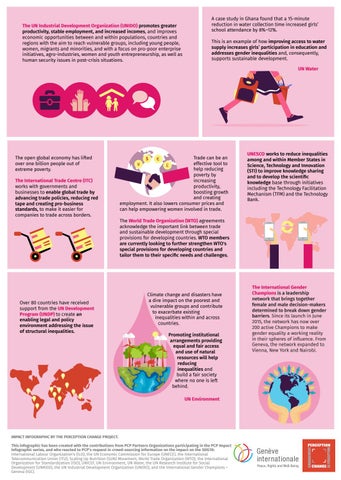
The UN Industrial Development Organization (UNIDO) promotes greater productivity, stable employment, and increased incomes, and improves economic opportunities between and within populations, countries and regions with the aim to reach vulnerable groups, including young people, women, migrants and minorities, and with a focus on pro-poor enterprise initiatives, agro-industries, women and youth entrepreneurship, as well as human security issues in post-crisis situations.
A case study in Ghana found that a 15-minute reduction in water collection time increased girls’ school attendance by 8%–12%. This is an example of how improving access to water supply increases girls’ participation in education and addresses gender inequalities and, consequently, supports sustainable development. UN Water
The open global economy has lifted over one billion people out of extreme poverty. The International Trade Centre (ITC) works with governments and businesses to enable global trade by advancing trade policies, reducing red tape and creating pro-business standards, to make it easier for companies to trade across borders.
Over 80 countries have received support from the UN Development Program (UNDP) to create an enabling legal and policy environment addressing the issue of structural inequalities.
Trade can be an effective tool to help reducing poverty by increasing productivity, boosting growth and creating employment. It also lowers consumer prices and can help empowering women involved in trade.
UNESCO works to reduce inequalities among and within Member States in Science, Technology and Innovation (STI) to improve knowledge sharing and to develop the scientific knowledge base through initiatives including the Technology Facilitation Mechanism (TFM) and the Technology Bank.
The World Trade Organization (WTO) agreements acknowledge the important link between trade and sustainable development through special provisions for developing countries. WTO members are currently looking to further strengthen WTO's special provisions for developing countries and tailor them to their specific needs and challenges.
Climate change and disasters have a dire impact on the poorest and vulnerable groups and contribute to exacerbate existing inequalities within and across countries. Promoting institutional arrangements providing equal and fair access and use of natural resources will help reducing inequalities and build a fair society where no one is left behind. UN Environment
IMPACT INFOGRAPHIC BY THE PERCEPTION CHANGE PROJECT.
This infographic has been created with the contributions from PCP Partners Organizations participating in the PCP Impact Infographic series, and who reacted to PCP’s request in crowd-sourcing information on the impact on the SDG10: International Labour Organization's (ILO), the UN Economic Commission for Europe (UNECE), the International Telecommunication Union (ITU), Scaling Up Nutrition (SUN) Movement, World Trade Organization (WTO), the International Organization for Standardization (ISO), UNICEF, UN Environment, UN Water, the UN Research Institute for Social Development (UNRISD), the UN Industrial Development Organization (UNIDO), and the International Gender Champions Geneva (IGC).
The International Gender Champions is a leadership network that brings together female and male decision-makers determined to break down gender barriers. Since its launch in June 2015, the network has now over 200 active Champions to make gender equality a working reality in their spheres of influence. From Geneva, the network expanded to Vienna, New York and Nairobi.