Expedition
速
WINTER 2011 VOLUME 53, NUMBER 3
THE MAGAZINE OF THE UNIVERSITY OF PENNSYLVANIA MUSEUM OF ARCHAEOLOGY AND ANTHROPOLOGY WWW.PENN.MUSEUM/EXPEDITION
special issue
animals in antiquity
MINOAN BULL-LEAPING PETS OF THE ANCIENT GREEKS THE HORSE FROM THE CLASSICAL PERSPECTIVE
special issue
animals in antiquity
contents winter 2011
VOLUME 53, NUMBER 3
features
6 14 24
6
BULLS AND BULL-LEAPING IN THE MINOAN WORLD
By Jeremy McInerney PENELOPE’S GEESE: PETS OF THE ANCIENT GREEKS
By Kenneth Kitchell A VIEW OF THE HORSE FROM THE CLASSICAL PERSPECTIVE: THE PENN MUSEUM COLLECTION
By Donald White
departments
14
2 3 4 34
From the Director From the Field— The Corinth Excavations of 2011: Bones in the Theater From the Field—Butrint, Albania In the Shadow of Butrint The Refuse of Urban History: Excavating the Roman Forum at Butrint
44 45 46 48 49
24
From the Editor
Collection Notes—The Museum’s Online Searchable Database Book News & Reviews—Animals and Ethics Museum Mosaic—People, Places, Projects Looking Back Index for Volume 53 on the cover: This portion of a famous Minoan fresco depicts both women (white figure) and men (brown figure) engaged in the sport of bull-leaping. It was recovered from the palace at Knossos in Crete, and dates to ca. 1450–1400 BC. The complete fresco is on page 11. Photo courtesy of the Heraklion Museum, Crete.
Expedition® (ISSN 0014-4738) is published three times a year by the University of Pennsylvania Museum of Archaeology and Anthropology, 3260 South St., Philadelphia, PA 19104-6324. ©2011 University of Pennsylvania. All rights reserved. Expedition is a registered trademark of the University of Pennsylvania Museum. All editorial inquiries should be addressed to the Editor at the above address or by email to jhickman@upenn.edu. Subscription price: $35.00 per subscription per year. International subscribers: add $15.00 per subscription per year. Subscription, back issue, and advertising queries to Maureen Goldsmith at publications@pennmuseum.org or 215.898.4050. Subscription forms may be faxed to 215.573.9369. Please allow 6-8 weeks for delivery.
We welcome letters to the Editor. Please send them to: Expedition Penn Museum 3260 South Street Philadelphia, PA 19104-6324 Email: jhickman@upenn.edu
from the editor
Animals in Antiquity the williams director
Richard Hodges, Ph.D. williams directors emeritus
Robert H. Dyson, Jr., Ph.D. Jeremy A. Sabloff, Ph.D. chief operating officer
Melissa P. Smith, CFA chief of staff to the williams director
James R. Mathieu, Ph.D. director of development
Amanda Mitchell-Boyask mellon associate deputy director
Loa P. Traxler, Ph.D. merle-smith director of community engagement
Jean Byrne director of exhibitions
Kathleen Quinn associate director for administration
Alan Waldt
expedition staff editor
Jane Hickman, Ph.D. associate editor
Jennifer Quick assistant editor
Jennifer McAuley subscriptions manager
Maureen Goldsmith advisory board
Clark L. Erickson, Ph.D. Maureen Goldsmith Jaesok Kim, Ph.D. Pam Kosty James R. Mathieu, Ph.D. Amanda Mitchell-Boyask Janet M. Monge, Ph.D. Alessandro Pezzati Kathleen Quinn C. Brian Rose, Ph.D. design Anne Marie Kane Imogen Design www.imogendesign.com
T
he winter 2011 issue on animals in antiquity began with a suggestion by Donald White two years ago. White, Curator Emeritus of the Mediterranean Section, has always had a keen interest in horses, having owned them since childhood. He thought that an article on horses incorporating images of Equus caballus from the Penn Museum’s Mediterranean Collection might be of interest to our readers. As White was writing his article, I met Kenneth Kitchell, a Classicist from the University of Massachusetts Amherst, and we began to talk about pets in antiquity. The germ of an idea for a second feature article was launched. Finally, a review appeared of a new book by Penn Classics professor Jeremy McInerney: The Cattle of the Sun: Cows and Culture in the World of the Ancient Greeks (Princeton University Press, 2010). McInerney agreed to write on Minoan bull-leaping for what was now shaping up to be a special issue on animals in antiquity. Several other short articles concerning animals are included here as well. Just this past summer, Charles K. Williams II excavated a large deposit of butchered animal bones associated with 4th–5th century AD Corinth in Greece. A preliminary report is included in this issue. Jacob Morton reviews Animals in Greek and Roman Thought, a new book that examines how animals were viewed in the ancient world. And, in “Looking Back,” one of our favorite images from the Archives—a 1904 photograph by Jessie Tarbox Beals—captures the importance of the human-animal bond. Because many new discoveries were made at the Albanian site of Butrint in 2011, we have included a two-part “From the Field,” which focuses on this site. We also include a piece—“Collection Notes”—which describes the Museum’s new online searchable database. Thank you to the many museums that have made this issue possible by contributing images of objects from their collections, especially the Heraklion Museum in Crete, the National Archaeological Museum in Athens, the British Museum, the Harvard Sackler Museum, the Worcester Art Museum, the Linda Hall Library, and, of course, the Penn Museum. Thank you also to Manfred Bietak, Nanno Marinatos, and Clairy Palivou for allowing the use of bull-leaping images from Taureador Scenes in Tell el-Dabca (Avaris) and Knossos (Vienna: 2007).
printing Conner Printing, Inc.
2
FPO
v olu me 53 , n umbe r 3 e xpedi ti o n
jane hickman, ph.d. Editor
from the director
Imagine Africa with the Penn Museum
P
Penn Museum
enn museum has been changing, gallery by gallery. The old Museum presented glorious objects in an often dry and uninspiring idiom. Ironically, for a museum which 40 years ago pioneered the importance of provenance for antiquities on the market, the Museum’s own exhibitions often provided limited context for the wonderful materials on display. Like countless archaeology and anthropology museums around the world, our exhibitions were aimed at visitors already “in the know.” But museums, like many aspects of life, are changing with the digital “flat world.” Today, it is no longer sufficient to address those who may already know something about the objects and cultures on display. Our goal has to be to create a conversation with all our audiences, permitting them to discover and enjoy and, indeed, challenge our presentations from their own standpoint. So in a major effort to move beyond the restrictive conVisitors to the new Imagine Africa exhibition use rubber stamps to fines of the glass case, the Penn Museum has installed Imagine create West African Adinkra patterns. Africa with the Penn Museum in the Sharpe Hallway near the café. This year-long exhibition (September 18, 2011–September 16, 2012) treats the continent of Africa as a kaleidoscopic experience leavened with contemporary African music. It introduces some of our great collection by a series of themes, while pointedly providing visitors with a compelling invitation to offer their views on the selection and display of objects. The exhibition includes material as diverse as masks, textiles, and the physical remains of slaves who brought sickle cell disease and its resistance to malaria to the New World. Supported by a prestigious Heritage Philadelphia Program planning grant, and the PoGo Foundation, this is an experimental exhibition, designed to pave the way for an equally vivid reinstallation of the Museum’s celebrated Africa Gallery. Accompanied by a wide range of public programs from lectures to pottery workshops to arts nights, and accessible through a series of free community nights and afternoons, this exhibition promotes a conversation about the power of material culture in shaping our lives. Please come along and join in!
richard hodges, ph.d. The Williams Director
w w w .p e nn.m us e um /e xp e d it io n
3
from the field
The Corinth Excavations of 2011
4
v olu me 53 , n umbe r 3 e xpedi ti o n
Above, this isometric drawing shows the West Hall of the theater, where animal bones were recovered during the spring 2011 excavation season. Top, more than one hundred baskets of bones were collected during excavation. The excavated finds were dry-sieved so that even the smallest bone fragments and teeth could be preserved and identified.
ASCSA Corinth Excavations (top), David Scahill (bottom)
T
he greek theater of ancient Corinth was reconstructed by the Romans by charles k. when they re-established the williams ii destroyed city as Colonia Laus Julia Corinthiensis in 44 BC. At that time they redesigned the theater to Roman specifications, adding a free-standing single-room hall at either end of the new stage building. It is the hall at the west end of the Roman stage building upon which the American School of Classical Studies at Athens focused this year, largely because, when about two-thirds of the hall was excavated in the 1920s, a good portion of a concentrated dump of cow, sheep, and goat bones was removed without much notice. We planned to correct that oversight in the spring of 2011 by the careful excavation and analysis of a sample taken from the deposit, about a third of which still remained in situ. Excavation recovered over one ton of discarded bones from the hall and more from the area immediately to its north.
bones in the theater
ASCSA Corinth Excavations
Bones are visible during the excavation of the southwest corner of West Hall. Cattle bones and sheep/goat horns were prevalent in the deposit.
This represents a probable one-eighth to one-tenth of the skeletal waste that had originally covered the area. The excavated fills were dry-sieved to facilitate the collection of all small teeth, bones of birds and rodents, and small slivers of bigger bones, with a preliminary analysis of the material made by Dr. Michael MacKinnon of the University of Winnipeg. Dr. MacKinnon will undertake the final publication of the skeletal material as well. The prime purpose of the present note is to present a few of the archaeological peculiarities of this very large skeletal deposit. First, the bones were laid down in strata, much of which was sealed at top and bottom by layers of sandy limestone chip waste from the remains of trimmed limestone blocks. The bones had been discarded through an opening in the north wall of the West Hall from a still incompletely explored area to the north. No admixture of pottery or earth was found within the various concentrated pockets of bone. Also, cooking wares and ash were missing from the strata. It appears that the bones came straight from the butcher’s block. Some coins, however, did find their way into the mix. The refuse is not, however, from a normal urban butcher shop or slaughter house. Pig is totally absent, as are wild and exotic animals. The largest percentage of bone is cattle, ranging from two years in age to animals in their sixth or seventh year. The butchering appears to have been rather casual judging by the knife and cleaver marks.
The most surprising fact about the deposit, however, is its date. Deposition may have occurred from the end of the 4th century or, more likely, starting slightly later and continuing through the mid-5th century AD, possibly into the last decade of the century. This means that the butchered meat was not being produced for use in connection with productions or celebrations in the theater, which at that time was an abandoned ruin. In fact, a comparison of bone waste from carcasses that had supplied meat for attendees of the theater during the 2nd century shows differences in the types of carcasses found and in the parts of the animal that were discarded. Also, in the building on the east side of the theater where the earlier bones were found, cooking wares were common, and one room was a kitchen. The evidence does point, however, to the bones recovered from the West Hall having accumulated as a result of butchering focused on supplying some sort of celebration or festival. If the meat had been used to celebrate a Christian martyr, the church that was honoring him or her—if it was in the neighborhood—is still to be found. The brief report offered here about the Corinth bone deposit is preliminary. Much research must still be done before final conclusions can be offered. charles k. williams ii is Director Emeritus of the Corinth Excavations in Greece.
For Further Reading Reese, D. “A Bone Assemblage at Corinth of the Second Century after Christ.” Hesperia 56 (1987): 255-274. Williams II, C.K. “Corinth, 1985, East of the Theater.’’ Hesperia 55 (1986): 134-138.
Over one ton of animal bones were found in 2011. Here, the washed bones are laid out to dry before preliminary examination.
w w w .p e nn.m us e um /e xp e d it io n
5
Bulls and Bull-leaping in the Minoan World by jeremy mcinerney
6
v olu me 53 , n umber 3 e xpedi ti o n
I
Archaeological Museum of Heraklion–Hellenic Ministry of Culture–TAP Service (page 6 and 7), Jennifer McAuley (map)
n cretan culture, the bull is everywhere. Horns of consecration adorned the top of Minoan shrines and may have decorated palaces at Knossos, Mallia, and Phaistos. Great ceremonial axes of bronze, perhaps suggesting the sacrificial slaughter of bulls, were recovered from palatial contexts. Objects such as the Hagia Triada sarcophagus, dated to the early 14th century BC, show cattle trussed in preparation for sacrifice. In every medium imaginable, from gold rings to terracotta figurines, from stone seals to frescoes in relief, the image of the bull permeates the Minoan world. Furthermore, depictions of bulls and bull-leaping figure prominently in the pictorial decoration of Neopalatial Knossos. Major entrances leading to the center of the palace complex were adorned with wall paintings of bulls and bull-leaping. Bulls also figure on rhyta (plural of rhyton), or more properly, as rhyta. The Cretan rhyta—pouring vessels with two openings—were probably derived from Syrian antecedents, but the Cretan vessels evolved into objects
of exceptional size and beauty. Vessels like the Bull’s Head rhyton from Knossos—carved out of serpentinite (sometimes referred to as steatite) and decorated with shell, rock crystal, jasper, and gold—were too heavy to be used in anything but ritual settings. The Boxer rhyton from Hagia Triada, carved in relief with scenes of boxing and bull-leaping, weighs 1 kg (2.2 pounds) empty and 3 kg when full. These rhyta are perforated at the bottom and could only hold liquid as long as they were plugged, so they must have been ceremonial containers.
Above, this Late Bronze Age sarcophagus was found in a funerary chamber at Hagia Triada in Crete. It was made of limestone, covered with a thin layer of lime plaster, and then painted. On one side of the sarcophagus (left), we see the sacrifice of a bull, accompanied by music and a procession of women. On the reverse side (above) another procession is depicted including women carrying buckets of blood to an altar and men presenting animals and a boat model to what may be a deceased man.
w w w .p e nn.m us e um /e xp e d it io n
7
The famous Bull’s Head rhyton from the Little Palace at Knossos was made from serpentinite. It has been reconstructed with inlays of shell, rock crystal, and jasper in the muzzle and eyes. The gilt wooden horns have also been reconstructed. This rhyton was dated to the Final Palace period, ca. 1450–1400 BC.
gathering at which they were used. If such a gathering were the feast following a sacrifice at which the bull was consumed or its meat distributed, a formal libation from a vessel imitating the bull’s head would have constituted a ritual re-enactment of the bloodletting that began the sacrifice. The savagery of the animal’s slaughter was replaced with the formal dignity of libation. The disposal of the rhyton after the ceremony amounted to a second killing. A deep-rooted tension between the wildness of the bull and the need to master it also appears to underlie the most famous Minoan institution involving bulls: bull-leaping. The details of this practice are much contested. At one extreme are those who deny such performances ever took place, while at the other are those who offer a detailed breakdown of how the ritual was performed. The latter base their conclusions on the various depictions of bull-leaping shown on ceramics, seals, rings, ivory figurines, and frescoes. Based on these artistic representations, Sir Arthur Evans, excavator at Knossos, believed
Gold necklace attachments in the shape of bulls’ heads, dated to the Final Palatial period, ca. 1350–1300 BC, were recovered from Hagia Triada.
8
v olu me 53 , n umber 3 e xpedi ti o n
Trustees of the British Museum (top), Archaeological Museum of Heraklion–Hellenic Ministry of Culture–TAP Service (bottom)
One possibility is that they dispensed wine and were used in a banquet setting. Nanno Marinatos, however, has persuasively argued that they were used to hold blood from sacrificial animals, which was collected and then poured onto the ground as a libation. The Hagia Triada sarcophagus shows women pouring what may be blood from the sacrificial bull into a large krater. A religious function is also suggested by the portrait-like quality of some rhyta. In contrast to the stylized depictions of priestesses, princes, and even deities, the Bull’s Head rhyta are remarkable for their vividness and their individuality. The lyre shape of the horns and the ring of white around the nostrils have suggested to some that the animals may be examples of the Greek steppe breed still to be found today in northern Greece. The portraits would have been the centerpiece of any
This terracotta figurine of a bull dates to the Mycenaean period, ca. 1300 BC. It was excavated from Ialysus on Rhodes. BM Image #1870,1008.127.
Archaeological Museum of Heraklion–Hellenic Ministry of Culture–TAP Service (left and bottom images), Sir Arthur Evans, 1921 (top right)
that the process consisted of four clearly defined phases as the leaper approached, grasped the bull by the horns, vaulted over onto the animal’s back, and then sprang onto the ground. Subsequent studies by A. Sakellariou and John Younger assembled evidence for variations on Evans’ schema until a range of styles was identified and associated with specific periods in Late Minoan culture. These changes in style make little sense divorced from an actual practice; they are therefore taken as evidence that a “sport” of bull-leaping did occur. The conclusion of Younger’s 1976 study sums up the connection between artistic representations and the performances they recall: “In conclusion, bull-leaping begins to appear in artistic representations toward the beginning of the Late Bronze Age in Crete and on the Mainland. The main system of performance probably followed that of the Diving Leaper Schema. When bull-leaping itself was discontinued, perhaps towards the close of the LB IIIA or the beginning of the LB IIIB period, ca. 1340 BC, later representations depicted the leaper in the floating pose (Type III), a pose not copied directly from the sport.” The ceremonial courts characteristic of Minoan palaces are often taken to be the locations for the sport, serving as Minoan bull-rings. Despite the assurance of Evans’ reconstruction, or perhaps in reaction to it, there are those who seriously doubt whether it is at all possible to leap a charging bull, particularly when, as in most of the scenes depicted in Minoan art, the bull has its head up, with its horns vertical. J. Alexander MacGillivray, for example, asserts that no person ever jumped over a bull’s back on Crete or anywhere else. He suggests instead that the artistic depictions of bull- leaping are representations of
a celestial drama. “Orion confronts Taurus, composed of the Hyades and Pleiades (the seven sisters), while Perseus somersaults with both arms extended over the bull’s back to rescue Andromeda.” Thornhill’s illustrations for John Flamsteed’s 1729 Atlas Coelestis show how easily constellations can be seen as snapshots of mythical episodes. Yet a cosmological reading need not preclude a ritual performance, and certainly does not disprove its existence altogether. Moreover, the lack of any Minoan liturgical text comparable, for example, to the Epic of Gilgamesh makes it hazardous to speculate about Minoan cosmology in anything but the broadest terms. We can read the Assyrian seals with some degree of confidence because we have a textual narrative that explains the scenes depicted, but we do not have
Above, an ivory figurine of a bull leaper was probably part of a three-dimensional composition depicting bull-leaping. Recovered from Knossos, it dates to the New Palace period, ca. 1600–1500 BC. Top left, this clay vessel was recovered from a tomb at Koumasa in southern Crete. It dates to the late Prepalatial period, ca. 2000–1900 BC. Three human figures are clinging to the horns, with the central figure flattened against the head of the bull. It may depict bull-leaping or the capture of a bull. Top right, Sir Arthur Evans, excavator at Knossos, provided this “diagrammatic sketch of [an] acrobat’s course” to show the sequence of movements in bull-leaping. From The Palace of Minos, page 223, fig. 156.
w w w .p e nn.m us e um /e xp e d it io n
9
anything comparable for Crete, unless we rely on later stories regarding Minos, Pasiphae, and the Minotaur—stories which were not written until after Crete had come under Greek control. If there were Bronze Age myths accompanying the stories of Pasiphae and Minos, they certainly were contaminated in the process of transmission. Here we come up against an abiding difficulty in recreating the particulars of Bronze Age religion: interpretation without textual support must remain tentative. Since we do not have the Cretans’ stories about the stars, we cannot assume that they identified Orion, Taurus, Andromeda, and the rest in the same way as the later Greeks or their own contemporaries in the Near East. Even if we were to suppose, reasonably, that the astrological traditions of the Near East were familiar to the Cretans, their existence alone would not be enough to dismiss bull-leaping as modern invention, or to read the scenes of bull-leaping as purely symbolic.
This cast bronze group shows an acrobat somersaulting over a bull’s head. Dated to ca. 1700–1450 BC, it measures 11.4 cm in height. BM Image #1966,0328.1.
A 1729 illustration by Sir James Thornhill depicts the Taurus Constellation.
10
v olu me 53, n umber 3 e xpedi ti o n
Trustees of the British Museum (left images), From Atlas Coelestis by John Flamsteed (1729), Linda Hall Library of Science, Engineering & Technology (right)
An agate lentoid seal, dated ca. 1500–1300 BC, is from Minoan Crete. It depicts a man leading a bull. BM Image #1892,0720.2.
The variety and specificity of the scenes, in fact, point towards actual performances. Why else would assistants be shown holding the horns? Why in some cases would two animals be shown? In most depictions the bull is charging but in at least one instance the great beast is calmly seated on the ground with its legs folded neatly beneath it. In another notable case the bull has begun to mount what looks like an altar, his forelegs raised above the ground and awkwardly hooked onto the stone blocks. These variations make no sense if all the artistic renderings refer to the same single cosmic drama. If on the other hand they commemorate specific performances, the differences between various depictions are intelligible. As with the realistic rendering of individual animals on bull’s head rhyta, the scenes of bull-leaping suggest an interest in commemorating actual events rather than representing a cosmological story. The only compelling objection to the existence of real bullleaping, in fact, is the assertion that it is physically impossible, a claim often made in discussions of contemporary bull sports. Yet in the southwest of France, a version of bull-jumping is still practiced regularly in a form that is an almost exact parallel of the Minoan version: the course landaise. The animals employed are not attacked, stabbed, or slaughtered by the participants. Instead, the emphasis is on athleticism. In one event, for example, the leaper vaults over the body of the charging cow. In a variation of this, the saut de l’ange (translated as “the angel’s leap”), the jumper leaps straight along the same axis as the charging animal. It looks exactly like the flying leap
Archaeological Museum of Heraklion–Hellenic Ministry of Culture–TAP Service (top), Fédération Française de la Course Landaise (bottom)
Above, a modern French sauteur or jumper leaps in the air as a vache landaise or cow rushes toward him. Top, the famous Bull-leaping fresco, from the palace at Knossos, depicts a critical moment in the event. Two female figures (in white) are positioned at each end of the bull, while a male figure (in brown) throws himself into a somersault off of the bull’s back. Although this fresco has been reconstructed—the darker fragments are the recovered pieces—the sport or ritual of bull-leaping is clearly depicted. The fresco dates to the Final Palace period, ca. 1450–1400 BC.
depicted in Minoan glyptics. Other leaps include a somersault over the cow’s back, the saut á pieds joints (“jump with feet tied together”), in which the leaper thrusts his legs forward while leaping vertically, and the most difficult of all, the saut vrillé (“twisting jump”), in which the sauteur performs a pike while leaping. I watched the youth championships held in the small French town of Le Houga in November of 2010 and can personally attest to the grace and skill of the young athletes, as well as the speed and aggression of the animals. One popular animal or vache landaise, called Manolita, managed to knock two boys over and scared another one clear out of the ring! Comparisons with the course landaise raise some intriguing possibilities for our understanding of Minoan ritual. For example, depictions of Minoan bull-leaping involving the killing of animals are rare, and it is possible that the point of the exercise was not to kill the animal but to demonstrate superior skill. The organization of the course landaise also raises questions regarding bull-leaping as an institution. Senta German has recently proposed that Minoan bull-leaping should be seen as a performance carried out by young men of high status. This is a plausible interpretation, but there is another pos-
w w w .p e nn.m us e um /e xp e dit io n
11
sibility. In the modern version of the sport, the performance is only one part of a larger system of both cattle production and specialized training, consisting of sixteen ganaderias, which function as breeding farms for the 1,200 vaches landaises, the breed specifically raised for the sport, and as ecoles taurines, training schools for the toreros. The same may have applied in Crete, so that rather than high-status youths engaging in acts that functioned to advertise and reinforce social hierarchy across Minoan society, these Cretan bull-jumpers were specialists from the place that was the home of bull-leaping: Knossos. In 1995, commenting on the distribution of bull imagery in Minoan art, Paul Rehak noted, “So prominent is this bull imagery that one suspects that its dissemination
12
v olu me 53, n umbe r 3 e xpedi ti o n
reflects an institutionalized source, perhaps the elite who controlled the Knossos palace.� Depictions of bull-leaping, though popular at Knossos, are uncommon at the other Minoan palaces, although actual performances surely took place in the great courts of these palaces. Bull-leaping elevated the palaces as ceremonial centers, since only palaces were designed for spectacle, but the institution required more than priests and hieratic processions. It depended on skilled athletes and suitable animals. By monopolizing the stock and the specialized personnel on which the institution was based, Knossos asserted its cultural dominance of Crete. Bull-leaping was thus a centerpiece of Minoan life. It may have been viewed as a sacred re-enactment of a cosmic drama with roots going back to earlier Near Eastern religious systems. Such connections with Egyptian and Near Eastern cosmology helped make the Cretan bull cult exportable: excavations within the last 20 years in Egypt at the Hyksos capital of Avaris (Tell el-Dabca) have brought to light wall paintings dating
M. Bietak, N. Marinatos, C. Palyvou, Austrian Academy of Sciences
Wall paintings dating to the 16th century BC from Tell el-Dabca (ancient Avaris) in Egypt show scenes of bull-leaping. The painting was recovered in fragments and has been reconstructed, with the detail on the left showing a close-up of the bull-leaper and bull on the far right in the larger composition. From Taureador Scenes in Tell el-Dabca (Avaris) and Knossos, by Manfred Bietak, NannĂł Marinatos, and Clairy Palivou, 2007.
to the 16th century BC showing scenes of bull-leaping, suggesting that the practice was already known outside of Crete well before the end of the Bronze Age. Similarly, Canaanite seals reflect an awareness of the practice, as do seals found at Alalakh in Syria dating to the 17th century BC. The exact details of the cult, especially the narrative that complemented the ritual, are probably irrecoverable, but the existence of such a dangerous performance shows that Cretan religion reflected the same legacy of pastoralism witnessed throughout the stratified states of the Bronze Age eastern Mediterranean: the compulsion to demonstrate in myth and ritual man’s control of nature through mastery of the bull. As in Egyptian and Near Eastern bull cults, Minoan bullleaping gave expression to a tension that underlies man’s somewhat tenuous mastery of nature, reaffirmed each time human triumphs over animal. Not coincidentally such cults flourish in societies as they become increasingly stratified, as the affirmation of human prowess serves by analogy as an affirmation of social order. For this reason bull-leaping was a public performance, displaying the theatrical quality that is a distinctive feature of Late Minoan society. Recent studies of Knossos have emphasized this aspect of Minoan culture. Neopalatial Knossos may have been as much a ceremonial as an administrative center, which would help to explain the prominence of theatral areas here and at the other palaces. The carefully designed entryways leading to the central court were decorated with reliefs that repeated certain topoi or traditional themes such as processions and bull-leaping, suggesting the very rituals which one would witness upon entering. If the frescoes throughout the complex can be read as guides to the performances that occurred there then there is every reason to believe that the palaces were the focal points for an increasingly hieratic society, in which religious celebrations such as harvest festivals were the major social events. There is also evidence for the use of complex proportional schemes, such as the Fibonacci sequence in the articulation of units of ashlar masonry in the west façades at Knossos, Mallia, and Phaistos during the Second Palatial period, suggesting that the design of the public space, like the decoration of the palaces, was meant to evoke the importance of the activities that occurred here. Like any rituals, these performances were ephemeral, but carved gold rings depicting bull-leaping commemorated the events. These rings were popular among Minoan officials, members of the Minoan elite, who favored scenes of bullleaping. We can infer the high status of the individuals who
used these rings from the fact that very similar sealings from the rings have come to light at various sites in Crete, from Chania to Zakros, and even from the Cycladic island of Thera. Fifty-three sealings from ten so-called Knossos replica rings have been found so far, and of these ten, six depict bull-leaping. The ideological significance of the ritual was paramount. jeremy mcinerney is Davidson Kennedy Professor of Classical Studies and Chair of the Department of Classical Studies at the University of Pennsylvania.
For Further Reading Evans, A. The Palace of Minos: A Comparative Account of the Successive Stages of Early Cretan Civilization as Illustrated by the Discoveries at Knossos. London: Macmillan and Co., 1921. German, S.C. Performance, Power and the Art of the Aegean Bronze Age. Oxford: Archaeopress, 2005. Koehl, R. B. Aegean Bronze Age Rhyta. Philadelphia: INSTAP Academic Press, 2006. MacGillivray, J. Alexander. “Labyrinths and Bull-Leapers.” Archaeology 53 (2000): 53-55. McCormick, J. Bullfighting: Art, Technique and Spanish Society. London: Transaction Publishers, 2000. McInerney, J. The Cattle of the Sun: Cows and Culture in the World of the Ancient Greeks. Princeton: Princeton University Press, 2010. Rehak, P. “The Use and Destruction of Minoan Stone Bull’s Head Rhyta.” In Politeia: Society and State in the Aegean Bronze Age (Aegaeum 12), edited by Robert Laffineur and Wolf-Dietrich Niemeier, pp. 435-460. Liège and Austin: Université de Liège and University of Texas at Austin, 1995. Sakellariou, A. Les Cachets Minoens. Paris: P. Geuthner, 1958. Younger, J. G. “Bronze Age Representations of Aegean Bull-leaping.” American Journal of Archaeology 80.2 (1976):125-137.
Websites Video clips of the course landaise can be viewed on the website of the Fédération Française de la Course Landaise at www.courselandaise.org/. Also, visit www.toropasion.net for bull-leaping in Spain. A lively thread on the discussion list Aegeanet, conducted in late February 2009, illustrates the continuing fascination with this topic and will lead the reader to many parallels from Hittite and other Bronze Age cultures. For the Aegeanet archives: http://lsv.uky.edu/ archives/aegeanet.html. Click on “2009, February week 4”: http://lsv. uky.edu/scripts/wa.exe?A1=ind0902d&L=aegeanet.
w w w .p e nn.m us e um /e xp e dit io n
13
Penelope’s Geese Pets of the Ancient Greeks by kenneth kitchell
M
ost people are familiar with the strong character of Penelope, who waited at Ithaca while her husband Odysseus was away 20 long years. In Homer’s Odyssey we watch in admiration as she holds together Odysseus’ kingdom and keeps a horde of suitors at bay until he returns. But many readers quickly pass over the fact that she kept a flock of geese to help ease her heart. Indeed, later Greek art often shows women in domestic situations with geese or ducks. Penelope’s geese are just one example of the importance of pets to the ancient Greeks. As illustrated on vases, bowls, jugs, reliefs, figurines, and even funerary stelae, pets and people enjoyed a strong emotional bond.
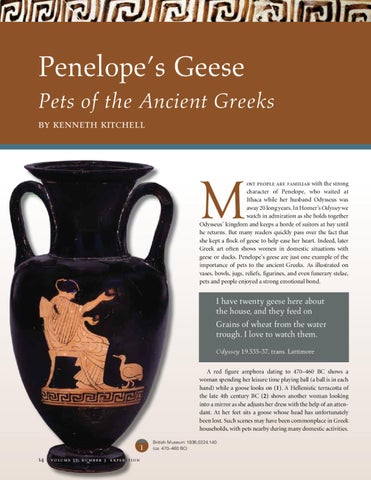
I have twenty geese here about the house, and they feed on Grains of wheat from the water trough. I love to watch them. Odyssey 19.535-37, trans. Lattimore A red figure amphora dating to 470–460 BC shows a woman spending her leisure time playing ball (a ball is in each hand) while a goose looks on (1). A Hellenistic terracotta of the late 4th century BC (2) shows another woman looking into a mirror as she adjusts her dress with the help of an attendant. At her feet sits a goose whose head has unfortunately been lost. Such scenes may have been commonplace in Greek households, with pets nearby during many domestic activities.
1 14
v olu me 53, n umber 3 e xpedi ti o n
British Museum 1836,0224.140 (ca. 470–460 BC)
Trustees of the British Museum
Another pet in the Odyssey is justifiably famous— Odysseus’ long-suffering dog. As Odysseus nears his home in a deformed beggar’s disguise provided by Athena, he has fooled everyone he has met. But at the city gates lies an old dog named Argos. Odysseus had raised him but left for Troy before the dog was fully grown. Argos had been a great hunter in his day, but now he is banished outside the gates of Ithaca, lying “in the dung, all covered with dog ticks” (Od. 17.300, trans. Lattimore), no longer useful to those who are making decisions in Odysseus’ absence. He is at least 20 years old—ancient in dog years—but as soon as Odysseus comes near, he sees through the disguise and recognizes his master. In one of the most heart-wrenching scenes from antiquity, the dog— who can no longer walk—lays his ears back, wags his tail, and closes his eyes for the last time. Homer tells us that tears came to Odysseus’ eyes as he watched the dog first welcome him and then die. Our first instinct is to view both scenes through modern eyes and think of the geese and Argos as family pets. But we must proceed carefully. Odysseus, pretending he does not know Argos, asks his guide whether the dog was a hunter in his day or perhaps “one of the kind of table dog that gentlemen keep, and it is only for show that their masters care for them” (Od. 17.309-10, trans. Lattimore). Herein lies the crux of the problem, because before we talk about the pets of the Greeks, we would be wise to define what a pet actually is. A pet is generally defined as an animal kept for companionship or amusement. But what about companion animals that also serve a practical use such as hunting or guarding, as Argos did? One would also assume that humans do not eat their pets. But did Penelope ever eat her geese? If they were kept for their flesh or eggs, an argument can be made that they were farm animals as well as pets. It is clear, then, that while some animals were kept strictly for emotional reasons, other pets might serve multiple functions.
Dogs
2
British Museum 1982,0729.83 (late 4th century BC)
3
British Museum 1876,0328.2 (attributed to the Thanatos painter, 435–425 BC)
common pets
Dogs were domesticated early and soon became close companions to humans. Current evidence suggests that dogs were domesticated by ca. 13,000 BC. Cats, on the other hand, are thought to have been domesticated later, about 8,000 BC in the Near East, not Egypt as is commonly
w w w .p e nn.m us e um /e xp e di t io n
15
4
British Museum 1867,0506.38 (attributed to Amasis painter, 550–530 BC)
5
British Museum 1843,1103.88 (attributed to Dikaios painter, 510–500 BC)
thought. Sometimes evidence of human-animal bonds appears in the archaeological record; a late Paleolithic burial in northern Israel dating from about 12,000 years ago yielded the skeleton of an elderly person of uncertain gender who had a hand placed carefully over the skeleton of a puppy. Mycenaean art frequently includes dogs, and the burial of dogs with humans is a well-known Mycenaean custom. The Ashmolean Museum at the University of Oxford exhibits a Mycenaean rhyton (drinking vessel), dated 1300–1190 BC, in the shape of dog or fox head. By classical Greek times the breeding of dogs had flourished, and D.B. Hull in his Hounds and Hunting in Ancient Greece (1964) patiently collected the names of at least 29 separate breeds, not counting breeds that may have been imported. The ancients mention the Castrian, Molossian, Cretan, Laconian, “fox-dog,” and many more, each with specific traits that made them appealing to humans. Equating these descriptions to modern breeds is difficult, if not impossible, but it is safe to say that Greek dogs fell into three basic categories. The first was a large mastiff-type dog such as the Molossian hound whose job was to guard flocks and fend off wolves. These animals probably spent the majority of their time outside and may not have been considered pets. The second type was used for hunting and was bred for speed, tracking, and tenacity (3). These dogs—the most
7
16
v olu me 53, n umber 3 e xpedi ti o n
British Museum 1848,1020.97 (Nereid Monument, Lycia, 390–380 BC)
Trustees of the British Museum
common were Laconian (Spartan) and Cretan—straddle the line between pet and work animal, for we often see them on Greek vases, accompanying young aristocrats on the hunt for deer, hare, and boar (4). They are also shown frequently in scenes depicting soldiers departing for war, perhaps indicating the close ties between men and dogs. One such scene (5) is of interest for many reasons (Why is a Phrygian archer here? Why does the old man hold his nose?), but is especially interesting because it clearly shows a dog’s body language. The dog appears nervous or anxious, a state brought on, we are to understand, by the imminent departure of its master. Such dogs were the constant companions of young aristocrats (in some periods described as ephebes), often in public places such as the gymnasium. When these young men are courted by older men—a common social interaction in ancient Athens—“love gifts,” many caught with the help of dogs, are often exchanged. A black figure amphora shows these gifts (6): a deer to the left, a hare hanging on the wall, and a fox to the right. The dogs of young aristocrats commonly wear collars, are often on leashes, and frequently recline under the young men’s couches at symposia, Greek drinking/dinner parties. So popular was this custom that the sculptor of the Nereid Monument from Lycia even shows King Arbinas with his dog (7). The writer Xenophon, best known for his histories and his works on Socrates, even
6
British Museum 1865,1118.39 (attributed to Berlin painter, ca. 540 BC)
8
British Museum 1864,1007.231 (ca. 420–400 BC)
w w w .p e nn.m us e um /e xp e di t io n
17
10
British Museum 1928,0117.61 (420–400 BC)
British Museum 1843,1103.74 (attributed to Berlin painter, ca. 480 BC)
wrote a treatise called the Kynegitika on the breeding, rearing, and training of just this sort of dog. The third type of dog is as much a creature of the house as the Molossian was of the field. These little Maltese definitely fall into the realm of “pet� for they serve no practical purpose other than to provide pleasure and companionship to their owners. In ancient Athens, a three-day festival to Dionysus took place each year called the Anthesteria, which was characterized by great merriment and drinking. During the festival children were given miniature versions of vases called choes (singular chous) which often depicted boys or girls with Maltese dogs. It has been persuasively suggested that children received pets as gifts at the Anthesteria; it is possible that male children were given Maltese dogs when young and then, in a kind of rite of passage, graduated up to a hunting dog, which then accompanied them on the hunt and on social occasions. Other animals are also seen on these choes, many of which are undoubtedly pets. A chous from the British Museum shows a young boy with two pets: a Maltese and a bird that may represent a jackdaw or a song bird (8). Another charming chous in the British Museum shows a young boy holding a bird and a push toy, perhaps another gift (9). Other choes bear images of roosters, birds that may be ducks or geese, hares, and carts drawn by (pet?) goats and fawns. Roosters, in fact, were commonly kept by aristocratic youths for the purpose of cock fighting (10). A chous in the Fitzwilliam Museum showing a large water bird pulling a cart may be more fanciful than factual. Although the Maltese is mostly associated with children and women, it is occasionally shown with an adult male. A famous vase (11) shows a wreathed reveler on his way home from a symposium, singing and playing the lyre, and accompanied by his small pet. Some scholars have even suggested that the figure is Anakreon, a famous 6th century BC lyric poet.
Cats The question of the cat as a pet in ancient Greece is rather vexing. Modern Athens is home to countless feral cats. However, the status of the cat in ancient Greece is unclear, as images of cats are fairly rare. The Greeks
18
v olu me 53, n umber 3 e xpedi ti o n
Trustees of the British Museum
9
Penn Museum (top), National Archaeological Museum Athens, Hellenic Ministry of Culture and Tourism/Archaeological Receipts Fund (bottom)
undoubtedly learned of the cat through contact with Egypt where the cat was so beloved that, according to the historian Herodotus, Egyptians shaved off their eyebrows when a pet cat died. But the Greeks seem never to have formed the same depth of attachment to the cat, and references to them are so infrequent in the literature that most scholars think their presence in ancient Greece was minimal. Cats were probably kept by Greek households as liminal animals—animals that come and go from the house as they wish. This may account for the fact that few cat bones have been found in domestic situations. In Greece the important job of “mouser” seems to have been handled by weasels and ferrets, many of which were also considered liminal pets. Yet some clear representations of cats do exist. The National Archaeological Museum of Athens hosts a famous funerary kouros base (NAM #3476) dating to about 510 BC that shows two seated Athenian noble youths, each holding a pet on a leash, one a cat, the other a dog. Other sides of the base show young men exercising in the gymnasium, and we are left to imagine that each of the seated youths has come to the gymnasium to show off his pet. The arched back of a cat as it faces a dog is familiar to anyone who has ever seen such an encounter. A funeral stele from Aegina or Salamis dates to 430–420 BC, and with craftsmanship of the highest order, it shows a youth in profile, holding a bird in his left hand and extending his right hand toward a cage (12). Just below the cage is a rectangular pillar, and upon this sits an animal, which—although his head is missing—is almost assuredly a domestic cat. An unusual askos in the shape of a lobster’s claw (13) shows a rather poorly drawn cat. One might take it for a wild cat, but elsewhere on the vessel are a dog and a cock, both of which were likely pets.
11
Penn Museum 75-10-1 (450–440 BC)
12
National Archaeological Museum, Athens, stele #715
Birds In addition to the geese described earlier, many birds were kept as pets. Next to dogs, they may have been the second most common type of pet in ancient Greece. The name vase of the Cage Painter (14) clearly shows a bird in a cage being held on a young man’s lap. Was this a personal pet or intended as a gift? As noted earlier, young children were given birds as pets. Grave stelae of children regularly show them holding a bird, commonly a dove. Many stelae, such as the Melisto stele in the Harvard Sackler Museum (15), show
w w w .p e nn.m us e um /e xp e di t io n
19
British Museum 1905,0710.9 (ca. 470–400 BC)
14
British Museum 1901,0514.1 (name vase of Cage painter, 485–480 BC)
15
20
Harvard Sackler Museum 1961.86
v olu me 53, n umbe r 3 e xpedi ti o n
a deceased child holding out a bird to a Maltese dog, as if inviting play. Pet birds are also depicted in happier circumstances. Plutarch and other authors tell us that starlings, crows, and parrots were all kept as pets and that these birds delighted their owners by imitating their voices. Likewise, small songbirds such as sparrows were kept in cages to entertain their owners with their song. Several Greek vases even show long-legged birds such as cranes in the women’s quarters, and the famous Alcibiades had a pet quail.
less common pets Over 30 years ago, Ann Ashmead published “Greek Cats” in this magazine (Expedition 20[3]:38-47). She was inspired by a vase in the Penn Museum (16) which effectively demonstrated that cheetahs were kept by aristocratic youths. The cheetahs may have been purchased from Egypt where they were also kept as pets. Cheetahs on Greek vases are clearly status symbols and often have collars and leashes (17). A red figure hydria (18) dating to the end of the Persian Wars (middle of the 5th century BC) shows a music lesson to which the students have brought their pets. The Maltese dog beneath the chair is of interest, but one youth, clearly showing off his affluence, is leading a cheetah on a leash. The relative size of the cat compared to the small dog leads us to believe it is still young. Compare this to the music lesson scene on the shoulder of a hydria attributed to the Agrigento painter and dating about ten years after the previous vase (19). Here a young cheetah is on a low table, to be admired by one and all. To the right side of the scene a figure is seated on the ground, leaning on its left side. The features of the figure lead us to believe that this may also be a pet—a monkey or small ape. Although there is scant evidence for simian pets in this period, we know that monkeys and apes were very popular as pets in later antiquity. A visit to an ancient Greek house might reveal a wide variety of other less traditional pets as well. Grasshoppers, crickets, and cicadas (20) were kept in tiny cages and were valued for their song. The Greek Anthology even has some epitaphs expressly written for such pets upon their demise, and the poet Meleager laments the loss of his cicada after three years of captivity, claiming that its singing helped him sleep and drove away cares. An ancient commentator on a passage from Aristophanes’
Trustees of the British Museum (top and center), Harvard Art Museums/Arthur M. Sackler Museum (bottom)
13
Penn Museum MS 399 (480 BC)
17
British Museum 1836, 0224.230 (attributed to Apollodoros painter, ca. 490 BC)
18
British Museum 1864,1007.85 (attributed to Pig painter, 480–470 BC)
19
British Museum 1864,1007.84 (attributed to Agrigento painter, 470–460 BC)
Penn Museum (top left), Trustees of the British Museum (remainder of page)
16
w w w .p e nn.m us e um /e xp e di t io n
21
20
British Museum, sard scarab 1814,0704.1291 (5th century BC)
21
British Museum 1892,0718.7 (510–500 BC)
Wasps tells us that children would tie a thread to the leg of a beetle and let them buzz through the air. They may have been pets or simply played with and released. Let us end this section with two animals generally overlooked as pets for the Greeks. The first is the hare. We have seen above that the hare was routinely hunted and presented as a gift. The hare’s fertility and active sex life associate it with Aphrodite and Eros. But evidence exists that the hare was also kept as a pet and not merely presented as a lifeless, tasty morsel to be eaten. A red-figured cup shows a youth running with a hare (21). A Tanagra figurine shows a girl holding a hare, and the Worcester Art Museum has a fine pyxis which shows Erotes at play, with a hare on a leash (22). Our last uncommon pet is the hedgehog, which was kept in and around houses, no doubt for its tendency to eat slugs and snails. Aristotle reported that a man in Byzantium kept a hedgehog that earned him a living by forecasting the weather. Hedgehogs build burrows with two entrances and, so it was told, blocked off one of them if bad weather was on the way.
22
22
Worcester Art Museum
v olu me 53, n umber 3 e xpedi ti o n
The number of pets appearing with humans on grave stelae, vases, and other objects is testimony to the fact that many Greeks formed strong emotional attachments to their pets. But were the Greeks enlightened as to animal “rights”? And do we know what their attitude was toward animal cruelty? Although the answers to these questions are not known with certainty, at least we can point to the relative infrequency with which tales of animal abuse appear in the Greek world, as well as the reverse—strong cases indicating respect for pets. Alcibiades, Socrates’ student and the most famous playboy of late 5th century BC Athens, once paid 70 minae for a dog. A mna (or mina) was worth 100 drachmas, so he paid 7,000 drachmas for the dog. This was a considerable sum, as a skilled laborer at that time earned only about one drachma a day. Plutarch, in writing about the life of Alcibiades, tells us that he had the dog’s tail cut off, which caused great resentment among his friends who said: All of Athens felt sorry for the dog. This writer knows of only one vase which depicts animal mistreatment. A late chous (360–350 BC) in the British Museum shows a young girl whirling a turtle about by a string attached to its rear foot, teasing her pet Maltese dog in the process (23). This may be compared to depic-
Trustees of the British Museum (top and center), Worcester Art Museum (bottom)
the treatment of animals
tions on funeral stelae of children holding birds in the air over leaping Maltese dogs, although these may be construed as scenes of play. One last anecdote sums up the attachment between the ancient Greeks and their pets. The date was 480 BC, and the Persians under Xerxes were closing in on Athens, which they would soon sack and burn. Themistocles ordered the evacuation of women, children, and the elderly. Among these was Xanthippus, the father of Pericles. Plutarch, in his life of Themistocles, relates that the dogs of Athens ran about howling at being separated from their masters, but the dog of Xanthippus swam after his master’s ship all the way to Salamis. He emerged from the water and promptly died of exhaustion on the shore. Showing his affection for his dedicated pet, Xanthippus buried the dog in a place near the sea that is known even today as the Dog’s Tomb. This brings us full circle, back to the emotion shown by Odysseus for Argos. The ancient Greeks kept a variety of animals for reasons other than utility. They also kept them for the emotional gratification they offered their owners.
23
British Museum 1856,0512.12 (360–350 BC)
kenneth kitchell is a Professor in the Department of Classics at the University of Massachusetts Amherst.
For Further Reading Arnott, W. Geoffrey. Birds in the Ancient World from A to Z. London: Routledge, 2007. Beavis, Ian C. Insects and Other Invertebrates in Classical Antiquity. Exeter: University of Exeter, 1988. Brewer, Douglas, Terence Clark, and Adrian Phillips. Dogs in Antiquity: Anubis to Cerberus. The Origins of the Domestic Dog. Warminster: Aris & Phillips, 2001. Davies, Malcolm, and Jeyaraney Kathirithamby. Greek Insects. London: Duckworth, 1986. Douglas, Norman. Birds and Beasts of the Greek Anthology. New York: Cape and Smith, 1929.
Trustees of the British Museum
Engels, Donald. Classical Cats: The Rise and Fall of the Sacred Cat. London: Routledge, 1999. Hull, Denison B. Hounds and Hunting in Ancient Greece. Chicago, University of Chicago Press, 1964. Kitchell, Kenneth. Animals in the Ancient World from A-Z. Routledge, 2013 (forthcoming). Pollard, John. Birds in Greek Life and Myth. London: Thames and Hudson, 1977.
w w w .p e nn.m us e um /e xp e di t io n
23
A View of the Horse from the Classical Perspective The Penn Museum Collection
E
quus caballus is handsomely stabled in the University of Pennsylvania Museum of Archaeology and Anthropology. From the Chinese Rotunda’s masterpiece reliefs portraying two horses of the Chinese emperor Taizong to Edward S. Curtis’s iconic American Indian photographs housed in the Museum’s Archives, horses stand with man in nearly every culture and time-frame represented in the Museum’s Collection (pre-Columbian America and the northern polar region being perhaps the two most obvious exceptions). Examples drawn from the more than 30,000 Greek, Roman, and Etruscan vases, sculptures, and other objects in the Museum’s Mediterranean Section serve here as a lens through which to view some of the notable roles the horse played in the classical Mediterranean world. The horse functioned as man’s inseparable and indispensible companion throughout classical antiquity. How do we know? In part because the ancient authors tell us so. From Homer’s brilliant animal similes and Xenophon’s authorita-
tive how-to manual On Horsemanship (“The tail and mane should be washed, to keep the hairs growing, as the tail is used to swat insects and the mane may be grabbed by the rider more easily if long.”) all the way down to the 9th century AD Corpus of Greek Horse Veterinarians, which itemizes drugs for curing equine ailments as well as listing vets by name, Greek and Roman literature is filled with equine references. One recalls the cynical utterance of the 5th century BC lyric poet Xenophanes from the Asia Minor city of Colophon: “But if cattle and horses and lions had hands, or were able to do the work that men can, horses would draw the forms of the gods like horses” (emphasis added by author). The partnership between horse and master in antiquity rested on many factors; perhaps the most important was that the horse provided man with his quickest means of overland movement. Usain “Lightning” Bolt, the fastest man in the world, was traveling nearly 22 mph when he broke the world’s record for the 100 m dash in 2009, while an American quarter horse carrying a saddle and rider has been clocked at over 45 mph. Several versions of “The Horse in Motion” photographed by Eadweard Muybridge in 1878 are available in the University Archives.
24
v olu me 53, n umber 3 e xpedi ti o n
Courtesy of the University of Pennsylvania Archives
by donald white
From the Iliad 15, 263–268 As when some stalled horse who has been corn-fed at the manger Breaking free of his rope gallops over the plain in thunder To his accustomed bathing place in a sweet-running river And in the pride of his strength holds high his head and the mane floats Over his shoulders; sure of his glorious strength, the quick knees Carry him to the loved places and the pasture of horses (trans. Lattimore).
wartime and sporting uses of horses Horse racing, with which Greek, Etruscan, and Roman society remained obsessed until the end of antiquity, was a direct outgrowth of warfare as it was practiced in the Late Bronze Age. Homer’s aristocratic Trojan and Greek heroes drove, not walked, into battle in two-horse chariots handled independently by their drivers. After casting their spears, they dismounted to continue the fight on foot. The famous funeral games staged by Achilles for his friend Patroclus featured chariot races. During the historical period Greeks and later the Romans competed with equal panache in the great panhellenic competitions at Olympia and elsewhere, and eventually in Rome’s Circus Maximus and the Hippodrome at Constantinople. Their flimsy racing chariots were drawn by four horses (first introduced at Olympia in 680 BC) and later by two and three horses, but in the Roman period even bigger and more unmanageable hitches were sometimes employed. The equine equivalent of today’s overpowered formula one racing cars, these predictably led to lethal crashes, to the doubtlessly raucous approval of the fans and gamblers who routinely jammed the Circus Maximus’s 200,000-plus seats in Rome in the 2nd century AD. Flat races were first staged at Olympia in 648 BC but never seemed to gain the same popularity as chariot races. Maybe their accident quotient was simply too low. Chariots disappeared from the battle field some time following the collapse of the Late Bronze Age Mycenaean world during the murky years between ca. 1000 and 900 BC.
Cavalry, or horse mounted soldiers, enter the pages of written history for the first time during the Lelantine war (ca. 700 BC). But a full century earlier, renderings of single horses unattached to chariots had already begun to appear on pottery as well as in the form of small-scale models in clay and bronze used as votive offerings at sanctuaries like Olympia. Whether these imply the deployment of cavalry as early as the end of the 9th century BC is hard to say, but what is certain is that cavalry continued to play an important role in Greek military thinking until the end of antiquity.
the status of horse owners in society When Athenian society was first organized for political reasons into three classes according to birth and wealth, the horse-owners or cavalrymen (hippeis) occupied the top rung of society. After Solon’s constitutional reforms in 592/91 BC, they were moved to the second of five classes which were by then determined solely on the basis of wealth. The social preeminence of horse owners continued, however, to be reflected over and over again in scenes on Attic vases showing Athenian men with their horses engaged in hunting, riding in the countryside, and other leisure time activities. For its part, Roman society was equally conscious of the social and economic importance of horse ownership. The Roman equites or knights were initially recruited from the same ranks of the wealthy and socially prominent to serve as the Republican state’s cavalry and as such were qualified for special voting privileges. As cavalry played a smaller role in military strategy these men metamorphosed into an influential class of officials serving on the staff of governors and military commanders. From the late 1st century BC onward the so-called equestrian order was assigned a new function which had little to do with horses. As for the Etruscans, who dominated central Italy between the Tiber and the Arno Rivers at a time when Rome was still in its infancy, we have only a meager written record and one empty of anything describable as “literature.” That said, the evidence obtained from material remains demonstrates the primacy of the horse in Etruscan society from the earliest times, when they seem to belong exclusively to the wealthy. This has continued down to the wildly popular modern Palio horse race celebrated each summer in Siena.
w w w .p e nn.m us e um /e xp e dit io n
25
Objects are not shown to scale. Museum numbers used in the text (e.g. 29-126-581 or MS 2250) correspond to label copy in gallery cases.
1
The Etruscan Gallery at the Penn Museum, curated by Dr. Jean Turfa of the Mediterranean Section, is one of the most important assemblages of Etruscan material in this country. Among the equine-related objects on display is a bronze bit (MS 1757) excavated from a 5th century BC burial. It features cheek pieces lined on their inner surfaces with spikes rivaling in cruelty the most extreme Spanish bit, as well as the actual teeth belonging to the animal interred alongside its master.
Before turning to the Museum’s Mediterranean Collection, what can be said about the history of the horse in this region? The horse is not indigenous to Italy. It is hard to say exactly when it was introduced, but this certainly had taken place by ca. 1000 BC. To trace the blood lines of the regional breeds extant in Italy today (e.g. the Maremmano, Persano, and Napolitano) is not easily done before AD 1600 with the possible exception of the Giara, the Sardinian pony, which was supposedly introduced in ancient times by either the Carthaginians or the Greeks. Much of the essential conformation of all these breeds is owed to cross-breeding with the Arab and the North African/Spanish Barb at various moments in history. Equine breeds in existence today run from a miniature version of a horse no bigger than a medium-sized dog to heavy draught animals, which, like the peerless English Shire, can measure at the withers (shoulders) more than 18 hands (one hand = 4 inches) and weigh in at well over one ton. The situation in the eastern Mediterranean is even more difficult to pin down. According to J.K. Anderson, the foremost authority on the Classical Greek horse, its domestication took place on the northern Asiatic steppes long before it entered the Mediterranean region and Egypt in the early second millennium BC. The Classical Greek horse familiar to us from the Parthenon frieze was warm-blooded, smallheaded, and fine-boned, although its small stature when compared with the frieze’s riders may be due to artistic license. Horses resembling the heavier “cold-blooded” (a term used to describe large and gentle horses) draught animals, which later carried the medieval knights of Europe, seem to have been known to the Persians but played no role in Greek, Etruscan, and Roman transportation and agriculture, in large measure because of the ancients’ failure
2
26
v olu me 53, n umbe r 3 e xpedi ti o n
Penn Museum
blood lines and breeds
to develop a proper horse collar. The other great failures were to provide stirrups and, before the Roman imperial period, iron horse shoes, which proved major impediments to capitalizing on the use of cavalry.
3
Penn Museum
equine representations in the mediterranean collection At least four equine breeds are represented by the Collection at the Penn Museum. Just how accurate they are in depicting specific types varies according to artistic convention and the familiarity of each artist to his or her subject. Our Punic electrum stater (Penn Museum 29-126-581) was struck between 310 and 270 BC (1) and must have been designed by either a South Italian or Sicilian Greek celator (coin engraver) working for Carthage, whose army was heavily dependent on cavalry drawn from its aristocracy, and utilized native, so-called Numidian horses. The free horse symbolizes a major North African natural resource as well as providing a not too subtle reference to the cavalry, the premier branch of the Punic military. As such, the coin probably portrays an early version of the Barb (a breed taking its name from berber), which the Greek artisan observed first hand on its native North African soil, or when it was being used against the Greeks in Sicily. The horses bred in eastern Libya before the arrival of the Greeks—highly sought after for chariot use by the 5th century BC—may have provided the ancestors to the North African and later Spanish Barb after the native Libyan horse had interbred with horses from Egypt. A 4th century BC white ground rhyton or drinking horn (MS 2250) comes from Apulia in the southeast corner of Italy (2). Because Italian stock lines are basically untraceable before the 17th century AD, it is hard to pinpoint the equine type’s origin, but it could be either an import from the Greek mainland or from Sicily, with an admixture of North African blood. A sharply crested neck (topped by a cut-short, “hogged” mane), five deep creases at the top of the neck where it meets the lower jaw, and a gaping mouth are the usual hallmarks of a warm-blooded animal portrayed in a state of nervous agitation. The awkwardly stretched-out front legs are artistic short-hand for a canter or gallop. While fragmentary, the vase MS 4873A is a masterpiece from the hand of Exekias, perhaps the greatest master of
4
w w w .p e nn.m us e um /e xp e dit io n
27
Athenian Black Figure painting (3). His refinement and sensitivity in handling the incised lines needs no further comment, but do note his exquisitely delicate rendering of the horse’s front knees, canon bones (shins), tufted fetlocks (projections above and behind the hooves), and slender pasterns (between fetlocks and hooves) connecting the legs to the hoofs. The composed but alert animal is shown quietly grazing. It illustrates the high level of success achieved by the Greeks in breeding warm bloods toward the end of the 6th century BC in the years leading up to the Persian war. The ca. 500 BC Attic Black Figure kyathos (MS 4863-12) is a small one-handled drinking cup (4) whose decorations often deal with Dionysos, the god of wine. Here a satyr, the god’s drunken companion, is set astride a braying mule (Greek hemíonos or “half-jackass”) shown stepping lightly to the right. The animal’s hiked-up tail and floppy ears may be a touch of humor. Is he intoxicated like his rider? Mules are the nearly always sterile offspring of male donkeys (the jack) and female horses (the jenny), but are never to be confused with the hinny, the spawn of male horses and female donkeys. Mules were in common use throughout antiquity.
5
6
A definitive answer to that old conundrum of whether all four feet of a galloping horse ever leave the ground at the same time had to wait until 1877. It was in that year that the British photographer Eadweard Muybridge figured out how to sequentially trip a line of cameras to prove that this was true (see page 24). In ancient times the preferred way to depict a speeding quadruped was to show the hind legs extended back while at the same time touching the ground, and the front legs thrust forward off the ground. Alternatively, the hind legs were shown gathered under the stomach; with the front legs left to “paw the air” off the ground. While the precise combinations of movements illustrated by the following figures may not occur in nature, some come close, and their creators deserve high marks for their observation skills. The attractive silver tetradrachm (29-126-58) was circulated by Alexander the Great’s father, Philip II of Macedon, between 342 and 336 BC (5). His mount’s arched neck and rapid walking gait recall the high-stepping action of a Peruvian Paso Fino or American Saddlebred. The smaller
7
28
v olu me 53, n umbe r 3 e xpedi ti o n
Penn Museum
caballus acceleratus: the horse in motion
companion coin is a silver didrachm (29-126-15) struck by the South Italian Greek city of Taras between 380 and 345 BC (6). The naked bareback rider sits his horse with a curved spine bent back off the perpendicular and feet carried well forward of the knees. This approximates the bareback positions of the 19th century American Indians and the daredevil riders competing in today’s Palio horse race in Sienna. The Museum’s masterpiece Syracusan decadrachm or ten drachm piece (29-126-41) is an exceptionally large and valuable silver coin (7) issued by Sicily’s principal city in the early years of the 4th century BC. Its designer was the renowned celator Euaenetos, whom the Syracusans honored by permitting him to sign his name to the coin in recognition of his exceptional artistic talents. The four galloping horses are displayed in three-quarter view from the front to enable the viewer to appreciate the complicated overlapping arrangement of their legs. Their driver (auriga in Greek) is crowned by a flying winged Victory or Nike. The late 6th century BC Attic Black Figure pyxis lid (MS 4845) shows three horses racing (8). What is preserved of their riders shows that they are naked as well as riding bareback and they adopt the same bareback seat illustrated by the Macedonian and Tarentine coins as well as the following Attic Red Figure lekythos (9). The Achilles Painter, a major Athenian Red Figure artist, is the artist of this elegant vase (30-51-2). Dated to 475–450 BC, it is a striking portrayal of a warm-blooded stallion and his aristocratic rider. With his eyes rolled back and ears slightly flattened, the horse displays a degree of nervous agitation denied to his classically idealized young rider by the artistic conventions of the period just before the Parthenon’s construction. His delicate bridle does not seem to be attached to reins, an omission which seems best attributed to artistic license. Somewhat short of back and thick of barrel, the horse shares the conformation of his slightly later Parthenon frieze cousins. His unshod rear hooves are interesting as, left this way, his feet could easily lead to stumbling. His gait is another matter: Is he breaking into a canter out of a full stop, or is this the artist’s way of showing him already in motion?
8
9
Penn Museum
the carriage trade The war chariot of the Homeric age lived on in historic times not only in the enormously prestigious multiple-
w w w .p e nn.m us e um /e xp e di t io n
29
11
30
v olu me 53, n umbe r 3 e xpedi ti o n
Penn Museum
horse chariot races which were star events at the panhellenic games at Olympia and elsewhere, but also in the imaginative realm of art in which the gods and heroes from the past are regularly shown moving about in horse-drawn vehicles. Although these chariots can be elaborate, they usually retain the basic two-wheeled chariot design. Occasionally we catch a glimpse of contemporary war chariots, which play a very limited role in 5th and 4th century BC Greek warfare. Our earliest piece is a Late Geometric Attic amphora (30-33-133) dating to the late 8th century BC (10). In what seems to be an archaizing recreation of a Homeric battle scene, a procession of heroes armed with spears and shields is shown mounting their two-horse chariots driven by unarmed charioteers. The horses walk in locked step at the same time that they illogically retain all eight feet planted firmly on the ground. The chariots’ shafts are drawn as if from above for clarity’s sake, but apart from reins, there is no further reference to a harness. An Attic Black Figure hydria (51-32-1) dating to ca. 530–520 BC (11), illustrates an armed warrior’s departure for battle in the presence of his concerned elderly mentor or father; both stand behind the team of horses used to draw his biga or war chariot. Their military driver, sheathed in a long white protective chiton not unlike the dusters worn by car enthusiasts before World War I, manages the reins with masterful ease while at the same time balancing his master’s two spears in his right hand. His own shield remains sensibly strapped to his back where, even if it cannot do him much good, it at least will not get caught in the spokes. Details of the harness are meticulously rendered, along with the spirited team’s stylishly hogged manes and flowing tails. Unlike the Persians, their soon-to-be adversaries, the Greeks seldom fought from chariots at this time; this may well illustrate a Homeric scene from the heroic past. Slightly later is an Attic Black Figure amphora (L-64180) from around 520–510 BC that depicts a beautifully arrayed Athena ascending her chariot drawn by a magnificent team of four jet black stallions (12).White paint was applied to the goddess’s exposed facial and body parts after the pot had been fired. Her lyre-playing brother Apollo, over whom she towers, is hailed by a loquacious but unidentifiable female (probably a goddess) similarly in-painted with white. Purple paint was then liberally applied to pick out
10
details of the costumes of the divine protagonists as well as the horses’ tails, manes, and on the nearer horse, the narrow breast band which takes the place of a collar. With their heads tossed back, mouths opened, and ears laid flat, they present an idealized vision of animal strength and controlled energy. On a more prosaic level, note the carefully drawn spokes of the near wheel. As a final example of equine-wheeled conveyance we find two half-horse, half-human centaurs (13) sculpted on a marble tomb loculus or cover slab (MS 4017) from the Museum’s Roman Gallery. Hybrid creatures of the imagination, centaurs share the artistic and literary stage with man from Homer’s day on, but here they date to the late 2nd or 3rd century AD. As part of the deity’s cortege of noisy celebrants, the oddly mismatched team of centaurs pulls Dionysus in a toy chariot, which, whether intentionally or not, seems to parody the ponderous triumphal carriage used to convey a Roman general during his formal triumph across the Roman Forum and up the slope of the Capitoline Hill. Staring at his unplucked lyre, the older centaur has a wearied, haggard expression, probably more the result of being worn down by the clamor going on around him than the combined weight of the young god and child Eros riding on his back. Slightly in advance of the first, the second and younger centaur blasts away with carefree abandon on a curved tuba, perhaps the ancient equivalent of the modernday soccer crowd pleaser, the vuvuzela. The artist does not bother with any distracting traces of harness. This is, after all, a divine epiphany not subject to any mortal constraints.
12
13
Penn Museum
horse tales Fables or moralizing anecdotes based on animal life (e.g. The Fox and the Grapes or The Horse, the Hunter, and the Stag) are particularly well represented throughout Greek and Latin literature, with Aesop, supposedly a 6th century BC slave from Samos, always topping the list of named fabulists. There may have also existed a parallel world of folktales familiar to the Etruscans. Although they cannot always be decoded, scenes drawn on vases comprise a cornerstone of our knowledge of Greek folktales, legends, and myths. We conclude with three vase scenes which cannot be specifically identified but which may represent illustrations of stories whose outlines would have been familiar to their ancient audiences.
w w w .p e nn.m us e um /e xp e dit io n
31
14
32
v olu me 53, n umber 3 e xpedi ti o n
Penn Museum
An Attic Type A Red Figure amphora (MS 5399) made by the painter Psiax and the potter Menon around 520–515 BC illustrates a scene in which a young man with two spears is shown wearing a Thracian cap, high boots with natty turned-down tops, and a chiton under his short chlamys or cape (14). He leads a pair of unusually large horses by their bridles. They are collectively labeled “tawny.” They are also more specifically identified as Skonthon (Trusty) and Pyres (Fiery). These names are not otherwise known to us from Greek literature. But the inhabitants of Thrace occupying the eastern half of the Balkan Peninsula were notorious for their savage, uncivilized ways of fighting, human sacrifices, and fondness for body tattoos, all of which made them seem barbarous in the eyes of the Greeks. There is something furtive, even devious about this Thracian. Could he be stealing Trusty and Fiery? If so, this is more than just a genre scene involving taking care of animals. It may be part of an adventure story involving a crime whose ending, while lost to us, would have made sense to its viewers. In a switch away from Athens, a handsome South Italian Greek column krater (40-34-1) made early in the 4th century BC provides an unusual narrative scene in which a cavalryman sporting high laced boots, a fancy helmet, and not much else brings his horse some grain (15). For his part the horse, with ears laid back and mouth open, steps forward briskly to receive his food from what seems to be a curiously elaborate stable structure with a roof supported by an Ionic column. While this could in theory be simply a genre scene of “life over at the stable,” there is a kind of specificity of detail that makes one wonder if the artist is not again telling us a story, the key to whose full understanding we unfortunately no longer possess. We finally come to what is certainly the most eccentric of all the pieces from our Collection (16): an Etruscan Black Figure amphora (MS 2491) made in the late 6th century BC. Technically known as an antiglyphon, it repeats the same scene on its front and back either because its painter ran out of ideas, or because he thought that this image was simply too important not to show twice. What he has left us
with is a naked rider mounted on a horse which has come within inches of colliding with an atypically aggressive deer. Nimbly rearing up on his hind legs, the anything but timid deer spins his head an alarming 180 degrees to stare down, eyeball-to-eyeball, the horse, whose alarmed reaction is to drop open its mouth and flash a truly remarkable set of equine teeth. To the best of my knowledge the scene is not repeated in ancient art and does not seem to correspond to any recorded myth or fable. With that said, it has the unmistakable feel of a specific folktale, especially in details like the deer’s elegant dappled coat and saucy expression, the horse’s snarling open mouth, and even his Liberace-style poofed-up mane and unconventionally braided tail (unless the latter is a fly-net). This brings to an end the gallop through some of the horses in the Mediterranean Section. For those who want to see more of how the classical world visually interpreted these animals, many additional pieces are on display in the galleries. By way of closing I wish to dedicate this to my wife who keeps on riding despite having broken her back twice on horseback, and to the memory of my father who was a pleasure to see sitting on a horse. donald white is Professor Emeritus of Classical Studies at the University of Pennsylvania and Curator Emeritus of the Mediterranean Section at the Penn Museum.
15
16
For Further Reading Anderson, J.K. Ancient Greek Horsemanship. Berkeley: University of California Press, 1961. Dossenbach, Monique, and Hans D. Dossenbach. The Noble Horse. Boston: G.K. Hall, 1983. Pickeral, Tamsin. The Horse: 30,000 Years of the Horse in Art. London and New York: Merrell, 2006.
Penn Museum
White, Donald, Keith DeVries, David Gilman Romano, Irene Bald Romano, and Yelena Stolyarik. The Ancient Greek World: The Rodney S. Young Gallery. Philadelphia: University of Pennsylvania Museum of Archaeology and Anthropology, 1995. White, Donald, Ann Blair Brownlee, Irene Bald Romano, and Jean Macintosh Turfa. Edited by Lee Horne. Guide to the Etruscan and Roman Worlds at the University of Pennsylvania Museum of Archaeology and Anthropology. Philadelphia: University of Pennsylvania Museum of Archaeology and Anthropology, 2002.
w w w .p e nn.m us e um /e xp e dit io n
33
from the field
Butrint, Albania In the Shadow of Butrint By Oliver Gilkes and Valbona Hysa
B
34
v olu me 53, n umber 3 e xpedi ti o n
Members of the 2011 Summer School excavated at Butrint.
One of these villas is the subject of the current excavations and also the location of the annual Albanian Heritage Foundation’s field training school, generously supported by the Packard Humanities Institute in collaboration with the Butrint Foundation. This year the school was attended by Albanian undergraduates from Albania, Kosovo, Macedonia, and, as a result of collaboration with the American University of Rome, the United States. The Summer School started in 2000 and was run by foreign specialists; now it is directed by its Albanian alumni.
Oliver J. Gilkes and Valbona Hysa
utrint is a place of contrasts. The main archaeological site with its forum and public buildings—described by Virgil as “Lofty Buthrotum on the height”—is shrouded in trees, and is the haunt of exotic birds, butterflies, and woodland life. Just across the Vivari Channel that connects Lake Butrint to the deep blue Ionian Sea lie the flat grasslands of the Vrina Plain, a savannah roamed by fierce beasts—shepherd dogs which are descendants of the Molossian hunting dogs of antiquity. This Albanian site has been the subject of extensive archaeological investigation over the past decade. Here the town meets countryside, with remains that span the 1st to 13th centuries AD. Examination of soil columns from the Vrina Plain, originally part of the once much more extensive Lake Butrint, reveals a complex history: successive episodes of open water, subsequent marsh formation, followed by forest, succeeded by marsh once again, and finally a thick layer of alluvial silts due to periodic flooding of the lake. It was this rather uncertain tract that was chosen by Emperor Augustus’s engineers to be the core of the colony laid out after 31 BC. This landscape was reclaimed and transformed into plots of land by Roman land surveyors, who also built a half-mile long bridge connecting this area to the town; beside the bridge, an aqueduct took sweet water from a distant spring into the city. By AD 150 the settlement and streets gradually coalesced into a series of large townhouses, villas, and monumental cemeteries along the water frontage.
Oliver J. Gilkes and Valbona Hysa
This is not the first villa to be examined at Butrint. Like the other villas excavated by the Butrint Foundation, it was situated on a shoreline. Here, though, instead of uncovering the grand residential rooms, the Summer School has concentrated upon areas that were used for agricultural and productive activities. A geophysical survey revealed the extent of the property, stretching back from the Vivari Channel and demarcated to the south by an elaborate ditch system. This villa almost certainly belongs to the age of Nero (1st century AD), when he oversaw major investment in this region, as well as in areas further to the south in Greece. Several seasons have been spent examining the northern part of this complex where a sequence of rustic buildings were found, including a detached bath house along the eastern side of an open yard, which may have been used by estate workers. Like all the properties in the shadow of the town, building occurred at regular intervals throughout the 2nd century until the early 3rd century AD after which, as elsewhere at Butrint, there was a significant economic downturn. Several service buildings were abandoned and later reemployed for a family burial cult; a substantial mausoleum
Above, an aerial view of the site shows the students’ hard work in the Roman villa remains. Top, Lake Butrint can be seen in the background in this photo of the summer 2011 excavations.
was constructed, which faced a massive stone platform, itself most likely having a funerary function. A gold coin from the 4th century AD—a solidus of Constantine II—was recovered from a grave cut into the surface of the platform. Creating a cult center for family burial rites is a phenomenon well known from a number of Italian sites, from Imperial villas to the
w w w .p e nn.m us e um /e xp e dit io n
35
oliver gilkes is a consulting archaeologist for the Butrint Foundation and works for Andante Travels in the UK. valbona hysa is the director of the Butrint Summer School with the Albanian Heritage Foundation at Tirana.
36
v olu me 53, n umber 3 e xpedi ti o n
Oliver J. Gilkes and Valbona Hysa
Above, old funerary inscriptions were reused and set into the floor to provide ad-hoc paving. Inside room F a marble grave stone was found with an inscription in Greek that can be translated as “Noble Gall[os]— He lived 40 years—Farewell.” Right, this bronze reliquary cross depicts the Virgin Mary. The inscription is translated as Meter Theou or Mother of God. Below, the solidus of Constantine II dates to 317–337 AD and weighs 4.46 g. The obverse and reverse sides of the coin are shown here.
farms of the country gentry. It is a sign of confidence in the establishment of a dynasty and family tradition. The mausoleum was modeled on a small temple, with freestanding columns, a portico, and a high central chamber to accommodate several sarcophagi and tombs. During the 200–300 years of its life, burials were inserted into almost every nook and cranny. In 2011 we also excavated a building on the southern side of the yard. This was a barn-like structure, with a portico and substantial doorway leading into what was originally the yard. With the building of the mausoleum, the portico and entrance were blocked off, closing access as well as the view onto the funerary space, though the building itself continued in use. After AD 235 a small wine processing facility with a pressing floor was created in its southeast corner, where plentiful remains of dolia, the gigantic storage jars normally partially buried, were found. Thanks to its agrarian activities the villa certainly continued a rather precarious existence during the troubled span of the 4th century AD and, as elsewhere on the Vrina Plain, there was a modest revival in the 5th century with some rebuilding. However, evidence of 6th century burials within rooms of the building—some of which cut through walls—made it clear that here as elsewhere at Butrint, the villa was deserted after nearly 500 years of occupation. This prominent shoreline ruin was to have a distinguished afterlife. A medieval rubbish dump from the 11th or 12th century contained fragments of high-quality glazed dishes from the Peloponnese, a decorated bronze reliquary cross, and other objects that may denote an aristocratic dwelling and family church. Another such property including a chapel was excavated to the west a few years ago. It is likely that the two sites shared a similar history until the 13th century. At this time, a period of flooding forced occupants to flee the Vrina Plain for the walled town of Butrint. The Vrina Plain became a marshy expanse and remained unaltered until the communist government drained it in the 1960s.
The forum pavement was unearthed more than 3 m (10 ft) below the surface in Trench 17. The well and building (above) date to the 6th century AD.
The Refuse of Urban History Excavating the Roman Forum at Butrint By David R. Hernandez
David R. Hernandez
F
or at least eight centuries, Roman generals marched in triumphal celebrations through the forum Romanum, the central town square of ancient Rome, to display to their fellow citizens booty and prisoners captured in military campaigns. The Roman Empire was a system built on the pursuit of plunder. The irony, of course, is that at no time in human history, with the exception of the modern age, was there such a degree of capital investment in urban infrastructure throughout the cities of the Mediterranean as there was during the time of the Roman Empire, especially in the 1st and 2nd centuries AD. This was due, in large part, to Julius Caesar, who initiated an unprecedented colonization program across the Mediterranean. As part of that plan, Caesar organized settlers from Rome
Work during the 2011 season focused on the east side of the Roman Forum.
w w w .p e nn.m us e um /e xp e di t io n
37
Above, students clean the forum pavement and record the well dating to the 6th century AD. Left,the Medieval house (left) and Late Antique public building (right) are located above the forum pavement in Trench 16.
38
v olu me 53, n umbe r 3 e xpedi ti o n
David R. Hernandez
to colonize the city of Buthrotum (later Butrint) against the wishes of Cicero and his intimate friend Atticus, who lived at this prosperous seaport on the Ionian Sea. The colonists ultimately arrived at Buthrotum in July 44 BC, two months after Caesar’s assassination. Two thousand years later, in June 2011, an archaeological research expedition in the UNESCO World Heritage Site of Butrint in southern Albania unearthed massive pavement slabs and structures belonging to the city’s ancient Roman forum, which the colonists had built to replicate the town square of their imperial capital. Funded by the University of Notre Dame and the American Philosophical Society, the excavations are redefining the urban history of Butrint. Unlike Pompeii in Italy, where sterile volcanic deposits rest directly above the ruins of the Roman city of AD 79, the ancient urban center of Butrint is buried deep beneath a multitude of deposits rich in cultural material, the remnants of thousands of years of human settlement. Excavation trenches, dug as deep as 5 m (about 16 ft), allowed us to peer, as if through a window, into the city’s historical transformation from the 5th century BC to modern times. The sequence of buildings and the sections of earth running from the bottom to the top of the trench tell a story of human and environmental actions which have buried the ancient city in tens of thousands of tons of earth and debris. The sheer quantity and array of material evidence generated by the excava-
David R. Hernandez
Wesley Wood, a student from the University of Notre Dame, touches the forum pavement after its discovery in Trench 17. Below, the Medieval house with a masonry-built hearth and burials dating to the late 6th century AD were found in Trench 16.
tions required a team of 40 individuals from eight countries, who worked together on site to help piece together the story of the city’s complex urban development. My project co-directors, Richard Hodges (Penn Museum) and Dhimitër Çondi (Albanian Institute of Archaeology), and I had been mulling over a topographical issue since 2005 when we discovered the Roman forum at Butrint. After exposing the western and northern edges of the forum, we spent years speculating what dimensions the forum might have had and whether the eastern side of the forum preserved the same pavement slabs as the western side. Now, six years after its discovery, we had assembled a team to locate the eastern extent of the forum and thereby reveal its complete topographical layout in the city. In an instant, after a month of intense excavation, this long-standing topographical problem was resolved when Tori Osmani, one
w w w .p e nn.m us e um /e xp e di t io n
39
40
v olu me 53, n umbe r 3 e xpedi ti o n
The silver coin of doge Andrea Contarini dates to AD 1368–1382.
Beneath the layer of large yellow ceramic roof tiles, the ground was burned and it was clear that the timber roof came crashing down while the house was in use. Complete ceramic vessels were recovered from the earthen floor of the house. Large amounts of wheat were recovered from the burned deposits of the earthen floor, using an archaeobotanical system of water floatation. In addition to wheat, we found barley, peas, legumes, and olives. These botanical remains constitute the first physical evidence for the dietary staples of the Butrint region in this period. The presence of food, especially in such quantities, shows that the house was in use when it became engulfed in flames. A masonry hearth paved with thick rectangular tiles built into the northwestern corner of the house indicated that we were excavating the kitchen area. Three silver coins minted in Venice were discovered on the floor of the house. One was a soldino of doge Andrea Contarini—the elected leader of the Venetian Empire—dating to AD 1368–1382. Coin and pottery evidence dates the
David R. Hernandez
of the most skilled Albanian workmen, pushed his hand through thick mud and touched the cold surface of the stone pavement, shouting out “dysheme!” (doo-shuh-may), the word for “pavement” in Albanian. The forum’s dimensions turned out to be 20 x 70 m (65 x 236 ft), much larger than anyone had imagined. The fact that almost all the stone slabs of the paved space remain in place after 2,000 years is remarkable. It is one of the best preserved forums in the provinces of the Roman Empire. Its excellent state of preservation is due to its violent end. An earthquake in the 4th century AD severely damaged the buildings around its perimeter and more significantly led to the inundation of the forum. In an attempt to reoccupy the space, the forum was backfilled after the earthquake in order to raise the level of the ground above the water table. The discovery of a public building of the 5th century AD and later of other buildings and a well from the 6th century show that the area continued in active use until the late 6th century, when burials begin to appear in what was formerly an urban environment. The dramatic downward shift of the city might have been the result of the Bubonic plague, a pandemic which spread across Europe during the reign of Justinian shortly after the mid-6th century. The urban center of Butrint was later reoccupied in Medieval times. One of the most exciting discoveries from the Late Medieval period was that of a large house, the first of its kind to be excavated at Butrint. We unearthed the northern side of the house, which measured more than 8.5 m (28 ft) across the trench. Built on a foundation of large boulders, the earth-bonded walls were made of small limestone blocks, which were reused masonry fragments from ancient Roman buildings. Patrick Conry, one of four students from the University of Notre Dame who participated in the excavation, found a Late Antique column fragment imbedded in the walls of the building. When we removed the debris of fallen walls, we found that the entire roof of the building had collapsed within the house.
David R. Hernandez
Preni Tanushi excavates the rocky coast full of ancient trash below the forum pavement in Trench 16.
w w w .p e nn.m us e um /e xp e dit io n
41
building to the late 14th or 15th century, which coincides with the acquisition of Butrint by the Republic of Venice in 1386. The house was destroyed in the 16th century, during a time of intense conflict at Butrint between the Venetians and Ottomans. The exact context of the destruction of the house remains unclear. However, it is significant that the house was never rebuilt and that the destruction debris was never cleared. The destruction of this grand house which stood in the town’s historic center might be linked to the capture of Butrint in 1537 by Sultan Suleiman the Magnificent, who used Butrint as a base to attack the Venetians at Corfu. The most fascinating discovery occurred on the very last day of the excavation. Three Albanian workmen—brothers Petrit, Alfred, and Preni from the Tanushi family—descended barefoot and covered in mud into the very bottom of Trench 16, 1.5 m (5 ft) below the forum pavement. As Catholic minorities in a predominantly Muslim country, these workmen live in Shën Deli, one of the poorest villages in southern Albania. Carrying pick axes and shovels, they were ready to excavate deposits not seen since the remotest times of classical antiquity. Having worked with me on the excavations at Butrint for years, they are skilled and experienced workers who regularly tackle the most difficult work on site. On this occasion, they were digging through thick dark mud 2.4 m (8 ft) below the water table when they encountered an unexpected deposit. It consisted predominantly of stones and was brimming with cultural material, particularly pottery sherds and animal bones. Some
of the pottery sherds were from wine amphorae imported from Corinth (Greece) in the 5th century BC. Many of the animal bones were found burned and broken. Murex shells and remains of marine life soon appeared in quantity amidst the stones. Although we were digging below the center of the Roman city, we had actually encountered the rocky coastline of the Classical Greek city of the 5th and 4th centuries BC. It occurred to me that the pottery and animal bones were the remains of ancient trash which had been heaped on the coast by the inhabitants of the ancient city. Almost instantly, my mind raced back to an experience I had when I first excavated in Albania nearly a decade ago. I remembered when I set out on a trail to get away from the smell of burning trash in the village only to come upon a gigantic pile of trash on the beach, which to my astonishment had been used by the villagers as a dump site. The beauty of archaeology is that it forces one to see new dimensions of human history, in this case that trash is perhaps a better measure of urbanism than monumental buildings or statues. Under a gray sky and intermittent claps of thunder, we sifted through this ancient trash and rocky rubble. Shortly before dusk, we discovered the numinous face of a goddess figurine from the 4th century BC. david r. hernandez is the director of the Butrint Archaeological Research Project and Assistant Professor in the Department of Classics at the University of Notre Dame.
David R. Hernandez
The face of a goddess figurine, discovered on the last day of excavation, dates to the 4th century BC.
42
v olu me 53, n umber 3 e xpedi ti o n
now
subscribe
❍O ne year for $35
Name______________________________________________________________________________________ Address____________________________________________________________________________________ ___________________________________________________________________________________________ Billing Address if different from Shipping Address_______________________________________________
Explore your love for learning, adventure, and travel! Published three times a year, Expedition magazine is a full-color, peer-reviewed popular journal that offers direct access to the latest findings of archaeologists and anthropologists around the world— many of them the Penn Museum’s own scholars.
___________________________________________________________________________________________ Email_______________________________________________ Phone__________________________________ ❍ Check: Enclosed is a check for $____________________________________________________________ (made payable to the “Trustees of the University of Pennsylvania”)
❍ Credit Card: ❍ Visa ❍ Mastercard CC # _________________________________________________________ Exp. Date__________________ Mail to Expedition Magazine, University of Pennsylvania Museum, 3260 South Street, Philadelphia, PA 191046324 or fax to 215.573.9369. Photocopies accepted. For international subscriptions, $50 for one year.
Order Today! Email publications@pennmuseum.org or call 215.898.4050.
w w w .p e nn.m us e um /e xp e di t io n
43
collection notes
P
enn museum is making information about its collections more accessible than ever before with the launch of a new online database feature on its website that will allow the public to explore the Museum’s Collection, including many objects that are not on display. This is made possible, in part, by new collections management software now in use at the Penn Museum that improves not just access to the Collection, but also the quality of the Museum’s collections data.
Mike Slivjak is one of many Museum staff and volunteers who work on data entry and cleanup for the website launch.
44
v olu me 53, n umbe r 3 e xpedi ti o n
The database will be available on the Museum’s website, www.penn.museum, where visitors will have the ability to search over 300,000 records by keywords or by specific details, including descriptions, titles, cultures, geographic locations, materials, and more. A selection of highlights from the Collection as well as a number of notable and representative objects from each of the Museum’s Curatorial Sections will also be showcased for browsing on the site. The launch of this new feature is a significant milestone in the Museum’s broader plan for online collections. Staff members are working to improve the number and quality of records published with a focus on public access and use. Photographs of objects, many of which were previously stored outside of the collections database, are being added for viewing by users of the website. The online database will be updated regularly to ensure that changes and additions made by staff will be readily available. After a multi-year selection and planning process, the Museum began using a customized version of KE Software’s EMu (Electronic Museum) system in November 2010 to record object details and to track activities such as exhibitions, loans, and acquisitions. The new software is helping improve how objects are described, providing more detailed information both to staff and to online users. International language support in EMu, for example, is making it possible for many of the written inscriptions on objects to be entered in their native script as well as in English translation. Even some of the basic descriptors such as dates and measurements are being refined as a result of options made available in the new database, and as part of ongoing efforts to provide clear, useful details online about the Museum’s Collection. The EMu database migration and the online database have been made possible by grants from the Philadelphia Cultural Management Initiative and the William Penn Foundation, and support from the Kowalski Family Fund for Digital Initiatives and A. Bruce and Margaret Mainwaring.
Penn Museum
The Museum’s Online Searchable Database
book news & reviews
Animals and Ethics Animals in Greek and Roman Thought: A Sourcebook by Stephen T. Newmyer (New York: Routledge, 2011). 142 pp., paperback, $38.95, ISBN 978-0-415-77335-5 re vie wed b y j a c o b m o r t o n , Ph.D. student in the Graduate Group in Ancient History at the University of Pennsylvania. This valuable book seeks to address a series of questions that have come to occupy an important place in contemporary ethical discussions: Are humans different from all other animals? Ought humans to treat these other animals with justice and, if so, does this mean that we should not eat them? If not, what rationale does one use to defend unjust behavior towards animals? How does one’s view of man’s relationship with animals shape one’s worldview? In Animals in Greek and Roman Thought, Stephen Newmyer gathers quotations from ancient authors ranging from Homer to Porphyry to illustrate how the aforementioned questions occupied the thoughts of people in the classical world and how their ways of thinking compare to modern concerns about animal rights. Newmyer states in his preface that this book is designed to fill a gap in the modern discussion on justice towards animals, and as such he often compares and relates the ancient sources to relevant modern discussions. This makes the focus of the book as much on the relevance of the views of the ancients to today’s world as on the relationships of the different thinkers in the ancient world to each other. The book has two parts: “Animals as Beings” and “HumanAnimal Relations.” Both parts are then divided into sections, each consisting of topical primary source quotations, commentary on the quotations by Newmyer, and briefly annotated suggestions for further reading. In these sections the author presents sources that focus on how humans view animals and how humans relate
themselves to the rest of the animal world. He gives background information on each author and work cited, explains Latin and Greek words of interest, positions the quotation in the larger work and, most helpfully, explains how this passage relates to the intellectual discussions of its day, and how the author in question is reacting to or incorporating previous discussions. The section “The Language of Animals” is representative of the book’s strengths. Newmyer begins by explaining that language was the trait separating man from other animals “most frequently singled out” (p. 59) by ancient authors. A lack of language would thus make an animal less than human and not due the justice due to a man. The author then links this ancient idea to the arguments of modern ethicists, cognitive ethologists, and philosophers. Newmyer walks the reader chronologically through six ancient authors, clearly demonstrating the development and exchange of ideas between ancient thinkers. True to his goal of presenting “arguments on both sides of every debate” (p. xii), the latter three authors, beginning with Plutarch, argue for language use by animals. The extensive use of Plutarch, who is responsible for 25 percent of the quotations in the book, is fitting from a Plutarch scholar of Newmyer’s stature. One cannot shake the feeling that modern concerns have perhaps received overly generous attention when Newmyer points out that “of all the uses to which animals were put in classical society, none was reckoned so essential to the functioning of the state as the sacrifice of animals in religious contexts” (p. 89). However, he cites only one author on animal sacrifice while, in contrast, citing seven authors on intellectual discussions of the less common behavior in antiquity of vegetarianism. Nevertheless, Newmyer does an exceptional job of gathering and contextualizing sources on the intellectual history of the question of what it means to be a human and how our understanding of this concept affects our relations with the rest of the animal world. This book will undoubtedly be an essential tool for students of the classical world and for people interested in the origins in Western thought of modern ethical arguments concerning treatment of animals.
w w w .p e nn.m us e um /e xp e di t io n
45
museum mosaic
One of the oversized doors at the Upper Main Entrance was removed for renovation in August 2011.
Opening day events for Imagine Africa included Nigerian ceramic pot making, demonstrated here by Winnie Owens-Hart, associated with the Philadelphia arts group Fleischer Art Memorial.
Renovations of the Museum’s Original Wing Continue
Museum Introduces Imagine Africa Community Outreach Initiative
Following the installation of a climate-control system and the renovation of the gallery housing the long-term exhibition Iraq’s Ancient Past in fall 2010, restoration of the other four galleries in the Museum’s West Wing, including new windows, millwork, and radiator covers, took place this fall. Generous support was received for renovations to the William B. Dietrich Gallery from the William B. Dietrich Foundation; for enhancements to the lighting systems in all five galleries from William and Judith Bollinger; for general renovations from the 1956 Otto Haas Charitable Trust; and for window replacement from Penn’s Facilities Renewal Fund. Thanks to thoughtful and generous gifts from and in honor of the Penn Museum Women’s Committee, the ornate wooden doors at the upper level of the Museum’s Main Entrance were also restored this fall and reinstalled on new tracks, allowing the doors to be opened to the Warden Garden for spring and fall events.
In September 2011, the Penn Museum launched Imagine Africa with the Penn Museum, a year-long community outreach initiative and interactive gallery experience. The program includes a series of engaging events, live performances by local dancers and musicians, artist demonstrations and workshops, free community evenings, and sustained public school outreach. These activities support an experimental installation showcasing select artifacts from our African Collection, asking visitors for their impressions and interpretations of these works and the topics presented. Imagine Africa with the Penn Museum is an innovative first for the Museum and promises to build new relationships with diverse community partners. Imagine Africa is made possible with funding from the Pew Center for Arts & Heritage through the Heritage Philadelphia Program, and the PoGo Family Foundation.
46
v olu me 53, n umber 3 e xpedi ti o n
Melissa Smith (left), Penn Museum (right)
People, Places, Projects
Dedicated Community Engagement Classroom Enriches Experience for School Groups Following their tours of Museum galleries, school groups visiting the Penn Museum this fall were able to enjoy presentations through International Classroom and other renowned programs in the newly dedicated Community Engagement Classroom adjacent to the group dining area on the second floor. The Classroom, which was created and furnished in October 2011 thanks to generous gifts from Annette MerleSmith and Jo Klein, makes it possible for the Community Engagement Department to offer archaeology and anthropology classes, along with Artifact Touching Workshops, Arts & Artifacts Workshops, and Where in the World programming, that were not possible previously due to space limitations. Future programming planned for the Classroom includes members’ weekend workshops, family workshops, and Penn student and adult workshops.
A Generous Gift of Koi Enhances the Museum’s Warden Garden While most of the animals in the Penn Museum’s stewardship are of the inanimate variety, the koi in the Warden Garden pond are very much alive and a popular visitor attraction. University of Pennsylvania Vice Chair and Making History Co-Chair George A. Weiss, W’65, added to the enormous breadth of Penn initiatives he has supported with a gift to the Museum of rare koi, raised at his farm in Connecticut. “This is certainly one of the more unusual gifts we have received, but we are honored and delighted to have our well-known koi pond graced with such a fine and beautiful collection,” noted Williams Director Richard Hodges.
Penn Museum
Grants Support Special Conservation Projects One of the notable animals in the Penn Museum’s Collection— the standing bull from the Ninhursag Temple at Tell Al-Ubaid, Iraq—will be conserved this year thanks to a conservation fellowship generously funded by the 1956 Otto Haas Charitable Trust. The copper-covered wooden bull, dating from ca. 2400–2250 BC, was one of two statues of standing bulls excavated by Sir Leonard Woolley when he visited the temple during his second field season (1923–1924) at the nearby site of Ur; the other is in the British Museum. Penn Museum’s Conservation Program has several additional reasons to be
grateful to the Haas Trust: grants this season and last have also made possible the purchase of important specialist equipment, including a portable XRF scanner, the creation of a full-time staff conservator position, held by Nina Owzcarek, and the reinstatement of the Conservation Internship Program, through which the Museum welcomed intern Tessa de Alcaron for the academic year beginning in September 2011. A grant from the Institute of Museum and Library Services added two more new faces to the program this fall: funded Conservation Fellows Ainslie Harrison and Frances Baas were hired to re-house and conduct a conservation survey of the Museum’s diverse and fragile collection of pottery and textiles from Pachacamac, Peru. Pachacamac has been a sacred center in the Andean region for more than 1,000 years and The standing bull from Tell Al-Ubaid, figures prominently in myth, oral Iraq, measuring 71.5 cm (28 in) in height, will be conserved in 2012. history, and Peruvian identity even today. The 12,000-item archaeological collection was assembled in 1895–1896. The re-housed pottery will be moved closer to the Pachacamac textiles, which in turn will be treated and moved into new custom cabinetry. The completed project will provide the Museum with a prioritized list of recommended conservation treatment, and re-housed materials that will be more safely accessible for classroom use, research, and community engagement.
Support from the Leon Levy Foundation Advances Digitization of Collections from Ur The Ubaid bull, together with the other objects excavated at Tell al-Ubaid and Ur by Sir Leonard Woolley, and the archival records from those excavations are closer to full digitization through an initiative generously funded by the Leon Levy Foundation. Following an exploratory meeting in Philadelphia in January 2011 attended by representatives of the British Museum, the Iraq National Museum, and the Penn Museum— the three institutions where the artifacts and records are housed—the Foundation provided a planning grant to enable the three museums to create the data records and surveys necessary to create digital records of their holdings, and to begin to consider the structure of a website that will house these records and information on the site of Ur to provide a global resource to scholars and the general public alike.
w w w .p e nn.m us e um /e xp e di t io n
47
looking back
— Alessandro Pezzati, Senior Archivist
48
v olu me 53, n umbe r 3 e xpedi ti o n
Pe nn M us eu m
A
nimals have always been part of human life, sharing the planet on which we live. They serve as companions, they work for us as hunters, and they guard our homes. Some animals are valued for the food and fur they provide. Where one finds people, one always finds animals. As the repository for prints and photographs at the Penn Museum, the Archives house a vast range of images of animals, from the awesome to the irresistible. Here we see Lorenza, a Patagonian woman, holding her pet dog Kak. This 1904 photograph by Jessie Tarbox Beals was taken at the Louisiana Purchase Exposition, also known as the St. Louis World’s Fair (UPM Image #152497).
index
volume 53.2011 U niversity of P ennsylvania museum of archaeology and anthropology
F ounded 1 8 8 7
no. page 3
6 McInerney, Jeremy – Bulls and Bullleaping in the Minoan World
3
45 Morton, Jacob – Book News & Reviews: Animals and Ethics
1
36 Muhly, James D. – Archaeometry and Shipwrecks: A Review Article
1
45
Museum Mosaic: People, Places, Projects
2
46
Museum Mosaic: People, Places, Projects
3
46
Museum Mosaic: People, Places, Projects
2
29 Pensabene, Patrizio, and Enrico Gallocchio – The Villa del Casale of Piazza Armerina
1
13 Fentress, Elizabeth, Caroline Goodson, and Marco Maiuro – Wine, Slaves, and the Emperor at Villa Magna
4 Pezzati, Alessandro – From the Archives: Jim Thompson, the Thai Silk King
2
48
Pezzati, Alessandro – Looking Back: Minturnae
3
48
Pezzati, Alessandro – Looking Back
3
34 Gilkes, Oliver, and Valbona Hysa – From the Field: In the Shadow of Butrint
1
11 Spooner, Brian – Afghan Wars, Oriental Carpets, and Globalization
3
38 Hernandez, David R. – From the Field: The Refuse of Urban History: Excavating the Roman Forum at Butrint
1
7 Turfa, Jean MacIntosh – What in the World: Telmu and Petrui: A Rediscovered Romance?
1
2
Hickman, Jane – From the Editor
2
21 Volpe, Giuliano – Rediscovering the Heel: Archaeology and History in Northern Apulia
3
2 Hickman, Jane – From the Editor: Animals in Antiquity
3
3
3 Hodges, Richard – From the Director: Imagine Africa with the Penn Museum
24 White, Donald – A View of the Horse from the Classical Perspective: The Penn Museum Collection
3
1
3 Hodges, Richard – From the Director: Penn Museum and Afghanistan
4 Williams II, Charles K. – From the Field: The Corinth Excavations of 2011: Bones in the Theater
2
2 Hodges, Richard – From the Director: Penn Museum and Italy
1
3
14 Kitchell, Kenneth – Penelope’s Geese: Pets of the Ancient Greeks
9 Williams, Lucy Fowler – From the Field: Guerilla Fashion: Textiles in Motion Push Change in Indian Art
1
21 Matero, Frank G., and C. Brian Rose – Resurrecting Gordion: Preserving Turkey’s Phrygian Capital
2
2
2
1
3 2
38 Bianchi, Giovanna – The Silver Rush in Tuscany’s Wild West: Medieval Archaeology in the Metal Hills 3 Bowes, Kim – From the Guest Editor: Reimagining Ancient Italy: New Directions in Italian Archaeology 4 Bowes, Kim, Mariaelena Ghisleni, Cam Grey, and Emanuele Vaccaro – Excavating the Roman Peasant 30 Campana, Stefano, Michelle Hobart, Richard Hodges, Adrianna de Svastich, and Jennifer McAuley – In Serarch of San Pietro d’Asso 44 Collection Notes: The Museum’s Online Searchable Database
w w w .p e nn.m us e um /e xp e di tio n
49
NON-PROFIT ORG. U.S. POSTAGE PAID PERMIT #2563 Philadelphia, PA 19104 philadelphia, pa 19104-6324, u.s.a.
3260 south street
Save the date! Home Décor: Cave to Castle Monday, February 13, 2012 A lecture on home décor, plus vendors, lunch, and more…presented by the Women’s Committee to benefit the Penn Museum. For more information, call 215.898.9202.
expedition magazine
And coming next spring… Maya 2012: Lords of Time May 5, 2012–January 12, 2013
university of pennsylvania museum
New in the galleries at the Penn Museum Imagine Africa with the Penn Museum Gallery Project September 18, 2011–September 16, 2012 Year of Games Special Display September 2011–May 2012 Vaults of Heaven: Visions of Byzantium Exhibition October 15, 2011–February 12, 2012
NEW BOOKS FROM THE UNIVERSITY OF PENNSYLVANIA MUSEUM NEW BOOKS FROM THE UNIVERSITY OF PENNSYLVANIA MUSEUM MAPPING MONGOLIA SUSTAINABLE LIFEWAYS Situating Mongolia in the World MAPPING from GeologicMONGOLIA Time to the Situating Mongolia in the World Present from by Geologic TimeSabloff to the Edited Paula L.W. Present Would marginalized countries such as Editedbenefi by Paula Sabloff Mongolia t fromL.W. a reconfi guration of Would area studies programs or evensuch fromas marginalized countries another way of thinking about how we Mongolia benefit from a reconfiguration group nations? This book uses Mongolia of area studies programs or even from as another a case study critiqueabout the area way oftothinking howstudwe iesgroup methodology theuses efficacy of nations?and Thistest book Mongolia theas“-scapes” method proposed by Arjun a case study to critique the area studAppadurai. ies methodology and test the efficacy of the| “-scapes” 2011 304 pages method | 55 illus.proposed + DVD by Arjun Appadurai. Cloth | $65.00 2011 | 304 pages | 55 illus. + DVD Cloth | $65.00
1.800.537.5487 www.pennpress.org 1.800.537.5487
Cultural Persistence in an SUSTAINABLEEnvironment LIFEWAYS Ever-changing Cultural in an Edited byPersistence Naomi F. Miller, Ever-changing Environment Katherine M. Moore, and Edited byRyan Naomi F. Miller, Kathleen Katherine M. Moore, and Bringing an archaeological eye to an Kathleen of Ryan examination human response to unpredictable Bringing anenvironmental archaeologicalconditions, eye to an this volume develops a picture of howtosocieties examination of human response unperceive environmental risk, how they this predictable environmental conditions, alter theirdevelops behaviorainpicture the face of changing volume of how societies conditions, and under what perceive environmental risk,challenges how they the most and far-reaching changes in alter rapid their behavior in the face of changing adaptation conditions,have and taken under place. what challenges the most| rapid and far-reaching changes in 2011 352 pages | 73 illus. | Cloth | $65.00 adaptation have taken place. 2011 | 352 pages | 73 illus. | Cloth | $65.00