USE CASE STUDY

USE CASE STUDY

Hardware Configuration
• 1U rack-mount chassis
• High-performance multi-core processor
• 4x DDR5 VLP ECC UDIMM slots
• 2x 32GB DDR5 VLP ECC UDIMMs (64GB total)
• Speed: 5600 MT/s
• Operating temperature: 0°C to 70°C
Performance Metrics
• Capable of monitoring up to 50,000 hosts simultaneously
• Real-time analysis of network flows at speeds up to 100 Gbps
• Reduced latency in threat detection and anomaly identification
Introduction
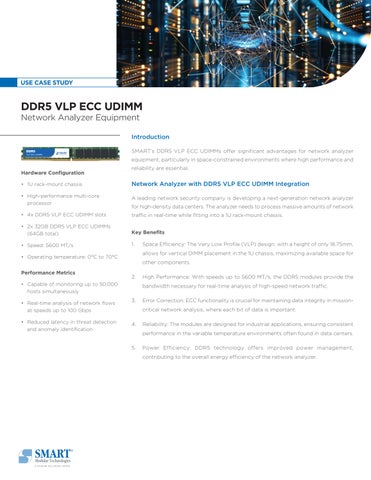
SMART’s DDR5 VLP ECC UDIMMs offer significant advantages for network analyzer equipment, particularly in space-constrained environments where high performance and reliability are essential.
A leading network security company is developing a next-generation network analyzer for high-density data centers. The analyzer needs to process massive amounts of network traffic in real-time while fitting into a 1U rack-mount chassis.
Key Benefits
1. Space Efficiency: The Very Low Profile (VLP) design, with a height of only 18.75mm, allows for vertical DIMM placement in the 1U chassis, maximizing available space for other components.
2. High Performance: With speeds up to 5600 MT/s, the DDR5 modules provide the bandwidth necessary for real-time analysis of high-speed network traffic.
3. Error Correction: ECC functionality is crucial for maintaining data integrity in missioncritical network analysis, where each bit of data is important.
4. Reliability: The modules are designed for industrial applications, ensuring consistent performance in the variable temperature environments often found in data centers.
5. Power Efficiency: DDR5 technology offers improved power management, contributing to the overall energy efficiency of the network analyzer.
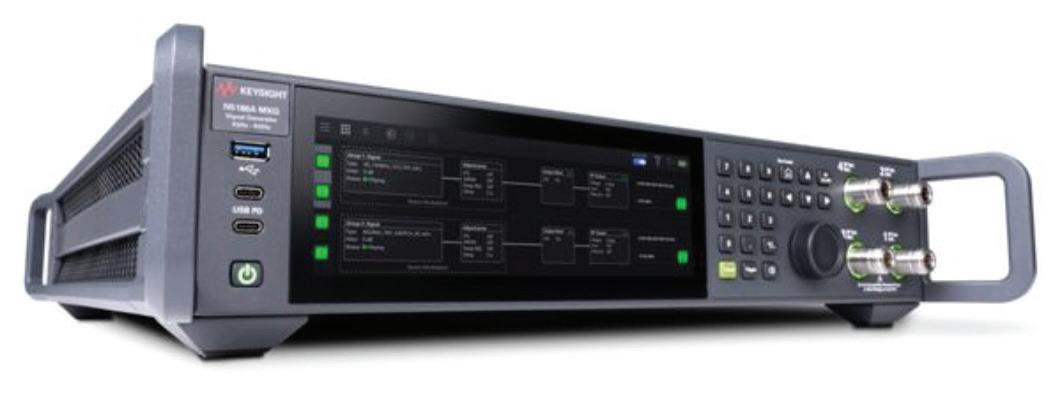

A large financial institution deploys this network analyzer in its primary data center. The analyzer continuously monitors all incoming and outgoing traffic, utilizing the high-speed DDR5 VLP ECC UDIMMs to process and temporarily store massive amounts of packet data. The ECC functionality ensures data integrity, critical for accurate threat detection and compliance reporting.
The compact 1U design, made possible by the VLP modules, allows the institution to install multiple analyzers in their limited rack space, providing comprehensive coverage without sacrificing other essential equipment. The high performance of the DDR5 memory enables the analyzer to keep up with peak traffic loads during high-transaction periods, ensuring no security vulnerabilities go undetected.
By leveraging the advanced features of SMART’s DDR5 VLP ECC UDIMMs, this network analyzer sets a new standard for performance, reliability, and efficiency in network security appliances, addressing the growing needs of data-intensive, space-constrained environments.
SMART’s DDR5-5600 VLP ECC UDIMMs; 16GB, 32GB 48GB (DDR5-6400 Q2’25) visit; https://www.smartm.com/product/ddr5-vlp-ecc-udimm
Headquarters/North America: T: (+1) 800-956-7627 • T: (+1) 510-623-1231 F: (+1) 510-623-1434 • E: info@smartm.com
Latin America: T: (+55) 11 4417-7200 • E: sales.br@smartm.com
Asia/Pacific: T: (+65) 6678-7670 • E: sales.asia@smartm.com
For more information, please visit: www.smartm.com
EMEA: T: (+44) 0 7826-064-745 • E: sales.euro@smartm.com
Customer Service: T: (+1) 510-623-1231 • E: customers@smartm.com