BBS-EVOL OF BIG GUNS REVISION FEB 2014:IOW MASTER-REVISED
The New Capital Ship
12/2/14
13:19
Page 36
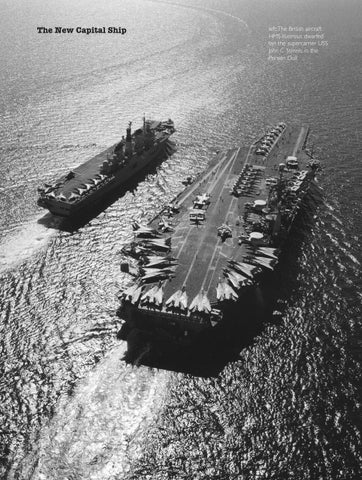
left:The British aircraft HMS Illustrious dwarfed byt the supercarrier USS John C. Stennis, in the Persian Gulf.
BBS-EVOL OF BIG GUNS REVISION FEB 2014:IOW MASTER-REVISED
12/2/14
13:19
Page 37
“If we rebuild the battle fleet and spend many millions on doing so, and then war comes and the airmen are right, and all our battleships are rapidly destroyed by air attack, our money will have been largely thrown away. But if we do not rebuild it and war comes, and the airmen are wrong and our airmen cannot destroy the enemy’s capital ships, and they are left to range with impunity on the world’s oceans and destroy our convoys, then we shall lose the British Empire.” —Royal Navy Admiral of the Fleet Sir Ernie Chatfield to Lord Halifax The Commander-in-Chief of the Combined Japanese Fleet, Admiral Isoroku Yamamoto, had been educated at Harvard University in Boston, Massachusetts. He had served Japan as its Naval Attaché in Washington and was well informed about the military strengths and capabilities of the United States. As the beginning of World War Two in the Pacific loomed, Yamamoto had no illusions about America as an adversary and did not favour such a war, but he accepted its inevitability. He also believed that Japan could not win a long, drawn-out war with the United States. Yamamoto was convinced that Japan must “give a fatal blow to the enemy at the outset, when it was least expected.” He was certain that anything less than the total destruction of the U.S. fleet “would awaken a sleeping giant.” Hector Bywater, a British naval authority had published a book in 1921, Sea Power in the Pacific, and by the following year it had become required reading at Japan’s Naval War College and her Imperial Naval Academy. Bywater believed that distance, and the effort connected with secondary fuel and supply consumption, meant that the Japanese home islands were essentially protected from direct assault by American forces.With impressive foresight, he predicted that the only workable strategy for an American assault on Japan would require a massive island-hopping campaign, through the Marianas and then on to Guam and the Philippines. Following the success of Sea Power in the Pacific, Bywater published a second book, The Great Pacific War, in which he argued that Japan could achieve the goal of making her empire invulnerable by mounting a successful surprise attack on the U.S. fleet, followed by an invasion of Guam and the Philippines and by the fortification of her mandate islands. Bywater and Yamamoto met for an evening at London’s Grosvenor House during the admiral’s 1934 trip to Europe. In the meeting,Yamamoto expressed his profound interest in Bywater’s theories and their possible implications for Japan. The creation of the Greater East Asia Co-Prosperity Sphere—that was how the Japanese referred to their intended conquest of Southeast Asia in the late 1930s. They had already conquered Manchuria and then invaded mainland China. These adventures caused the United States to impose an embargo on Japan which covered war materials, scrap iron, steel, and aviation fuel. All Japanese assets in the U.S. were frozen as well. Japan had few natural resources and now her sources for strategic commodities were drying up. Her militarist rulers knew that, to survive and to win in China, they had to have the tin, bauxite, rubber and oil of Malaya and the Dutch East Indies.They saw war with the British Empire, the Dutch government in exile, and the United States as inevitable, and began planning attacks on American air bases in the Philippines and the U.S. Pacific Fleet at Pearl Harbor, Hawaii. The complete destruction of these targets would be necessary to clear the way for Japanese forces to conquer Malaya, the East Indies and China.They called upon Admiral Yamamoto to 37
BBS-EVOL OF BIG GUNS REVISION FEB 2014:IOW MASTER-REVISED
HMS Illustrious
12/2/14
13:19
Page 38
BBS-EVOL OF BIG GUNS REVISION FEB 2014:IOW MASTER-REVISED
12/2/14
13:19
Page 39
HMS Illustrious is one of three Invincible class light aircraft carriers built for the Royal Navy in the late 1970s. After participating in the Falklands conflict, Illustrious served in operations in Iraq, Bosnia and Sierra Leone. In 2010, her Sea Harrier II aircraft were retired from service and she has since operated as a helicopter carrier.
BBS-EVOL OF BIG GUNS REVISION FEB 2014:IOW MASTER-REVISED
12/2/14
13:19
Page 40
BBS-EVOL OF BIG GUNS REVISION FEB 2014:IOW MASTER-REVISED
far left: Admiral Isoroku Yamamoto; left: Japanese torpedo carrier-based torpedo bombers; below: U.S. Navy’s Pensacola, Florida base in the 1930s.
12/2/14
13:19
right: U.S. Navy Fleet Admiral Chester Nimitz; centre far left:Taranto pilot John Wellham; far left bottom: U.S. Navy fighter ace Stanley Vejtasa; bottom centre: Douglas Aircraft assembly line for SBD divebombers in World War Two; below: Women war workers in an aircraft plant during the WW2.
Page 41