Milestones 8
February 2021
The burning of Pennsylvania Hall By Constance Garcia-Barrio
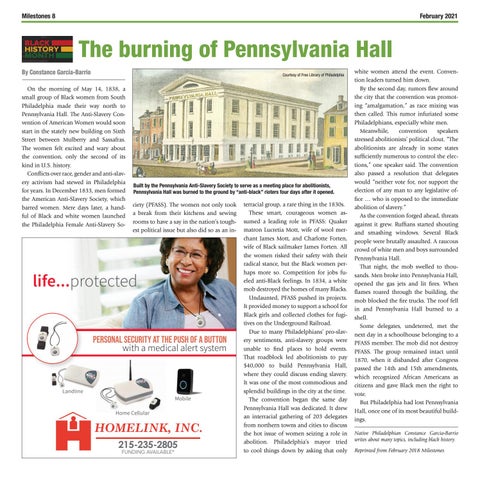
Courtesy of Free Library of Philadelphia
On the morning of May 14, 1838, a small group of Black women from South Philadelphia made their way north to Pennsylvania Hall. The Anti-Slavery Convention of American Women would soon start in the stately new building on Sixth Street between Mulberry and Sassafras. The women felt excited and wary about the convention, only the second of its kind in U.S. history. Conflicts over race, gender and anti-slavery activism had stewed in Philadelphia for years. In December 1833, men formed the American Anti-Slavery Society, which barred women. Mere days later, a handful of Black and white women launched the Philadelphia Female Anti-Slavery So-
Built by the Pennsylvania Anti-Slavery Society to serve as a meeting place for abolitionists, Pennsylvania Hall was burned to the ground by “anti-black” rioters four days after it opened.
ciety (PFASS). The women not only took a break from their kitchens and sewing rooms to have a say in the nation’s toughest political issue but also did so as an in-
life...protected PERSONAL SECURITY AT THE PUSH OF A BUTTON with a medical alert system
Landline Mobile Home Cellular
215-235-2805 FUNDING AVAILABLE*
terracial group, a rare thing in the 1830s. These smart, courageous women assumed a leading role in PFASS: Quaker matron Lucretia Mott, wife of wool merchant James Mott, and Charlotte Forten, wife of Black sailmaker James Forten. All the women risked their safety with their radical stance, but the Black women perhaps more so. Competition for jobs fueled anti-Black feelings. In 1834, a white mob destroyed the homes of many Blacks. Undaunted, PFASS pushed its projects. It provided money to support a school for Black girls and collected clothes for fugitives on the Underground Railroad. Due to many Philadelphians’ pro-slavery sentiments, anti-slavery groups were unable to find places to hold events. That roadblock led abolitionists to pay $40,000 to build Pennsylvania Hall, where they could discuss ending slavery. It was one of the most commodious and splendid buildings in the city at the time. The convention began the same day Pennsylvania Hall was dedicated. It drew an interracial gathering of 203 delegates from northern towns and cities to discuss the hot issue of women seizing a role in abolition. Philadelphia’s mayor tried to cool things down by asking that only
white women attend the event. Convention leaders turned him down. By the second day, rumors flew around the city that the convention was promoting “amalgamation,” as race mixing was then called. This rumor infuriated some Philadelphians, especially white men. Meanwhile, convention speakers stressed abolitionists’ political clout. “The abolitionists are already in some states sufficiently numerous to control the elections,” one speaker said. The convention also passed a resolution that delegates would “neither vote for, nor support the election of any man to any legislative office … who is opposed to the immediate abolition of slavery.” As the convention forged ahead, threats against it grew. Ruffians started shouting and smashing windows. Several Black people were brutally assaulted. A raucous crowd of white men and boys surrounded Pennsylvania Hall. That night, the mob swelled to thousands. Men broke into Pennsylvania Hall, opened the gas jets and lit fires. When flames roared through the building, the mob blocked the fire trucks. The roof fell in and Pennsylvania Hall burned to a shell. Some delegates, undeterred, met the next day in a schoolhouse belonging to a PFASS member. The mob did not destroy PFASS. The group remained intact until 1870, when it disbanded after Congress passed the 14th and 15th amendments, which recognized African Americans as citizens and gave Black men the right to vote. But Philadelphia had lost Pennsylvania Hall, once one of its most beautiful buildings. Native Philadelphian Constance Garcia-Barrio writes about many topics, including black history. Reprinted from February 2018 Milestones