PROMOTION
Gifting in the new
tax era
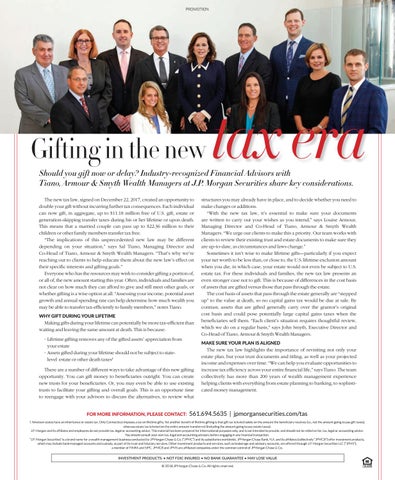
Should you gift now or delay? Industry-recognized Financial Advisors with Tiano, Armour & Smyth Wealth Managers at J.P. Morgan Securities share key considerations.
The new tax law, signed on December 22, 2017, created an opportunity to double your gift without incurring further tax consequences. Each individual can now gift, in aggregate, up to $11.18 million free of U.S. gift, estate or generation-skipping transfer taxes during his or her lifetime or upon death. This means that a married couple can pass up to $22.36 million to their children or other family members transfer tax free. “The implications of this unprecedented new law may be different depending on your situation,” says Sal Tiano, Managing Director and Co-Head of Tiano, Armour & Smyth Wealth Managers. “That’s why we’re reaching out to clients to help educate them about the new law’s effect on their specific interests and gifting goals.” Everyone who has the resources may wish to consider gifting a portion of, or all of, the new amount starting this year. Often, individuals and families are not clear on how much they can afford to give and still meet other goals, or whether gifting is a wise option at all. “Assessing your income, potential asset growth and annual spending rate can help determine how much wealth you may be able to transfer tax-efficiently to family members,” notes Tiano. WHY GIFT DURING YOUR LIFETIME Making gifts during your lifetime can potentially be more tax-efficient than waiting and leaving the same amount at death. This is because: • Lifetime gifting removes any of the gifted assets’ appreciation from your estate • Assets gifted during your lifetime should not be subject to state- level estate or other death taxes1
There are a number of different ways to take advantage of this new gifting opportunity. You can gift money to beneficiaries outright. You can create new trusts for your beneficiaries. Or, you may even be able to use existing trusts to facilitate your gifting and overall goals. This is an opportune time to reengage with your advisors to discuss the alternatives, to review what FOR MORE INFORMATION, PLEASE CONTACT:
structures you may already have in place, and to decide whether you need to make changes or additions. “With the new tax law, it’s essential to make sure your documents are written to carry out your wishes as you intend,” says Louise Armour, Managing Director and Co-Head of Tiano, Armour & Smyth Wealth Managers. “We urge our clients to make this a priority. Our team works with clients to review their existing trust and estate documents to make sure they are up-to-date, as circumstances and laws change.” Sometimes it isn’t wise to make lifetime gifts—particularly if you expect your net worth to be less than, or close to, the U.S. lifetime exclusion amount when you die, in which case, your estate would not even be subject to U.S. estate tax. For these individuals and families, the new tax law presents an even stronger case not to gift. This is because of differences in the cost basis of assets that are gifted versus those that pass through the estate. The cost basis of assets that pass through the estate generally are “stepped up” to the value at death, so no capital gains tax would be due at sale. By contrast, assets that are gifted generally carry over the grantor’s original cost basis and could pose potentially large capital gains taxes when the beneficiaries sell them. “Each client’s situation requires thoughtful review, which we do on a regular basis,” says John Smyth, Executive Director and Co-Head of Tiano, Armour & Smyth Wealth Managers. MAKE SURE YOUR PLAN IS ALIGNED The new tax law highlights the importance of revisiting not only your estate plan, but your trust documents and titling, as well as your projected income and expenses over time. “We can help you evaluate opportunities to increase tax efficiency across your entire financial life,” says Tiano. The team collectively has more than 200 years of wealth management experience helping clients with everything from estate planning to banking, to sophisticated money management.
561.694.5635 | jpmorgansecurities.com/tas
1 Nineteen states have an inheritance or estate tax. Only Connecticut imposes a tax on lifetime gifts. Yet another benefit of lifetime gifting is that gift tax is levied solely on the amount the beneficiary receives (i.e., not the amount going to pay gift taxes), whereas estate tax is levied on the entire amount transferred (including the amount going to pay estate taxes). J.P. Morgan and its affiliates and employees do not provide tax, legal or accounting advice. This material has been prepared for informational purposes only, and is not intended to provide, and should not be relied on for, tax, legal or accounting advice. You should consult your own tax, legal and accounting advisors before engaging in any financial transaction. “J.P. Morgan Securities” is a brand name for a wealth management business conducted by JPMorgan Chase & Co. (“JPMC”) and its subsidiaries worldwide. JPMorgan Chase Bank, N.A. and its affiliates (collectively “JPMCB”) offer investment products, which may include bank-managed accounts and custody, as part of its trust and fiduciary services. Other investment products and services, such as brokerage and advisory accounts, are offered through J.P. Morgan Securities LLC (“JPMS”), a member of FINRA and SIPC. JPMCB and JPMS are affiliated companies under the common control of JPMorgan Chase & Co.
INVESTMENT PRODUCTS: • NOT FDIC INSURED • NO BANK GUARANTEE • MAY LOSE VALUE © 2018 JPMorgan Chase & Co. All rights reserved.