MARÍA BERRÍO TWO x TWO 2023 ARTIST HONOREE
Plus, Jaune Quick-to-See Smith
Abraham Ángel
Afro-Atlantic Histories
Bianca Bondi
12TH ANNIVERSARY ISSUE




KAWS, CLEAN SLATE 2015, NANCY A. NASHER AND DAVID J. HAEMISEGGER COLLECTION.
FEATURING: HUMA BHABHA JONATHAN BOROFSKY ANTHONY CARO TONY CRAGG MICHAEL CRAIG-MARTIN MARK DI SUVERO JIM DINE LEONARDO DREW BARRY FLANAGAN TOM FRIEDMAN LIAM GILLICK ANTONY GORMLEY KATHARINA GROSSE SIOBH Á N HAPASKA THOMAS HOUSEAGO KAWS ALAIN KIRILI HENRY MOORE IVÁ N NAVARRO PAMELA NELSON AND ROBERT A. WILSON MIMMO PALADINO JOEL SHAPIRO FRANK STELLA LEO VILLAREAL HE XIANGYU

deBOULLE deBoulle.com 214.522.2400 BUCCELLATI Ml LANO DAL 1919

214.520.8300 ERINHOME.COM ERIN DALLAS’ ORIGINAL REAL ESTATE INFLUENCER ® ® ERIN MATHEWS
PLUG IN TO ONE AGENT. LIGHT A NETWORK OF 24. They bring this city to life like no other group. In a spirit of collaboration that has propelled some of Dallas’ most legendary real estate transactions, this premier networking group continues to do what it does best—connect people and properties. What does that mean for you? A more expertly facilitated sale of your prized property. A more perfectly matched home for your next move. Twenty-four of the most admired and knowledgeable real estate professionals in Dallas come together to put their resources and their vast experience to work for you. Insider information, off-market properties, Dallas’ most exquisite estates—all leveraged for your benefit. Thinking of a change? Put the Masters of Residential Real Estate to work for you.
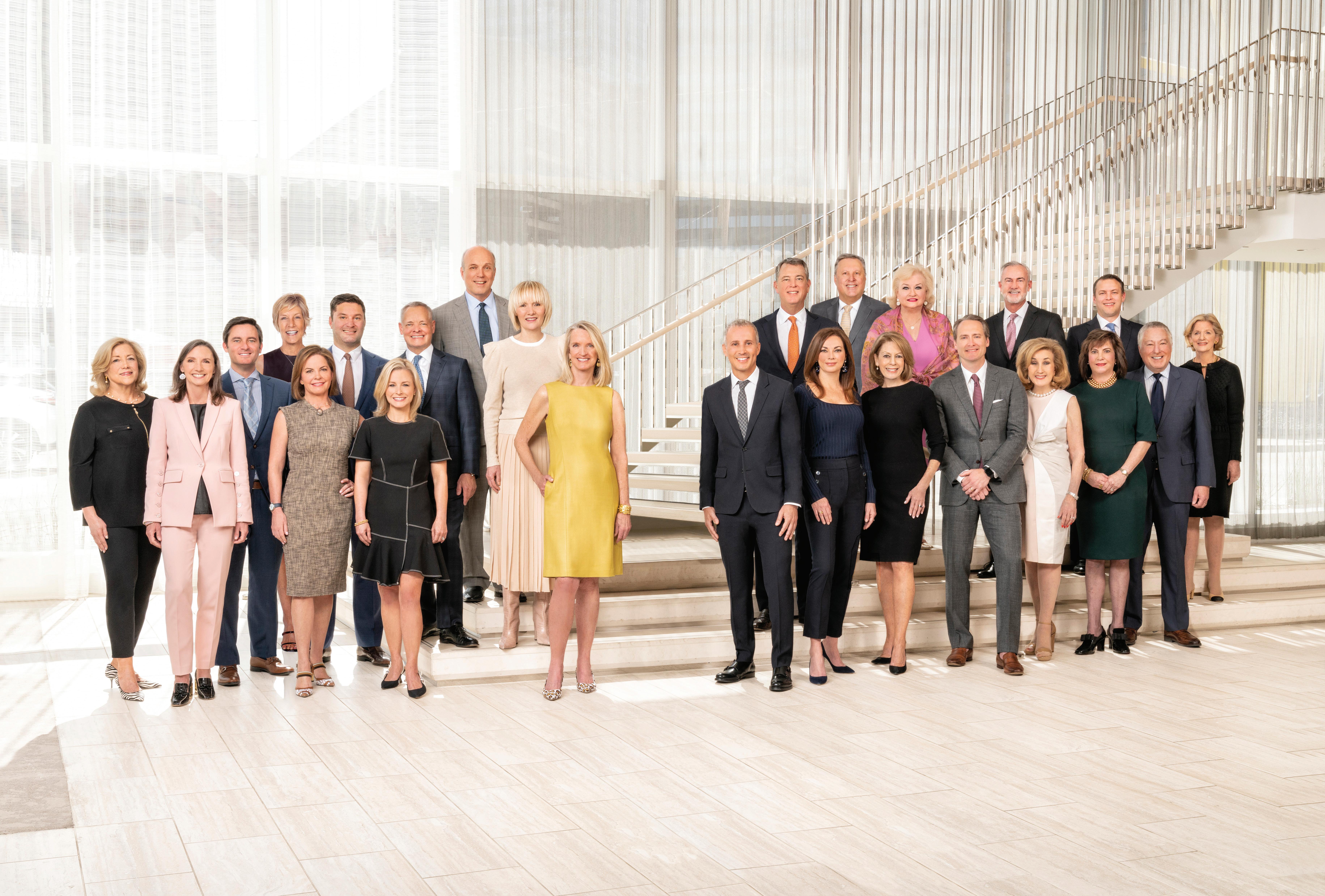
FRONT ROW : JACKIE MCGUIRE , Compass SUSAN BALDWIN , Allie Beth Allman and Assoc. MICHELLE WOOD , Compass AMY DETWILER , Compass MADELINE JOBST, Briggs
Freeman Sotheby’s FAISAL HALUM , Briggs Freeman Sotheby’s EMILY RAY-PORTER , Dave Perry-Miller Real Estate JOAN ELEAZER , Briggs Freeman Sotheby’s BURTON
RHODES , Compass DORIS JACOBS , Allie Beth Allman and Assoc. EMILY PRICE CARRIGAN , Emily Price Carrigan Properties FRANK PURCELL , Allie Beth Allman and Assoc. SUSAN MARCUS , Briggs Freeman Sotheby’s BACK ROW : CHAD BARRETT, Allie Beth Allman and Assoc. BECKY FREY, Compass JONATHAN ROSEN , Compass
RALPH RANDALL , Briggs Freeman Sotheby’s KYLE CREWS , Allie Beth Allman and Assoc. ERIN MATHEWS , Allie Beth Allman and Assoc. TOM HUGHES , Compass
STEWART LEE , Dave Perry-Miller Real Estate PENNY RIVENBARK PATTON , Ebby Halliday Realtors MARK CAIN , Compass RYAN STREIFF, Dave Perry-Miller Real Estate
GREEN FAMILY ART FOUNDATION PRESENTS:
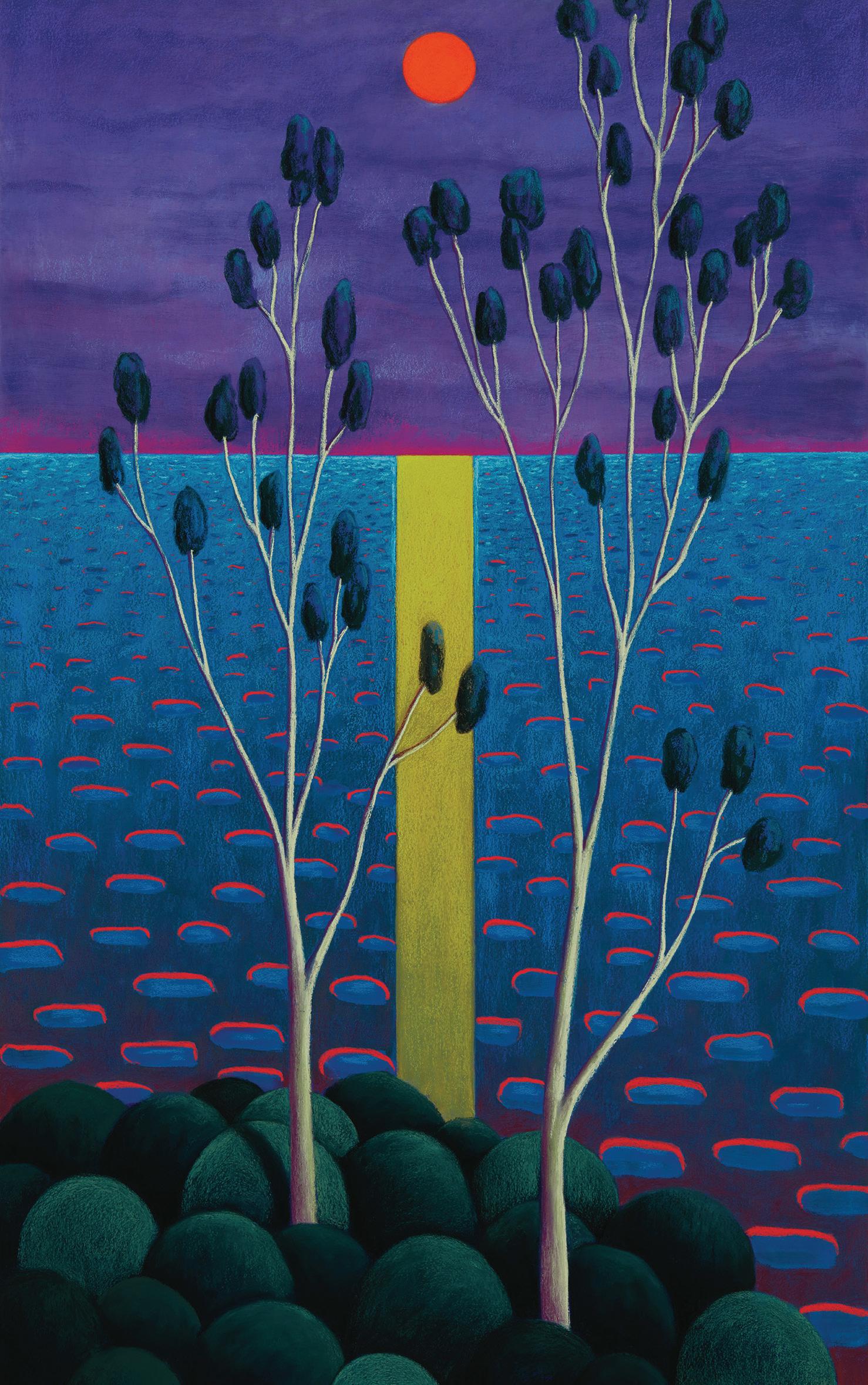
NICOLAS PARTY: LANDSCAPE
TOGETHERNESS: FOR BETTER OR WORSE
OPENING RECEPTION: OCTOBER 7, 5-8PM | ON VIEW: OCTOBER 7, 2023 - JANUARY 21, 2024 2111 FLORA STREET, SUITE 110, DALLAS, TX | WWW.GREENFAMILYARTFOUNDATION.ORG
NICOLAS PARTY SUNSET, 2018
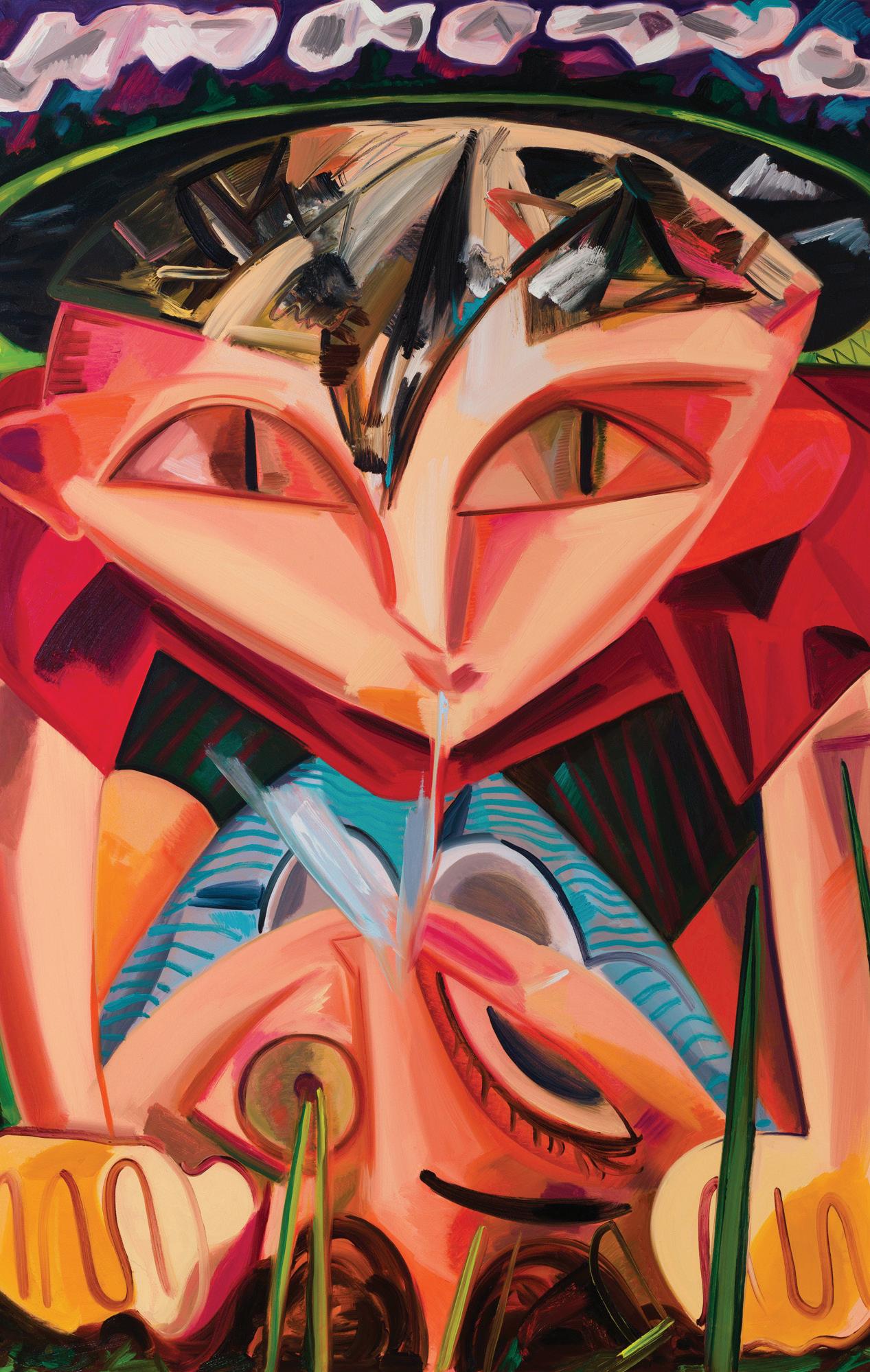
DANA SCHUTZ SPIT, 2015

Paul R. Minshull #16591. BP 15-25%; see HA.com. Licensed by the City of New York #1364738/9-DCA 73716 DALLAS | NEW YORK | BEVERLY HILLS | CHICAGO | PALM BEACH LONDON | PARIS | GENEVA | BRUSSELS | AMSTERDAM | HONG KONG Always Accepting Quality Consignments in 50+ Categories 1.75 Million+ Online Bidder-Members THE FALL SEASON Signature ® Auctions Prints & Multiples | October 24 Design | November 7 Modern & Contemporary Art | November 14 American Art | November 17 Urban Art | November 30 Texas Art | December 2 European Art | December 7 Visit HA.com/Auctions for a Complete Calendar Inquiries: Frank Hettig | 214.409.1157 | FrankH@HA.com 2801 W. Airport Freeway Dallas, Texas 75261-4127 (Northwest corner of W. Airport Freeway [HWY-183] & Valley View Lane)
Collection,
Prints
Keith Haring (1958-1990) | Andy Mouse (portfolio of four), 1986
Screenprints
in colors on Lenox Museum Board | 38 x 38 inches (96.5 x 96.5 cm) (each sheet)
Private
Miami, Florida Estimate: $700,000 - $900,000 |
& Multiples
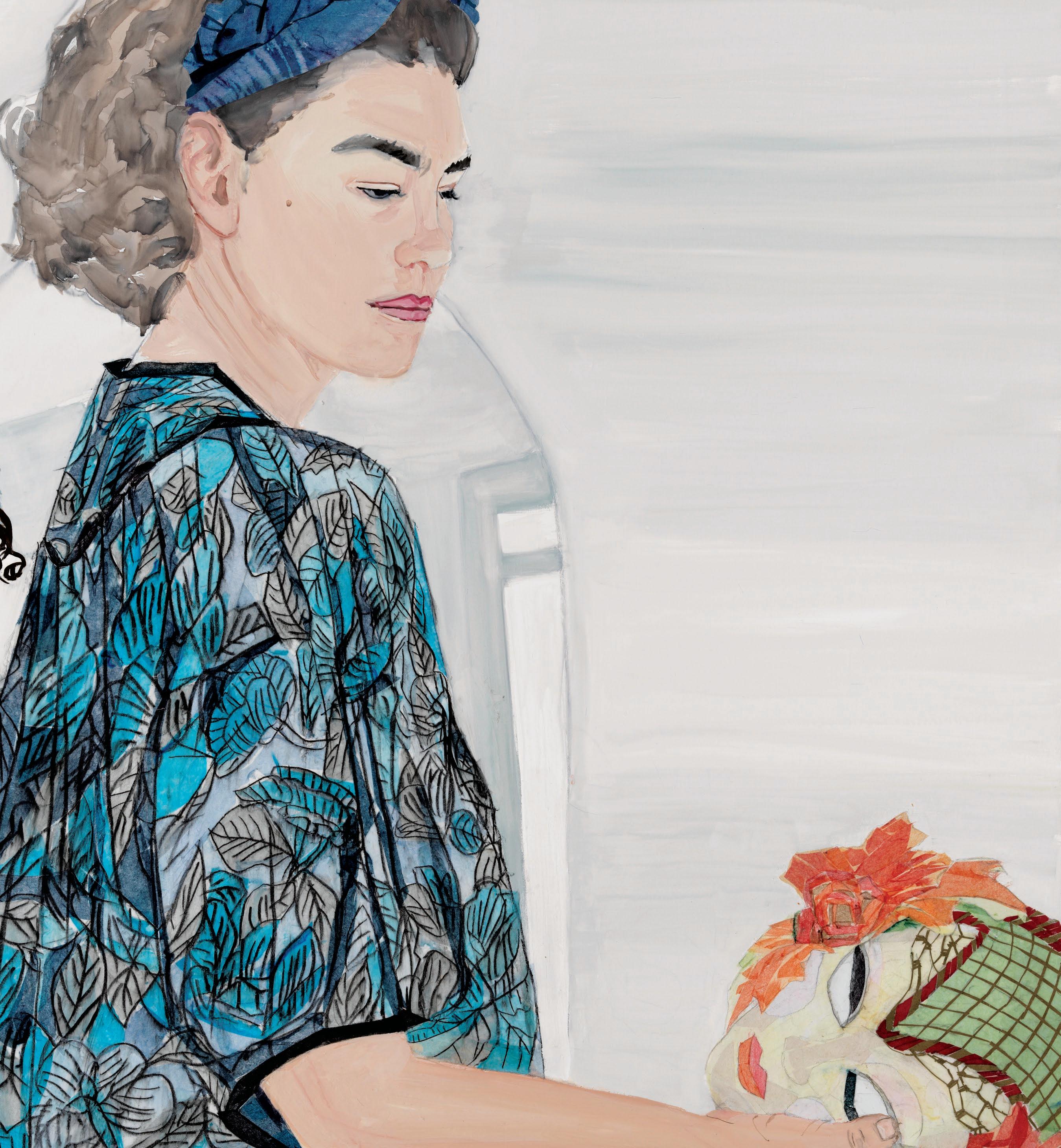
Marking Patron’s 12th Anniversary issue and the tradition of featuring the work of the TWO x TWO for AIDS and Art artist honoree, a detail of María Berrío’s painting ACT II Scene 4: Threshold from the series A Feast for Ammit enhances our cover. The collaged painting of Japanese paper and watercolor on linen will be under Sotheby’s gavel at the perennial auction and gala benefit at The Rachofsky House. Considering Echo’s soliloquy of unrequited love as she contemplates a mask, Dr. Anna Katherine Brodbeck, Dallas Museum of Art’s Hoffman Family Senior Curator of Contemporary Art, interviews the artist about this work and her unique oeuvre in María Berrío Makes Sense of Things
Rooted in minimal and conceptual art, women artists turned to the land to create work outside the white cube. Land art from the ’60s to the ’90s, largely experiential and often ephemeral, is the subject of a sweeping exhibition, Groundswell: Women of Land Art, opening at the Nasher Sculpture Center this month. Curated by Nasher associate curator Dr. Leigh A. Arnold, the exhibition examines the work of 12 artists. Eve Hill-Agnus shares insights in Laying the Groundwork.
In Unraveling Histories, Dr. Agustín Arteaga, Eugene McDermott Director of the Dallas Museum of Art, tells Darryl Ratcliff that for the museum, “It is really important to have art at the center, and community at the core.” With that driving sense of community, Afro-Atlantic Histories and Abraham Ángel: Between Wonder and Seduction, both on view at the DMA, are bound to attract new audiences through the historical consideration of legacies and identities.
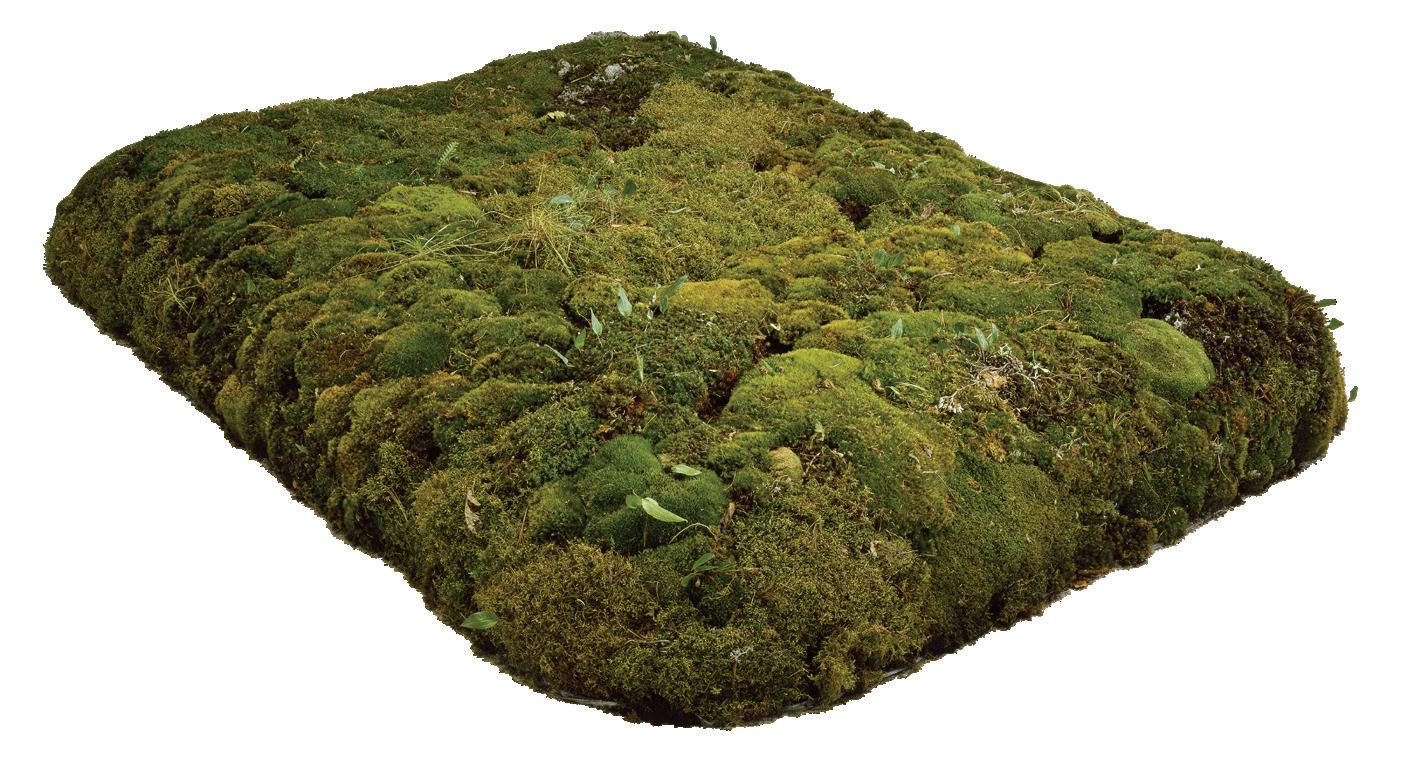
Stephanie Cristello delves into the practice of South African, Paris-based artist Bianca Bondi in Poetic Post-Apocalypse. In November, Dallas Contemporary will mount Bianca Bondi: A Preservation Method, which takes as its starting point the Highway Beautification Act of 1965 to prohibit billboards in natural environments, which was passed by President Lyndon B. Johnson, spurred on by his wife Lady Bird Johnson’s advocacy for the environment.
The invincible artist and activist Jaune Quick-to-See Smith, a Montana citizen of the Confederated Salish and Kootenai Nation, injects humor in her work while confronting a harrowing Native American history through contemporary dialogues. In The Storyteller, Steve Carter previews the artist’s retrospective Memory Map, coming from the Whitney Museum of American Art and opening at the Modern Art Museum of Fort Worth on October 15.
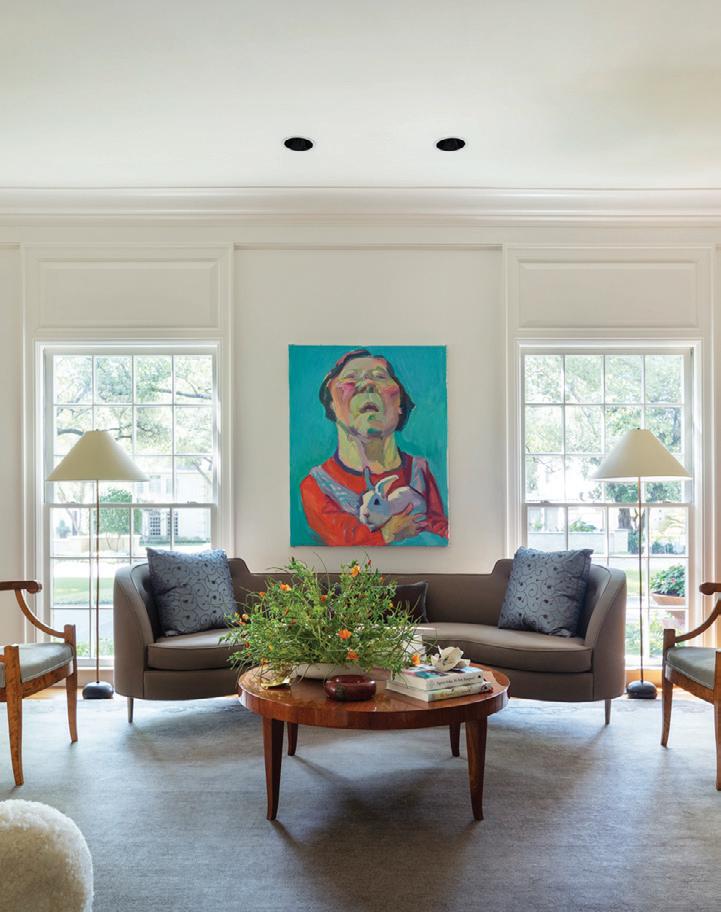
Marguerite Hoffman’s classic elegance and thirst for contemporary art is evinced in A Soft and Serene Sanctuary, featuring considered architecture and design by Bodron/Fruit. A “cocoon for art,” the work of celebrated artists like Gerhard Richter, Louise Bourgeois, Maria Lassnig, and Cecily Brown embrace the comely residence’s garden views.
Jill Parker and Rod Sager contribute to the region’s art ecosystem tenfold. Their passion for artists and collecting, with work acquired from local galleries displayed in every room of their Bluffview home, is palpable. Nancy Cohen Israel takes readers inside in A Living Story.
In Balancing the Distortion , we take a peek inside Anna Membrino’s studio. The artist, known for her otherworldly large-scale landscapes, investigates abstraction for her November solo show, Ripples, at Erin Cluley Gallery.
A fall visit to the Crystal Bridges Museum of American Art situated on verdant grounds in Bentonville, Arkansas, is always worth a trip. And now, Annie Leibovitz, whose portraits convey larger stories, has an epic solo show on view through January 29. John Zotos shares highlights. Back at the Whitney, Chris Byrne interviews Elisabeth Sussman, the Sondra Gilman Curator of Photography, regarding the first-ever Harry Smith survey.
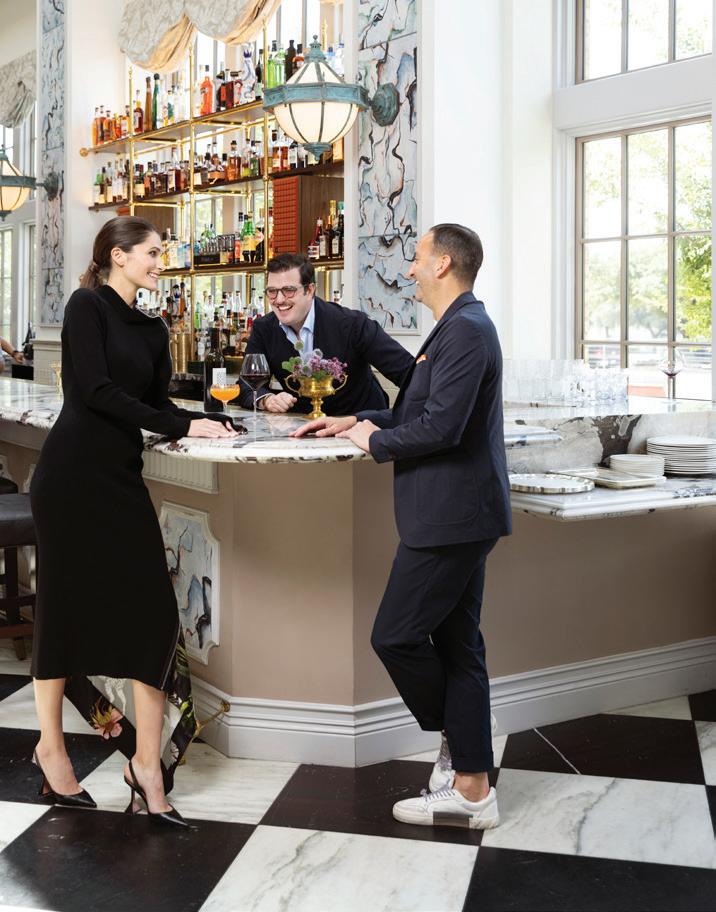
Courting Mister Charles takes us inside the consummate new restaurant from Duro Hospitality. Justin Clemons lends his expertise to photograph fashion, jewelry, design, and food combined with stunning floral design by Concepto. Get your fall on and make a reservation at this hot spot.
In the issue’s final page, Joan Davidow remembers her son and SITE131 partner Seth in Endpapers
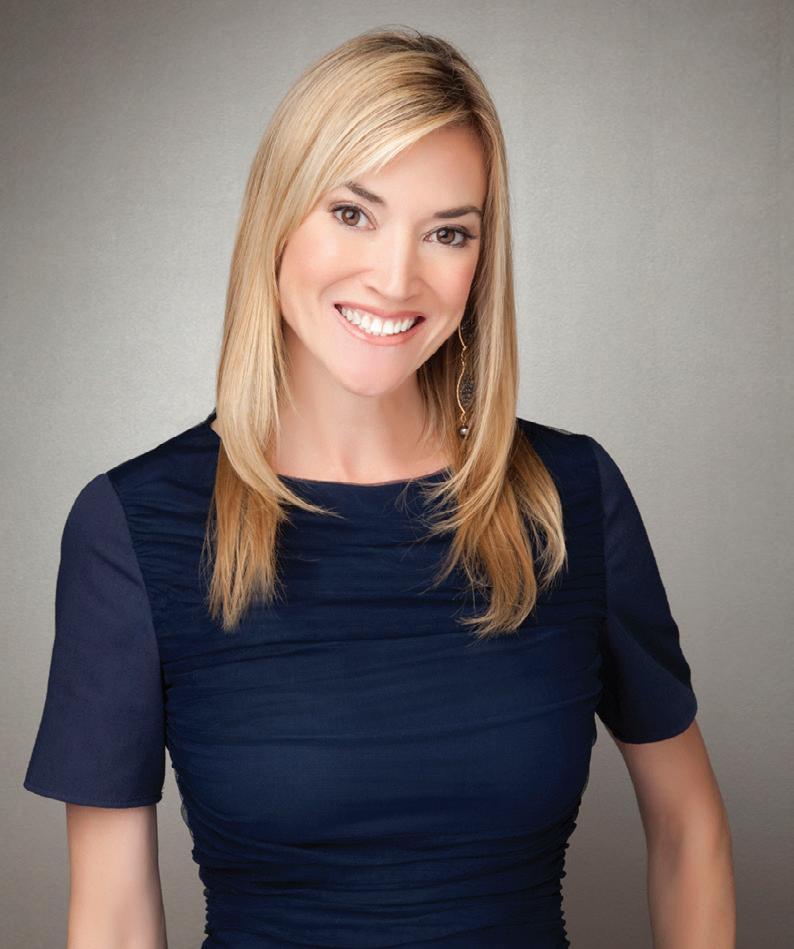
Terri Provencal
10 PATRONMAGAZINE.COM
–
TERRI
Publisher /
in
terri@patronmagazine.com Instagram terri_provencal and patronmag
PROVENCAL
Editor
Chief
Portrait Tim Boole, Styling Jeanna Doyle, Stanley Korshak

www.akris.com
FEATURES
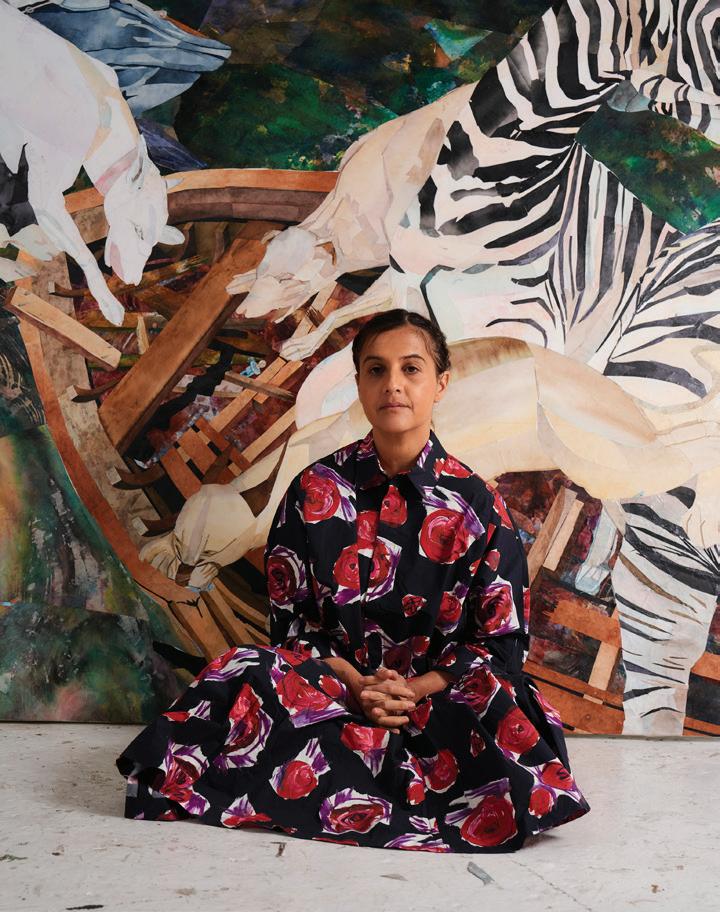
70 MARÍA BERRÍO MAKES SENSE OF THINGS
The Colombian-born, New York–based TWO x TWO 2023 artist honoree takes an intimate look at contemporary realities to create mythic worlds.
 By Dr. Anna Katherine Brodbeck
78 LAYING THE GROUNDWORK
The Nasher’s vast, ambitious exhibition turns its gaze to land art.
By Eve Hill-Agnus
84 UNRAVELING HISTORY
The Dallas Museum of Art looks to the past while mining the present to connect the diverse communities of Dallas.
By Darryl Ratcliff
88 POETIC POST-APOCALYPSE
Bianca Bondi at Dallas Contemporary.
By Stephanie Cristello
92 THE STORYTELLER
The Modern Art Museum of Fort Worth’s Jaune Quick-to-See Smith: Memory Map is a timely, timeless retrospective.
By Steve Carter
96 A SOFT AND SERENE SANCTUARY
Marguerite Hoffman engages Bodron/Fruit to create a “cocoon for art” in her classic home.
By Eve Hill-Agnus
104 A LIVING STORY
A modern and contemporary collection evolves in the home of Jill Parker and Rod Sager.
 By Nancy Cohen Israel
112 COURTING MISTER CHARLES
At the hottest restaurant in town, a fashion muse makes a statement. Photographs by Justin Clemons; Styling by Elaine Raffel; Creative Direction by Concepto and Terri Provencal
On the cover: María Berrío, Act II, Scene 4: Threshold (detail), 2023, collage with Japanese paper and watercolor on linen 51 x 35.25 in. © María Berrío. Courtesy of the artist and Victoria Miro.
12 PATRONMAGAZINE.COM 112 70
1 96
CONTENTS
78
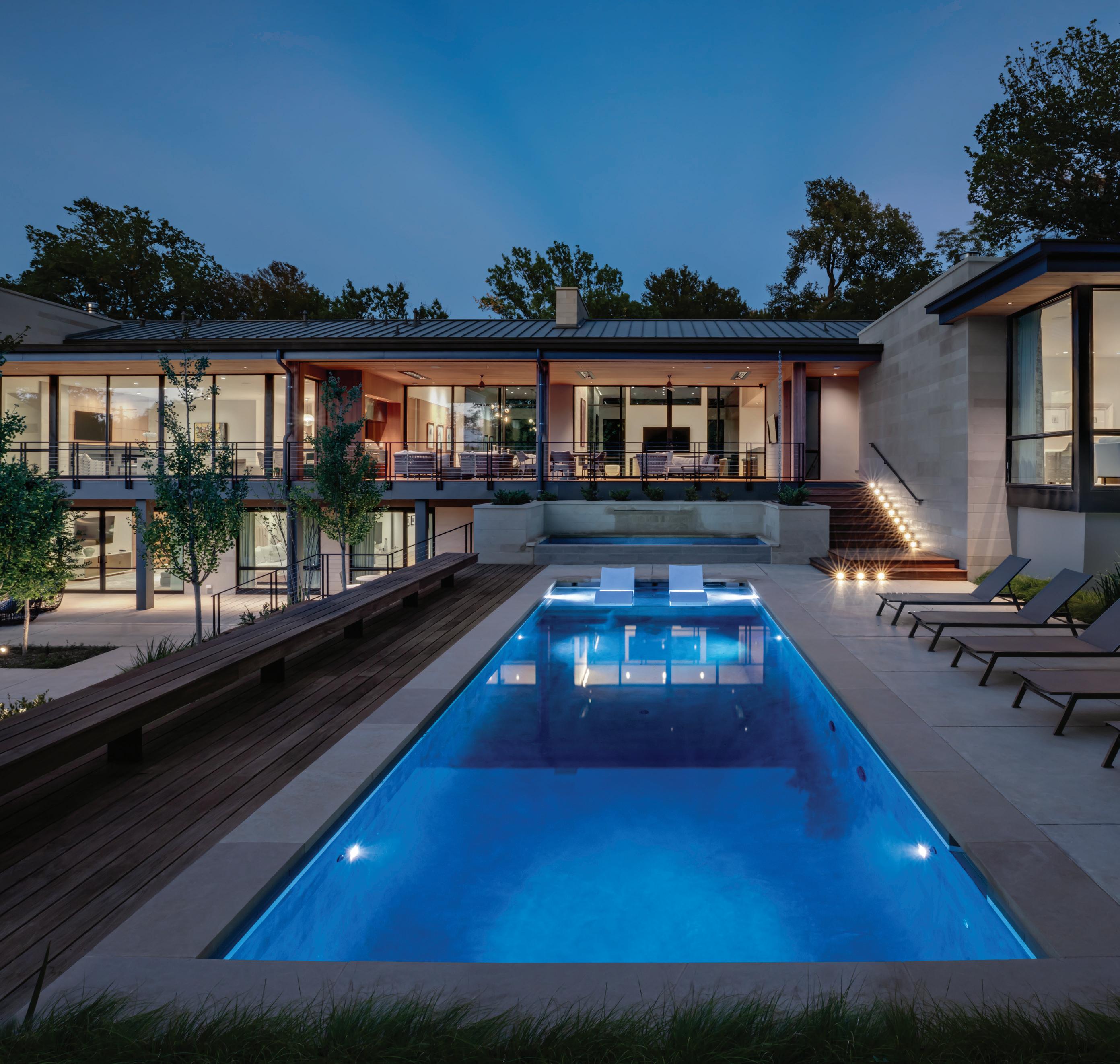
214.219.4528 / bmarchitects.com
CONTENTS
DEPARTMENTS
10 Editor’s Note
16 Contributors
34 Noted Of Note
42 ARTISTIC MARVELS FROM TOKYO AND MONTREAL
By Anthony Falcon
Auction
52 SHARP-EYED BIDDING
Sotheby’s Charlie Adamski Caulkins shares her top picks for the one-of-akind TWO x TWO silent and live auction. By Charlie Adamski Caulkins
Fair Trade
56 MONUMENTAL QUESTIONS
Iván Argote’s WildFlowers invites discourse on the history of statues in public spaces. Interview by Vivian Li
Openings
58 TUREEN DISHES UP A DIVERSE ROSTER
At this new Oak Cliff gallery, which favors the avant-garde, community is the mission. By Sara Hignite
Contemporaries
62 TOUR DE FORCE
Annie Leibovitz at Work , on view at the Crystal Bridges Museum, sheds an intimate light on the artist’s mind at work. By John Zotos
64 FOLK HERO
Harry Smith makes history at the Whitney Museum of American Art. Interview by Chris Byrne
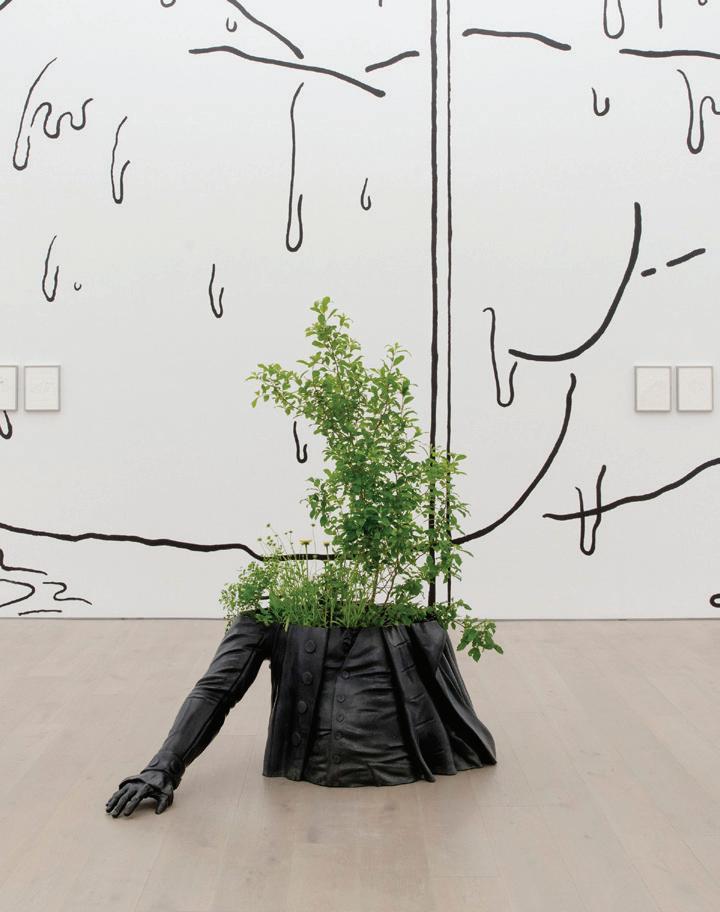
Studio
66 BALANCING THE DISTORTION
For her solo show, Ripples, Anna Membrino’s invented landscapes lead to abstraction. By Terri Provencal
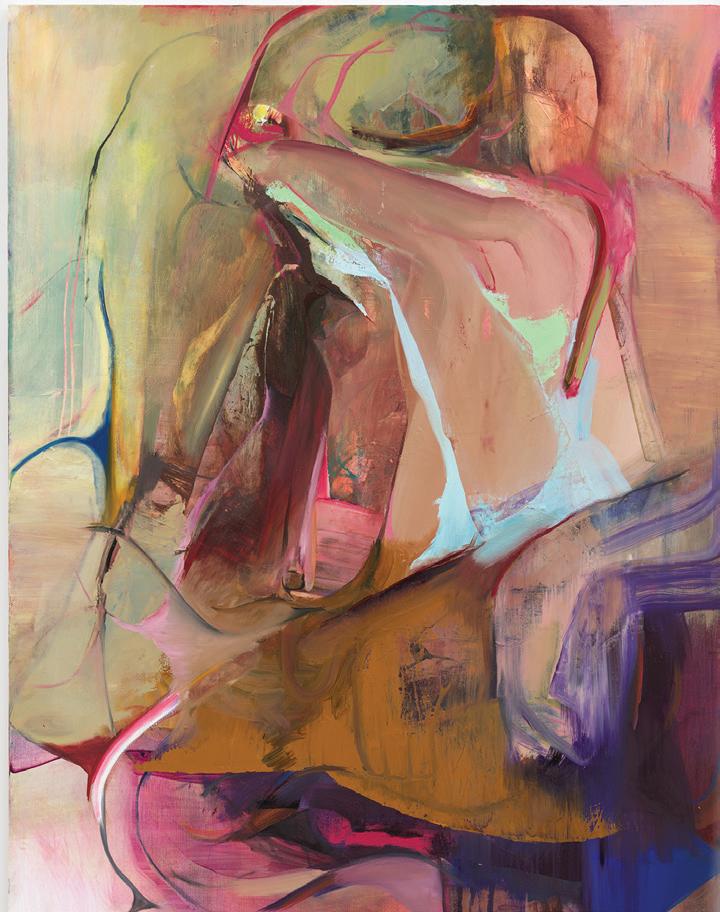
Atelier
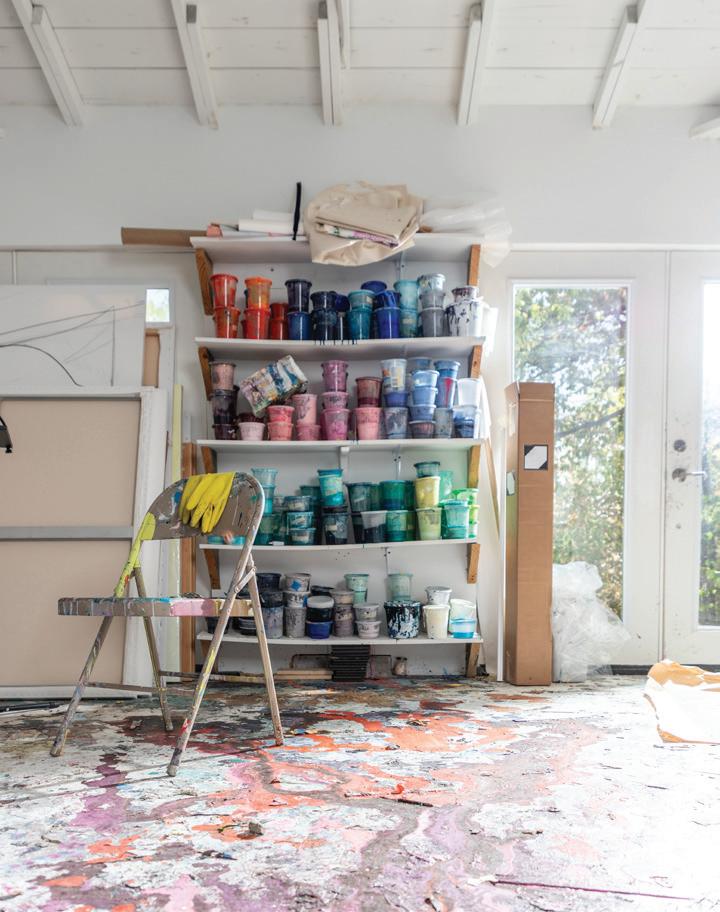
122 THE FINER POINTS
Southern-born sisters Kasey Lemkin and Lawren Sample insist on timeless details to envision Partlow. By Terri Provencal
124 GUCCI GUCCI GOO
NorthPark Center wows with the expanded boutique for brand devotees. By Elaine Raffel
There
126 CAMERAS COVERING CULTURAL EVENTS
Furthermore 128 ENDPAPERS
A mother’s mirrored passion with her late son is remembered in SITE131’s …to see is a gift: Seth Davidow collection. By Joan Davidow
14 PATRONMAGAZINE.COM
56 52 66
2 122

TOOTSIES.COM ATLANTA DALLAS HOUSTON CARA CARA
CONTRIBUTORS
ANNA KATHERINE BRODBECK
is the Dallas Museum of Art’s Hoffman Family Senior Curator of Contemporary Art. She served as associate curator for Brazilian artist Hélio Oiticica’s retrospective, coorganized with the Art Institute of Chicago and Whitney Museum. For the DMA she curated For a Dreamer of Houses, Jonas Wood, and America Will Be!: Surveying the Contemporary Landscape. In this issue, read her insightful interview with TWO x TWO for AIDS and Art 2023 artist honoree María Berrío.
CHRIS BYRNE
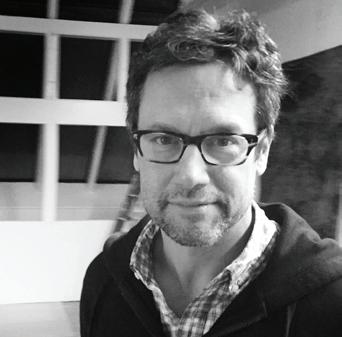
authored the graphic novel The Magician (Marquand Books, 2013), included in the Library of Congress. He is the coeditor of Frank Johnson, Pioneer of American Comics
Vol. 1: Wally ’s Gang
Early Years (1928-1949) and The Bowser Boys (1946-1950), published by Fantagraphics in 2023. Byrne chaired AVAM, the national museum for visionary art. He founded the Elaine de Kooning House in East Hampton, listed on the National Register of Historic Places and an affiliate member of the National Trust’s Historic Artists’ Homes and Studios.
STEVE CARTER has been a Dentonbased freelance arts writer for the past two-plus decades, as well as a musician, bandleader, songwriter, backyard renovation project overseer, office manager, part-time editor, and factotum. For this issue he previews the Modern Art Museum of Fort Worth’s Jaune Quick-toSee Smith: Memory Map, a retrospective of the acclaimed 83-year-old Indigenous artist’s career. The exhibition originated at the Whitney, and the Modern is its second destination.
LAUREN CHRISTENSEN
has over two decades of experience in advertising and marketing. As a principal with L+S Creative Group, she consults with a wide variety of nonprofit organizations and businesses in many sectors, including retail, real estate, and hospitality. Lauren is a Dallas native and a graduate of SMU with a BA in advertising. Her clean, contemporary aesthetic and generous spirit make Lauren the perfect choice to art direct Patron
JUSTIN CLEMONS
loves the adventure that photography offers him, and his engaging works display depth and narrative. His goal is to create an image that captures a reader, that makes them want to lean in closer to the page, and that entices them to read deeper into the story he is visually telling. Courting Mister Charles shows off Justin’s mastery of his craft, from capturing jewelry, floral, and food details to sweeping fashion and interiors.
NANCY
COHEN ISRAEL is a Dallas-based writer, art historian, and educator. Walking with Jill Parker and Rod Sager through their spectacular collection for the current issue was a unique privilege. This fall, Nancy looks forward to presenting the Martín Lecture Series in the Humanities at the Meadows Museum. In conjunction with the exhibition Spanish Light: Sorolla in America, she will be focusing on American collectors, particularly those acquiring work by Sorolla.
EVE HILL-AGNUS
DARRYL RATCLIFF is an artist, poet, writer, and curator whose work engages communities and mobilizes social issues. He builds collaborative, durational cultural projects that promote civic engagement and increase community health. As a Yerba Buena Center for the Arts 10 Fellow, he works on prototypes addressing climate change and racial equity. He also founded Gossypion Investments. For Patron he examined two shows at Dallas Museum of Art in Unraveling History.
JOHN SMITH
STEPHANIE CRISTELLO
is a contemporary art curator, critic, and author living in Chicago who serves as the director / curator at Chicago Manual Style. She is a guest curator of contemporary art at Driehaus Museum and a curator-at-large for Kasmin. She was a curator at Kunsthal Aarhus, Malmö Art Museum, and a curatorial advisor for Busan Biennale. She previewed Bianca Bondi’s A Preservation Method, coming to Dallas Contemporary, for Patron
VICTORIA GOMEZ
graduated from the University of North Texas in December 2022. Her practice includes editorial and fine art photography while her personal work focuses on themes regarding femininity, identity, culture, and intersectionality. She has shown her work at Vignette and the Dallas Center for Photography. For Patron, she visited artist Anna Membrino in her Kessler Park studio and, nearby, Cody Fitzsimmons and Christopher Scott at their new Oak Cliff gallery, Tureen.
SARA HIGNITE has worked in the arts for over 20 years at institutions including the DMA, Meadows Museum, GossMichael Foundation, and Mildred Lane Kemper Art Museum in St. Louis. From 2020–2022, Sara oversaw the Karpidas Collection, curating Texas’ first Richard Prince exhibition and editing the accompanying catalogue. She launched Hignite Projects this year, supporting artists through curatorial initiatives, career development, and agency representation.

is a writer, editor, and translator with roots in France and California. She has been a teacher of literature and journalism; a dining critic who also covered art and dance; and a freelance writer/editor of nonfiction, fiction, and poetry. Her recent joy has been translation, whether the translation of one language to another or of art into words. In this issue she takes readers inside Marguerite Hoffman’s home and examines Groundswell at the Nasher Sculpture Center.
is a Dallas-based photographer who flexes his degree in architecture to photograph homes of distinction. Years of experience provides him with a unique appreciation for his clients’ vision, including architects, interior designers, and artists. A long-time contributor to Patron, for the current issue he photographed the home of Jill Parker and Rod Sager, whose collection spans modern and contemporary art, from blue-chip masterworks to emerging artists of the day.
16 PATRONMAGAZINE.COM
PRESENTED BY
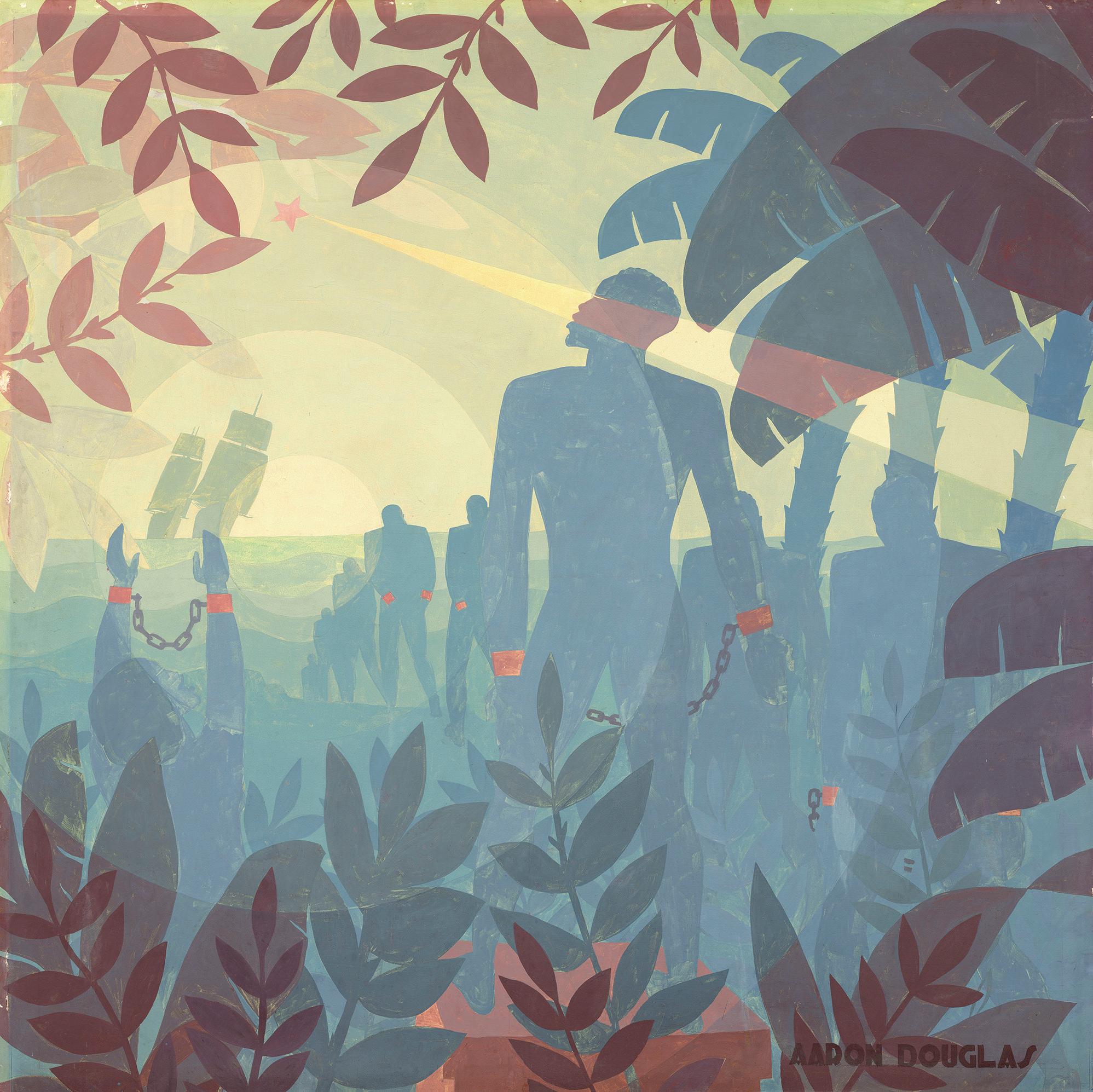
October 22, 2023 to February 11, 2024
Afro-Atlantic Histories is co-organized by the Museum of Fine Arts, Houston, and the Museu de Arte de São Paulo in collaboration with the National Gallery of Art, Washington, D.C. This exhibition is presented by Bank of America. Free General Admission to the Dallas Museum of Art is made possible with generous support from the Robert Gerard Pollock Foundation. The Dallas Museum of Art is supported, in part, by the generosity of DMA Members and donors, the National Endowment for the Arts, the Texas Commission on the Arts, and the citizens of Dallas through the City of Dallas Office of Arts and Culture.
EXHIBITION SUP PORT LOCAL SUPPORT Arlene J. Ford, PhD Christopher P. Reynolds Learn more and get tickets at afro-atlantic-histories.dma.org Into Bondage 1936. Aaron Douglas. Oil on canvas. National Gallery of Art, Washington, D.C., Corcoran Collection (museum purchase and partial gift from Thurlow Evans Tibbs, Jr., the Evans Tibbs Collection). © 2021 Heirs of Aaron Douglas / Licensed by VAGA at Artists Rights Society (ARS), NY.
PRESENTED BY MAJOR SUPPORT
PUBLISHER | EDITOR-IN-CHIEF
Terri Provencal terri@patronmagazine.com
PUBLISHER | EDITOR-IN-CHIEF
Terri Provencal terri@patronmagazine.com
ART DIRECTION
Lauren Christensen
ART DIRECTION
Lauren Christensen
DIGITAL MANAGER/PUBLISHING COORDINATOR
Anthony Falcon
DIGITAL MANAGER/PUBLISHING COORDINATOR
Anthony Falcon
COPY EDITOR
COPY EDITOR
Sophia Dembling
Sophia Dembling
PRODUCTION
PRODUCTION
Michele Rodriguez
Michele Rodriguez
CONTRIBUTING WRITERS
CONTRIBUTING WRITERS
Chris Byrne
Anna Katherine Brodbeck
Steve Carter
Charlie Adamski Caulkins
Nancy Cohen Israel
Joan Davidow
Sara Hignite
Frank Hettig
Chris Byrne
Steve Carter
Eve Hill-Agnus
Eve Hill-Agnus
Elaine Raffel
Brandon Kennedy
Nancy Cohen Israel
Stephanie Cristello
Peggy Levinson
Diana Spechler
Darryl Ratcliff
John Zotos
CONTRIBUTING PHOTOGRAPHERS
CONTRIBUTING PHOTOGRAPHERS
AJ Boling
Bruno
James Baker Hall
Tamytha Cameron
Sharen Bradford
Cathy Carver
Danny Campbell
Thomas Clark
Justin Clemons
Daniel Driensky
Scott Frances
Sylvia Elzafon
Thomas Garza
Rebecca Fanuele
Stephen Karlisch
Victoria Gomez
Timo Ohler
Joan Marcus
Sarah Reyes
Jeff McLane
Richard W. Rodriguez
David Needleman
Roberto Ruiz
Amitava Sarkar
Carrie Schneider
John Smith
Kevin Todora
John Smith Studio Shift
Kevin Tachman
CONTRIBUTING STYLISTS/ASSISTANTS
Bradley Linton
Pablo Arellano
Quin Mathews Films
Ramiro Garcia
Tom Le
STYLISTS/ASSISTANTS
Matt McElligott
Missie Allen
Cameron Pitts
Lisa Martensen
Elaine Raffel
Elaine Raffel
Duane Tinkey
Kevin Todora
ADVERTISING info@patronmagazine.com or by calling (214)642-1124
ADVERTISING info@patronmagazine.com or by calling (214)642-1124
PATRONMAGAZINE.COM
PATRONMAGAZINE.COM
View Patron online @ patronmagazine.com
View Patron online @ patronmagazine.com
REACH US info@patronmagazine.com
REACH US info@patronmagazine.com

SUBSCRIPTIONS
amazon.com/patronmagazine
One year $48/6 issues, two years $60/12 issues
SUBSCRIPTIONS amazon.com/patronmagazine
One year $36/6 issues, two years $48/12 issues
For international subscriptions add $15 for postage
For international subscriptions add $15 for postage
For subscription inquiries email info@patronmagazine.com
For subscription inquiries email info@patronmagazine.com
SOCIAL @patronmag
SOCIAL Follow us @patronmag
1019 Dragon Street | Design District | sminkinc.com
is published 6X per year by Patron, P.O. Box 12121, Dallas, Texas 75225. Copyright 2022, Patron. All rights reserved. Reproduction in whole or in part without express written permission of the Publisher is strictly prohibited. Opinions expressed in editorial copy are those of experts consulted and do not necessarily reflect the opinions of the editors, publisher or the policy of Patron. Unsolicited manuscripts and photographs should be sent to the address above and accompanied by a self-addressed stamped envelope for return. Publisher will take reasonable precaution with such materials but assumes no responsibility for their safety. Please allow up to two months for return of such materials. 16 PATRONMAGAZINE.COM
is published 6X per year by Patron, P.O. Box 12121, Dallas, Texas 75225. Copyright 2023, Patron. All rights reserved. Reproduction in whole or in part without express written permission of the Publisher is strictly prohibited. Opinions expressed in editorial copy are those of experts consulted and do not necessarily reflect the opinions of the editors, publisher or the policy of Patron. Unsolicited manuscripts and photographs should be sent to the address above and accompanied by a self-addressed stamped envelope for return. Publisher will take reasonable precaution with such materials but assumes no responsibility for their safety. Please allow up to two months for return of such materials. 18 PATRONMAGAZINE.COM
1019 Dragon Street, Dallas, Texas 75207 www.sminkinc.com SMINK ROGER SEATING SYSTEM | RODOLFO DORDONI DESIGN SUPERQUADRA COFFEE TABLES | MARCIO KOGAN / STUDIO MK27 DESIGN DISCOVER MORE AT MINOTTI.COM/ROGER


Circa 1980’s
WE BUY AND SELL FINE JEWELRY AND TIMEPIECES.
Assisting individuals with gem and timepiece liquidation for nearly 60 years. By appointment, in your home, your bank, or our salon at NorthPark Center. For more information please contact Michael Johnson at 214.369.6100.
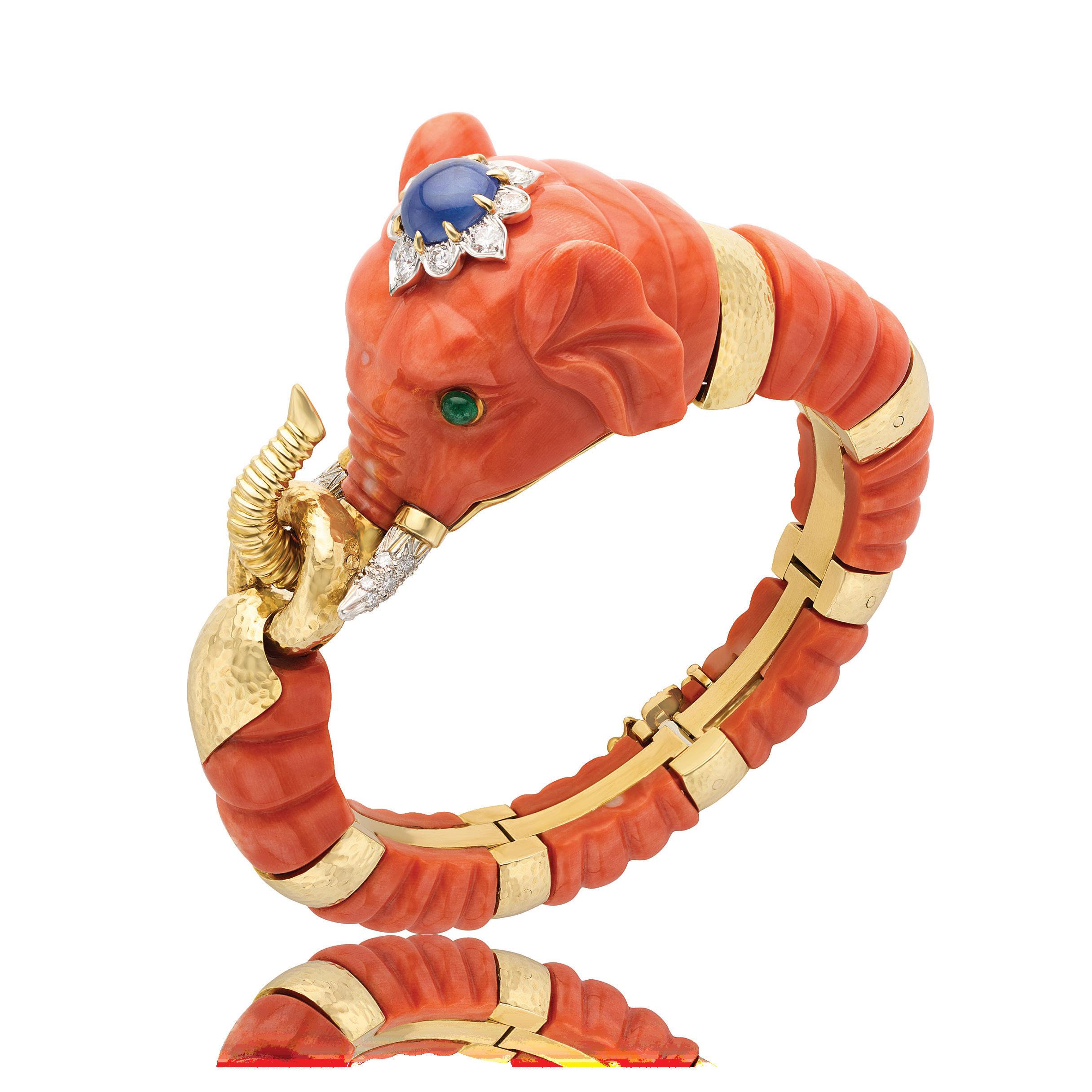
 David Webb
Coral and Yellow Gold
Elephant Bangle
David Webb
Coral and Yellow Gold
Elephant Bangle
Elevating Expectations.

Bentley Bentayga Extended Wheelbase.
You have high expectations, you can now have longer ones, too, with the Bentley Bentayga Extended Wheelbase SUV. Explore the world’s most luxurious SUV available at Bentley Dallas, an Avondale Dealership. Avondale is committed to providing extraordinary vehicles and innovative automotive solutions through personalized care and elevated experiences. Visit bentleydallas.com.

BENTLEY DALLAS | 5300 Lemmon Ave. | 214.849.5300 | BentleyDallas.com BENTLEY DALLAS
The
device
©
name ‘Bentley’ and the ‘B’ in wings
are registered trademarks.
2023 Bentley Motors, Inc. Model shown: Bentayga Extended Wheelbase
October 5 - 8 Dallas Market Hall
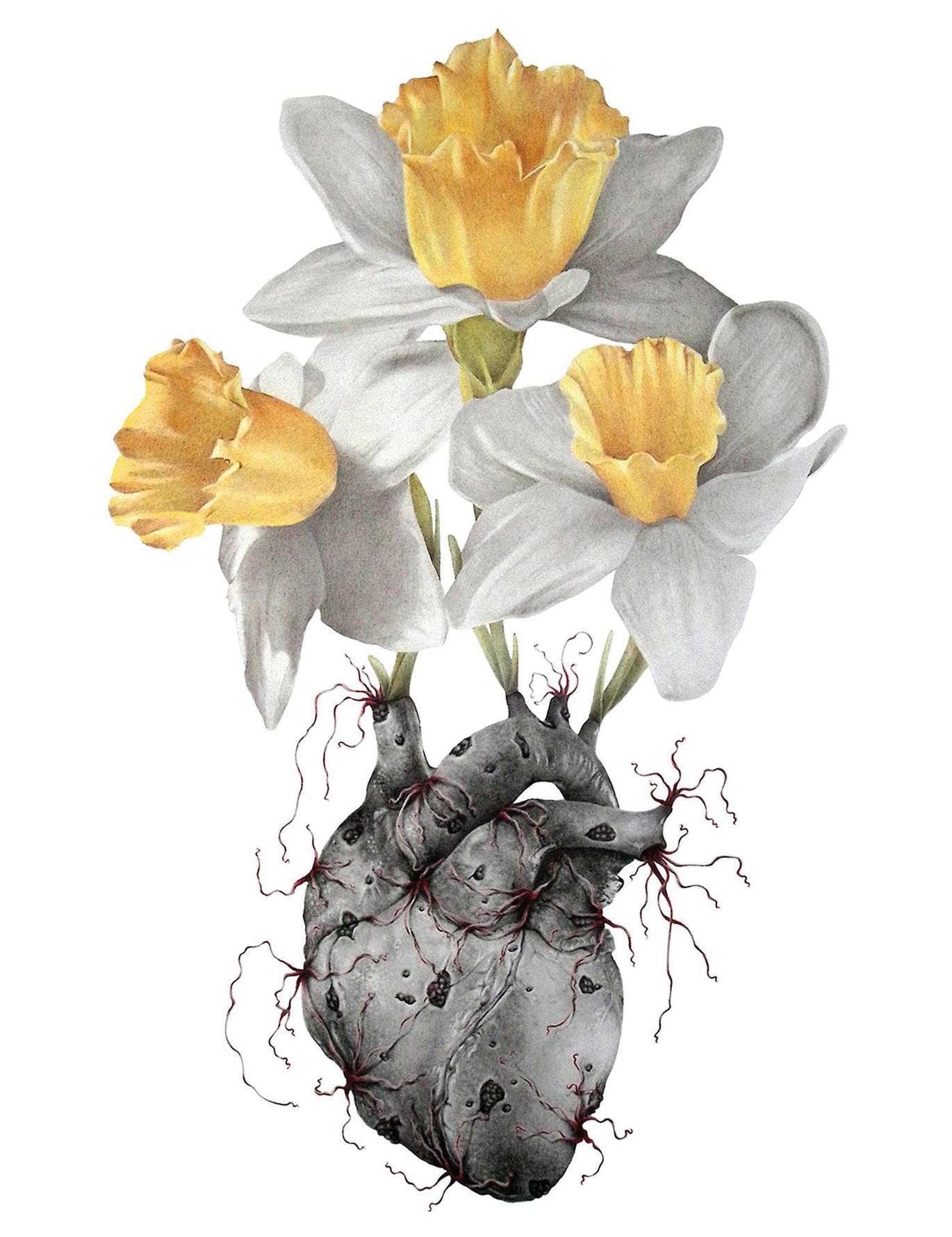


Art Reframed
Scan to Buy Tickets Scan to Apply as an Artist
Artwork by Anna Mikhaela Reyes
THANKS THE ARTISTS AND GALLERIES THAT HAVE CONTRIBUTED TO THIS YEAR’S BENEFIT
THANKS THE ARTISTS AND GALLERIES THAT HAVE CONTRIBUTED TO THIS YEAR’S BENEFIT
ALICIA ADAMEROVICH
Michael Kohn Gallery
KELLY AKASHI
Tanya Bonakdar Gallery
LITA ALBUQUERQUE
Michael Kohn Gallery
YOSHITAKA AMANO
LOMEX
GHADA AMER
Tina Kim Gallery
MARYAM AMIRYANI
Ulterior Gallery
TOM ANHOLT
Josh Lilley
WILLIAM ATKINSON
Erin Cluley Gallery
DARREN BADER
Andrew Kreps Gallery
RUSH BAKER IV
Keijsers Koning
KATE BARBEE
Michael Kohn Gallery
ALEXANDRA BARTH
Mrs. Gallery
KENNETH BERGFELD
Project Native Informant
MARÍA BERRÍO
Victoria Miro
MICHELLE BLADE
Micki Meng
SILAS BORSOS
Nicelle Beauchene Gallery
PEPPI BOTTROP
Pilar Corrias
KERSTIN BRÄTSCH
Gladstone Gallery
ANDREA MARIE BREILING
Almine Rech Gallery,
Night Gallery
COADY BROWN
Shulamit Nazarian
LUCY BULL
David Kordansky Gallery
LUZ CARABAÑO
Hannah Hoffman
GRACE CARNEY
PPOW
CHLOE CHIASSON
albertz benda
CLAIRE COLETTE 12.26
CHELSEA CULPRIT
Morán Morán
BETHANY CZARNECKI
Massey Klein
RONAN DAY-LEWIS
Galleri Urbane
JOHNNY DEFEO
Cris Worley Fine Art
SIMON DENNY
Altman Siegel
THORNTON DIAL
James Fuentes
JESSICA DICKINSON
James Fuentes
ANDIE DINKIN
Half Gallery
ALI DIPP
Franklin Parrasch Gallery
MADELINE DONAHUE
Various Small Fires
TARA DONOVAN
Pace Gallery
KALETA DOOLIN
Erin Cluley Gallery
LATIFA ECHAKHCH
Pace Gallery
JUAN MANUEL
ECHAVARRÍA
Bienvenu Steinberg & J
JERONIMO ELESPE
Van Doren Waxter
MANUEL ESPINOSA
Sicardi | Ayers | Bacino
LIAM EVERETT
Kasmin, Altman Siegel
YUAN FANG
Prince & Wooster
LORSER FEITELSON
Louis Stern Fine Arts
EMILY FERGUSON
Prince & Wooster
SARA FLORES
C L E A R I N G
JACKIE GENDEL
Soco Gallery
ROBERTO GIL DE MONTES
kurimanzutto
BAMBOU GILI Night Gallery
SKY GLABUSH
Stephen Friedman Gallery
JOANNE GREENBAUM
Mitchell-Innes and Nash
ALEXA GUARIGLIA
Moskowitz Bayse
HEATHER GUERTIN
JDJ
PATRICK HALL
Fergus McCaffrey
JESSIE HENSON
Anthony and Celeste Meier
DAVID HUFFMAN
Jessica Silverman, Casey Kaplan
PATRICIA IGLESIAS
PECO
François Ghebaly
FEBRUARY JAMES
Tilton Gallery
YIFAN JIANG
Meliksetian | Briggs
OTIS JONES
Nino Mier Gallery
ANISH KAPOOR
Lisson Gallery
ANTONIA KUO Chapter NY
View the complete auction catalogue online and register to bid at: twoXtwo.org/Catalogue
YOWSHIEN KUO
Luce Gallery
TED LARSEN
Conduit Gallery
MARK LEONARD
Louis Stern Fine Arts
LAURA LETINSKY
Monique Meloche Gallery
TALIA LEVITT
Rachel Uffner Gallery
PETER LIGON
Barry Whistler Gallery
AMY LINCOLN
Sperone Westwater
TANYA LING
Harper’s
JAMES LUMSDEN
Holly Johnson Gallery
CONNY MAIER
Société
ROBERT
MAPPLETHORPE
Gladstone Gallery
MARCELYN MCNEIL
Conduit Gallery
FABIO MIGUEZ
Nara Roesler Gallery
SOFIA MITSOLA
Galerie Eva Presenhuber, Pilar Corrias
FRANCESCA MOLLETT
GRIMM, Micki Meng
gala & auction
gala & auction
SATURDAY, OCTOBER 21, 2023
SATURDAY, OCTOBER 21, 2023
EMILIA MOMEN
Ronchini
THADDEUS MOSLEY
Karma
CARRIE MOYER
Alexander Gray Associates
JEAN KATAMBAYI
MUKENDI
Ramiken
JEAN-LUC MYLAYNE
Sprüth Magers
ROY NACHUM
Cristina Grajales Gallery
SHOTA NAKAMURA
C L E A R I N G
JORDAN NASSAR
Anat Ebgi Gallery
DOUG OHLSON
Washburn Gallery
WOODY DE OTHELLO
Karma, Jessica Silverman
MADELINE
PECKENPAUGH
Alexander Berggruen
SOLANGE PESSOA
Mendes Wood DM
HAYAL POZANTI
Timothy Taylor, Jessica Silverman
ALEXIS PYE
Inman Gallery
UMAR RASHID
Blum & Poe
CALIDA RAWLES
Lehmann Maupin
ROB REYNOLDS
Anthony and Celeste Meier
JOHN RIEPENHOFF
Broadway
CELIA ROGGE
LEIGH RUPLE
Page (NYC)
MAJA RUZNIC
Karma
EDUARDO SARABIA
OMR
BILL SAYLOR
Magenta Plains
TARIKU SHIFERAW
Galerie Lelong & Co.
TREVOR SHIMIZU
47 Canal
JAY SHINN
Barry Whistler Gallery
SERGIO SISTER
Bienvenu Steinberg & J
RUBY SKY STILER
Nicelle Beauchene Gallery
TAVARES STRACHAN
Marian Goodman Gallery
MARI TANIMOTO
Peter Augustus Gallery
EVITA TEZENO
Luis De Jesus Los Angeles
LILIANE TOMASKO
Kerlin Gallery, Nino Mier Gallery
SHIRO TSUJIMURA
Axel Vervoordt Gallery
XIYAO WANG
Perrotin
GRACE WEAVER
Galerie Max Hetzler
HANNAH WILKE
Marc Selwyn Fine Art
TIM WILSON
Nathalie Karg Gallery
MICHAELA
YEARWOOD-DAN
Marianne Boesky Gallery
OSCAR YI HOU
James Fuentes
KATSURO YOSHIDA
Yumiko Chiba Associates
COCO YOUNG AND NOW
TOH YUN-HEE
Gallery Hyundai
HÉCTOR ZAMORA
LABOR
BARI ZIPERSTEIN
Vielmetter Los Angeles
as of September 8, 2023
For
Meg@RachofskyHouse.org
Artist and gallery list
/
inquiries:
THANKS OUR 2023 SPONSORS
PRESENTING SPONSOR
SAKS
DIAMOND SPONSORS
CADILLAC DE LA TORRE FOUNDATION
GENE AND JERRY JONES FAMILY
THE MOODY FOUNDATION DEEDIE ROSE
ENTERTAINMENT SPONSOR IF NOT YOU, THEN WHO?
AFTER PARTY SPONSOR LOEWE
LIVE AUCTION SPONSOR
SOTHEBY’S
ART SPONSOR
CHUBB PERSONAL INSURANCE
IMA SELECT
EVENT DESIGN X DÉCOR SPONSOR
TODD EVENTS
LUXURY COCKTAILS AND CHAMPAGNE SPONSORS
BELVEDERE
LA GRANDE DAME
MOËT HENNESSY
TEQUILA CASA DRAGONES
CELEBRITY TRAVEL SPONSOR
HEADINGTON COMPANIES
FINANCIAL SERVICES SPONSOR
BAKER TILLY
CAVIAR SPONSOR
REGIIS OVA
SILVER SPONSORS
DISPLAYS FINE ART SERVICES
UNIFIED FINE ARTS SERVICES
UOVO
MEDIA SPONSOR
PATRON MAGAZINE
IN-KIND SPONSORS
ACQUA PANNA
ARTSPACE, A PHAIDON COMPANY
ART 2 CATERING
DJ ROMIQ
DROESE PR
EMPIRE BAKING COMPANY
GOLD CROWN VALET
GRANGE HALL
HILTON PARK CITIES
HÔTEL SWEXAN
MASTERPIECE INTERNATIONAL
MICATO SAFARIS
ONE&ONLY
PIZZANA
POGO’S
ROCHE BOBOIS
ROSEWOOD MANSION ON TURTLE CREEK
THE CULTURED CUP
THE JOULE HOTEL
THE TYNAN TRAVEL COMPANY
WHITEWALL MAGAZINE
FOR MORE INFORMATION, VISIT TWOXTWO.ORG/SPONSORS OR EMAIL MELISSA@RACHOFSKYHOUSE.ORG.
SPONSORS AS OF SEPTEMBER 12, 2023
SAKS IS PROUD TO BE THE PRESENTING SPONSOR OF TWO X TWO FOR AIDS AND ART

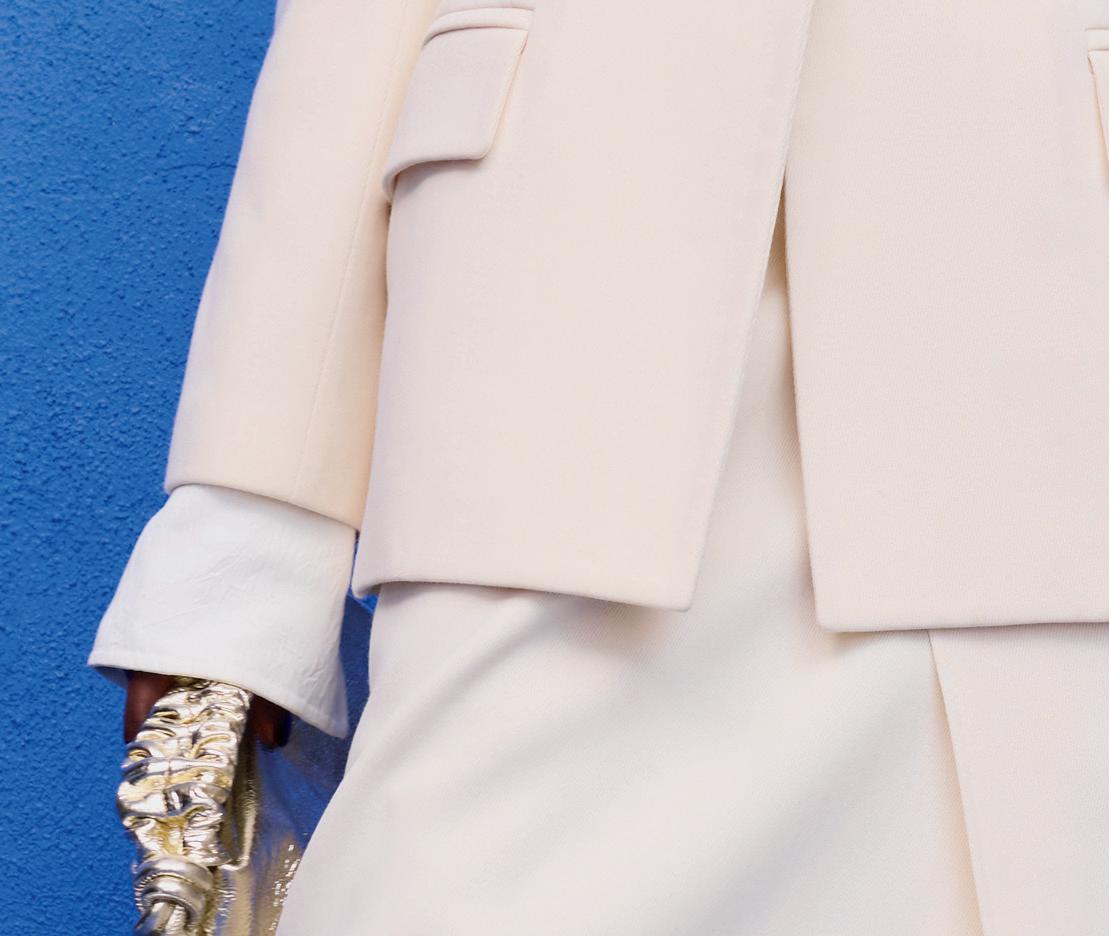


 Proenza Schouler
Cheers to delicious, harvest-inspired dishes at Ellie’s, curated by Executive Chef, Anthony Hsia. Located within HALL Arts Hotel, in the heart of the Dallas Arts District, our showstopping dining experience will leave you ready for an encore.

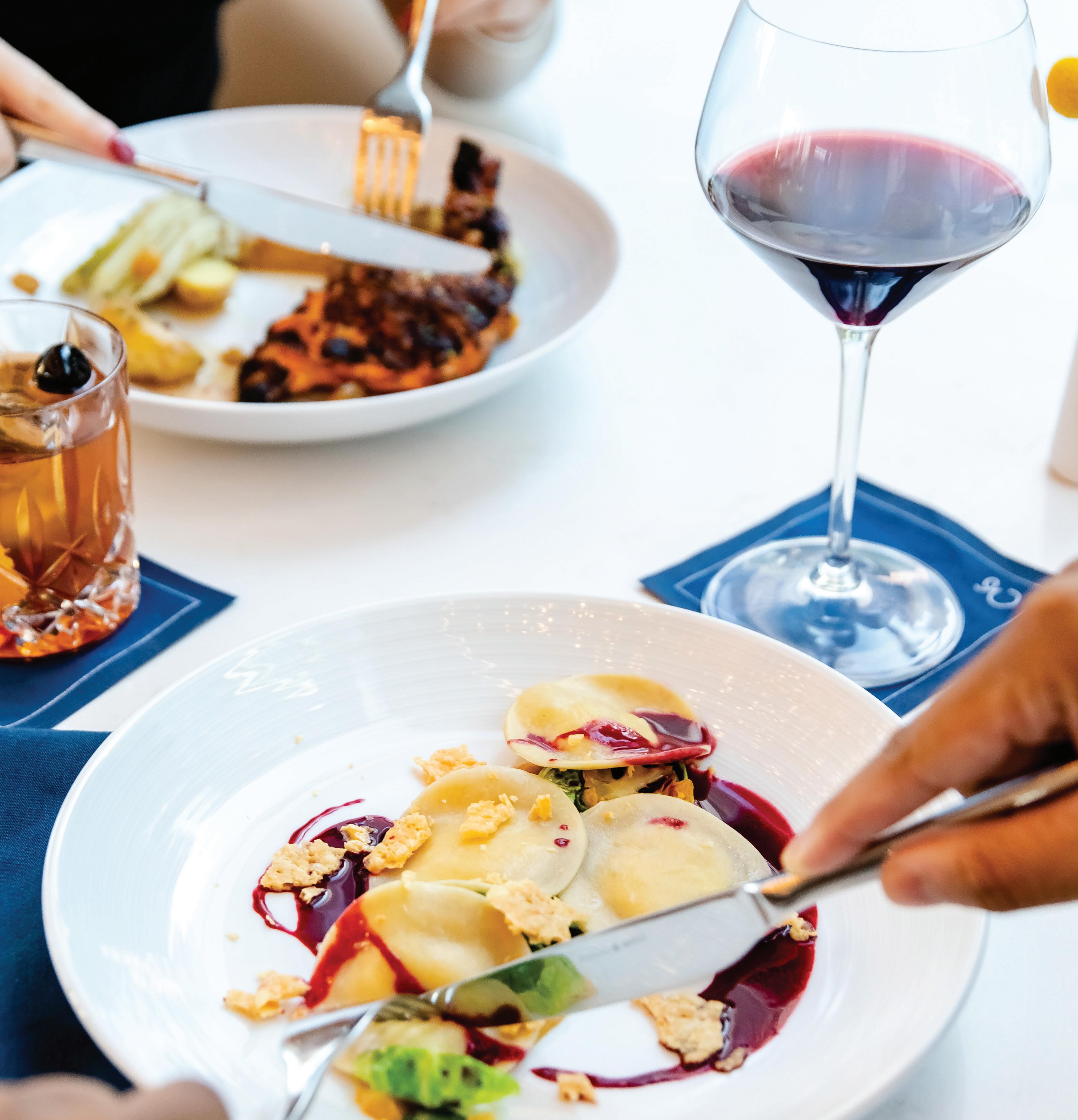
SAVOR THE AUTUMN SEASON AT ELLIE’S.
1717 LEONARD STREET, DALLAS, TEXAS 75201 | 972.629.0924
ELLIESDALLAS.COM
|
Photography by Love List Digital
DALLAS ART
4 - 7, 2024
INDUSTRY GALLERY
INTERNATIONAL ART GALLERIES FAIR ww w .da ll asa r tf ai r .co m
APRIL
FASHION
90
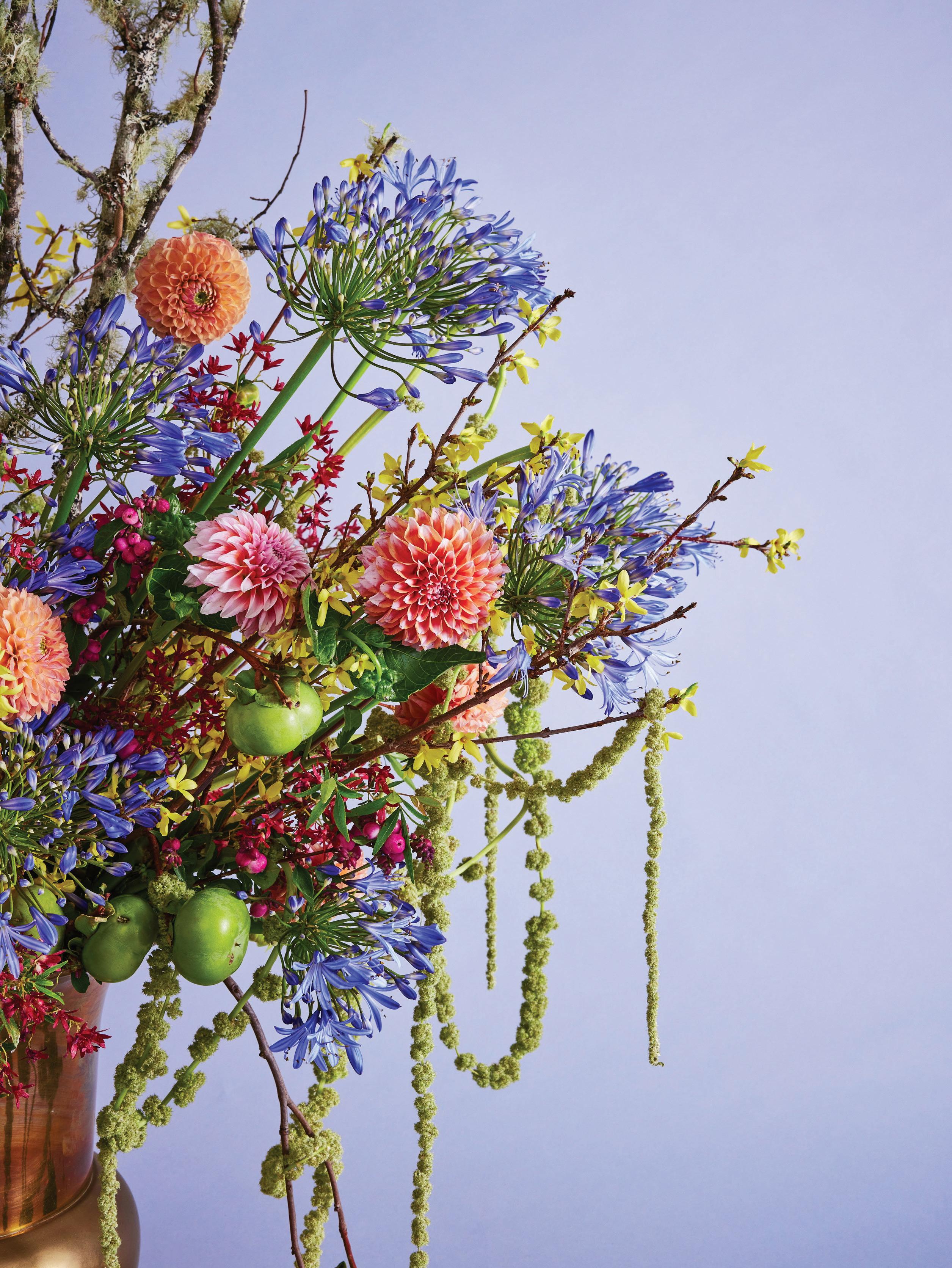
CONCEPTO Bespoke Floral Arrangements Events • Retail • Residential • Installations concepto@conceptoboutique.com conceptoboutique.com 214.668.0056
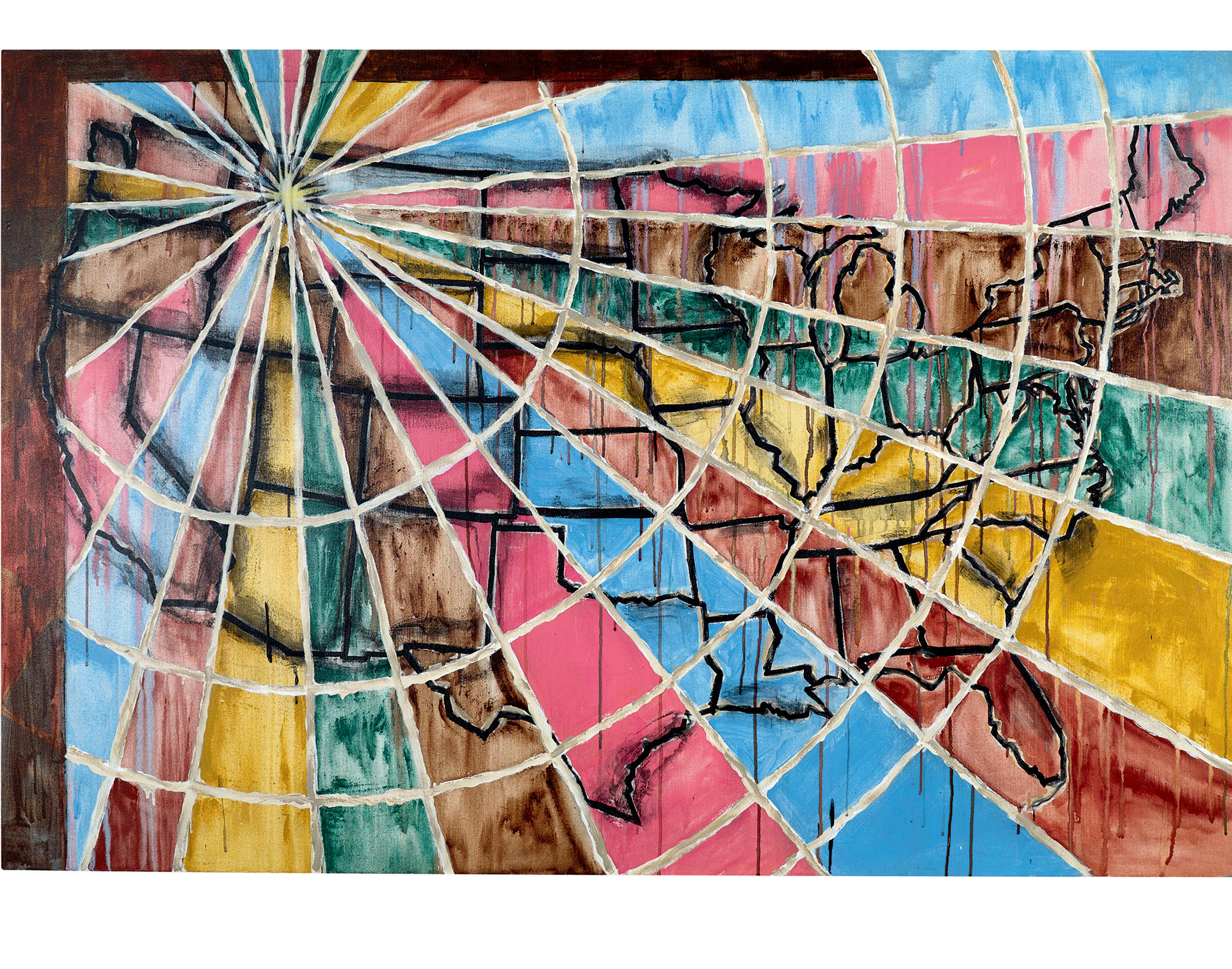
MODERN ART MUSEUM OF FORT WORTH 3200 Darnell Street • Fort Worth, Texas 76107 • 817.738.9215 • themodern.org Jaune Quick-to-See
15, 2023–January 21, 2024 This
was organized
the Whitney
of American Art, New York. Generous support for this exhibition is provided by the Henry
Foundation and the Terra Foundation for American Art. Support for the presentation in Fort Worth is provided, in part, by Frost. Pictured: Jaune Quick-to-See Smith, Homeland , 2017 (detail). Oil and acrylic on canvas, 48 1/4 x 72 1/8 inches (122.6 x 183.2 cm). Buff alo AKG Art Museum, New York; bequest of John Mortimer Schiff by exchange 2018:12. © Jaune Quick-to-See Smith. Photograph
for Buff alo AKG Art Museum
Smith: MEMORY MAP October
exhibition
by
Museum
Luce
by Tom Loonan and Brenda Bieger
We take pride in all aspects of craftsmanship. From our detailed drawings to relationship building, our artistry is seen far beyond dovetail joints and level five finishes. We give our best work so you can live your best life. We put our craftsmanship into everything we do.




 Personal I Exceptional I Craftsmanship I MHMLIVING.COM
Design by Urbanology Designs
Personal I Exceptional I Craftsmanship I MHMLIVING.COM
Design by Urbanology Designs
40 YEARS OF REDEFINING OUTDOOR SPACES
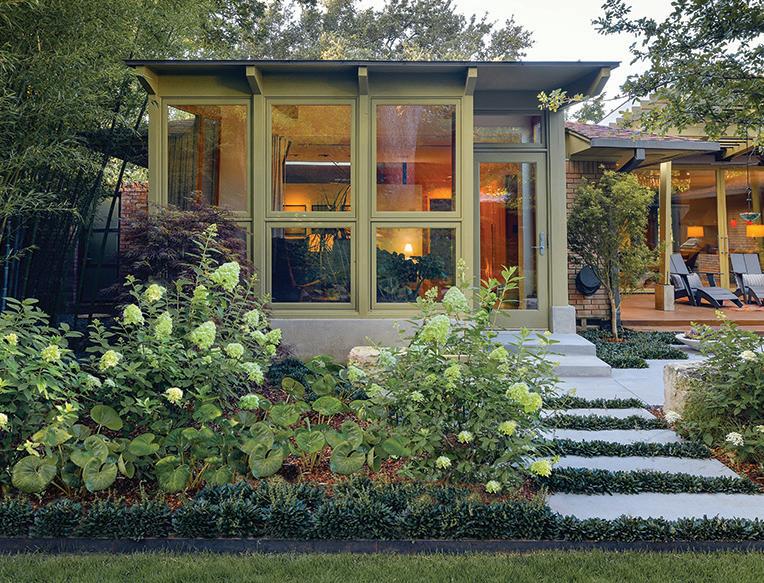
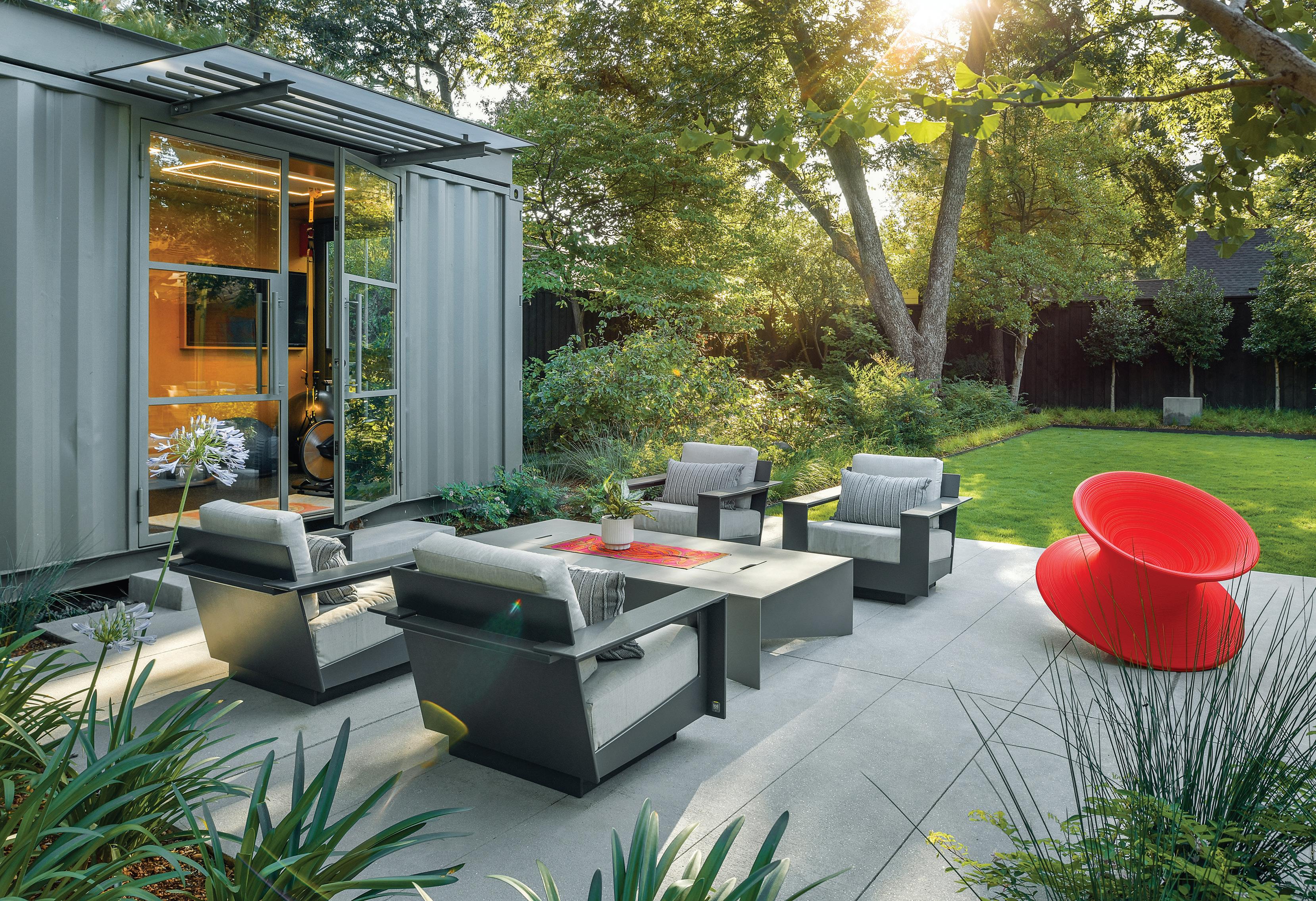
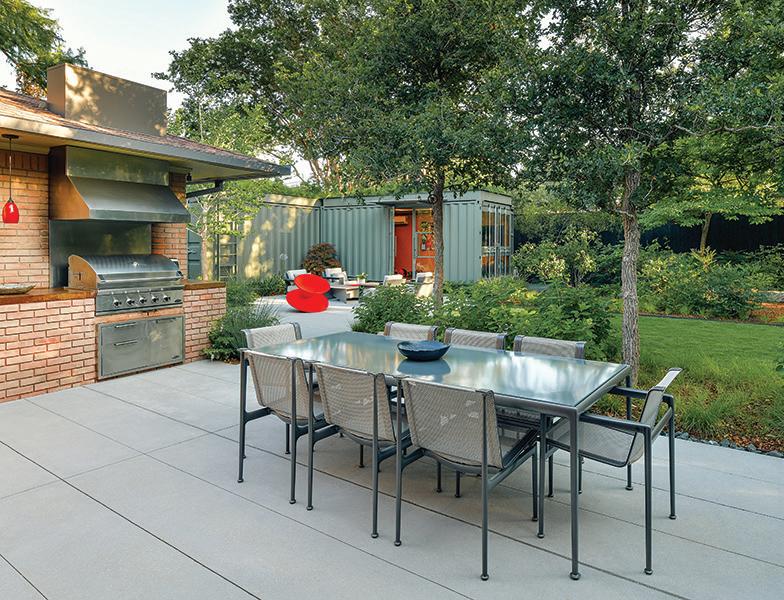
LANDSCAPE DESIGN | CONSTRUCTION | GARDEN CARE POOL CONSTRUCTION | POOL CARE AND SERVICE COLLABORATIVE PROJECTS 972.243.9673 | BONICKLANDSCAPING.COM CREATING PERSONAL SANCTUARIES
NOTED
THE LATEST CULTURAL NEWS COVERING ALL ASPECTS OF THE ARTS IN NORTH TEXAS: NEW EXHIBITS, NEW PERFORMANCES, GALLERY OPENINGS, AND MORE.
01 AFRICAN AMERICAN MUSEUM
Discover the hidden gems of South African art in If You Look Hard Enough, You Can See Our Future. Curated from Nando’s vast archive of over 25,000 pieces, this is the exhibition’s global debut. The exhibition brings together nearly 90 pieces from over 60 emerging, mid-career, and established artists. Free of charge, the exhibition runs through Oct. 22. aamdallas.org
02 AMON CARTER MUSEUM OF AMERICAN ART
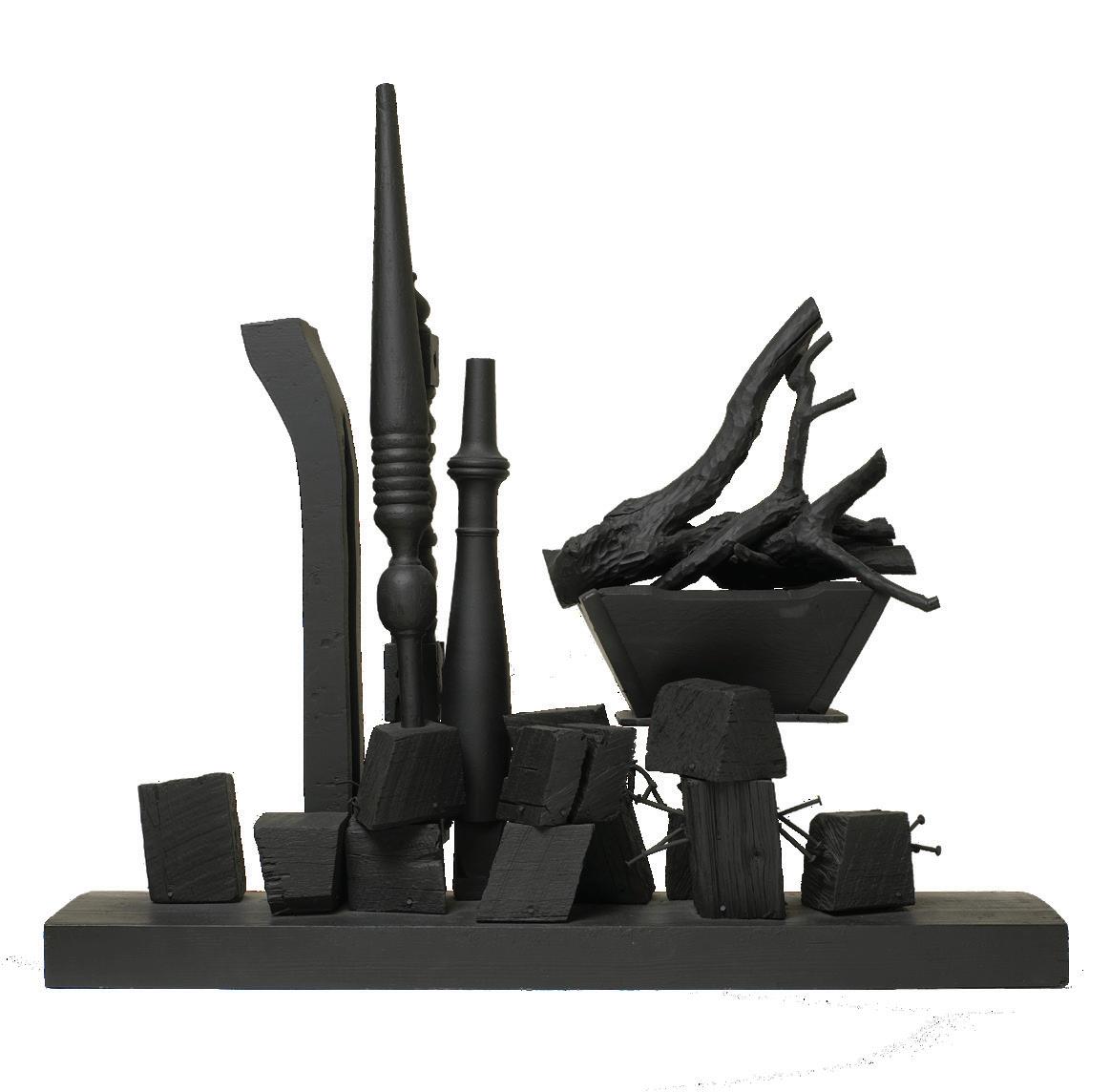
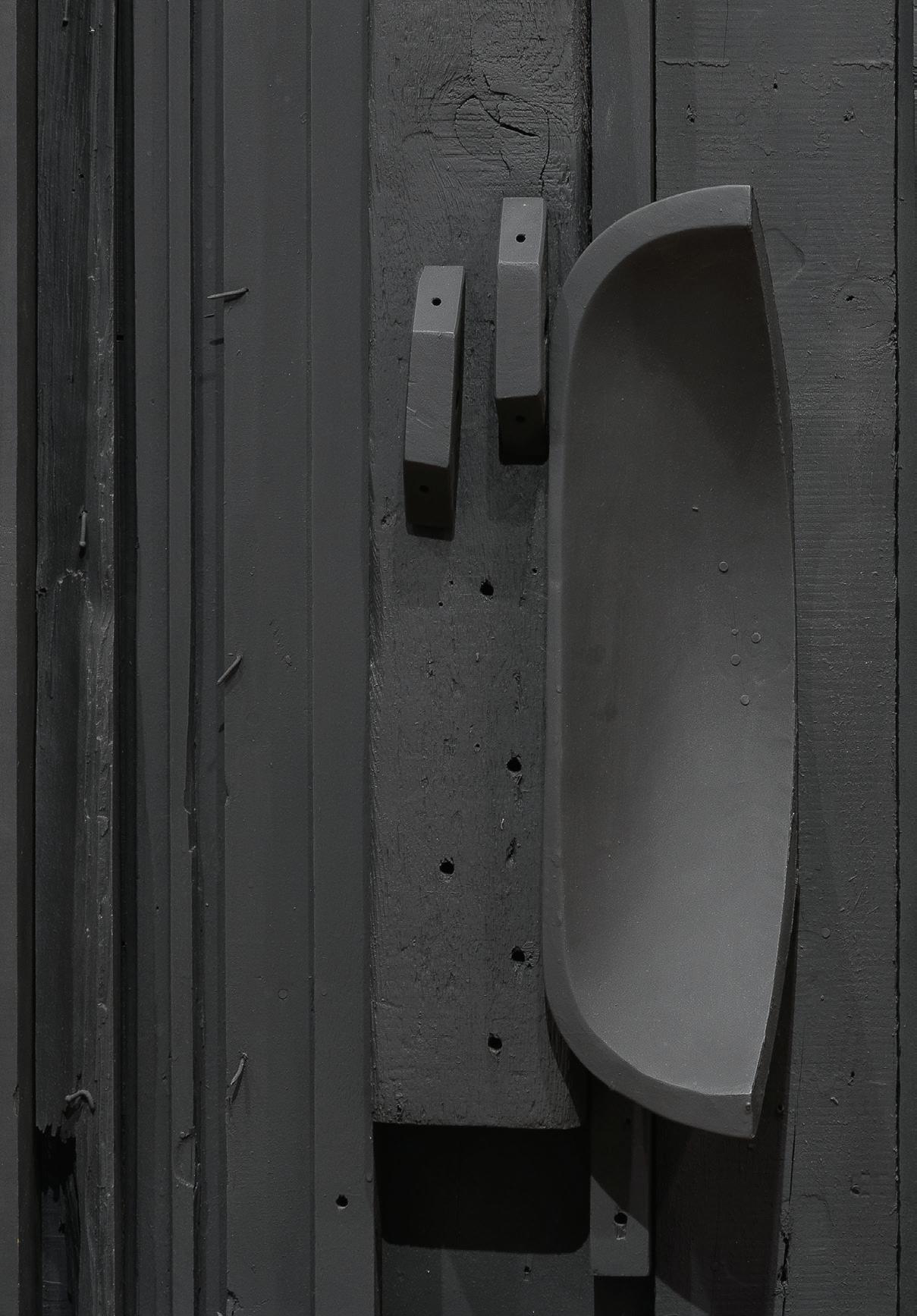
Elizabeth Turk’s The Tipping Point: Echoes of Extinction, part of the Carter’s outdoor sculpture program, continues through May 1, 2024. Leonardo Drew’s site-specific commission, Number 235T, features the artist’s “planets” as central sculptural pieces surrounded by hundreds of smaller objects, emphasizing their interconnectedness; through Jun. 30, 2024. Organized by the Carter, World Outside: Louise Nevelson at Midcentury illuminates Nevelson’s multidimensional mastery of form and dialogue with postwar America through over 50 defining artworks. A collection of 19thcentury photographs from the Carter’s Fred and Jo Mazzulla Collection showcases Colorado’s history through its promotion as an outdoor playground and as a mining region in Come to Colorado. Both exhibitions continue through Jan. 7, 2024. Trespassers: James Prosek and the Texas Prairie continues through Jan. 28, 2024. Image: Louise Nevelson (1899–1988), Night Landscape, 1955, wood painted black. The Museum of Contemporary Art, Los Angeles. Gift of Mr. and Mrs. Arnold Glimcher. © 2022 Estate of Louise Nevelson / Artist Rights Society (ARS), New York. cartermuseum.org
03 CROW MUSEUM OF ASIAN ART OF THE UNIVERSITY OF TEXAS AT DALLAS
Through April 14, 2024, the Crow Museum presents Japan, Form & Function: The Montgomery Collection a landmark exhibition based on the collection of Jeffrey Montgomery. More than 240 works are on view, subdivided into themes and categories throughout the galleries. crowmuseum.org
04 DALLAS CONTEMPORARY
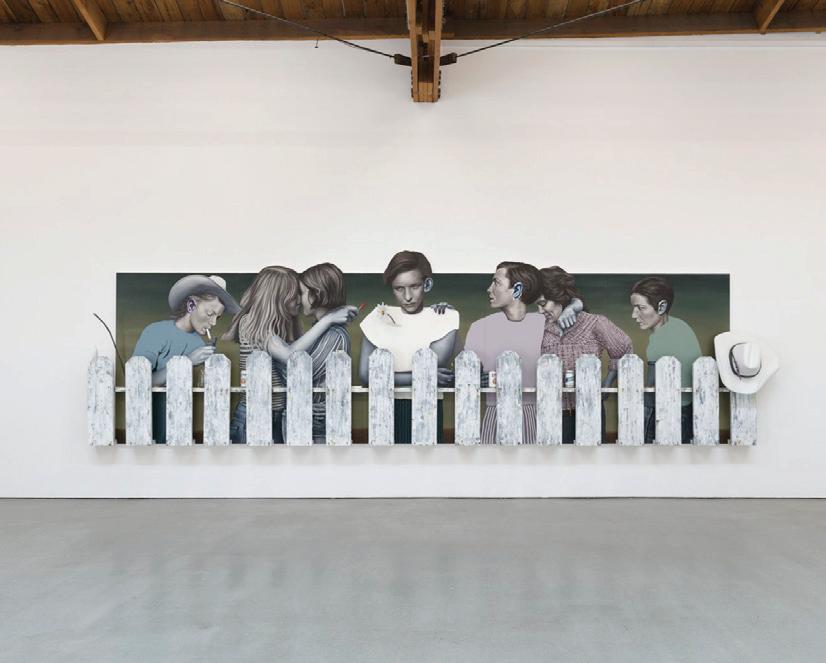
Cerámica Suro: a story of collaboration, production, and collecting in the contemporary arts examines the studio’s influence vis-à-vis the collection amassed by Marcela and José Noé Suro; through Dec. 21. Opening Oct. 13, Chloe Chiasson’s Keep Left at the Fork will exhibit her largest body of mixed-media paintings to date Chiasson revisits Americana imagery from previous work to continue her explorations of nonconforming sexualities and identities in environments like that of her childhood in Texas; through Mar.
17, 2024. From Nov. 17–Mar. 17, 2024, Bianca Bondi: A Preservation Method sees work based on Bondi’s research into the Highway Beautification Act of 1965, passed by President Lyndon B. Johnson and inspired by his wife Lady Bird Johnson’s passion for the environment. Image: Chloe Chiasson, Red Rover, Red Rover, oil, acrylic, wood, foam, resin, aluminum, nails, mason jar, cigarette butts, matches, coins, plastic, fishing wire, fishing hook, canvas on shaped panel, 71.5 x 266 x 14.5 in. Courtesy of the artist, UTA Artist Space, Los Angeles, and Albertz Benda, Los Angeles and New York. dallascontemporary.org
05 DALLAS HOLOCAUST AND HUMAN
RIGHTS MUSEUM
Through Dec. 31, Black Citizenship in the Age of Jim Crow explores the struggle for full citizenship and racial equality that unfolded in the 50 years after the Civil War. The exhibit guides spectators on a journey that commences with the Civil War and culminates at the end of World War I, illuminating the courageous advocacy efforts of African Americans fighting for their rights. dhhrm.org
06 DALLAS MUSEUM OF ART
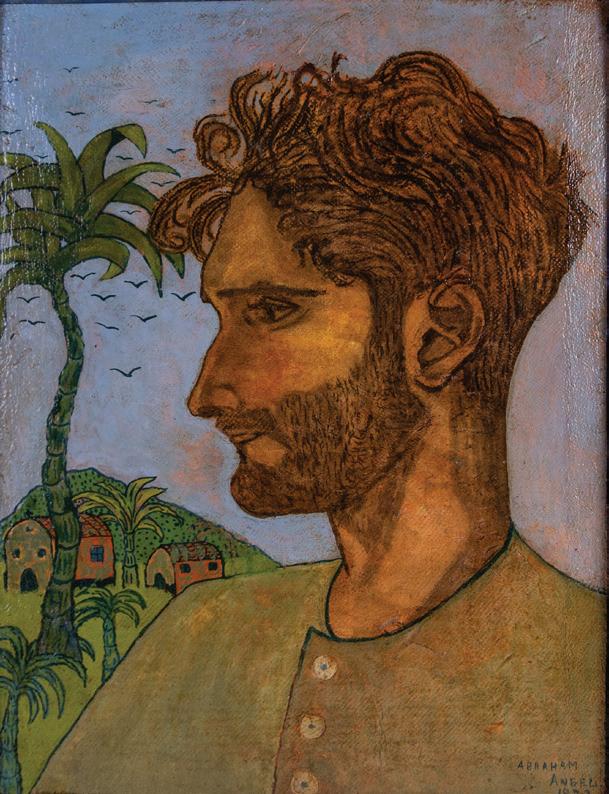
Concentrations 64: Ja’Tovia Gary, I KNOW IT WAS THE BLOOD, on display through Nov. 5 , brings together five artworks and related ephemera created by the Dallas-native filmmaker and visual artist over the past three years. Through works on paper from the DMA’s collection, Picasso’s Muses: Between Inspiration and Obsession celebrates the muses in his oeuvre 50 years after his death; though Jan. 7, 2024. Tiffany Chung: Rise into the Atmosphere marks the sixth iteration of the museum’s Concourse mural series; through Aug. 2025 Abraham Ángel: Between Wonder and Seduction brings together an astounding near-complete collection of the legendary artist’s known surviving pieces to a US audience. Witness the mesmerizing oeuvre of Ángel, on view through Jan. 28, 2024. Through Aug. 3, 2024, Backs in Fashion: Mangbetu Women’s Egbe delves into the artistry of the egbe, a back apron garment. Afro-Atlantic Histories, an ambitious exhibition that sees over 100 works, charts the transatlantic slave trade and its legacies in the African Diaspora; Oct. 22–Feb. 11, 2024. Image: Ábraham Angel, Portrait of Manuel Rodríguez Lozano - Retrato de Manuel Rodríguez Lozano, 1922. dma.org
07 GEORGE W. BUSH PRESIDENTAL LIBRARY AND MUSEUM
Freedom Matters uses rare artifacts and historical documents, interactive activities, and personal perspectives to examine the concept of freedom: where it comes from, what it means, what free societies look like, and the role of the individual in protecting and
34 PATRONMAGAZINE.COM
04 02 11

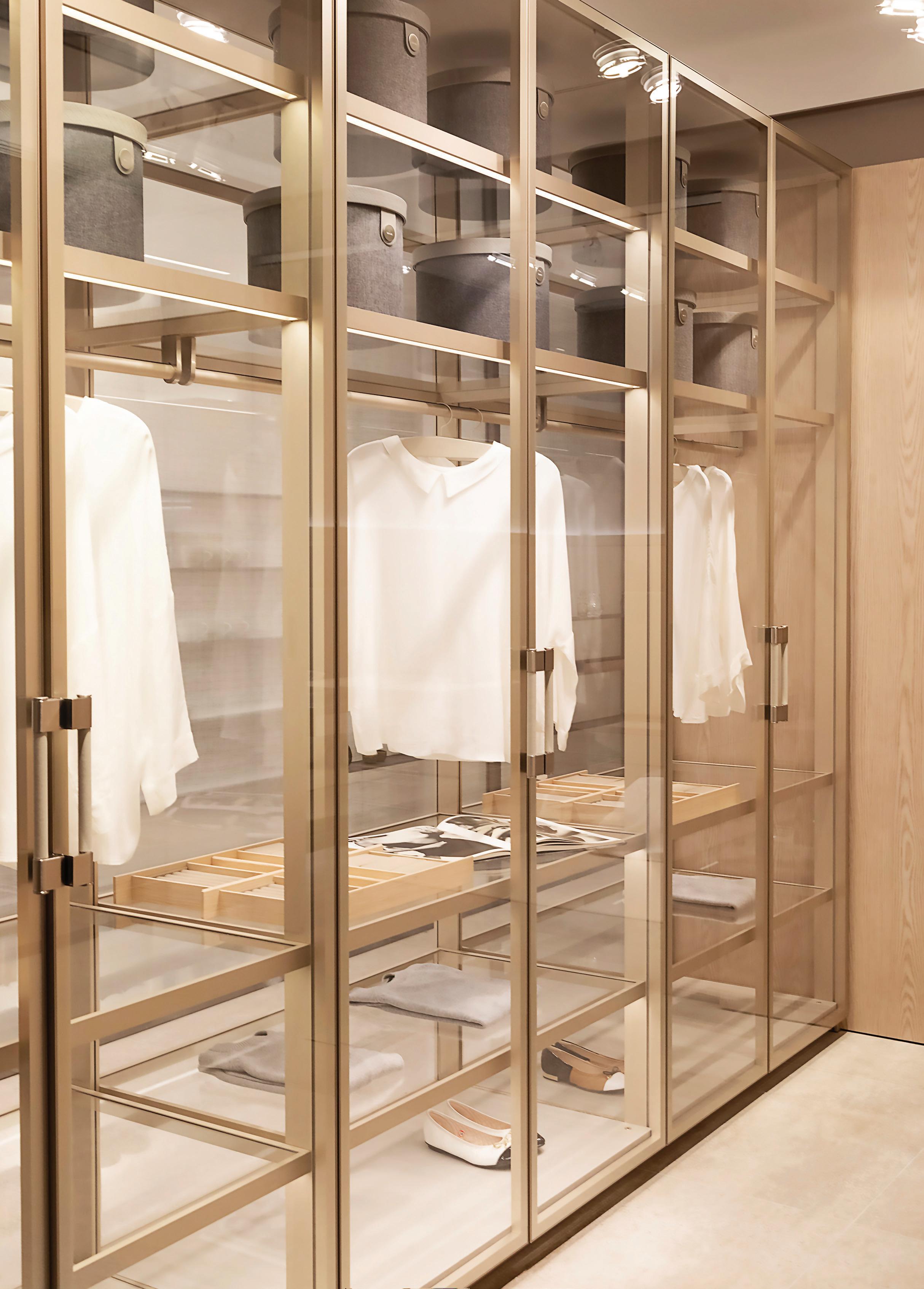
crystal case STUDIO ORNARE Ornare Dallas Design District 1617 Hi Line Dr,190A, Dallas, TX, 75207 | (214) 377.1212 ornaredallas | ornare.com CLOSETS • KITCHENS • SYSTEMS
spreading freedom around the world. view at the museum through Dec. 31. georgewbushlibrary.gov
08 KIMBELL ART MUSEUM
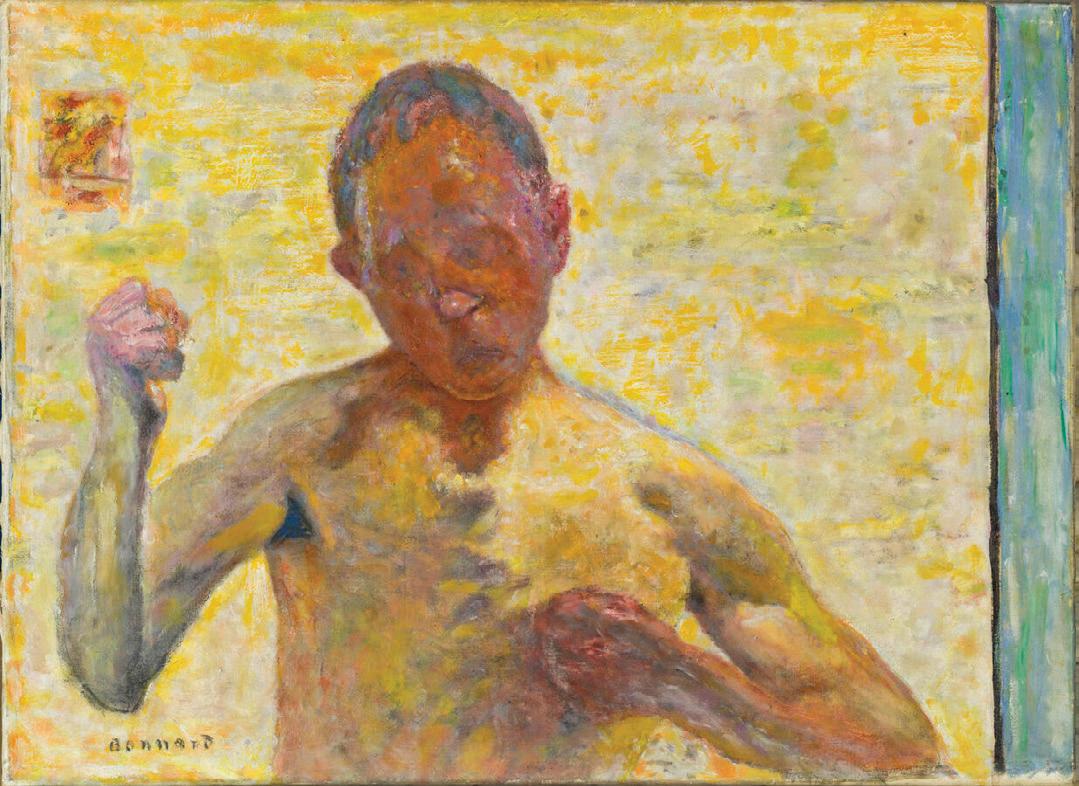
The Kimbell will present its first exhibition dedicated to French painter Pierre Bonnard, inspired by the museum’s 2018 acquisition of Landscape at Le Cannet. Bonnard’s Worlds will feature 70 of his finest works and aims to explore the sensory experiences that influenced his art. The works have been gathered from both European and American museums as well as private collections worldwide; Nov. 5–Jan. 28, 2024. Image: Pierre Bonnard, Self-Portrait (The Boxer), 1931, oil on canvas. Musée d’Orsay, Paris. Donation of Philippe Meyer, 2000. © 2023 Artists Rights Society (ARS), New York / ADAGP, Paris. Photograph courtesy of Art Resource, NY; © RMN–Grand Palais (Musée d’Orsay) / Michèle Bellot. kimbellart.org
09 LATINO CULTURAL CENTER
LCC holds its free movie screening highlighting Latino culture in Cine de Oro on Oct. 18 and Nov. 15. lcc.dallasculture.org
10 MEADOWS MUSEUM
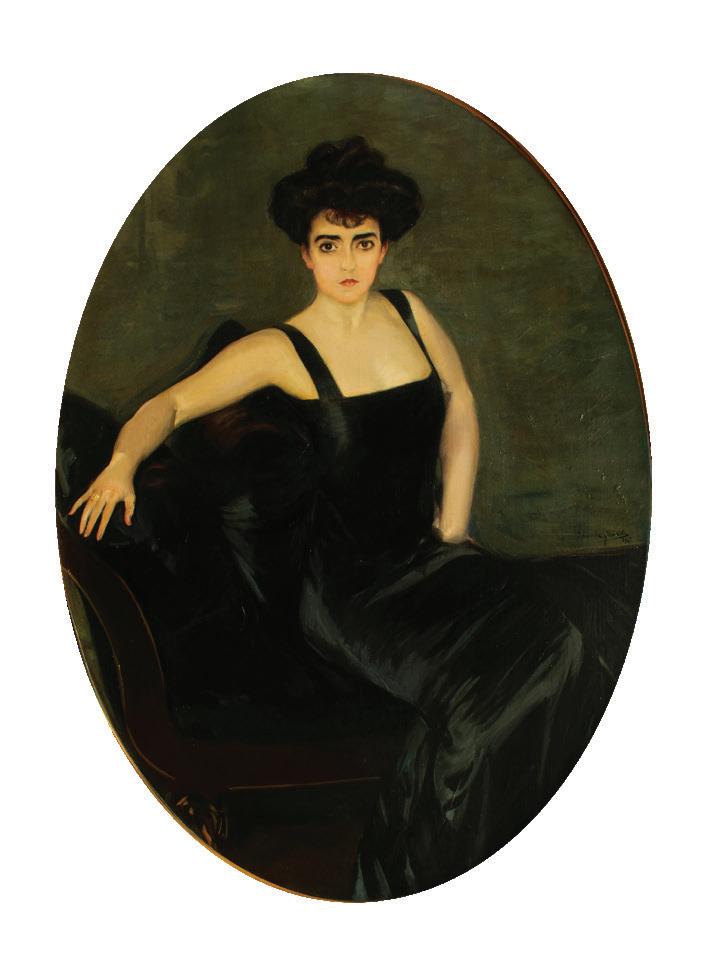
Marking the centenary of acclaimed Spanish painter Joaquín Sorolla y Bastida’s death, 2023 has been declared the “Year of Sorolla” by the Spanish government. Celebrating this milestone, the Meadows Museum presents Spanish Light: Sorolla in American Collections, curated by the artist’s great-granddaughter and renowned scholar, Blanca Pons-Sorolla The exhibition spotlights 27 seldom-seen Sorolla paintings from private American collections. Visit Sorolla’s radiant world through his favorite subjects, from sun-dappled Valencian boats to spirited garden scenes. The accompanying catalogue provides fresh insights into Sorolla’s legacy; on view through Jan.
7. Image: Joaquín Sorolla y Bastida (Spanish, 1863–1923), Portrait of Esperanza Conill de Zanetti (Retrato de Esperanza Conill de Zanetti), 1909, oil on canvas, 61.25 x 48.88 in. Jaime L. Ponce de Leon. Photograph courtesy of Leon Gallery. meadowsmuseumdallas.org
11 MODERN ART MUSEUM OF FORT WORTH
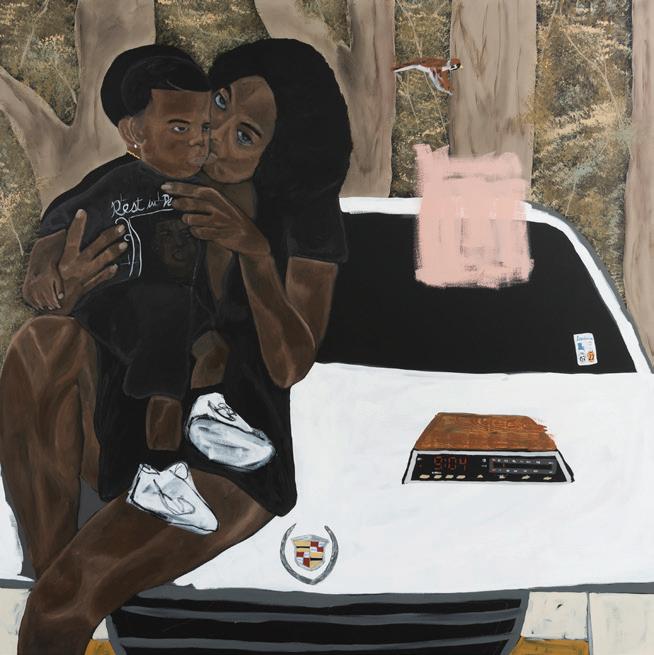
Jammie Holmes’ Make the Revolution Irresistible, curated by María Elena Ortiz, delves into the visual and conceptual significance of the Black figure. Holmes’ powerful paintings, challenging stereotypes and exploring themes such as masculinity, mourning, childhood, and race, create a stirring dialogue on contemporary social and political conditions. The exhibition displays paintings that span Holmes’ career, from early works referencing his Southern upbringing to recent compositions that honor veterans and the 1960s Civil Rights Movement , through Nov. 26. Memory Map, a retrospective of artist Jaune Quick-to-See Smith organized by the Whitney Museum, spans five decades and various media.
Smith’s art blends contemporary art modes with Native ideology, challenging historical narratives and dominant cultural norms; Oct. 15–Jan. 21. Image: Jammie Holmes, Just Like Your Father, 2022, acrylic and oil pastel on canvas, 72 x 72 in. Private Collection, New York © Jammie Holmes. Photograph by Tony Prikryl. Courtesy of the artist and Marianne Boesky Gallery, New York and Aspen. themodern.org
12 MUSEUM OF BIBLICAL ART
Ancient Tribal Maps of the Holy Land, featuring the Twelve Tribes of Israel, is on view in collaboration with the University of North Texas’ Jewish Studies Program. biblicalarts.org
13 NASHER SCULPTURE CENTER
Groundswell: Women of Land Art redefines the narrative of land art history, spotlighting the integral contribution of women artists who innovatively employed natural materials like earth, wind, fire, and more to create striking art beyond traditional gallery confines in the 1960s. Showcasing 12 artists renowned for their consistent engagement with land art, including Lita Albuquerque, Alice Aycock, Beverly Buchanan, and others, the exhibition illuminates the themes and artworks that form the backbone of land art history; through Jan. 7, 2024. Additionally, on Nov. 15, see Art and the Urban Experience, a public program at the Nasher led by Alan Govenar. nashersculpturecenter.org
14 PEROT MUSEUM
On Oct. 14, a partial solar eclipse will be visible in Dallas. The Perot Museum is proud to partner with the Carnegie Institute of Science for an extraordinary event to safely experience the eclipse perotmuseum.org
15 SIXTH FLOOR MUSEUM
On the 60th anniversary of President Kennedy’s assassination, the Sixth Floor Museum sheds new light on his final campaign with Two Days in Texas. Opening Nov. 8, the exhibition follows in the president’s footsteps as he made campaign stops in San Antonio, Houston, and Fort Worth before his untimely death in Dallas on November 22, 1963. Illuminating the president’s final days are eyewitness accounts, the president’s own words from delivered and undelivered speeches, historical artifacts, documents, as well as still and film footage, including a newly produced sequential video of the Kennedy motorcade in Dealey Plaza. jfk.org
16 TYLER MUSEUM OF ART
Impressed: Prints from the Permanent Collection sees an exhibition featuring works on paper, including numerous recent acquisitions; through Nov. 26. tylermuseum.org
36 PATRONMAGAZINE.COM
NOTED: VISUAL ARTS
06 08 10
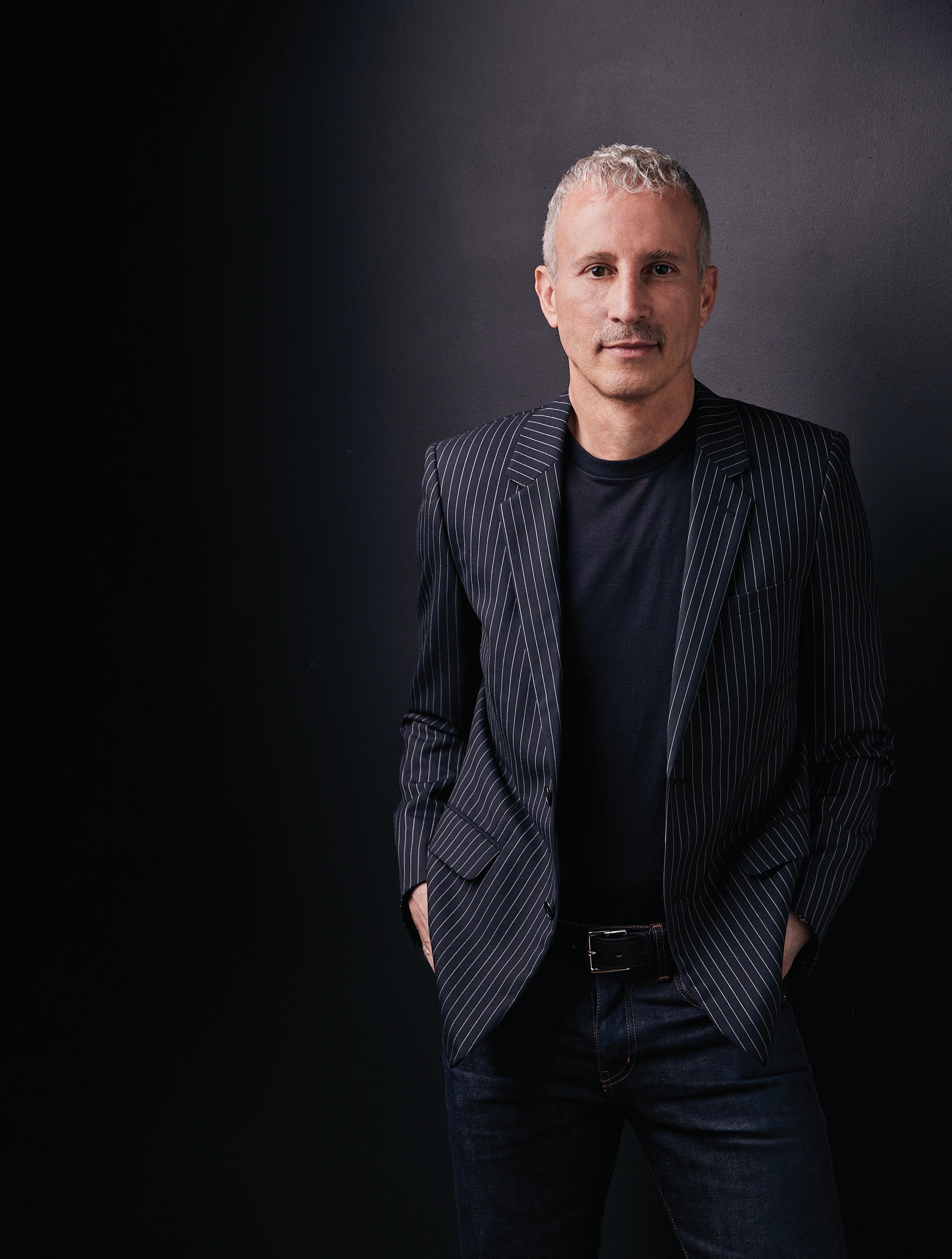
Excellence. Everywhere. SOURCE: 2023 REALTRENDS + TOM FERRY ‘THE THOUSAND,’ AS ADVERTISED IN THE WALL STREET JOURNAL One of the Top 100 residential agents by volume in the entire United States #2 luxury agent by volume in all of Dallas #3 luxury agent by volume in all of Texas Faisal Halum Global Real Estate Advisor 214-240-2575 fhalum@briggsfreeman.com © 2023 Each Office is Independently Owned and Operated.
01 AMPHIBIAN
Good will play as part of the National Theater Live series on Oct. 11 and 14. Main Stage returns on Oct. 20 with The Visit through Nov. 12. amphibianstage.com
02 AT&T PERFORMING ARTS CENTER
Comedian Jen Fulwiler takes the stage on Oct. 5. See History That Doesn’t Suck with Professor Greg Jackson on Oct. 6, followed by Jim Brickman Hits Live! And A Little Bit of Christmas on Oct. 7. Volver by Tango Lovers returns on Oct. 19. On Oct. 21, Turn Up the Lights features a lineup of talented dancers, singers, and bands. John Malkovich in The Music Critic will delight on Oct. 21. Johnny Cash—The Official Concert Experience recalls the Man in Black on Oct. 27. In the Conservatory with the Knife, stirs up mystery Nov. 3–4. Kansas: Another Fork in the Road—50th Anniversary Tour stops in Dallas on Nov. 16. Lake Street Dive: Gather Round Sounds Tour sees a fearless refusal to limit sound on Nov. 17. The Bravo! Gala will honor the generosity and advocacy of the Moody Foundation.
AT&T Performing Arts Center Presents Andrea Bocelli on Nov. 30. Image: John Malkovich in The Music Critic. Photograph by Julie Wesely. attpac.org
03 BASS PERFORMANCE HALL
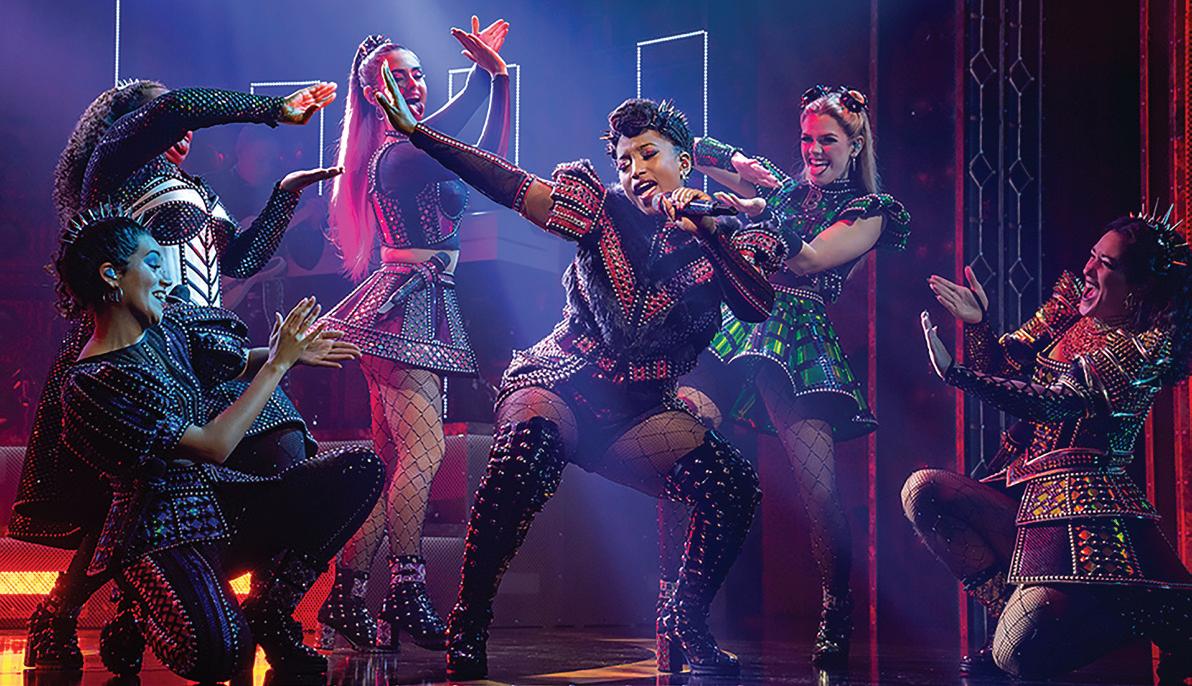
Johnny Cash—The Official Concert Experience will project video clips from The Johnny Cash TV Show while a live band and singers perform in sync with him; Oct. 28. From Tudor queens to pop icons, the SIX wives of Henry VIII take the microphone to remix five hundred years of historical heartbreak into a euphoric celebration of 21st-century girl power; Nov. 28–Dec. 3. Image: Terica Marie as Anna of Cleaves in The North American Tour Boylen Company of SIX. Photograph by Joan Marcus. basshall.com
04 BROADWAY DALLAS
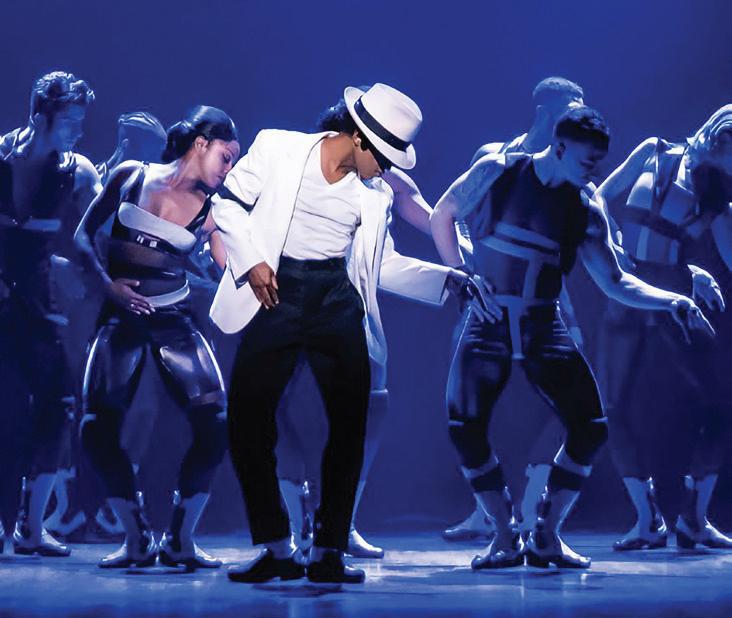
Raphael Saadiq Revisits Toni! Tony! Toné! Just Me & You Tour 2023 makes a stop in Dallas on Oct. 28. The Flaming Lips are live in concert on Nov. 9. Ali Wong brings the laughs on Nov. 10. MJ, the multi-Tony Award-winning musical centers around the making of the 1992 Dangerous World Tour; Nov. 21–Dec. 3. Image: MJ: The Musical. Photograph by Matthew Murphy. broadwaydallas.org
05 CASA MAÑANA
The Children’s Theatre will present Beauty and the Beast Oct. 7–29. The Reid Cabaret Theatre presents A Pin-Up Girls Christmas Nov. 8–18, featuring holiday classics and musical surprises. The Best Christmas Pageant Ever: The Musical runs Nov. 24–Dec. 23 and tells the story of the Herdmans, who unexpectedly join a church Christmas pageant. Next, Christmas in the Movies, Nov. 28–Dec. 16, celebrates hit films. casamanana.org
06 DALLAS BLACK DANCE THEATRE
Get ready to be transported to the heart of Africa at the 18th annual
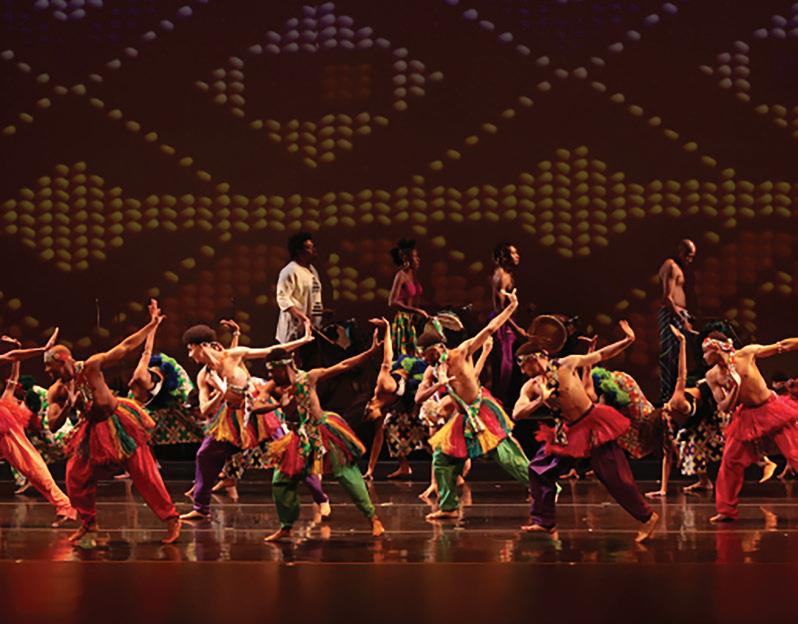
DanceAfrica festival on Oct. 6–7. See the best of the Director’s Choice on Nov. 10–11 and then go Behind the Scenes Nov. 20–21. Image: DBDT's DanceAfrica . Photograph by Amitava Sarkar. dbdt.com
07 DALLAS CHILDREN’S THEATER
Mufaro’s Beautiful Daughters kicks off DCT’s 40th season through Oct. 14. The Secret Lives of Girls takes the stage as part of the Teen Scene Players series Oct. 6–15. From Nov. 25–Dec. 23, experience A Charlie Brown Christmas. dct.org
08 THE DALLAS OPERA
The Dallas Opera Orchestra and Chorus present Tosca, a grand opera filled with power, desperation, and betrayal. For younger audiences, there’s The Billy Goats Gruff, a 35-minute performance in English, onstage Oct. 14. The story involves three little goats dealing with a mean billy goat blocking their way home. The world premiere of The Diving Bell and the Butterfly, Nov. 3–11, tells the true story of journalist Jean-Dominique Bauby, who, after waking up from a coma in a “locked-in” state, writes his memoir with the help of his assistant. dallasopera.org
09 DALLAS SYMPHONY ORCHESTRA
Rachmaninoff Symphony No. 3 fills the concert hall on Oct. 6–8, followed by Brahms Piano Concerto No. 2 on Oct. 12–15. Ben Folds in Concert with the Dallas Symphony Orchestra takes the stage Oct. 20–21. Relive the magic in Harry Potter and the Prisoner of Azkaban in Concert Oct. 27–29. Celebrate Día de los Muertos with the DSO on Oct. 31. Thomas Ospital joins the Gould Family Organ Recital Series on Nov. 1. Vienna Boys Choir stops in Dallas on Nov. 2. Vengerov Plays Brahms Nov. 3–5 . As We Speak: Béla Fleck, Zakir Hussain, Edgar Meyer featuring Rakesh Chaurasia returns Nov. 6. See Strauss’ Don Juan Nov. 9–11. Tchaikovsky’s Pathétique, Nov. 16–19, is the composer’s searing final work. Stravinsky’s Firebird has it all: a prince, 13 princesses, the Firebird’s magic feather, and an evil ogre and his hellish minions; Nov. 24–26. mydso.com
10
DALLAS THEATER CENTER
In The Rocky Horror Show, sweethearts Brad and Janet find themselves in the eerie mansion of Dr. Frank-N-Furter after getting a flat tire during a storm. This rock ‘n’ roll sci-fi gothic musical invites audience participation, including sassy comments, flying toilet paper, and more, making it a perfect adult-friendly celebration for the Halloween season; through Oct. 29. Three spirits visit the miserly Ebenezer Scrooge to take him on a frightful journey through Christmases past, present, and future in A Christmas Carol, Nov. 30–Dec. 30. dallastheatercenter.org
11 DALLAS WIND SYMPHONY
The Dallas Winds perform Oct. 17 with The Organ Symphony. On Nov. 7, spend an evening with Eighth Blackbird as they perform a new concerto for sextet and wind band. Celebrate the indomitable
38 PATRONMAGAZINE.COM NOTED: PERFORMING ARTS
04 14 06
OVER 100 MUSICIANS. 24 SOLOISTS. AND THAT’S JUST THE FIRST HALF.
RING CYCLE THE

The Dallas Symphony Orchestra Proudly Presents the Complete Wagner Ring Cycle in Concert

Ring Cycle: Das Rheingold | MAY 1 & 4, 2024
Ring Cycle: Die Walküre | MAY 2 & 5, 2024
spirit of the Ukrainian people with the world premiere of Bury and Rise by Ukrainian composer Catherine Likhuta. dallaswinds.org
12
EISEMANN CENTER
Hear the RSO with Lili Boulanger’s vibrant D’un matin de printemps on Oct. 7. Ranky Tanky will mix jazz, gospel, funk, and R&B along with vocalist Lisa Fischer to bring Gullah culture to life on Oct.13. On Oct. 16, Keyboard Conversations presents The Power and Passion of Beethoven. De Yun She brings Chinese comedic xiangsheng to the stage on Oct. 19. Spend A Night in Vienna with the PSO on Oct. 21. Step Afrika! will stomp on Oct. 22. Nightmare Before Nutcracker tells the story of a ballerina as she makes her way back to the top; Oct. 25–29. The Manhattan Transfer will perform Oct. 26. Experience Moein live in concert on Oct. 27. When You Wish Upon a Star sees Disney classics through the lens of jazz on Nov. 10. Get Happy: Michael Feinstein Celebrates the Judy Garland Centennial commences on Nov. 11. Join Versa-Style Dance Company on Nov. 17 followed by Vocal Majority: Christmas Vacation on Nov. 28. eisemanncenter.com
13 FORT WORTH SYMPHONY ORCHESTRA
Experience Game ON! as epic game universes unfold before your eyes on Oct. 7. Canada’s Old Trout Puppet Workshop brings Prokofiev’s Peter and the Wolf to life with large-scale puppetry and the FWSO; Oct. 20–22. Buddy Bray and Keith Cerny will perform on Oct. 29. Principal violist DJ Cheek will perform Bartók’s final composition, his Viola Concerto Nov. 3–5. Storybook: Cinderella brings the story to life on Nov. 11. Next up, hear Bond and Beyond Nov. 10–12. Mermaids from Zemlinsky and Brahms is up next from Nov. 17–19. fwsymphony.org
14 LYRIC STAGE
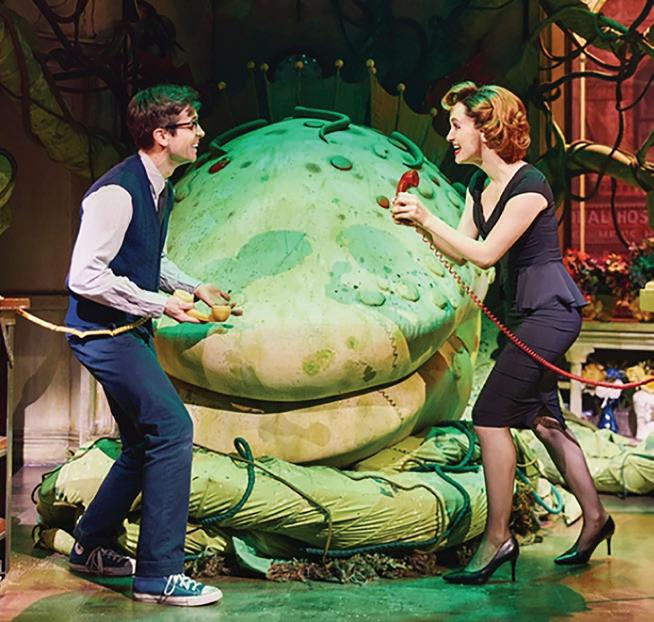
Join Lyric Stage in their new studio space in the Design District. The grill will be lit cooking up burgers and dogs and the booze will be flowing. The Great American Trailer Park Musical breaks in the new stage through Oct. 7. Get spooky with Little Shop of Horrors on Halloween weekend at the Majestic Theatre, Oct. 26–29. Image: Photograph by Emilio Madrid. © Joe Mazza. lyricstage.org
15 MAJESTIC THEATRE
See Jimmy Carr: Terribly Funny on Oct. 9. Pat Metheny returns to Dallas on Oct. 11. Mark Normand: Ya Don’t Say Tour will be live on Oct. 14. Nickel Creek with special guest Monica Martin take the stage on Oct. 20. See John Malkovich in The Music Critic on Oct. 21.
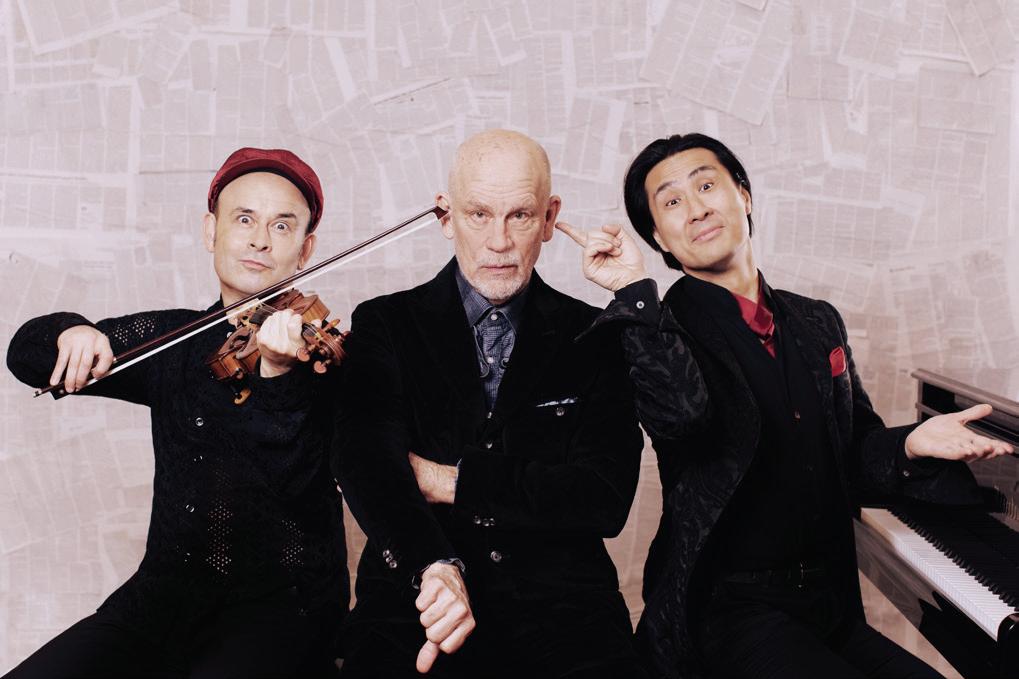
Nick Cave plays Dallas on Oct. 22. St. Paul and the Broken Bones: Angels in Science Fiction is up next on Nov. 2. The Fab Four play Beatles favorites on Nov. 3. Ms. Pat: Ya Girl Done Made It will make your night on Nov. 4. Eddie Izzard’s The Remix Live reimagines some of her own favorite comedy bits on Nov. 5. Spend a night of comedy with Joe Gatto on Nov. 10. Jim Jefferies: Give ‘Em What
They Want Tour brings the laughs on Nov. 17. Wynonna Judd will perform her first two albums on Nov. 19. majestic.dallasculture.org
16 TACA
TACA nurtures arts organizations and provides visionary and responsive leadership to the arts community. By providing flexible funding and much-needed resources, like professional development workshops, TACA allows arts organizations to spend less time on keeping their doors open and more time on running effective programs that transform lives through the arts. taca-arts.org
17 TEXAS BALLET THEATER
Enter the terrifying domain of Dracula as he stalks the stage Oct. 6–8. The Nutcracker heralds the magic of the holiday season with visions of enchantment and joy; Nov. 24–Dec. 3. texasballettheater.org
18 THEATRE THREE
LIZZIE: The Musical explores the mind of Lizzie Borden and speculates on the motivations she may have had: oppression, abuse, and madness; through Oct. 29. theatre3dallas.com
19 TITAS/DANCE UNBOUND
Tokyo’s Sankai Juku is known worldwide for its elegance, precision, and emotional depth; Oct. 13–14. Montreal’s Les 7 Doigts, an art collective of multiple disciplines, will stage PASSAGERS, a fascinating work of dance and circus exploring chance vs. choice vs. destiny; Nov. 3–4. titas.org
20
TURTLE CREEK CHORALE
In Nov. TCC will share the stories of immigrants from our Southern border in Border Song. turtlecreekchorale.com
21 UNDERMAIN THEATRE
With the onset of puberty, Zuri must use her wits to outsmart the twisted desires of a drunken master and a sadistic mistress in Bondage ; through Oct. 15. In a decayed house in London’s Hampstead Heath, two men face each other over a drink in No Man’s Land . Their ambiguity and the comedy intensify when two younger men arrive; Nov. 9 –Dec. 3. undermain.org
22
WATERTOWER THEATRE
Chaplin explores the life of Charlie Chaplin, tracing his journey from 19th-century London to receiving an honorary Academy Award in 1972. Featuring an original score by Christopher Curtis, the musical offers a poignant look at the man behind the Tramp character, revealing his struggles to find personal happiness; Nov. 8–19. watertowertheatre.org
40 PATRONMAGAZINE.COM NOTED: PERFORMING ARTS
02 03
welcharchitecture.com
Through January 7, 2024
ARTISTIC MARVELS FROM TOKYO AND MONTREAL TITAS/Dance Unbound amps up the 2023/2024 season.
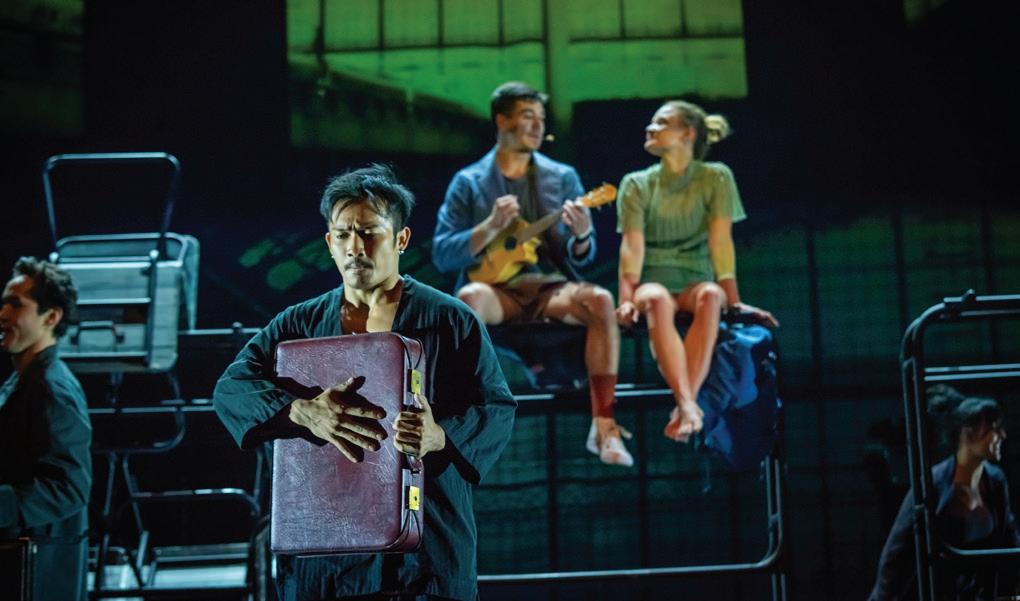
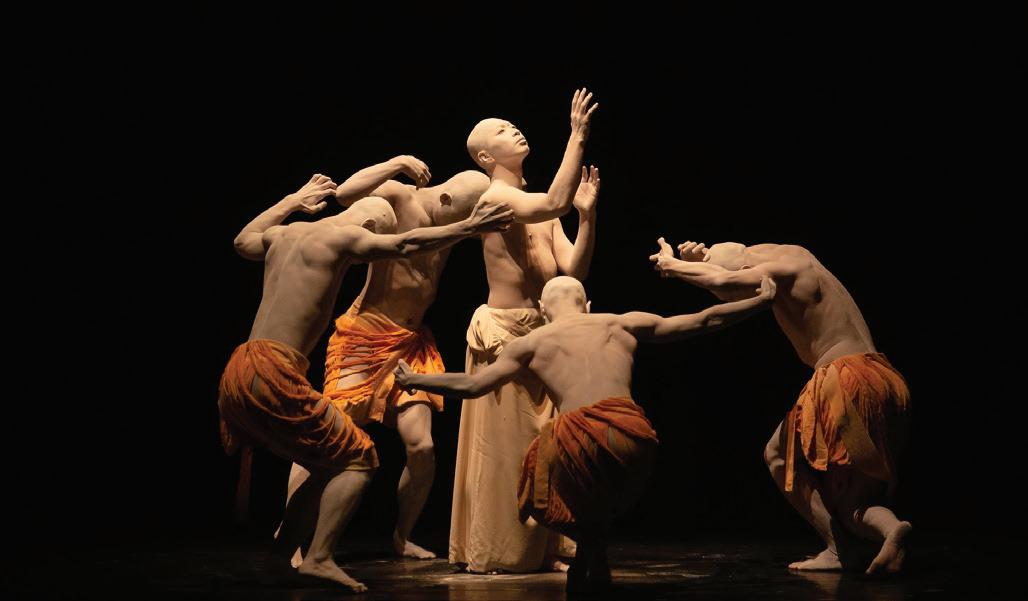
Charles Santos, the always-enthused executive and artistic director of TITAS/Dance Unbound, wants audiences to discover the unexpected and daring. That’s why he is thrilled Dallas is poised to experience two unparalleled artistic feats as Sankai Juku and Les 7 Doigts take the stage this fall.
A mesmerizing performance is bound to ensue when Sankai Juku comes to Dallas. Internationally acclaimed for its mastery of movement and artistic narratives, the company has carved out a reputation that transcends cultures and nations. Led by the venerated choreographer and dancer Ushio Amagatsu, the troupe offers more than dance through an immersive experience engaging audiences emotionally and philosophically. Their latest, KŌSA, epitomizes Amagatsu’s vision and invites audiences to delve into the realms of Japanese culture and creativity. For those eager to immerse themselves in a world brimming with Japanese culture, unparalleled artistic prowess, and the sheer force of imagination, October 13–14 are dates to mark in gold.
When Santos speaks of Les 7 Doigts his energy is visceral. Dance and cirque, he says, have never looked the same. Coming from Montreal, Canada, Les 7 Doigts is an arts collective known for pushing artistic boundaries. Merging acrobatics, theatre, dance, artists, and multimedia storytelling, the troupe will present PASSAGERS. The performance delves into the nuances of existence—the dichotomies of departure and arrival, chance and destiny, past and future, confinement and liberation. Each act provokes contemplation on themes that resonate deeply within humanity. Texans can witness this boundary-defying performance November 3–4, in the company’s state debut. titas.org―Anthony Falcon P
42 PATRONMAGAZINE.COM
Louise Nevelson (1899–1988), Lunar Landscape (detail), 1959–60, painted wood, Amon Carter Museum of American Art, Fort Worth, Texas, Purchase with funds from the Ruth Carter Stevenson Acquisitions Endowment, 1999.3.A-J
The World Outside: Louise Nevelson at Midcentury is organized by the Amon Carter Museum of American Art. Generous support for the project comes from The Kaleta A. Doolin Foundation and the National Endowment for the Arts. The Carter’s presentation of The World Outside: Louise Nevelson at Midcentury is supported by the Ann L. & Carol Green Rhodes Charitable Trust, Bank of America, N.A., Trustee; and the Alice L. Walton Foundation Temporary Exhibitions Endowment.
OF NOTE
Les 7 Doigts PASSAGERS. Photograph by Philippe Escalier.
KOSA . Photograph courtesy of Sankai Juku.
End End Luxury
Unlike most other significant life purchases we make, buying or selling a home is a process. It’s imperative you have confidence in that process not only at the outset and the outcome, but at every point in between. Seeing buyers and sellers through is something every one of our professional, educated, client-centric associates knows how to do.

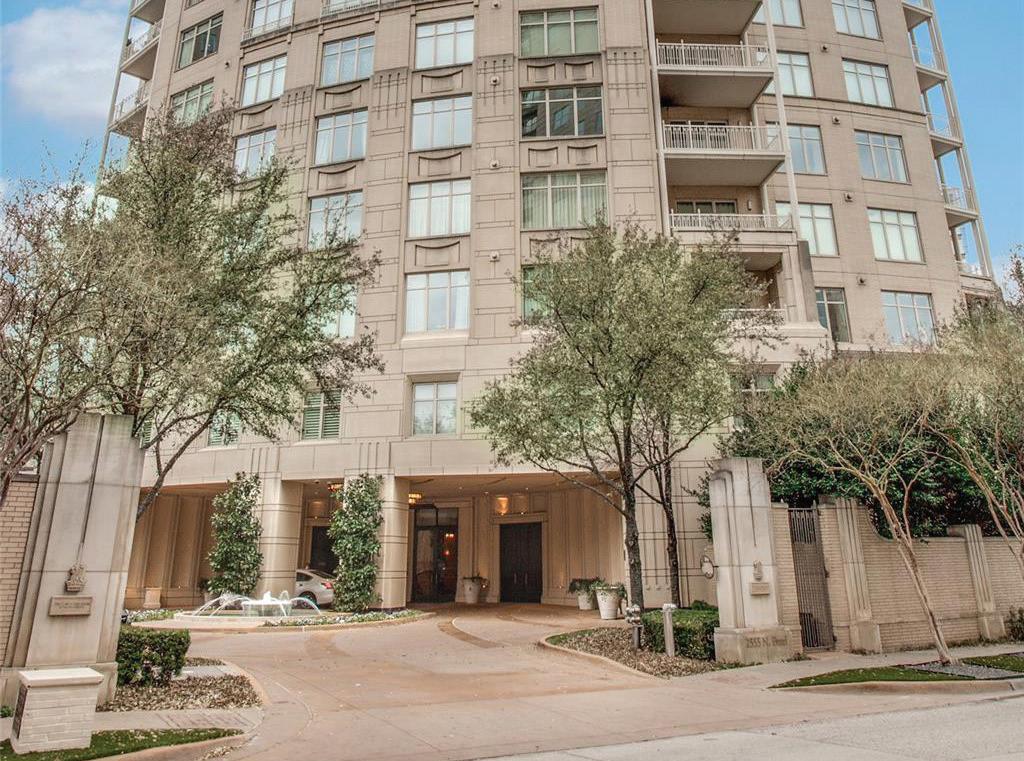
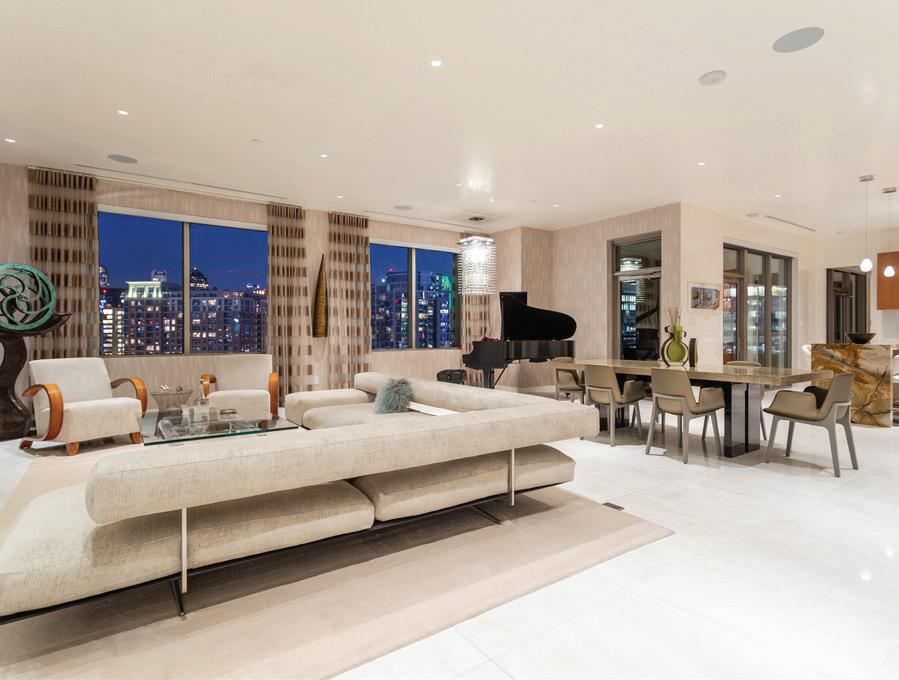
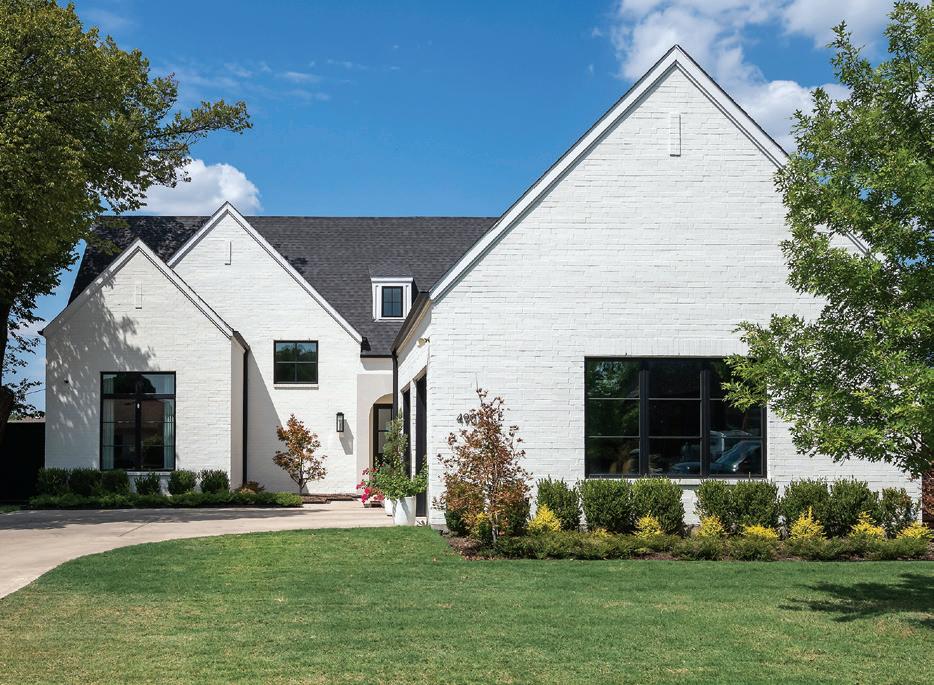
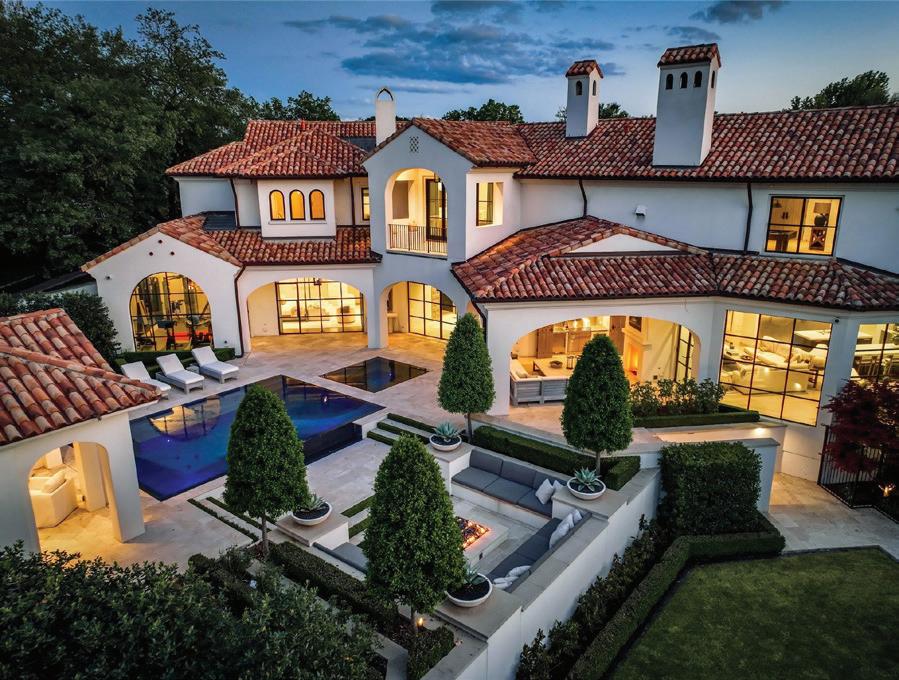
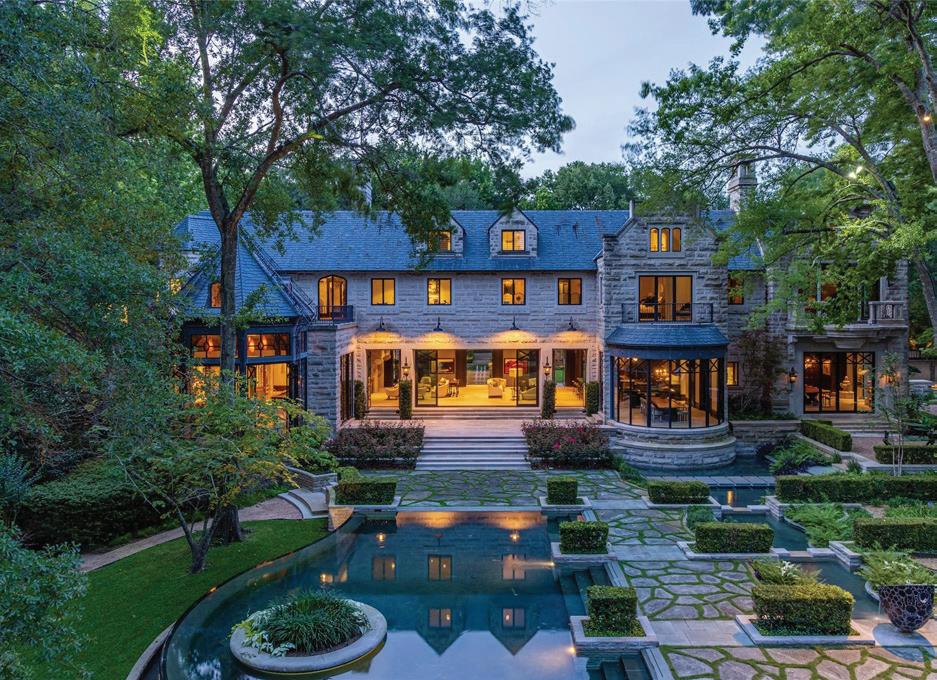
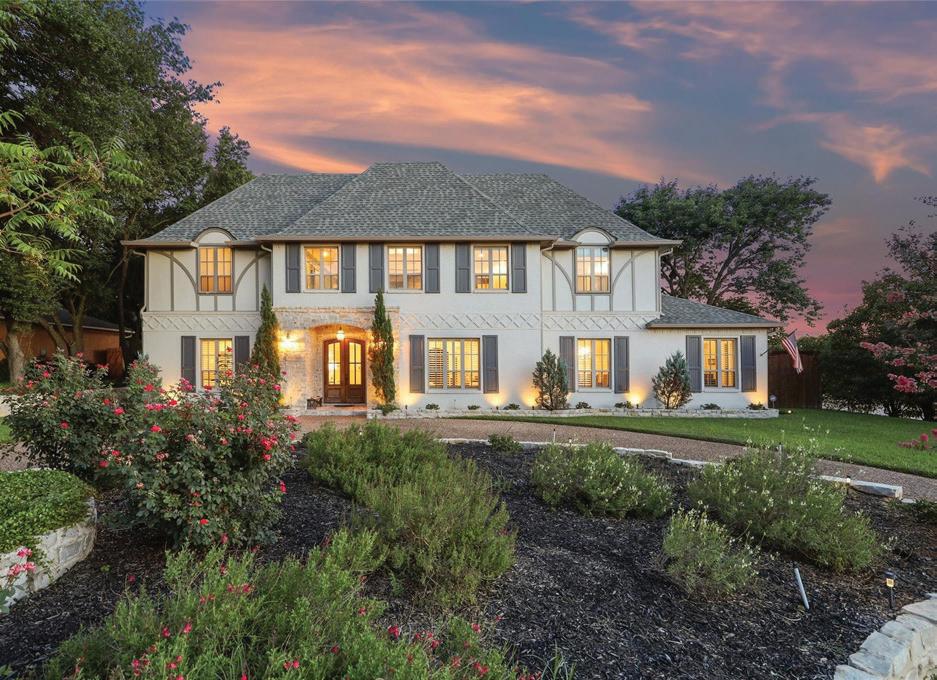
107timberwilde.dpmre.com Billy Dolan 310.569.4741 billydolan@dpmre.com 107 Timberwilde Lane 8 BED | 9.3 BATH | 22,000 SQ. FT. | $65,000,000 HOUSTON | LODGE AT HUNTERS CREEK SOLD, Represented Buyer Garrett Holloway 214.986.9158 garrett@dpmre.com 6825 Golf Drive 6 BED | 6.4 BATH | 14,652 SQ. FT. | $19,950,000 UNIVERSITY PARK PENDING Claudine King 214.789.0101 claudine@dpmre.com 4907 Wenonah Drive 4 BED | 4 BATH | 3,370 SQ. FT. | $1,998,000 SHANNON ESTATES 2300wolf12b.dpmre.com Sharon S. Quist 214.695.6565 sharonquist@dpmre.com Stoneleigh Residences #12B 3 BED | 3.1 BATH | MEDIA | 3,467 SQ. FT. | $3,700,000 UPTOWN | 2300 WOLF STREET SOLD, Represented Buyer Emily Ray-Porter 214.544.5698 emily@dpmre.com 2555 N. Pearl Street #703 2 BED | 2 BATH | 1,736 SQ. FT. | $1,549,000 UPTOWN | RITZ-CARLTON RESIDENCES
daveperrymiller.com Price and availability subject to change. Information deemed reliable, but not guaranteed. A Berkshire Hathaway Affiliate 4206altavista.dpmre.com Kyle Rovinsky 972.989.8568 kylerovinsky@dpmre.com 4206 Alta Vista Lane 4 BED | 4.1 BATH | 5,195 SQ. FT. | $2,075,000 HOCKADAY AREA
An
Experience to
NOTED: GALLERIES
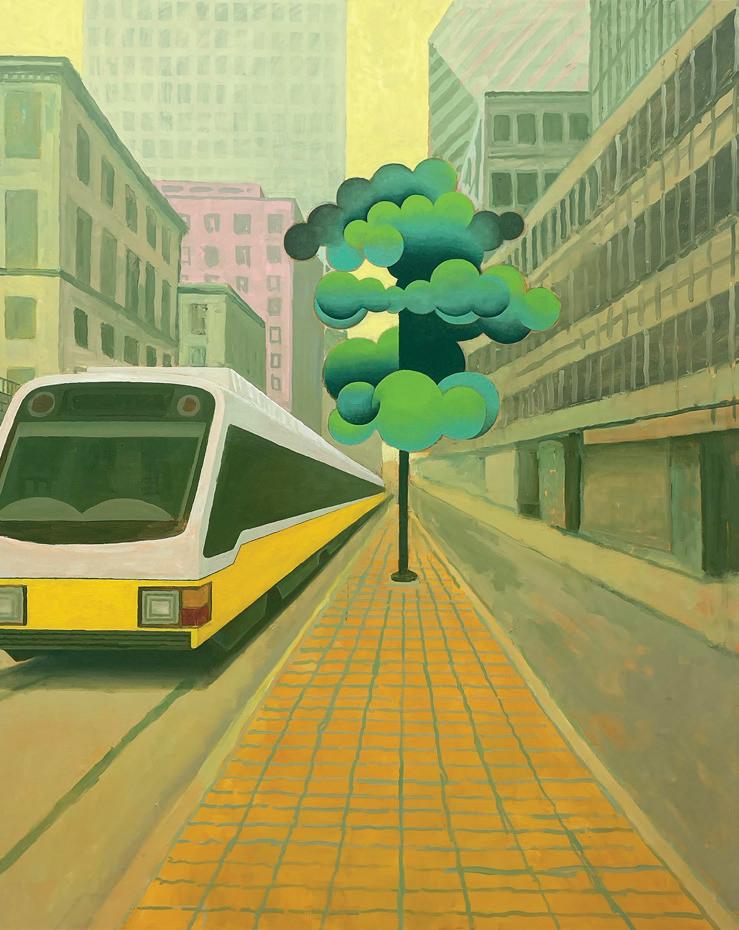
01 12.26
In Masamitsu Shigeta: Reflections, the artist examines the urban terrains of Dallas. In Case of Fire displays new paintings by Brooklyn-based artist Lee Maxey, concurrently through Oct. 14. A group show investigating pattern featuring Claire Colette, Hanna Hur, Bea Fremderman and Annabeth Marks is up next along with Theodora Allen: The Bowstring’s Tension ; Oct. 20–Dec. 2. Image: Masamitsu Shigeta, A street car and a Tree (2), 2023, oil on canvas with wood frame, 61.50 x 49.25 in. gallery1226.com
02 500X GALLERY
500X is an artist-run gallery with a long tradition. Euphoria , a photography-based show, will open Oct. 7. 500x.org
03
ALAN BARNES FINE ART
Alan Barnes Fine Art specializes in 19th- and 20th-century American and European Paintings. The gallery’s exhibition 20thCentury Art is on view through Nov. alanbarnesfineart.com
04 AND
NOW
Michelle Rawlings’ solo show remains on view through Oct. 21. Rawlings will exhibit with the gallery at Frieze London, Oct. 11–15. New York–based Kathryn Kerr’s solo show fills the gallery next, from Nov. 4–Dec. 30. andnow.biz
05 ARTSPACE111
Renewal , featuring Carol Benson, Janet Chaffee, Allie Regan Dickerson, and Erika Huddleston, continues through Oct. 28. artspace111.com
06
BARRY WHISTLER GALLERY
Peter Ligon: En Plein Air features small-scale paintings from Oct. 7–Nov. 11 with Linnea Glatt: Recent Drawings, which sees new largescale drawings that incorporate fabric. Danny Williams: Back from Black, on view Nov. 18–Dec. 22, exhibits colorful paintings on paper alongside hand-colored photographs in Ann Stautberg: Recent Photographs. barrywhistlergallery.com
07 BEATRICE M. HAGGERTY GALLERY
SOLID: Texas Sculpture Association Juried Member Exhibition sees selections by juror Thomas Feulmer, curator at The Warehouse, in this exhibition of 30 members. Nov. 3–Jan. 24. udallas.edu/gallery
08 CADD
Contemporary Art Dealers of Dallas regularly hosts happy hours, bus tours, scholarships, and other events supporting artists and galleries in the region. caddallas.org
09 CHRISTOPHER MARTIN GALLERY
The gallery presents the reverse-glass paintings of Christopher Martin; the Rodeo series of photographer Steve Wrubel; the colorfield paintings of Jeff Muhs; Dutch image maker Isabelle van Zeijl; the acrylic constructions of Jean-Paul Khabbaz; California-based painter Chris Hayman; Liz Barber’s light-infused paintings, and rotating artists. christophermartingallery.com
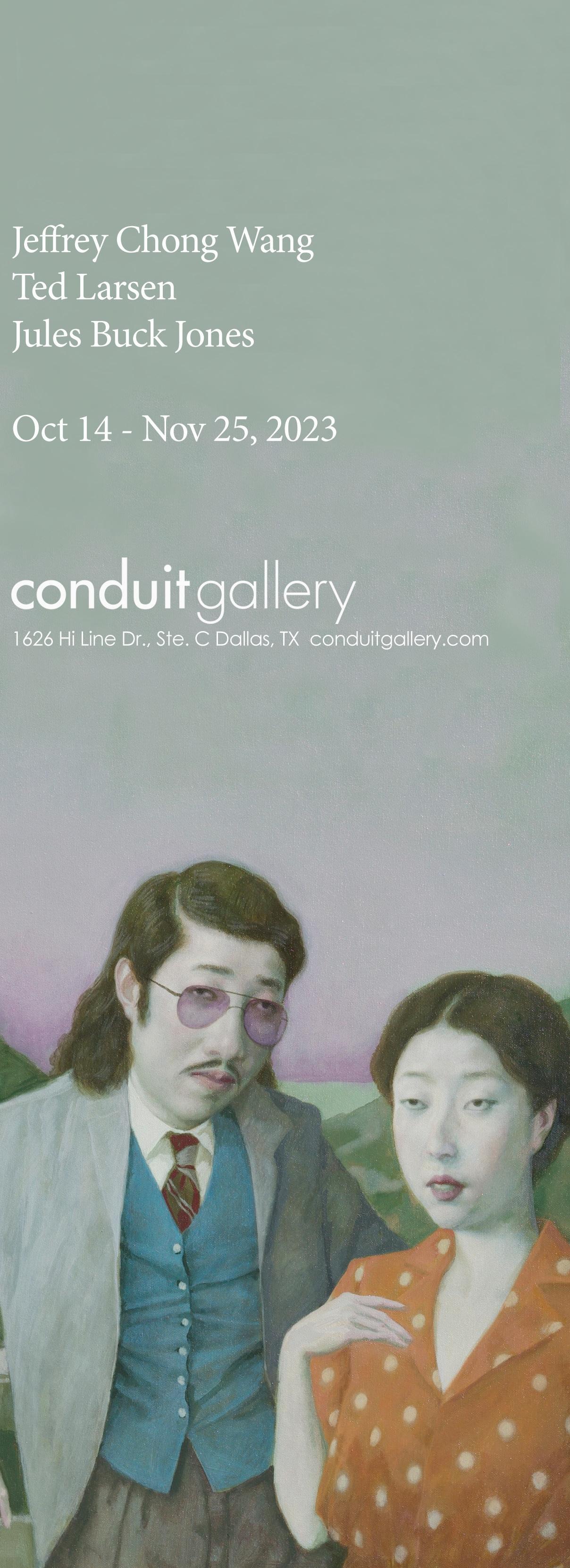
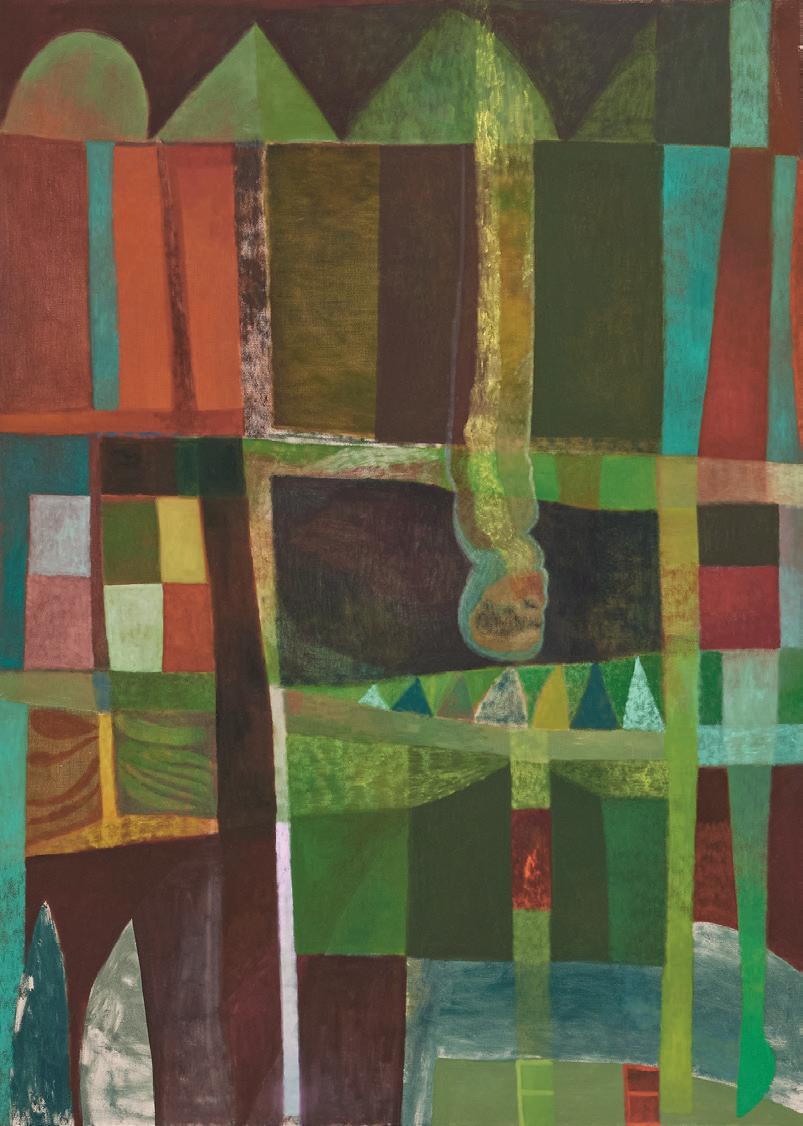
10 CONDUIT GALLERY
Conduit Gallery will open three new exhibitions with a public reception for the artists Ted Larsen, Jules Buck Jones, and Jeffrey Chong Wang on Oct. 14. The exhibitions will be on view through Nov. 25. Image: Jules Buck Jones, Linear Spins, 2023, acrylic on canvas , 80 x 80 in. conduitgallery.com
11 CRAIGHEAD GREEN GALLERY
From Oct. 7–Nov. 11, Carole Pierce, Mark Smith, and Marla Ziegler showcase their talents in the gallery. Next, Patrick Pietropoli, Frank Morbillo, and Jeanie Gooden fill CGG from Nov. 18–Dec. 30. craigheadgreen.com
12 CRIS WORLEY FINE ARTS
Anna Elise Johnson: Earthworks-Mojave Desert highlights Cris Worley from Oct. 14–Nov. 11. Johnson shares the gallery with Harry Geffert’s exhibition A Place Beside the Road, on view through Dec. 16. Isabelle du Toit’s paintings close out the year from Nov. 18–Dec. 23. Image: Harry Geffert, Falling Man, 2001, cast bronze, 24 x 24 x 3 in. crisworley.com
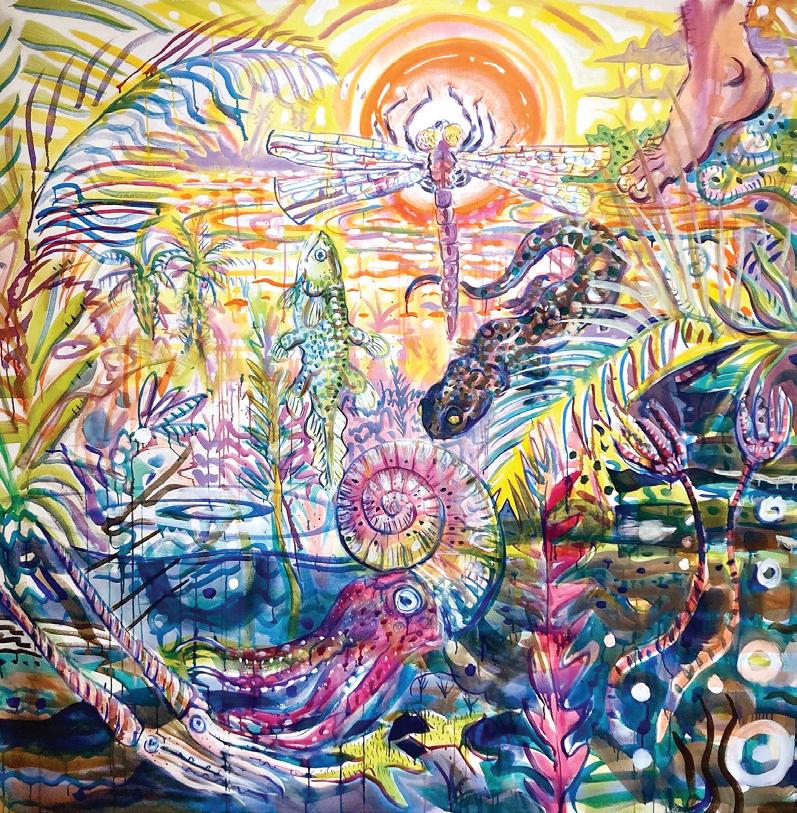
13 CVAD, UNT COLLEGE OF ART AND DESIGN GALLERIES
CVAD Galleries examine Cey Adams’ career as a visionary artist, cultural pioneer, and innovative designer. Adams honed his skills painting graffiti in New York City in the late 1970s before moving downtown, where street art was leaking into high-end galleries. Through Dec. 15. cvad.unt.edu
14 DAISHA BOARD GALLERY
DBG represents contemporary BIPOC, LGBTQ+, and artists with disabilities in various media at its three locations DBG West, The Joule, and in the Tin District. daishaboardgallery.com
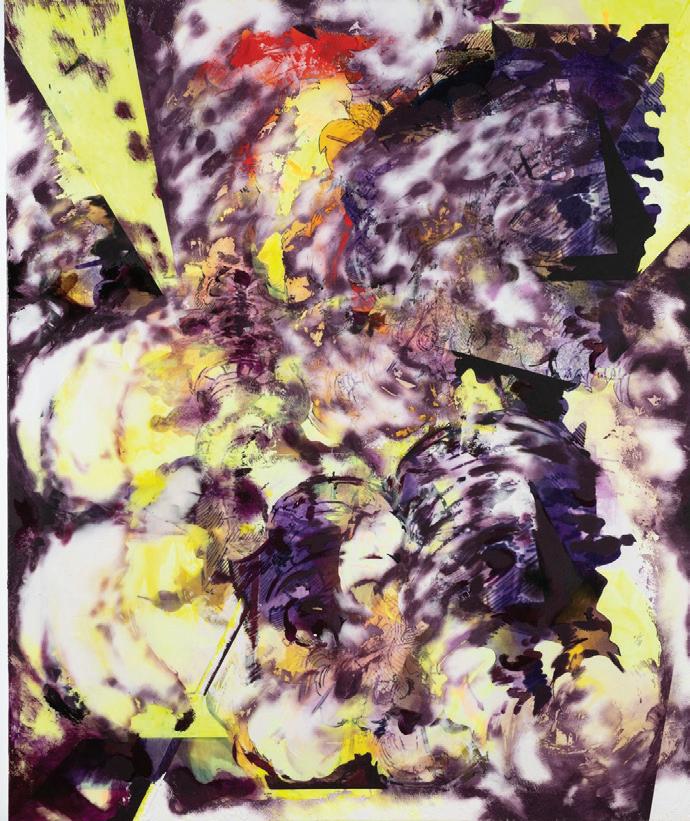
15 DAVID DIKE FINE ART
The 27th Annual Texas Art Auction takes place Oct. 21 at DDFA in Alpha Plaza. Over 400 lots of Texas art range from early and traditional to contemporary work. Highlights include paintings by Dorothy Hood, Ben Culwell, Julian Onderdonk, Karl Hermann
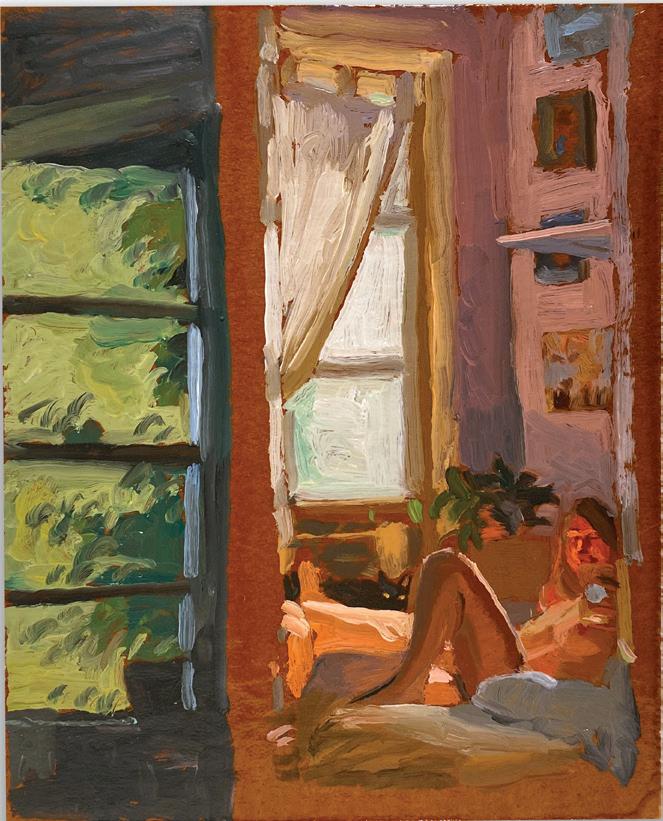
44 PATRONMAGAZINE.COM
21 18 10

24TH ANNUAL
X
AIDS
ART
OF
ALL-ELECTRIC CELESTIQ.
Preproduction model shown. Actual production model will vary. By inquiry only. See cadillac.com for details. ©2023 General Motors. All rights reserved. The marks appearing in this ad are the trademarks or service marks of GM, its subsidiaries, affiliates or licensors.
CADILLAC IS PROUD TO SUPPORT THE
TWO
TWO FOR
AND
WITH A SPECIAL APPEARANCE
THE
CELESTIQ
A WORK OF ART AS SINGULAR AS ITS OWNER
NOTED: GALLERIES

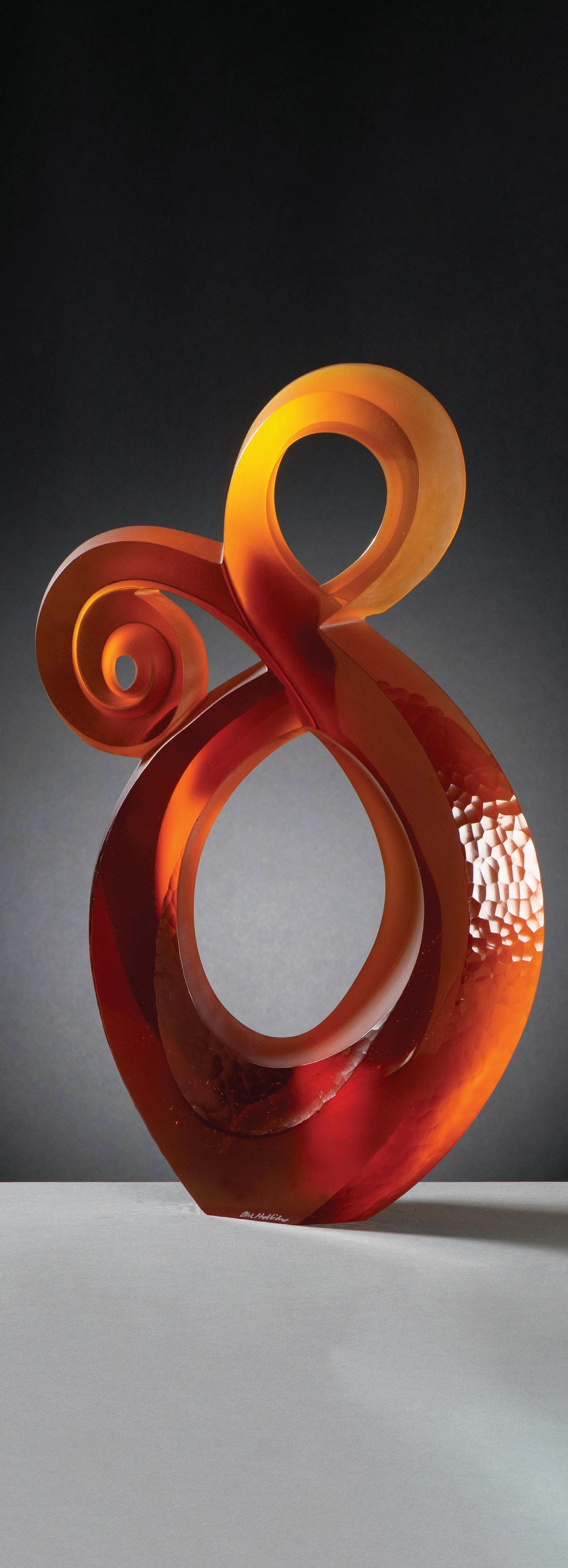
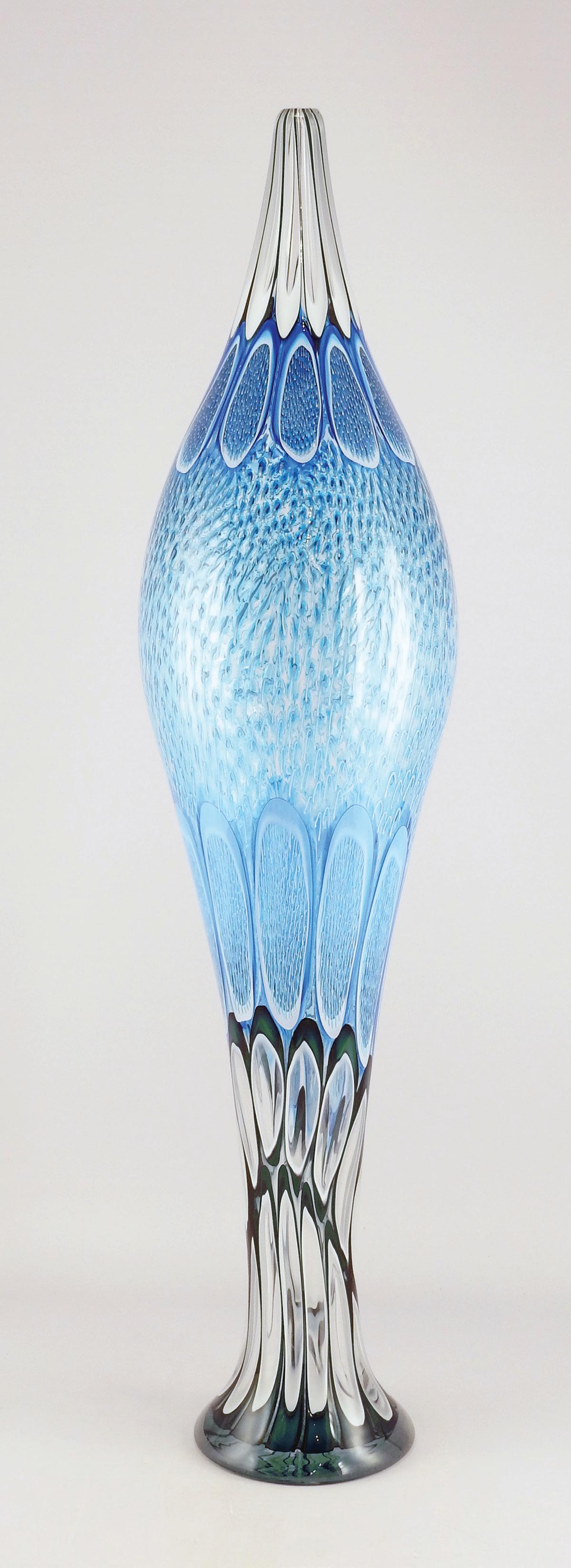
K ittrell/Riffkind Art Glass Gallery


16 ERIN CLULEY GALLERY
Zeke Williams: Pick and Pop and Du Chau: Through the Garden highlight the gallery from Oct. 7–Nov. 11. Next, Anna Membrino’s Ripples will fill the gallery Nov. 18–Jan 6. erincluley.com
17 FERRARI FINE ART GALLERY
Ethereal oil paintings by Mark Russell Jones and Eric Breish, known for abstract paintings on metal that create holographic illusions, are on view through Dec. 30. The gallery welcomes Julian Voss-Andreae, whose works blend figurative sculpture with scientific insights into the nature of reality. ferrarigallery.net
18 GALLERI URBANE
On view Oct. 5–Nov. 11, Gallery 1 displays Samantha McCurdy’s solo show A lick between the eyes. Gallery 2 introduces Drea Cofield’s Send N*des, an exhibition of work drawing from her ongoing “selfie” project spurring topics of self-expression and censorship, the canonical art-historical narrative, and the contemporary realities of technology and AI. Image: Drea Cofield, Selfie 1 (Drop Shadow), 2023, oil on canvas. galleriurbane.com
19 GREEN FAMILY ART FOUNDATION
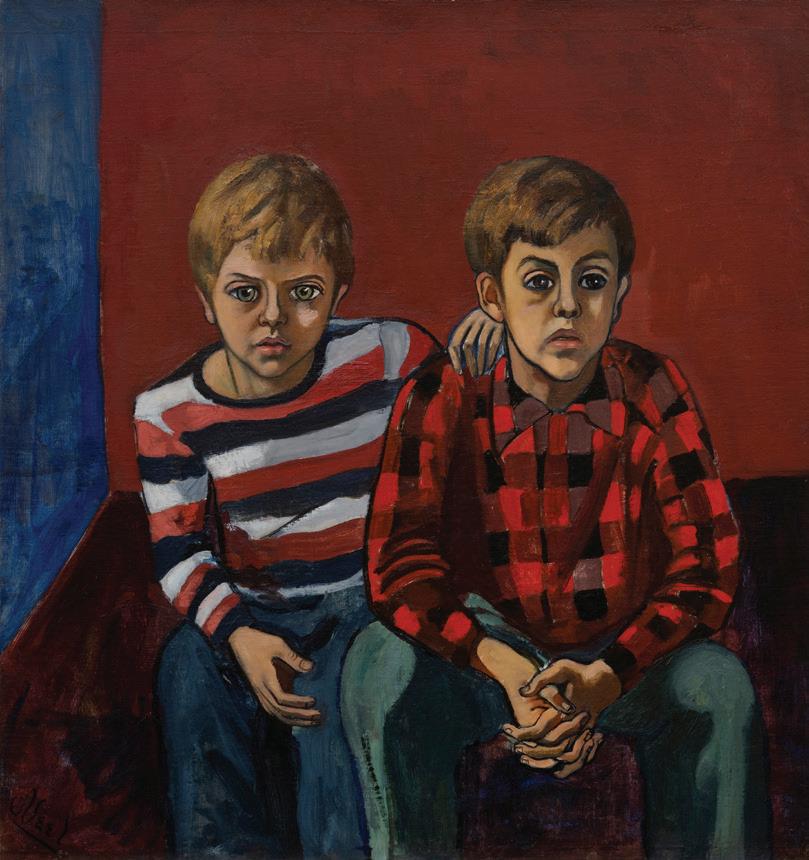
GFAF opens Togetherness: For Better or Worse, a group show, on Oct. 7. Nicolas Party’s solo show, Landscap e, runs concurrently. Both remain on view through Jan. 21, 2024. Image: Alice Neel, Richard and Hartley, 1950, oil on canvas, 42 x 39 in. Photograph by HV-studio, Brussels. Courtesy the Estate of Alice Neel and Xavier Hufkens, Brussels. © The Estate of Alice Neel. greenfamilyartfoundation.org
20


HOLLY JOHNSON GALLERY
Michael Young: Works on Paper, an exhibition by the Austin-based artist, continues through Nov. 11. Young brings the subtleties of his chosen materials to life, creating captivating art pieces that merge man-made artistry with natural influences. hollyjohnsongallery.com
21
KEIJSERS KONING
Beya Gille Gacha’s first solo exhibition in the US, called
46 PATRONMAGAZINE.COM
Lungkwitz, and a significant work by Franke Reaugh, along with a 1936 painting by Charles Bowling. daviddike.com
4500 Sigma Rd. Dallas, Texas 75244 972.239.7957
Offering Dallas’ finest selection of art glass! kittrellriffkind.com
19
Chad Holliday Fervent Zeal 18x12x3 in.





S OUTHWEST G ALLERY 4500 Sigma Rd. Dallas, Texas 75244 972.960.8935 swgallery.com Offering Fine Art, Sculpture, Custom Framing, and Art Glass for over 50 years.
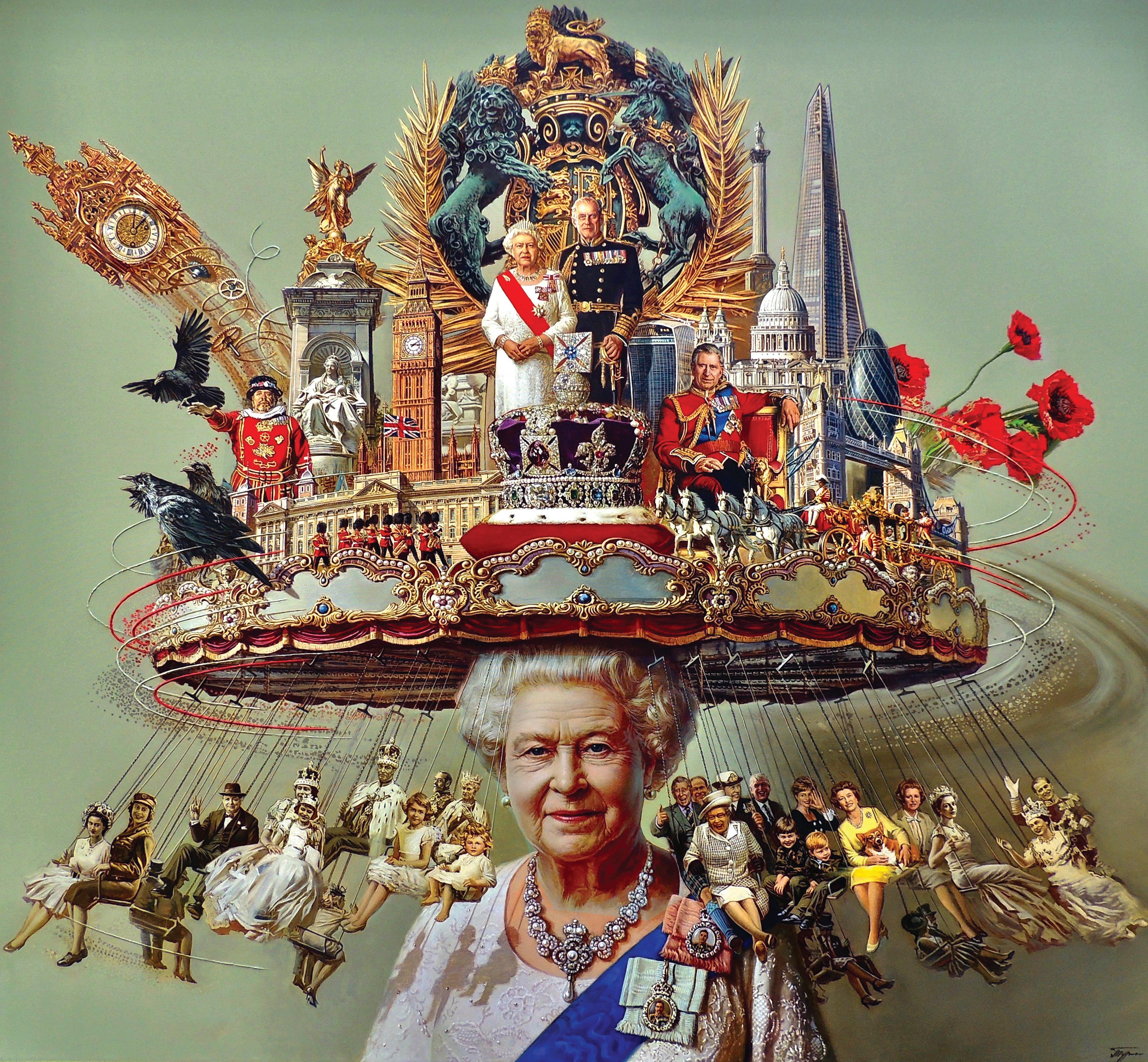
Opening Exhibition Fall 2023 “Queens Hat” Oil on Canvas 58x62 in.
Oleg Turchin
214.649.4375
jeanne.milligan@alliebeth.com jeannemillligan.com
Hide and Seek, remains on view through Oct. 7 Next, Rush Baker IV’s energetic and frenetic abstractions invoke a range of concerns, from the perils of living while Black and the widening income gap to the proliferation of alternative facts and weaponized technology, Oct. 14–Nov. 18. Image: Rush Baker IV, Harpers Ferry, 2021, acrylic, spray paint, paper, resin and plaster on canvas 72 x 60 in. Courtesy of Keijsers Koning. keijserskoning.com
22 KIRK HOPPER FINE ART
From Oct. 7–Nov. 11, More Contemporary American Art features Richard Armendariz, Connie Arismendi, Debra Barrera, Alex Diaz, Carlos Donjuan, Gaspar Enriquez, John Hernandez, Cesar Martinez, Gabriel Martinez, Diana Molina, Celia Alvarez Munoz, Andrew Ortiz, and Giovanni Valderas. kirkhopperfineart.com
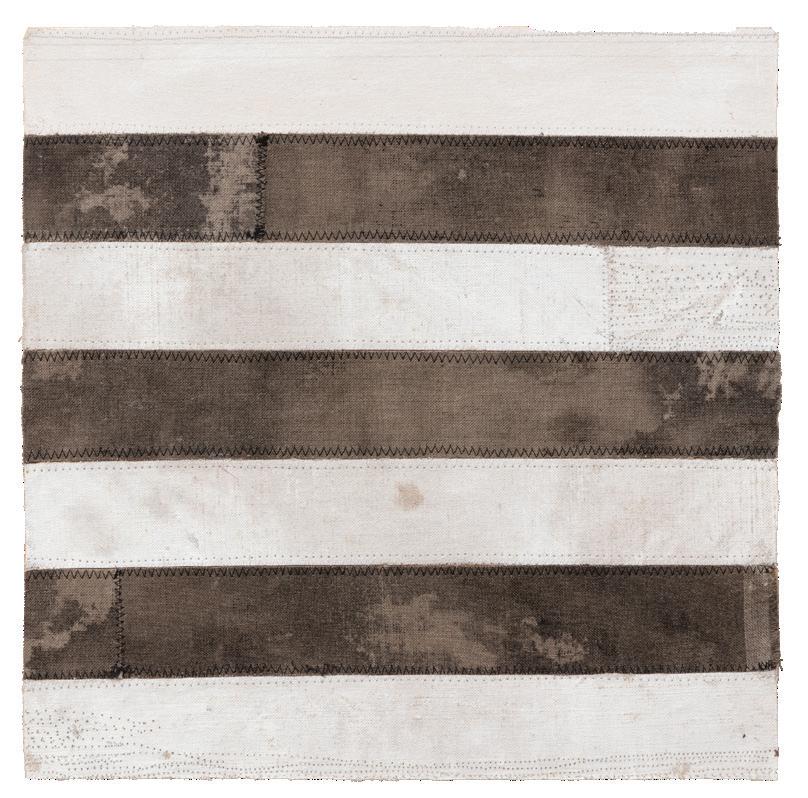
23 KITTRELL/RIFFKIND ART GLASS
The One of a Kind exhibition also marks the 33rd Anniversary Gala, a group show featuring over 50 artists, through Nov. 4. Next, Holiday Treasures opens Nov. 11 and continues through Dec. 31. kittrellriffkind.com
24 LAURA RATHE FINE ART
Through Nov. 4, Flow States examines the practices of Meredith Pardue and Lucrecia Waggoner, who each carry deep reverence for the Earth. Their unique methods reveal how similar influences can manifest in different outcomes. In Chromatopia Mike Hammer, Katherine Houston, and Jane Waterous mine interpretations of color, Nov. 18–Jan. 6. laurarathe.com
25 LILIANA BLOCH GALLERY
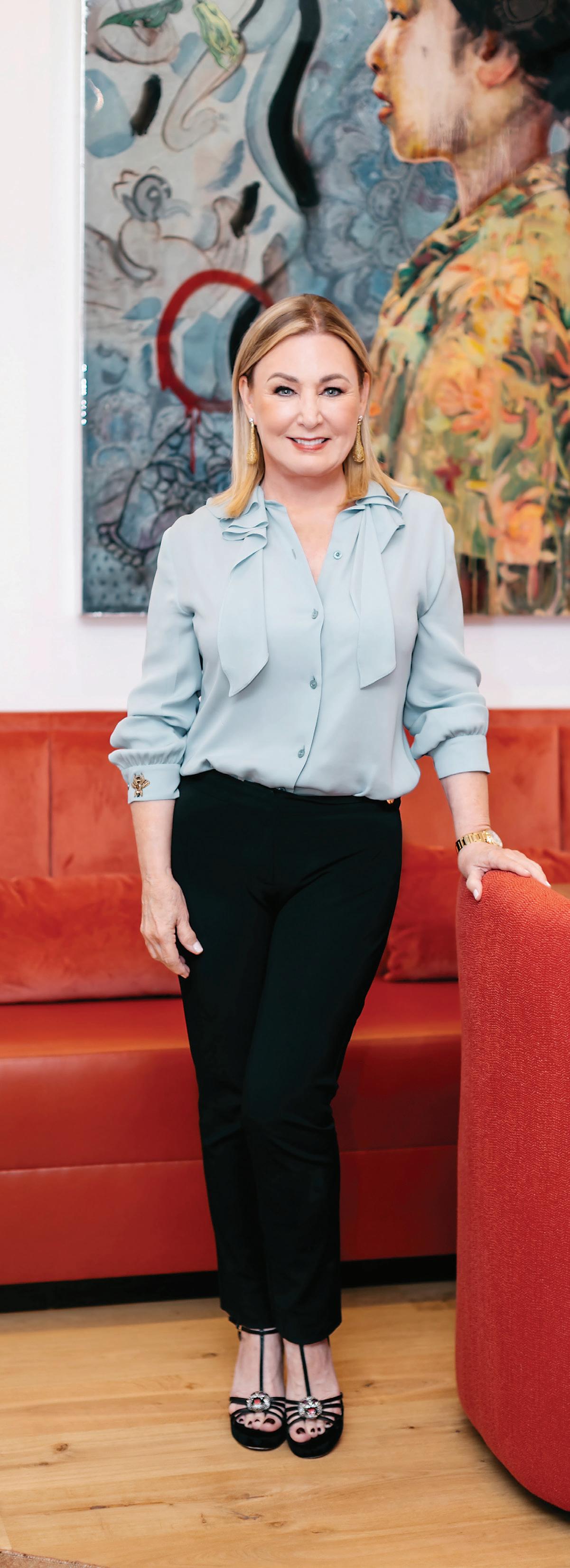
Through Nov. 11, Kathy Lovas: Indexicality, The Archive, and The Frame, A Retrospective Installation will command the gallery space. lilianablochgallery.com
26 LONE GALLERY

Where Wheels Can’t Go, Wild Cats Prowl sees work by Bruce Lee Webb through Oct. 28. lonegallery.com
27 MARKOWICZ FINE ART
RISK: Neon Paragon features the artist’s work through Oct. 19. RISK is an illustrator and street artist who pioneered the West Coast graffiti movement. markowiczfineart.com
48 PATRONMAGAZINE.COM
NOTED: GALLERIES
37 FEBRUARY / MARCH 2023
Artful Living:
43
Your Dream, My Expertise.
28 MELIKSETIAN | BRIGGS
A solo exhibition for Alex Heilbron. through Oct. 28. The exhibition takes its title from apophenia, an early symptom of schizophrenia in which a person begins to draw connections between seemingly unrelated phenomena. meliksetianbriggs.com
29 PENCIL ON PAPER

Desireé Vaniecia:
Allowed to Bury It
Elyse Hradecky through Oct. 28. Rapheal Crump’s the Soul and Emmanuel Gillespie’s view Nov. 18–Dec. 30. pencilonpapergallery.com
30 PETER AUGUSTUS
Tobe Kan’s betweenness through Oct. 21. peteraugustgallery.com
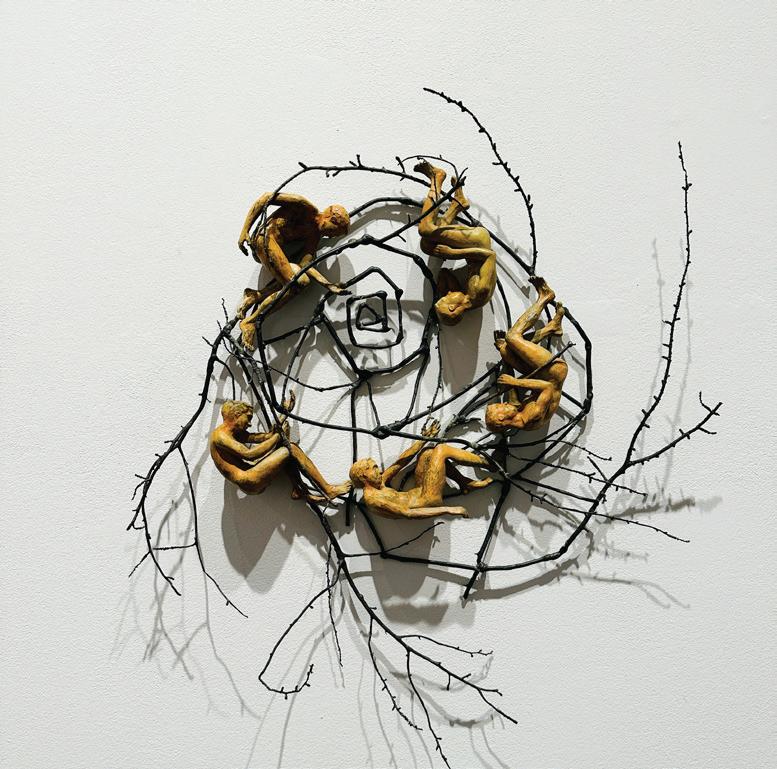
31 PHOTOGRAPHS DO NOT BEND
Denton Modernism: 1940–1980
Elyse Hradecky’s
28. Marcy Palmer: Private Collection Kenna: Trees pdnbgallery.com
32 THE POWER STATION
A solo show for Robert Grosvenor curated by Rob Teeters opens Oct. 20 at The Power Station and continues through Mar. 2, 2024. powerstationdallas.com
33 RO2 ART
Ro2 Art’s Bumin Kim: Jovian Resonance
George: Neal will open on Oct. 21 and remain on view through Nov. 25. ro2art.com
34 SAMUEL LYNNE GALLERIES
Artist Tyler Shields returns to Dallas for the unveiling of his 2023
35 SITE131
Site131 memorializes its founding partner in is a gift: Seth Davidow collection collection over a 30-year period. Through Dec. 9. site131.com
12
November 5–January 28
Experience the light and color of France
NOTED: GALLERIES
36 SMINK
A showcase of fine design and furniture, the showroom also hosts exhibitions featuring Robert Szot, Gary Faye, Richard Hogan, Dara Mark, and Paula Roland. sminkinc.com
37 SOUTHWEST GALLERY
Southwest Gallery offers Dallas the largest collection of fine 19th–21st-century paintings and sculptures. Oleg Turchin, a master at blending photorealism and surrealism to create a signature style in his paintings of cityscapes, portraits, and still lifes, will mount at the gallery from Nov. 4–Nov. 31. swgallery.com
38 SWEET PASS SCULPTURE PARK
A Long Leash by Ryan Hawk remains on view through Nov. 11. Hawk explores alternate corporeality and forms of embodiments. sweetpasssculpturepark.com
39 TALLEY DUNN GALLERY
Eva Lundsager: Seeing Changing closes Oct. 7. New Works by Leonardo Drew continues through Dec. 9. A new exhibition, Sun Dogs, sees Natasha Bowdoin in the gallery from Oct. 21–Dec. 9. talleydunn.com
40 VALLEY HOUSE GALLERY
Emily LaCour: Full Circle continues through Oct. 28. An exhibition for Mary Vernon highlights VHG from Nov. 11–Dec. 9. Image: Emily LaCour, Inheritance, 2021, oil on panel, 59.87 x 47.87 in. valleyhouse.com
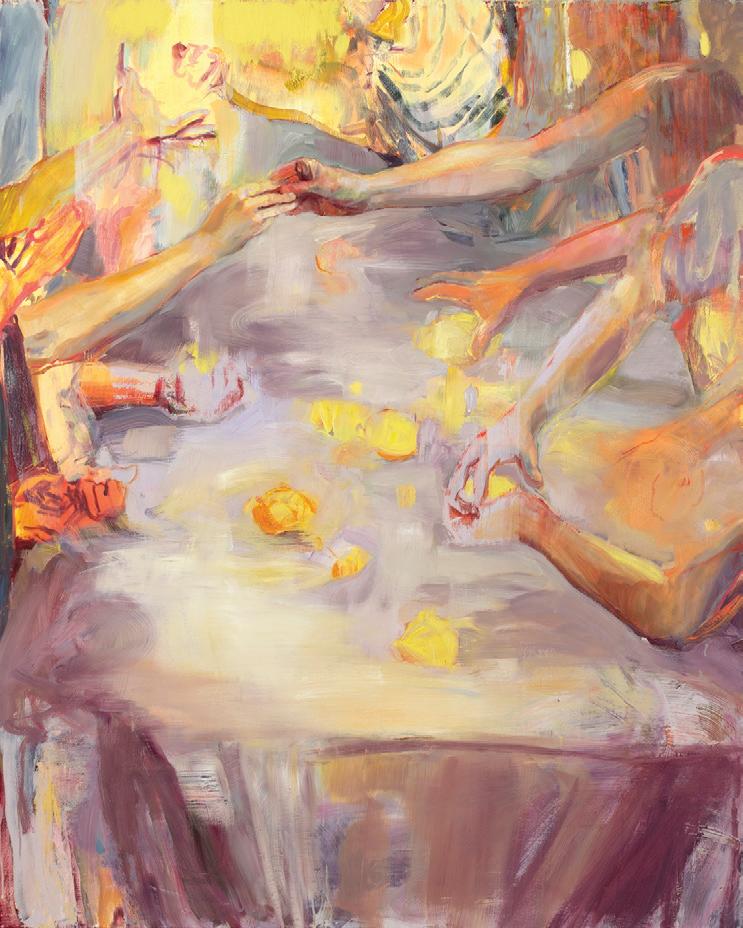
41 VARIOUS SMALL FIRES
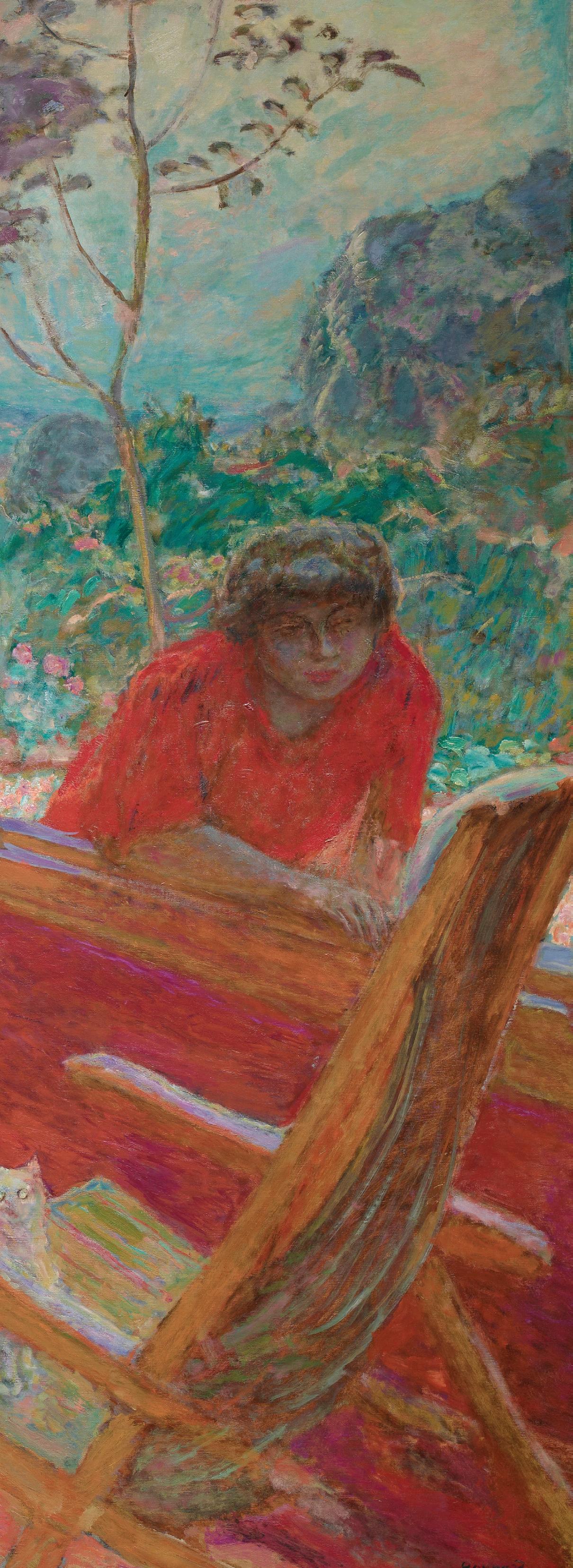
Nightscapes with Palms and Egrets marks the Texas debut solo exhibition by Trinidad-based artist Che Lovelace. The exhibition advances Lovelace’s practice that celebrates his homeland and homes among the island’s lush flora and fauna; through Oct. 28. Next, Alina Perez’s The Turquoise Room is on display from Nov. 4–Dec. 23. vsf.la
42 WEBB GALLERY
Waxahachie’s Webb Gallery will host an exhibition for Carl Block through Nov. 28. webbartgallery.com
50 PATRONMAGAZINE.COM
The exhibition is organized by the Kimbell Art Museum and The Phillips Collection. It is supported in part by Frost, the Texas Commission on the Arts, and by an indemnity from the Federal Council on the Arts and the Humanities.
40
Pierre Bonnard, Dining Room in the Country (detail), 1913, oil on canvas. Lent by the Minneapolis Institute of Art, The John R. Van Derlip Fund. © 2023 Artists Rights Society (ARS), New York Promotional support provided by
43 WILLIAM CAMPBELL CONTEMPORARY ART NEXT
At the Byers location, Gigi Mills’ first exhibition at the gallery continues through Nov. 11. Work by Patty Sutherland, Julie Lazarus, and Maxine Helfman remain on view at the Foch location through Oct. 21. Image: Patty Sutherland, 4 White Lines with 3 Black Lines, 2023, mixed-media 14 x 14 x 1.50 in. williamcampbellcontemporaryart.com
AUCTIONS AND EVENTS 01 HERITAGE AUCTIONS
HA auction highlights include: Urban Art Showcase Auction on Oct. 4, Luxury Accessories Signature Auction on Oct. 5, Illustration Art Signature Auction on Oct. 6, In Focus: Edouard Cortès, Antoine Blanchard, and the Painters of Paris Auction on Oct. 10, Depth of Field: Photographs Showcase Auction on Oct. 11, the Fine & Decorative Arts Showcase Auction on Oct. 12, the In Focus: Robert Indiana Showcase Auction on Oct. 18, Art of the West Showcase Auction on Oct. 20, Luxe Jewels Showcase Auction on Nov. 2, Modern & Contemporary Art Signature Auction on Nov. 14, and the American Art Signature Auction on Nov. 17. ha.com
02 THE OTHER ART FAIR
Returning October 5–8 at Dallas Market Hall, The Other Art Fair presents 100-plus artists from across the globe, including guest artist Charles Michael Davis, who will craft scenes and capture portraits inspired by his blackand-white series Park Menagerie. Fairgoers will have the chance to acquire their own Wild at Heart portrait, including a static unmasked photograph and a masked action shot directed by Charles Michael Davis.
03 TWO X TWO FOR AIDS AND ART
While the TWO x TWO for AIDS and Art 2023 Gala is sold out, bidding is now open and continues through Oct. 21. The annual auction benefits the Dallas Museum of Art and amfAR, the Foundation for AIDS Research. twoxtwo.org
51 OCTOBER / NOVEMBER 2023
01
Sotheby’s Charlie Adamski Caulkins shares her top picks for the one-of-a-kind TWO x TWO silent and live auction.
 BY CHARLIE ADAMSKI CAULKINS
SHARP-EYED BIDDING Y
ear after year, the TWO x TWO for AIDS and Art team assembles an impressive and dynamic auction that mirrors and anticipates trends in the contemporary art world. This year is no different as we see a renewed emphasis on figuration as well as the addition of new galleries to the roster. As head of the Dallas office for Sotheby’s, I work with clients all over Texas and relish the opportunity to explore the upcoming TWO x TWO offerings; it’s a moment for discovery and teaching. This auction has something for everyone—every price point, medium, and taste. Sotheby’s is thrilled to be supporting TWO x TWO again, for the 23rd year in a row.
52 PATRONMAGAZINE.COM
This auction has something for everyone—every price point, medium, and taste.
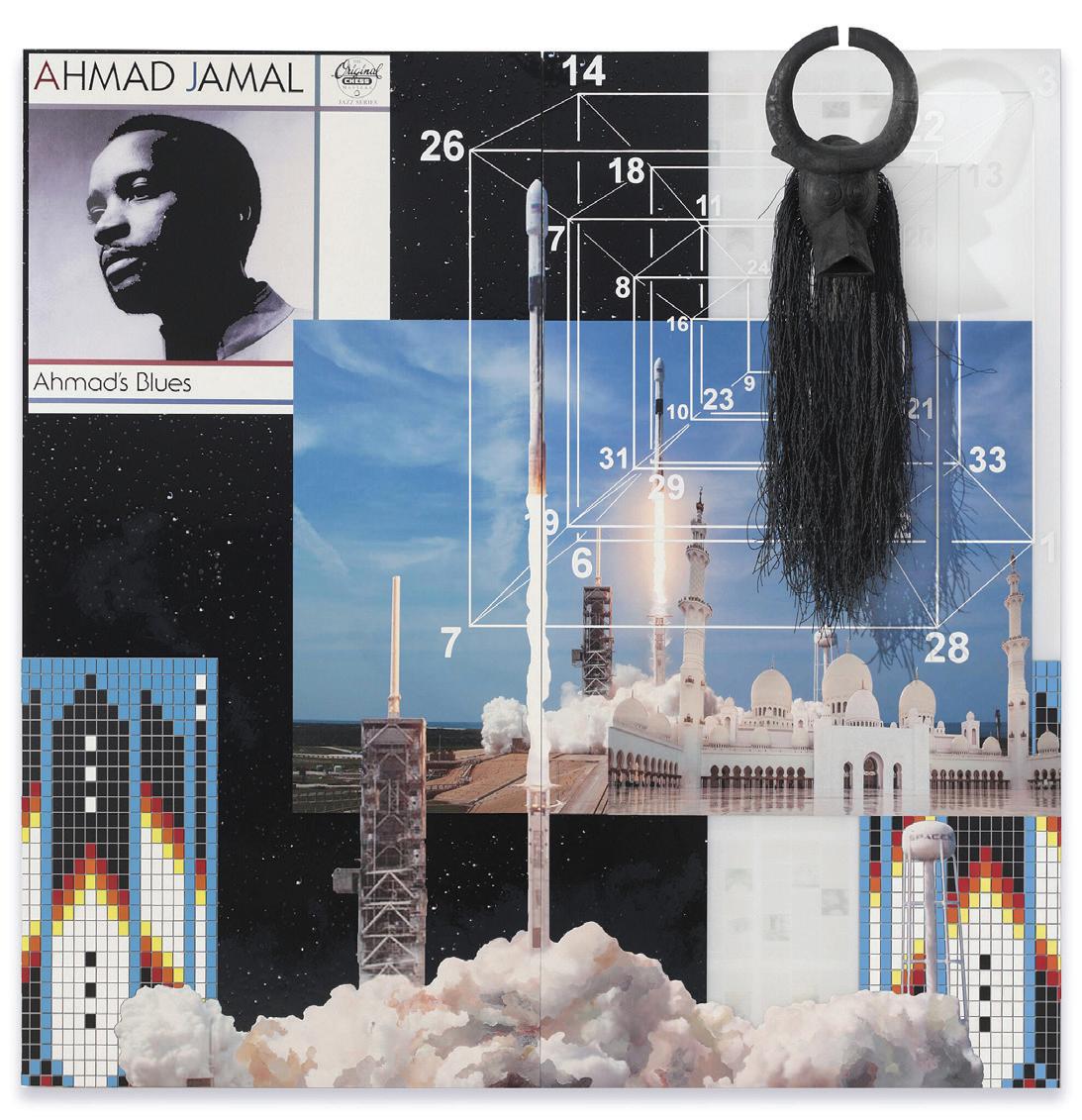
Tavares Strachan, The Blues, 2021, 2 panels, oil, enamel, Bambara mask (Mali), natural fibers, pigment, brass, and acrylic, 84 x 84 x 2.50 in. Courtesy of the artist and Marian Goodman Gallery.
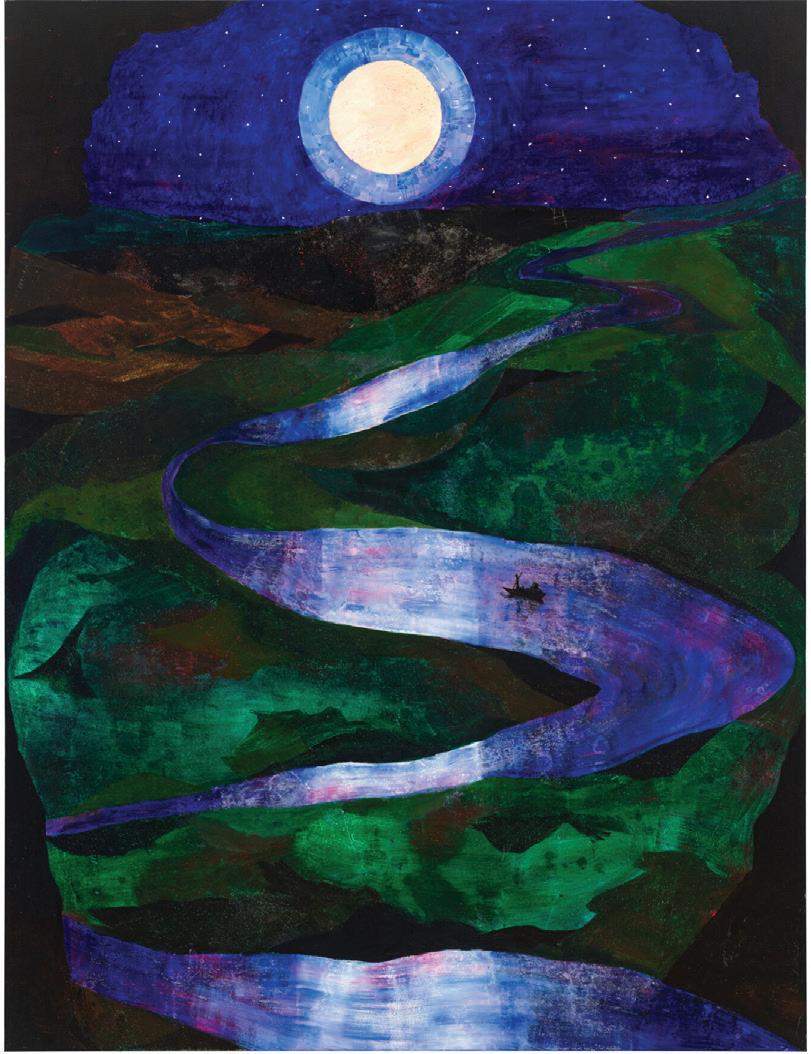
Tom Anholt, Upstream, 2023, oil on linen, 99 x 75 in. Courtesy of the artist and Josh Lilley, London.
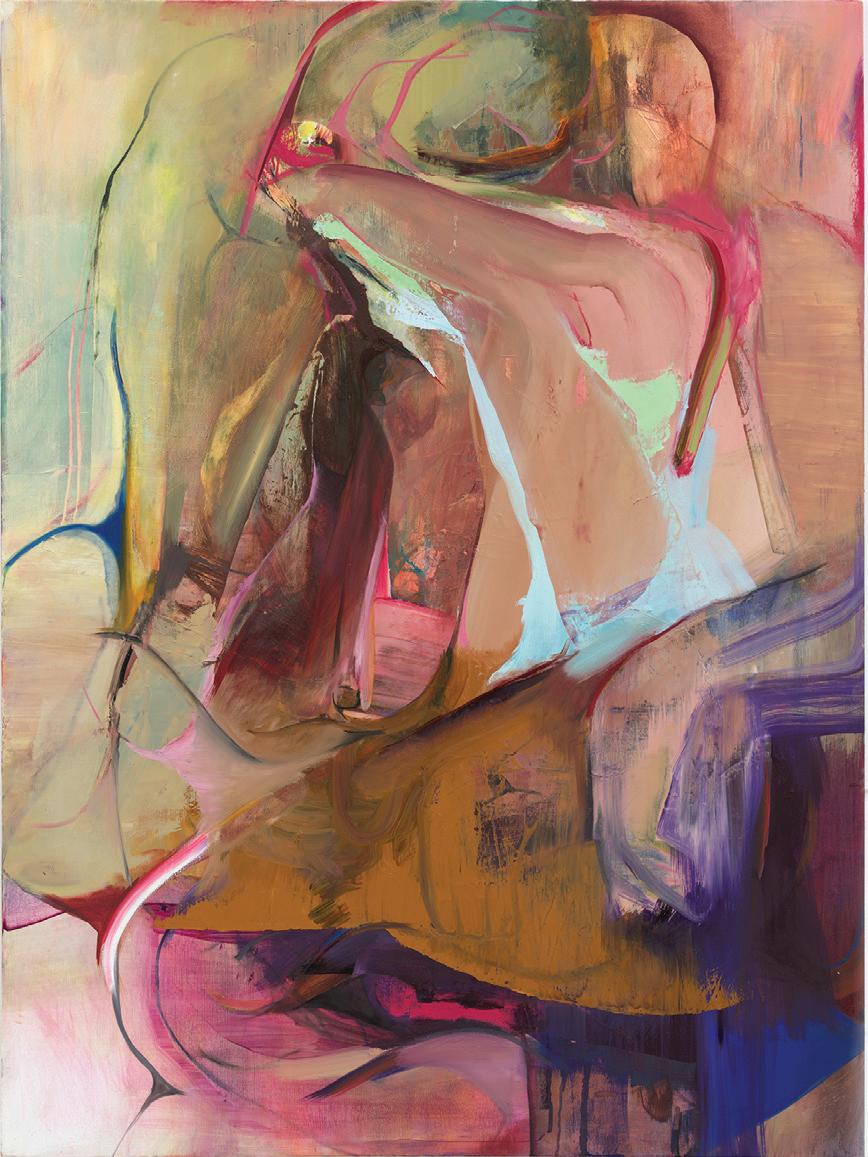
Maja Ruznic, Promaja/Draught, 2023, oil on linen, 70 x 50 in. Courtesy of the artist and Karma, New York and Los Angeles.
A FEW POINTERS TO GET STARTED
1
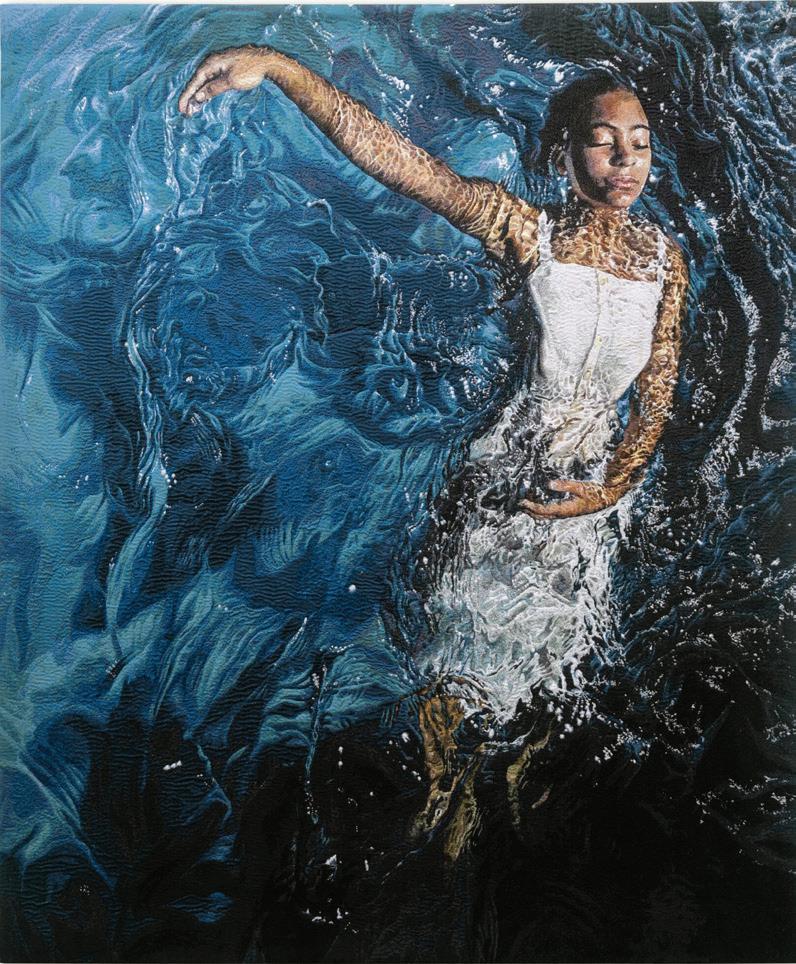
After perusing twoxtwo.org, see the works in person. (Thumbnails do not do the art justice. One example: Calida Rawles’ stunning Our Grace is a full-scale jacquard tapestry, not a photo or painting, which makes a completely different impression.)
2
Pay attention to how the works are being sold: Works designated as OWNitNOW, are available for immediate purchase as early as Oct 10th, so you must act quickly.
3
Follow your gut and have fun—learn something new and engage in a bit of friendly competition to raise much-needed funds for two incredible charities: amfAR, the Foundation for AIDS Research and the Dallas Museum of Art.
On October 21, once gala guests have gathered in the tent for dinner, Michael Macaulay, Sotheby’s auctioneer and a TWO x TWO veteran, will take the stage flanked by Howard Rachofsky and John Runyon as wingmen extraordinaire. They will face a glittering room of art enthusiasts with paddles poised to jump into action.
MY LIVE AUCTION PICKS
Honoree María Berrío’s elegant watercolor and collage painting Act II, Scene 4: Threshold anchors this year’s live auction and warrants a close look and appreciation.
I am particularly excited about Bahamian artist Tavares Strachan’s painting, The Blues . An impressive example of his dynamic allegorical compositions, this 2021 composition combines the artist’s intense interest in science, history, and art.
Measuring an impressive 99 inches high, Tom Anholt’s Upstream transports the viewer into a fantastical nightscape where a lone
53 OCTOBER / NOVEMBER 2023
AUCTION
Follow your gut and have fun—learn something new and engage in a bit of friendly competition.
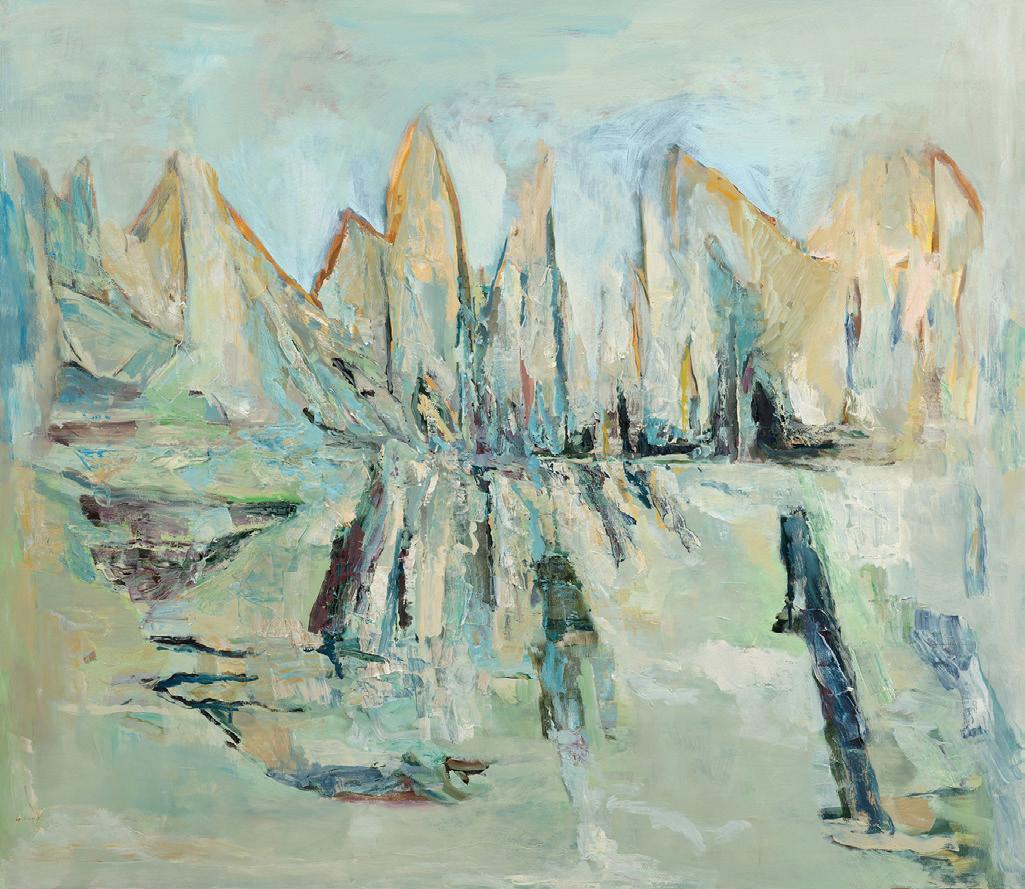
Francesca Mollett, Casts, 2023, oil on calico, 51.12 x 59 in. Courtesy of the artist, GRIMM, Amsterdam, New York, and London; and Micki Meng, San Francisco.
Grace Carney, Tiny Grief, 2023, oil on canvas, 48 x 36 in.
Photograph by JSP Art Photography. Courtesy of the artist and PPOW, New York. Photograph by JSP Photography.
Calida Rawles, Our Grace, 2022, jacquard tapestry, 96 x 78 in., edition 1 of 10. Courtesy of the artist and Lehmann Maupin, New York, Hong Kong, Seoul, and London.
AUCTION
canoe, guided only by moonlight and the stars, makes its way up a winding river. Upstream is a wonderful example of Anholt’s more recent paintings, in which vast, dreamy landscapes become the focal point.
Maja Ruznic’s painting Promaja/Draught consists of layers of oil paint applied in geometric forms. The composition takes on an otherworldly aura as the artist references a cold, blustery, mystical wind in the title. Found in several Dallas collections, including the DMA and The Rachofsky Collection, this artist’s surrealist paintings have made a splash in Dallas the past few years.
Now for the silent auction. Look for the opportunities in this section. Maximum bids can be placed on behalf of individuals not attending the gala. At the gala, follow the crowd immediately after dinner as Howard Rachofsky and his team close each lot consecutively.
MY SILENT AUCTION PICKS
Works by 2022 MFA graduate Grace Carney expertly walk the line between abstraction and figuration, resulting in painterly compositions that exude emotion. Entangled limbs highlighted by striking shades of crimson and teal along with the work’s title, Tiny Grief, point to an emotionfilled narrative behind the composition. Carney is one to watch, with her first solo exhibition on the horizon for 2024 with P P O W Gallery.
Casts, painted by rising star Francesca Mollett, is a
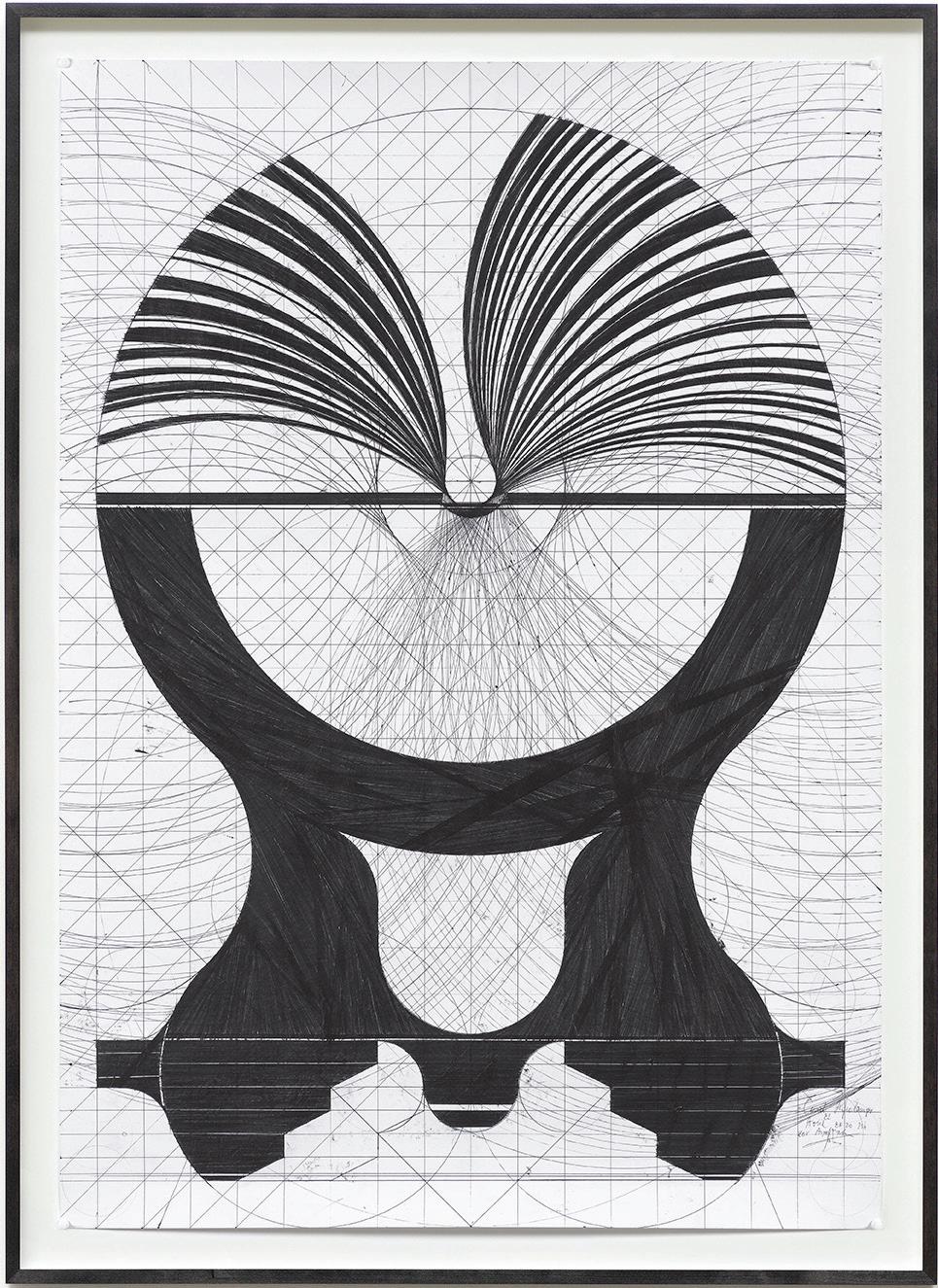
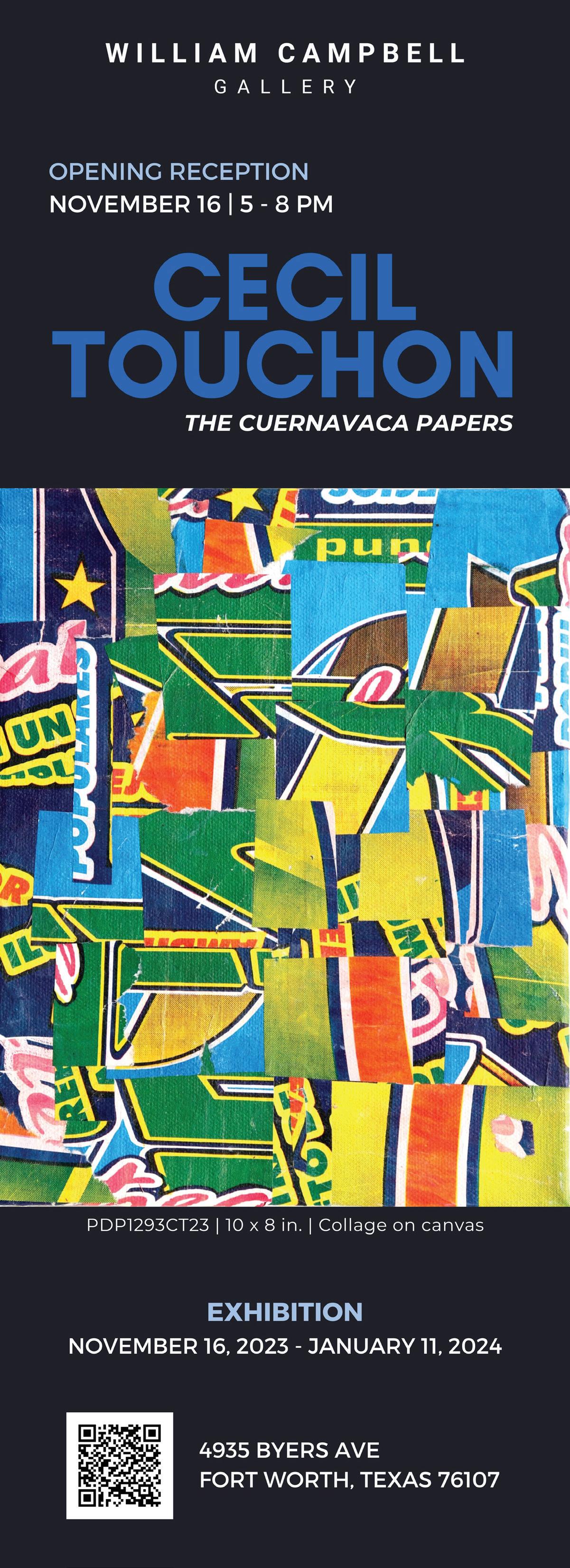
54 PATRONMAGAZINE.COM
Jean Katambayi Mukendi, Covid 22 Afrolampe Perpétuation Avril 2020 23h, 2020, pen on paper, 39 x 28 in. Courtesy of the artist and Ramiken, New York.
wonderful example of the artist’s abstract compositions, which have resonated within the art world. Heavily worked, the result is a shimmering image that not only exudes a sense of calm in its overall tonality, but also a decisiveness in its determined lines. Exhibited at the GRIMM Gallery in Amsterdam this summer and represented by Micki Meng gallery in San Francisco, this British artist is certainly getting exposure across the globe. This work has been designated as OWNitNOW.
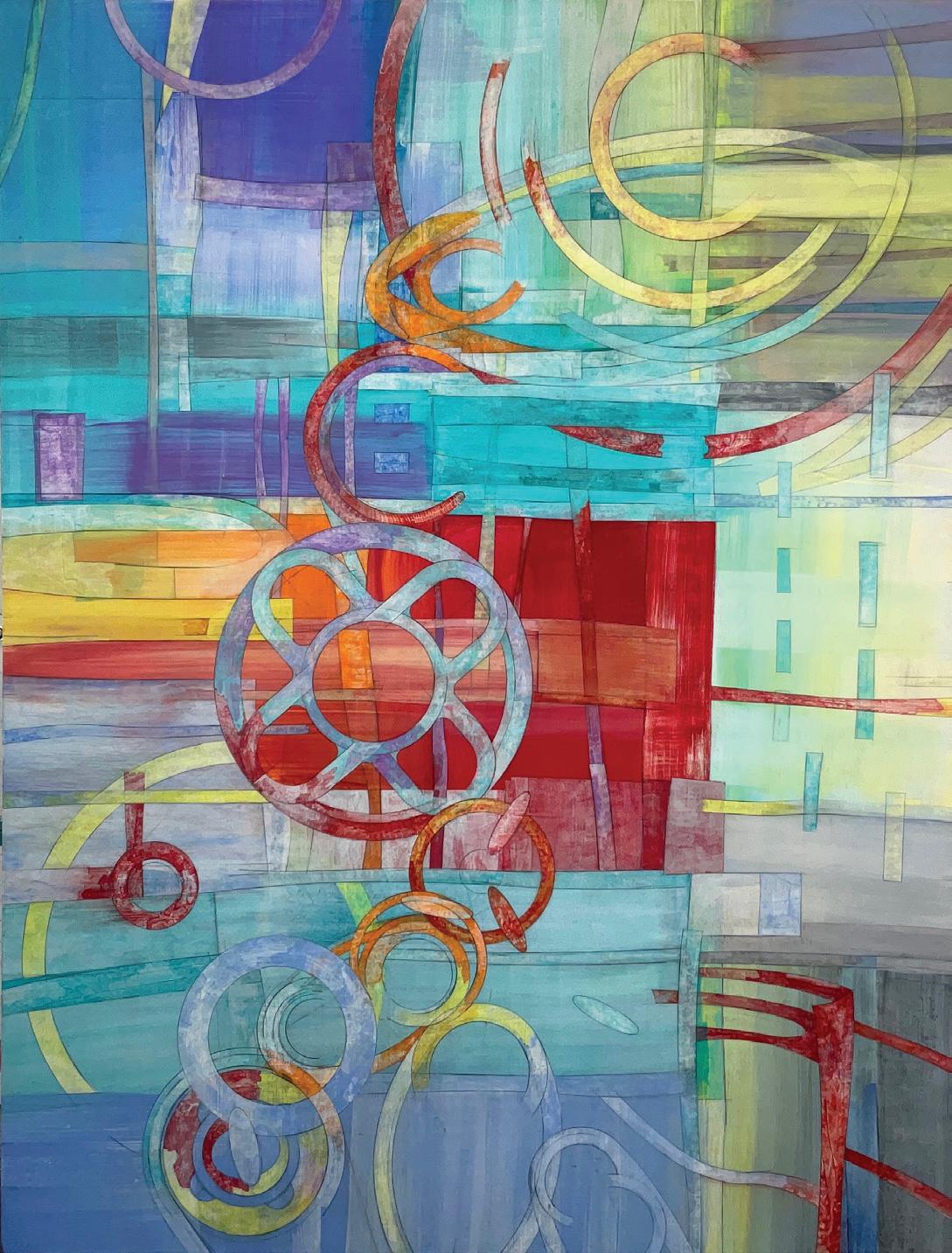
The mesmerizing detail of Congolese artist Jean Katambayi Mukendi’s 2020 pen drawing Covid 22 Afrolampe Perpétuation Avril 2020 23h immediately caught my eye. From a series debuted in his first US exhibition at Ramiken gallery back in 2020, Mukendi called on his engineering background as a foundation for this series, which features fantastical meditations on the inner workings of the light bulb. The compositions themselves take on a deeper meaning as he employs the light bulb as commentary on global geopolitical tensions.
As a mother, I find Madeline Donahue’s beautifully composed depictions of the moments that define motherhood resonant, particularly in the way she injects a sense of humor and humanity. I sadly missed my opportunity to acquire a work this summer at VSF in Dallas but am excited to have another chance. Balancing the beauty and chaos of everyday moments, in Arms
Donahue embraces her daughter poolside on a summer day while a fallen half-eaten apple lays at their feet and whimsical lizards add a sense of playfulness throughout the composition.
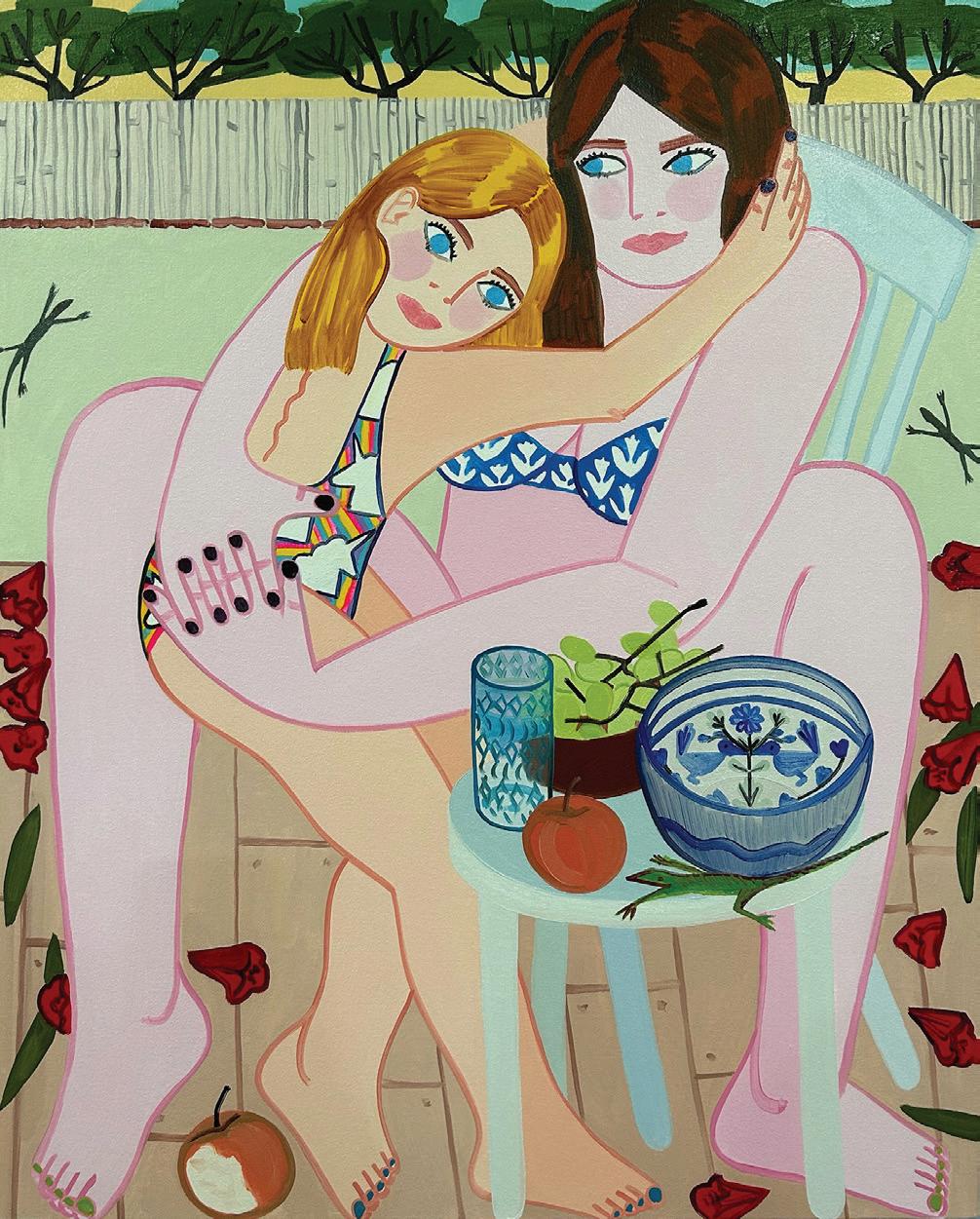
Happy bidding! P

55 OCTOBER / NOVEMBER 2023 The Space Between the Notes: presents MARK SMITH
An
Opening Reception October 7th 4
PM 1011 Dragon St. Dallas TX, 75207 · 214.855.0779 · craigheadgreen.com New paintings and a review of past work
image: Mark Smith “Helios” 48x64 in, 2023
exhibition
commemorating Mark Smith’s 50th anniversary as an artist
- 7
Madeline Donahue, Arms, 2023, oil on canvas, 30 x 24 in. Courtesy of the artist and Various Small Fires, Los Angeles/Dallas/Seoul.
MONUMENTAL QUESTIONS
Iván Argote’s WildFlowers invites discourse on the history of statues in public spaces.
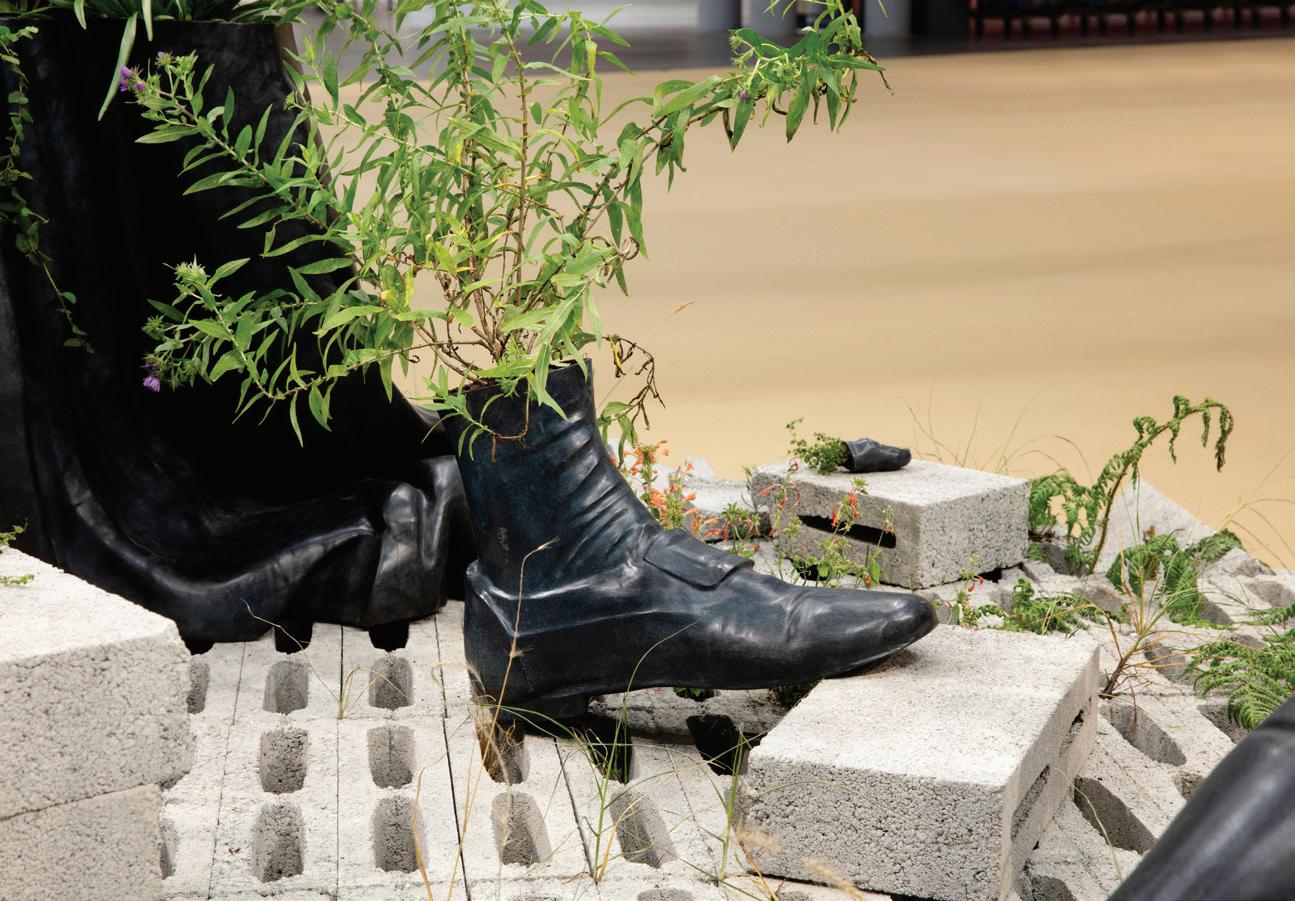
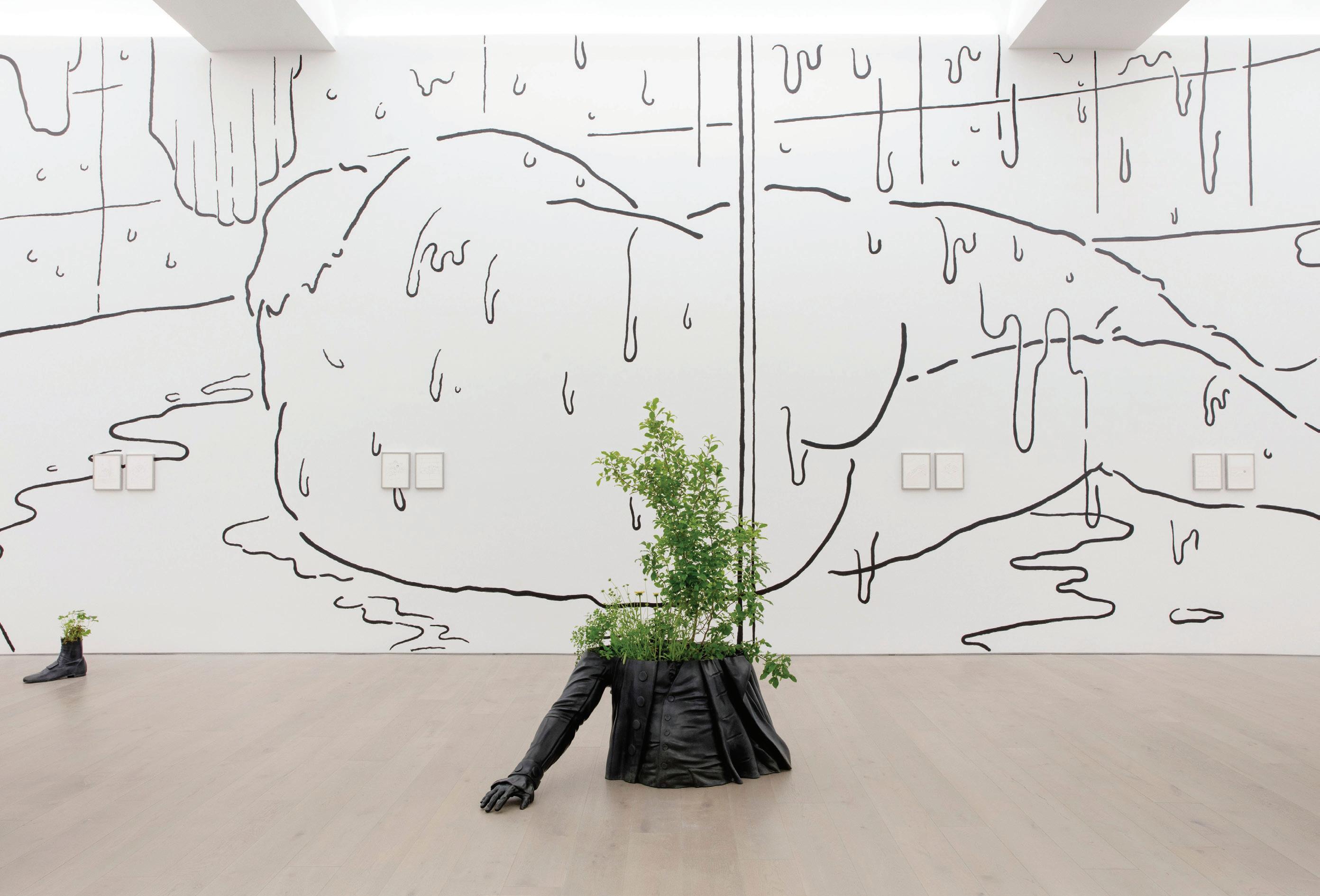 INTERVIEW BY VIVIAN LI
Following a successful showing at Perrotin Gallery’s Dallas Art Fair booth, Iván Argote returns to Dallas this fall with WildFlower s, installed along the Katy Trail. Vivian Li, the Lupe Murchison Curator of Contemporary Art at the Dallas Museum of Art investigates here:
Vivian Li (VL): I am so thrilled you’ll be a featured artist on the Katy Trail this fall, organized in partnership with the Dallas Museum of Art. You have become well-known internationally for your remarkable and poetic interventions in public spaces. Can you introduce your unique practice around public art?
Iván Argote (IA): I grew up [in Colombia] in the projects in front of a favela and spent time between them. Outside was where I developed my own identity. A lot of the work I do comes from those first perceptions of public space on the street. What do we see? How do we live outside, how do we exchange with others outside? I grew up in a very militant and politically engaged family; they have all worked in politics and still do. So I had these two sides: a kind of Tom Sawyer life in the projects, in wild, unconstructed areas of the city, then all the emotions, information, and political views on history from my family. Some years later we moved to the city center in Bogotá, I was fourteen, and I remember discovering a city of monuments, of representation.
56 PATRONMAGAZINE.COM
FAIR TRADE If You Look Hard Enough, You Can See Our Future, installation view at the African
American Museum.
Installation view of Ívan Argote, WildFlowers at The Armory Show, 2022, New York. Photograph by Guillaume Ziccarelli. Courtesy of the artist and Perrotin.
Installation view of Iván Argote: A Place For US at Perrotin New York, 2021. Photograph by Guillaume Ziccarelli. Courtesy of the artist and Perrotin.
So I feel very comfortable working in public spaces. My work has, in the past 15 to 16 years, started from performances and continued with interventions on monuments, proposing sculptures or interactive installations outside, always willing to generate reactions in people and create new narratives. Sometimes it’s more political, about history and historical figures, or how we relate to our own history very intimately. Sometimes it’s more about interaction with others, how we consider otherness.
VL: This won’t be the first time you’ve shown in Texas. The first time we met was in 2021, when you were an international artist-in-residence at Artpace in San Antonio, and you came up to Dallas to visit. Can you talk about some of your other projects, maybe your project at Artpace and your relationship to Dallas and Texas in general?
IA: On a field trip before the [Artpace] residency, I went to walk around San Antonio with the idea of getting lost. I ended up in a square at nighttime, kind of under a highway—a strange place. And then I saw a monument. It was Christopher Columbus, and I’ve done so many projects about him. So, I was like, “Okay, dude, you again?” I started working on this idea of making a Texas barbecue around the square, bringing people who have different opinions on the statue to have a dialogue about it. Then the pandemic happened, and I couldn’t realize that idea.
Just before the residency in 2021, I thought about the statue. The Artpace team told me the statue was removed. Now that the plinth was empty, I proposed to the city to place a stairway so everybody could reach the plinth and be the monument themselves, or use it as a balcony, as a point of view, or do a speech, or sing, or perform. City hall first accepted, then decided not to do it because they were afraid of media reactions. I ended up doing a prototype and the barbecue in Artpace. We invited community members, politicians, and people from different organizations. I reproduced the plinth with the structure that I proposed, plus some interactive games, like children drawing their own monuments. A lot of my work begins with having a place to meet and then proposing a conversation.
VL: Your work deals with such complex and sometimes heavy issues about the histories and values surrounding monuments and public art today. There is a lot to think about, but you also have such a great element of humor and play in your work. How do humor and play fit into your work in general?
IA: There’s something about humor that interests me, and it comes naturally for me. In a country like Colombia—I grew up in the ’80s, ’90s, very violent years—humor helps us process this violent reality. Sometimes when there are strong feelings around topics, humor can
help open a conversation space or introduce critical layers. Humor or affection can help us find a common ground; it’s all about generating empathy. Tenderness and humor are subversive in such a hard world. They can put us in a place where we are more open to putting ourselves in someone else’s shoes.
VL: Katy Trail is a beloved public space that winds through various neighborhoods. Hundreds of people use it daily, creating an engaged audience for public art. And Katy Trail Art began in 2021. It’s entering its third year and has featured many renowned local as well as national and international artists, such as yourself. Can you describe WildFlowers and why you decided to bring this work to the Katy Trail?
IA: WildFlowers is a series of sculptures related to monuments, which is a topic I’ve been working on a lot in the past year. I am always creating these stories in order to start conversations around real actions. What kind of monuments do we have? Why do we have these monuments? What did they represent at the time they were installed and what do they represent today?
Public spaces are always changing with new generations, different perspectives that have visions that are perhaps more welcoming. I often think about possible futures for statues when places change. One was, what if a statue stayed in place, but we generate [a] new use [for it]? So out of a controversial image comes new life. The WildFlower s series is a bronze statue that is cut in parts and has been overtaken by wildlife. The statue becomes planters that host local wildflowers.
There is no face on the monument, so it remains anonymous. It looks very 18th century. I don’t necessarily want to attach it to that period, but I don’t hide that it’s a replica of those statues. But in the end, it’s more about the aesthetics of those kinds of monuments.
I made the first iteration of this series at Perrotin New York, in a show called A Place For Us. It was a replica statue of George Washington, a statue you can find in downtown New York. It was 2021, so the topic was very hot. It was kind of a reaction [to] recent events. Then I installed it again in New York for The Armory Show, curated by Tobias Ostrander, from Tate Modern.
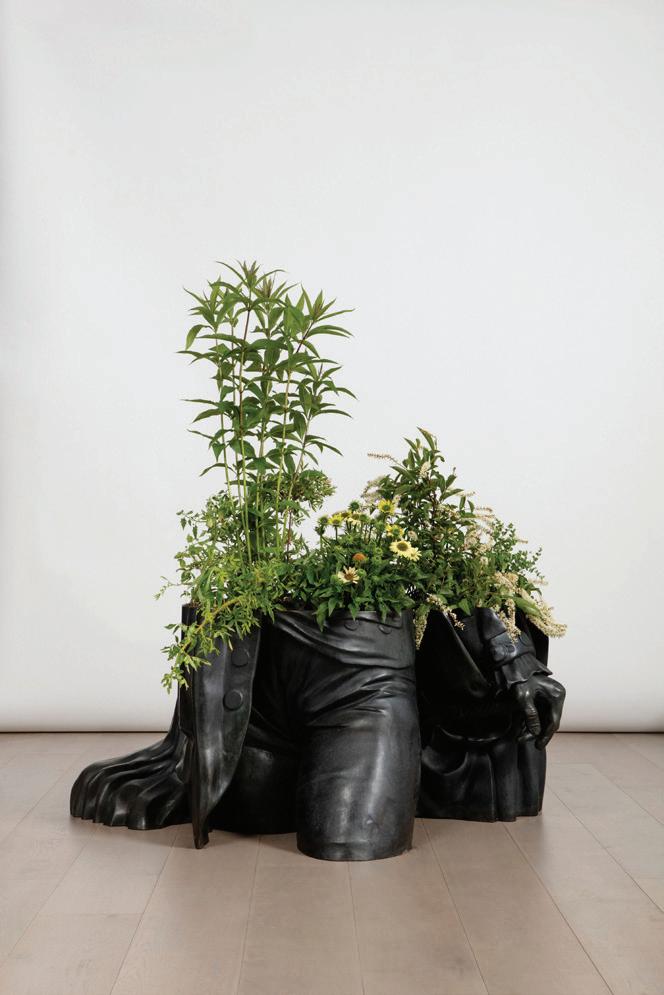
Katy Trail is the first time I’m going to show the series in a public space, which is very exciting because for me, it kind of completes the work. I like the idea that people will wonder if this statue was removed, abandoned, or ready to be installed. Or is it a ruin? Is this a new kind of monument? The sculpture is made to generate those questions. I like to think that the piece is going to be completed by people on the Katy Trail. P
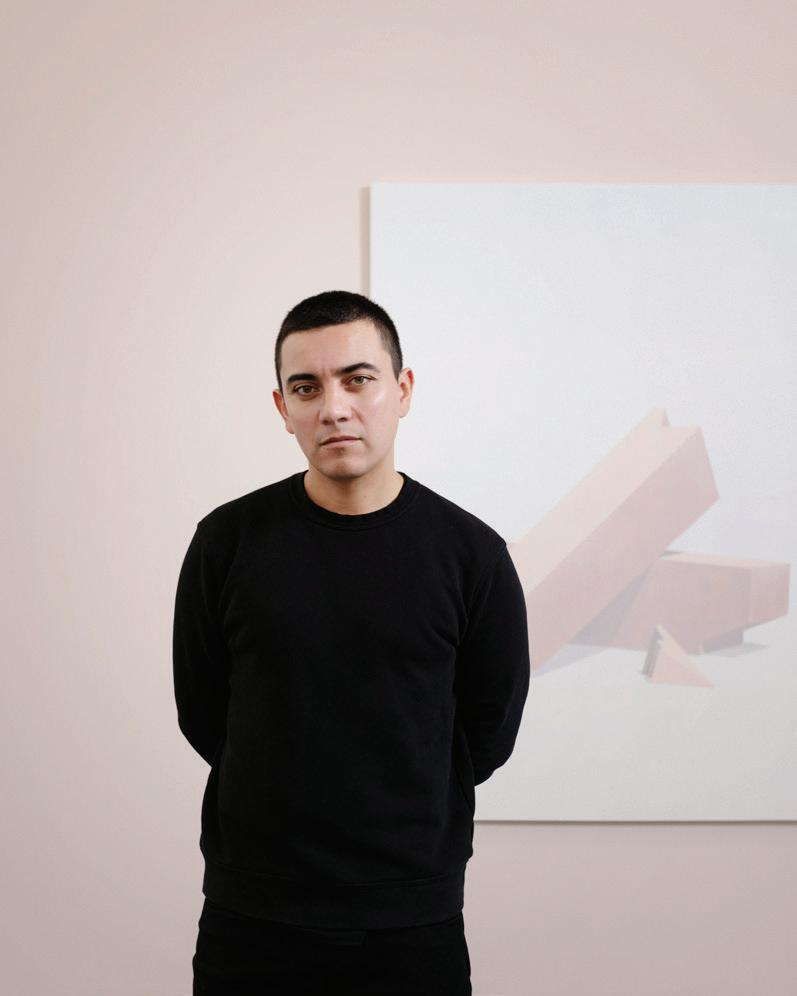
57 OCTOBER / NOVEMBER 2023
Ívan Argote. Photograph by Guillaume Ziccarelli. Courtesy of the artist and Perrotin.
Ívan Argote, WildFlowers: A Hip, 2021, bronze sculpture with live wildflowers, 23.62 x 52.37 x 40.18 in. Photograph by Guillaume Ziccarelli. Courtesy of the artist and Perrotin.
TUREEN DISHES UP A DIVERSE ROSTER
At this new Oak Cliff gallery that favors the avant-garde, community is the mission.
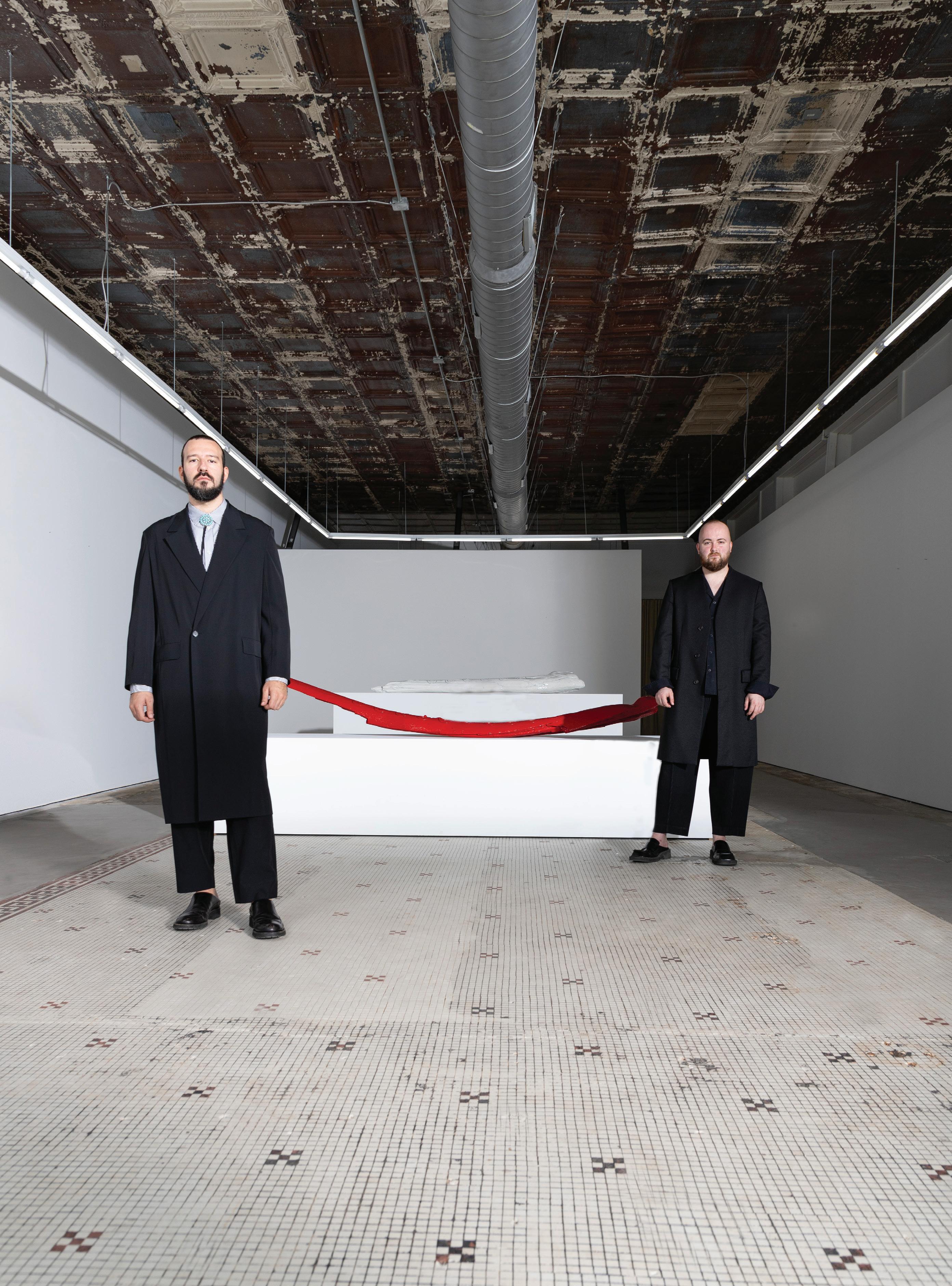 BY SARA HIGNITE PHOTOGRAPHS BY VICTORIA GOMEXZ
Chris Scott and Cody Fitzsimmons at Tureen. Photographs by Victoria Gomez.
BY SARA HIGNITE PHOTOGRAPHS BY VICTORIA GOMEXZ
Chris Scott and Cody Fitzsimmons at Tureen. Photographs by Victoria Gomez.
As today’s art market increasingly transacts in the digital sphere, what is the role of the brick-and-mortar commercial gallery? For the owners of Tureen, a new project-based contemporary art space located in Oak Cliff, it comes down to the essential and irreplicable experiences of viewing art and fostering community in real life.
Tureen is the brainchild of Cody Fitzsimmons and Chris Scott, serious contemporary art collectors who moved to Dallas in 2022 from Houston, where Fitzsimmons cut his art-world chops at galleries including Hiram Butler before becoming a respected art advisor. Scott is an attorney by trade but is equally involved in both the business and creative concerns of the gallery.
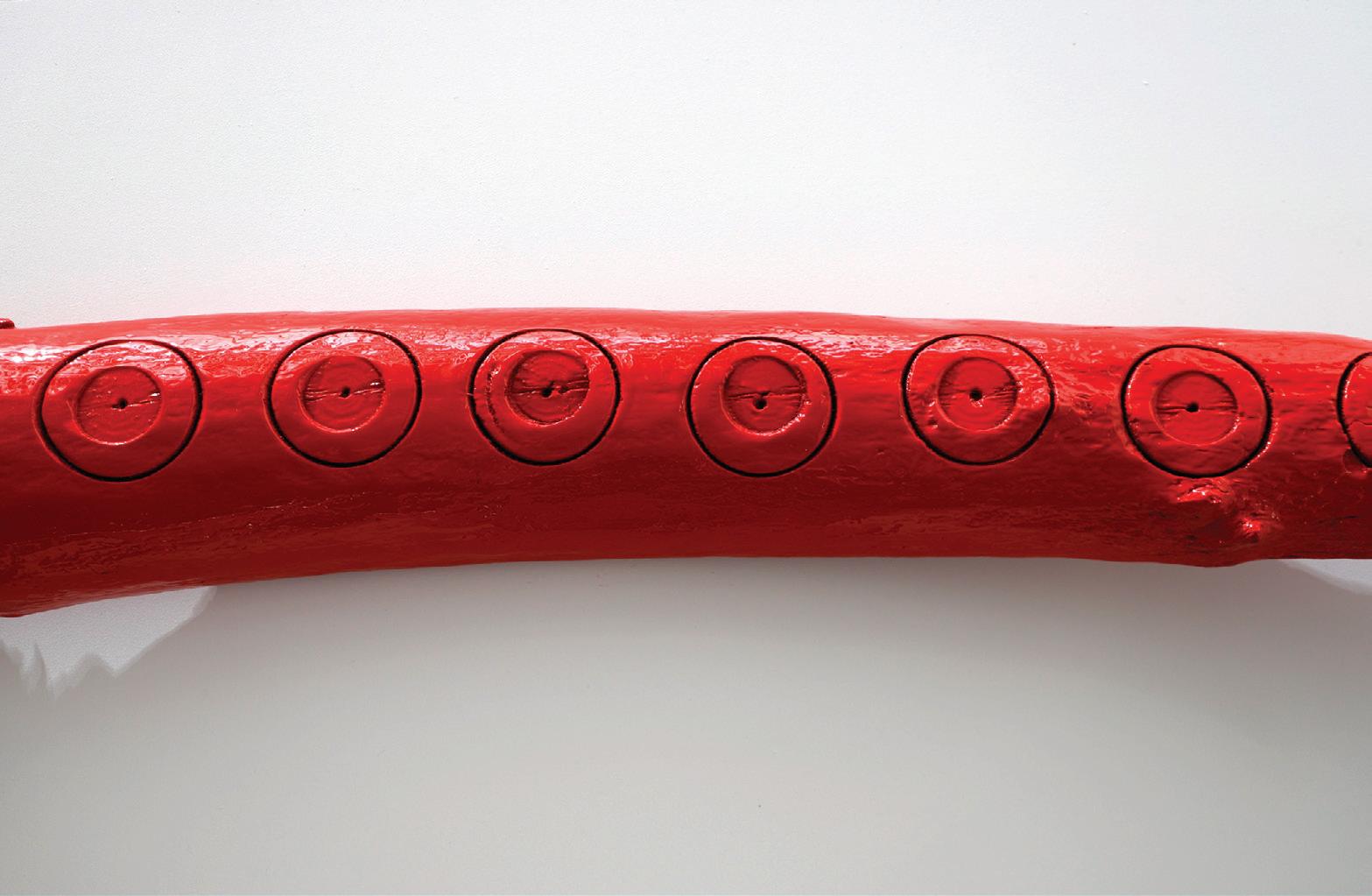
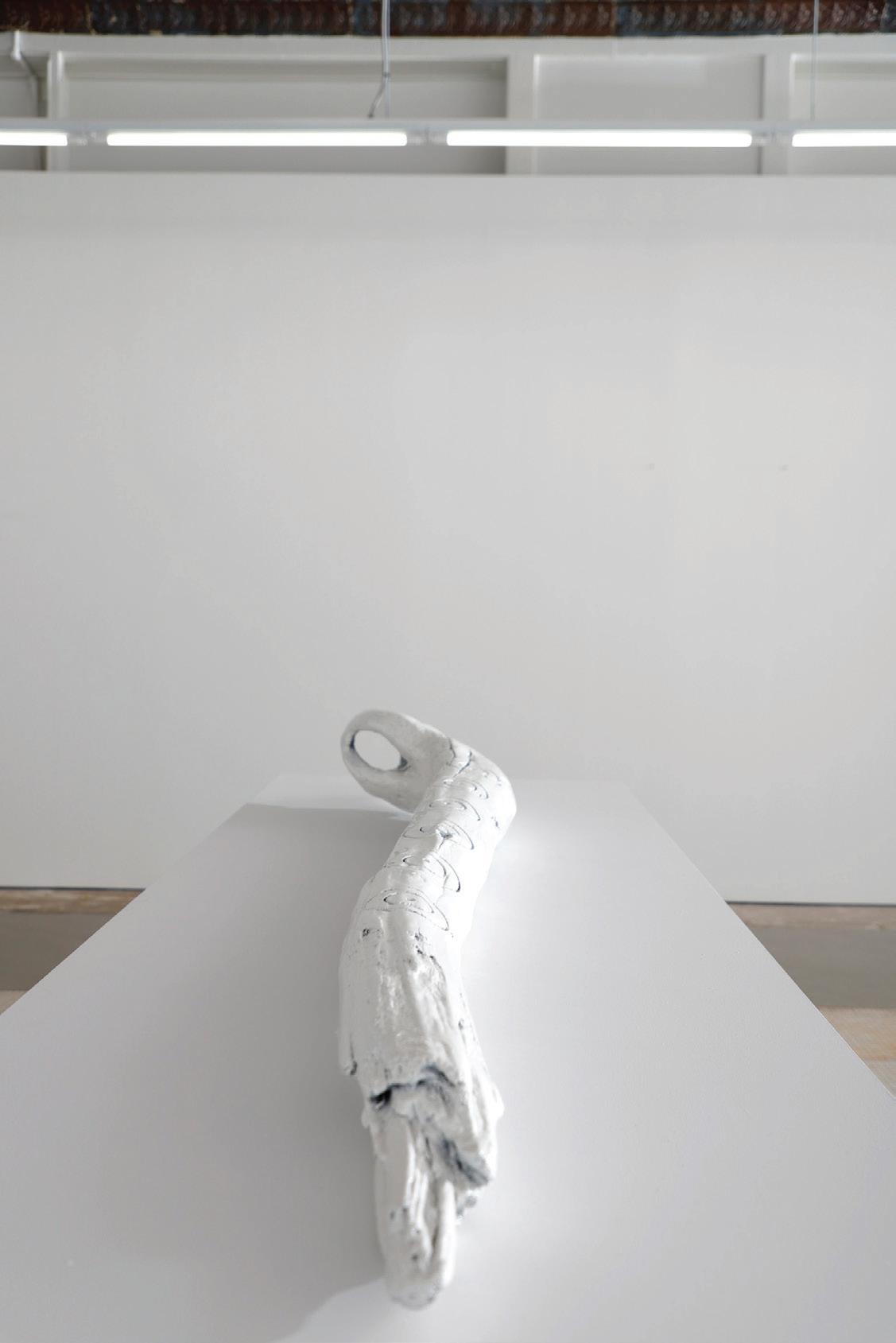
On October 21, Tureen will open a solo show of multidisciplinary artist Theresa Chromati, a Guyanese American rising star based in Brooklyn. Tureen’s exhibition will feature bold new paintings that continue Chromati’s kaleidoscopic and nuanced explorations of the complexities of Black femininity. The artist’s expressive signature style marries figuration and abstraction in a manner of controlled chaos that brings to mind Arshile Gorky while channeling the bold, sparkling power and glitter of Mickalene Thomas.
Chromati’s solo presentation will be the third exhibition to grace the walls of the new project space, which opened on July 15 with an ambitious group show. The exhibition, titled Eugenics in the Garden, took as its starting point the eponymous book by architecture historian Fabiola López-Durán. The challenging works in the show addressed the dissemination of European notions of eugenics via modernism to Latin America and elsewhere across the globe—all in the name of “progress.”
59 OCTOBER / NOVEMBER 2023
OPENINGS If You Look Hard Enough, You Can See Our Future, installation
at the
view
African American Museum.
Above: Sonya Kelliher-Combs, White New Artifact, 2023, found wood and automotive paint, 9 x 83 x 15 in.
Left: Sonya Kelliher-Combs, Red New Artifact (detail), 2023, found wood and automotive paint, 16 x 103 x 16 in.
Fitzsimmons and Scott, whose own collection of art and design reflects a love of the avant-garde, are imbuing Tureen’s program with their elevated taste level and passion for challenging subject matter. Tureen’s name “arose out of discussions about what is important to us—exquisite objects, presentation, and ceremony,” explains Fitzsimmons, and was borrowed from Louise Lawler’s groundbreaking 1984 photograph Pollock and Tureen, Arranged by Mr. and Mrs. Burton Tremaine, Connecticut
Community is essential to Tureen’s mission, and its owners approached the location of their new gallery with intention, selecting one of the most historically significant buildings in Oak Cliff, near the couple’s home: a 1912 storefront that originally served as the town pharmacy. The inviting space features original mosaic tile flooring and tin ceilings that distinguish it from other local galleries. Fitzsimmons wants Tureen to channel its location’s history as a hub of the neighborhood while honoring Dallas’s art scene: “We are thrilled to build upon the legacy set forth by the rich history of galleries, institutions, and collectors in Dallas, which have paved the way for contemporary art in Texas.” In shaping their program, they have carefully and thoughtfully considered how an art gallery can become a meaningful part of its neighborhood and the larger community.
Tureen opened its second show in September with a solo presentation of new work by Sonya Kelliher-Combs, mounted in collaboration with Los Angeles gallery STARS, which exhibited a concurrent show of the artist’s work. Kelliher-Combs uses synthetic and organic materials to explore identity through the lens of traditional “women’s work” across both Western and Indigenous contexts. There is a tension present in the mixed-media paintings and sculptures, a pull between Western and Indigenous, traditional and modern, personal and communal. The artist’s practice is grounded in the history of modern and contemporary art, particularly minimalism, as much as it is rooted in her extensive observation of her Inupiaq and Athabascan communities in Nome, Alaska.
Inclusivity in all its forms is integral to Tureen’s program, and the gallery plans to present a diverse, global roster of artists, from emerging to established. For Fitzsimmons and Scott, who is a citizen of the Cherokee nation, fostering an inclusive and diverse art space is simply part of who they are. Scott’s roots also make Tureen the sole Indigenous-owned commercial art gallery in Dallas, and one of only a handful in the United States.
Says Scott, “So few spaces historically have shown Indigenous artists, and when they have, the context is often more anthropological or craft-focused. I’m interested in showing work by those artists in a fine art context, to show the art world that they are making some of the greatest contemporary art being made today. [My] Indigenous identity makes that effort so much more personal and less about checking a box of exhibiting underrepresented histories.”
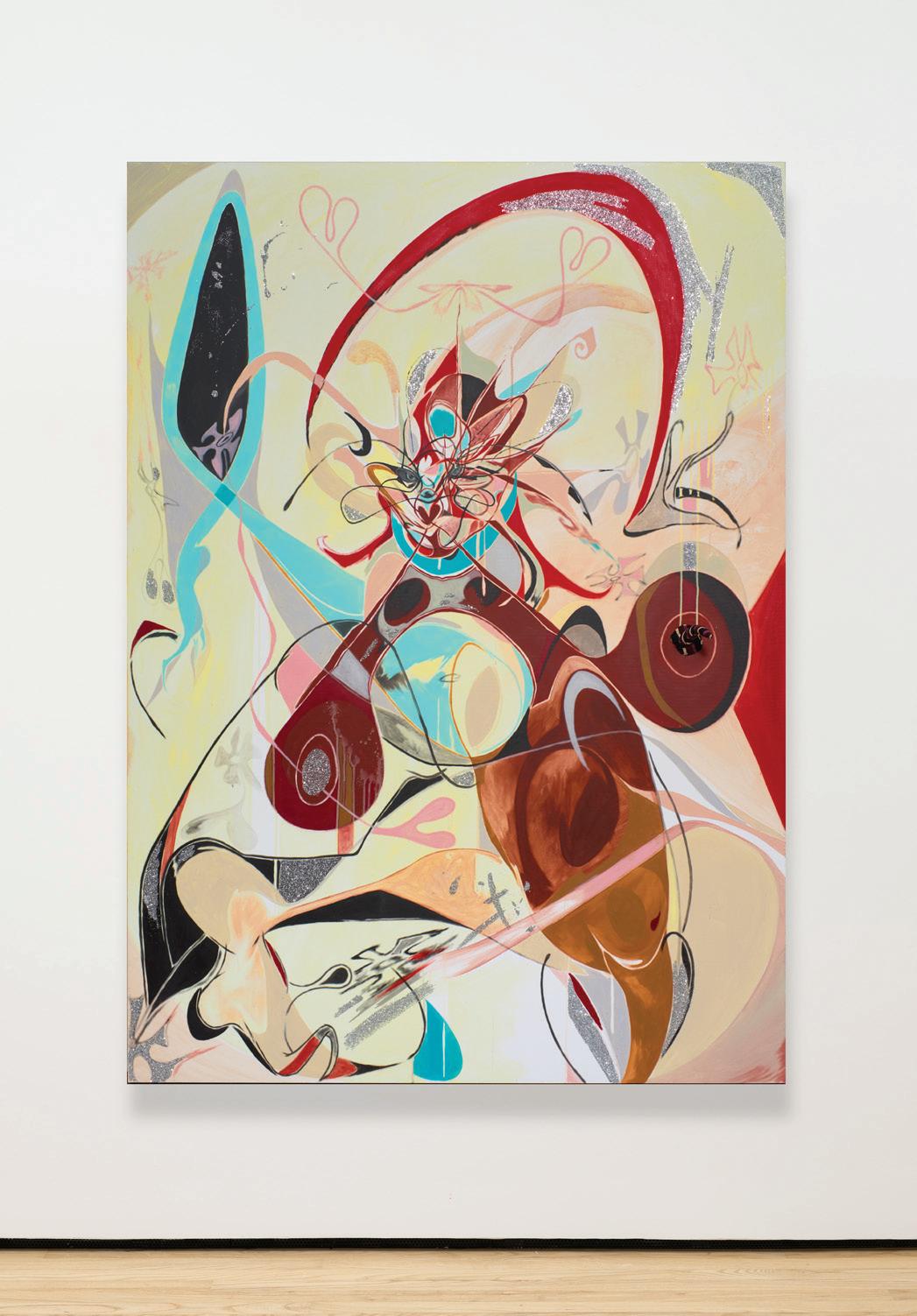
Stepping foot into Tureen’s welcoming, bright space— grounded in community and curated with a strong and clear point of view—serves as a reminder that, in the end, both art and human connection are best experienced in person. P
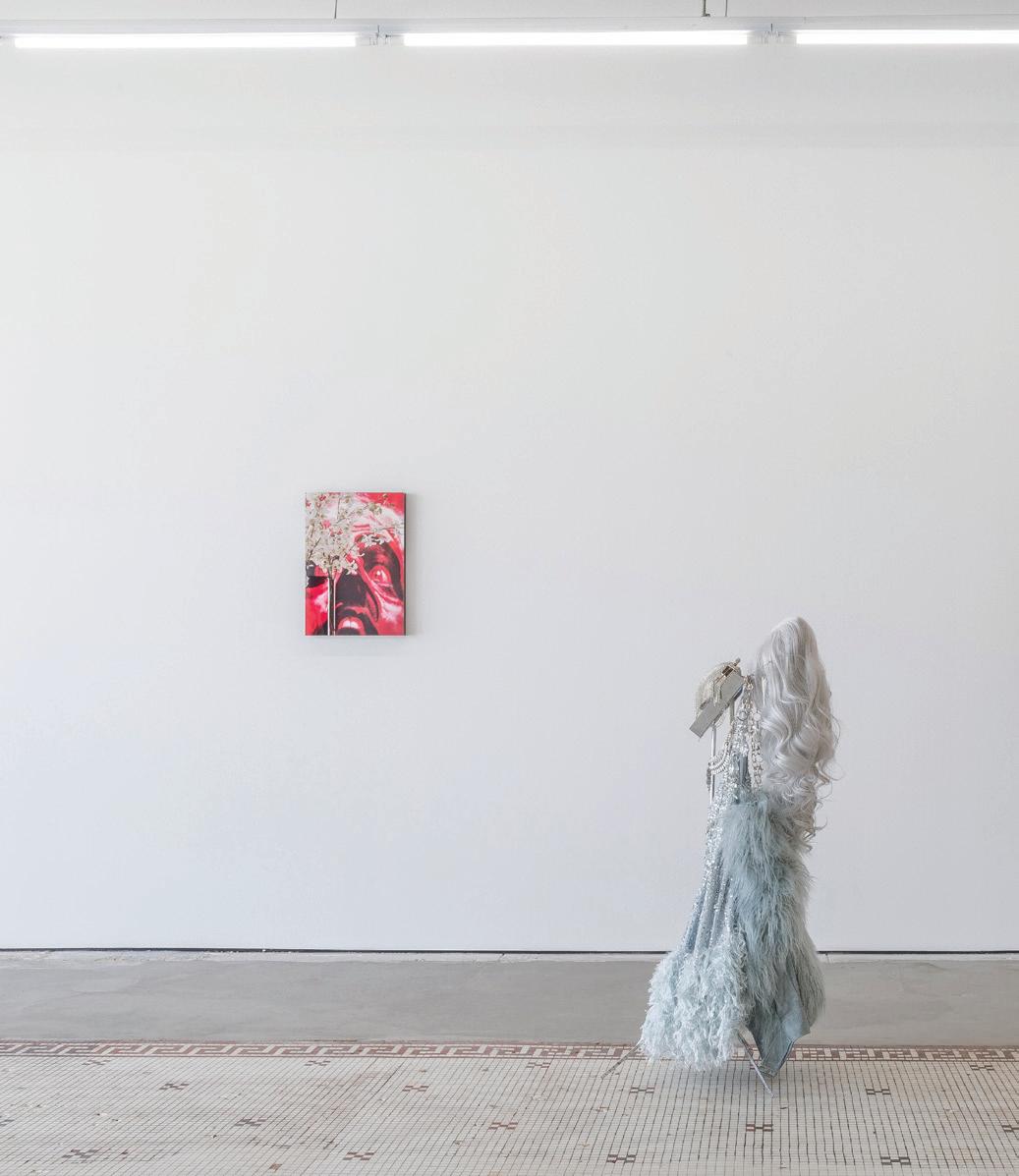
60 PATRONMAGAZINE.COM OPENINGS
Installation views of Eugenics in the Garden Works by Louise Lawler and Kayode Ojo.
Theresa Chromati, Hard Fall and Quick release (Bending in order to Stand), 2023, acrylic and glitter and silk soft sculpture on canvas, 84 x 60 in.
SECURE STORAGE FOR ART, FASHION, AND WINE
COMPREHENSIVE COLLECTION MANAGEMENT
TRANSPORTATION AND CONCIERGE DELIVERY
ART INSTALLATION
PRIVATE VIEWING ROOMS
LOCATIONS NATIONWIDE
UOVO.ART • (833) 344-8686 • INFO@UOVO.ART
TOUR DE FORCE
Annie Leibovitz at Work, on view at the Crystal Bridges Museum, sheds an intimate light on the artist’s mind at work.
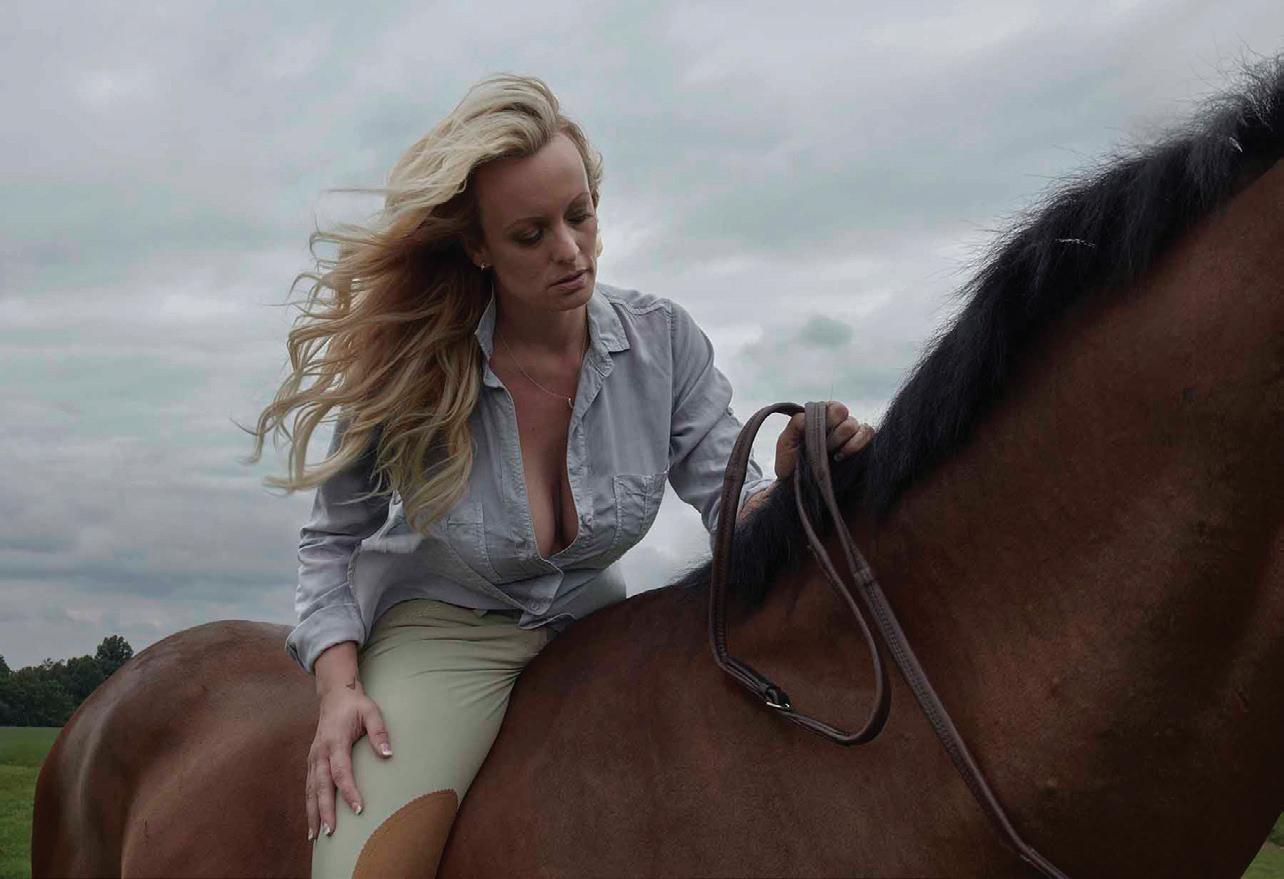
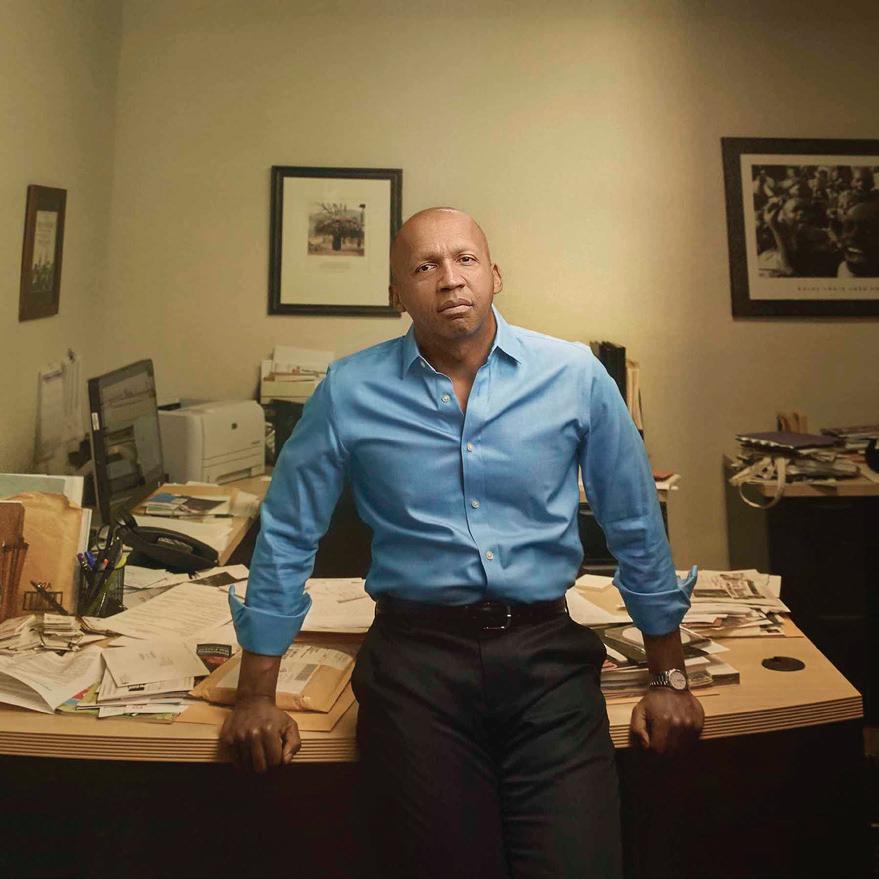
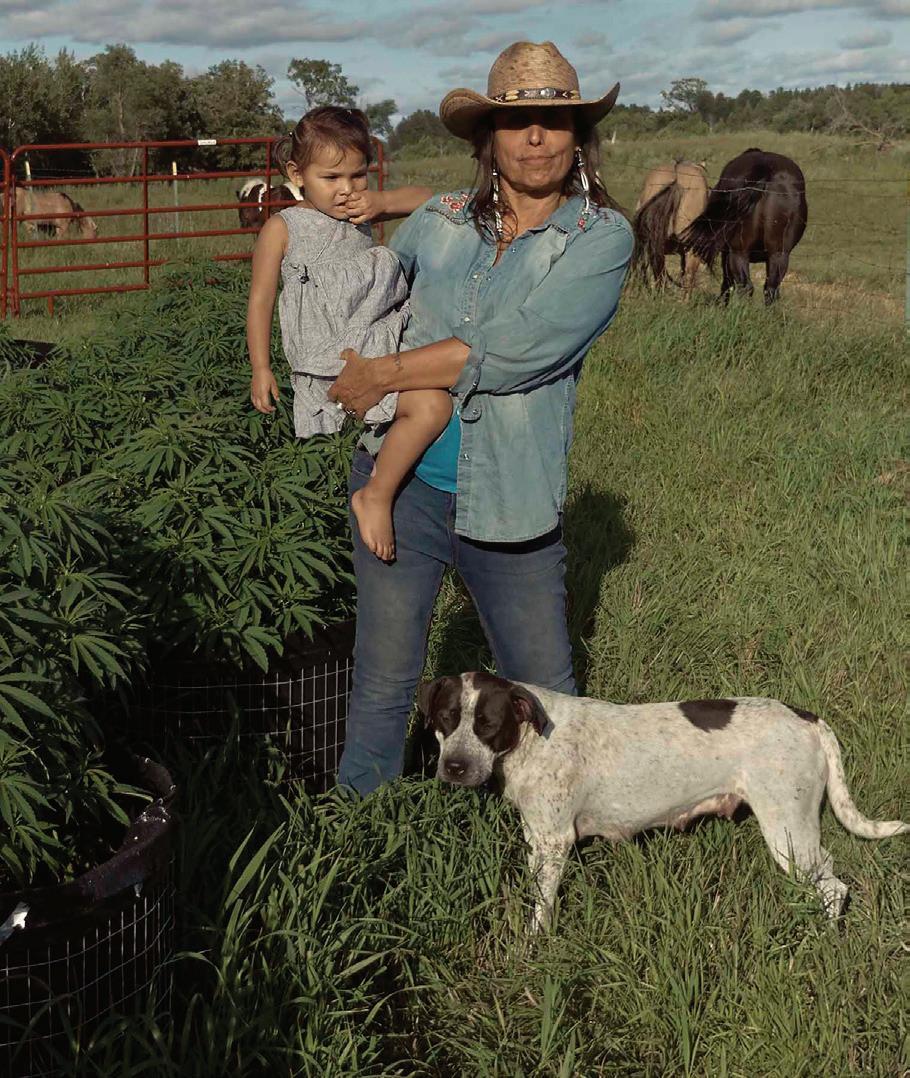
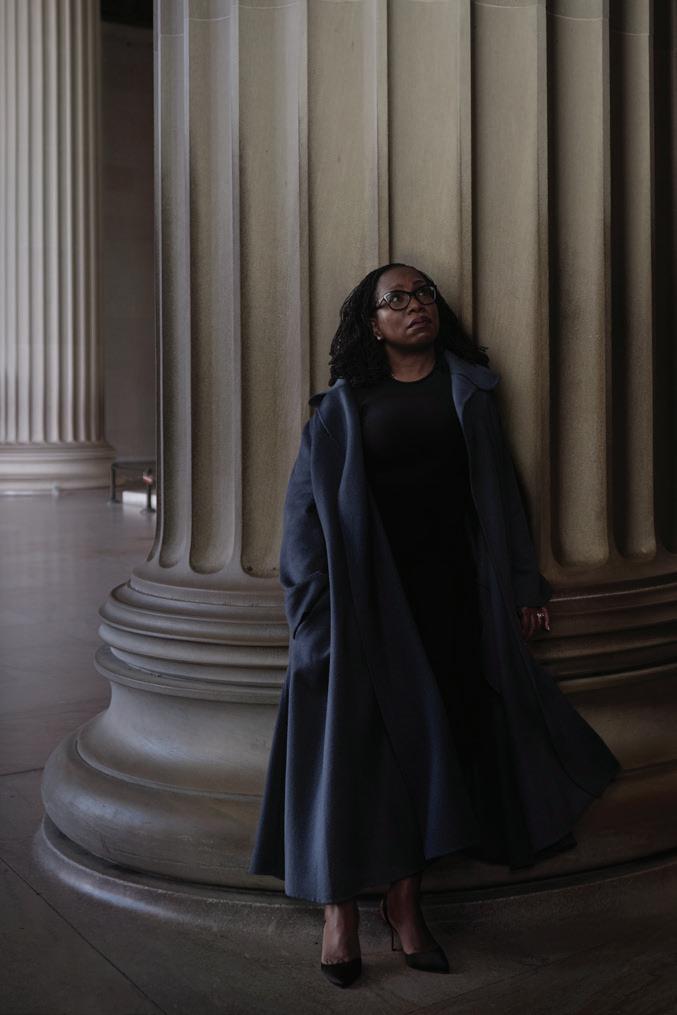
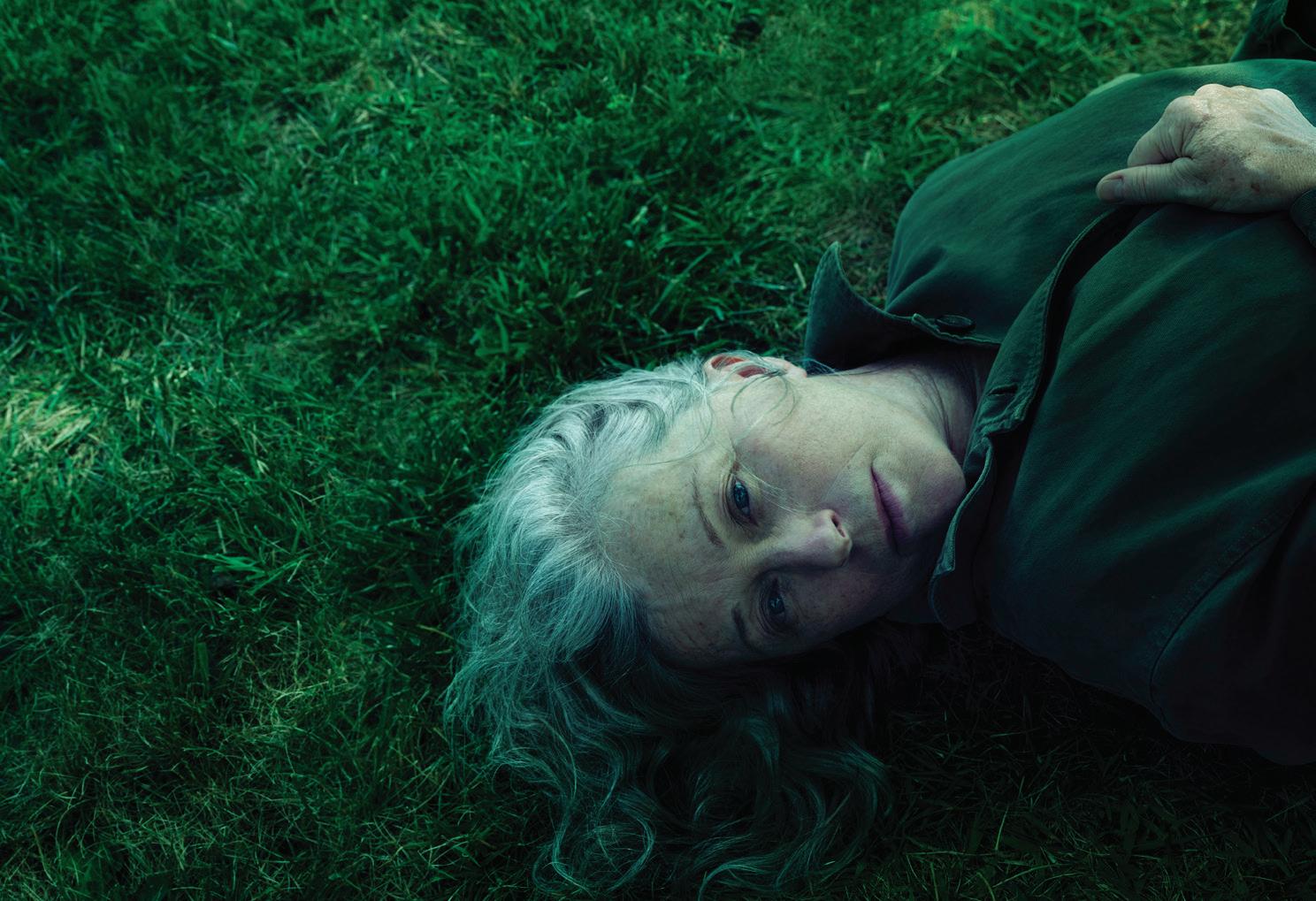 BY JOHN ZOTOS
62 PATRONMAGAZINE.COM CONTEMPORARIES
Clockwise from top left: Annie Leibovitz, Bryan Stevenson , Montgomery, Alabama, 2019. Photograph courtesy of the artist. ©Annie Leibovitz; Annie Leibovitz, Stormy Daniels, West Grove, Pennsylvania, 2018. Photograph courtesy of the artist. ©Annie Leibovitz; Annie Leibovitz, Justice Ketanji Brown Jackson, Washington, DC, 2022. Photograph courtesy of the artist. ©Annie Leibovitz; Annie Leibovitz, Winona LaDuke, Osage, Minnesota, 2019. Photograph courtesy of the artist. ©Annie Leibovitz; Annie Leibovitz, Cindy Sherman, East Hampton, New York, 2022. Photograph courtesy of the artist. ©Annie Leibovitz.
Since the invention of the medium, few photographers ever achieve that elusive status of household name. For Annie Leibovitz, though, it’s been a given for decades. Since the late ’70s her iconic, readily recognizable, and intimate images of cultural and political figures have captivated the popular imagination in numerous publications, starting with Rolling Stone. She increased her visibility by moving on to Vanity Fair and Vogue during the ’80s. Her famed photographs of John Lennon and Yoko Ono (1980), Meryl Streep (1981), and Demi Moore (1991) are virtually seared onto our collective retinas.
This energetic era early in her career culminated in a show at the National Portrait Gallery in 1991, the museum’s first-ever solo exhibition featuring a woman artist. Annie Leibovitz at Work , the artist’s first major museum exhibition in around a decade, is now on view at the Crystal Bridges Museum of American Art in Bentonville, Arkansas, through January 29, 2024.
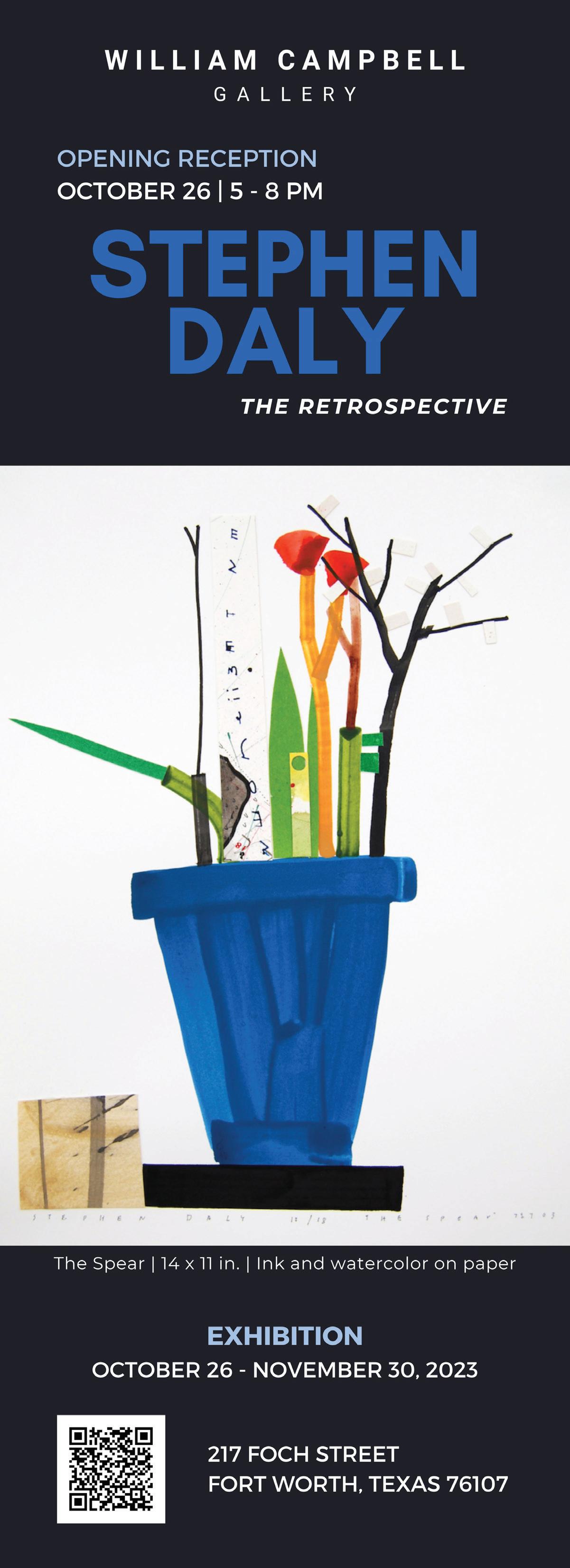
Curated by Alejo Benedetti, acting curator of contemporary art at Crystal Bridges, the exhibition will subsequently travel to four additional venues in the US. Benedetti explains, “We were in conversation with her about doing a commission, and this exhibition grew out of that” as a presentation of new work “in conversation with all she has done across her career, spanning the last fifty years.” At the time there were no examples of her work in their permanent collection.
As such, this exhibition includes around twenty-five new images in dialogue with several earlier periods in the artist’s career, with the important distinction that this is no mere retrospective. It offers viewers the chance to experience Leibovitz’s experimentation with exhibition practices related to installation art in that the images are presented as media, with the use of four massive video screens. Another selection of pieces is displayed in grid formations that forego the traditional arrangement of photographs in a horizontal format.
These unique displays, and the decision to revisit the older work, are in Benedetti’s words, “Annie crisscrossing her legendary career in a deeply personal and self-reflective way in order to give a peek into her mind at work” and “the result is a tour de force filled to the brim with an intimacy and clarity of vision that could only come from Annie herself.”
That’s saying a lot, making a visit to this exhibition all the more enticing. In addition, the idea is that a visual conversation takes place among images from her entire career precisely for the purpose of involving viewers, whose presence makes the exhibition complete. In the past Leibovitz has experimented with various techniques to augment and activate the reception of her work; in this exhibition they are all brought together for the first time.
Expect to see some familiar faces from the art world, such as Cindy Sherman, Amy Sherald, and James Turrell, and figures from the world of music, including Patti Smith and Bruce Springsteen. Leibovitz also includes public figures like Bryan Stevenson, a lawyer and law professor who started the Equal Justice Initiative. The well-known activist, environmentalist, and economist Winona LaDuke also makes an appearance, as does Stormy Daniels.
Beyond these particulars, you have to wonder how the exhibition will look as it travels to four more quite different venues throughout next year and beyond. These include the Mint Museum in Charlotte, NC; the Crocker Art Museum in Sacramento, CA; The Frist in Nashville, TN; and the Wichita Art Museum in Wichita, KS. The obvious thing is that Dallas isn’t on the list, which gives us a reason to take a long weekend trip sometime in the coming months to see the work of an American icon in an interesting new light. P
63 OCTOBER / NOVEMBER 2023
FOLK HERO
The late Harry Smith makes history at the Whitney Museum of American Art.
INTERVIEW BY CHRIS BYRNE
Part of the Beat Generation in New York City, Harry Smith was a major figure in folk music in the 1960s, defined by his compilation of song recordings in the Anthology of American Folk Music. In homage to the polymath, the Whitney Museum of American Art presents Fragments of a Faith Forgotten: The Art of Harry Smith, examining his life and work in a solo museum exhibition for the first time.
Through a series of distinct sculptural spaces, designed in partnership with artist Carol Bove, paintings, drawings, experimental films, and personal objects from the late folk hero’s collection (paper airplanes, Seminole textiles), his influence lives on.
Chis Byrne connects with Elisabeth Sussman, the Sondra Gilman Curator of Photography at the Whitney
CHRIS BYRNE (CB): It’s exciting that the Whitney Museum of American Art is hosting the first solo exhibition of Harry Smith’s work — how did Fragments of a Faith Forgotten: The Art of Harry Smith come about?
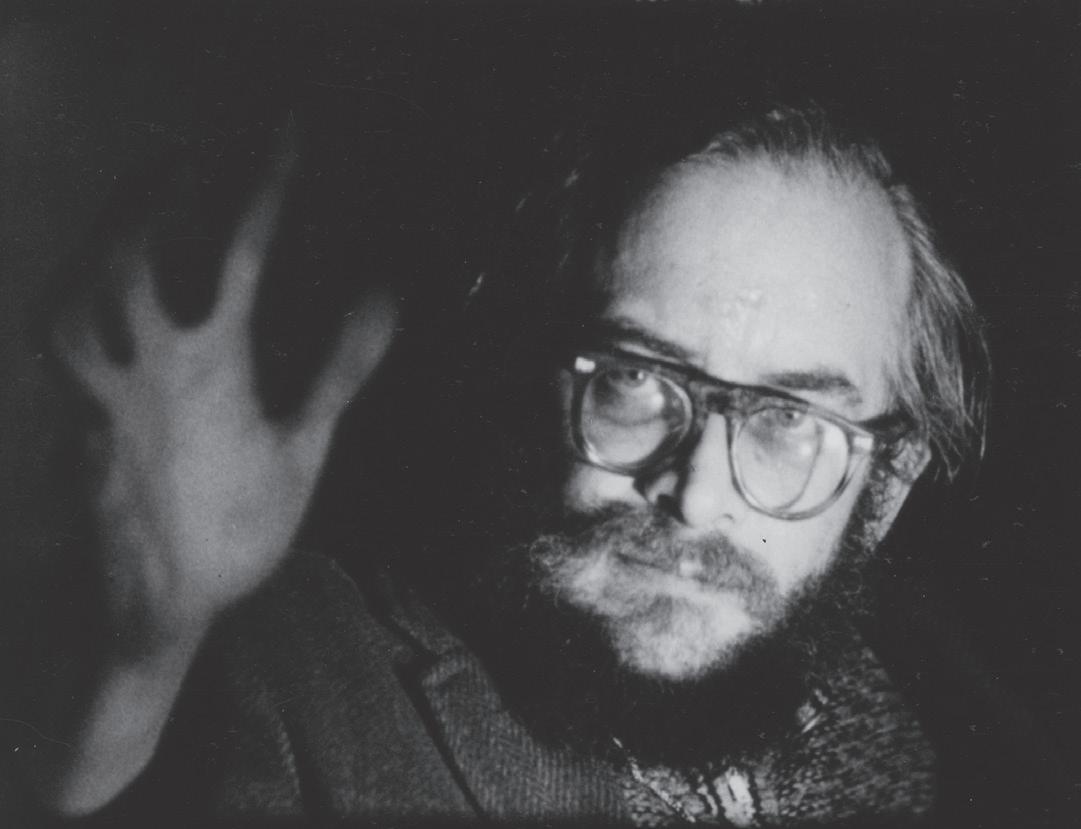
ELISABETH SUSSMAN (ES): I had a long-standing fascination with Harry Smith and started actual research and planning for the exhibition around ten years ago. I have had a long interest in crossover, non-media-specific exhibitions, so Harry’s hybrid reputation as an artist interested me. Also, I was interested in his West Coast beginnings, his involvement with spirituality and surrealism, and his underground status. It has been a treasure hunt and challenge to put this exhibition together.
CB: To what do you attribute this (renewed) interest in his contributions to 20th-century American cultural histories?
ES: I think all the areas that interested me originally are strong in today’s art world. Many people have heard of Smith, but he remains a mystery and a fascination.
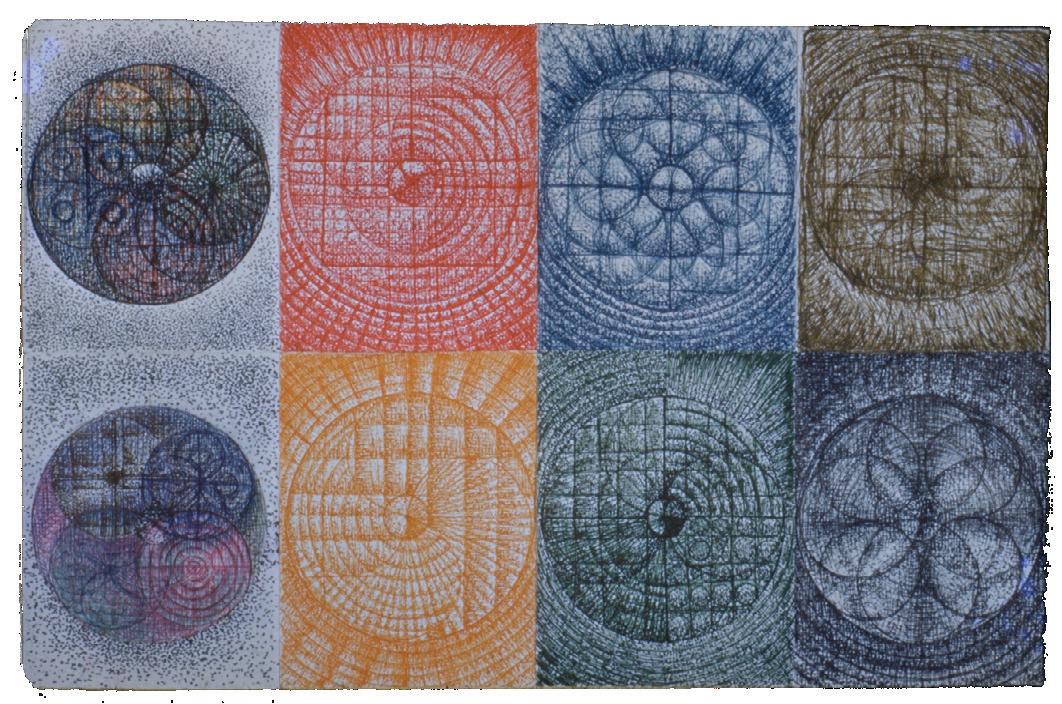
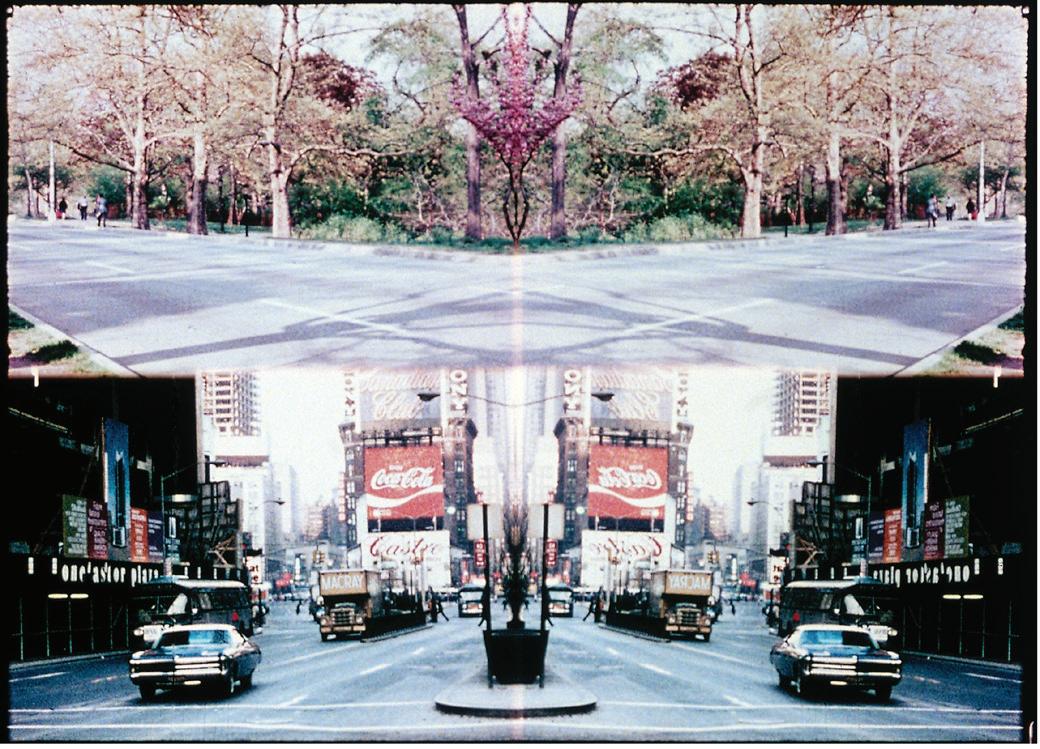
CB: I understand that the exhibition includes paintings, drawings, designs, films, and examples of his collections of objects...
ES: Yes, that’s correct, and many of the works will be on view to the public for the first time.
64 PATRONMAGAZINE.COM CONTEMPORARIES
Andy Warhol, Screen Test: Harry Smith [ST314], 1964, 16mm film transferred to digital video, black and white, silent; 4 min. © The Andy Warhol Museum, Pittsburgh, PA, a museum of Carnegie Institute. All rights reserved. Film still courtesy The Andy Warhol Museum.
From above: Harry Smith, still from Film No. 18: Mahagonny, 1970–80, 16mm film, restored to 35mm film, transferred to digital video, color, sound; 2 hr. 21 min. © and courtesy of Anthology Film Archives and Harry Smith Archives; Harry Smith Papers, Getty Research Institute, Los Angeles; Harry Smith, Abstract film studies (two slides projected alternately), 1951, Film stills, 21.87 x 33.50. Estate of Jordan Belson.
CB: Was it important for you and Carol Bove (with curators Dan Byers, and Rani Singh) to make a clear distinction between Smith’s artwork and his vast archival materials? The installation features a number of designed sculptural spaces...
ES: Carol Bove was included in all research and was responsible for the design of the show, in consultation with the rest of us. It was important to us to reveal the beauty of the artworks that he made—the films, paintings, drawings. Harry is often called eccentric and referred to as a collector. He was all that, but also a very strong artist and daring technician.
CB: The show presents the liner notes of the Anthology of American Folk Music (1952) as well as a listening environment to explore the three-album compilation...
ES: Yes, there is a listening lounge for the Anthology, where you can hear the music and see on monitors the liner notes written by Smith to accompany the music. Smith’s Anthology laid the groundwork for the popularization of folk music in the 1960s and has inspired generations of artists, musicians, and listeners.
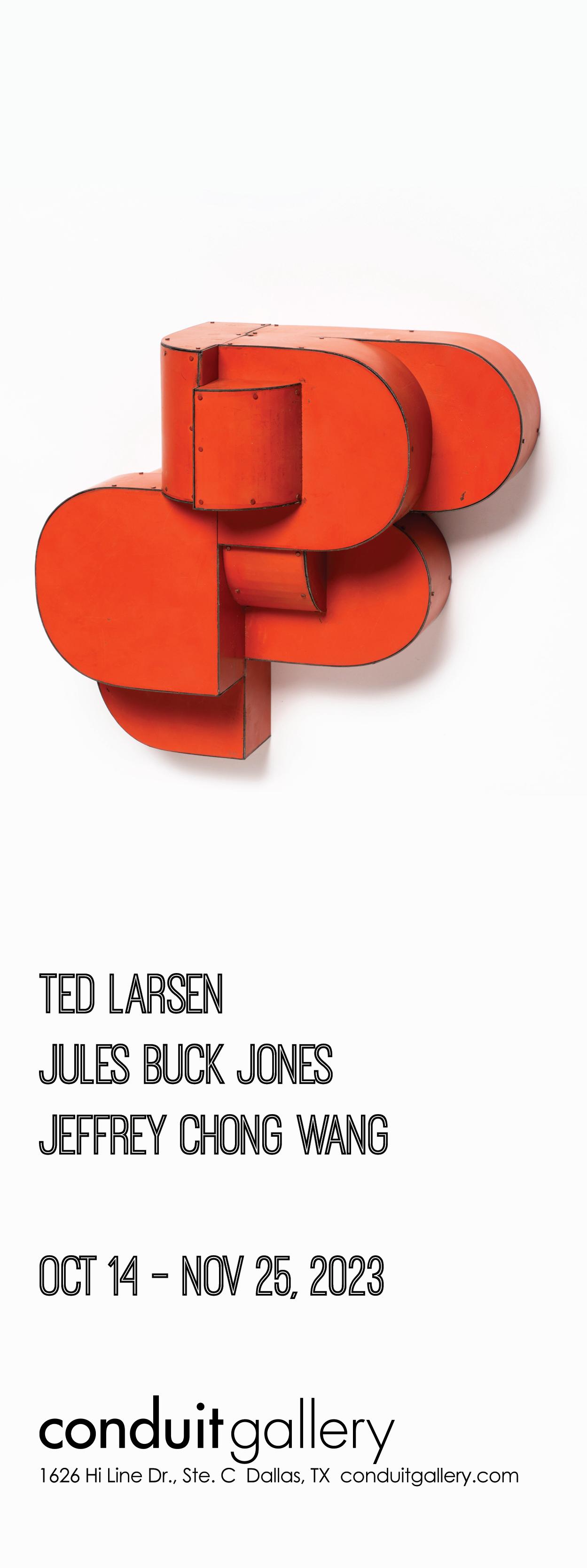
CB: And the collage films Heaven and Earth Magic Feature (c. 1957–62) and Mahagonny (1970–80) will also be on view...
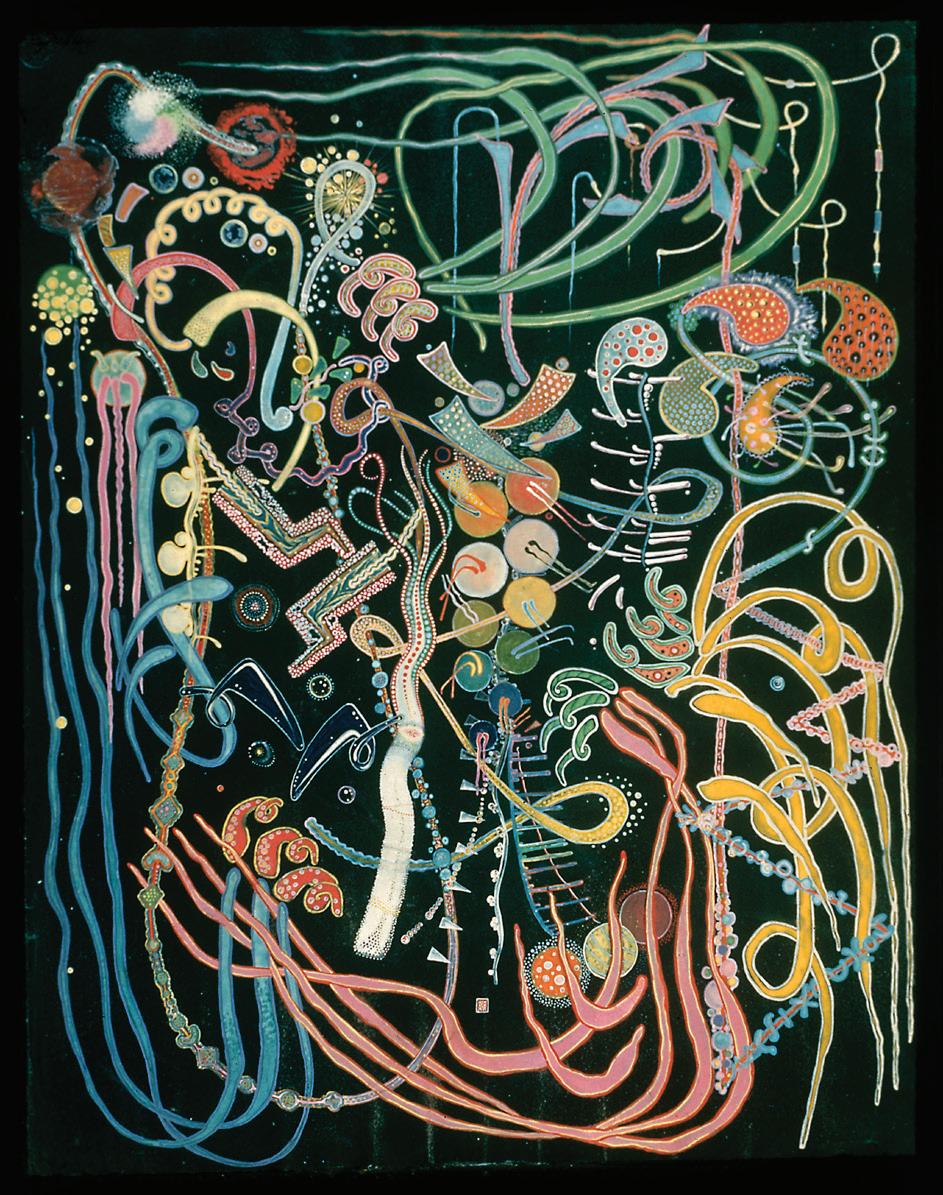
ES: The films, Mahagonny and Heaven and Earth Magic Feature, are shown in immersive installations. There are additional Harry Smith films showing on video monitors and a screen. And there will be showings of the films, music, and a full menu of programming in the Whitney Museum’s Hess Theater.
CB: In November 2024, The Carpenter Center for the Visual Arts at Harvard University will also present a version of this project...
ES: Yes, Carpenter Center is presenting a version of the exhibition next fall, and there will be a catalogue published in conjunction with the presentation. P
65 OCTOBER / NOVEMBER 2023
Harry Smith, Manteca [Jazz Painting], c.1948–49, Lightbox projection from 35mm slide of lost original painting, 27.60 x 21.87 in. Estate of Jordan Belson.
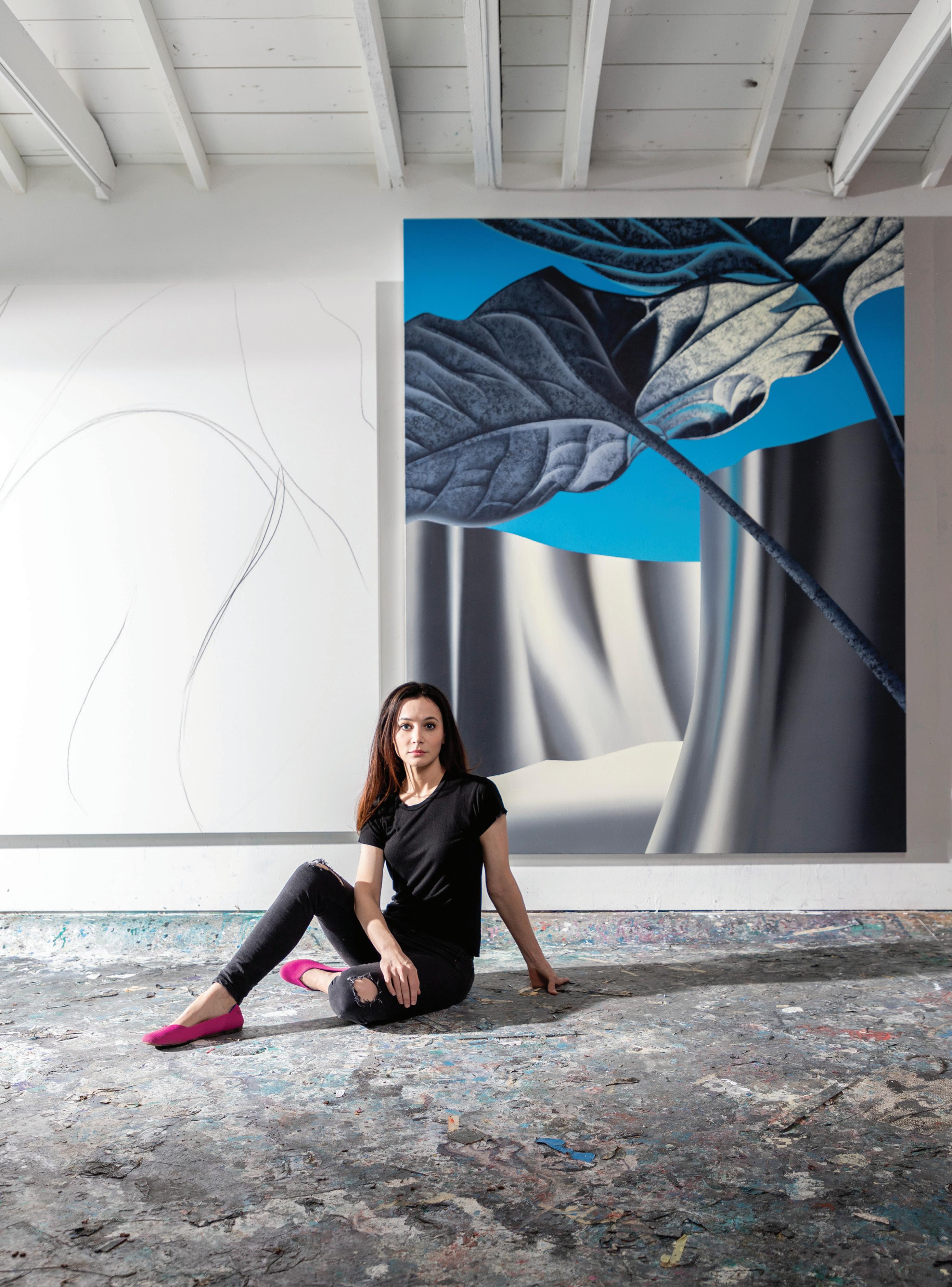 Anna Membrino in her studio, pictured with Ripple, 2023, acrylic on canvas, 83 x 65 in.
BALANCING THE DISTORTION
BY TERRI PROVENCAL PHOTOGRAPHS BY VICTORIA GOMEZ
The floors of Anna Membrino’s studio are thick with layers of splattered paint, an occasional wood mixing stick lies flat, embedded and immobile within the swirling odyssey of colors. A skylight casts interesting shadows. It’s clear an artist spends enormous amounts of time here.
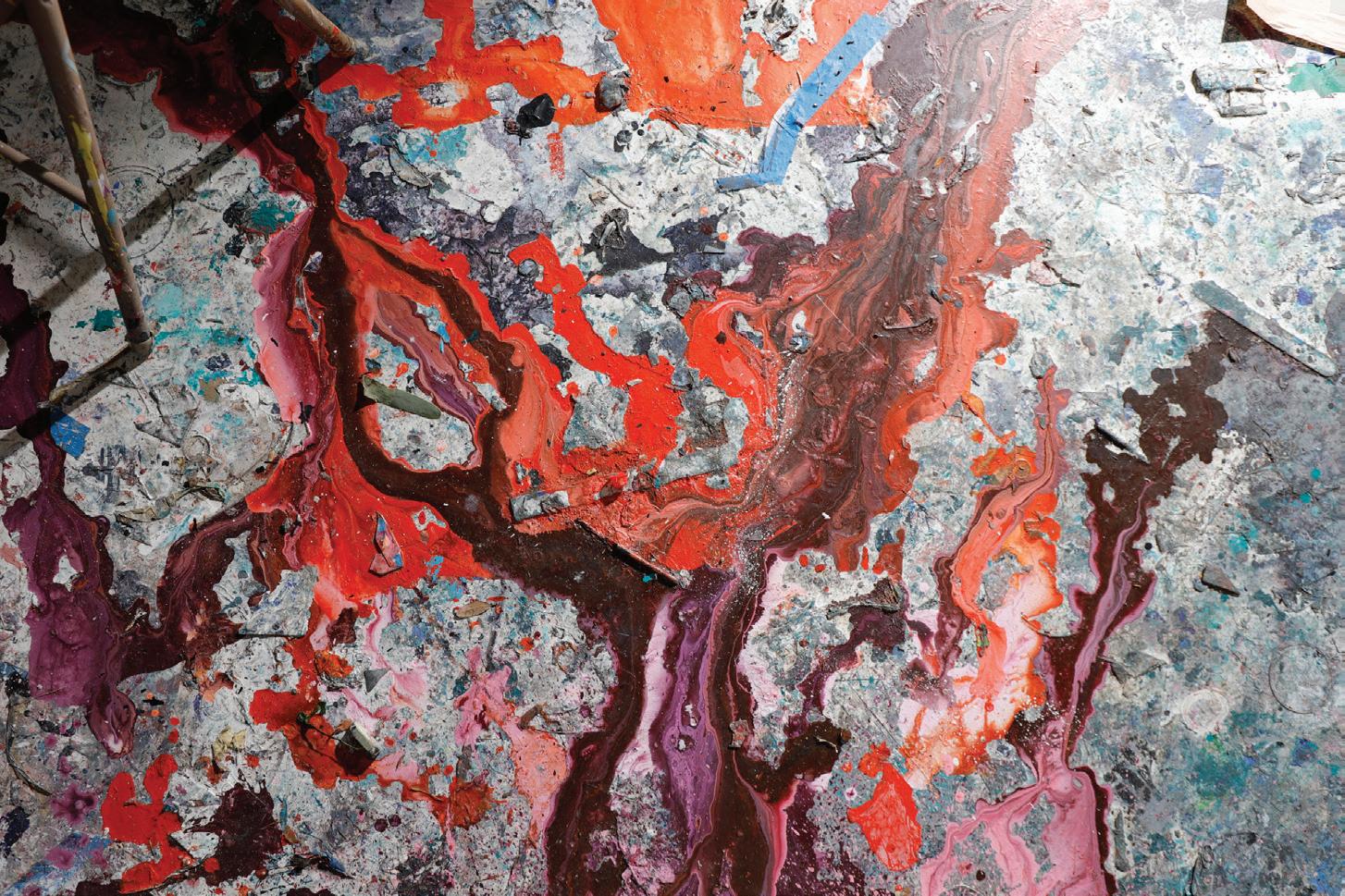
Though petite in stature, Membrino is known for her largescale landscapes of commanding color. However, there is nothing ordinary about these landscapes. The paintings begin as still lifes, she explains. “I start by building a maquette. I arrange plants, paper, and sculptures in a small theatre.” A hiker, she finds her organic material—twigs, rocks, plants—in places she treks with her husband.
“At this point of my process, I have created a composition which either pulls the viewer into compressed spaces or, in some pieces, into more expansive ones. The scale envelopes the viewer in this new space.” At this juncture she begins to study the effect of light on each of the objects within the still life. The sculptures often mine the plateaus of New Mexico the couple frequents or the faraway undulating drumlins of Northern Ireland from a remembered trip.
Light is its own medium here, as it leaps among the objects in the theatre. “The light is the most powerful component in my
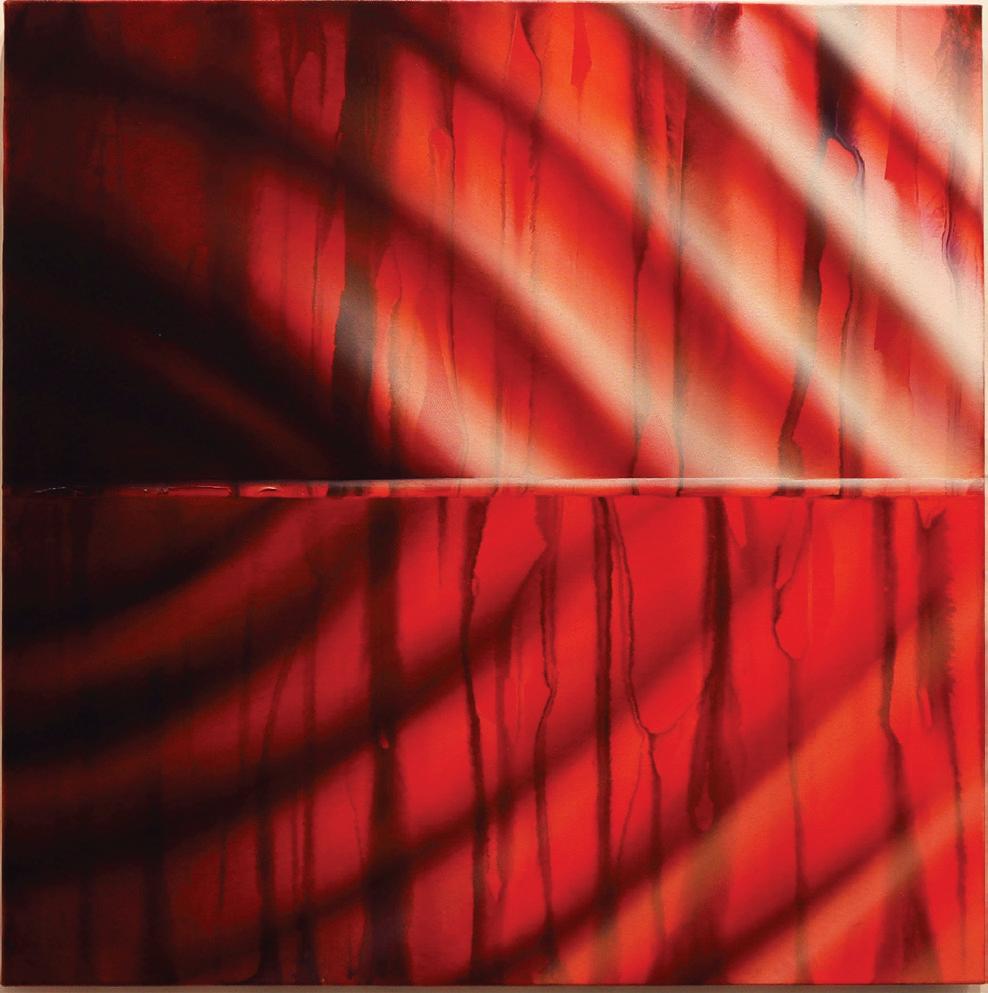
67 OCTOBER / NOVEMBER 2023
For her solo show, Ripples, Anna Membrino’s invented landscapes lead to abstraction.
STUDIO
Anna Membrino, Wave No. 2, 2023, acrylic on canvas, 30 x 30 in. Courtesy of the artist and Erin Cluley Gallery.
Anna Membrino studio view.
STUDIO
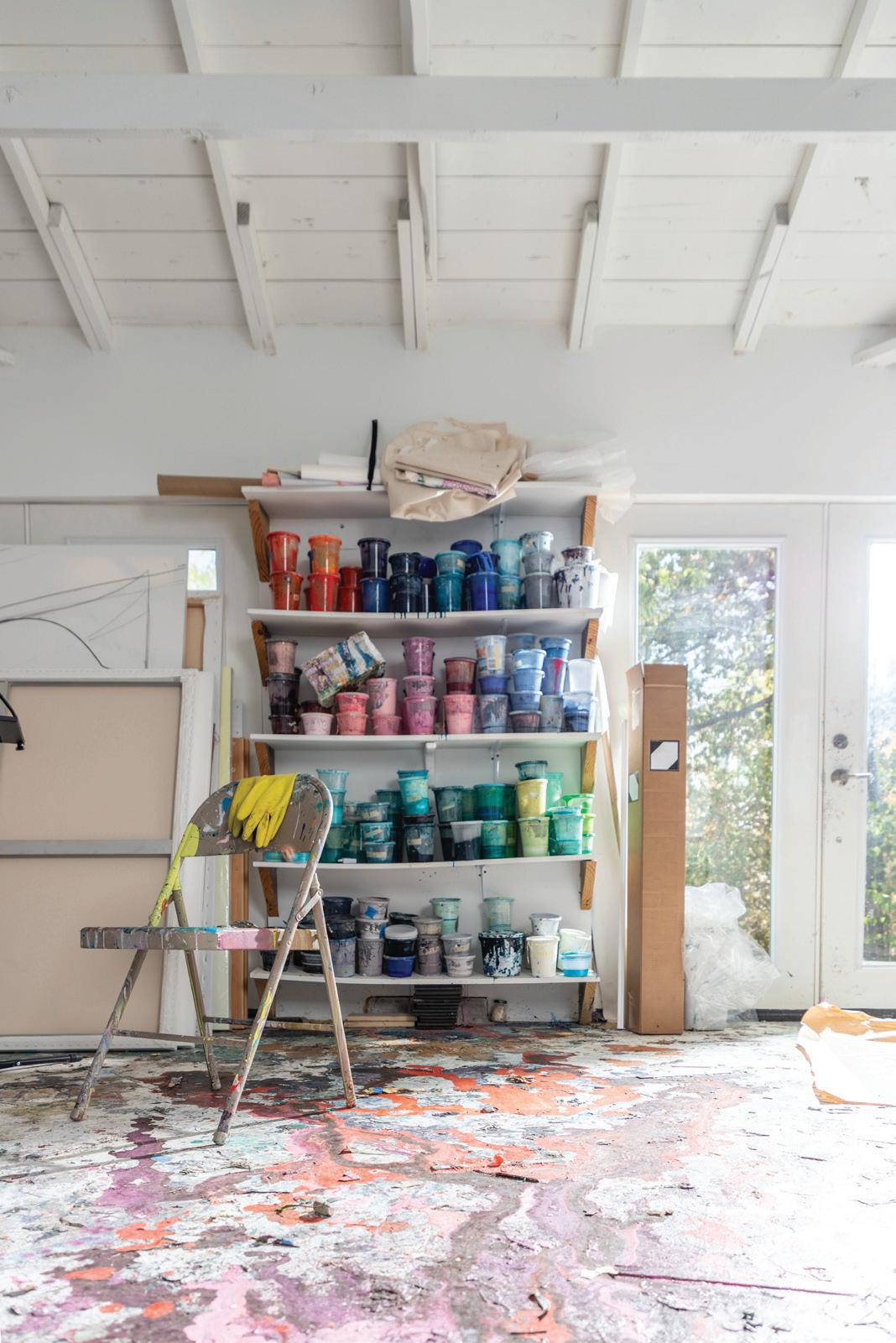
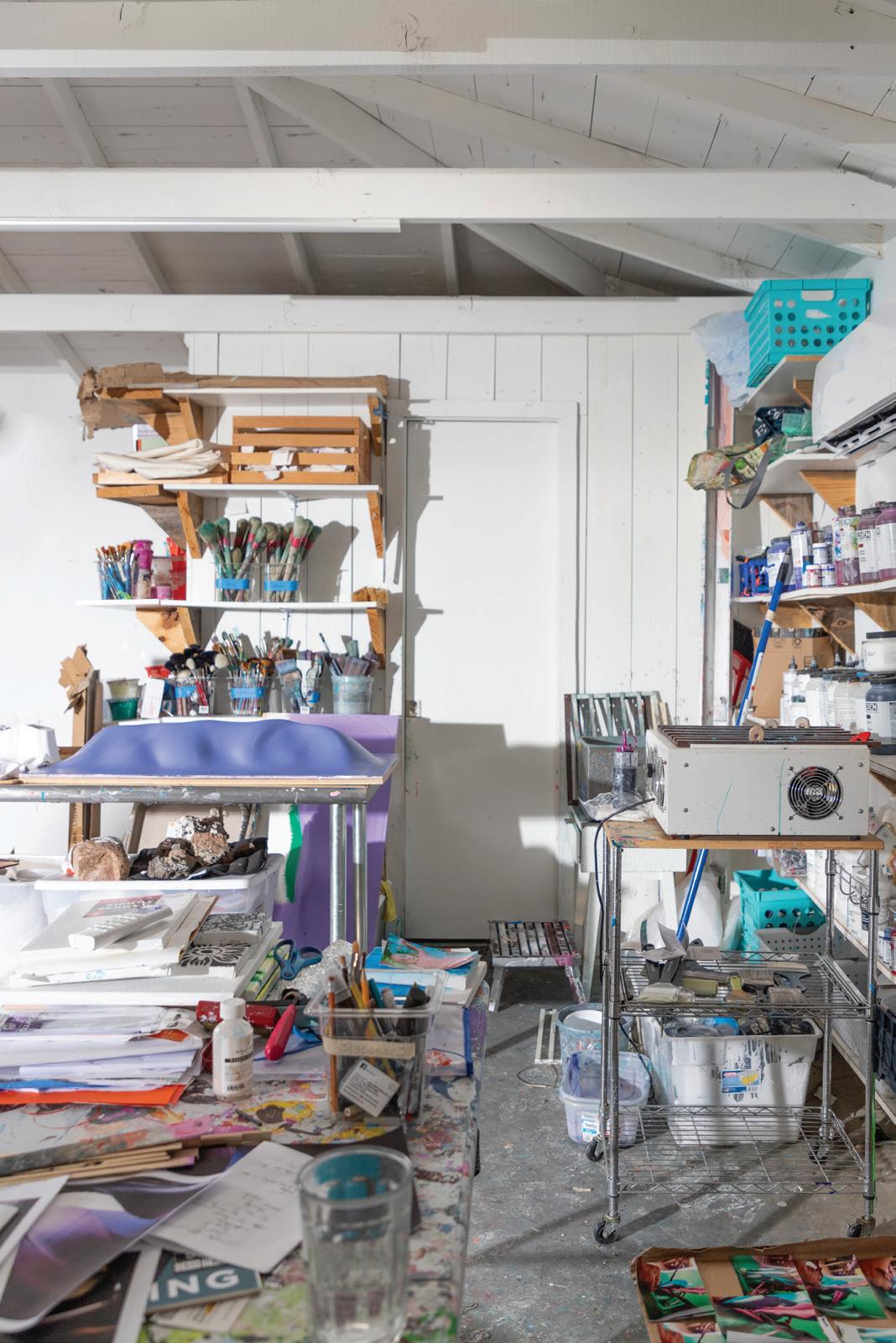
work. Multiple sources of light appear—some are outside the picture plane, and some are within the composition itself in the form of reflections bouncing light back and forth,” which, she says, “keeps the color moving.” She seeks voluminous plants with curvature to “find these amazing shadows in.” Her paintings are still and desolate, but there is a feeling of movement and vibration in the work through light and color.
Pleased with the still life, she paints directly from the assemblage or from drawings or photographs of the arrangement. Scale shifts are crucial to the work as it moves from the maquette to the canvas. “It takes these paintings from the realm of still life into otherworldly, surreal landscapes,” she says. In Ripple, a purchased plant, “eerily familiar, but slightly off,” appears menacing yet curious as it hovers over a mesa dwarfing the landform. An impossibly ultramarine blue sky disorients. Surreal— this can’t be Earth.
Ripples, inspired by the largest painting in her November exhibition, is the title of her third solo show at Erin Cluley Gallery. “It refers to the slight sense of movement in each of the paintings and the ripple effect of the light bouncing off of each of the objects as it enters the scene,” she says. Glazing techniques reveal the light on the objects through many layers of sheer paint applied with soft brushes. This is a muchly considered process: “With each coat, I take careful note of the change in the objects. At a certain point the ambiguous shapes of the landscape appear to be three-dimensional and lifelike.”
Along with Ripple, smaller works will be shown. For these
30 x 30-inch canvases, she zooms in on the plant life, furthering the distortion, the landscape discarded. “As I’ve been creating these landscapes, I always get fixated in the organic material, and I wanted to lose that identity in these and play with the pure form.” She references the modernist American photographer Edward Weston, known for his magnification of organic biomorphic shapes like his Cabbage Leaf, 1931, within the holdings of MoMA.
Veiled glazes are especially important in Membrino’s new work, as are background textures. “There are areas that are pure gradients that almost feel out of focus,” she points out. In order to make the background feel very real and sharp, she adds texture through rollers, sponges, poured paints, stencils, and more veils of color, furthering the abstraction. “You see through these objects, but now we are seeing deeper and deeper into these spaces. With the title of the show, I really want to address the translucency in this work and the layers you’re moving through.”
Membrino earned her MFA at Southern Methodist University and a BFA from the University of North Florida. She has taken part in numerous prestigious artist residencies: Can Serrat in El Bruc, Spain; Sanskriti Foundation in New Delhi, India; and Radius Workshops in Grambois, France. “In India I was seeing foliage and pattern I’d not seen before.” She came back with a million ideas.
“I want my work to create a new environment; a dreamlike space that conjures memories of a specific space or time but is simultaneously a new experience.” P
68 PATRONMAGAZINE.COM
Anna Membrino studio view.
Anna Membrino studio view.

Guiding You Home. Christopher McGuire Christopher McGuire Luxury Real Estate Advisor christopher.mcguire@compass.com M: 214.454.1128 With over two decades of curating luxury spaces for clients, my expertise allows me to transform their home into living art. Ready for your production? Connect with me for unparalleled solutions for today’s market! Compass is a licensed real estate broker and abides by Equal Housing Opportunity laws. All material presented herein is intended for informational purposes only. Information is compiled from sources deemed reliable but is subject to errors, omissions, changes in price, condition, sale, or withdrawal without notice. This is not intended to solicit property already listed. Photos may be virtually staged or digitally enhanced and may not reflect actual property conditions.
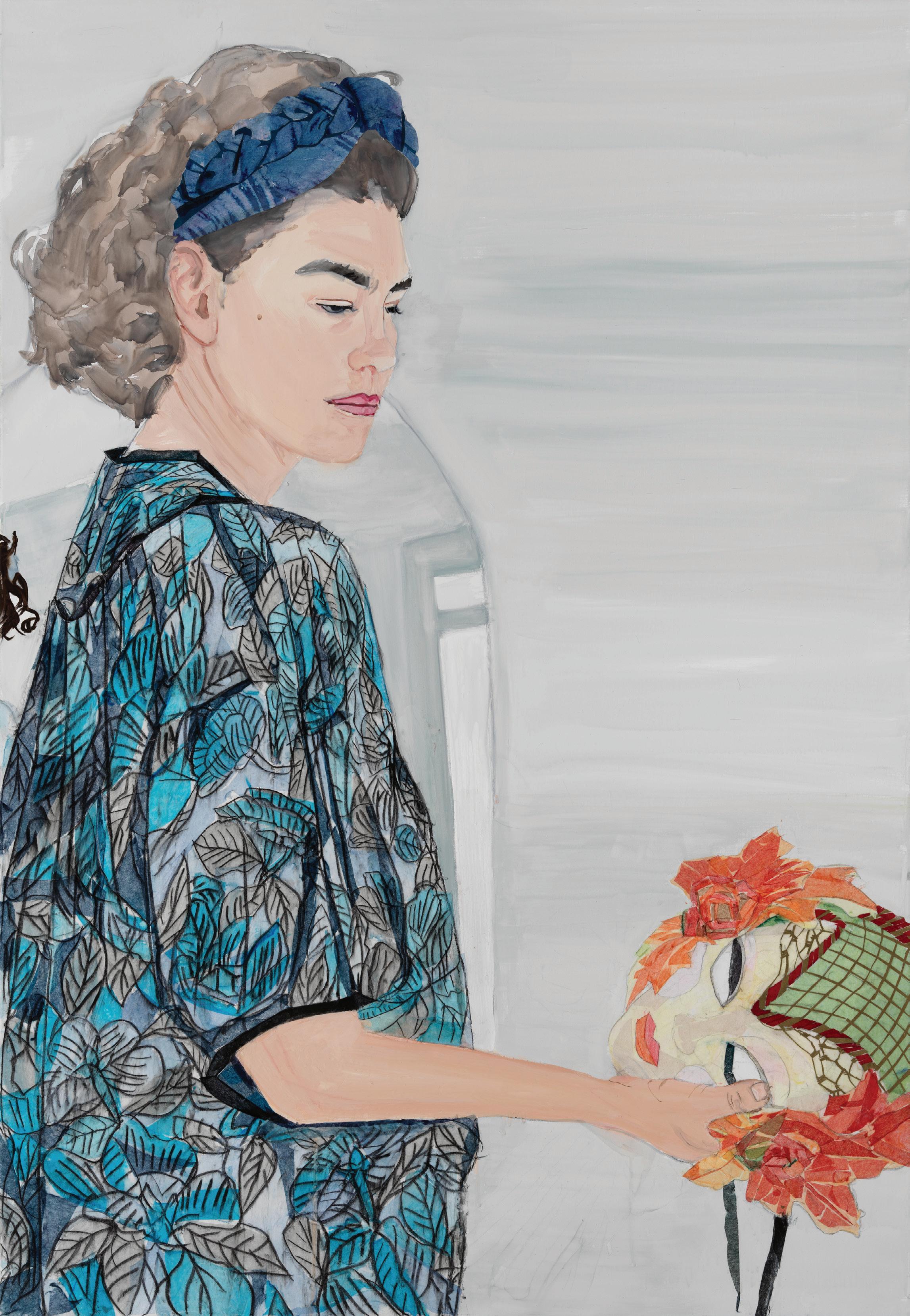
70 PATRONMAGAZINE.COM
María Berrío Makes Sense of Things
THE COLOMBIAN-BORN, NEW YORK–BASED TWO X TWO 2023 ARTIST HONOREE TAKES AN INTIMATE LOOK AT CONTEMPORARY REALITIES TO CREATE MYTHIC WORLDS.
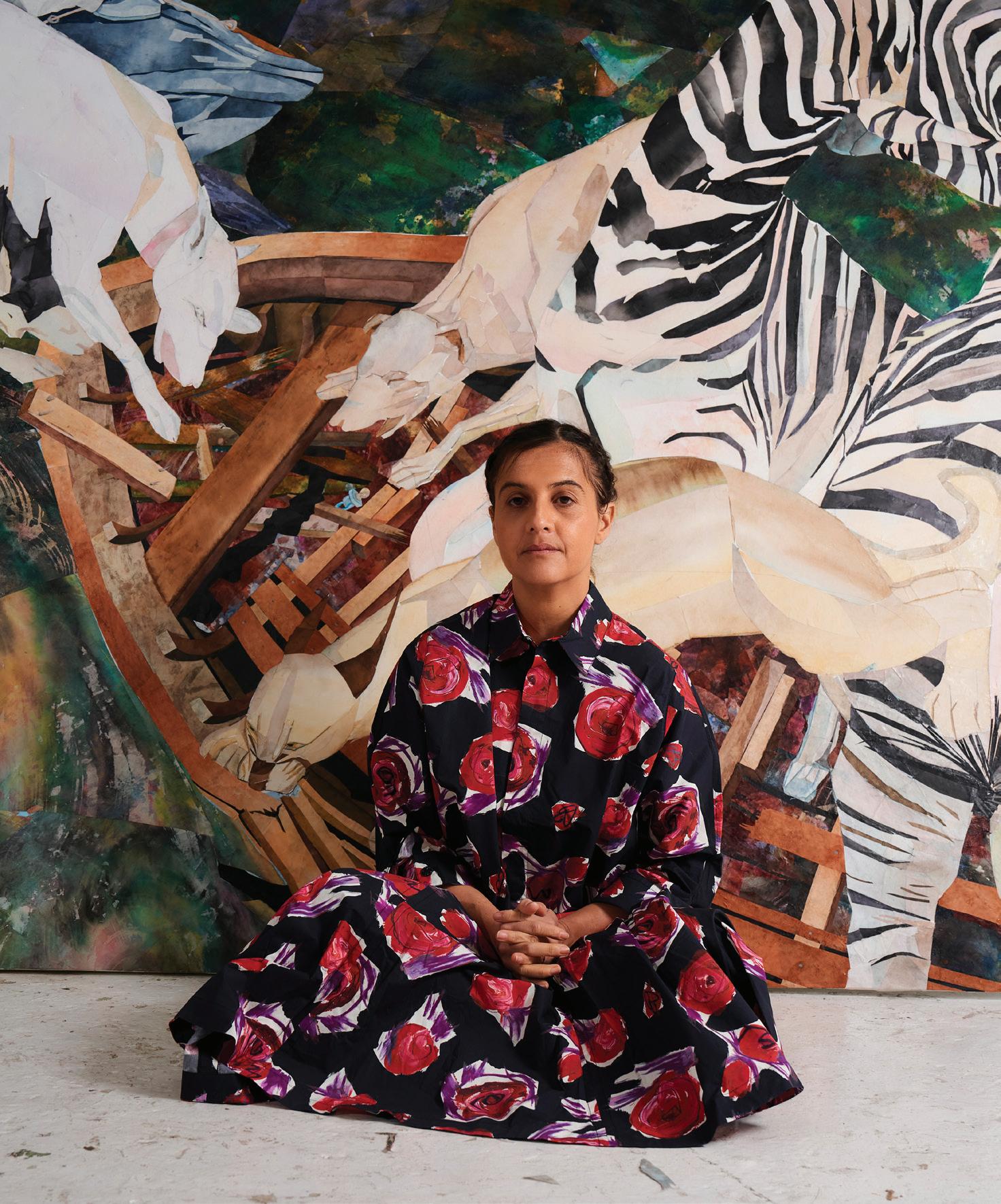 BY DR. ANNA KATHERINE BRODBECK
71 OCTOBER / NOVEMBER 2023
This page: Portrait of María Berrío. © María Berrío. Courtesy of the artist and Victoria Miro. Photograph by Kyle Dorosz. Opposite: María Berrío, Act II, Scene 4: Threshold, 2023, collage with Japanese paper and watercolor on linen, 51 x 35.25 in. © María Berrío. Courtesy of the artist and Victoria Miro.
Through collaged watercolor layers of Japanese paper, María Berrío (b. 1982 Bogotá, Columbia), engenders a utopian milieu within a polychromatic backdrop depicting a coexistent balance between nature and humans. Her intimate compositions, populated with women and children, address today’s pressing issues. Drawing from her own history, along with folklore, poetry, and migration, her oeuvre spurs a cross-cultural dialogue.
Berrío received her BFA at Parsons School of Design and her MFA at the New York School of Visual Arts. She has since settled in New York City. Her work is among the Dallas Museum of Art’s holdings, and her epic Wildflowers, 2017, depicting a train bringing immigrants to a new world, was exhibited in Women Painting Women at the Modern Art Museum of Fort Worth last year.
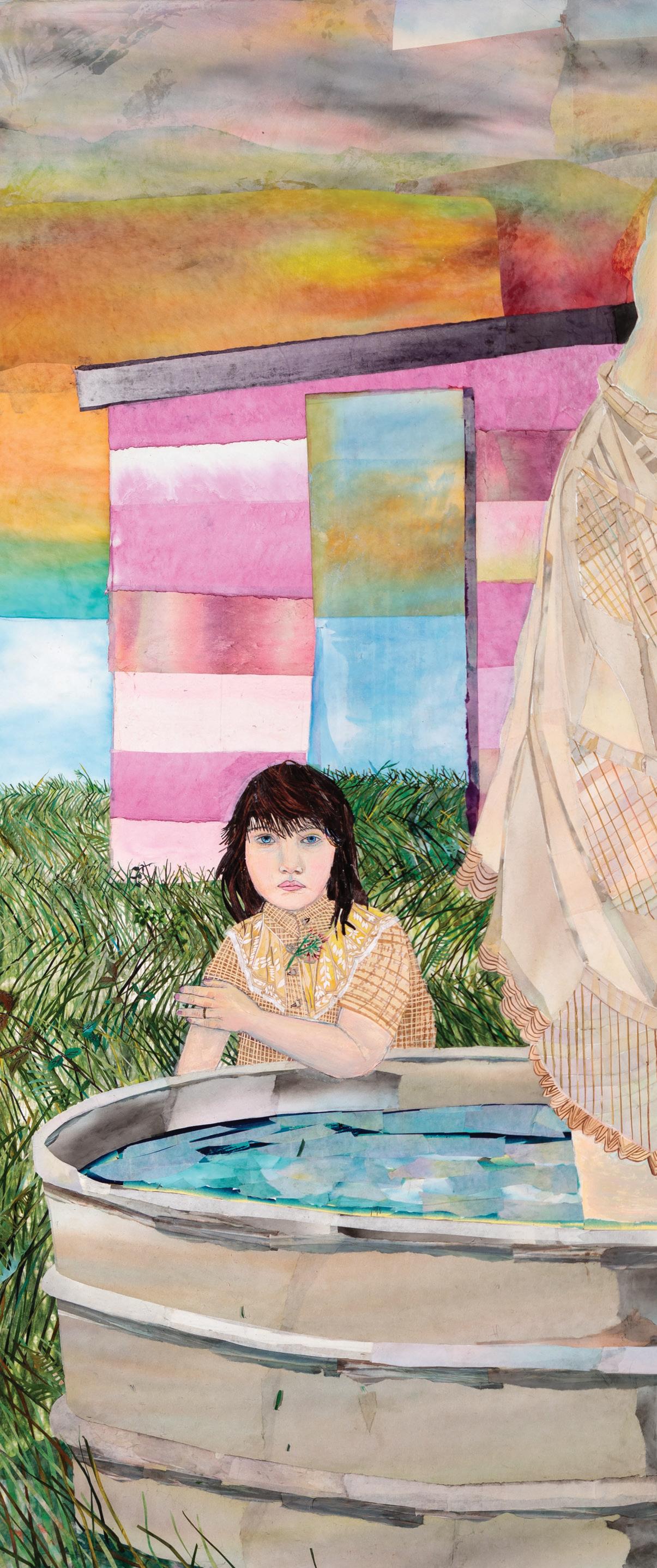
Within TWO x TWO for AIDS and Art’s storied history, amfAR honors an artist each year with the Award of Excellence for Artistic Contributions to the Fight Against AIDS in recognition of amfAR’s programs. Berrío will be recognized at this year’s gala. Dr. Anna Katherine Brodbeck, Hoffman Family Senior Curator of Contemporary Art at the Dallas Museum of Art (a co-beneficiary of the annual art fundraiser), discusses Berrío’s practice here:
Anna Katherine Brodbeck (AKB): Maria, we are so excited to have you as this year’s TWO x TWO for AIDS and Art honored artist. I have learned so much from our conversations over the past few years, and it’s so meaningful to be able to share your work with our larger community.
Our relationship began when the Dallas Museum of Art became the grateful recipient of your powerful 2019 painting Oda a la Esperanza (Ode to Hope), which was inspired in part by the well-publicized detaining of unaccompanied minors at the US-Mexico border during their migration journey. And on view at the museum is A Last View of the Sky from the same year, on loan from The Rachofsky Collection, which in its own subtle and beautiful way deals with another of the most pressing issues of the day: the climate crisis.
Your work renders humanitarian issues of such an enormous scale with such a touch of intimacy. How do you choose your subject matter?
María Berrío (MB): I often make paintings of imaginary worlds, usually with touches of fantasy or surrealism to them. But for me, making art is not an exercise in escapism as much as it is a way of making sense of the real world. Outside of my studio I am just like anyone else, inundated with the world and its ailments, with our collective griefs and triumphs and uncertainties. Inside the studio, I can take that whirling confusion of external events and narrow the focus into something understandable. It’s difficult to really grasp events without seeing them through the smaller-scale, intimate view of the individual. So my work is often a personal attempt to make sense of things: what does it feel like to undergo, say, climate change and the existential fear it invokes?
That said, I don’t start a work thinking “this one will be about greenhouse gasses.” There are various ideas that I am playing with, various emotions, and I begin connecting [the] dots of disparate subjects. In the process, the story emerges. Folklore and history, things personal and political, poetry, music, theories of animal consciousness, wars, etc.; all these things are liable to flit through a person’s mind throughout the day, and all of them may manifest themselves in my work.
72 PATRONMAGAZINE.COM
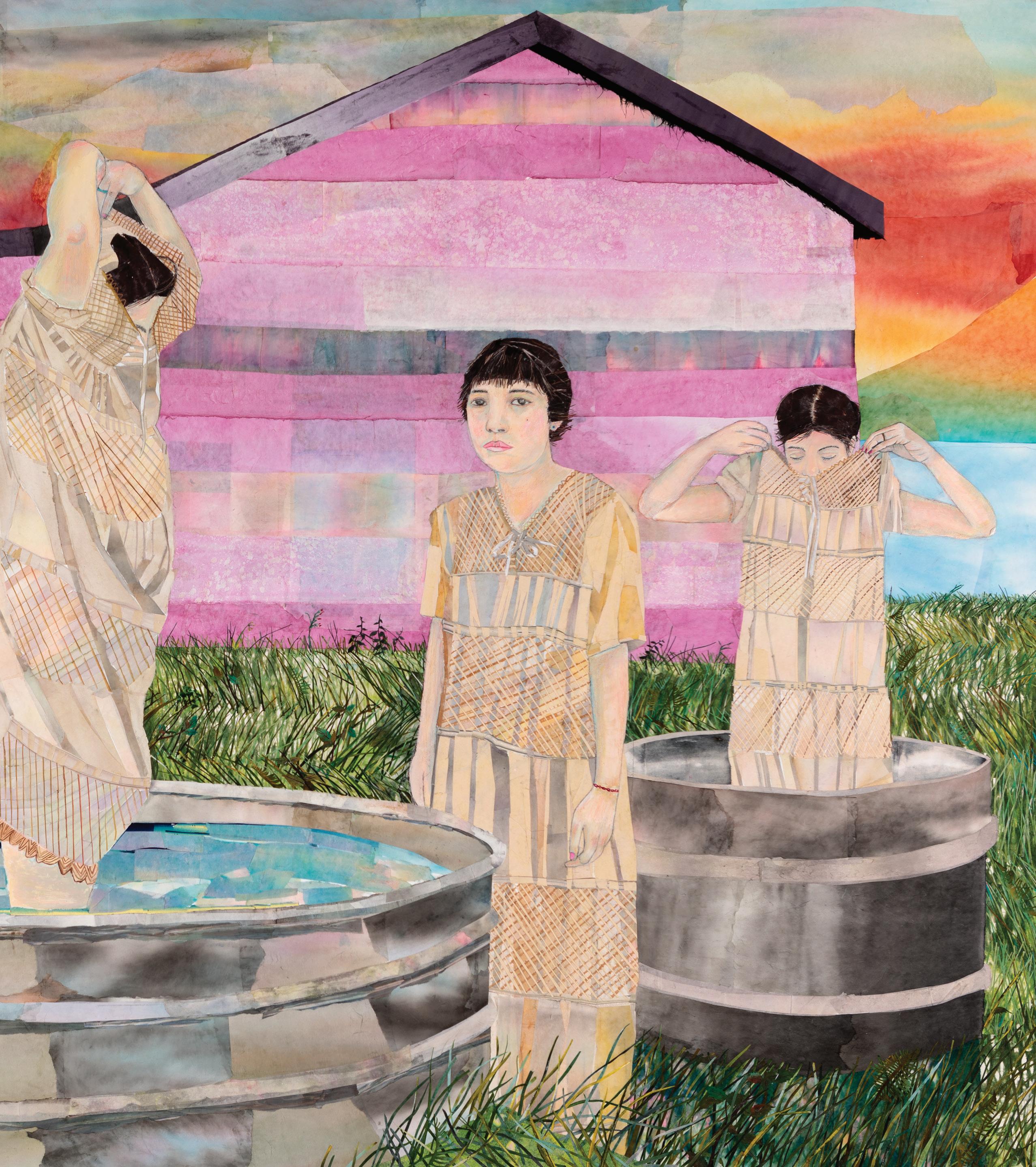
73 OCTOBER / NOVEMBER 2023
María Berrío, A Last View of the Sky, 2019, collage with Japanese paper and watercolor paint on canvas, 84 x 105 in. © María Berrío. Courtesy of the artist and Victoria Miro.
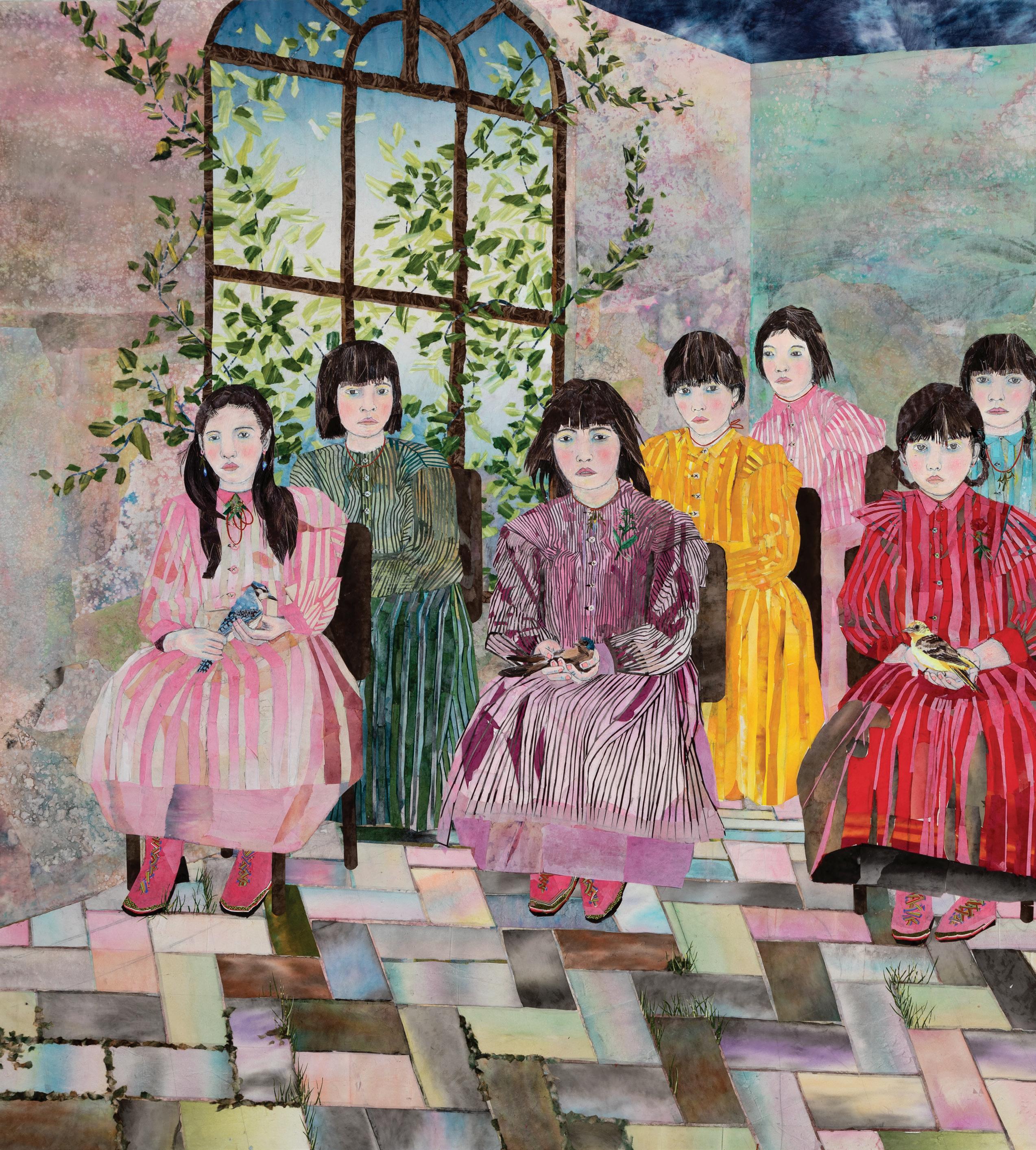
74 PATRONMAGAZINE.COM
María Berrío, Oda a la Esperanza (Ode to Hope), 2019, collage with Japanese paper and watercolor paint on canvas, 92 x 118 in. © María Berrío. Courtesy of the artist and Victoria Miro.
AKB: One of the ways that you accomplish this sense of intimacy and disarming beauty is through your chosen media—collaged, custom-made Japanese paper. It makes the work so palpable and even immersive by drawing viewers into these carefully constructed worlds. How did you come to choose this medium and how has your use of it evolved over the years?
MB: When I was in art school, I was given to dressing in bright colors and contrasting patterns, a habit that I still have, though one that has mellowed with age. A school friend of mine, Y Katori, once remarked that I should paint like I dress. She said I reminded her of Japanese papers and then showed me some. That was where the idea came from.
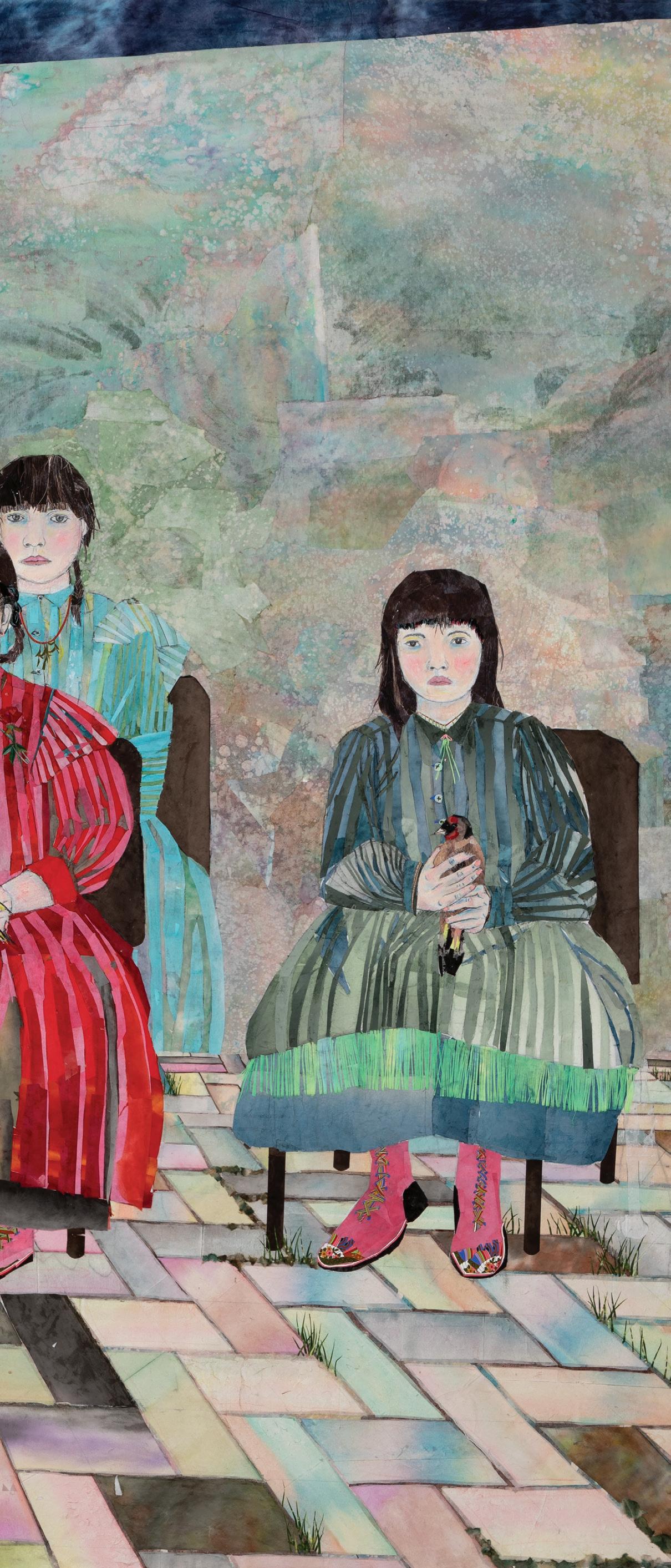
Up until that point, drawing had been my primary medium. When I began experimenting with collage, I was instantly struck by how similar it seemed to drawing. I loved it. I loved the tactile sensation of different paper textures, of ripping and cutting them. I loved the feeling of slapping glue on canvas and sticking papers to it, without the remove of a brush, the childlike joy of it. Over the years I’ve discovered a lot with collage, but I still feel there is much more to learn, which keeps me interested.
Drawing is still the base from which I start all of my collages. And while we originally had a rocky relationship, I’ve also made peace with painting and have been including it more and more within my works. The interplay between them all intrigues me.
AKB: Tell us about the work you are creating for the benefit and how it fits into your larger body of work.
MB: I’m making a series titled A Feast for Ammit, where the paintings are meant to be images from a play by that name. The play is something like a Greek tragedy, and the paintings are all depicting different acts and scenes from it. The play revolves around the story of Echo, a woman whose obsessive love has led her to undergo a supernatural ritual, all in the hopes of attaining her unrequited love. The ritual results in her obtaining a mask and a warning that though the object of her desire will indeed respond to her, there is a chance that Echo may lose her soul when putting it on. The work ACT II Scene 4: Threshold is a depiction of Echo’s soliloquy as she contemplates this mask.
My last series was The Children’s Crusade, which was a fantastical imagining of global migration. For this series I wanted to move a little away from current events and take inspiration more from Euripides and Sophocles than from the headlines. But this series and this work still fit into my larger body of work in that they all show my fascination with storytelling and constructing an entire world with my paintings, not just solitary pieces.
AKB: I know it was important to you that Oda a la Esperanza find a home in Texas because of our position on the border. You are clearly so sensitive to the viewer’s experience, and to the larger role that art can play in society. Because it strikes such a resonant chord with viewers, we couldn’t be more thrilled to have your work on view at the museum, where I know it will serve as the catalyst for such important dialogue.
What does being the honored artist at TWO x TWO mean to you in this context?
75 OCTOBER / NOVEMBER 2023 Image caption.
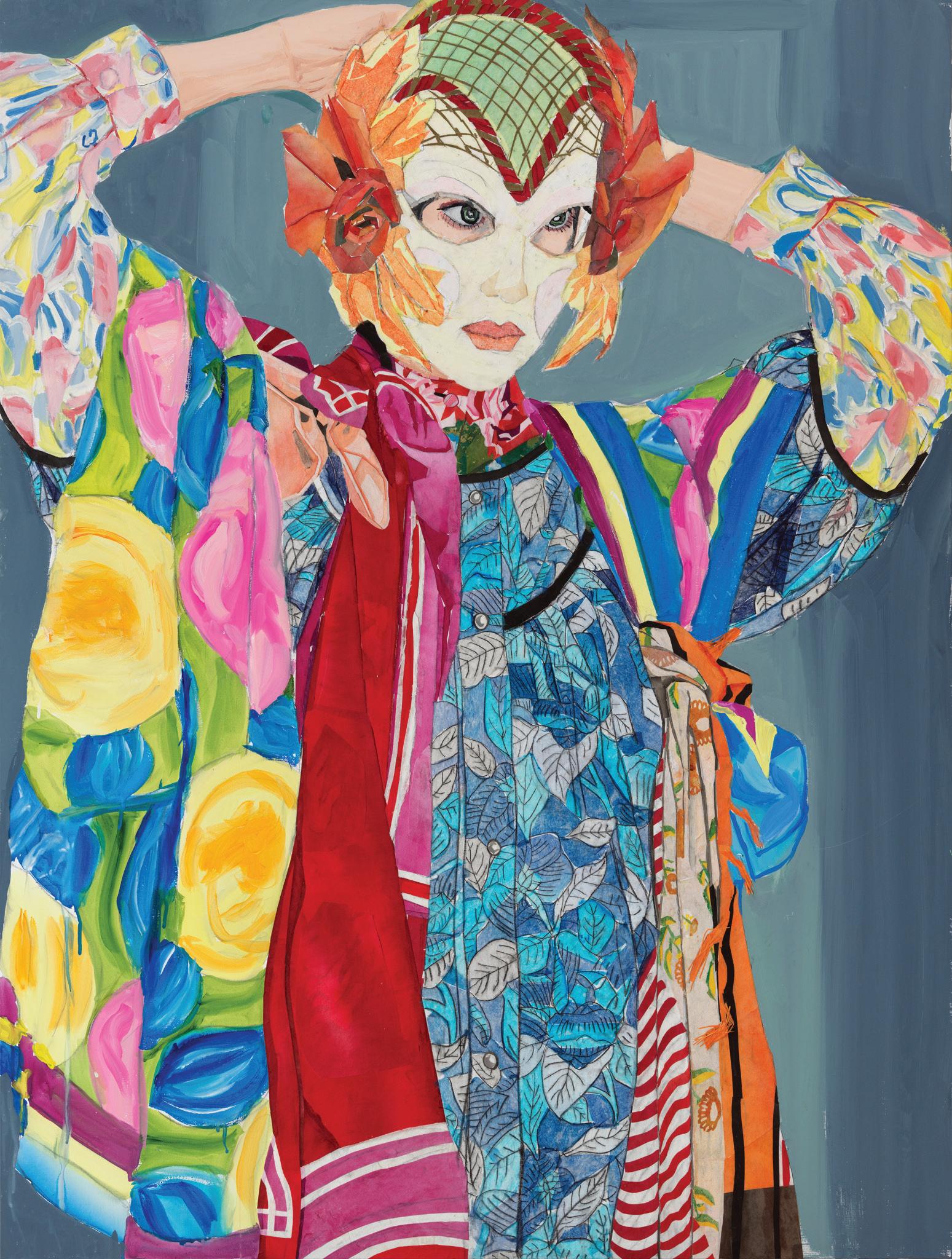
76 PATRONMAGAZINE.COM
María Berrío, Act III, Scene 1: Orchestra of the Departed, 2023, collage with Japanese paper and watercolor paint on linen, 49.25 x 37.25 in. © María Berrío. Courtesy of the artist and Victoria Miro.
MB: Oda a la Esperanza was originally a reaction to the US’s 2018 family separation policy, one where I wanted to try and make sense of the experience of the detained. It is done through fantasy because of that interesting paradox where it is often through fiction and symbolism that we can better grasp reality.
What was important to me was that the characters in that painting all engaged the viewer, that each seemed like an individual. We so easily turn people into statistics and abstractions: 2,000 children separated is just a number. But it’s far more difficult to dissolve an individual into an abstraction when she is staring you in the face, and I wanted to do that with that work.
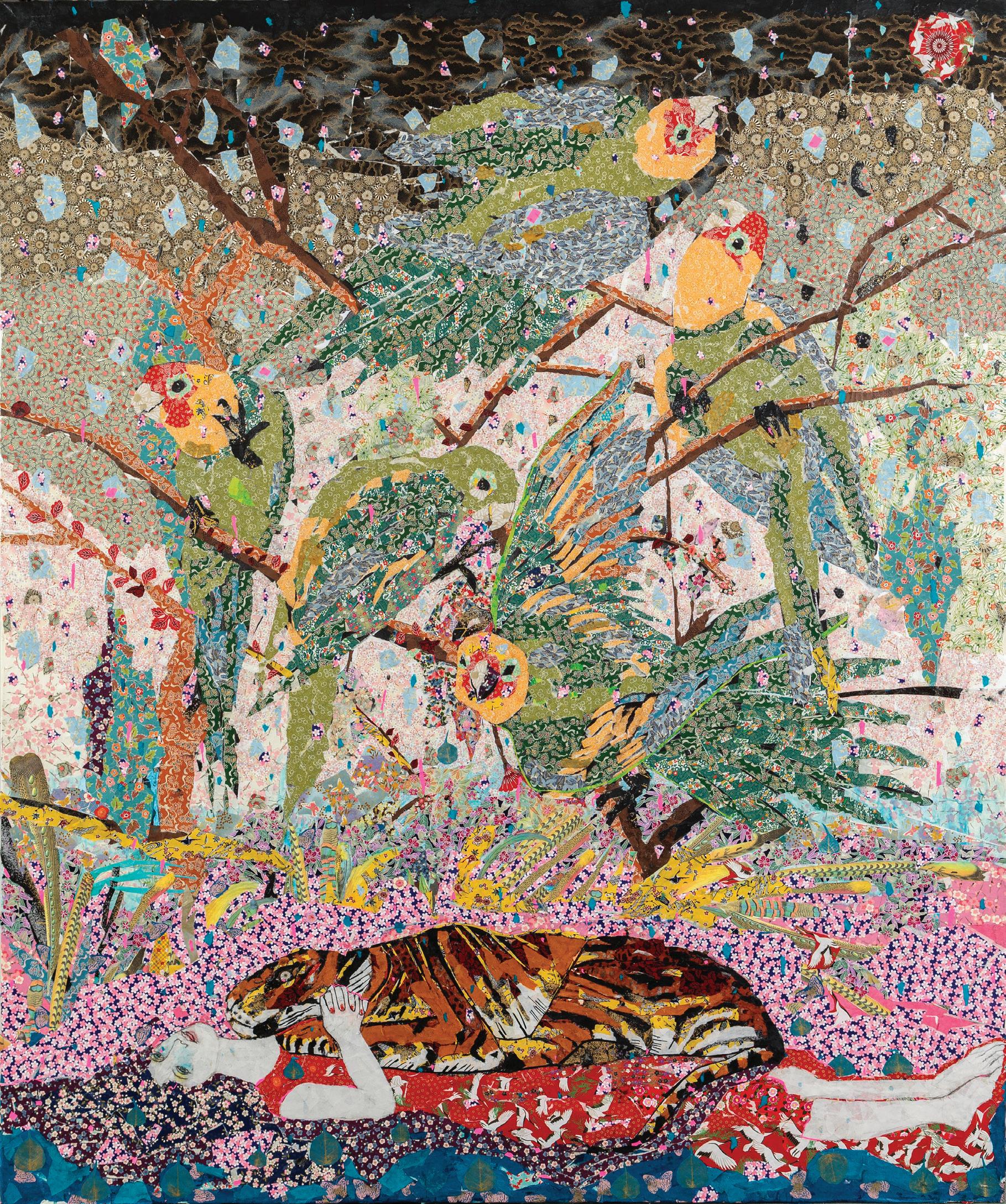
My own experience as an immigrant to this country has been completely different from that of anyone I tried to depict in that
work, and I would never claim that I can relate to those experiences. At most I can imagine what it is like and try to remind myself and others of the humanity of those who undergo those and similar situations.
That said, it means a lot to me to be the first Latin American woman to be honored at TWO x TWO. There is a lot of talent in that community, and it’s wonderful that it is becoming more recognized. Being honored at TWO x TWO is humbling, perhaps a bit overwhelming, and I feel deeply fortunate and grateful for everything that has been happening in my career of late.
AKB: Thank you so much for your time we can’t wait to welcome you to Dallas in October!
MB: I’m really looking forward to it! P
77 OCTOBER / NOVEMBER 2023
María Berrío, El Cielo Tiene Jardines, 2013, collage with Japanese paper and watercolor paint on canvas, 96 x 86 in. © María Berrío. Courtesy of the artist and Victoria Miro.
LAYING THE GROUND
WORK
THE NASHER’S VAST, AMBITIOUS EXHIBITION TURNS ITS GAZE TO LAND ART.
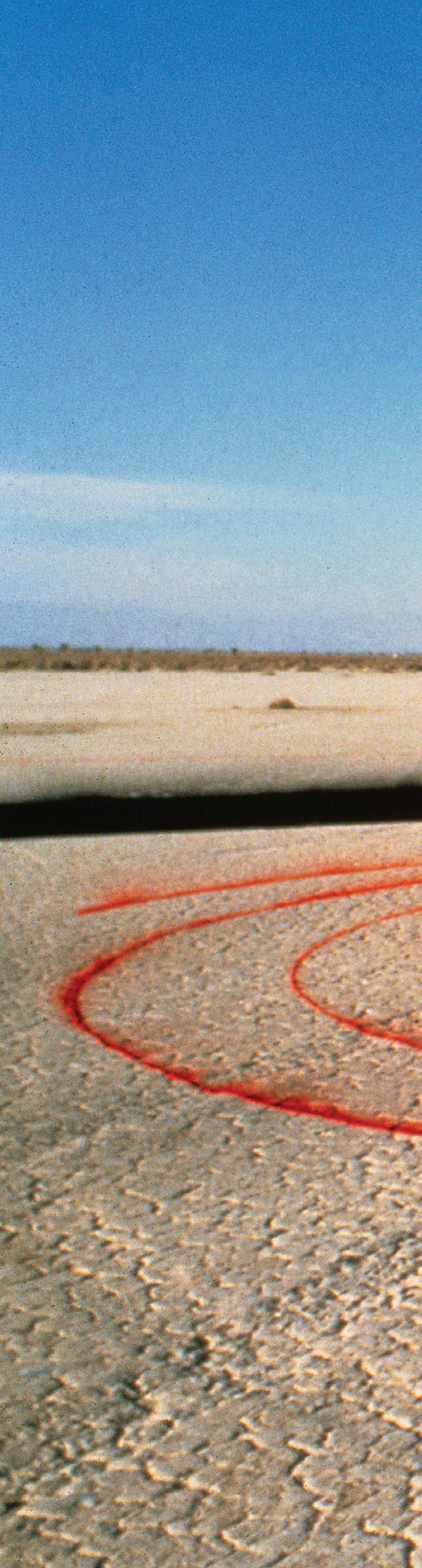 BY EVE HILL-AGNUS
Agnes Denes, American, born Hungary 1931, Wheatfield—A Confrontation: Battery Park Landfill, Downtown Manhattan—With Statue of Liberty Across the Hudson, 1982, chromogenic print, each 16 x 20 in. Collection of the Nevada Museum of Art, the Altered Landscape, Carol Franc Buck Collection.
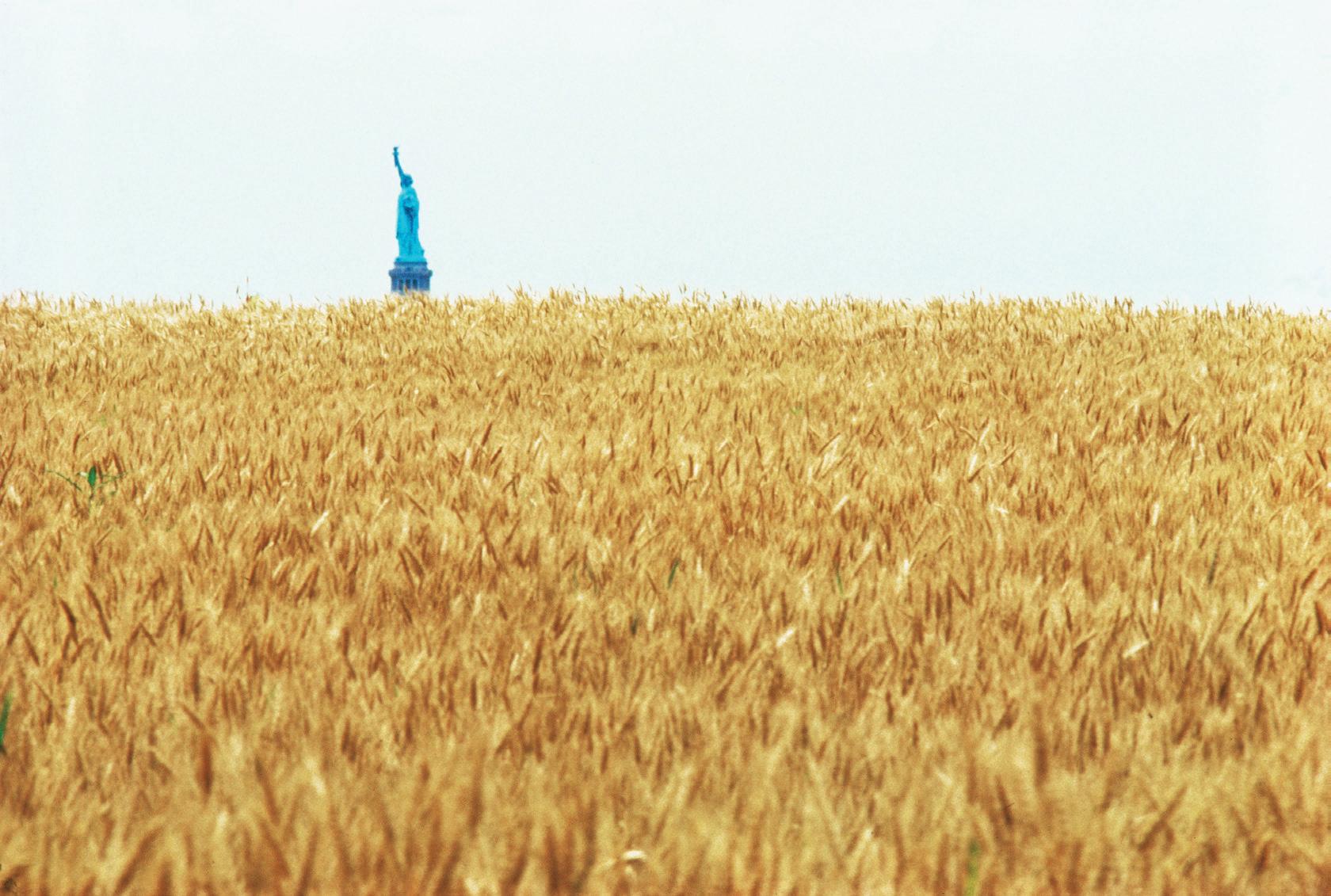
78 PATRONMAGAZINE.COM
-
In 1980, Lita Albuquerque worked with a group of university students to trace, with powdered pigments on the dry crust of California’s Mohave Desert floor, a series of fleeting, ghostly geometrical shapes.
But how do you harness the ephemeral? A daunting task faced Nasher Sculpture Center assistant curator Leigh Arnold as she steered to completion the current, ambitious exhibition, Groundswell: Women of Land Art, which she has been planning since 2016. How do you present work that may have existed for a minute or a month or a season? Work, perhaps, that is elsewhere. Work that was once elsewhere but exists no longer.
Then again, this exhibition, the first of its kind, is a corrective for the lacunae that have left us thinking that land art must be masculine, powerfully and permanently transforming the Earth, ever remote. Certainly, giants Robert Smithson, Walter De Maria,
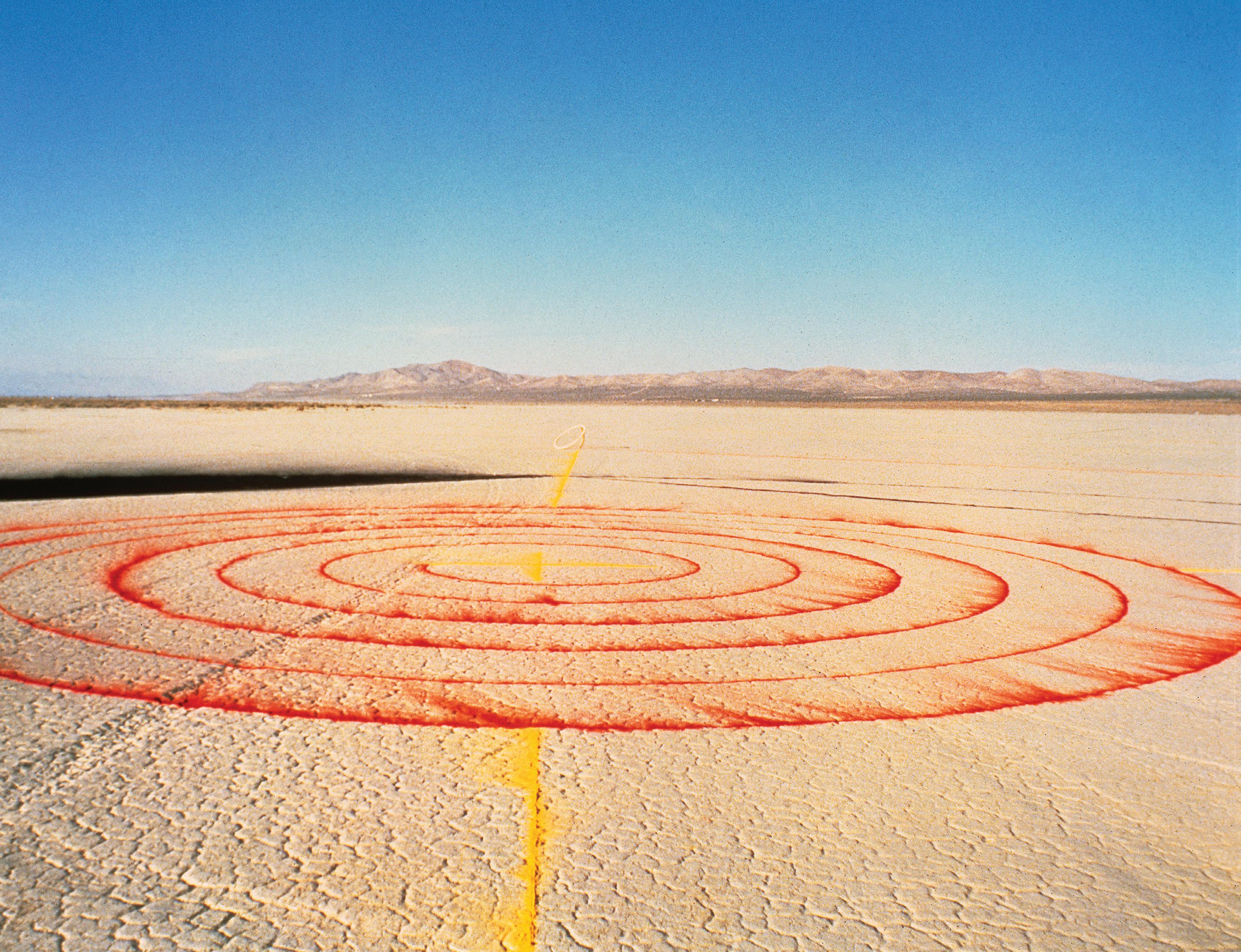
and Michael Heizer created a template in that very American period begun in the 1960s and ’70s, when works of monumental scale and inherent bravado put forth a new paradigm against a backdrop of limitless American spaces.
But land art is due for revision. The prevailing notion of what land art is has been incomplete, not wholly representative. Myths have reigned. At a time when Second Wave feminism and the Civil Rights Movement rallied, the Vietnam War raged, ecological angst and social unrest simmered, and America landed on the moon, the 12 women artists whose work forms the current exhibition were putting forward their own often prescient ideas, wholly shaping the zeitgeist, utterly in dialogue with the moment.
There were Albuquerque’s mesmerizing pigments. Nancy Holt rested her four massive Sun Tunnels (1973-76), concrete structures in Utah’s Great Basin Desert, where perforations in the cylinders
79 OCTOBER / NOVEMBER 2023
Lita Albuquerque, American, born 1946, Spine of the Earth, 1980, photo mural, (pigment, rocks, and wood sundials, El Mirage Lake, Mojave Desert, California, destroyed). Courtesy of the artist and Kohn Gallery, Los Angeles.
allowed viewers to see the inside speckled with stellar constellations, and the celestial could be brought to Earth. On a landfill in downtown Manhattan, Agnes Denes planted and harvested two acres of wheat in 1982 (Wheatfield—A Confrontation), the piece a protest against climate change and economic inequality.
The dozen artists in the show—three of them deceased and the rest predominantly now in their 80s—worked in earth, clay, peat moss, and branches, but also concrete, the scaffolding of architectural mazes, ancient cisterns, or scatterings of pink-painted trash. Some used their bodies.
“They were thinking through these problems,” Arnold says. “Now we’re at code red” regarding climate change and our relationship to the environment, while they were Cassandras, prophetic.
The works and our experience of them will take the form of photographs, photo montages and murals, videos, maquettes and
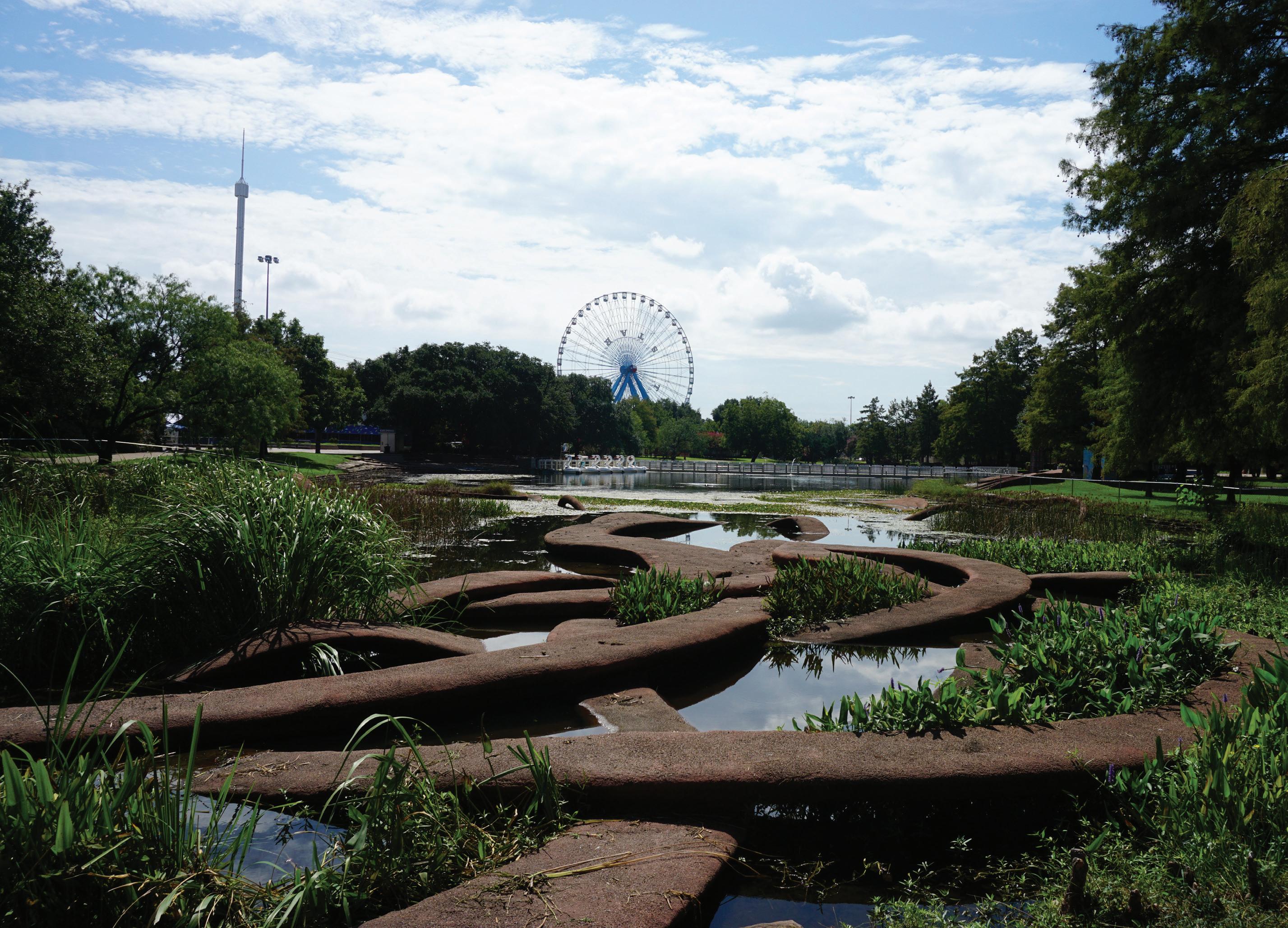
models, maps and sketches (pencil drawings of mazes on vellum, colored pencil drawings of toxic rainbows, or watercolor and graphite renderings of semi-imaginary landscapes). “Every artist has their idea of what is an artwork versus what is a document, what is something they want to show as a representation of the thing that no longer exists,” Arnold says.
Artist Mary Miss, for example, who has had a resolutely urban, public-art or socially charged practice, “was adamant about not including any of her drawings. For her, photography was the only way to try to recapture the experience of her artworks,” which have often been temporary, large-scale sculptures. On the other hand, for an artist such as Alice Aycock, who created notoriously intricate structures like her 1972 dodecagonal Maze, “drawing is so fundamental to her practice that she is insistent: drawing is the thing. If you can’t show Low Building With Dirt Roof (For Mary) [sited
80 PATRONMAGAZINE.COM
Patricia Johanson, American, born 1940, Fair Park Lagoon, 1981–86, gunite, native plants, and animal species. For the People, the Meadows Foundation, Communities Foundation of Texas, Texas Commission on the Arts and their private and corporate donations. Permanently sited in Fair Park, Dallas, Texas.
Left: Installation image of Groundswell: Women of Land Art. Nasher Sculpture Center, September 23, 2023–January 7, 2024. Mary Miss (b. 1944), Stream Trace: Dallas Branch Crossing (2023), mirror-polished stainless steel, dimensions variable. Photograph courtesy of the Nasher Sculpture Center. Photograph by Kevin Todora. Below: Nancy Holt, American, 1938–2014, Sun Tunnels, 1978, 16mm film on HD video, duration: 26:31 minutes, color, sound. Courtesy of Holt/Smithson Foundation and Electronic Arts Intermix (EAI), New York.
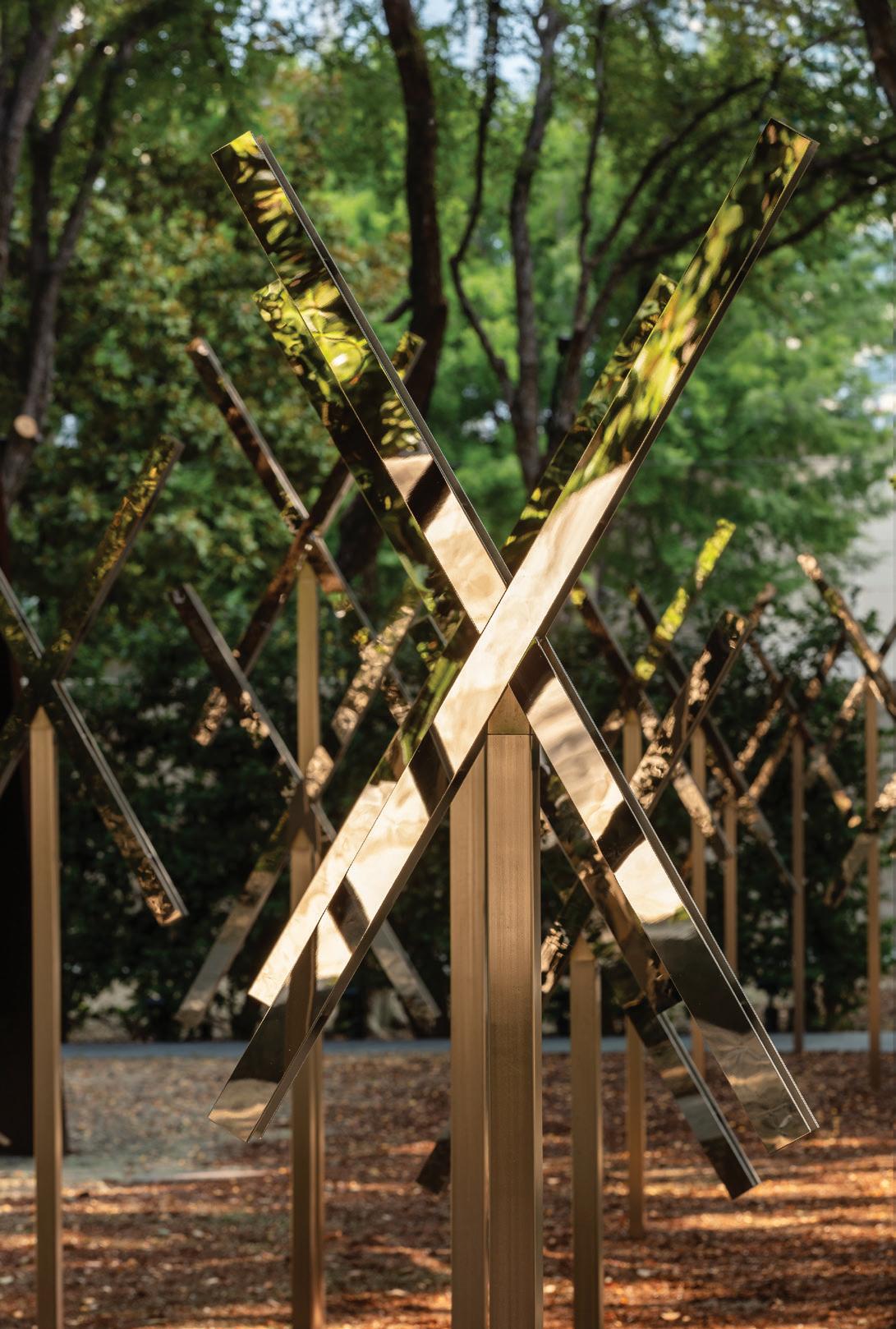
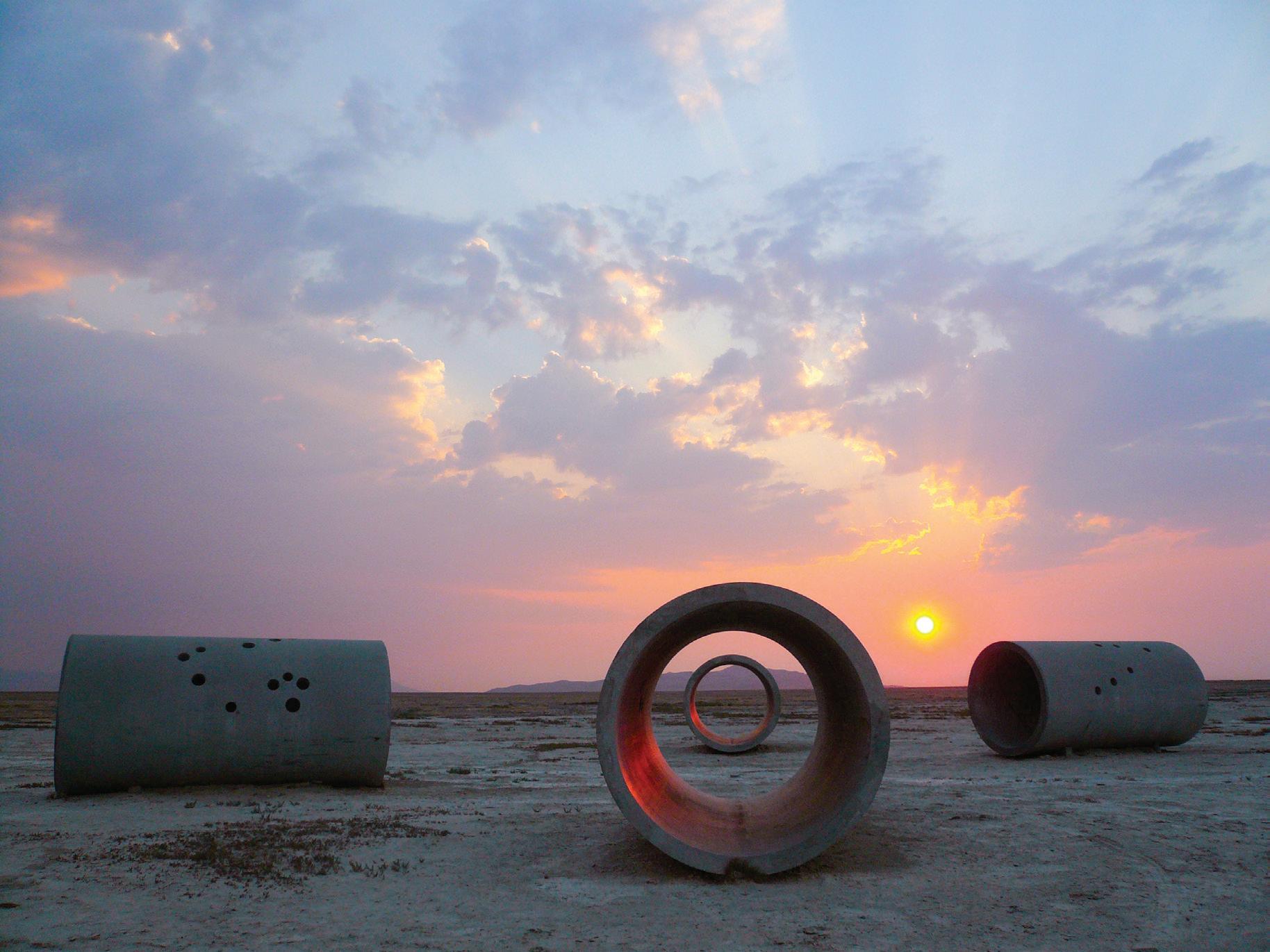

81 OCTOBER / NOVEMBER 2023
Maren Hassinger, American, born 1944, Pink Trash, 1982, three chromogenic color prints, 10 x 14 x 1.50 in. Courtesy of the artist and Susan Inglett Gallery.
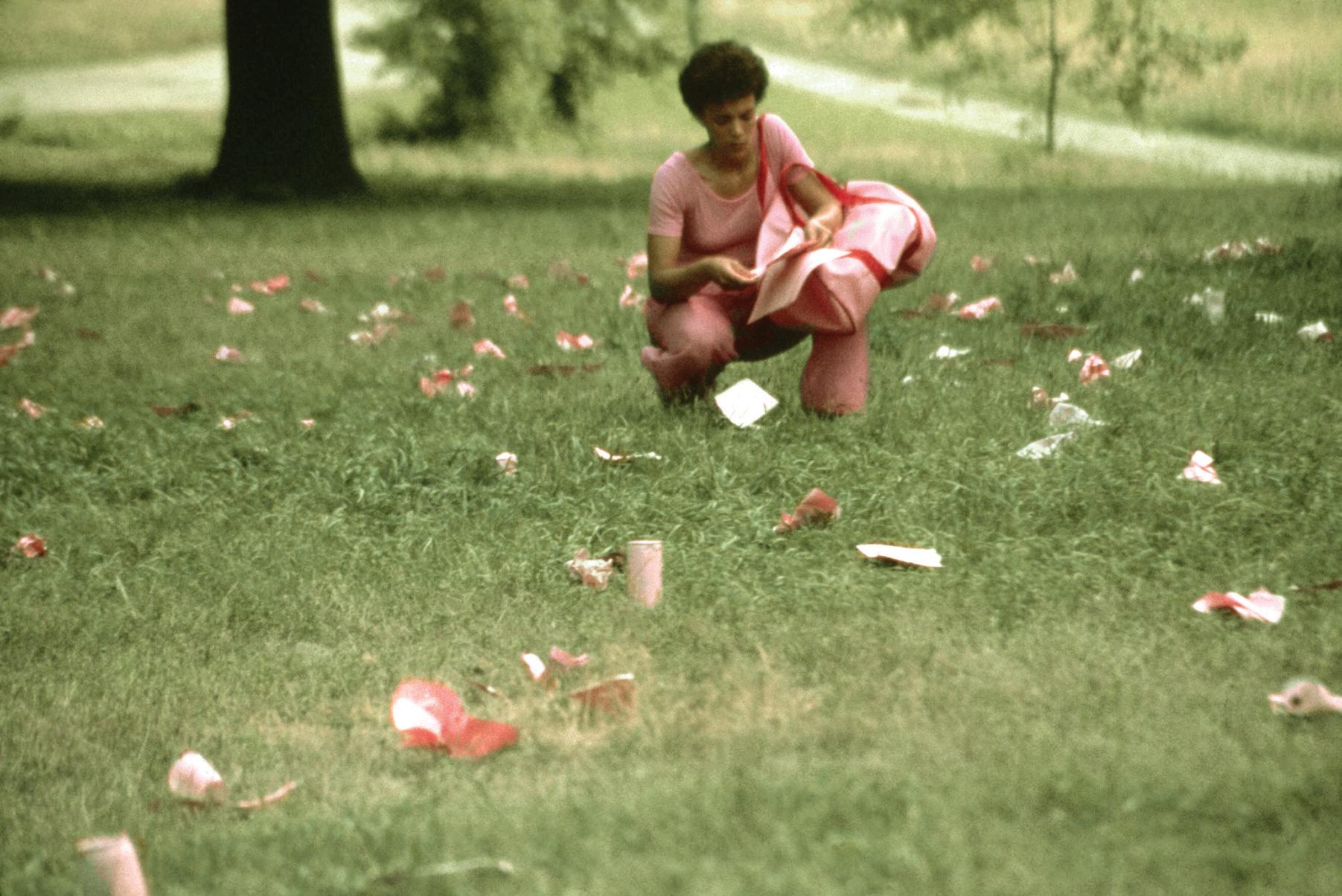
in New York state], then the drawing of it is what I want you to show. Because that, I think, for her communicates, ‘This is a real thing’ ” out in the world.
In this exhibit, the idea, proposed by Smithson, of the dialectic between a “site” and a “non-site” comes into play: the site being a place; the non-site being, as Arnold says, “its referent—either a visual reference or a verbal reference to something that exists out there in the landscape”—a photo or diagram or talisman that conjures.
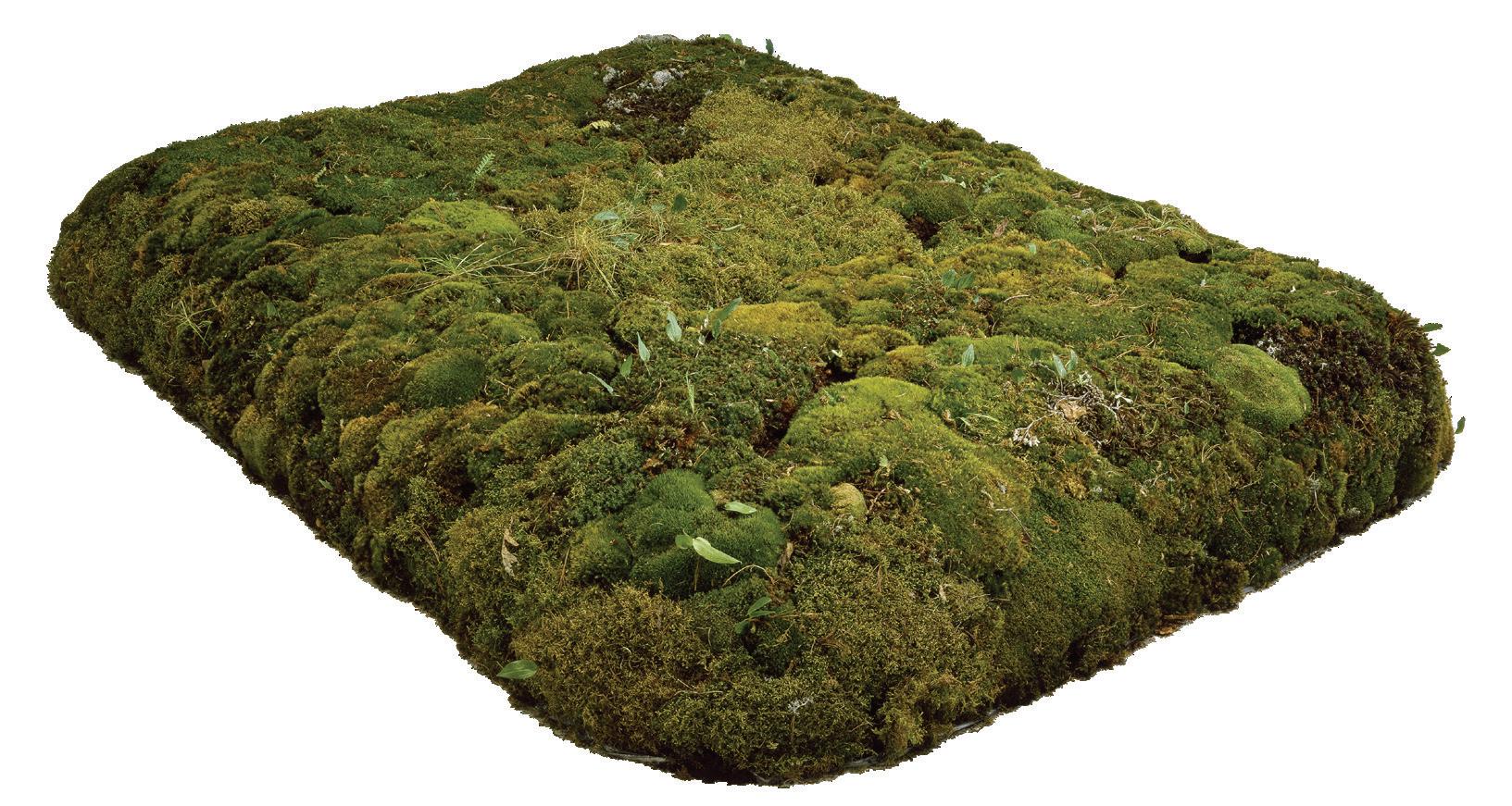
Perhaps one of the most striking premises of the exhibition is the notion that sculpture can be an experience or “it can be something that exists outside of the gallery wall that you have to imagine in your mind,” Arnold says. The viewer will be tasked with such imaginative acts, but the Nasher equally presents onsite installations.
The late Holt’s Pipeline, a labyrinthine sculpture of steel and oil, which the artist installed twice ephemerally in Alaska in 1986, is assembled without instructions but in close collaboration
Alice Aycock, American, born 1946, Maze, 1972, photo mural, 1972 (12-sided wooden structure of 5 concentric dodecagonal rings broken by 19 points of entry and 17 barriers, 6 x 32 ft. dia. Originally sited at Gibney Farm near New Kingston, Pennsylvania, destroyed). Courtesy of the artist; Meg Webster, American, born 1944, Moss Bed, Queen, 1986/2005, peat moss, earth, and plastic tarp, 10 x 60 x 80 in. Walker Art Center, T. B. Walker Acquisition Fund, 2006.
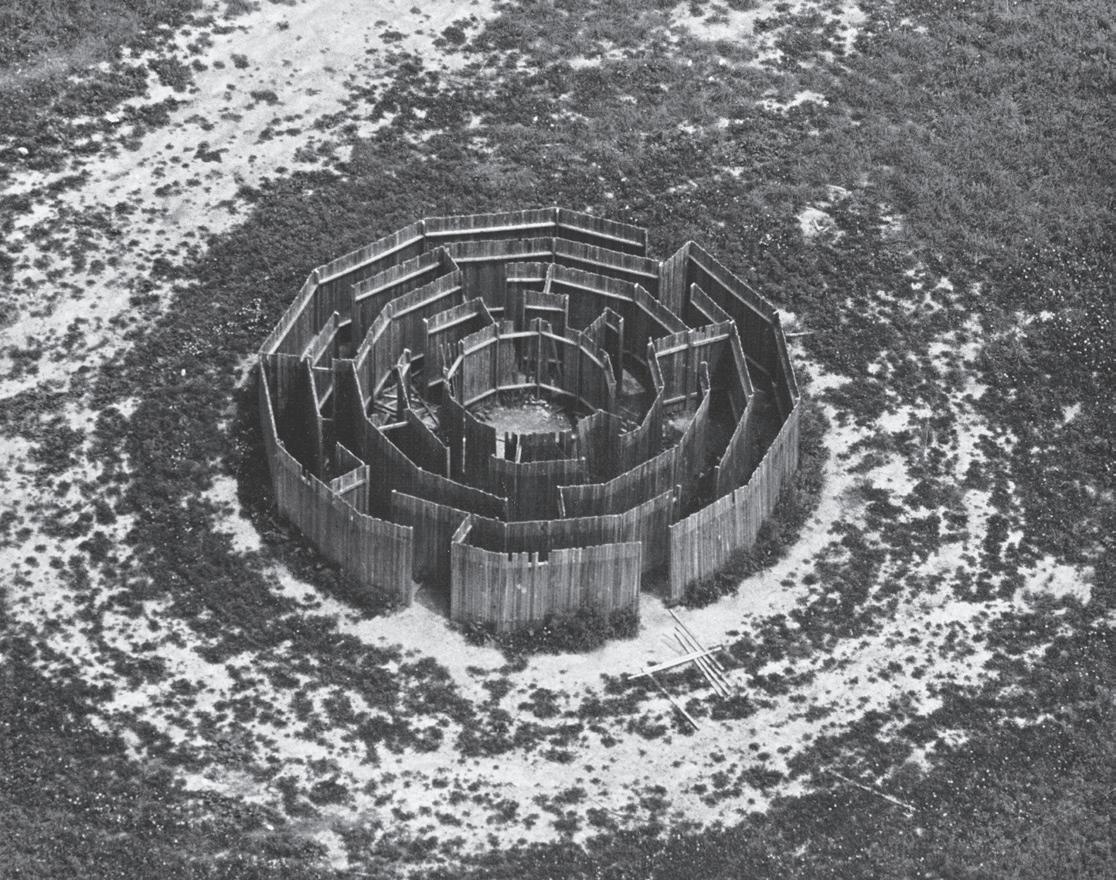
82 PATRONMAGAZINE.COM
with the Holt/Smithson Foundation. Michelle Stuart, who submerged army-issued flashlights in a body of water in Alaska, has reimagined and refashioned the work in the Nasher Garden’s fountain, poetically mirroring a constellation that can be seen in the Dallas night sky. Miss has traced an underground stream that trickles under the Nasher toward the Trinity River, marking its path in the garden, while artists will lead monthly walks and talks about the urban history buried along with the stream.
Logistics dominated this exhibition that surpasses all others in number of objects (around 150) and number of artists with whom the Nasher staff worked. “In some ways, we’re taking on the role of an artist assistant,” laboring “to realize something on behalf of an artist. It’s not something we take lightly, this idea of remaking an artwork,” Arnold says, this notion of historically recreating or readapting.
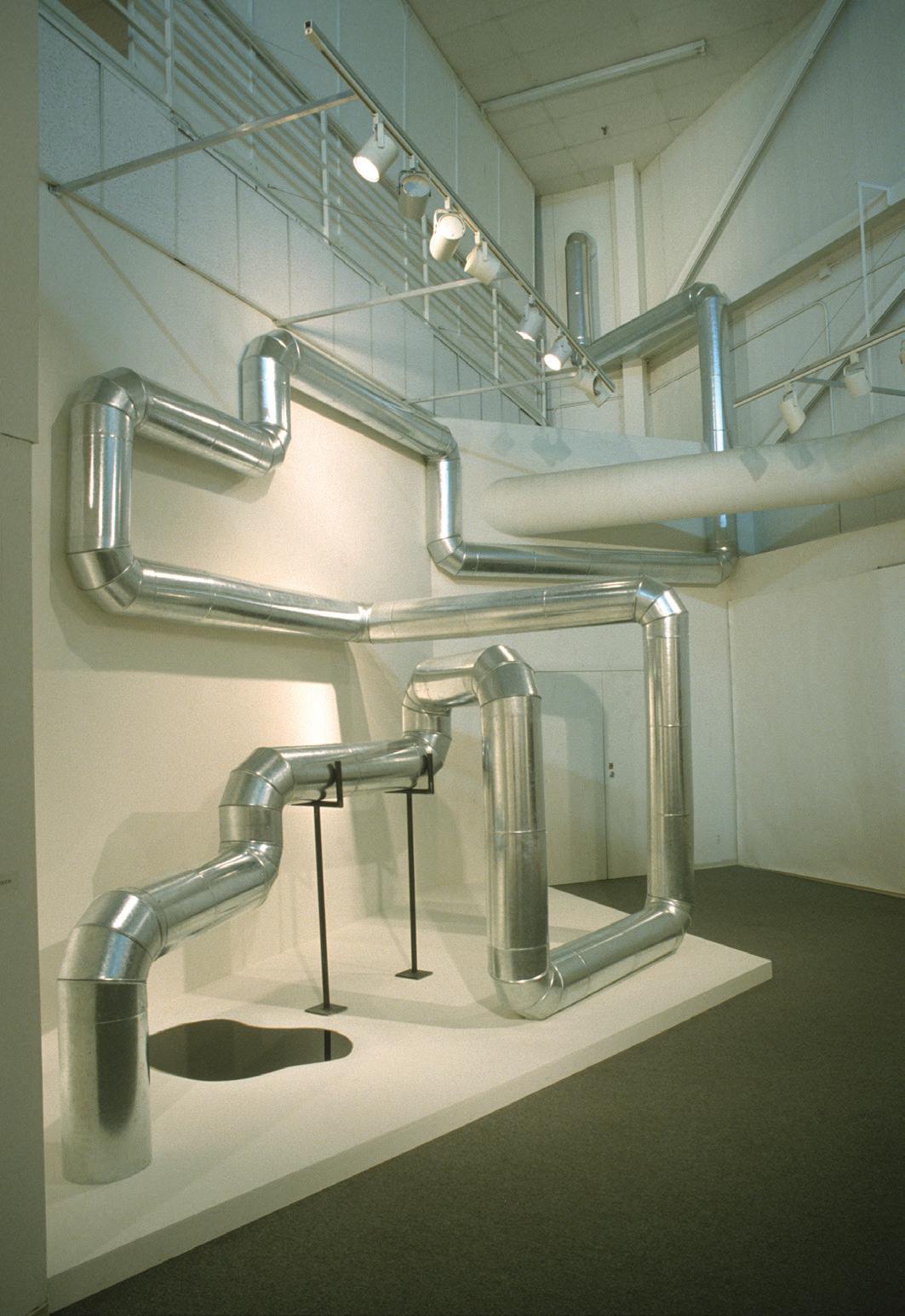
“It’s been the greatest education, but also the greatest pleasure of my career,” she says. It is also a novel, necessary gaze at a movement. “We should shed this notion that land art only exists in desolate locations”—just as we should do away with the romanticization of expansive space as “open.” “It’s also urban. It’s ephemeral, not just permanent. It can be private, or it can be public.”
Why are these artists, prolific in their careers, not more referenced outside informed circles? For no reason save that history reduces, eclipses. Groundswell will, Arnold hopes, ensure that the movement is seen for its richness “and not just its singularity”—that it will touch and awaken and incite one to act or question, or to imagine one’s relationship to the environment anew, the way Nancy Holt’ s Sun Tunnels make one catch one's breath in awe. P
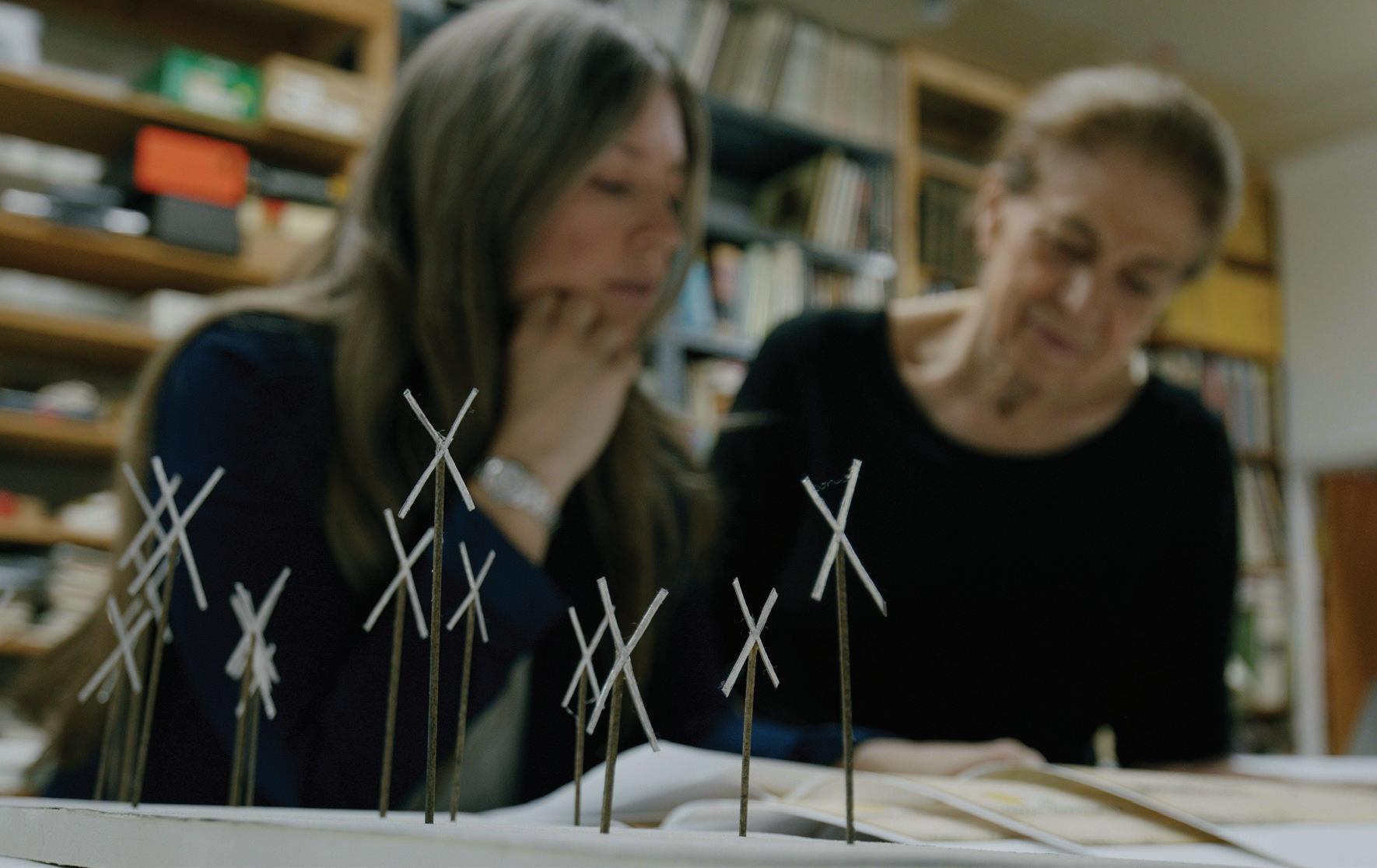
83 OCTOBER / NOVEMBER 2023
Nancy Holt, American, 1938–2014, Pipeline, 1986, steel and oil, dimensions variable. Courtesy of the Holt/Smithson Foundation.
Mary Miss (right) in her studio with Dr. Leigh Arnold, New York, 2023. Photograph by Oresti Tsonopoulos.
UNRAVELING HISTORY
THE DALLAS MUSEUM OF ART LOOKS TO THE PAST WHILE MINING THE PRESENT TO CONNECT THE DIVERSE COMMUNITIES OF DALLAS.
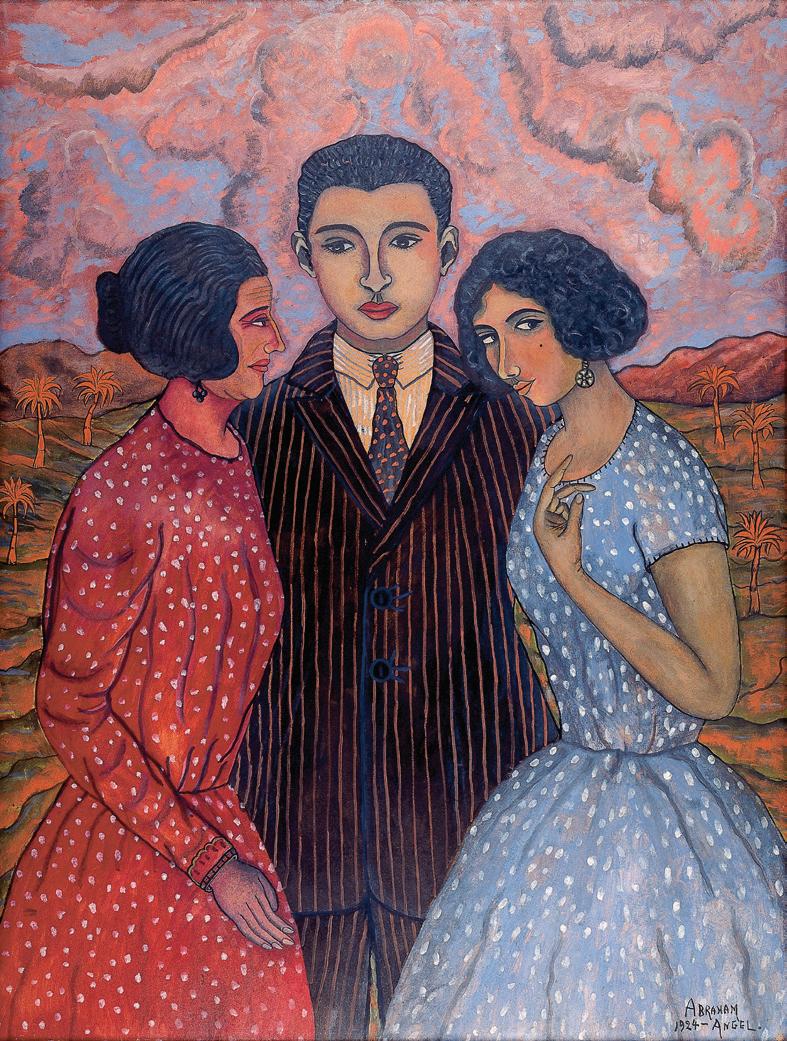
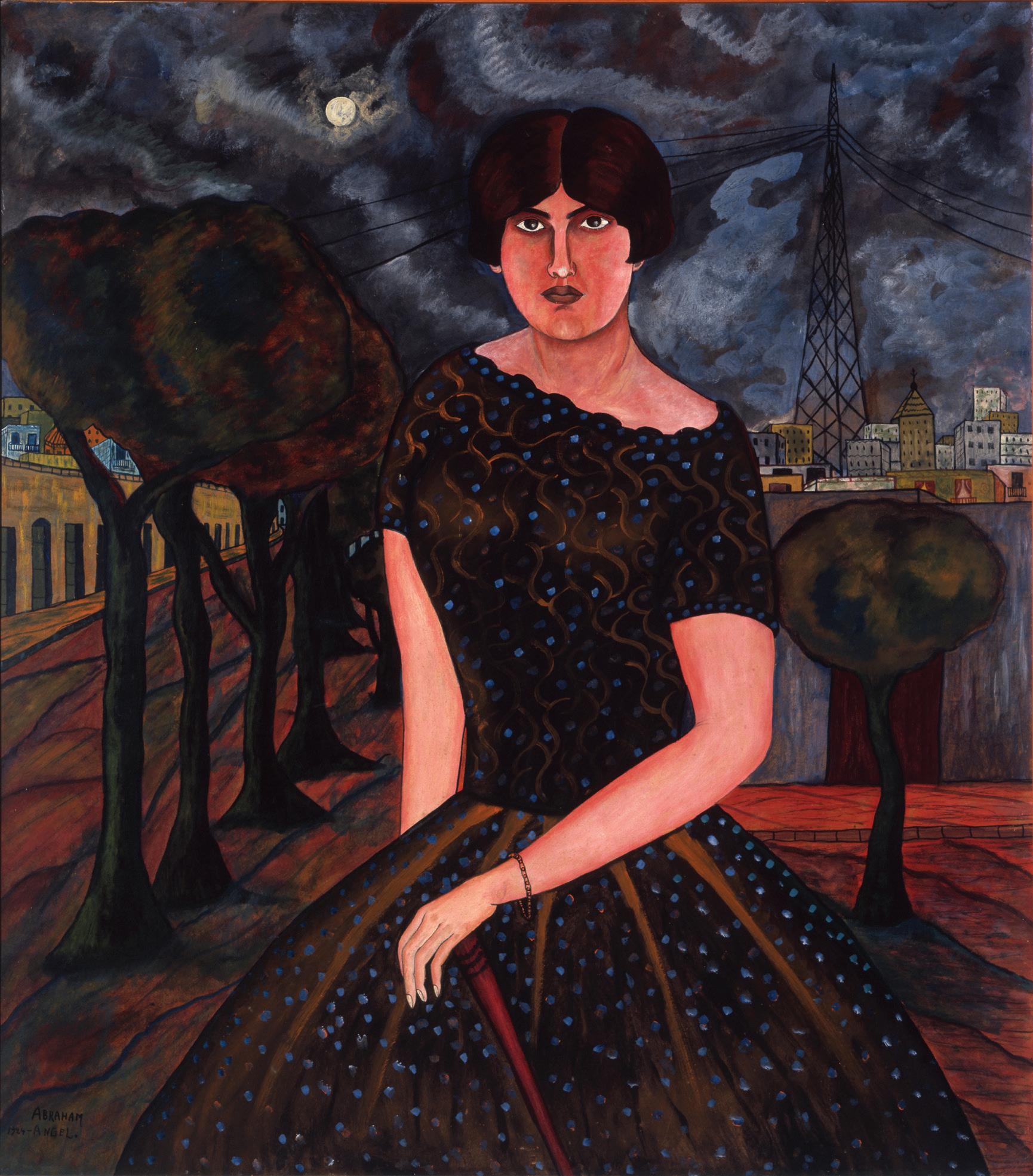 BY DARRYL RATCLIFF
84 PATRONMAGAZINE.COM
Abraham Ángel, Portrait of Cristina Crespo / Retrato de Cristina Crespo, 1924, oil on cardboard, 53.87 x 47.62. Museo Nacional de Arte. INBAL / Secretaría de Cultura, Mexico City.
Abraham Ángel, The Family / La familia, 1924, oil on cardboard, 63 x 48 in. Museo de Arte Modern. INBAL / Secretaría de Cultura, Mexico City.
The Dallas Museum of Art is presenting not one but two groundbreaking exhibitions that promise to redefine our understanding of history, identity, and artistic expression. This fall, the DMA brings together the past and the present, weaving narratives of resilience and rediscovery through AfroAtlantic Histories and Abraham Ángel: Between Wonder and Seduction . The exhibitions, which will hopefully resonate across Black, Latino, and LGBTQIA+ audiences, will feature art in a variety of styles that will attract both new and longtime museumgoers. “It is really important to have art at the center, and community at the core,” says Dr. Agustín Arteaga, Eugene McDermott Director of the Dallas Museum of Art.
Abraham Ángel: Between Wonder and Seduction is the first major survey of Ángel’s work in over 35 years, and the first dedicated showing of his paintings in the United States. This exhibition shines a spotlight on Ángel’s singular artistic style, cultivated during his tragically brief three-year career. “These are paintings with a unique palette, so alive and vibrant, reds and oranges. Angel died at 19 but his work has endured for a century,” says curator Dr. Mark A. Castro.
Abraham Ángel, who produced just 24 paintings during his short life, left an indelible mark on the Mexican art scene of the 1920s. His journey began when he met painter Adolfo Best Maugard, and he soon became part of a generation of young students and artists exploring the potential of the Maugard method, which aimed to democratize art. Over the next two years, Ángel’s immersion in the vibrant cultural scene of Mexico City, along with a passionate romantic relationship with painter Manuel Rodríguez Lozano, shaped his distinctive visual language and style. “Tapping into the capital’s emerging queer subculture, Ángel’s work asserted his own identity, and in doing so carved out space for future queer artists in Mexico,” says Castro.
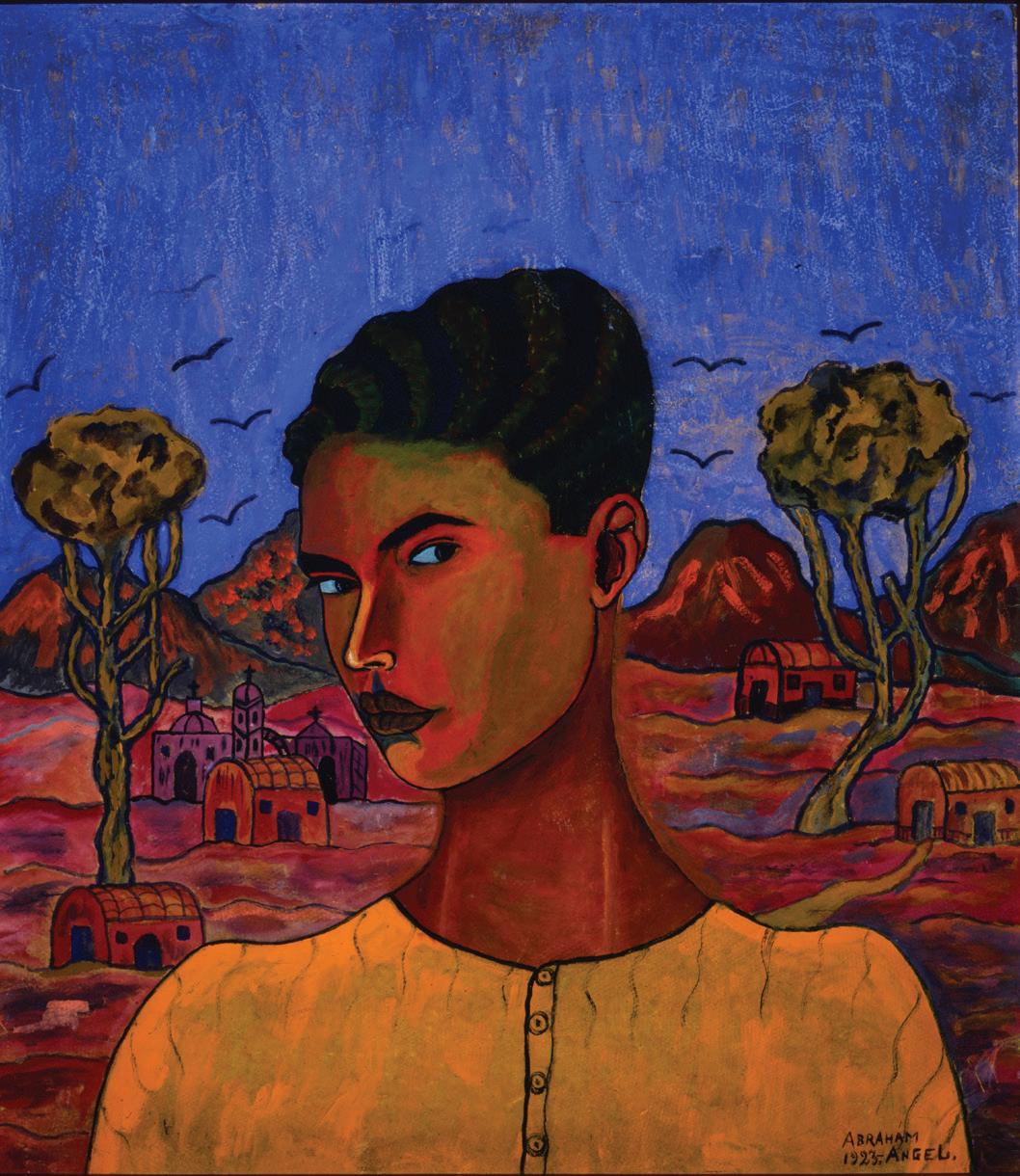
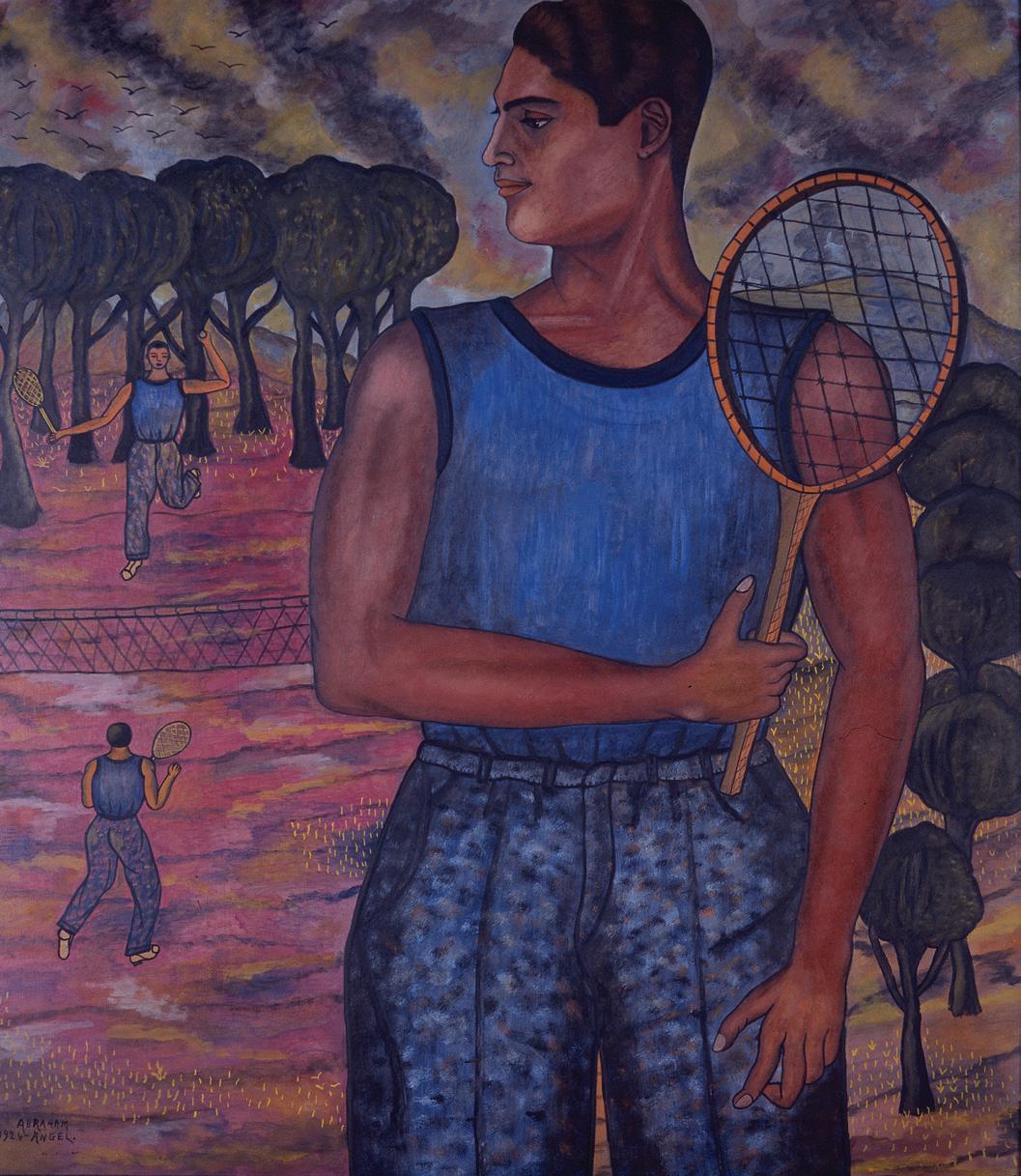
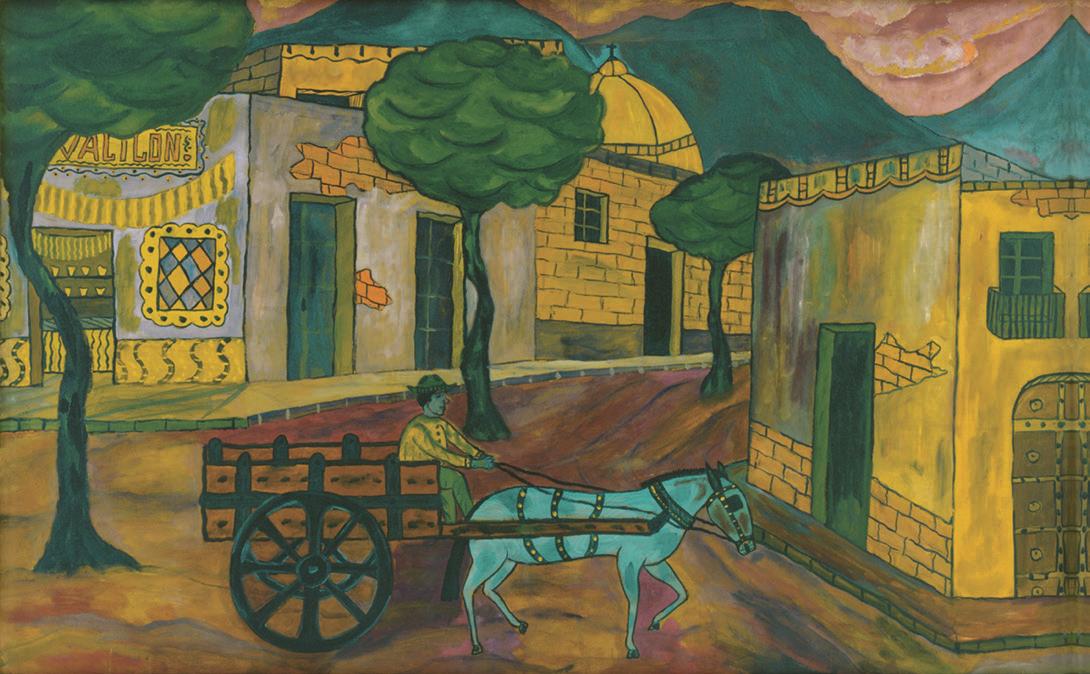
Although there is much mystery over the cause of Ángel’s death, much of it fueled by speculation of the title of his final painting, I killed myself for a traitorous woman, it is certain that the artist, who lost his father at a young age and was exiled from his family for being queer, had a rough life. “He grew up in a society that was not ready for him,” says Arteaga.
The resurfacing of histories, legacies, and identities continues
85 OCTOBER / NOVEMBER 2023
Above: Abraham Ángel, Self-Portrait / Autorretrato, 1923, oil on cardboard, 31.87 x 28.25 in. Museo Nacional de Arte. INBAL / Secretaría de Cultura, Mexico City. Below: Abraham Ángel, Portrait of Hugo Tilghman / Retrato de Hugo Tilghman, 1924, oil on cardboard, 53.50 x 47.25 in.
Abraham Ángel, Landscape (The Little Mule) / Paisaje (La mulita), 1923, oil on cardboard, 30 3/4 x 39 3/8 in. Museo de Arte Moderno. INBAL / Secretaría de Cultura, Mexico City. Museo Nacional de Arte. INBAL / Secretaría de Cultura, Mexico City.
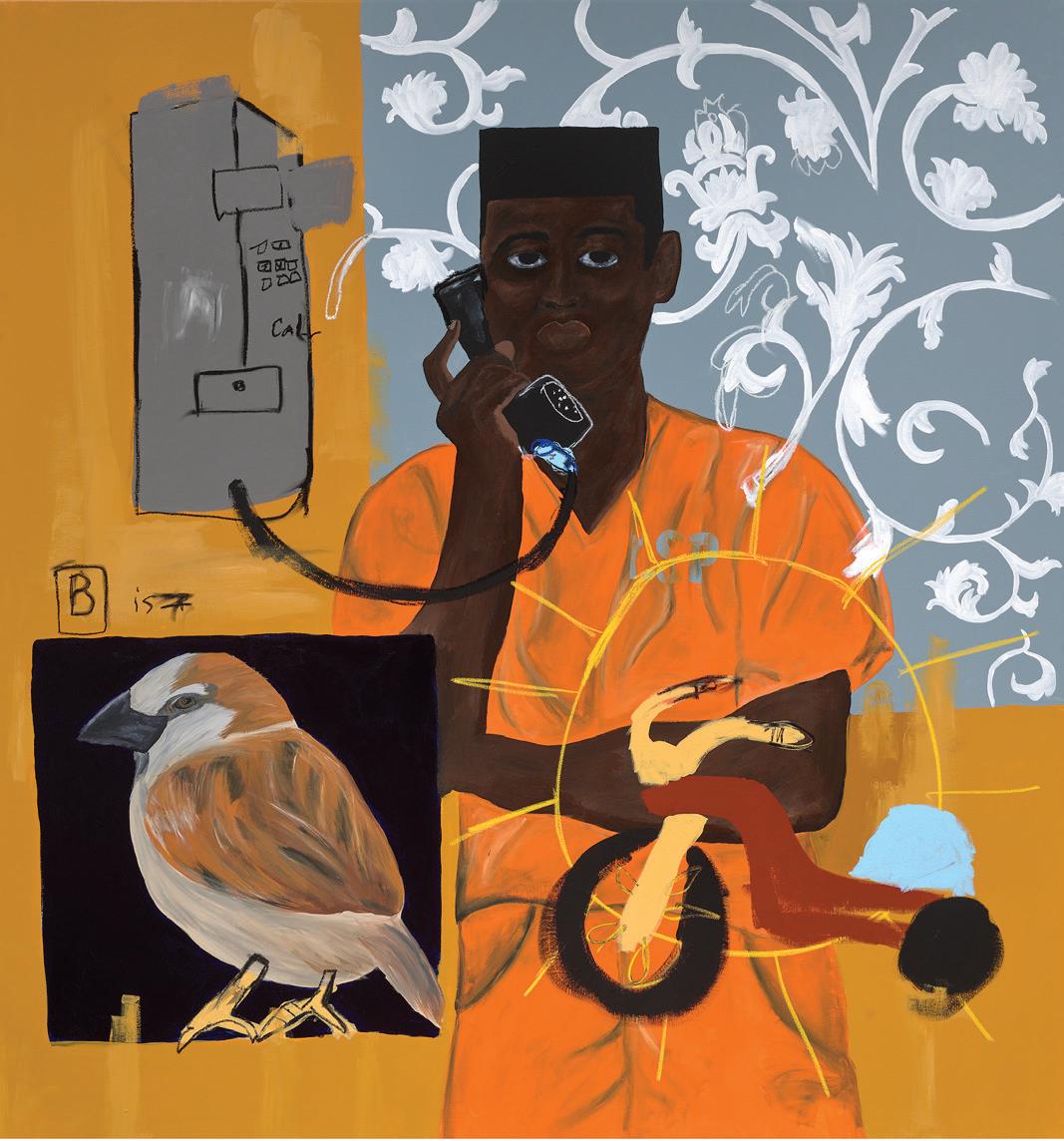
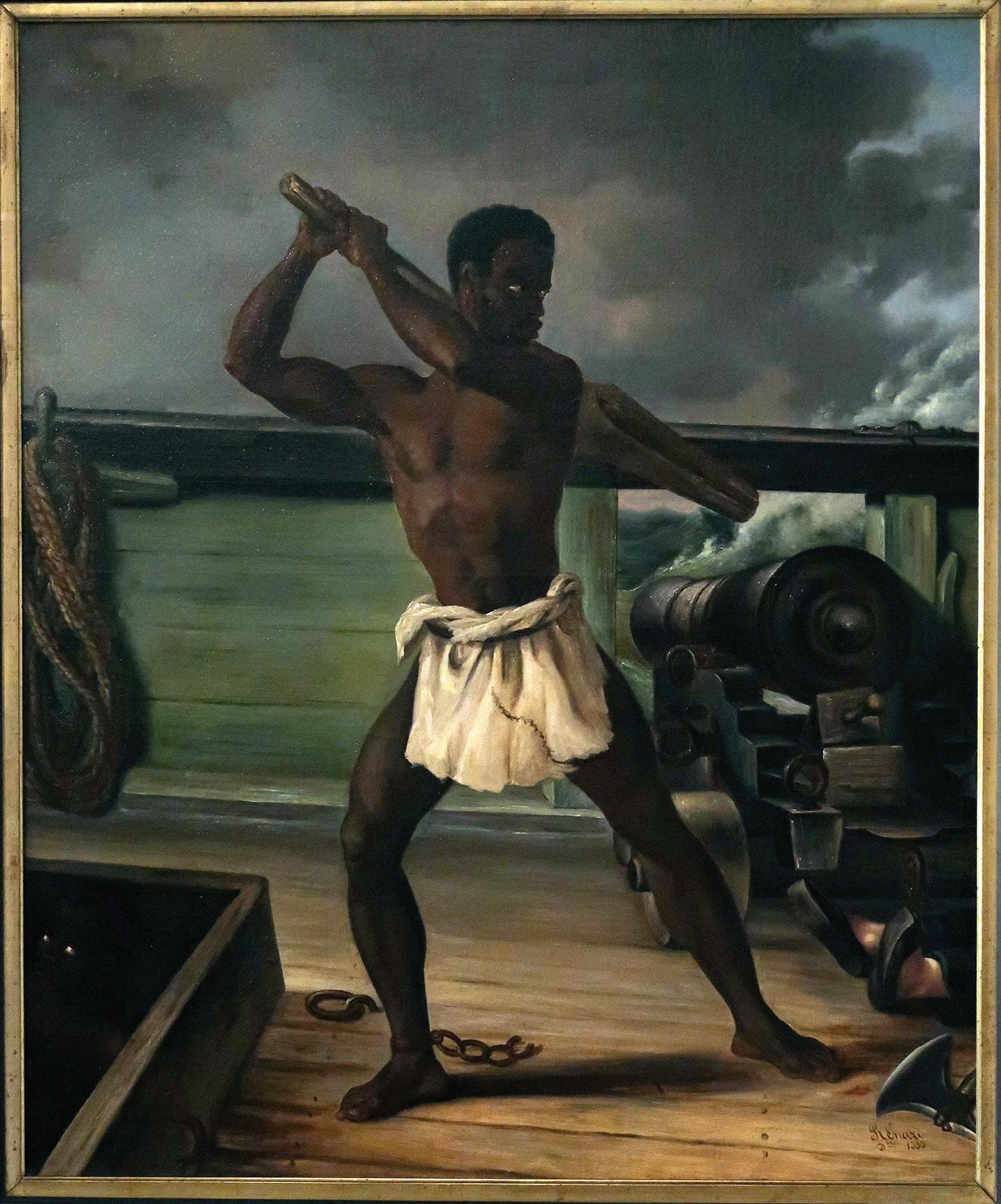
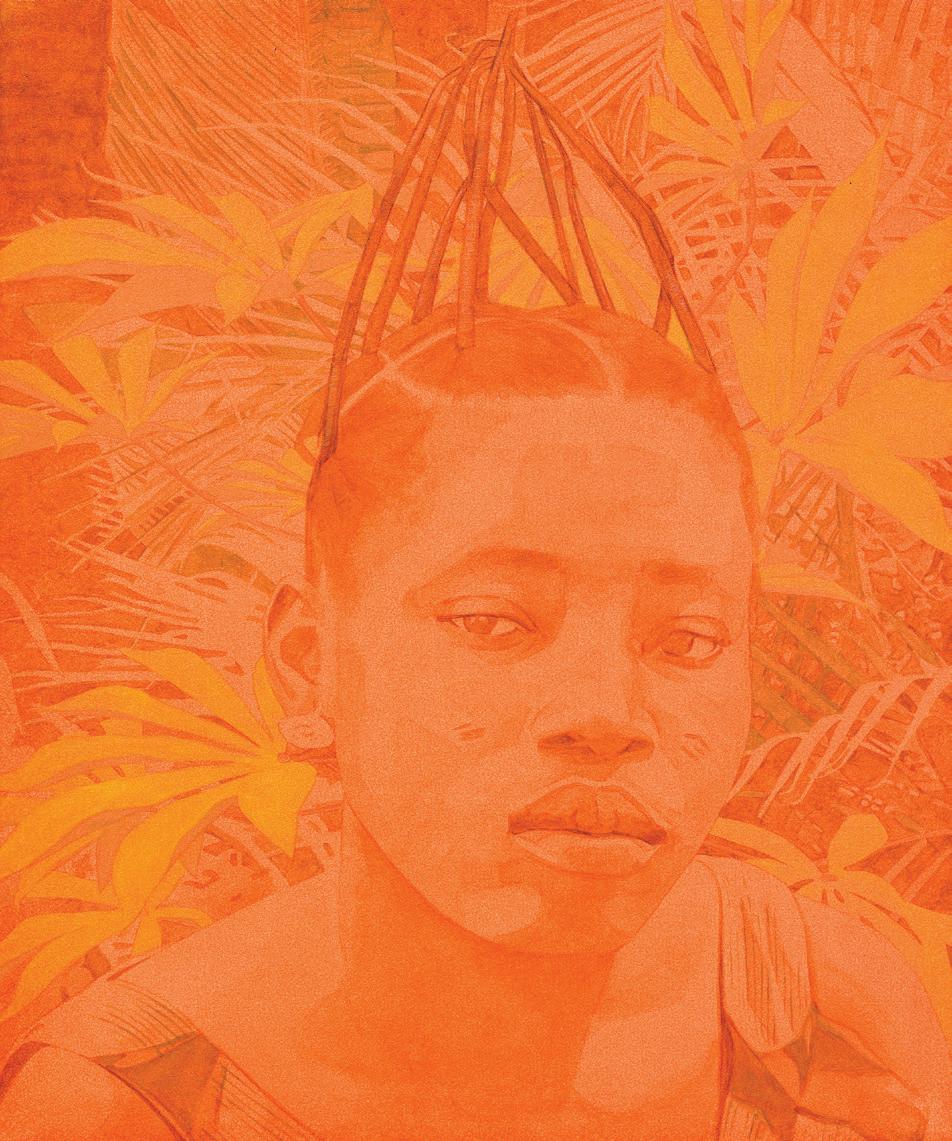
86 PATRONMAGAZINE.COM
Édouard-Antoine Renard, A Slave Rebellion on a Slave Ship, 1833, oil on canvas. Musée du Nouveau Monde. Collections d’rt et d’Histoire, La Rochelle, France.
Jammie Holmes, Brown Sparrow, 2020, acrylic and oil crayon on canvas. The Museum of Fine Arts Houston. Museum purchase funded by Joseph Nguyen and Tamie Tong. © 2020 Jammie Holmes.
Njideka Akunyili Crosby, Eko Skyscraper, 2019, acrylic and color pencil on panel. National Gallery of Art, Washington. Purchased with support from the Ford Foundation. © Njideka Akunyili Crosby. Courtesy of the artist, Victoria Miro, and David Zwirner.
at the DMA through Afro-Atlantic Histories, an exhibition that takes us on a visual odyssey through the history and legacy of the African Diaspora. This critically acclaimed exhibition, originally presented in 2018 by the Museu de Arte de São Paulo, has been captivating audiences across the United States. It brings together around 100 artworks and documents, ranging from the 17th century to the present day, shedding light on the profound impact of the transatlantic slave trade and the enduring resilience of Black communities.
“Rather than organize artworks chronologically, the exhibition unfolds thematically, which yields compelling juxtapositions that reveal the ways the past lingers in the present,” says Ade Omotosho, the Nancy and Tim Hanley Assistant Curator of Contemporary Art. The thematic categories are Maps and Margins, Resistances and Activisms, Enslavements and Emancipations, Portraits, Rites and Rhythms, and Everyday Lives. As such, Édouard-Antoine Renard’s A Slave Rebellion on a Slave Ship, 1833, which depicts a Black man wielding an oar in mutiny, might be in the same gallery as Jammie Holmes, Brown Sparrow, 2020. The sparrow often appears in Holmes work as a symbol of peace.
Some notable contemporary artists included in the exhibition are Kara Walker, Hank Willis Thomas, Titus Kaphar, Firelei Báez, Nina Chanel Abney, Njideka Akunyili Crosby, and Zanele Muholi,
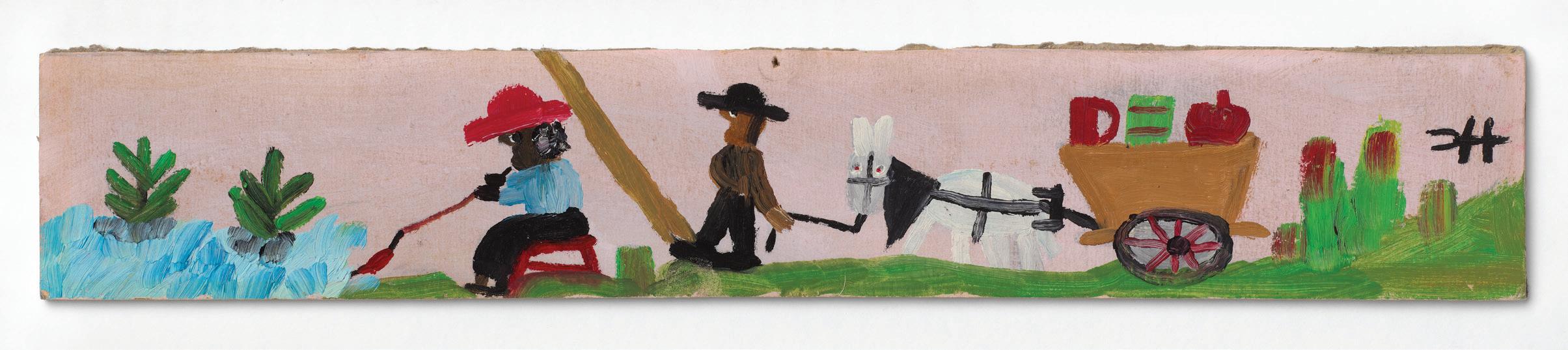
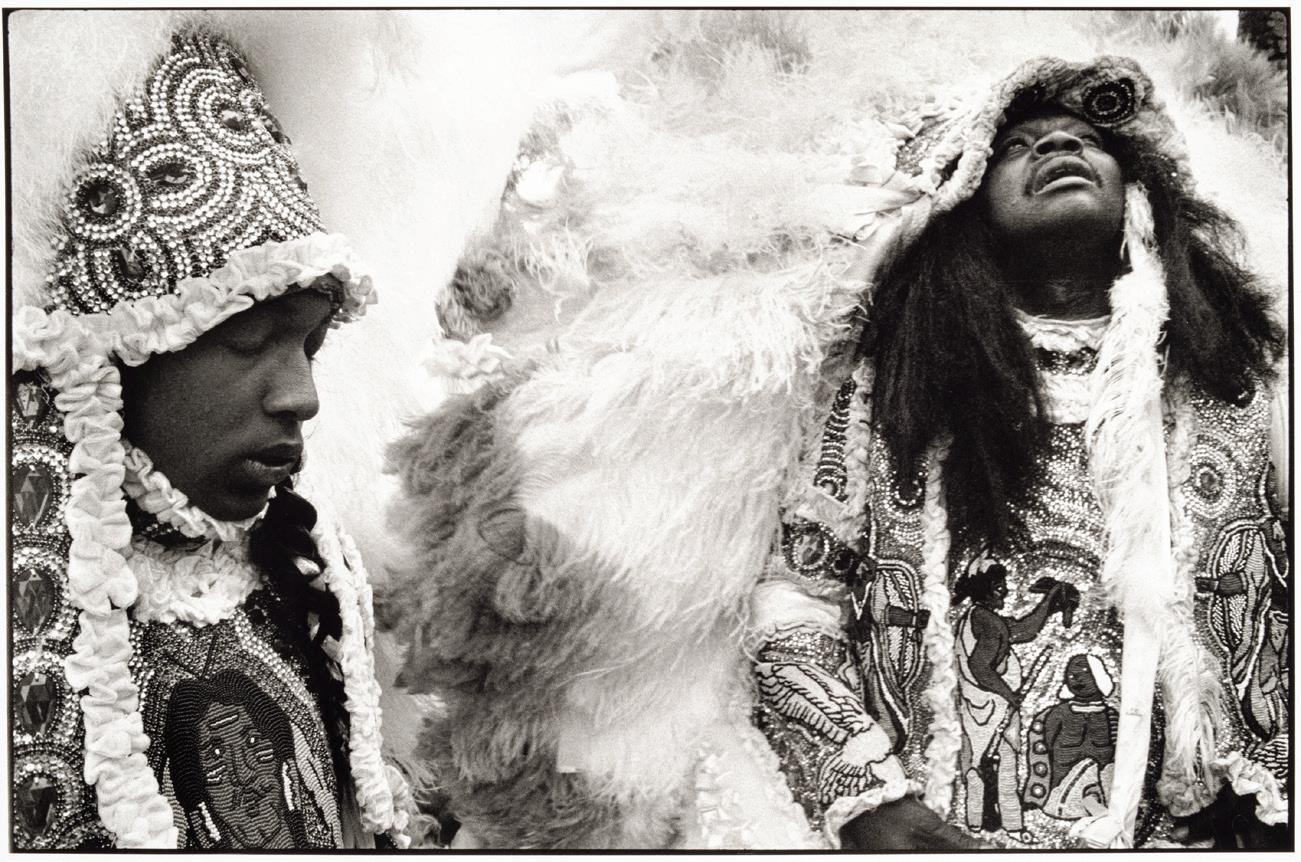
who also had a signature piece in the If You Look Hard Enough, You Can See Our Future exhibition at the African American Museum, Dallas. The DMA is building on its community engagement efforts by offering free community days during both exhibitions. The museum will celebrate Hispanic Heritage Month on October 8 with free admission to Abraham Ángel: Between Wonder and Seduction, and access to programs exploring mental health, hope, and resilience. On November 18 and 19, the museum will host a DMA Free Community Weekend: Revelation & Celebration: Black History and Culture in connection with Afro-Atlantic Histories
Dr. Arteaga teases that the museum is working on an upcoming exhibition of the past decade of collecting for the DMA that is “very focused on artists of color, female artists, and queer artists. Very keen on trying to present history and stories of artists who are lesser known but not of lesser quality.”
In his seventh year at the helm of the museum, recently selecting the Spanish architecture firm Nieto Sobejano Arquitectos to lead a massive extension of the DMA, Dr. Arteaga is determined to find ways the museum can better connect to the diverse communities of Dallas while keeping art at the center of everything the institution does. “I don’t want much, I just want more. More for the DMA and better.” P
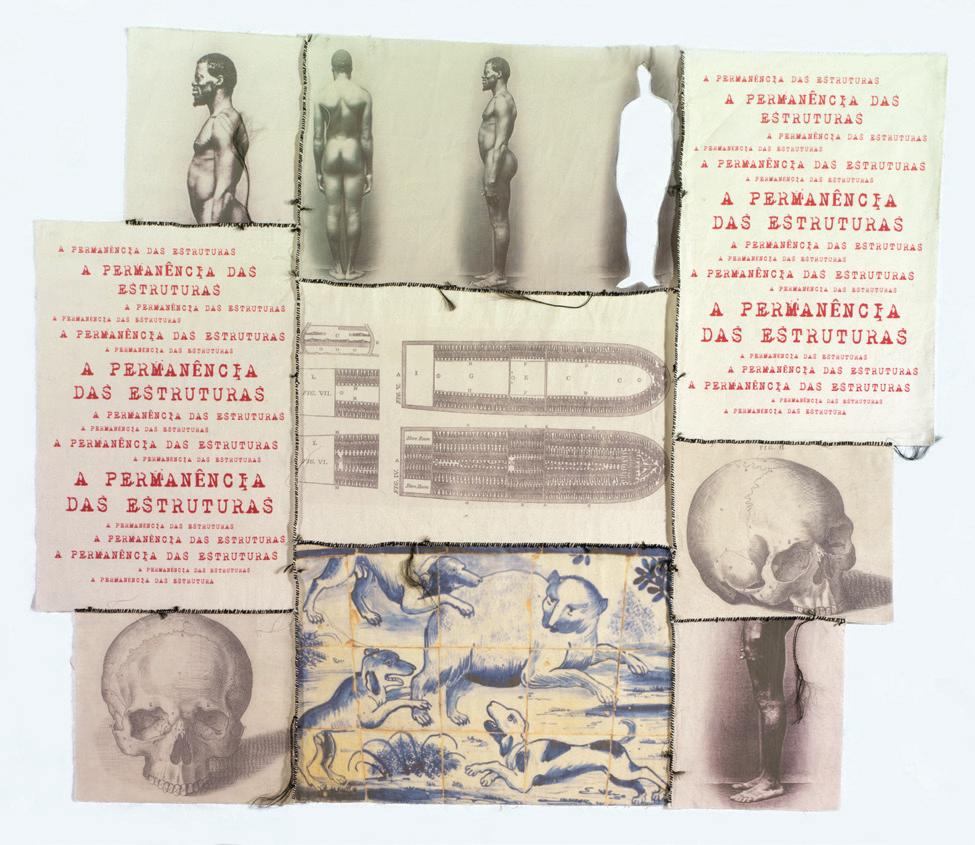
87 OCTOBER / NOVEMBER 2023
Clementine Hunter, Untitled, c. 1970, oil on cardboard, The Museum of Fine Arts, Houston, Gift of Anne Wilkes Tucker in honor of Alice C. Simkins
Marilyn Nance, The White Eagles, Black Indians of New Orleans , 1980, gelatin silver print, Light Work Collection, Syracuse.
Rosana Paulino, The Permanence of Structures , 2017, digital print on cut and sewn fabric, Museu de Arte de São Paulo Assis Chateaubriand –MASP. Gift of Fernando Abdalla and Camila Abdalla in the context of the Afro-Atlantic Histories exhibition, 2018.
Poetic Post-Apocalypse
Bianca Bondi at Dallas Contemporary
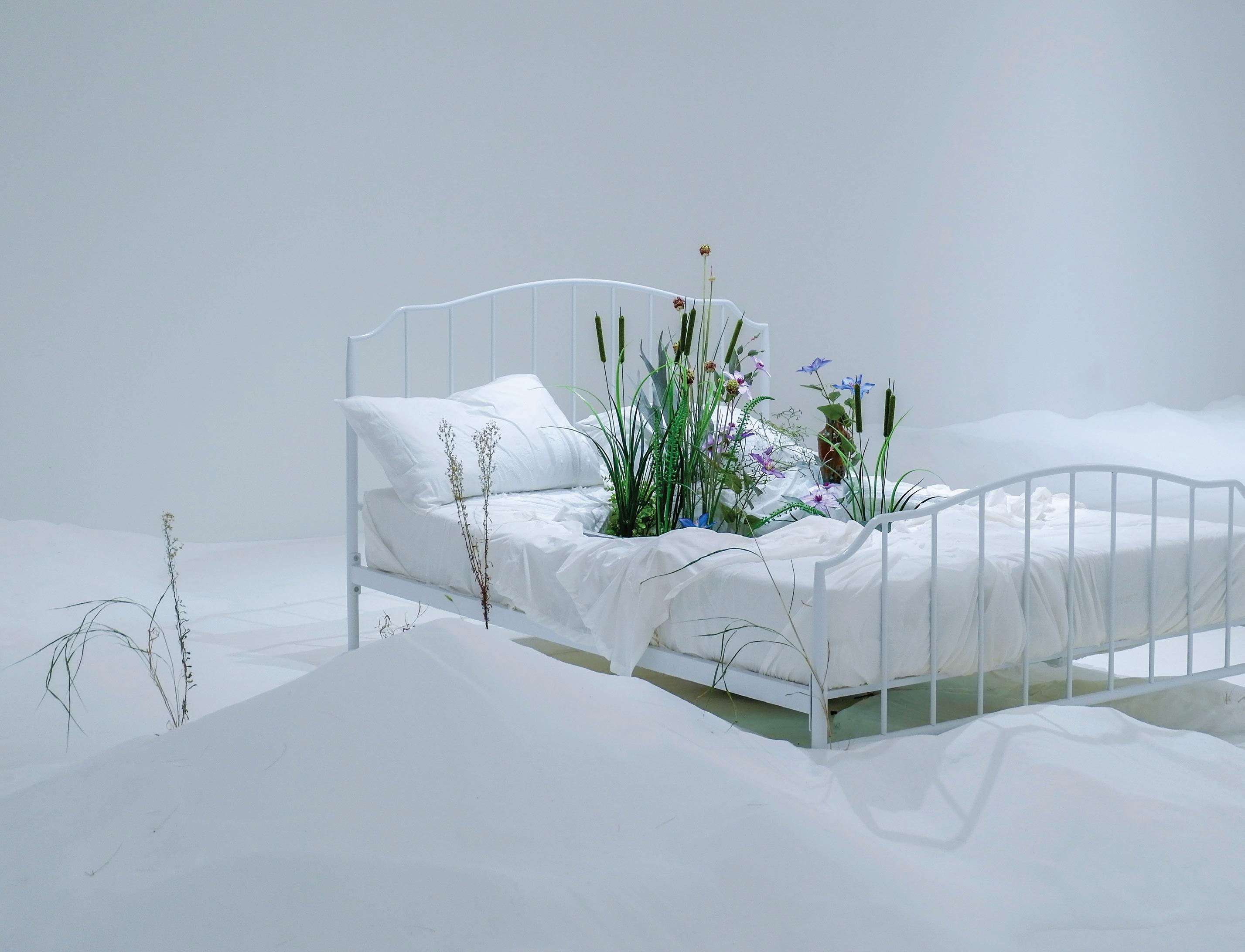 BY STEPHANIE CRISTELLO
88 PATRONMAGAZINE.COM
Bianca Bondi, exhibition views: Vanilla Oxide, 2022. CAP Saint-Fons, Lyon, France. mixed media, scent created by Yann Vasnier (Givaudan). Courtesy of the artist and Mor Charpentier. Photographs by David Desaleux.
In 1965, the president of the United States signed a law proposed by his wife, Lady Bird Johnson, in the name of beauty. The Highway Beautification Act called for the removal and control of outdoor advertising, billboards, and signs—a pollution of not only material waste along the nation’s growing interstate infrastructure, but also to the American landscape. Newspaper reports from the White House ceremony quoted from President Lyndon B. Johnson’s remarks: “In our eagerness to expand and improve, we have relegated nature to a weakened role, banishing it from our daily lives. I think we are a poorer nation as a result.” As the US rapidly increased its military forces in South Vietnam, bombing its countryside and civilians alike, the president closed his speech in the nation’s capital on the virtues of landscape with the words: “Beauty belongs to all the people.”
In her current solo exhibition at Dallas Contemporary, the South African, Paris-based artist Bianca Bondi elaborates on the implications of this history across the state’s vistas— Lyndon B. Johnson was, after all, from Texas. Swaths of desert and fields of bluebonnets have since become contested territory as open-space advocates and commercial companies battle for the continued placement of over 45,000 billboards along Texas roads. Rural areas still stand largely uninterrupted, and yet a highway runs through them. The artist’s interest in the Anthropocene, the indelible mark of human activity upon Earth’s surface, underscores the installation of A Preservation Method, on view through March 17, 2024. Set upon three metric tons of salt—a material constant in Bondi’s work for its properties as an agent used to either heal or harm, depending on its measure—the artist’s large-scale sculpture is informed by
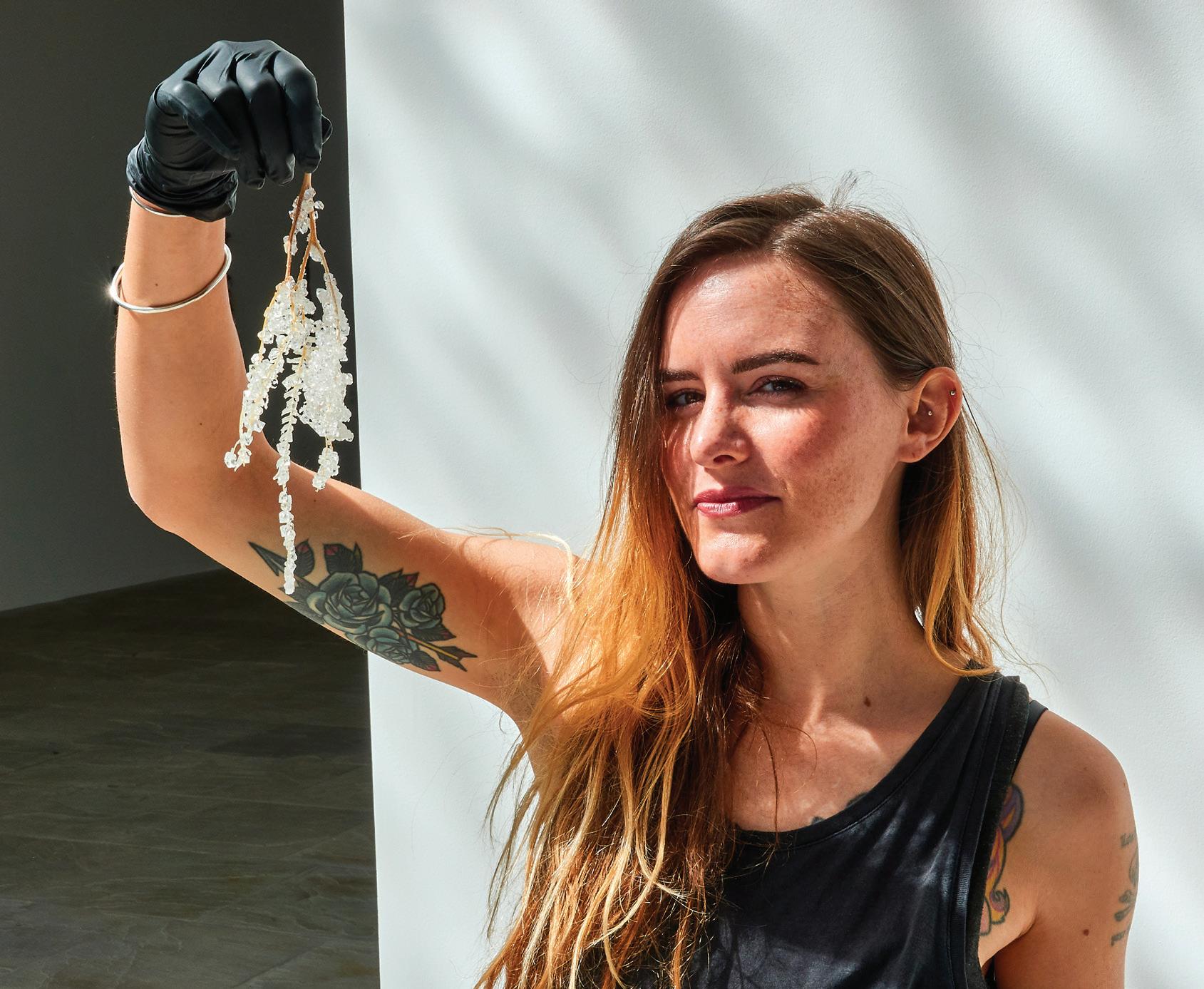
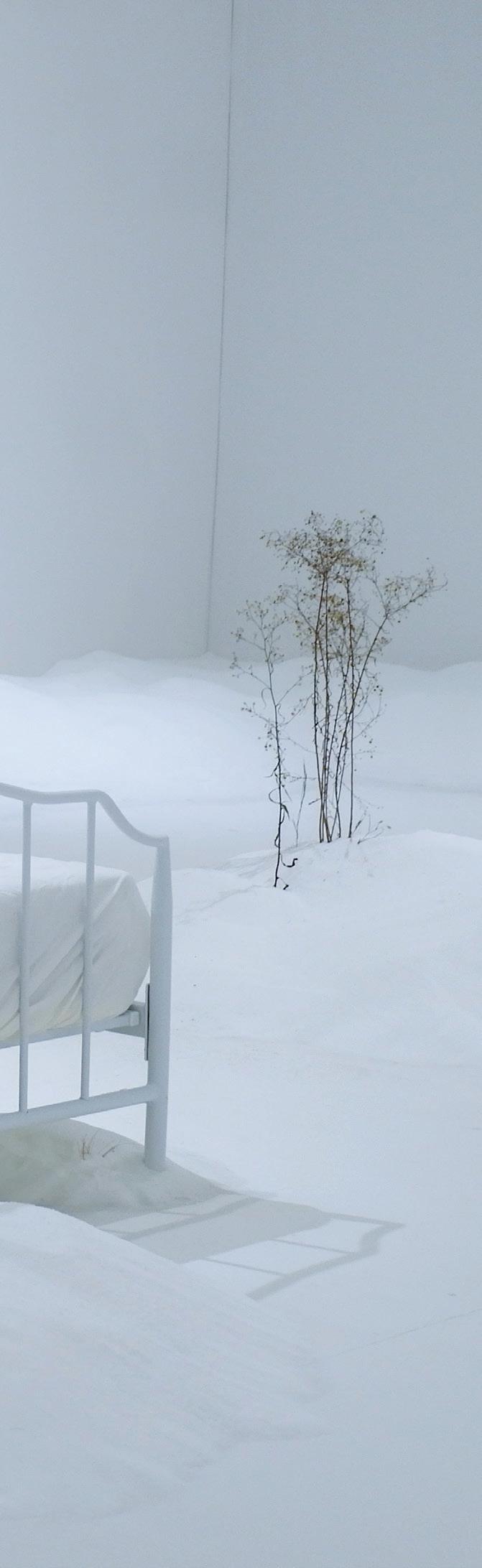
89 OCTOBER / NOVEMBER 2023
Bianca Bondi. Photograph by Laurent Lecat.
the dimensions and materials of a standard billboard’s commercial substrate. Seen at such proximity, the monumental metal framework, measuring 14 by 48 feet, occupies the main gallery of the museum as a kind of architectural relic. Bathed in the crisp, white glow of various neon lights, which emanates from discarded signs scattered on the floor in the otherwise darkened space, the scene is poetic and post-apocalyptic, fitting of some possible future. As the artist implies, while the landscape may remain largely uncluttered by the visual noise of advertisements due to an idiosyncratic law passed almost sixty years ago, other pollutants threaten the existence of the land itself.
If the structure of the installation were a sonnet, this is its volta. Across the undulating ground of the exhibition, dried wildflowers and fragile plant species native to Dallas and its surrounding region, selected in partnership with Sweet Pass Sculpture Park, are
embedded into the expanse of salt. Pigmented with colors often not found in nature, technicolor hues more closely shared with artificial or toxic matter, the presence of these plants posits an alternate landscape that appears post-human. As with many of Bondi’s recent works, the installation operates as a type of diorama, such as one might find in a display at a natural history museum. Yet in place of the glass barrier that often relegates viewers to the role of an observer instead of an active participant, the labyrinthine paths Bondi traces through her total environments provide access to an immediate sense of mise-en-scène To view the artist’s work is to inhabit it.
This exhibition, the artist’s first in a US museum, marks a decided departure in subject matter from Bondi’s more well-known installations—domestic settings such as bedrooms, kitchens, and dining rooms softened by the artist’s signature ethereal and delicate
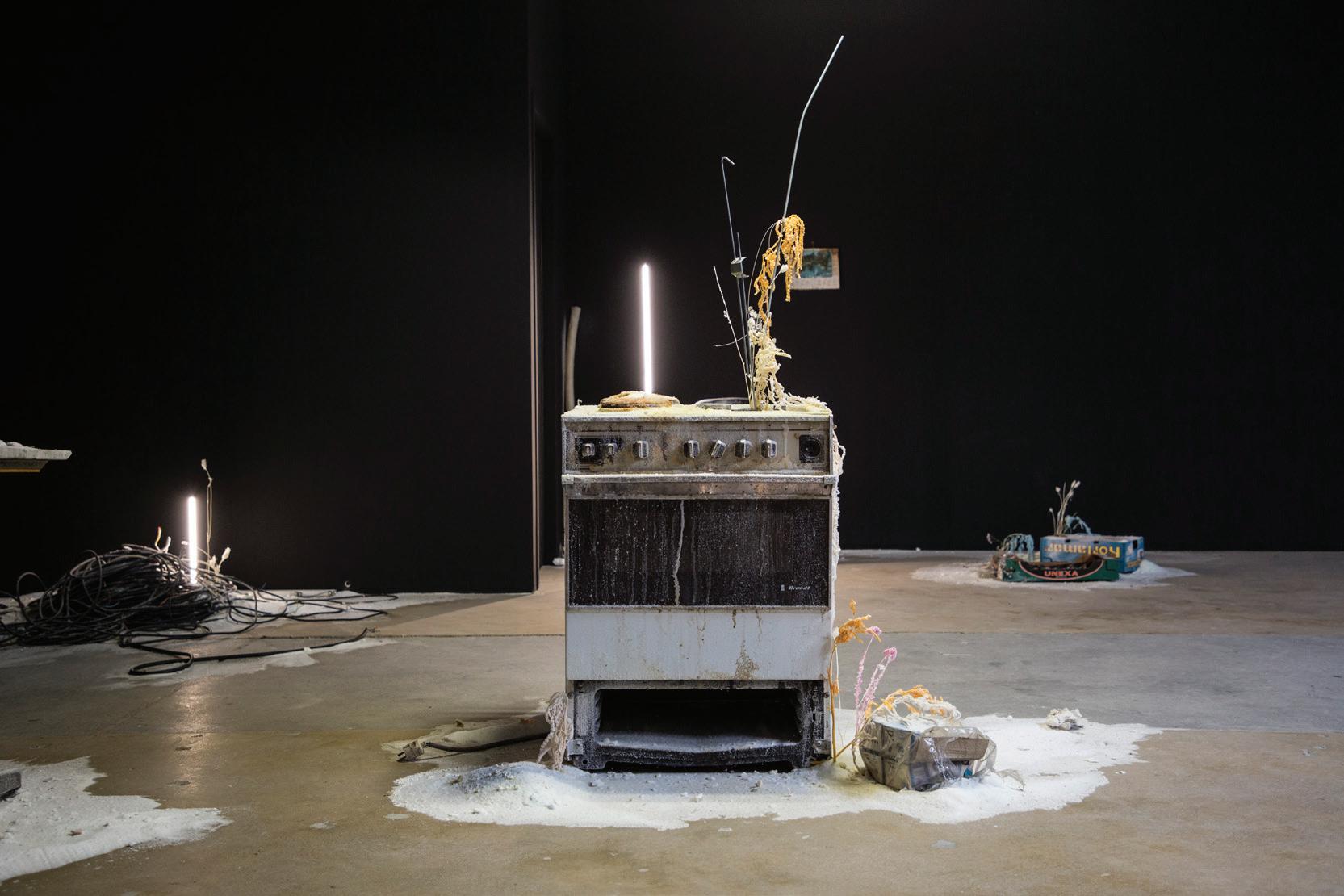
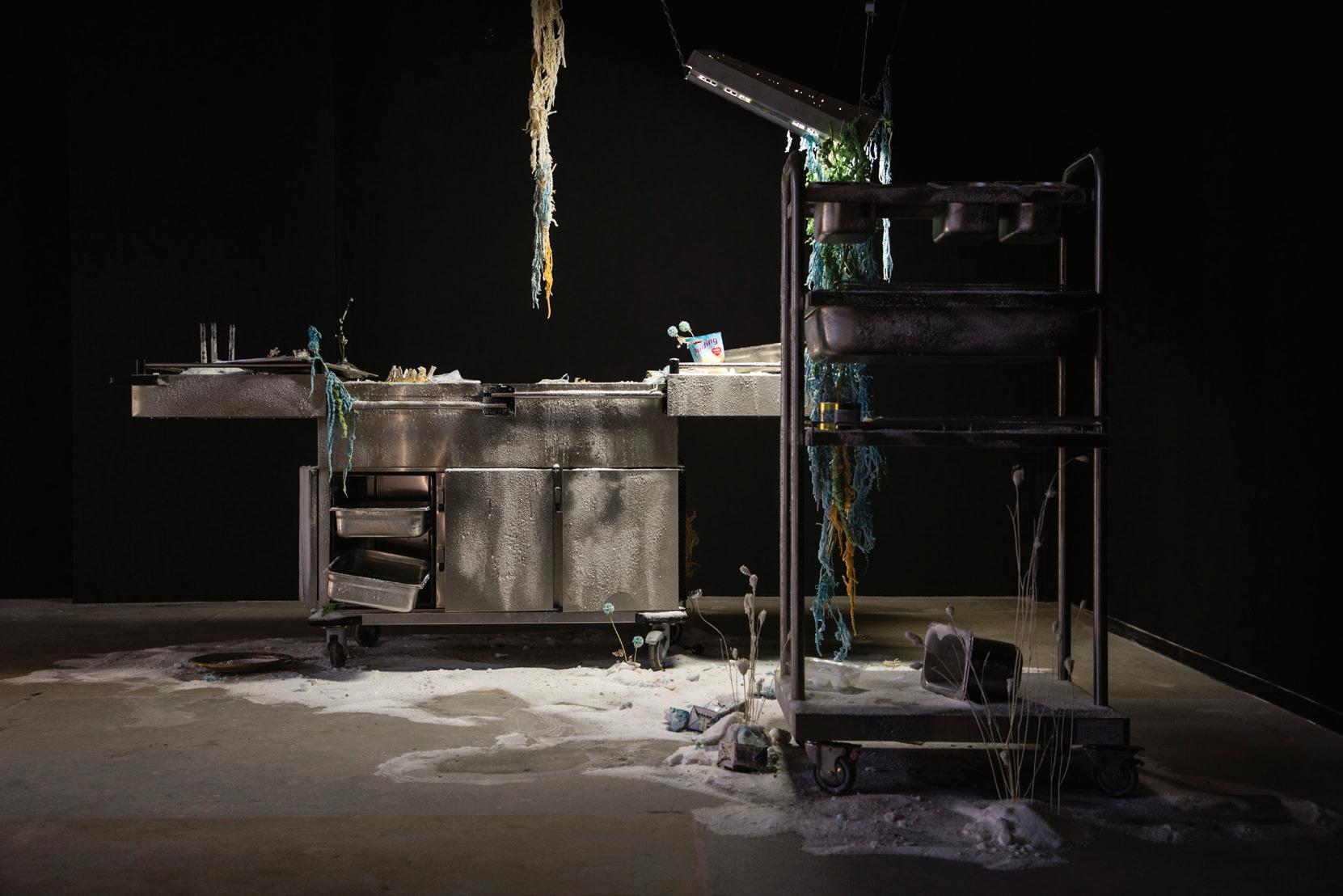
90 PATRONMAGAZINE.COM
Bianca Bondi, The Antechamber (Tundra Swan), 2020. Installation view from the 2020 Busan Biennial at the Museum of Contemporary Art.
Bianca Bondi, The Antechamber (Tundra Swan), 2020. Installation view from the 2020 Busan Biennial at the Museum of Contemporary Art.
approach. Her past works similarly incorporate materials that are prone to oxidization or shifting states of being. The alchemical reactions that result from Bondi’s exposure of her installations to these elements develops throughout the length of her exhibitions. Whether through the corrosion of copper or the crystallization that takes place as salt dries, time is marked by the various stages of chemical processes or natural decay, suspended in a constant state of becoming.
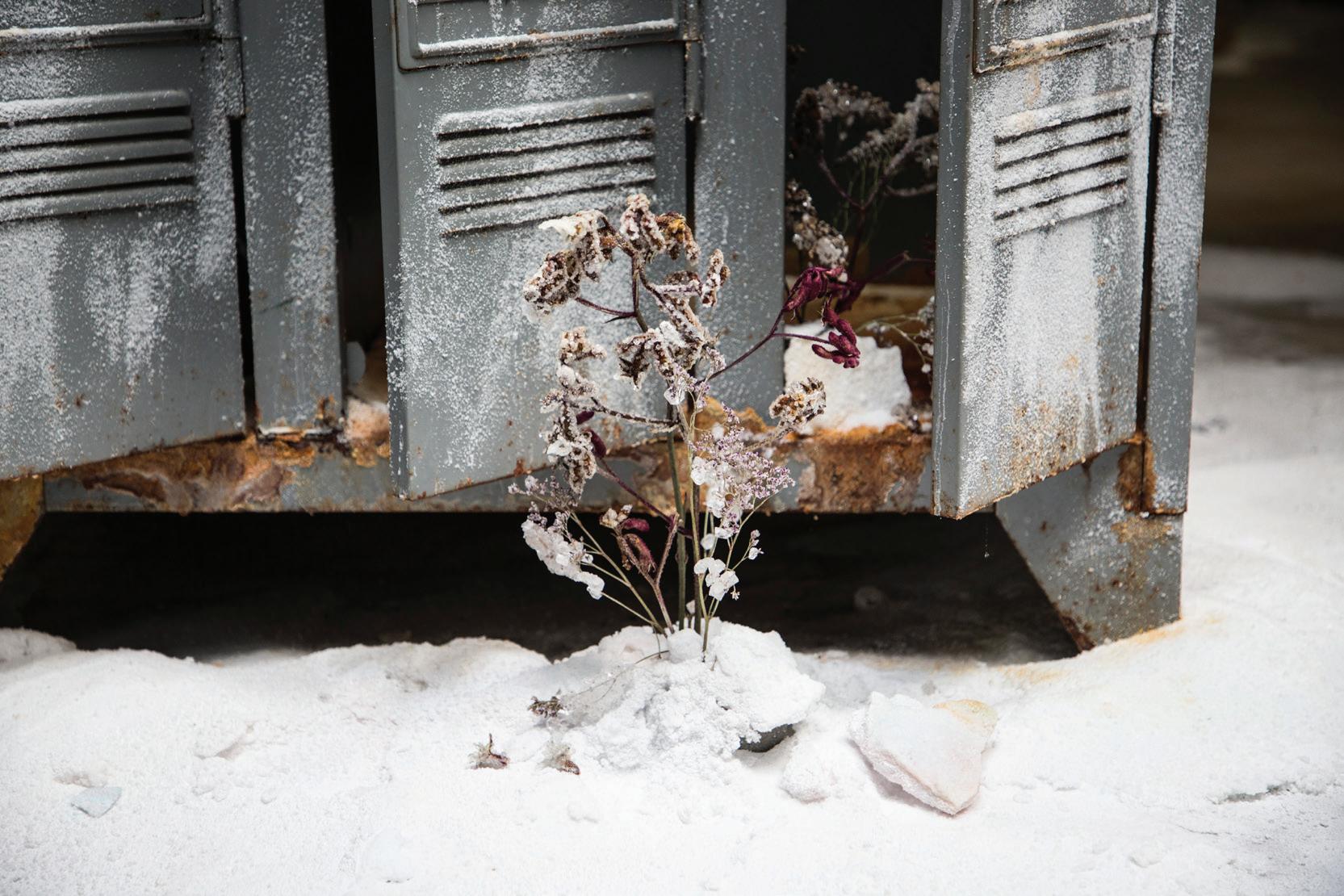
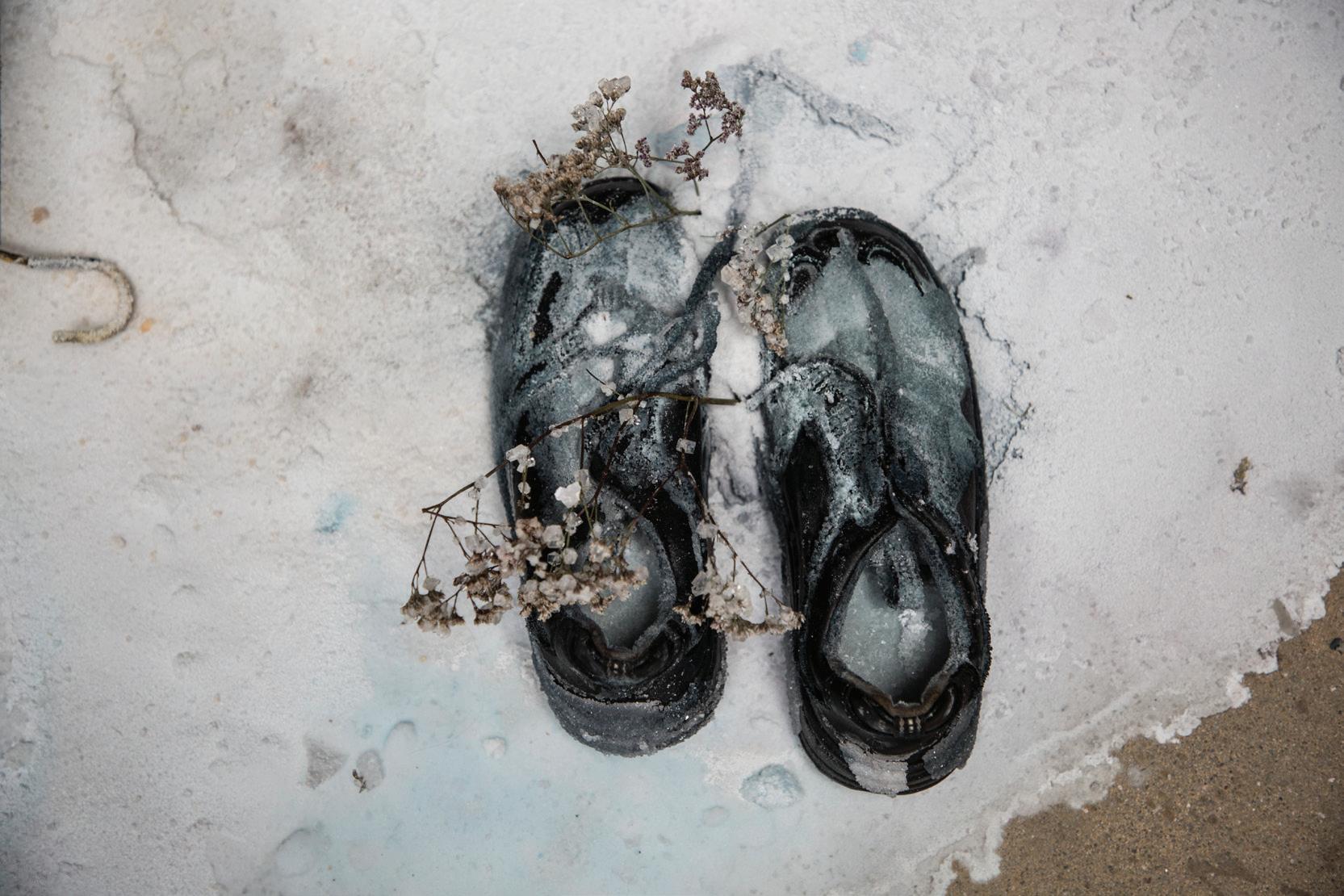
In The Antechamber (Tundra Swan), included in the 2020 Busan Biennial in South Korea, this quality manifested as an actual threshold—an immersive work that transformed the whole of the gallery into a space of passage. The two primary figurative objects within the installation consisted of a bed, whose mattress held a circular pond in place of where one would sleep, and a dresser, above which a large round mirror reflected the space as well as
the circumference of the water. “The bed is where you come into being and where you take your last breath,” says Bondi—a site of cycles. Surrounded by the white sheets of the bedding, flora erupted from the interior of the artificial pond: plastic cattails, gooseneck loosestrife, and clematis vines of violet and blue. Amid the salt, sparse dried branches foraged from the native landscape rose from the fragile white blanket as if after a snowfall. A porcelain swan vase sat upon the surface of the dresser, whose open drawers spilled with sea vegetation, as if underwater. Each component of the installation created a harmonious, yet impossible, landscape.
Bondi’s antechamber, much like her approach at Dallas Contemporary, signaled an entrance into another realm. While significantly more somber in tone, A Preservation Method is no less dreamlike, illusory, or nuanced. A beauty suggestive of healing the land by letting it heal itself. P
91 OCTOBER / NOVEMBER 2023
Bianca Bondi, The Antechamber (Tundra Swan), 2020. Installation view from the 2020 Busan Biennial at the Museum of Contemporary Art.
Bianca Bondi, The Antechamber (Tundra Swan), 2020. Installation view from the 2020 Busan Biennial at the Museum of Contemporary Art.
THE STORYTELLER
The Modern Art Museum of Fort Worth’s Jaune Quick-to-See Smith: Memory Map is a timely, timeless retrospective.
BY STEVE CARTER
This fall, the Modern Art Museum of Fort Worth hosts a revelatory, long overdue, don’t-even-think-about-missingit blockbuster of an exhibition, Jaune Quick-to-See Smith: Memory Map. Opening October 15th and running through January 21, 2024, the show celebrates the 83-year-old artist’s nearly 50-year career with over 100 works—paintings, prints, sculptures, and drawings—chronicling her against-the-odds journey of triumphant creativity.
Smith, a citizen of the Confederated Salish and Kootenai Nation in Montana, is inarguably one of the country’s foremost contemporary Indigenous artists, and the Modern is the retrospective’s second stop. Memory Map originated at New York’s Whitney Museum of American Art this past spring, playing to rave reviews; after Fort Worth it’ll make one last stop at the Seattle Art Museum. Significantly, the
retrospective is the Whitney’s first of an Indigenous artist, and the Modern’s exhibition marks the first large-scale showing of Smith’s work anywhere in this region.
Organized thematically rather than chronologically, the exhibition constitutes not only a portrait of Jaune Quick-to-See Smith as artist, but it also illuminates other key aspects of her life that inform her art. Her job description might well include storyteller, historian, political activist, curator, educator, social/cultural critic, and advocate-atlarge—she wears a lot of hats, and wears all of them well. Exhibition organizer Laura Phipps, associate curator at the Whitney, worked with Smith for five-plus years on developing Memory Map and is grateful for the experience. “As a person, as an artist, as an activist, Jaune’s been fighting for much of her life, and yet the energy doesn’t wane, which is really something to be admired,” Phipps says.
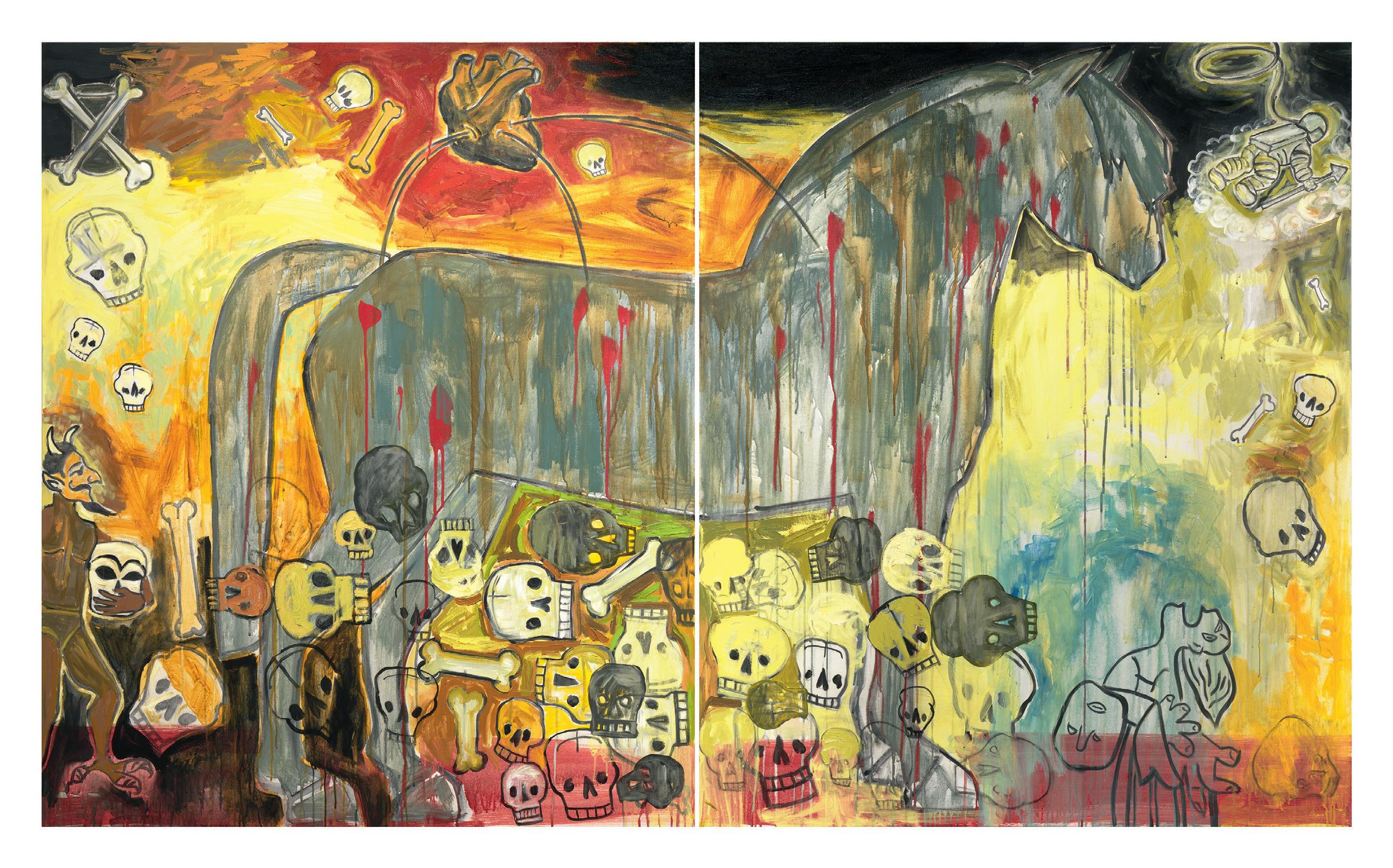
92 PATRONMAGAZINE.COM
Above: Jaune Quick-to-See Smith, War Horse in Babylon, 2005, oil and acrylic on canvas, two panels: 60 x 100 in. overall. Forge Project Collection, traditional lands of the Muh-he-con-ne-ok. © Jaune Quick-to-See Smith. Photograph courtesy the artist and Garth Greenan Gallery, New York.
These are my stories, every picture. Every drawing tells a story. I create memory maps.
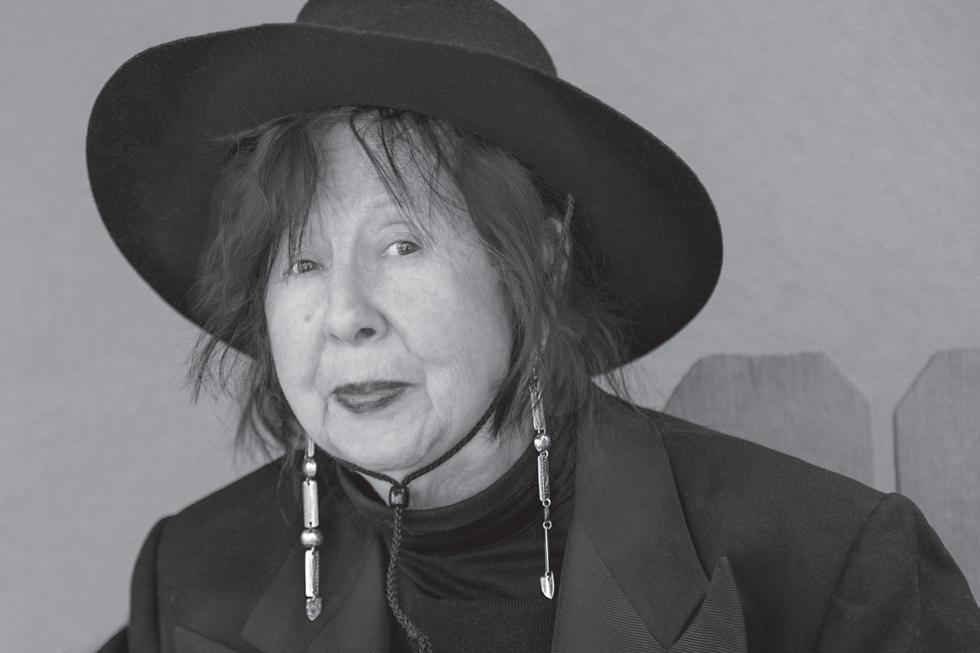
–Jaune Quick-to-See Smith
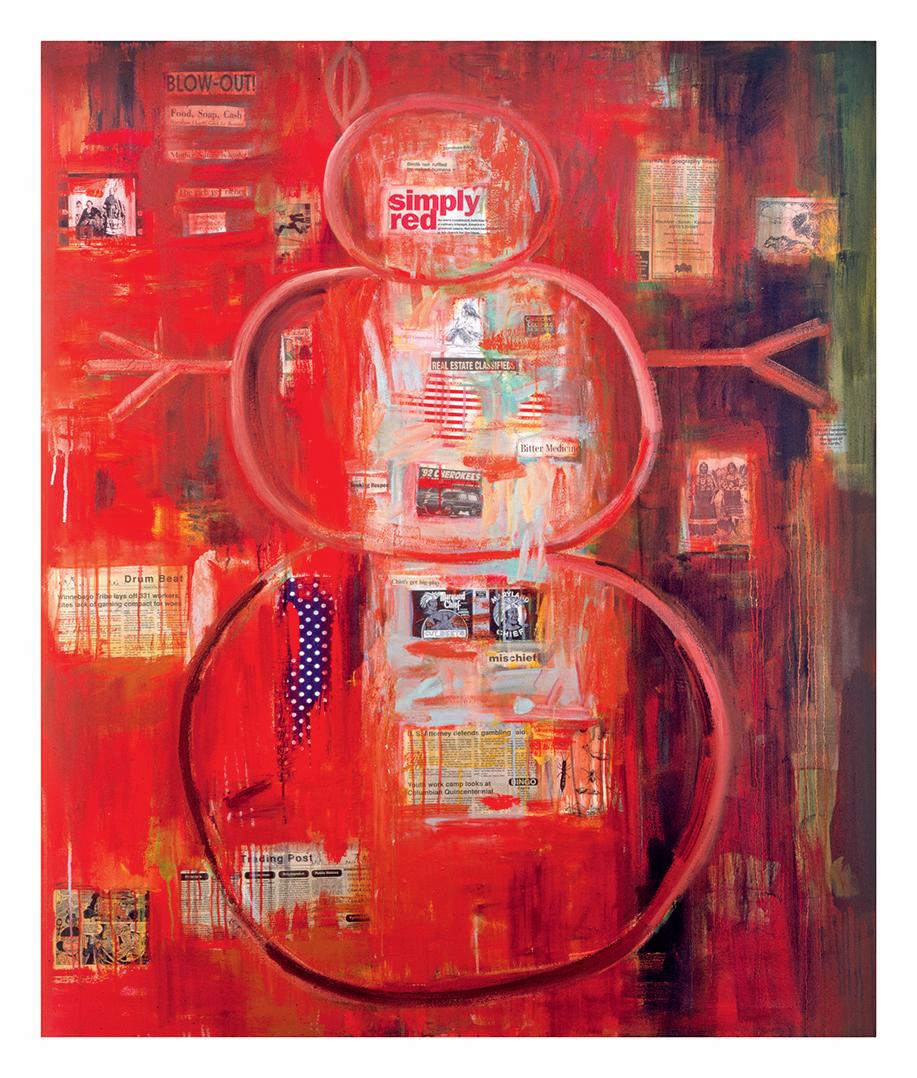
93 OCTOBER / NOVEMBER 2023
Jaune Quick-to-See Smith, I See Red: Snowman, 1992, oil, acrylic, paper, newspaper, and fabric on canvas, 66 x 50 in. Collection of Beth Rudin DeWoody. © Jaune Quick-to-See Smith. Photograph courtesy of the artist and Garth Greenan Gallery, New York.
Jaune Quick-to-See Smith, Pandora’s BoxX Project, 2021.
Photograph by Grace Roselli.
“The most amazing thing about working with her and learning from her is the incredible net she casts, the community that she’s made and gathers around her—so many brilliant thinkers, artists, and other curators, and getting to know so many people through her has been incredible…as she says, ‘If you get me you also get my whole community.’”
Smith was born on the Flathead Indian Reservation in Montana and raised in various locales across the Pacific Northwest and California; she now lives in New Mexico. She showed artistic promise at an early age but sometimes met resistance along the way. Attending community college as a young adult, an art teacher once assessed at year’s end, “You know, you can draw better than the men, but you can’t be an artist, you’re a woman—you need to know your place in life…”
Undeterred, Smith went on to earn an AA degree from Olympic College in Bremerton, Washington, a BA in art education from Framingham State College in Massachusetts, and an MA in visual arts from the University of New Mexico. While her works evince swirling nods to pop art, word art, neo-expressionism, and abstraction, her uniquely Native perceptions, observations, and perspectives are signature and unmistakably Jaune Quick-to-See Smith; hers is a deep, fecund visual language.
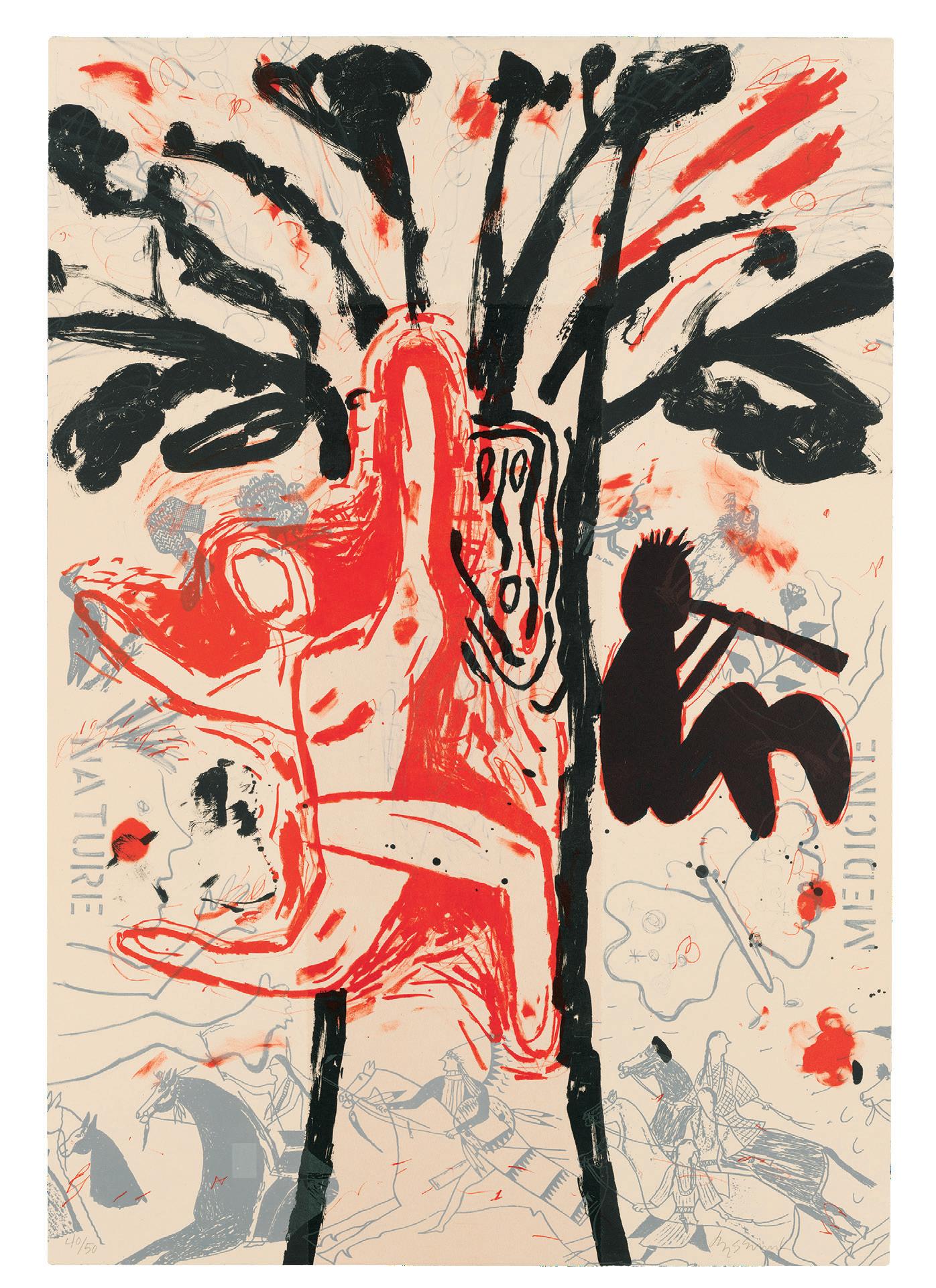
The show’s elemental endoskeleton explores nine themes that interweave throughout Smith’s oeuvre: Early Work, Dedication to Land, Depictions of a Postcolonial World, Reflections on Invasion, Critiques of Capitalism and Consumerism, Legacy and Matriarchy, U.S. Maps, Environment and Intervention, and Trickster. Phipps
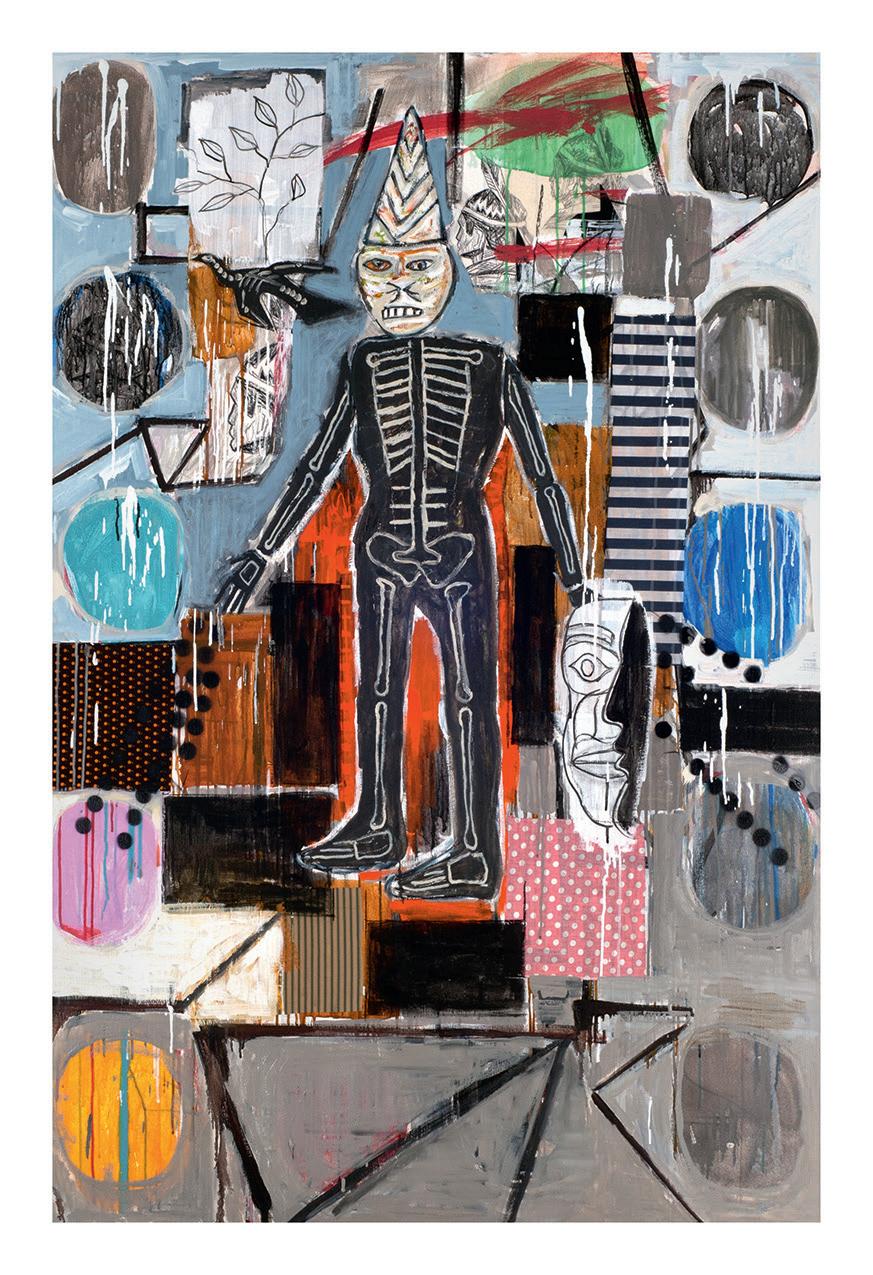
94 PATRONMAGAZINE.COM
Jaune Quick-to-See Smith, Survival Suite: Nature/Medicine, 1996, lithograph with chine-collé. 36.12 x 24.81 in. Whitney Museum of American Art, New York; gift of Joe and Barb Zanatta Family in honor of Jaune Quick-to-See Smith. Printed by Lawrence Lithography Workshop, Kansas City, Missouri. Published by Zanatta Editions, Shawnee, Kansas. © Jaune Quick-to-See Smith. Photograph courtesy of Whitney Museum of American Art, New York.
Jaune Quick-to-See Smith, Grasp Tight the Old Ways, 2011, oil, acrylic, paper, fabric, and charcoal on canvas, 72 x 48 in. Sheldon Museum of Art, University of Nebraska-Lincoln; Robert E. Schweser and Fern Beardsley Schweser Acquisition Fund through the University of Nebraska Foundation. © Jaune Quick-to-See Smith. Photograph courtesy of the artist and Garth Greenan Gallery, New York.
notes, “No work is solely about one thing. Each one is so layered and complex that you’ll see the connections between a depiction of the postcolonial world and the concern with ecological disaster either within a work or as you look from gallery to gallery.”
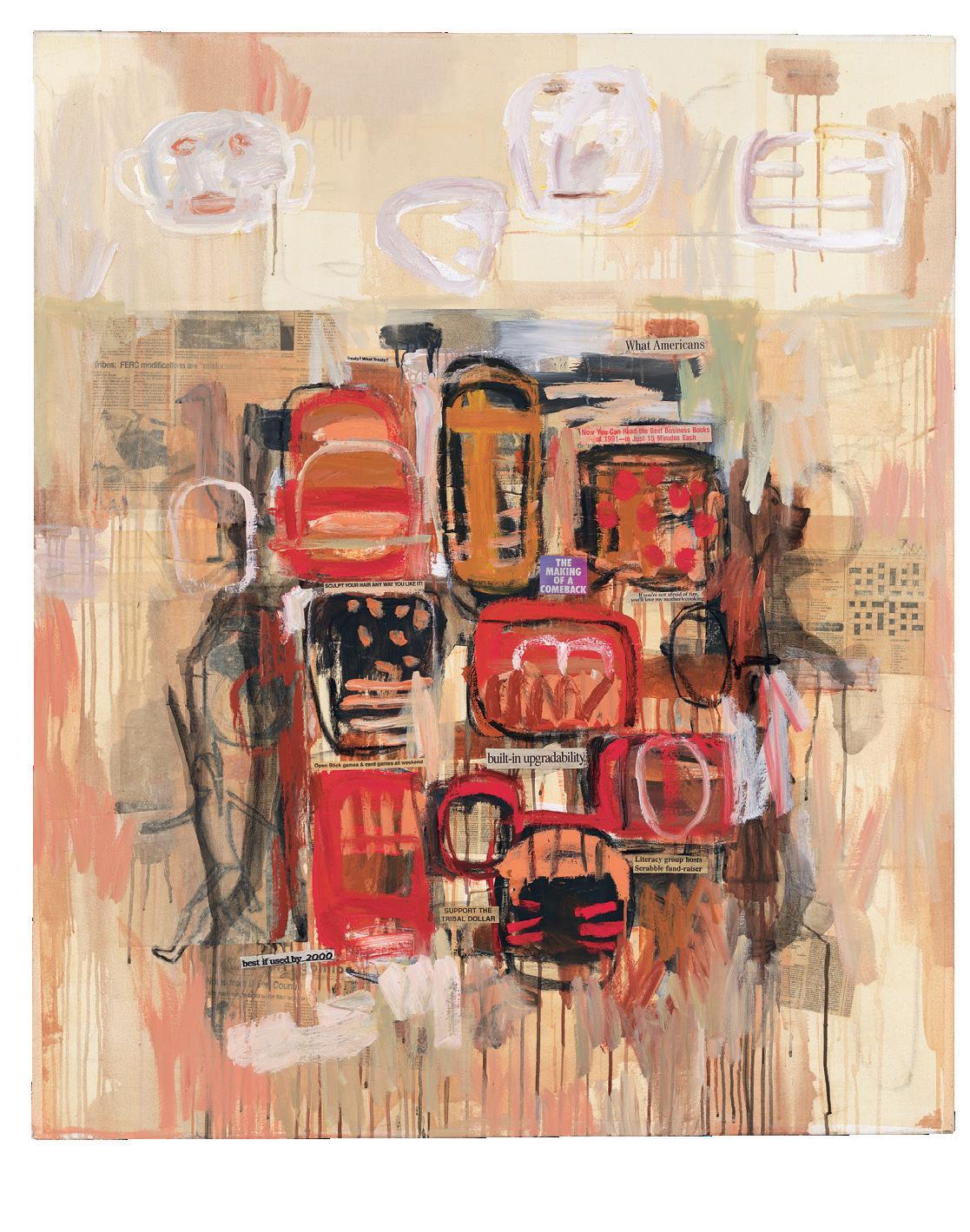
Smith’s visual storytelling utilizes a singular symbology although her cast of characters may have shifting significances; her lexicon is malleable and fluid. “The horse or the bison, the canoe, even the American flag or the map of the United States—these are images that she often talks about as icons that she started introducing into her work in the ’90s,” Phipps says. “These central, iconic images become almost containers, something for the viewer to latch onto and recognize, to draw you into a work.”
And although she’s tackling tough issues—the politics of land, the formation of the country and its appalling treatment of Native Americans, the environment, genocide, American imperialism, food sovereignty, cultural stereotypes, and more, the work is never didactic or preachy. There’s a welcoming sense of playfulness, humor, and irony that seduces viewers into closer-look engagement. “She makes you think, without realizing that you’re doing it,” Phipps adds with a laugh. “Humor is a huge part of the way she thinks about the world and communicates, and so therefore it’s in her art. It’s such an important part of the way she approaches the work. In the same way that a recognizable figure of a horse or a bison draws you in, humor can do the same thing…and then you start unpacking what it is you’re understanding.” P
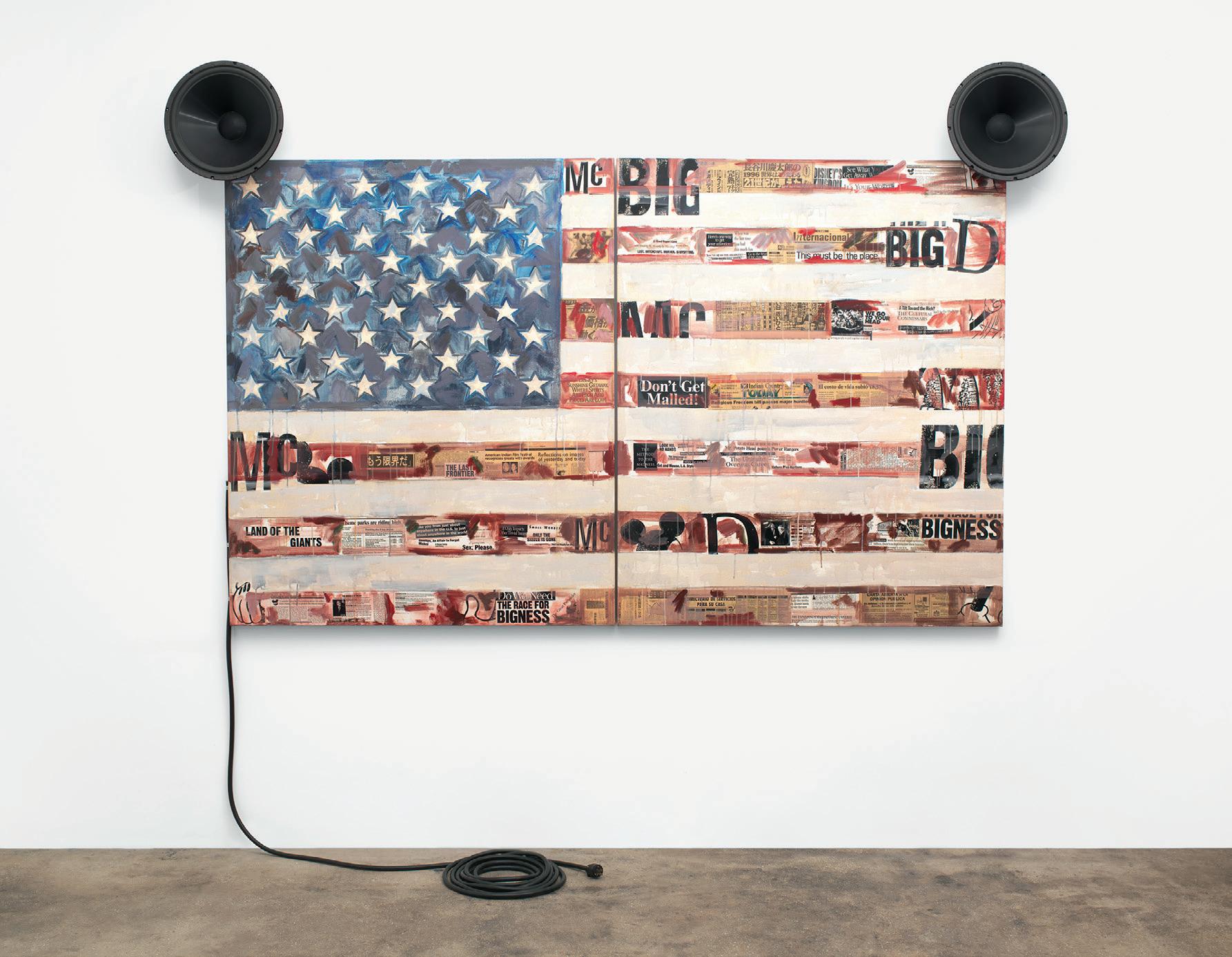
95 OCTOBER / NOVEMBER 2023
Jaune Quick-to-See Smith, McFlag, 1996, oil, paper, and newspaper on canvas with speakers and electrical cord, three parts: 60 x 100 in. overall. Tia Collection. Fabricated by Neal Ambrose-Smith. © Jaune Quick-to-See Smith. Photograph courtesy of the artist and Garth Greenan Gallery, New York.
Jaune Quick-to-See Smith, The Vanishing American, 1994, acrylic, newspaper, paper, cotton, printing ink, fabricated chalk, and graphite pencil on canvas, 60.12 x 50.12 in. Whitney Museum of American Art, New York; gift of Dorothee PeiperRiegraf and Hinrich Peiper in memory of Arlene LewAllen. © Jaune Quick-to-See Smith. Photograph courtesy of Whitney Museum of American Art, New York.
A SOFT AND SERENE SANCTUARY
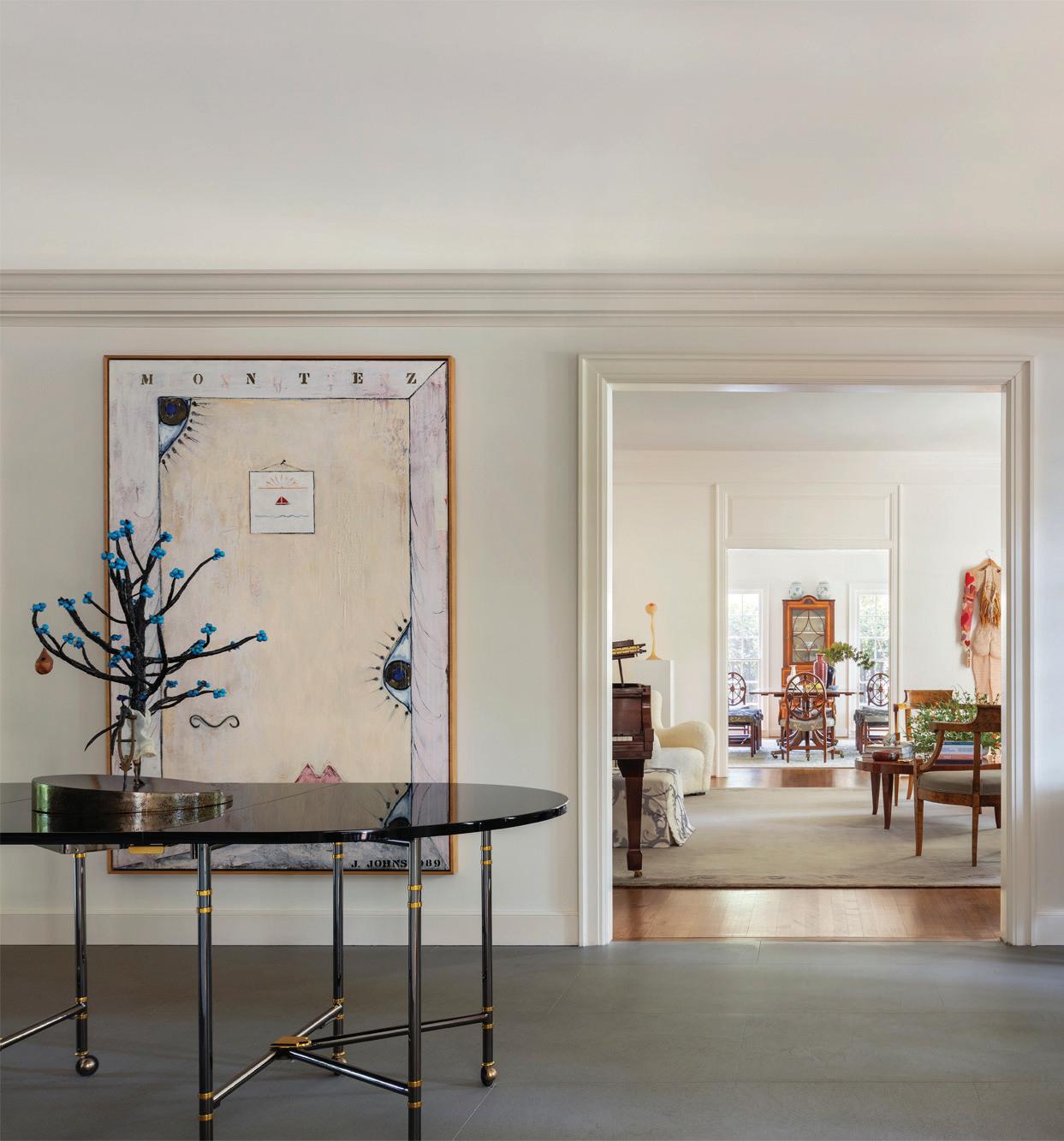
Marguerite
BY EVE HILL-AGNUS PHOTOGRAPHS BY SCOTT FRANCES
96 PATRONMAGAZINE.COM
Hoffman engages Bodron/Fruit to create a “cocoon for art” in her classic home.
97 OCTOBER / NOVEMBER 2023
Louise Bourgeois, Topiary III, 1999, steel, fabric, beads, wood; Jasper Johns, Montez Singing, 1989, encaustic and sand on canvas; Tatiana Trouvé, The Guardian, 2019, patinated bronze, paint, marble, wood; Wolfgang Laib, Pollen from Pine, 1978, Pollen from Moss , 1978, Pollen from Hazelnut, 1980, Pollen from Dandelion, 1990, pollen in glass jar; table vintage Maison Jansen, Wooster Gallery, New York.
Portrait of Marguerite Hoffman.
Photograph by David Needleman.
At first glance, Marguerite Hoffman’s North Dallas residence looks like any other on her street: a stately, symmetrical home fronted in classical red brick with neoclassical white pillars framing a porch and shaded by majestically spreading oaks.
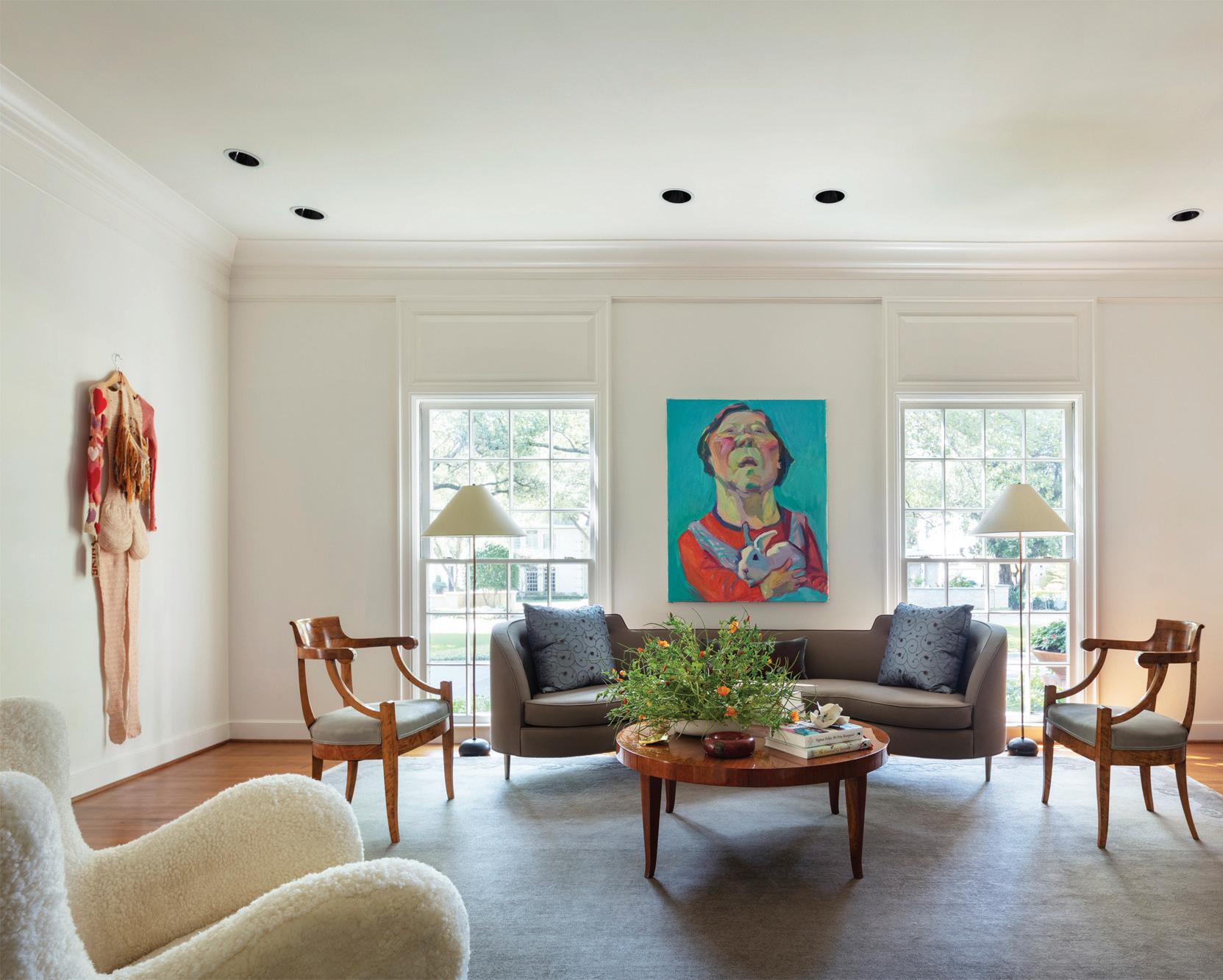
But inside, the renovated but still traditional front rooms transition to contemporary spaces, and in the backyard, a private gallery designed by the late Bill Booziotis is a dedicated spot to stage exhibits of Hoffman’s personal collection of more than 1,000 pieces.
When Hoffman partnered with Dallas architecture and design firm Bodron/Fruit, it was a chance to redesign a classically proportioned house and add stunning views of the garden. When she moved into the home—designed in the 1950s and built in 1961—in 1994 with her late husband, Robert, the landscape by Michael Van Valkenburgh was the first task, along with the gallery. Then the main house beckoned.
“We knew we had to make a house for art,” Mil Bodron says, as well as a haven for three young children. They’ve made it a
98 PATRONMAGAZINE.COM
Su Richardson, Underwear Skin Sale, 1978, cotton, wool, Lurex; Maria Lassnig, Untitled (Selbstportrait mit Hasen) [Self-portrait with Hare], 2000 oil on canvas; Linda Stark, Suffragette, 2019, oil on canvas over panel; vintage Dunbar Oasis sofa by Ed Wormley, Alan Moss, New York; 19th-century Swedish Karelian birch open armchairs; Flemming Lassen chair, attributed Modernity, Sweden; coffee table vintage T.H. Robsjohn-Gibbings, Donzella Ltd., New York, 17th/18th-century Dutch walnut chest of drawers.
Swedish Design
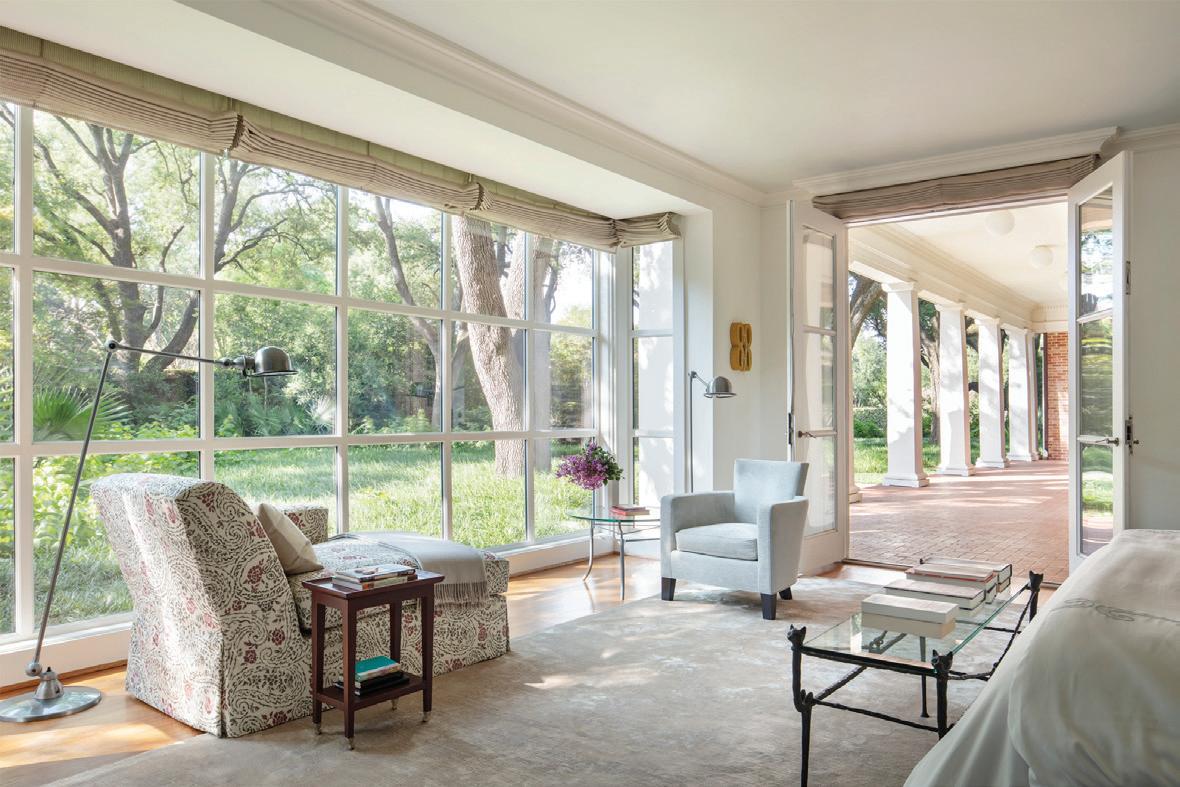
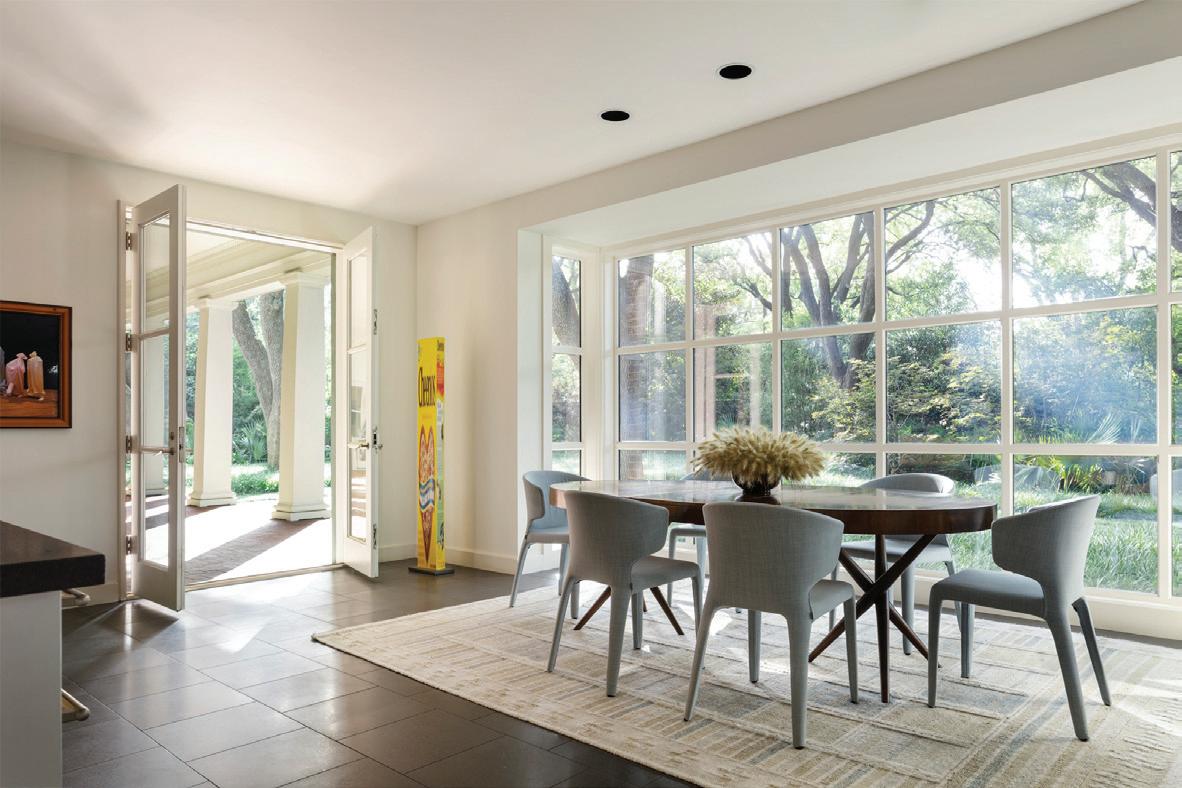
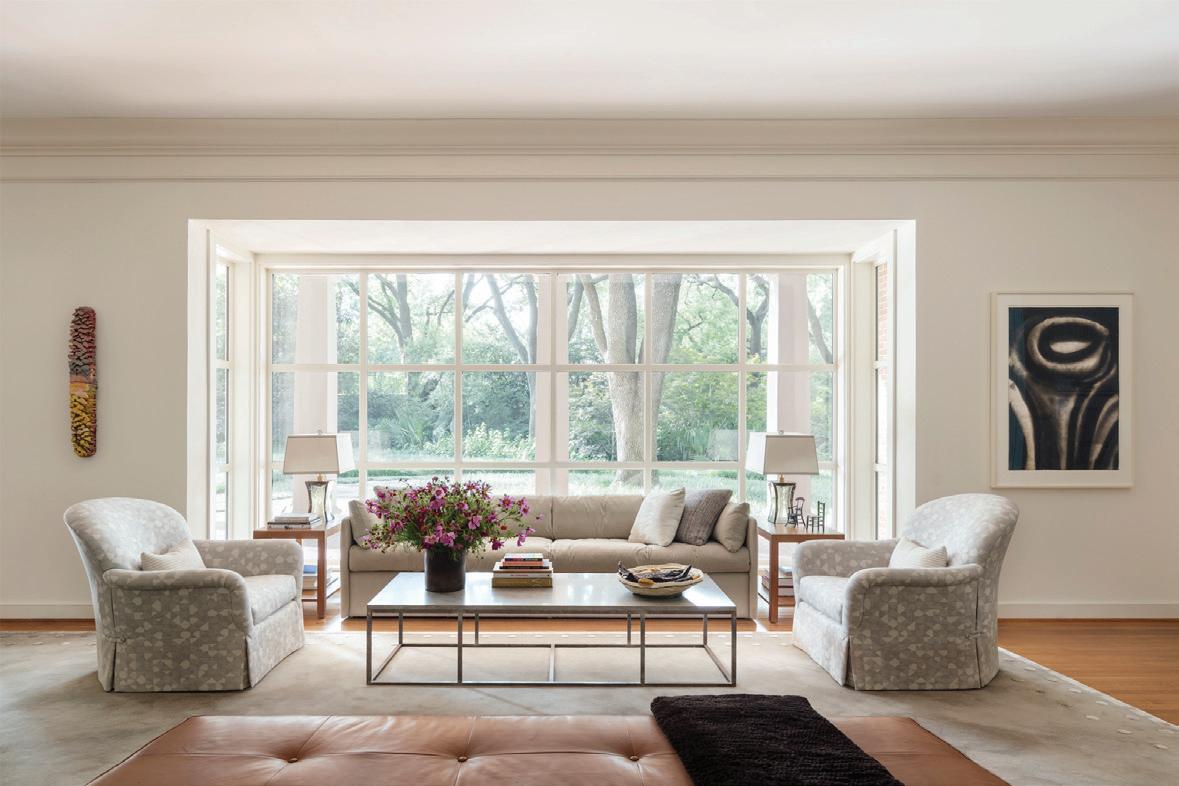
Tripod
Gallery. Lynda Benglis, Untitled, 1975, purified pigmented beeswax and damar resin on Masonite; Lee Bontecou, Untitled, 1958, soot on paper; Carmen tub chairs, John Boone, New York; steel and stone low table Richard Shapiro Studiolo, Los Angeles; vintage T.H. Robsjohn-Gibbings daybed, Alan Moss, New York; custom club sofa Saladino, New York; vintage T.H. Robsjohn-Gibbings side tables Donzella Ltd., New York; Torre lamp, Donghia, Dallas; rug, Martin Patrick Evan, New York. Anne Truitt (American, 1921-2004), March Wing, 1979, acrylic on canvas; Diego Giacometti Cradletable, model with cats, bronze, glass; Arne king bed, Roman Thomas, New York; linens, E. Braun & Company, New York; Brousse chaise, and club ‘Kloob’ chair, Christian Liaigre; Gallery telephone table, J. Robert Scott; steel floor lamp, Jeilde France; Venezia, Chinese mulberry silk rug, Tai Ping; Ricky Swallow, Double Zero with Rope (doubled), patinated bronze and oil paint; Diego Giacometti, Cradle-table, model with cats, bronze, glass.
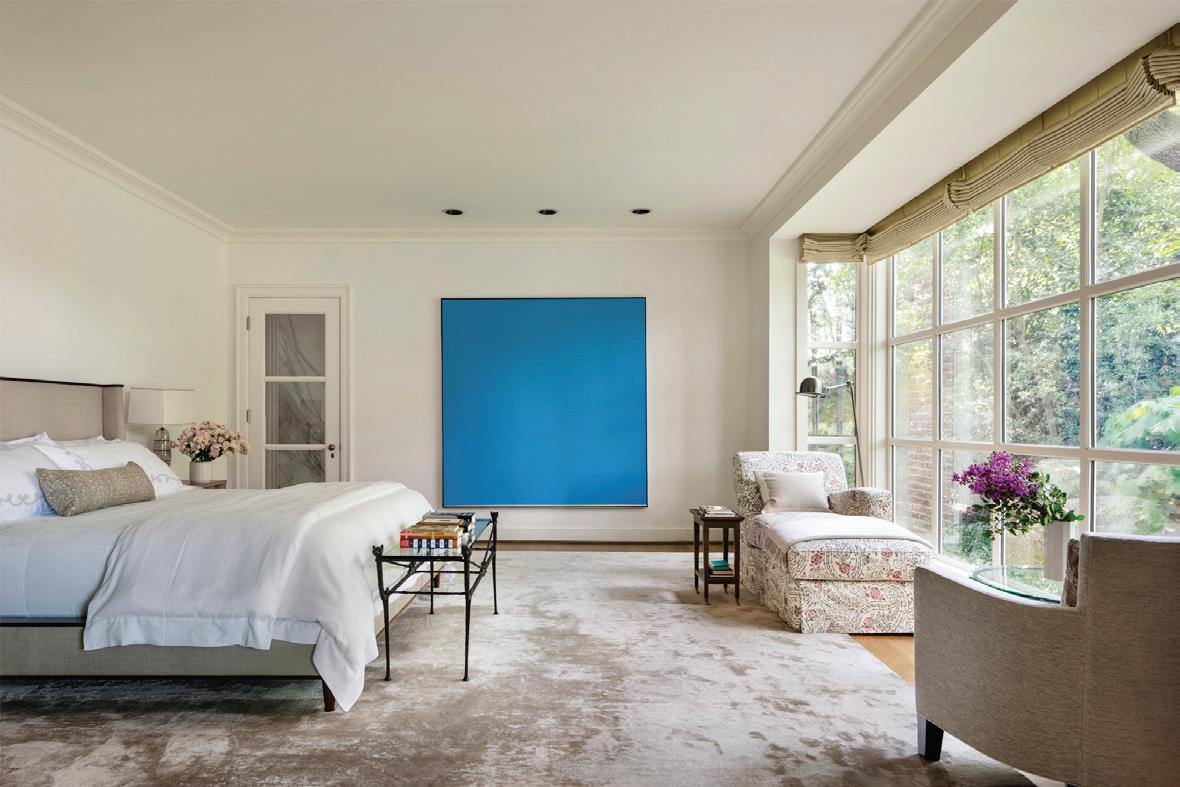
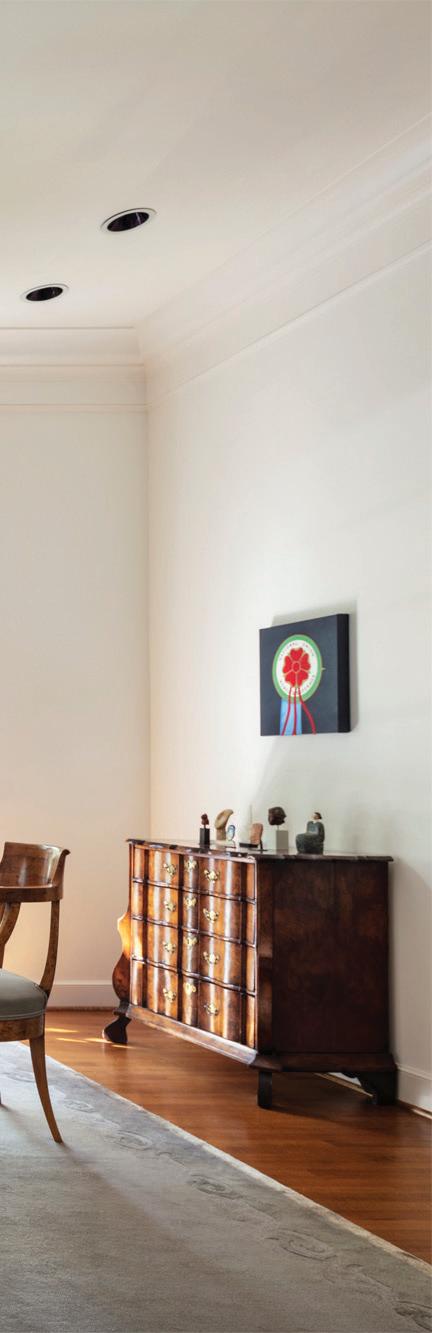
99 OCTOBER / NOVEMBER 2023
From above: Tom Friedman, Untitled (Cheerios boxes), 2004, five Cheerios boxes; Nic Nicosia, Sex Act #5, 1996, Fuji super gloss photograph; Cassina Hola chairs, Scott + Cooner, Dallas; vintage T.H. Robsjohn-Gibbings
Table Model 1642, Mil Bodron Design;
Kilim, Abrash Rug
celebration of softness.
In the entry hall, the dusky-grey, custom-cut pietra serena that lies underfoot is the same stone that lines the streets and surfaces the Renaissance architecture of Florence. On a vintage Maison Jansen table, a Louise Bourgeois sculpture, Topiary III (1999), is one of three pieces in the home that rarely moves. “It’s one of my talismans,” Hoffman says. “She did that when she was in her 80s. It’s a tree trunk that has this little lace dress on it, and it’s been amputated and has a crutch, and yet it has all this beautiful fruit and even a little nest. After my husband died I thought, ‛If this woman can do this after all she’s been through as a person, as an artist, I can too.’” In the same entrance hall, she may have a chair by artist Tatiana Trouvé, a work that’s a barely perceptible trompe l’oeil in bronze and marble.
“I need a sense of calm in my house,” Hoffman says. “I
need some part of it to be calming and not jarring.”
In the redesign, bay windows at the back of the house opened up space and flooded the rooms with more natural light while opening views onto the enveloping greenery. Meanwhile, each room’s rug brings subtle textures and neutral tones. The Chinese mulberry silk expanse in the primary bedroom is as lush and quiet as the whisper-soft grey beauty in the living room.
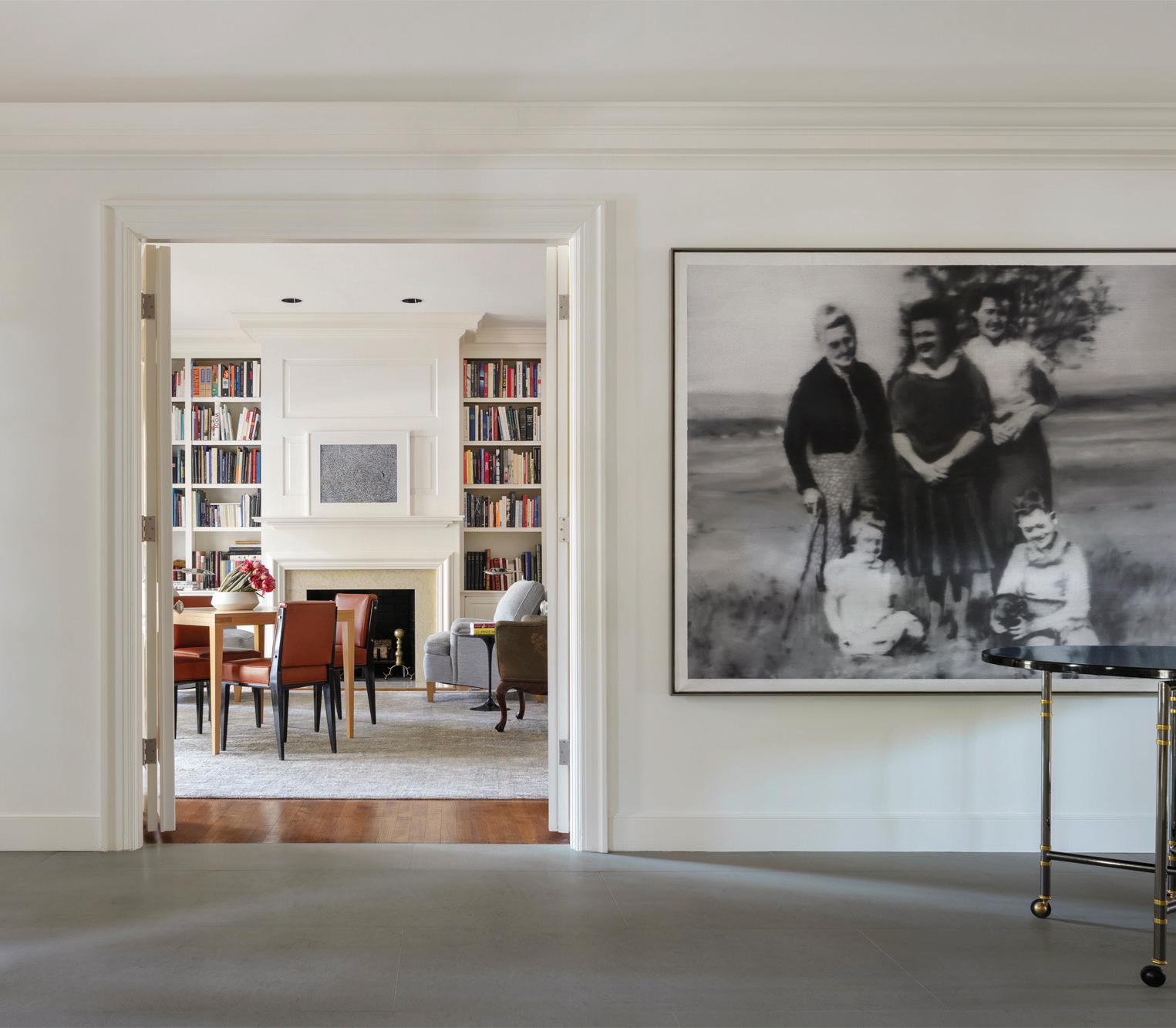
“We try to create a rich but neutral pattern” so the furnishings remain “submissive to the art,” Bodron says. Still, “they can’t be too submissive.” Rather, they create a cocoon for art that rotates.
For Hoffman, “a sense of order and calm” must dominate. “Balance is really important to me. Functionality.” As well as the sense that “nothing pulls your eye too much.”
Bodron, who trained as an architect, was careful to avoid
100 PATRONMAGAZINE.COM
Mark Tobey, Living wall with sign, 1965, tempera on paper; vintage Dupre-Lafon game chairs, Alan Moss, New York; Gerhard Richter, Familie, 1964, oil on canvas, Louise Bourgeois, Topiary III, 1999, steel, fabric, beads, wood; vintage Maison Jansen table, Wooster Gallery, New York.
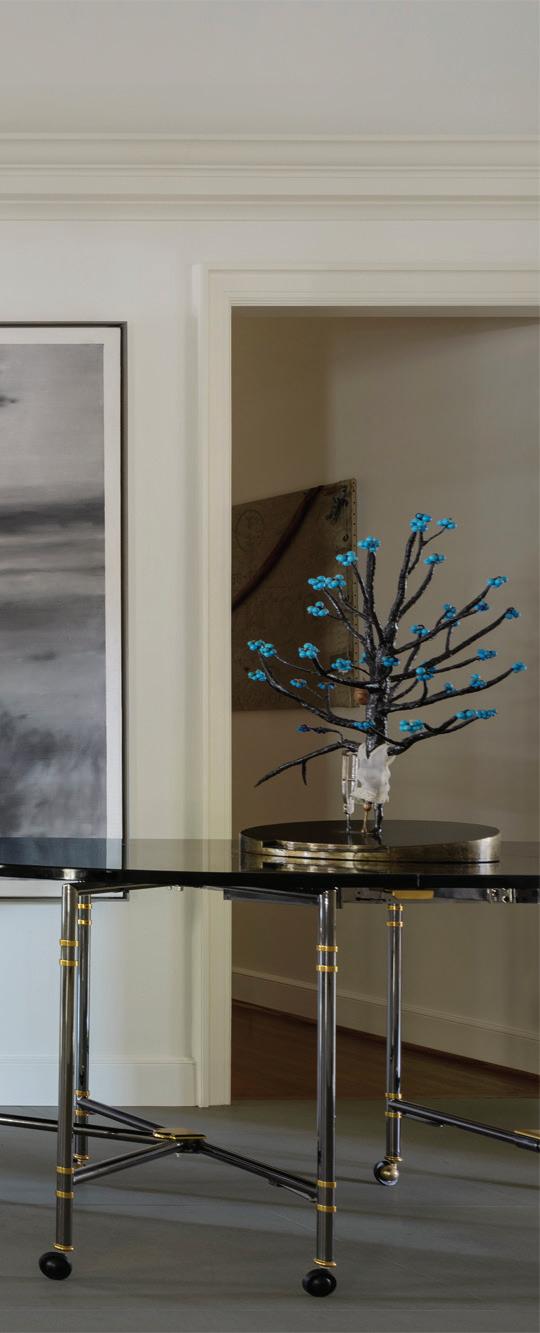
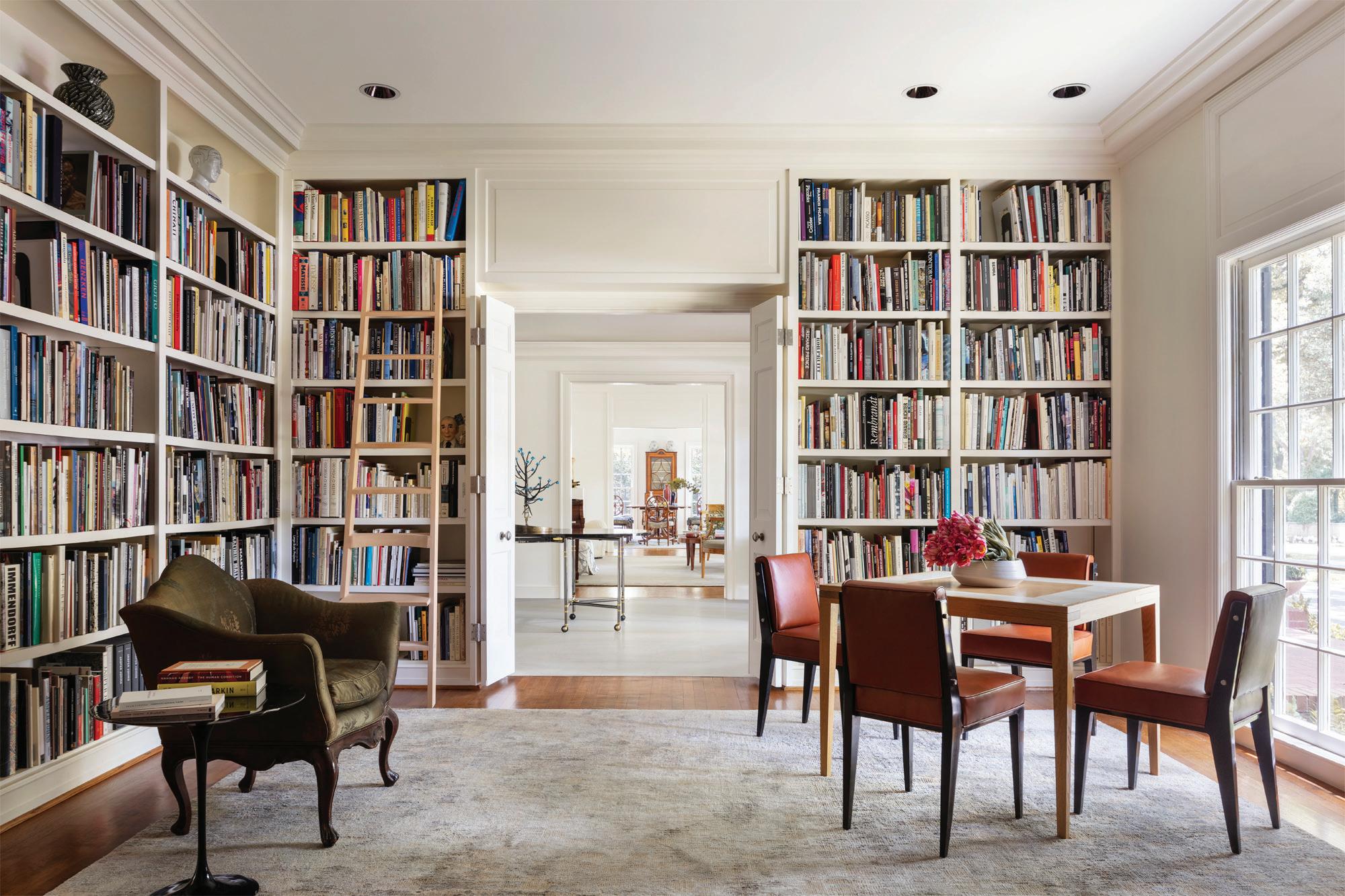
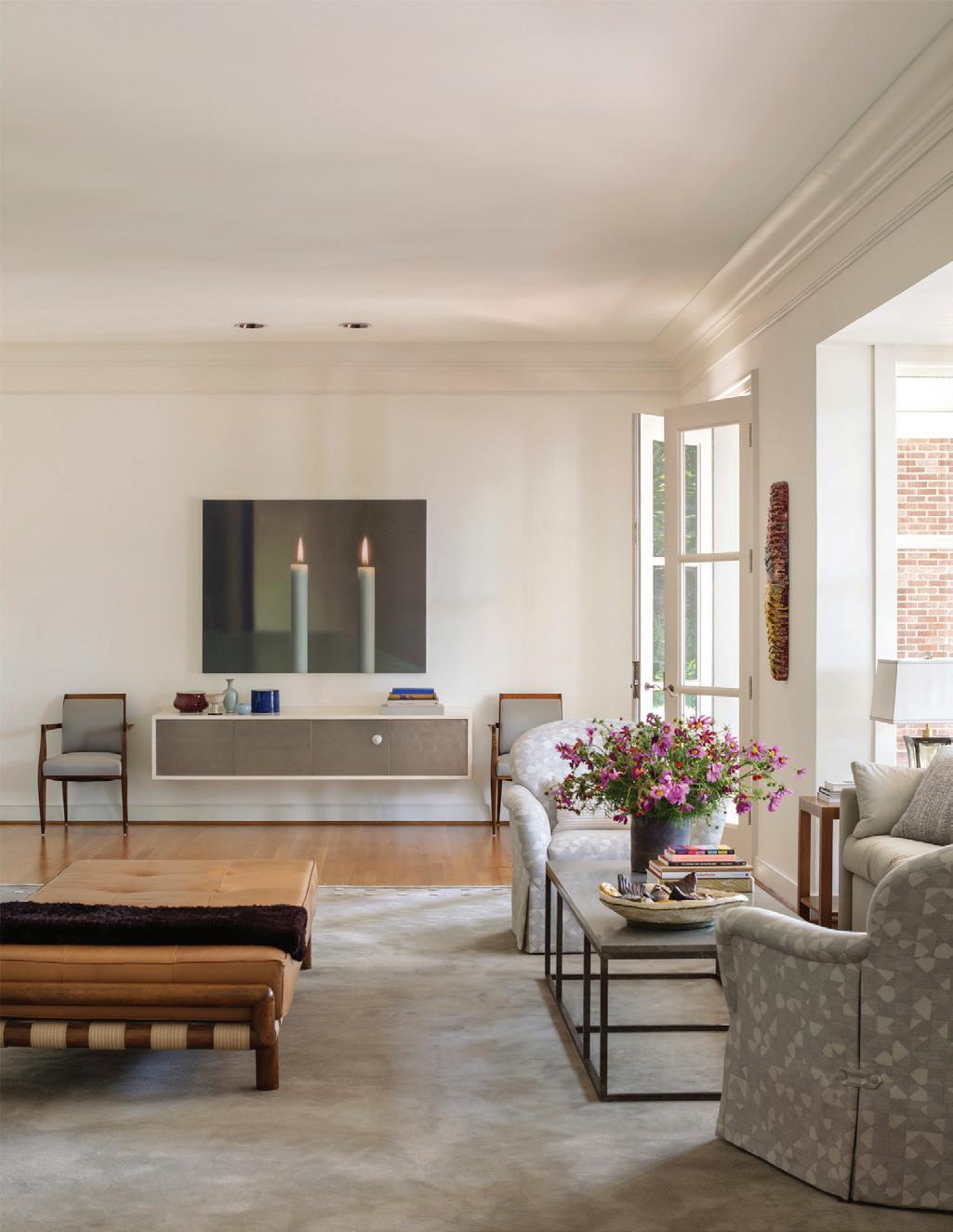
101 OCTOBER / NOVEMBER 2023
Gerhard Richter, Two Candles, 1982, oil on canvas; Lynda Benglis, Untitled, 1975, purified pigmented beeswax and damar resin on Masonite.
18th-century Venetian walnut bergere lounge chair; The Saarinen Collection side table Knoll, Dallas; vintage Dupre-Lafon game chairs, Alan Moss, New York; Mattaliano Frank Game Table, Sutherland, Dallas; Doris Leslie Blau rug, New York.
placing furniture against walls, instead floating sofas, lounge chairs, and daybeds more centrally in the rooms. In the primary bedroom, rather than occupying a wall, the duo of a chaise lounge and chair hovers in the bay window. In the living room, a vintage Dunbar Oasis sofa with sinuous contours curves away from the wall, offering breathing room for the art behind it. In the den, a painting by Gerhard Richter— Two Candles, another piece that never moves—hangs above a delicate, Italian, wall-hung console. The furnishings register just enough of a presence in Bodron’s schema, “all the while leaving the walls open for art.”
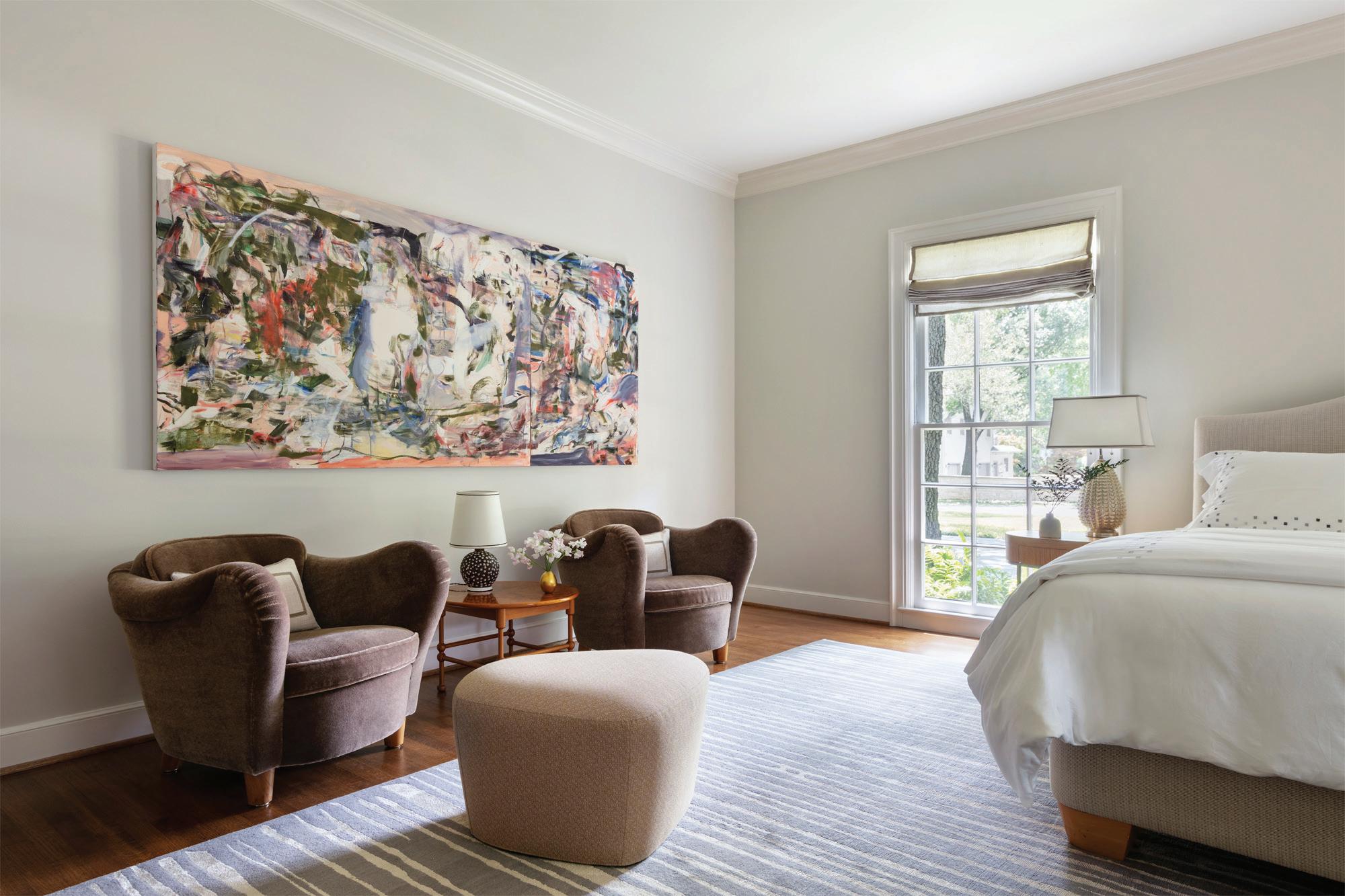
In the library, art books fill traditional floor-to-ceiling bookcases, a voluminous cache that speaks to Hoffman’s passion, while a vintage game table allows for playing cards or laying out books.
“I think things should feel as gracious and welcoming and inviting as they can,” Hoffman says. In this elegant, subdued sanctuary, “I love things that you want to touch, and you want to be cozy in. That’s what I want the spaces to feel like: high-end cozy.” She has often found herself asking, “‘Can we have that in a softer fabric? Can we have that in cashmere? Something that feels good not only in its touch but its form?’ I want to provide spaces that people want to be in.” Bodron, for his part, wanted to make sure all the spaces lent themselves to looking at the art.
Meanwhile, the furnishings often meld styles and eras
in synchrony. “Robert had a lot of antique furniture, so we wanted to have a mix of his older furniture and contemporary. It had to be blended together very carefully,” Hoffman says. “[Bodron] helped us find some pieces that I think are very beautiful and have a patina of age. It all somehow works together.” For example, in the living room, where the grand piano Hoffman plays joins a 17th/18th-century Dutch walnut chest of drawers and a vintage coffee table, 19th-century Swedish Karelian birch armchairs offer seating beside the inviting bouclé plushness of an oversize armchair by modernist Danish designer Flemming Lassen, and the effect is one of beautiful harmony.
While the relationship between house and gallery has remained—each a space for art, each in view of the other— over the years, the main house’s uses have changed. Children have grown up and moved away. The upstairs was redesigned by Bodron/Fruit to house more art books in a casual setting. Bodron says his challenge and delight, in addition to delving into classical proportions, has been to underscore “all the softness and combine different eras of furniture.”
“My house appears quite small, but Mil made every room so serene and beautiful,” Hoffman says of her home of almost 30 years. “I like that it’s a bit of a surprise. Because it’s very unassuming, people might have different expectations.” But inside, the space opens up, making the art soar in a dialogue that is both lofty and simple. P
102 PATRONMAGAZINE.COM
Cecily Brown, Madrepora (Nicosia), 2016, oil on linen, two parts; vintage Greta Magnusson-Grossman chairs, STUDIO, Sweden; Sassi footstool, Erba, Italy; vintage Josef Frank side table, Modernity, Sweden; stoneware table lamp attributed to Jean Besard, Gallery BAC, New York; Dream Bed, Donghia, Dallas; linens, E. Braun & Company, New York; MaxAlto Apta Oval tables , B&B Italia, Dallas; vintage Mercury Glass Beehive lamps, Avalon; rug from The Rug Co., Dallas.
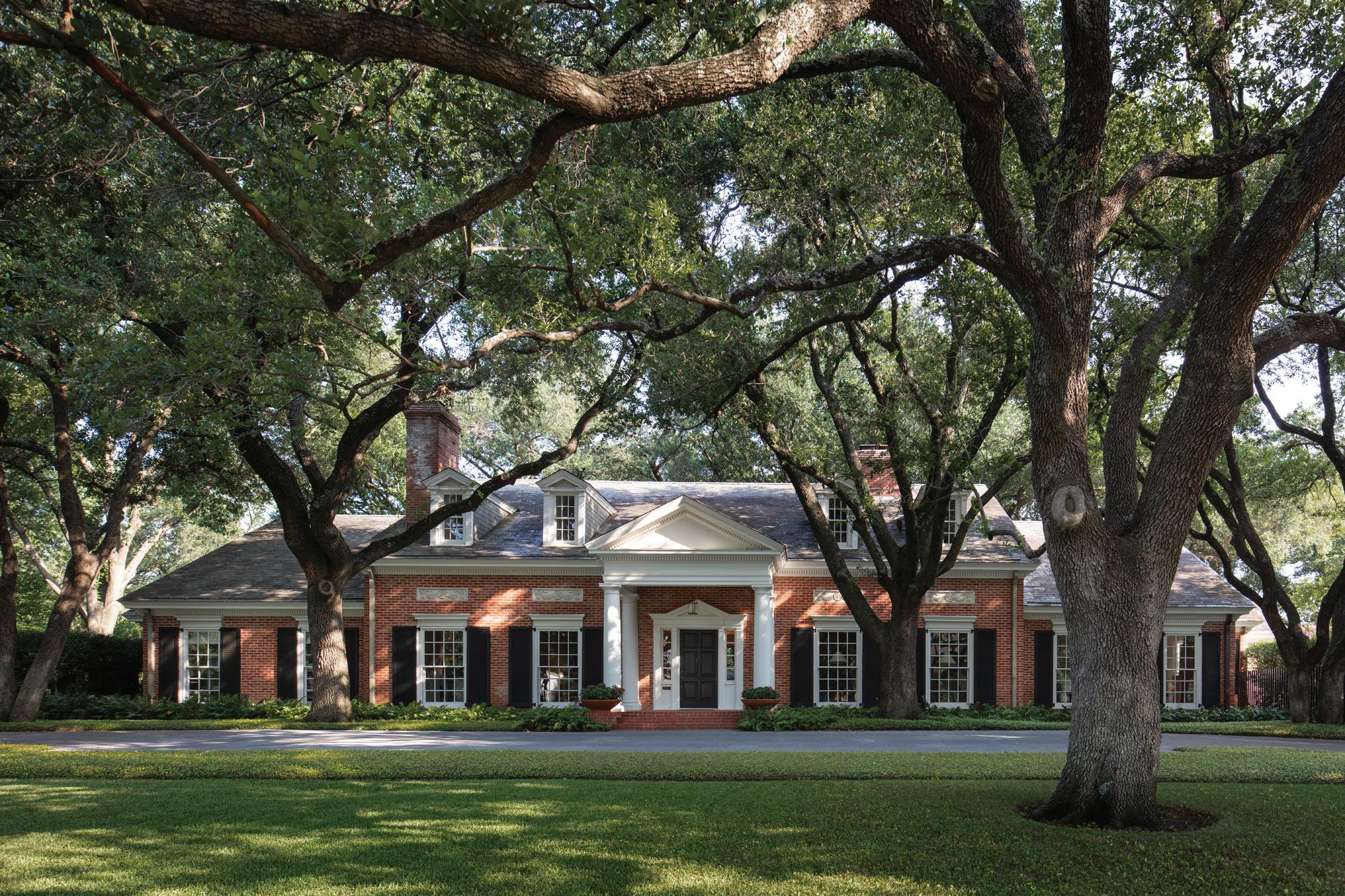
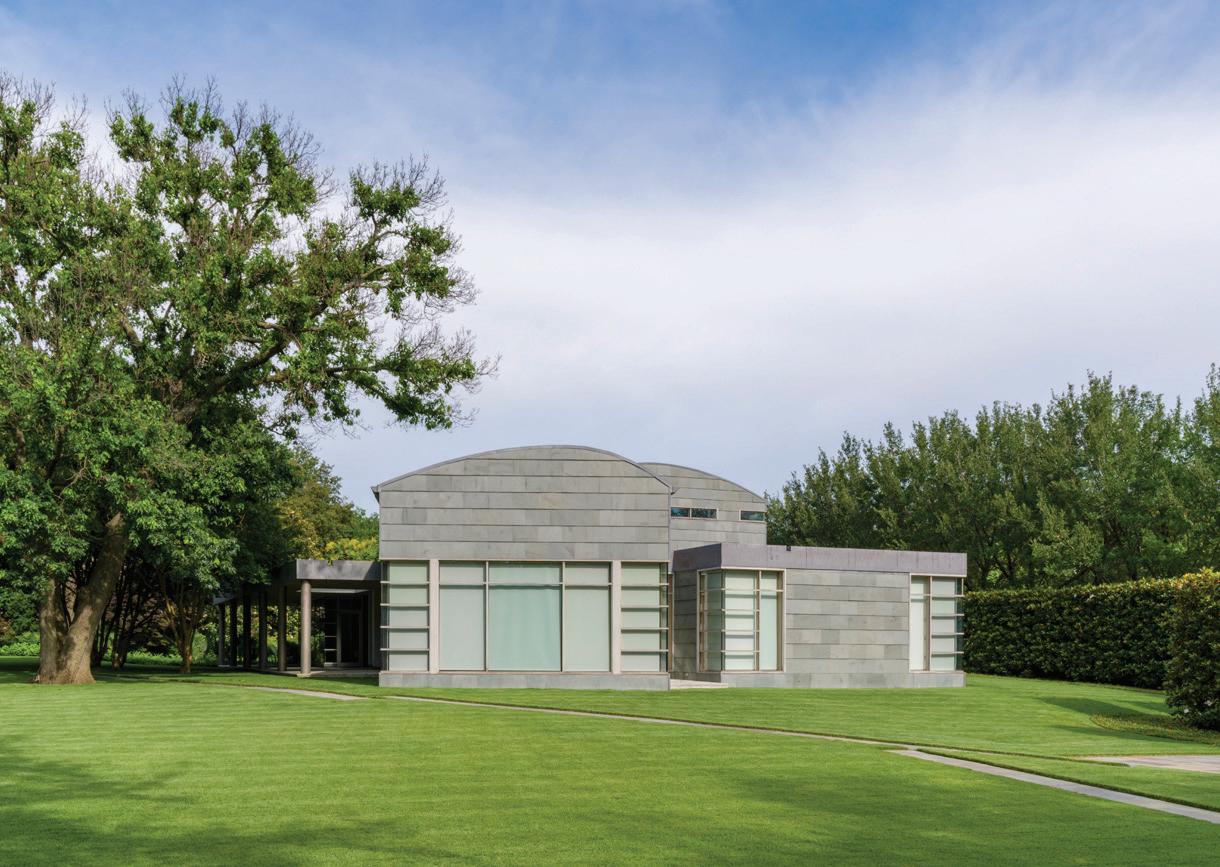
103 OCTOBER / NOVEMBER 2023
An exterior view of the home.
The Garden Gallery was designed by the late Bill Booziotis. Photograph by Jeff McLane.
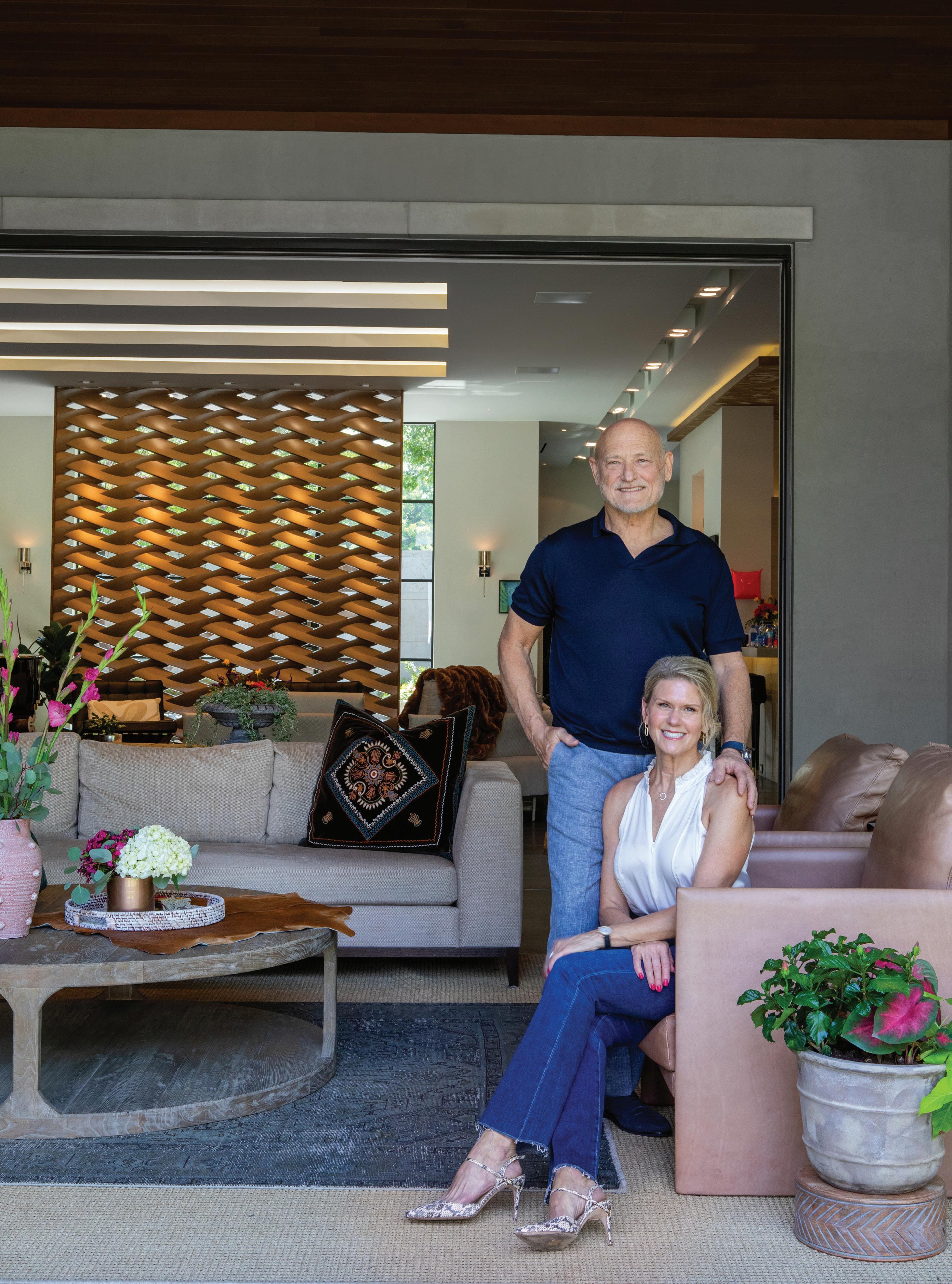 Jill Parker and Rod Sager in their Bluffview home.
A LIVING STORY
A MODERN AND CONTEMPORARY COLLECTION EVOLVES IN THE HOME OF JILL PARKER AND ROD SAGER.
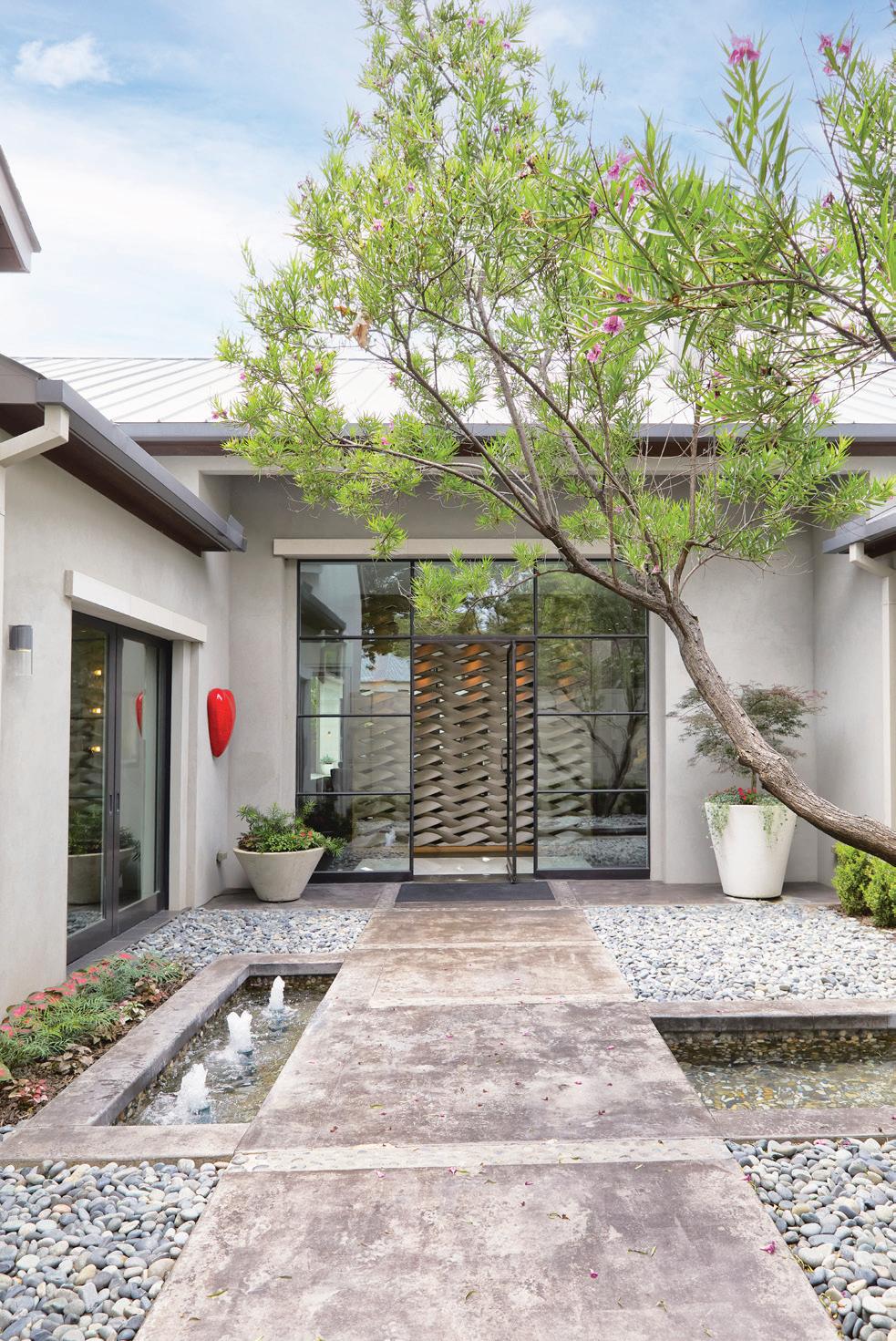
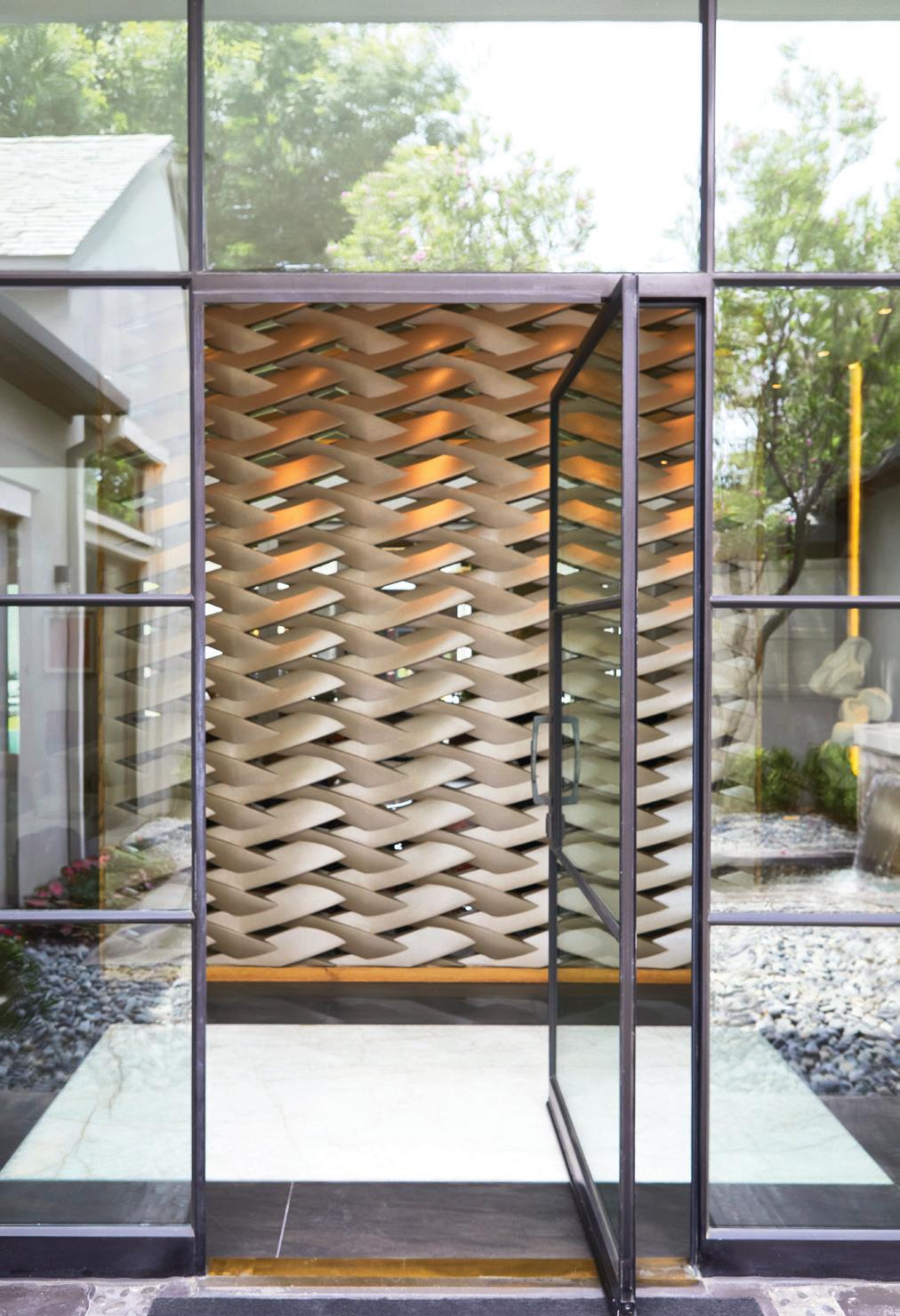 BY NANCY COHEN ISRAEL PHOTOGRAPHS BY JOHN SMITH
Buy what you love, a cardinal rule of art collecting, is a guiding tenet for Jill Parker and Rod Sager. Their collection of modern and contemporary art is serious, playful, eclectic, deeply personal, and has grown in almost geologic layers. “We went through different periods,” Sager explains. His own foray into collecting began when the late Lupe Murchison’s blue-chip masterworks were being sold. Notable dealer Ron Hall handled the details. “Ron told me that I bought more pieces of art than any other clients,” Sager says. This experience also gave him a primer into the world of collecting, and these earliest acquisitions still find pride of place in the couple’s home.
Parker brought her own bona fides into the relationship. A seasoned art professional with a degree in arts management, she moved to North Texas decades ago to work at the Dallas Museum of Art. The couple met through art advisory work that she did for Sager.
The Murchison acquisitions include many luminaries. Among them are Helen Frankenthaler and Elaine de Kooning, whose works inspired Sager to focus on female abstract expressionists. “Their work was underappreciated and undervalued,” he notes. Vivian Springford, whose color field abstractions pulse with energy, is another included underrepresented artist. “She was losing her
105 OCTOBER / NOVEMBER 2023
Custom-built sculptural wall panel; Paul Evans, The Bulb from the Patchwork Series, 1963, steel, in the courtyard; the home’s courtyard entrance.
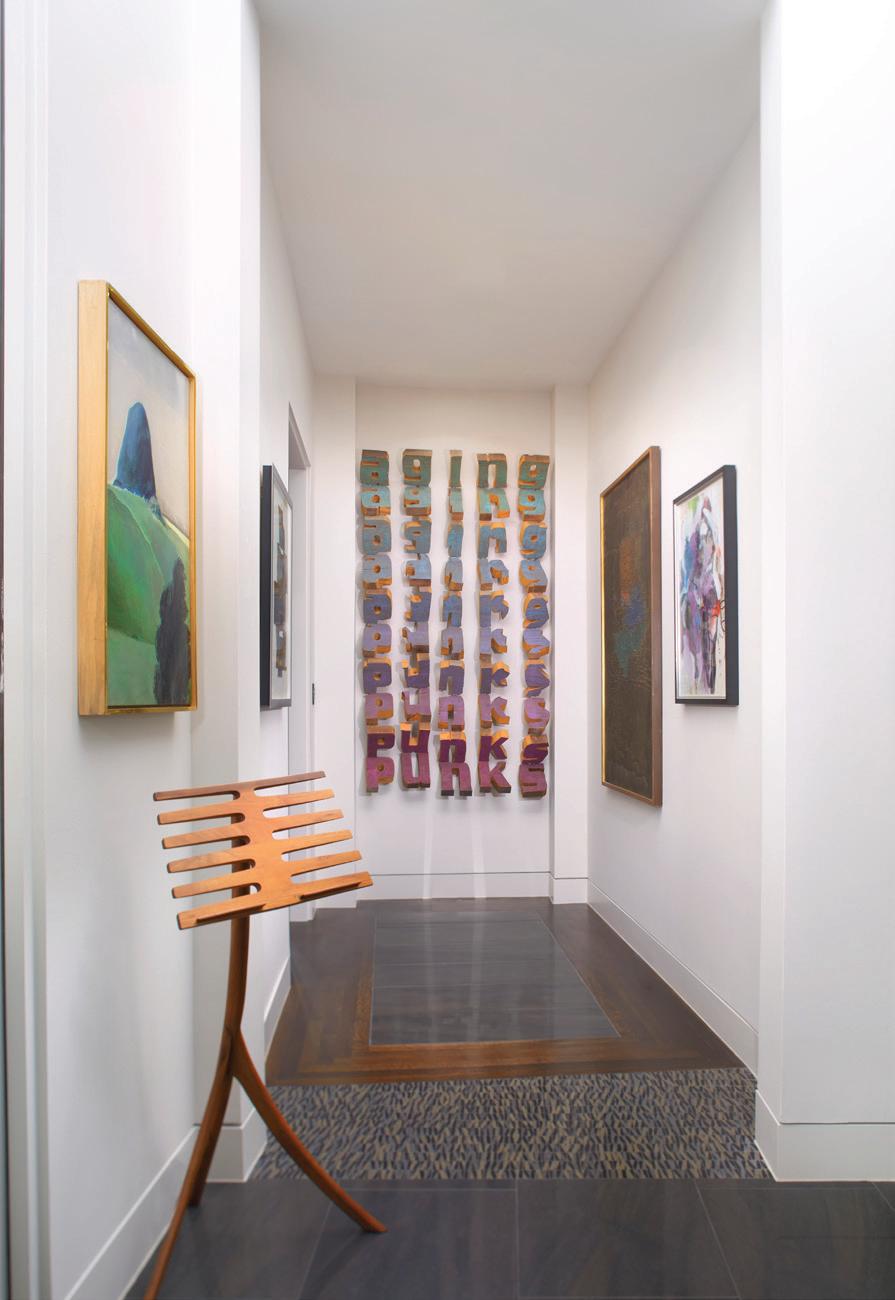
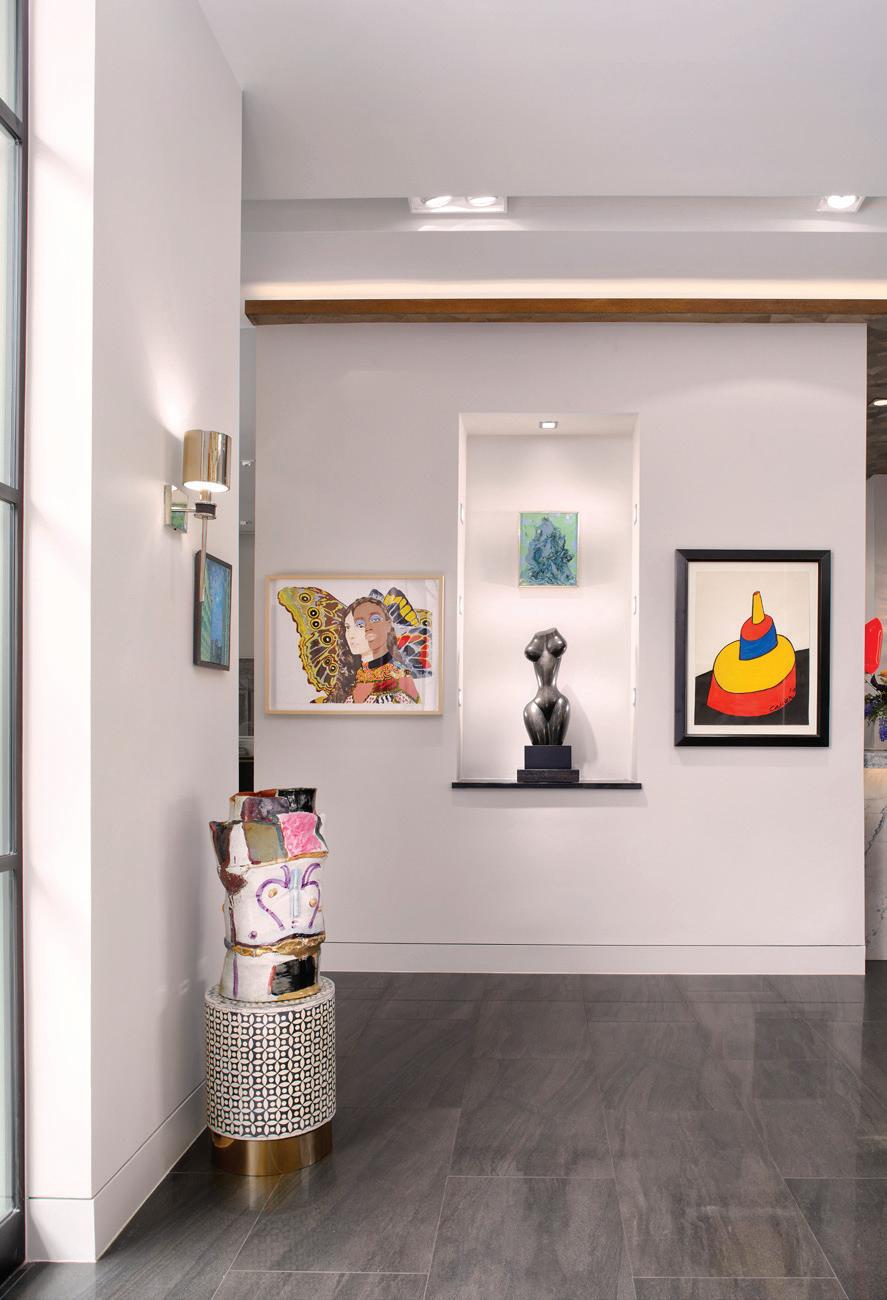
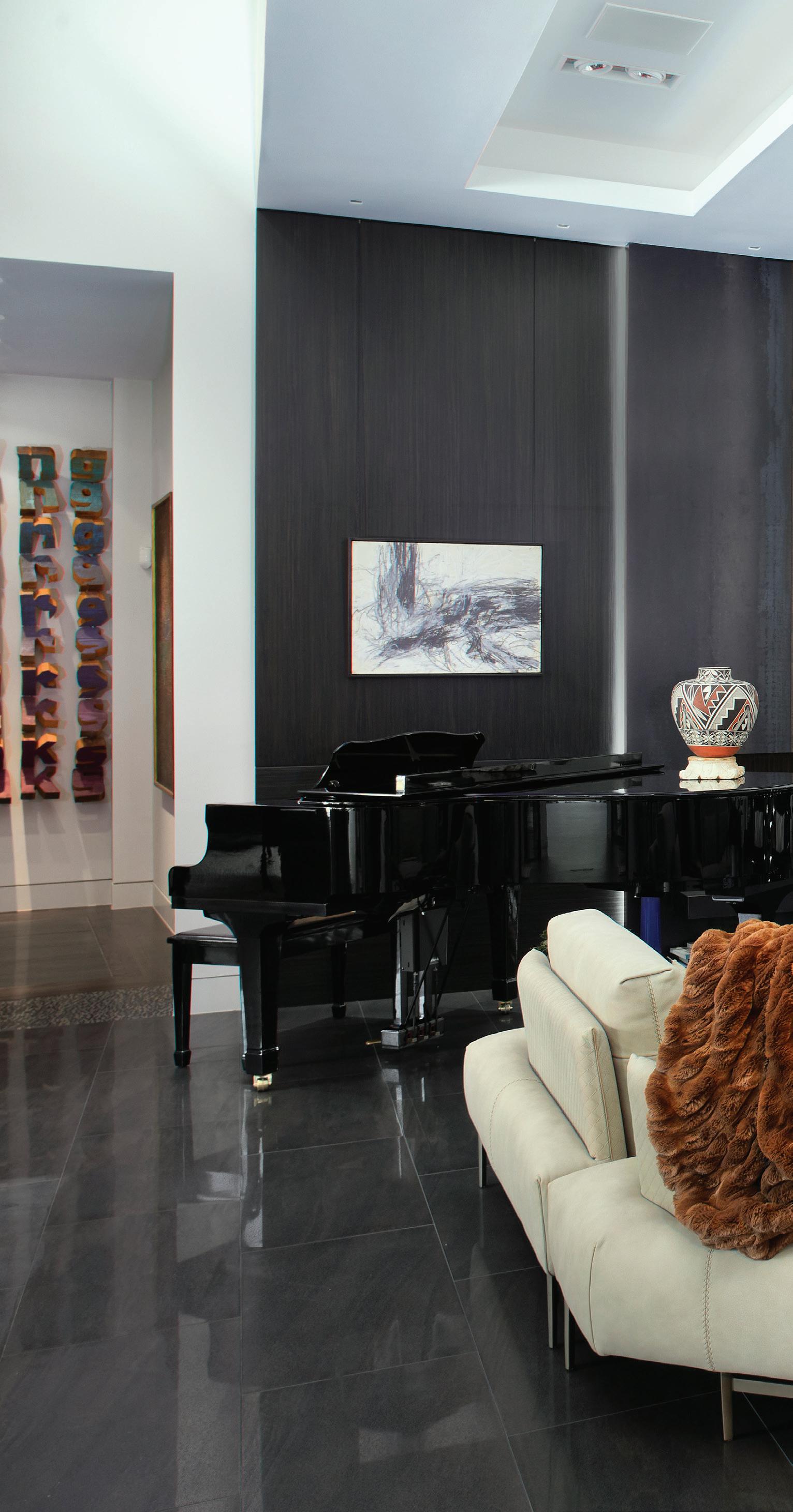
106 PATRONMAGAZINE.COM
Above: Richard Stout, Wind, 1983, oil on canvas, 30 x 20 in.; Nancy Dwyer, Aging Punks, 1966, cedar with enamel, 78.5 x 39.50 in.; György Kepes, Earth and Sun, 1957, oil and sand on canvas. Below: Rudy Autio, Untitled, 1974, glazed ceramic vessel; Masamitsu Shigeta, Moon and Building 3, 2023, oil on panel and wood frame; Christiane Lyons, Frida, Study, 2021, oil on paper; Alexander Calder, Mazda, 1974, gouache and ink on paper; Elaine de Kooning, Bacchus #27, 1982, acrylic on plywood; David Hostetler, Nude Torso, patinated bronze.
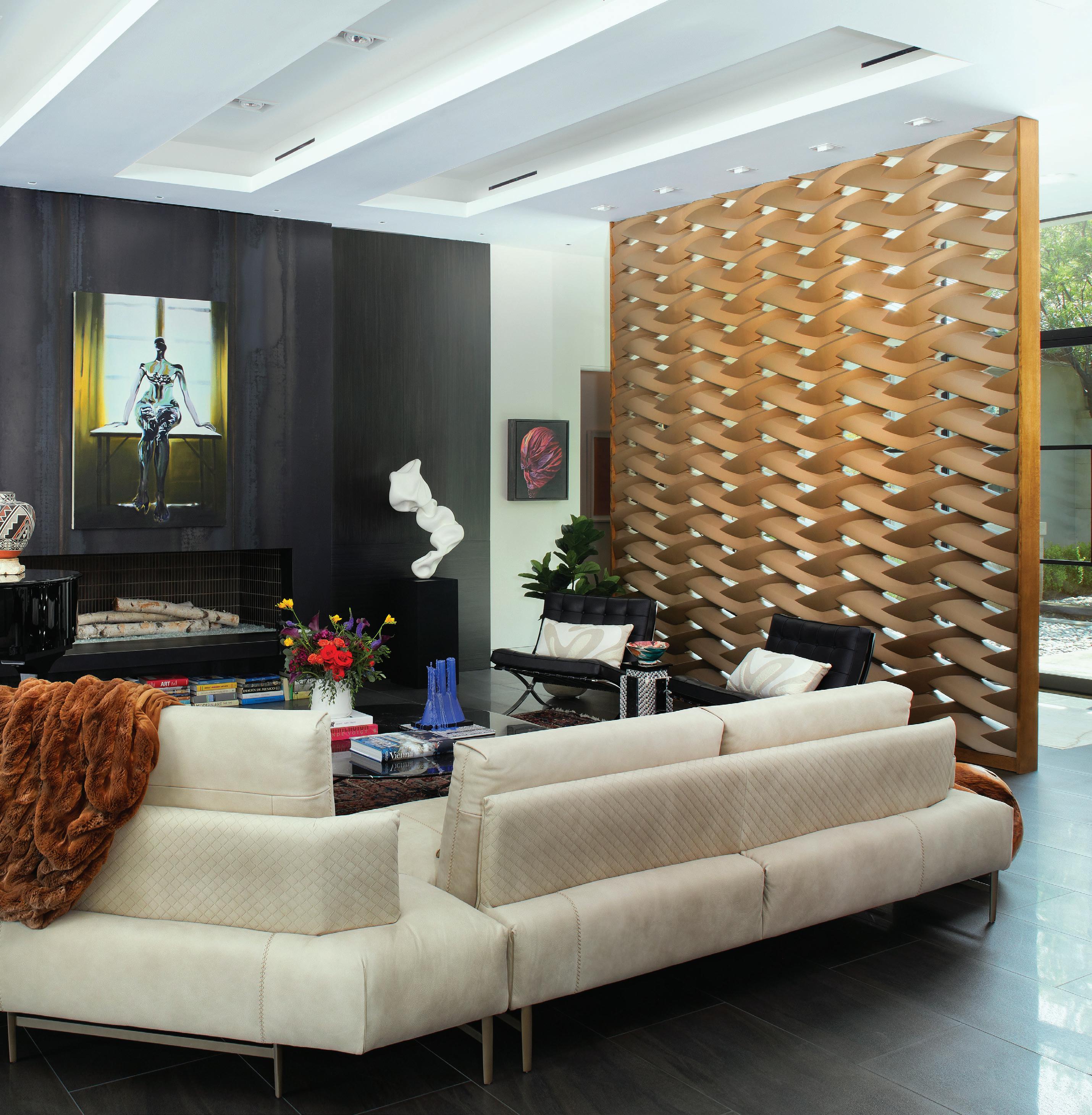
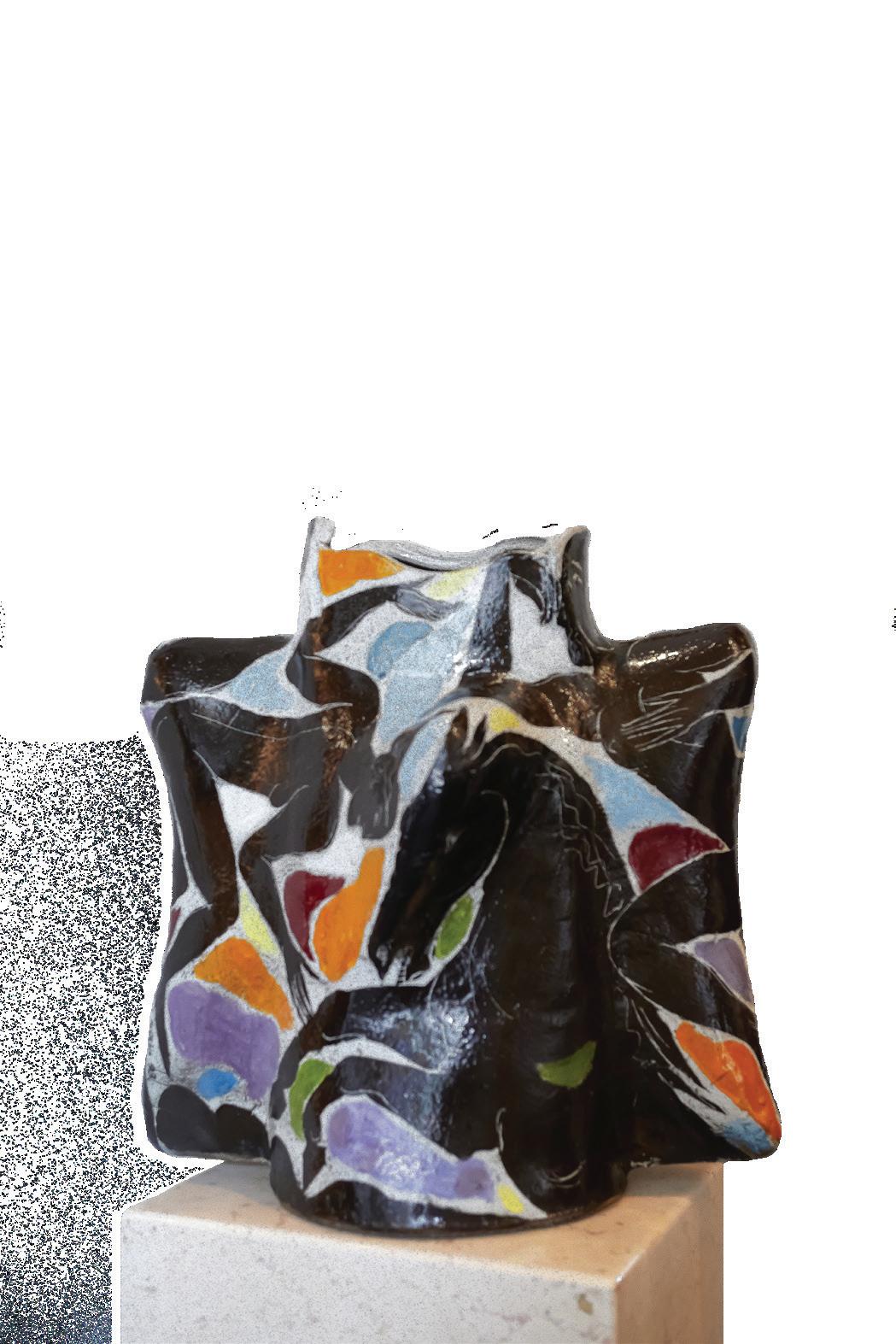 Above the piano hangs Mary Abbott, Untitled, 1951, mixed-media on paper; Vicki Garcia’s Acoma polychrome, 1988, ceramic jar roosts on top; Above the mantle: Yifan Jiang, Late Afternoon, 2023, oil on canvas; Jacob Burmood, Soul Spill, painted resin. Rudy Autio, Odysseum, 1993, coil-made ceramic vase.
eyesight, so all these works are like an iris. I find this fascinating because these are very ocular, fluid works,” Parker notes. Mary Abbott and Perle Fine are also at home within this collection.
So too are artists associated with American art movements, such as Jules Olitski, Louise Nevelson, Claes Oldenburg, Kenneth Noland, James Rosenquist, John Chamberlain, Janet Lippincott, and Agnes Martin, as well as European masters Alexander Calder, Pablo Picasso, Sonia Delaunay, Karel Appel, and Joan Miró, to name a few. The couple also owns work by artists associated with the Bauhaus school, such as Josef Albers and György Kepes. Early Texas modernists Bror Utter and Robert Preusser are also represented.
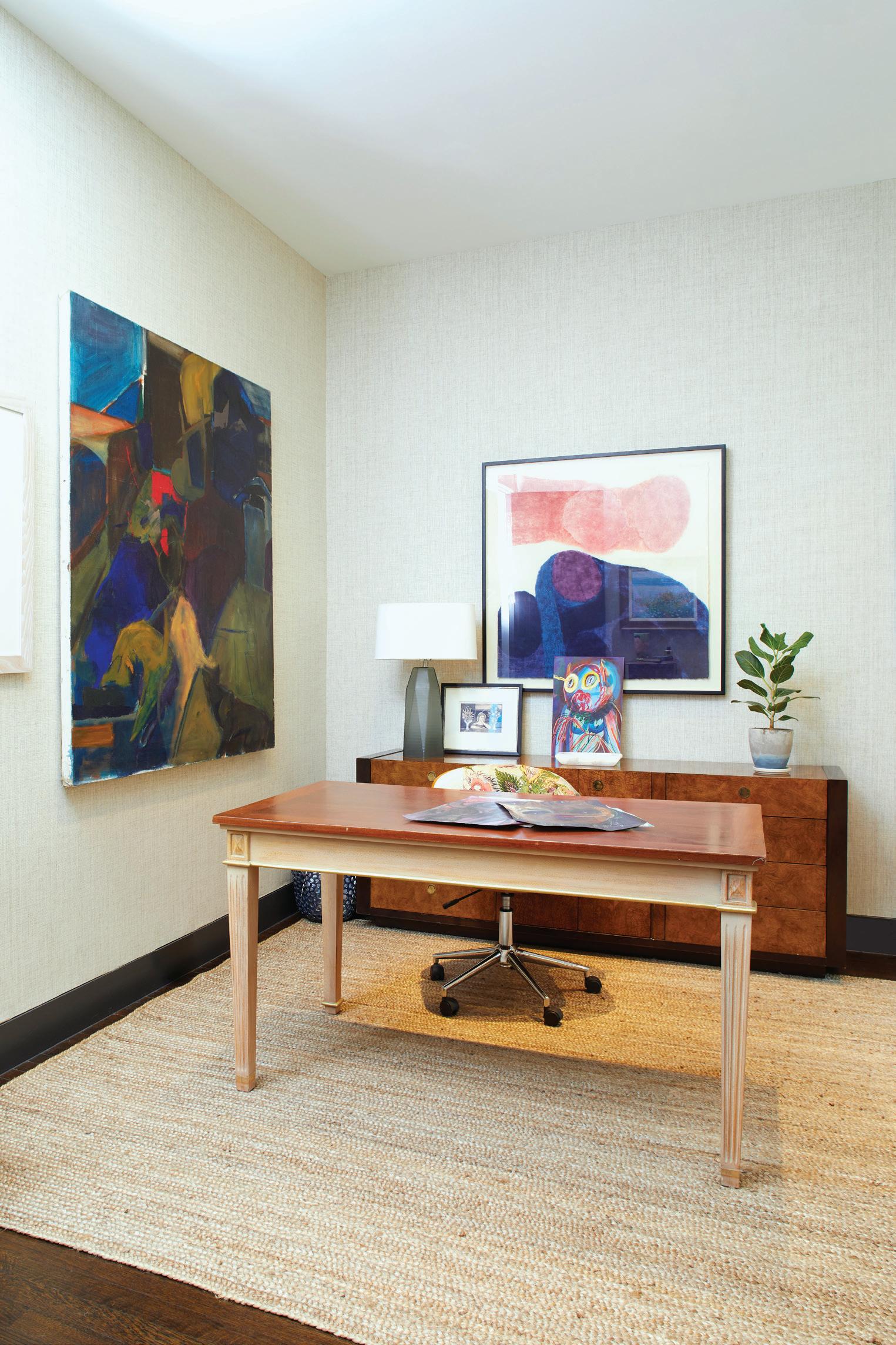
They often look to the secondary market for interesting finds.
Nancy Dwyer’s Aging Punks, for example, came from Sotheby’s with the dissolution of the Lehman collection. “It spoke to me,” says Sager. Similarly, Dennis Blagg’s West Texas nocturnal, Nightfall, was once part of the JCPenney collection.
Collecting contemporary art was a natural progression. Now sitting on the boards of the Dallas Contemporary and the Dallas Art Fair Foundation, Sager has a bird’s-eye view of, and respect for, today’s emerging artists. “We have a responsibility to support living local and regional artists. When you spend time in any way with artists you see their work differently. It’s like a living story,” he says.
With over 100 objects in this collection, and counting, it may seem reasonable to think that its installation would remain relatively static. But moving into their Bluffview home just over a year ago
108 PATRONMAGAZINE.COM
Perle Fine, Untitled, 1951, oil on canvas; Carol Summers, Aetna’s Dream, 1961, woodcut, ink on paper; Bror Utter, Two Vases, color lithograph; Mindy Weisel, The Ballet, 2002, acrylic and oil pastel on paper.
offered fresh perspectives. A new environment, Parker says, “has a different feeling in this home than our previous one.” And new acquisitions inspire new installations.
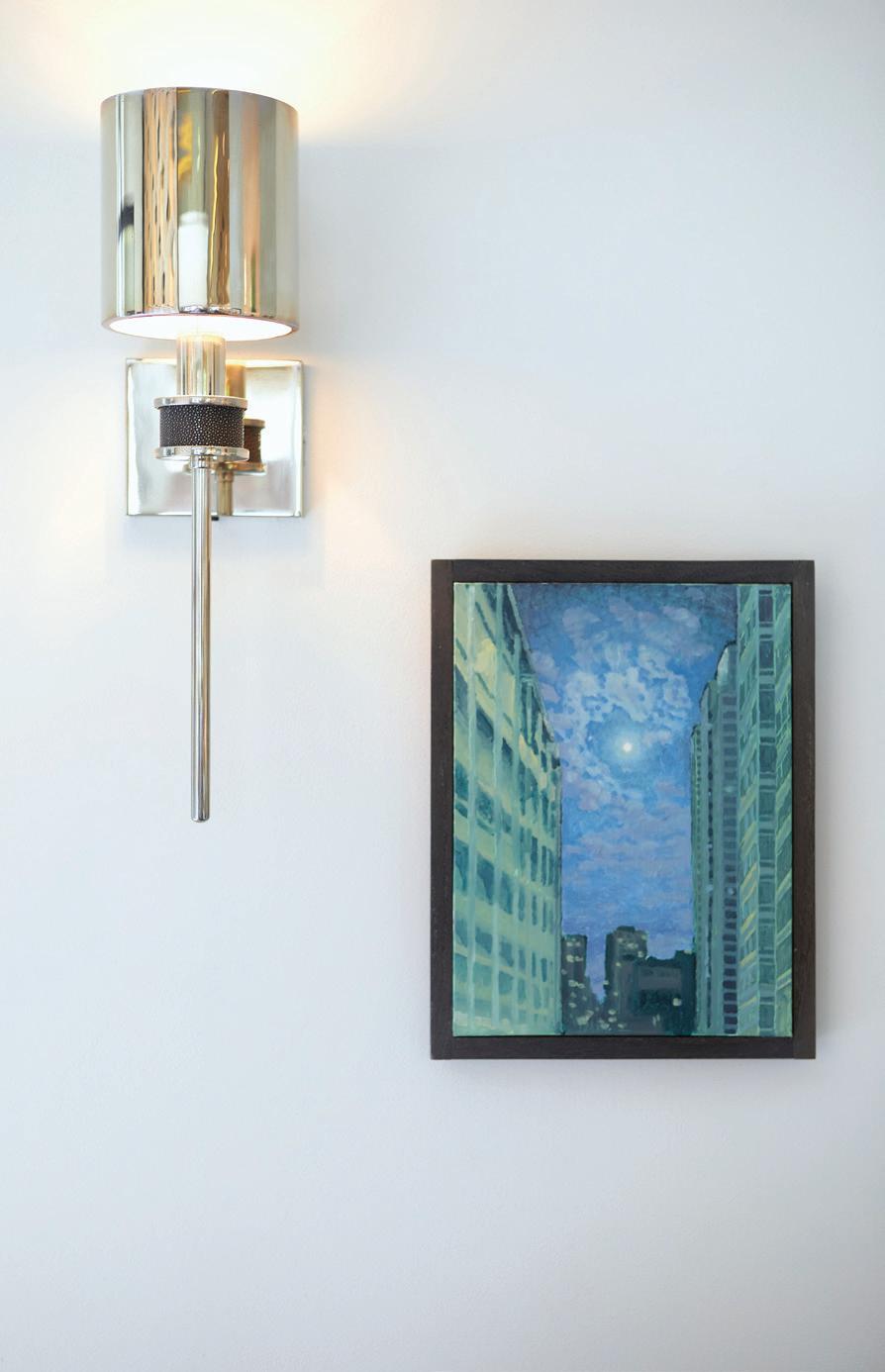
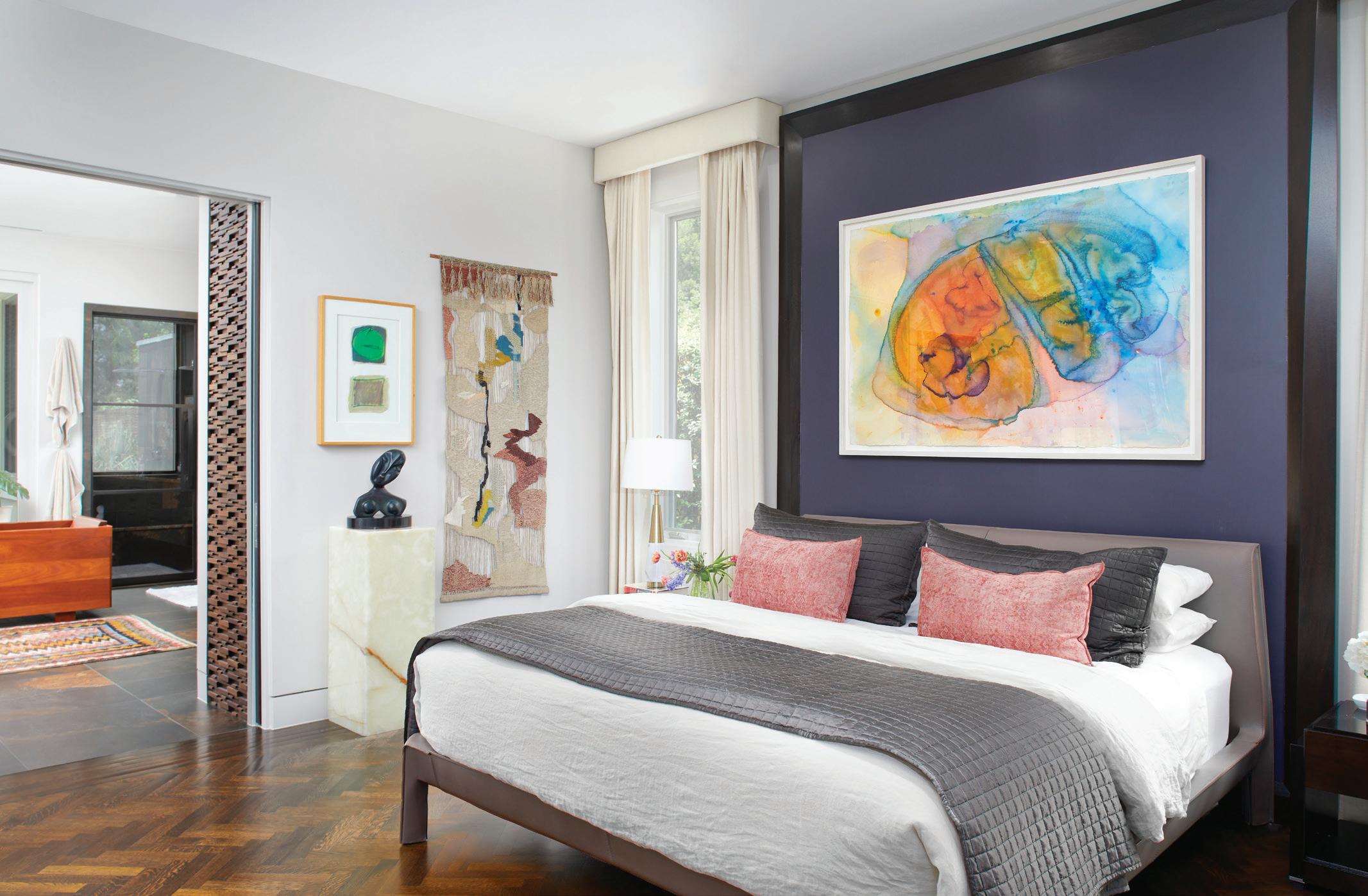
Yifan Jiang’s painting Late Afternoon, for example, was acquired at this year’s Dallas Art Fair from Meliksetian | Briggs. Its arrival, along with other fair finds, called for some rearranging. Hanging prominently over the living room fireplace, Jiang’s seated figure seemingly invites guests to sit down to converse.
The couple also has a strong interest in three-dimensional work, particularly by ceramic artists. In fact, a large red heart, bought on their honeymoon in Mexico, brings a splash of color to their entry courtyard. As with much of the collection, it exudes a sense of welcome. This can be felt, too, in Rudy Autio’s sculptural vessel that greets visitors just inside the front door. Above it is a painting by Masamitsu Shigeta, acquired at this year’s fair from Gallery 12.26. Through the Dallas Art Fair Foundation, the Dallas Museum of Art also bought one of his pieces at this year’s fair.
Additionally, Parker and Sager are enthusiastic patrons of Renata Morales. Her ceramic plates line the kitchen wall, along with a painting by Armando Sebastian, acquired from Erin Cluley Gallery. Ida Kohlmeyer’s mixed-media basket of flowers serves as a punctuation mark on the counter next to them.
In a space that invites whimsy, the bar area features some of the most playful work. Gracing one wall is William Cannings’ plush-looking pillow, rendered in inflated steel, from Cris Worley Fine Arts. It is juxtaposed with ceramic cubes by Kaiser Suidan.
Nearby, a vibrant orange vessel by Brooks Oliver, from the Dallas Pottery Invitational, is a centerpiece on the dining room table. Its
109 OCTOBER / NOVEMBER 2023
In the primary bedroom: Ida Kohlmeyer (1912-1997), Monoliths from Mind’s Eye, mixed-media on paper; Rythnus Lavogrou, May, 1956, watercolor on paper; Scott Gentry, Gladys, bronze; modernist American wall hanging tapestry, mid 20th century, linen, cotton, rayon, wool; Vivian Springford, Untitled (VSF383),1980, watercolor on paper.
Masamitsu Shigeta, Moon and Building 3, 2023, oil on panel and wood frame from 12.26.
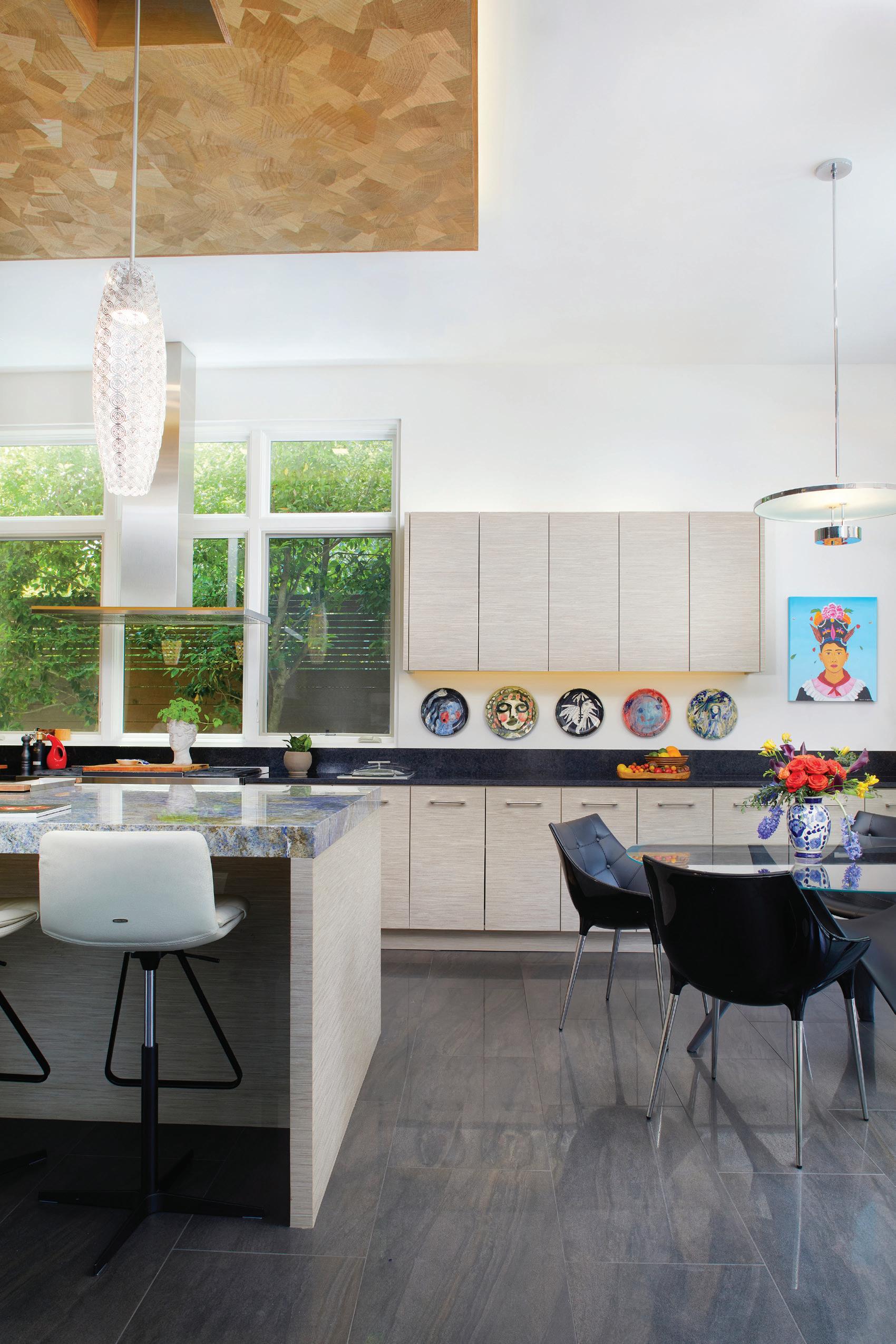
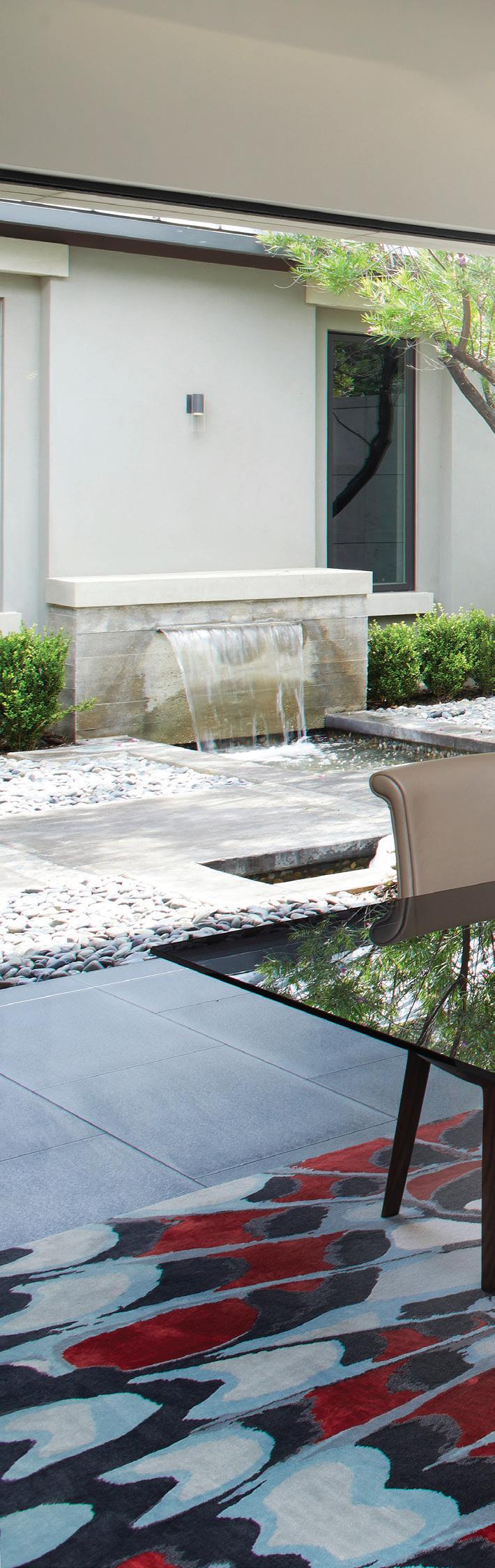
110 PATRONMAGAZINE.COM
This page: Renata Morales, Untitled series, ceramic plates acquired through Dallas Contemporary; Armando Sebastian, Nino Shaman, 2021, acrylic on canvas. Opposite: Tomio Kinoshita, Untitled (Three Heads), 1961, woodblock print; Unknown artist, Untitled (Winged Man), bronze; Brooks Oliver, Untitled (Zig-Zag), 2022, ceramic; Alexander McQueen rug from The Rug Company.
organic shape is echoed around the room in work by Ida Kohlmeyer and Anna Membrino, the latter from Erin Cluley Gallery. Beneath, an Alexander McQueen rug from The Rug Company adds interest.
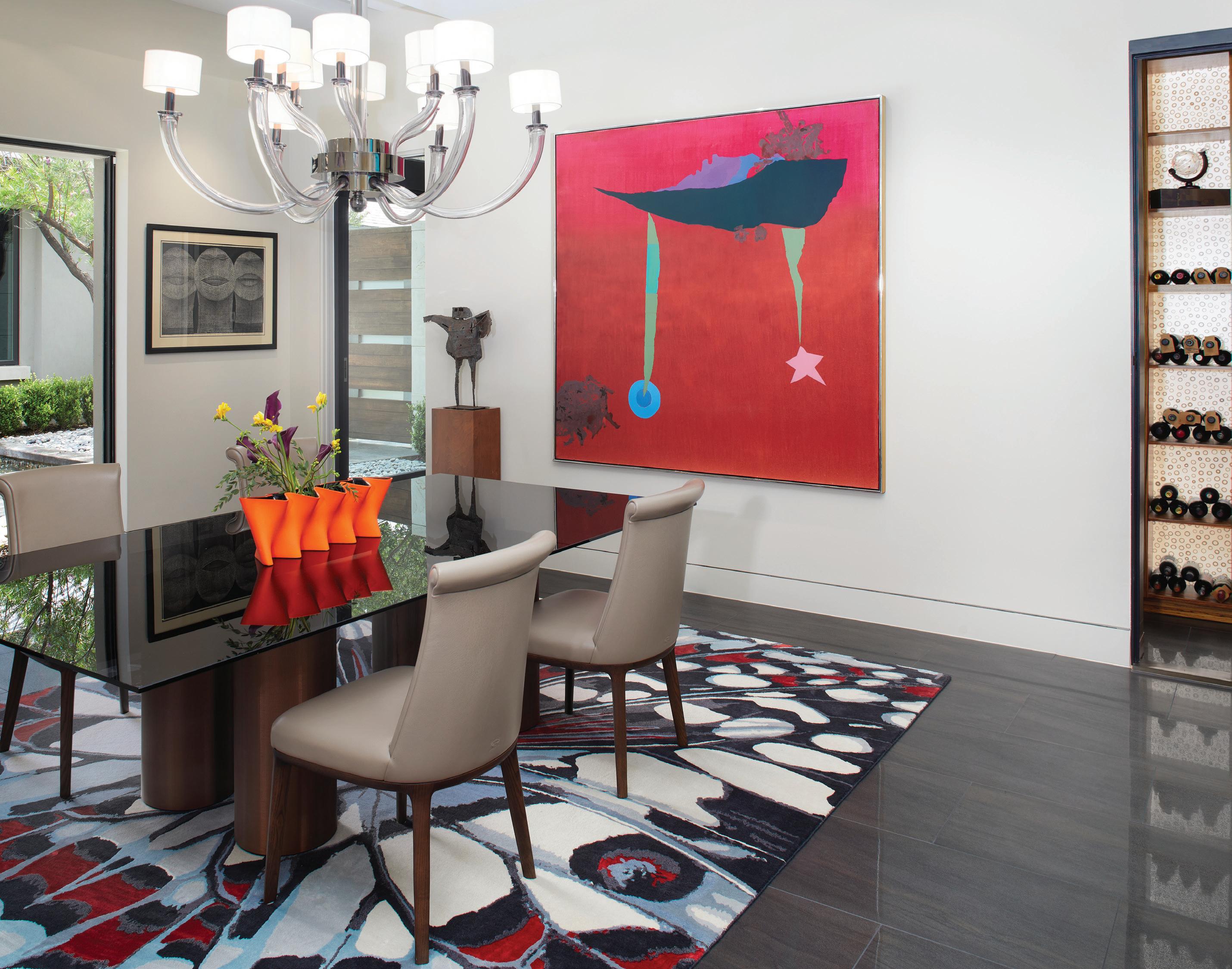
The collection also spills onto the backyard pool deck. Here, John Berry’s Wire Woman (Renee) invites us to join her poolside. Her softness is balanced by Mac Whitney’s angular Zarzamore. Anabel Juárez’s large-scale Summer Blossoms, another fair discovery, brings floral energy to the area. The couple bought it from Anat Ebgi Gallery.
Much of the collection reflects the couple’s travels. On a recent trip to London, they bought a trio of intimate still lifes by Kate Verrion. With a crispness often associated with 17th-century
painting, their playful titles give them a contemporary edge. “It’s fun when we travel to pick up something. It reminds me of where we have been and what we have done,” explains Parker. With access to a plethora of good art and the artists who make it, Parker and Sager feel fortunate to also be able to acquire locally. “One of the things about collecting emerging artists is getting to meet them and getting to know them,” says Parker. And while she and Sager lend invaluable support to the local arts ecosystem, they also view their participation as a privilege. As Sager concludes, “We feel honored to be focusing on living artists.” The contemporary artists whose works enter this august collection can feel equally honored to be in such outstanding company. P
111 OCTOBER / NOVEMBER 2023
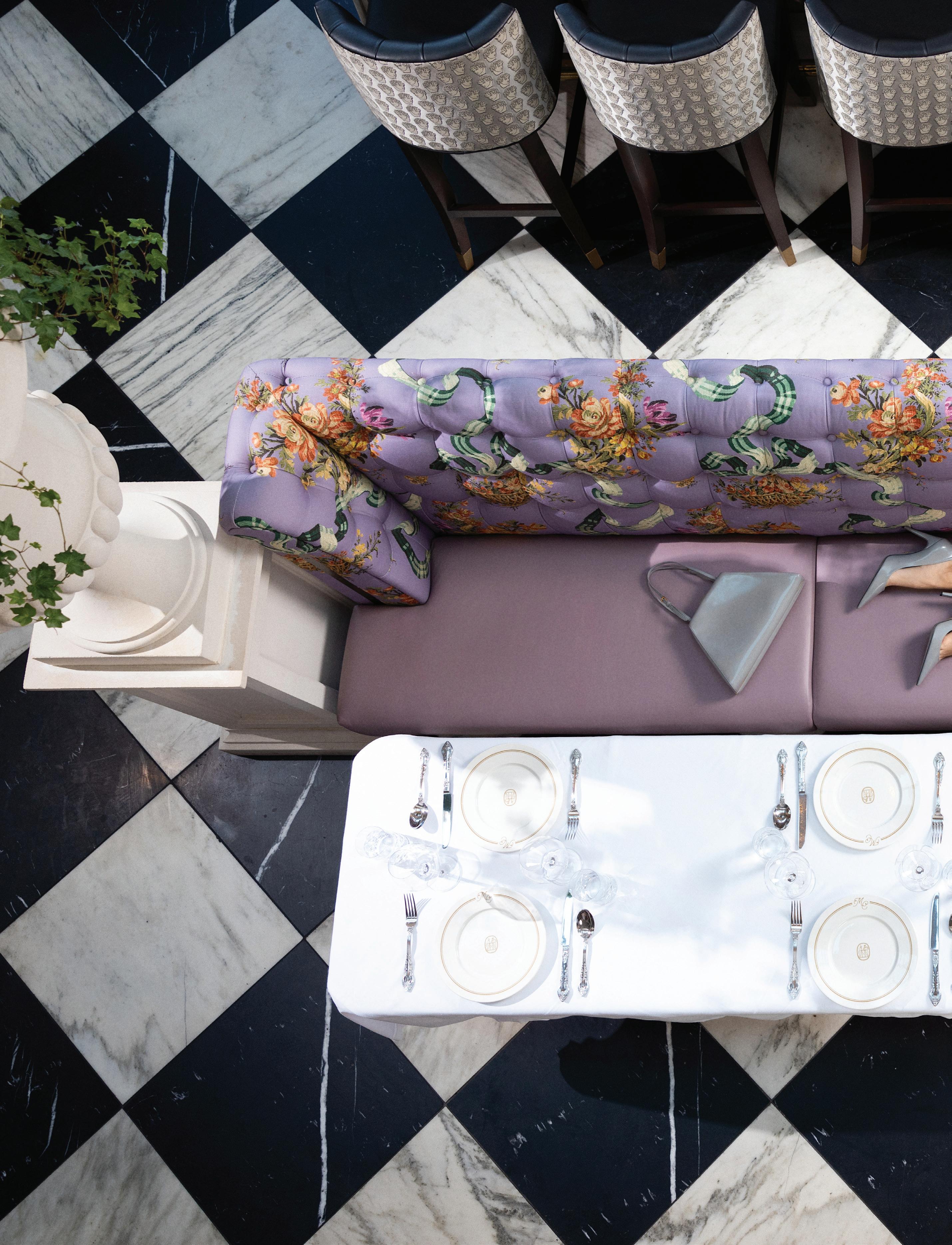 Hair/makeup Lisa Martensen, Kim Dawson Agency; Model Nicolly Dalpra, Kim Dawson Agency; Photographer’s first assistant, Matt McElligott; Photographer’s second assistant, Cameron Pitts; Photographer’s intern, Tom Le. Prada stretch natté dress; Prada Cloudy Grey brushed leather pumps and medium Saffiano bag, prada.com Floral by Concepto. conceptoboutique.com
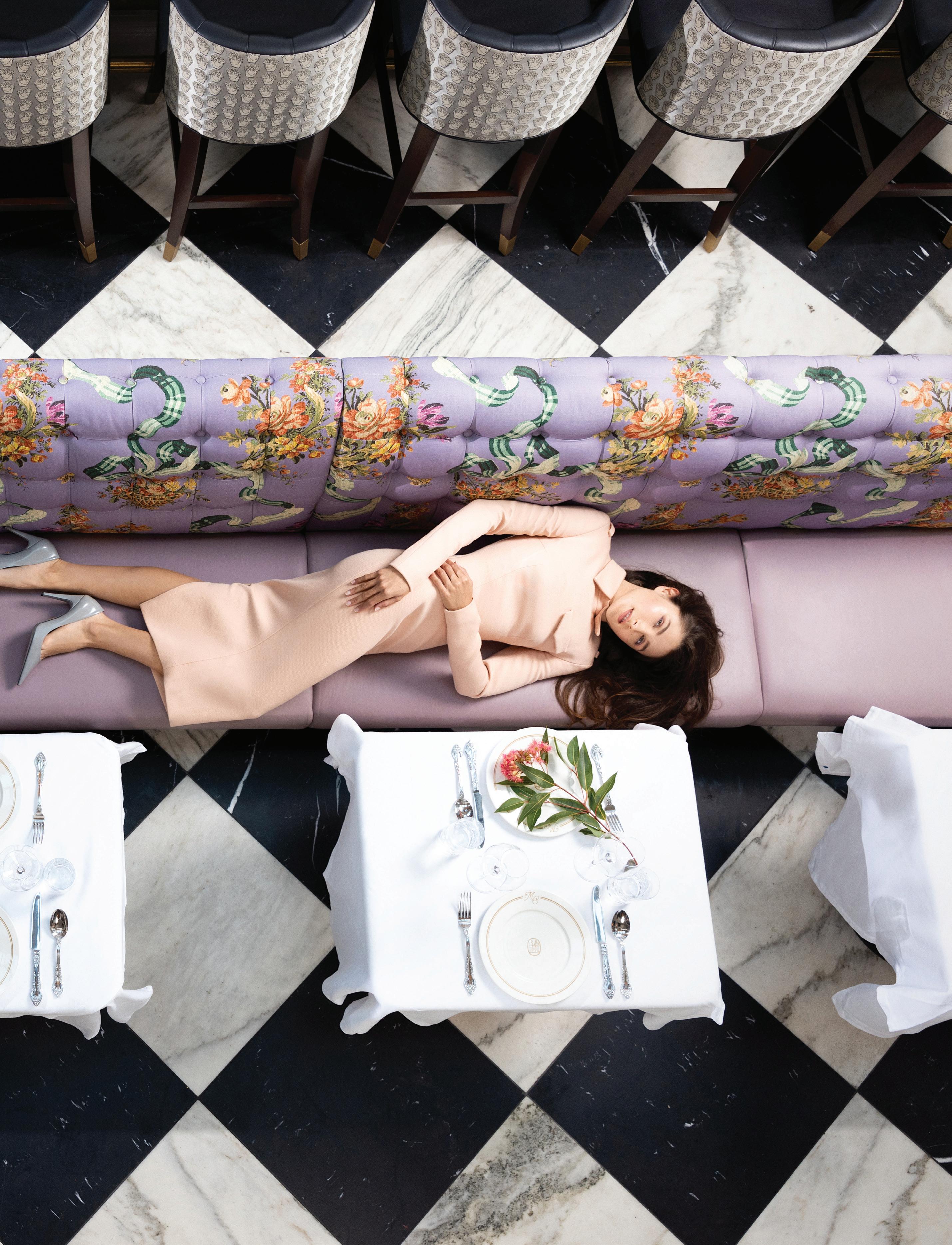
PHOTOGRAPHS
CREATIVE DIRECTION BY CONCEPTO & TERRI PROVENCAL
At the hottest restaurant in town, a fashion muse makes a statement.
BY JUSTIN CLEMONS
STYLING BY ELAINE RAFFEL
Courting Mister Charles
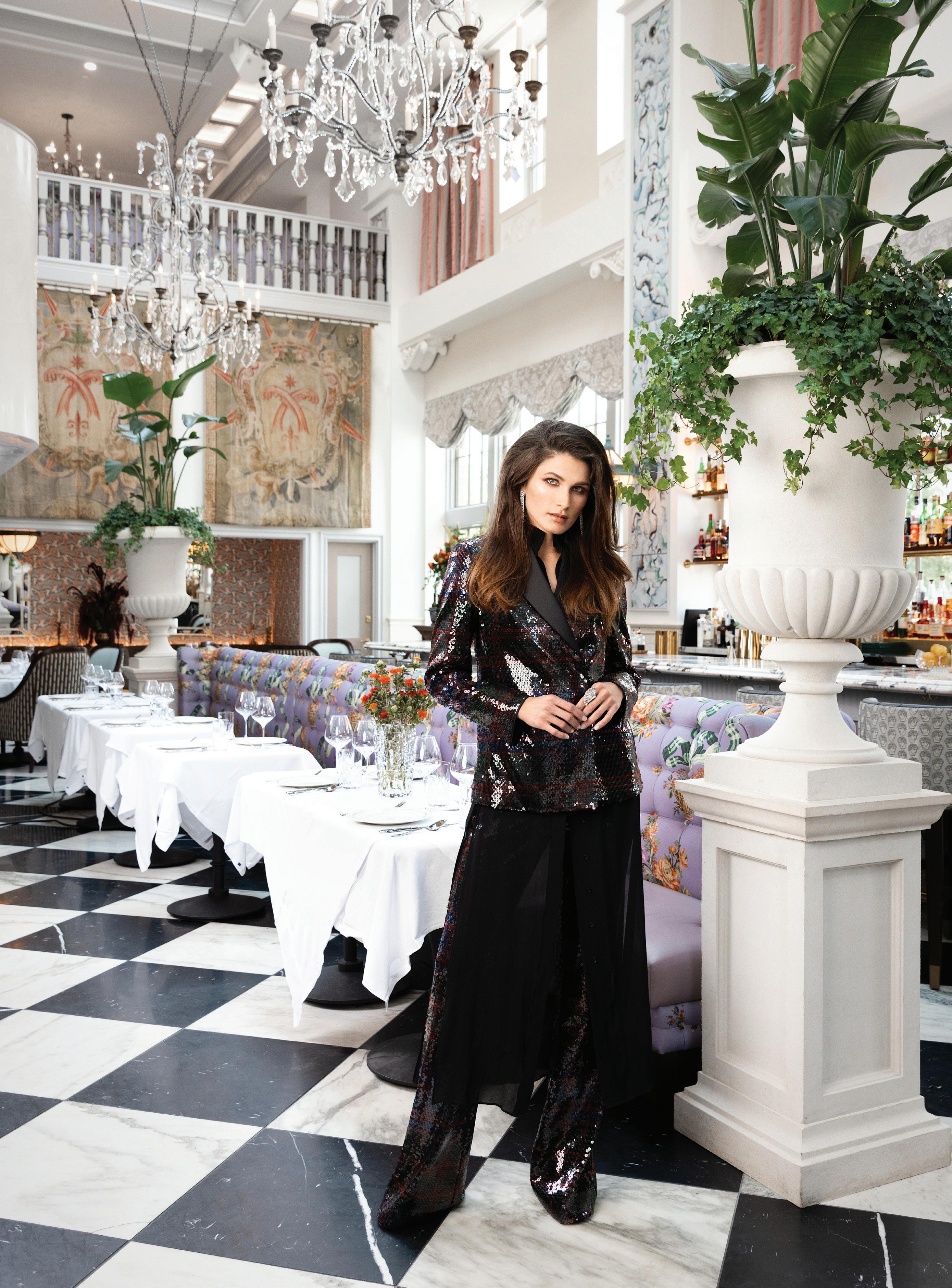
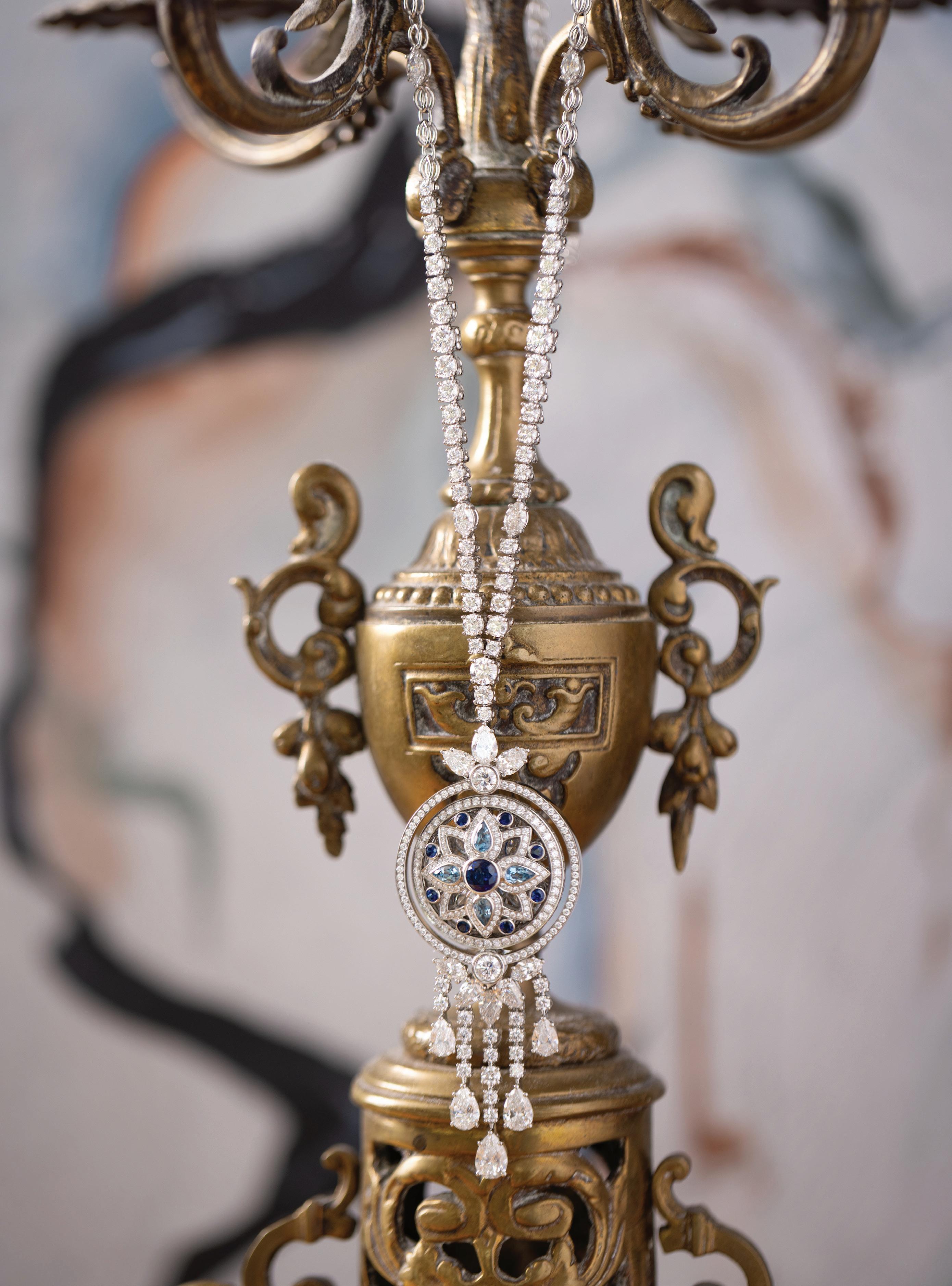 This page: Harry Winston Secret Wonder necklace featuring diamonds, sapphires, and aquamarines set in platinum. Harry Winston, Highland Park Village. Opposite: Akris liquid sequin jacket and sequin bootcut pants with check print. Akris, Highland Park Village. Eiseman Collection 18k white gold ring featuring a large plume of emerald-cut and round, brilliant-cut diamonds; Piranesi 18k white gold leaf drop earrings set with round brilliant- and marquise-cut diamonds. Available at Eiseman Jewels, NorthPark Center. Floral by Concepto. conceptoboutique.com
Diamond and platinum bracelet with pear-, oval-, round-, triangle-, and shield-shaped rose-cut diamonds set within an intricate mesh design. Gross weight: 210.40 grams, dimensions: 6.50 in. x 3.25 in. The Collection of Riki Schaffer. Exclusively through Heritage Auctions, ha.com. Floral by Concepto. conceptoboutique.com
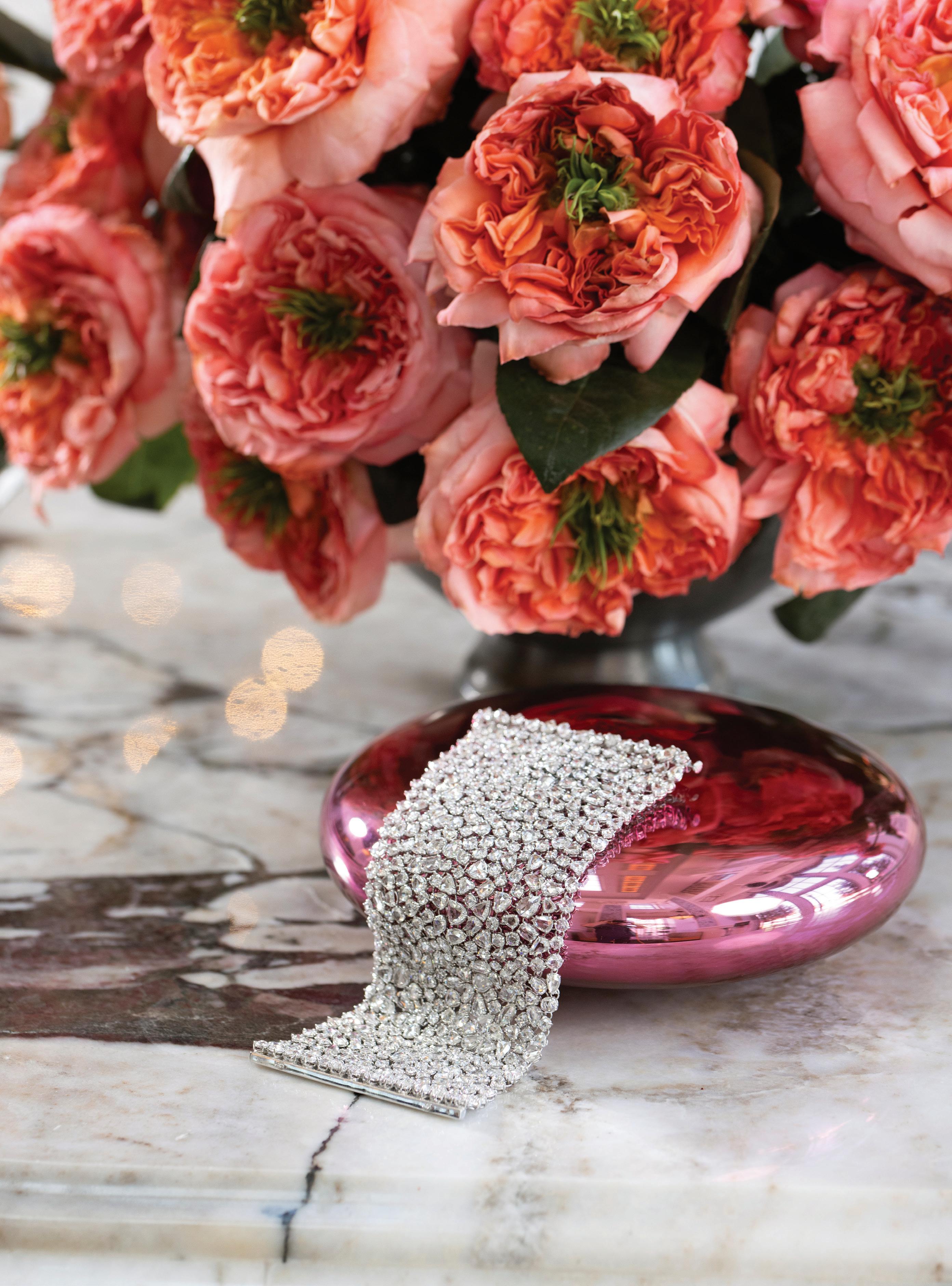
Brunello Cucinelli cashmere turtleneck sweater with shiny contrast cuffs and crispy silk maxi column skirt with ramage embroidery; virgin wool and cashmere fleecy bucket hat with shiny trim. All at Brunello Cucinelli, Highland Park Village. Floral by Concepto. conceptoboutique.com
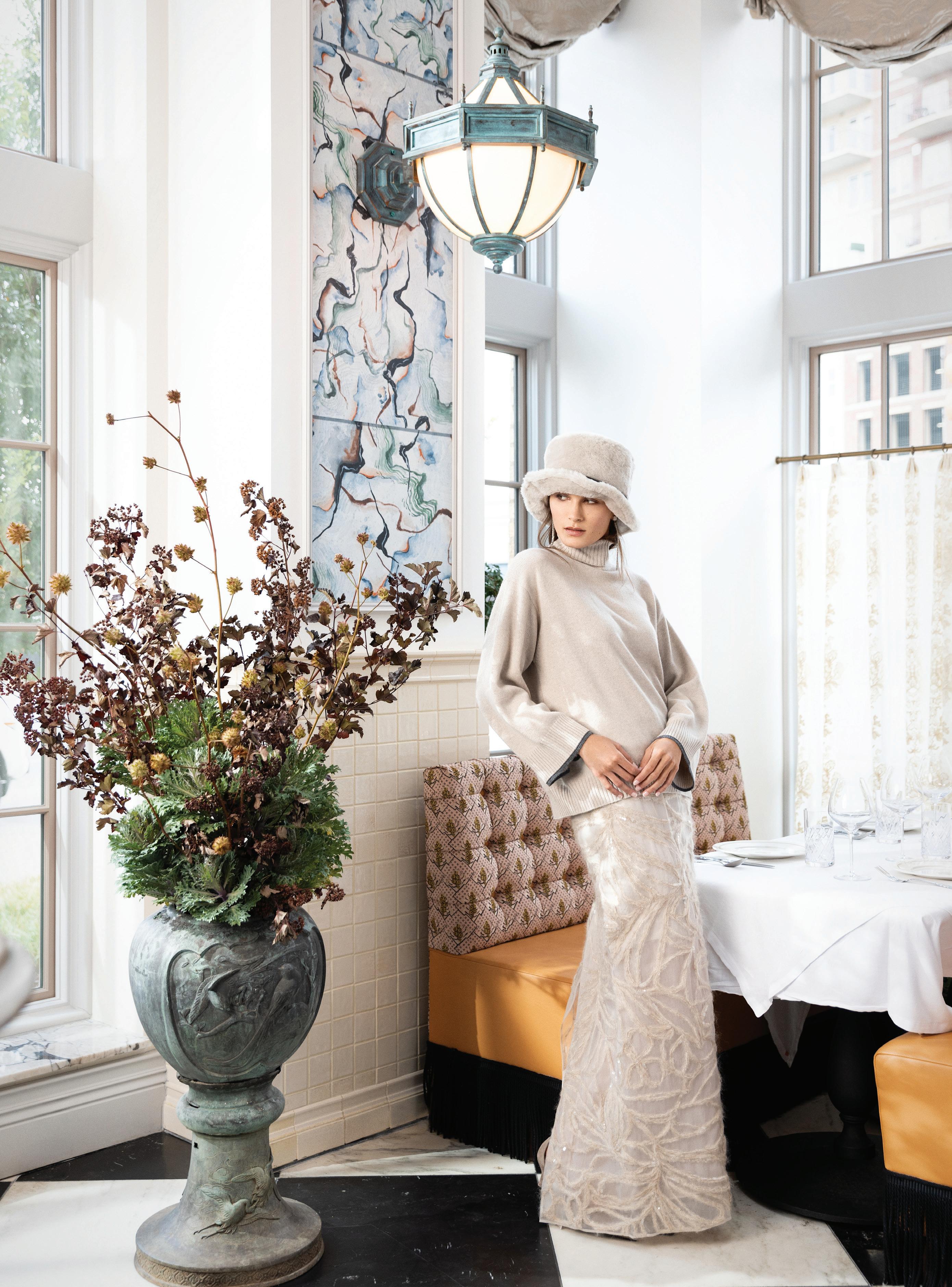 Image caption
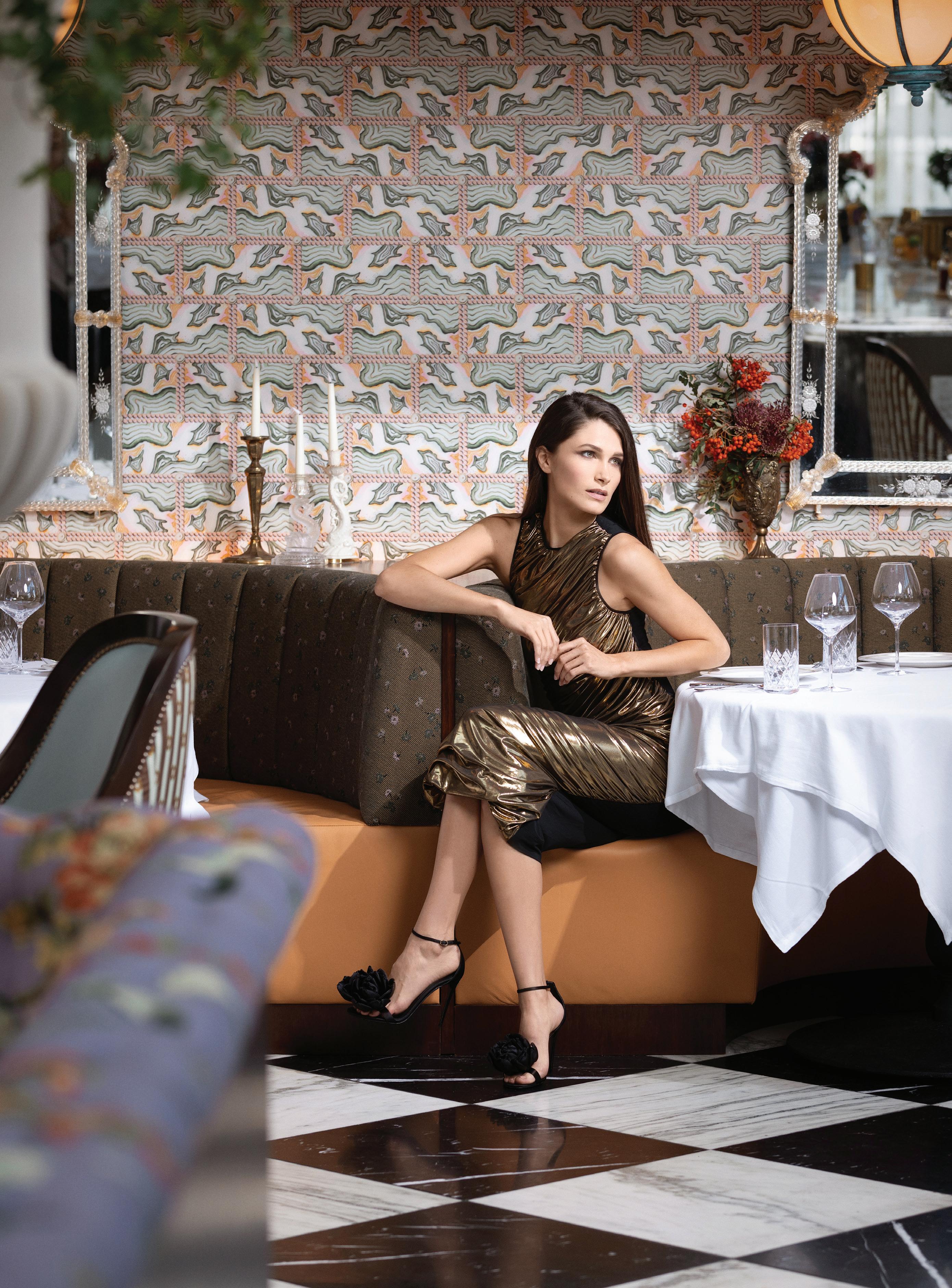 Dolce & Gabbana foiled organza calf-length dress. Dolce & Gabbana, NorthPark Center. Floral by Concepto. conceptoboutique.com
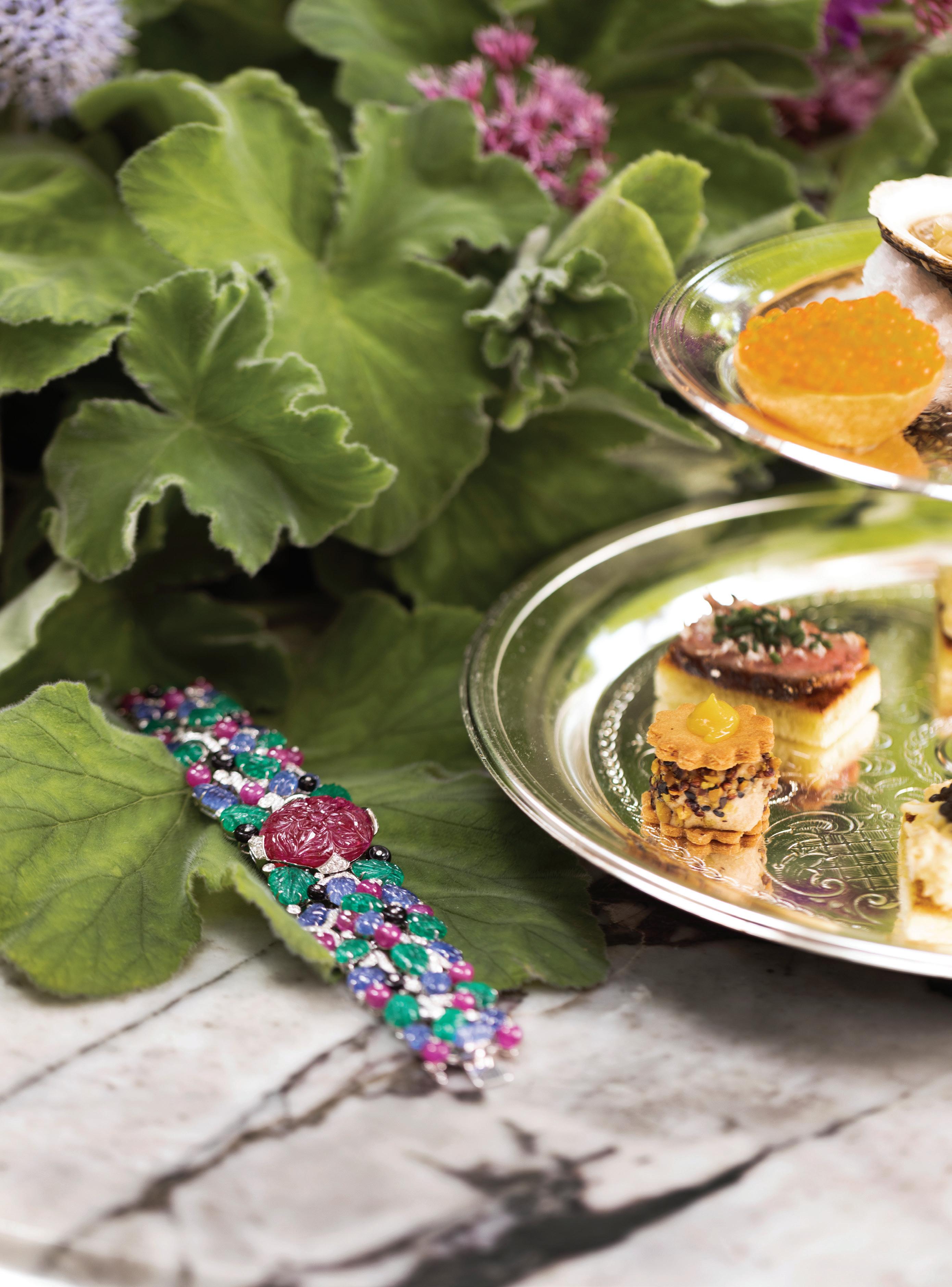 deBoulle High Jewelry Collection Tutti Frutti bracelet with carved no-heat Burma ruby totaling more than 52 carats, surrounded by pear-shaped, carved no-heat Burma sapphires totaling more than 35 carats, carved leaf-shaped Colombian emeralds totaling more than 31 carats, with ruby beads, diamonds, and onyx, crafted in 18k white gold. Available at deBoulle Diamond & Jewelry, Preston Road. Floral by Concepto. conceptoboutique.com
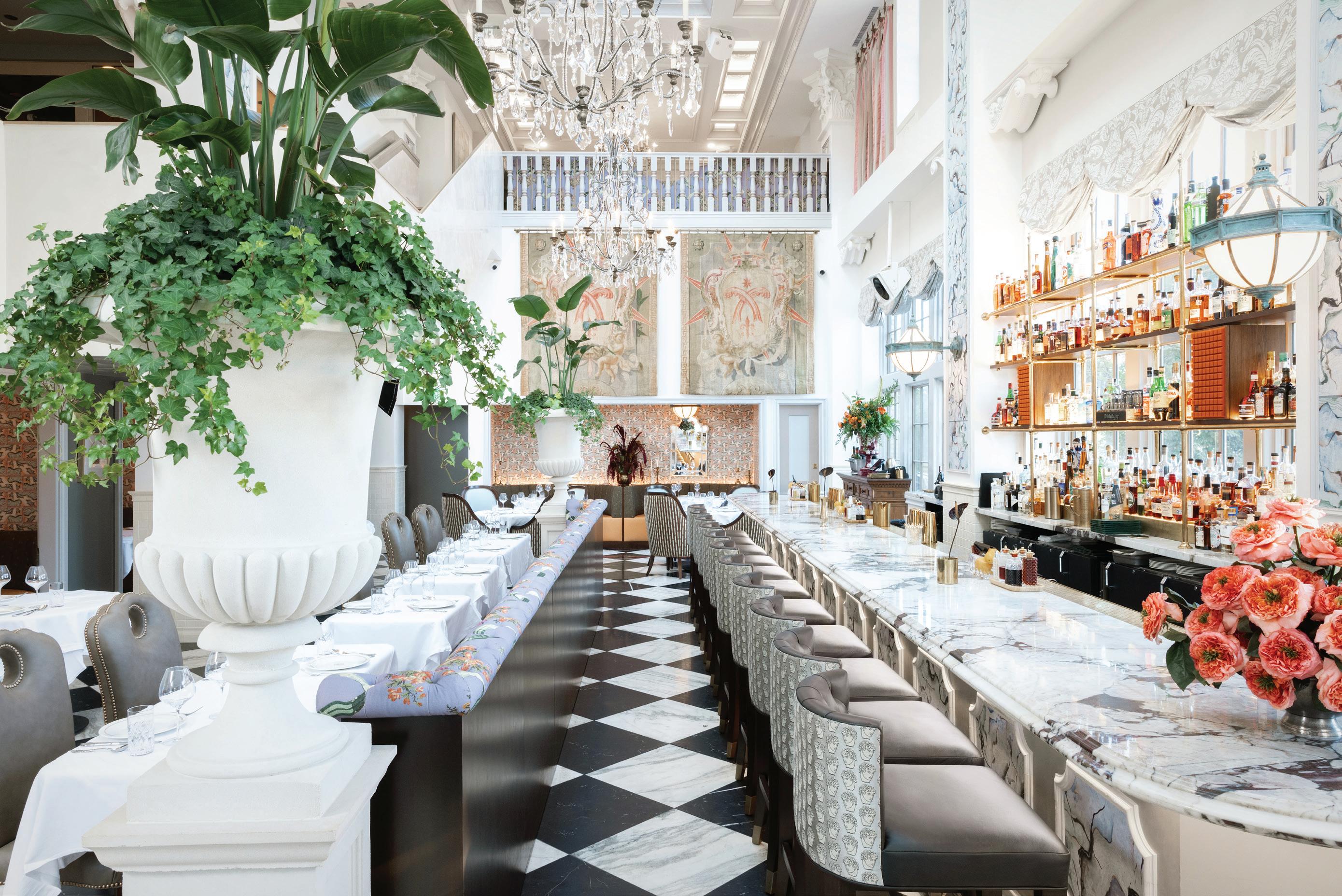
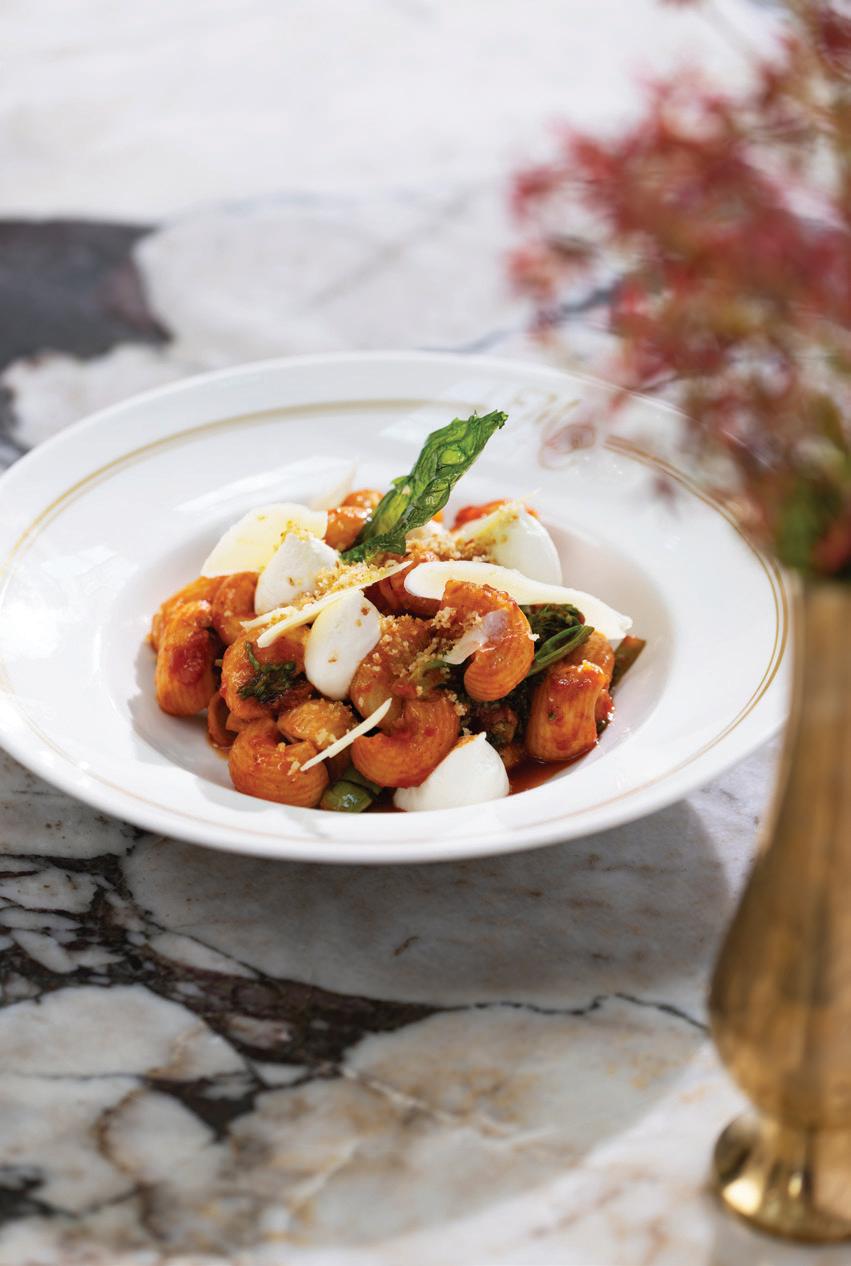
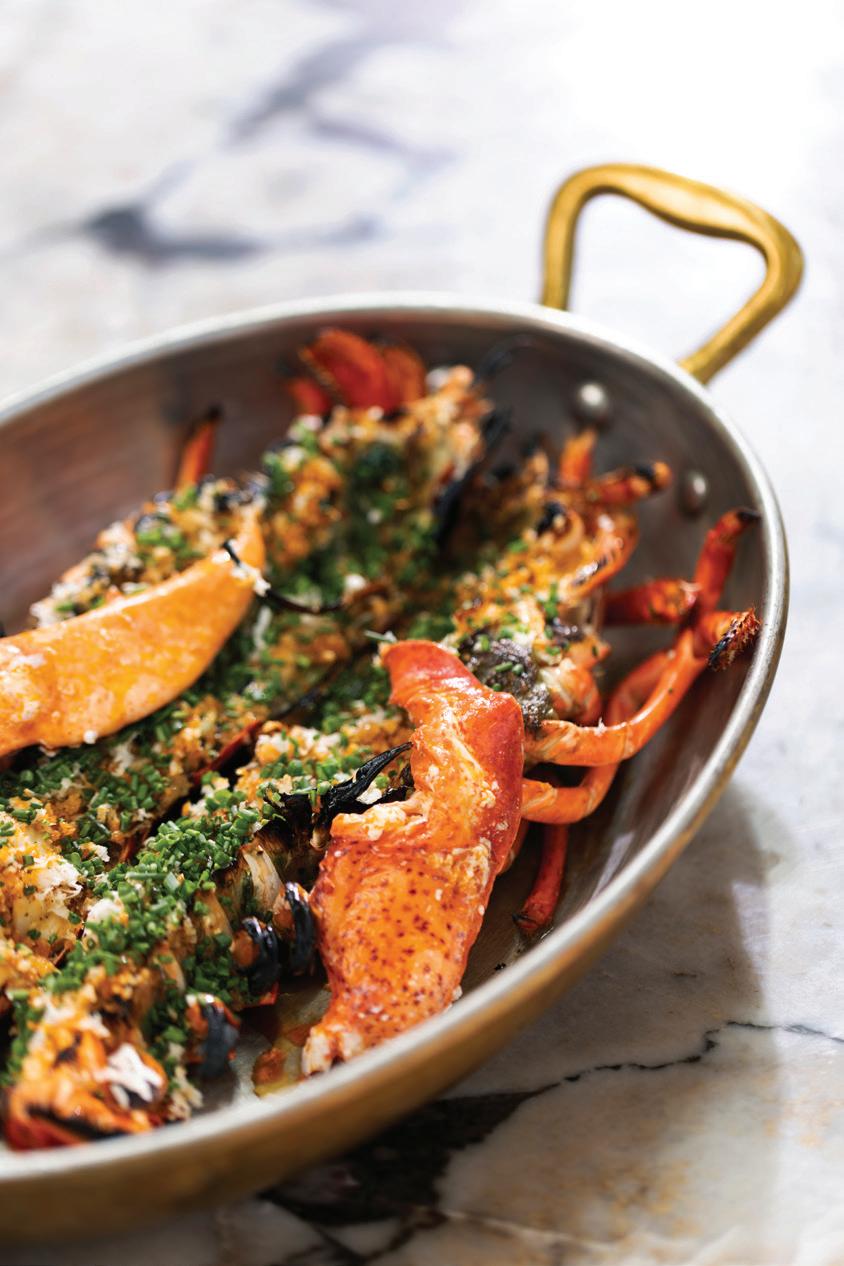
120 PATRONMAGAZINE.COM
“Heaven” dining room and bar at Mister Charles. Florals by Concepto on bar and rear. conceptoboutique.com
Lobster Thermidor, Calabrian Tarragon Butter. Spicy Lumache Arrabbiata, Broccolini, Tomato Conserva. All expertly prepared by Executive Chef Brendan Frankel for Mister Charles. All floral by Concepto. conceptoboutique.com
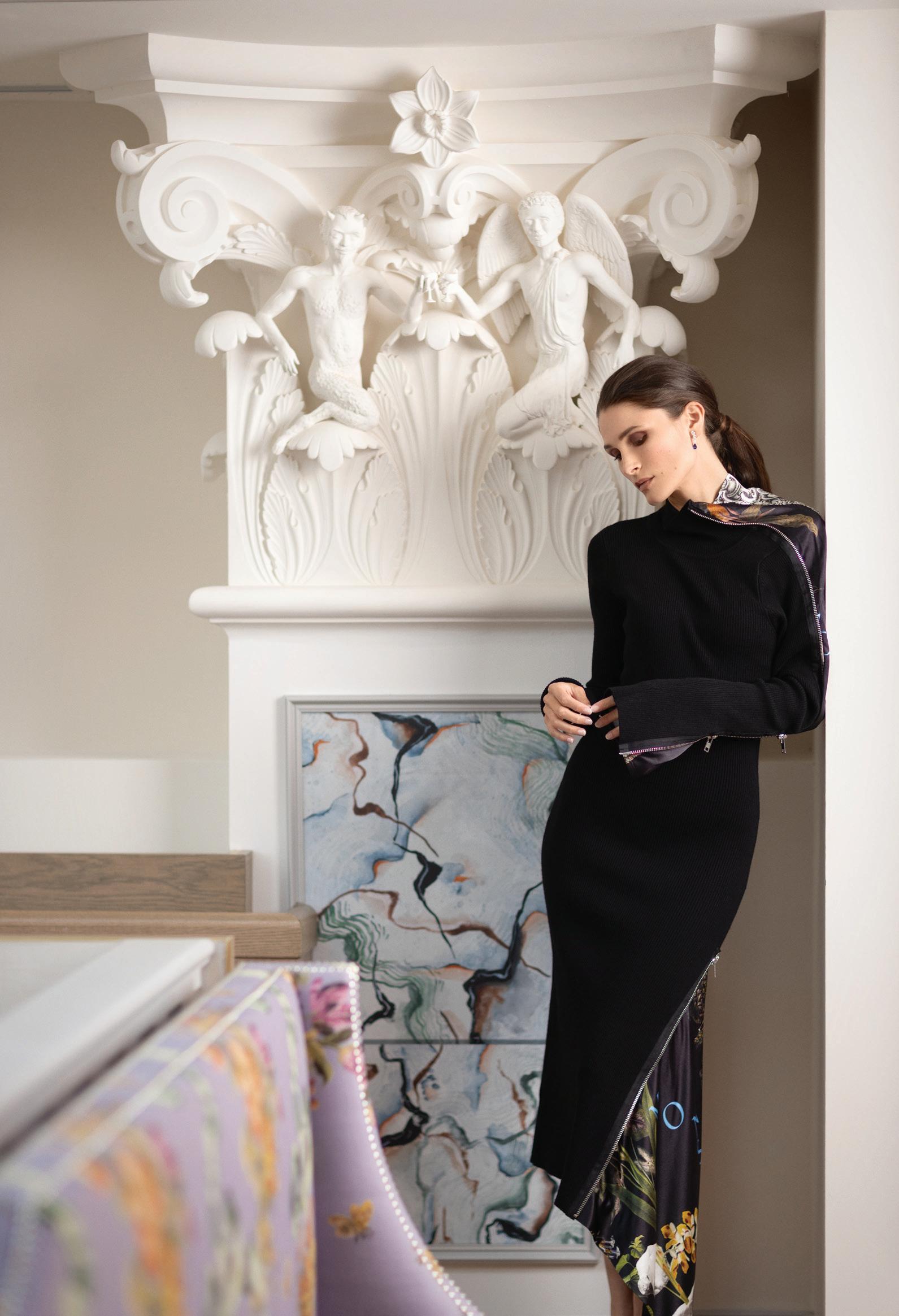
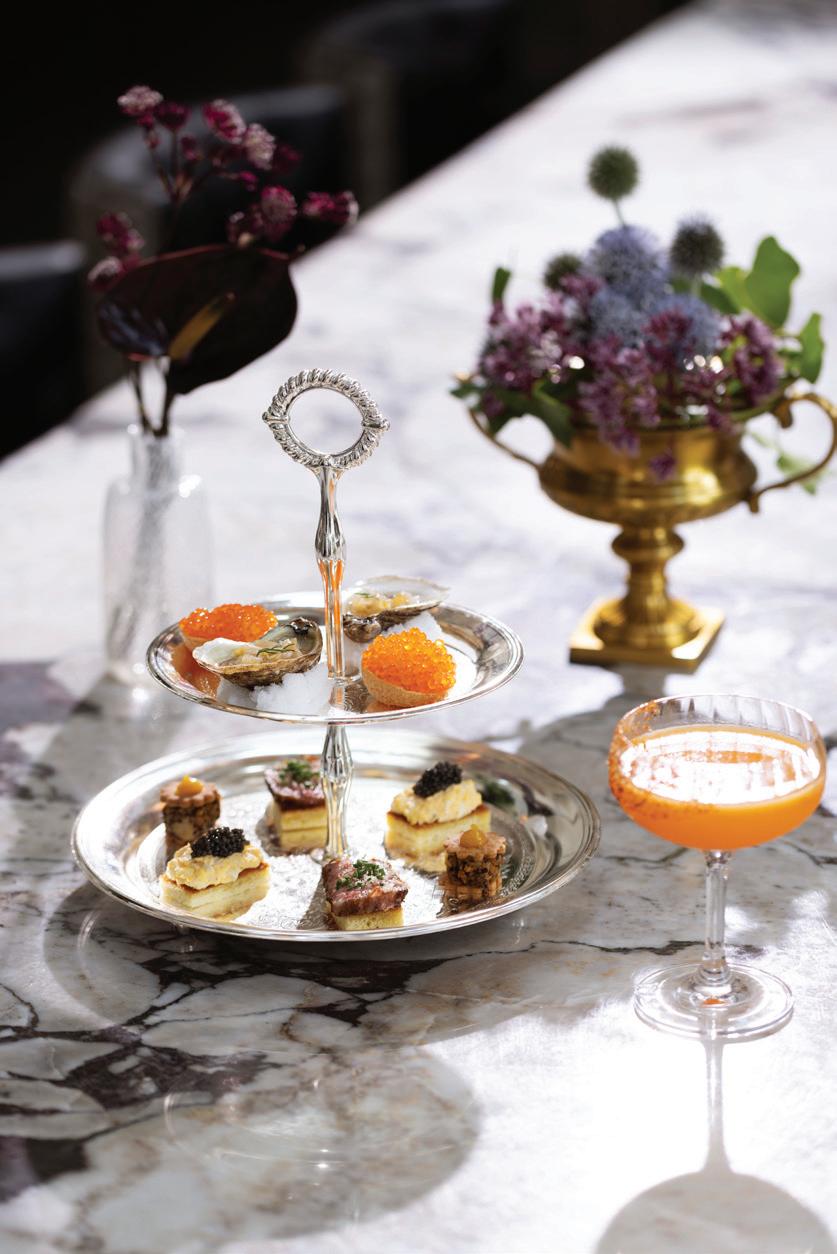
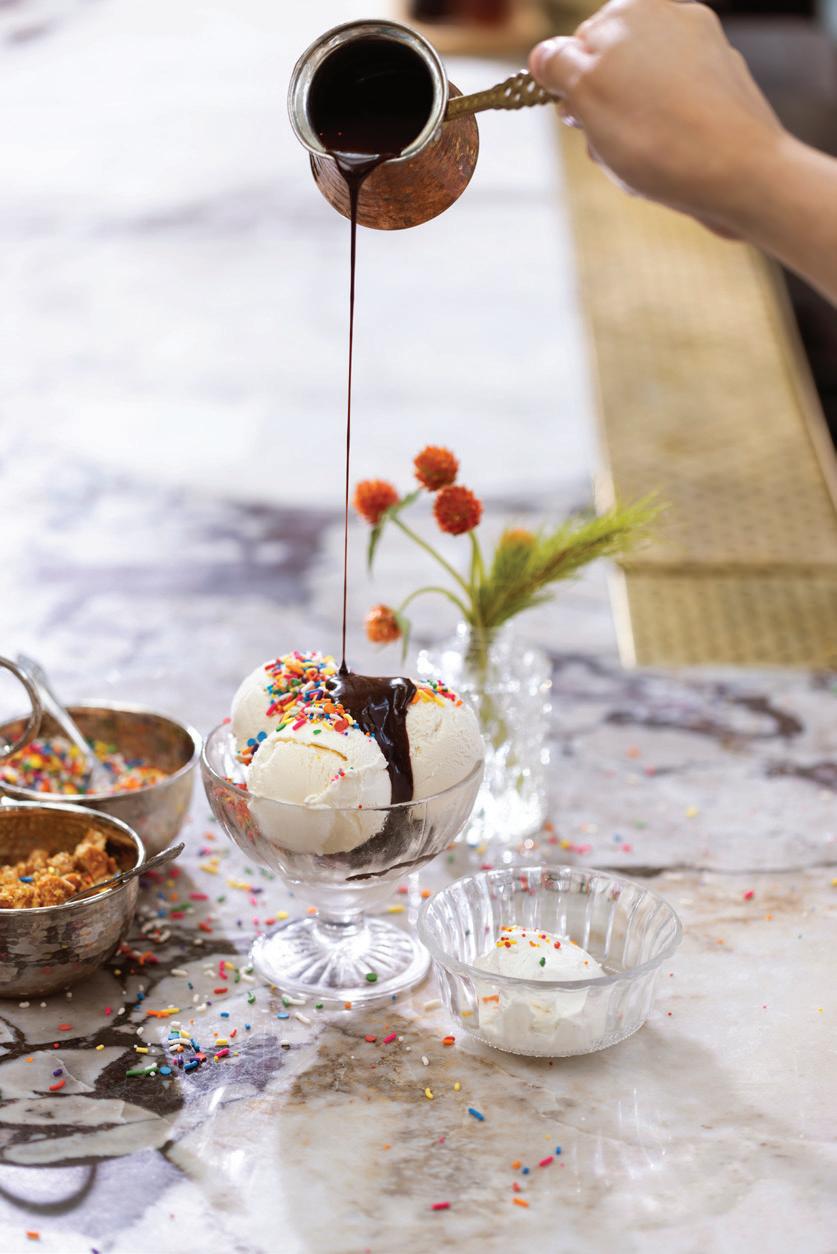
121 OCTOBER / NOVEMBER 2023
From top: Mister Charles Canape Tower. Floral by Concepto. conceptoboutiqu.com. The Soda Fountain Sundae is served with tableside toppings.
Monse merino wool rib-knit logo-inset midi dress with side-zip accent. Available at Tootsies, The Plaza at Preston Center; Piranesi 18k white gold leaf drop earrings set with round brilliant- and marquise-cut diamonds. Available at Eiseman Jewels, NorthPark Center.
THE FINER POINTS
Southern-born sisters Kasey Lemkin and Lawren Sample insist on timeless details to envision Partlow.
BY TERRI PROVENCAL
When considering Dallas as one of today’s cosmopolitan cities, attracting scores of Californians in recent years, it may seem a stretch to recall its history as a central trading post. But leave it to the impervious cowboy boot to buck the trends and evoke the roots of Texas while engendering today’s wisdom of pairing them with fashion-forward styling.
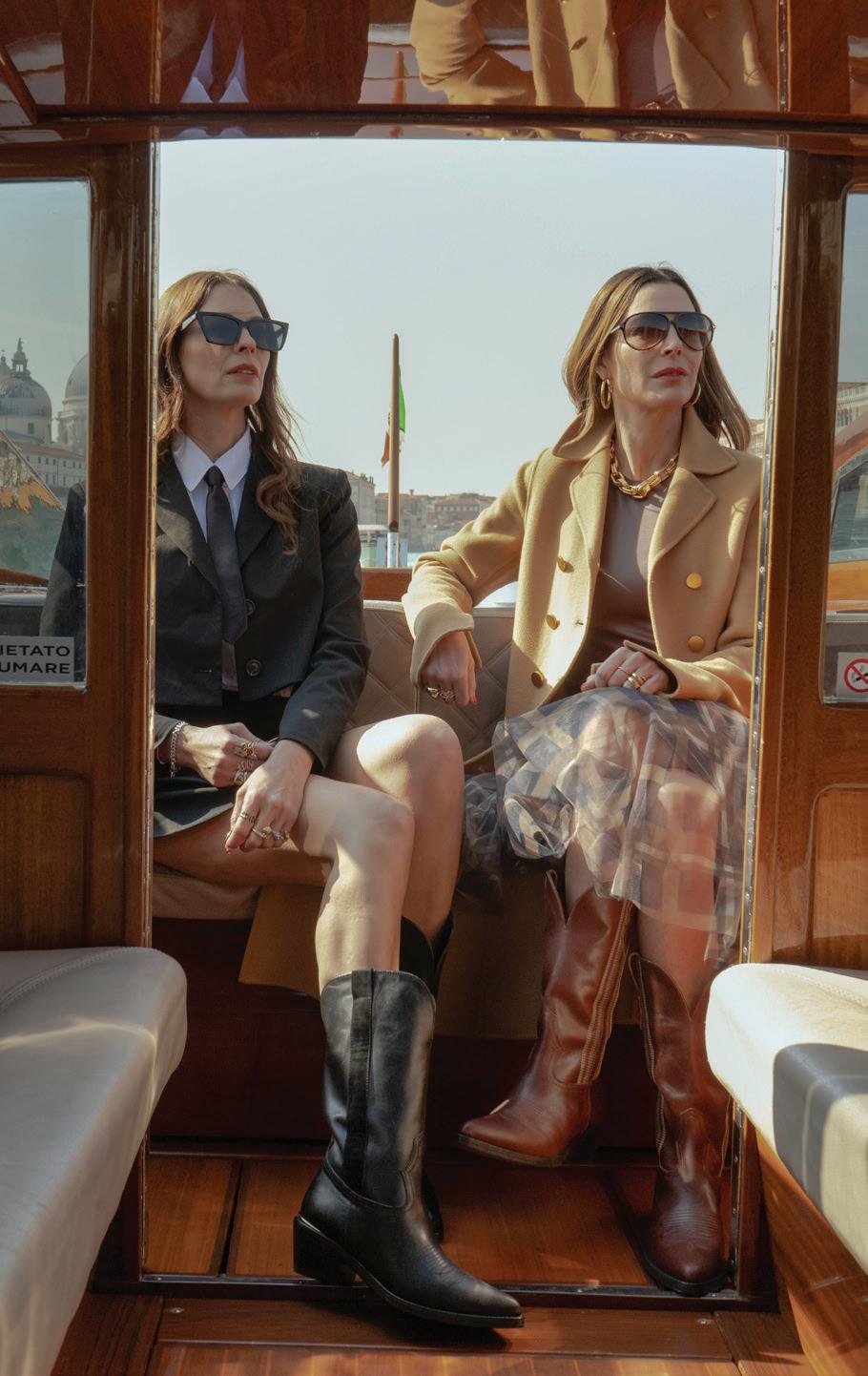
We’ve seen a few boot brands emerge here, but none quite like Partlow, a new label founded by sisters Kasey Lemkin and Lawren Sample. Their fashion prowess was destined. Originally from Tupelo, they grew up visiting their resourceful grandmother Gigi (Aleene) Partlow, Plantersville, Mississippi’s entrepreneurial doyenne who owned a beauty salon in her backyard that Southern ladies frequented.
“She was an impressive woman. Everything she wore she felt great in, she looked great in, and she didn’t second-guess herself. We saw her very much as a modern woman,” Lemkin says. “We swear she was one of the first women in town to ever wear pants,” laughs Sample, adding, “It was a very small town, but she had all the magazines in her salon. Whatever they didn’t have, she had the latest Vogue patterns for it, and she would make her own clothes.”
Partlow pays homage to this family’s matriarch. “Without her direction I wouldn’t have started in fashion design,” says Lemkin, who made a sophisticated splash when she relocated to Dallas with her husband and children from Los Angeles in 2021. A graduate of the Fashion Institute of Technology, she developed successful merchandising and e-commerce businesses for esteemed brands following an international modeling career. She is philanthropically active and opens her well-appointed home to a number of charitable events, and she and her husband Todd share a passion for art.
Equally comely, Los Angeles–based Lawren Sample doesn’t follow trends—she sets them as a fashion stylist for A-list celebrities along with her work on prestigious editorial shoots. She cut her
chops in costume design for Hollywood films, which dovetails with her love of vintage clothing and interiors she travels the world to find. Before Partlow she looked to vintage boots to pair with her wardrobe.
As for Partlow—they say there was a hole in the market for these refined boots. “If we created the right cowboy boot, they could go with anything and be worn on a daily basis,” Lemkin suggests. “We wanted them to be versatile, very understated, with simple details and great leather.” To accomplish this, they insisted the boots be made from the finest Italian leathers and manufactured in Italy. “We’ve made them a hybrid between a Western boot and riding boot to make it more of an everyday boot with a more classic, clean, rounded toe— less stylized, not as much stitching,” says Lemkin.

“This boot has more dimension than a typical Western boot,” says Sample. The two-inch heel was her mandate, and she said the boot’s 12-inch shaft height was equally important. “I really pushed for the leg to look amazing. We’ve made it a more elegant classic.” An added touch of sophistication is the gold horseshoe on the back of the boot, just above the heel, as the brand identifier. “I like to call it a little piece of jewelry. When anyone walks away, you’ll know it’s a Partlow boot.”
In addition to all that understated style, the boots have six millimeters of comfort padding. Lemkin says, “It’s like you’re walking on a cloud. No need to break them in. I prefer them to any shoe I have in my closet because they are so comfortable.”
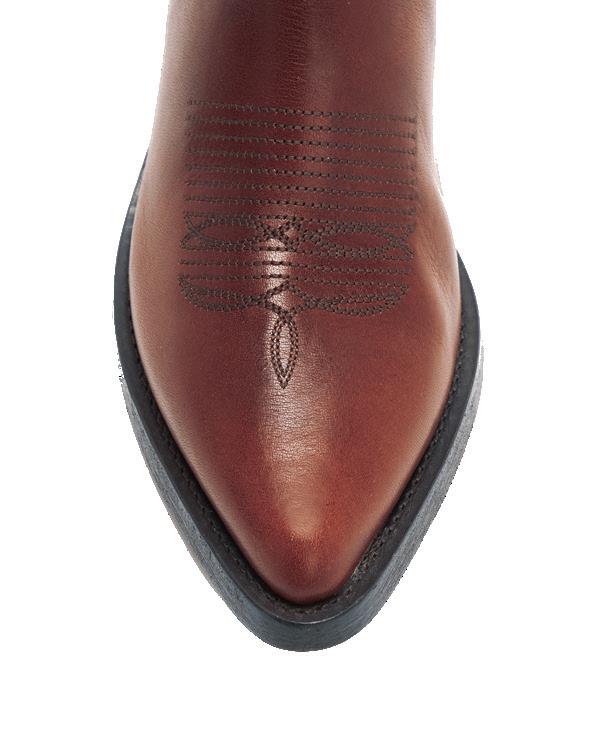
Their debut collection kicked off with six styles. Look to the super-clean Julia and Jordana for pared-down styling, while Abigail, Rochelle, Christina, and Whitney have more detailing, such as metallic cutouts and gold piping. “These boots are just so streamlined. It makes the outfit more luxurious,” avers Sample.
Like-minded sister Lemkin agrees: “When I put on a pair of cowboy boots, they transport me to childhood, but as an adult I feel like this confident, very powerful woman.” Recalling her grandmother she says, “People are sentimental for cowboy boots.” P
122 PATRONMAGAZINE.COM
ATELIER
Partlow founders Lawren Sample and Kasey Lemkin in Venice. All images courtesy of Partlow. partlowofficial.com
The gold horseshoe elegant detail lets admirers know it’s a Partlow boot. Shown in Christina.
The classic, clean rounded toe shown in Jordana, Christina, and Abigail.
Houston’s finest boutique hotel.
The Lancaster Hotel, redefining modern hospitality with our acclaimed service and amenities. From our collection of over 200 works by noted Texas contemporary artists, fine dining at Cultivated F&B and the refined Lancaster Afternoon Tea service.

The Lancaster is the perfect holiday escape for any patron of the arts.
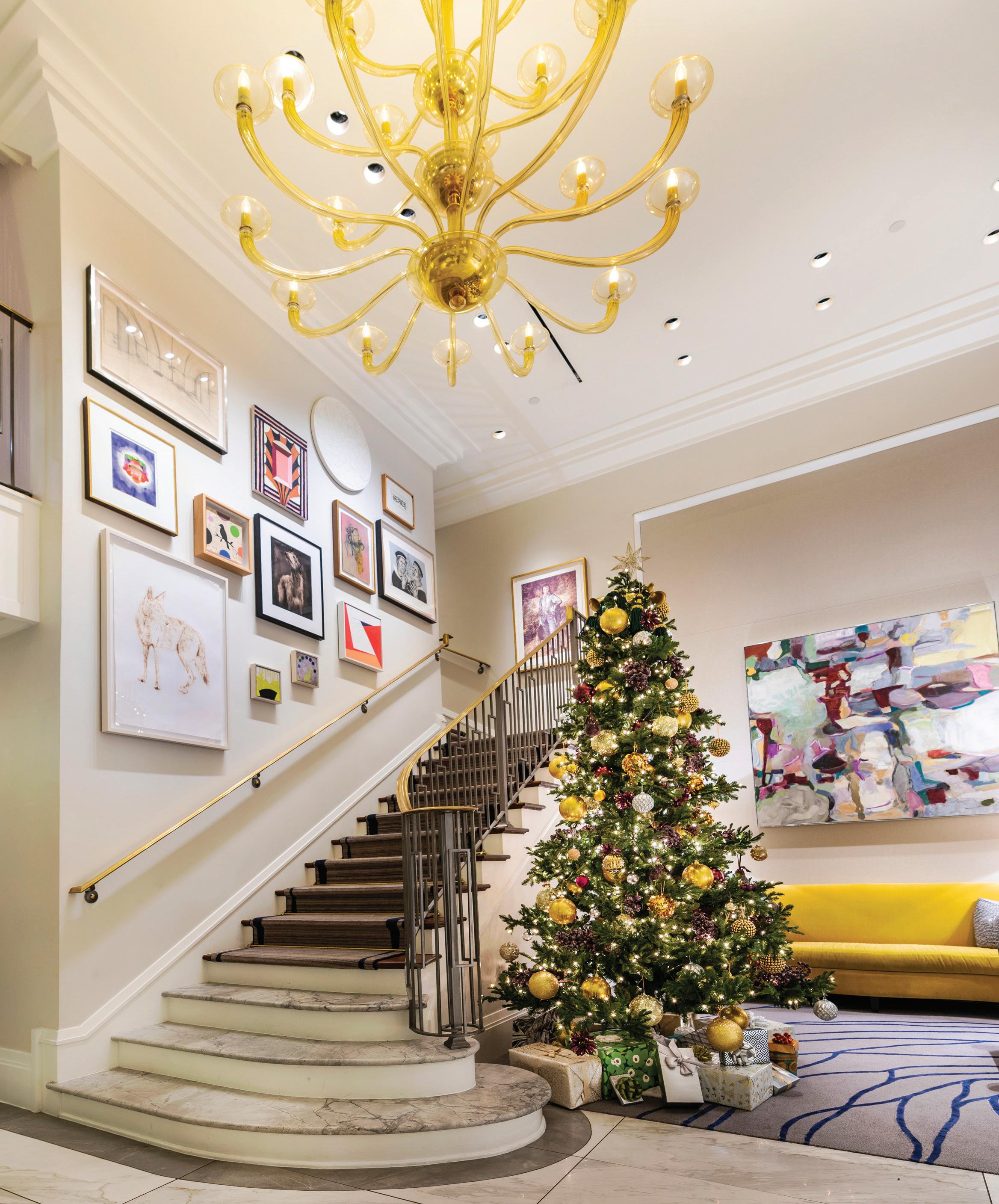
www.lancasterhotel.com 701 Texas Avenue Houston, Texas 77002 713.228.9500
GUCCI GUCCI GOO
NorthPark Center wows with the expanded boutique for brand devotees.
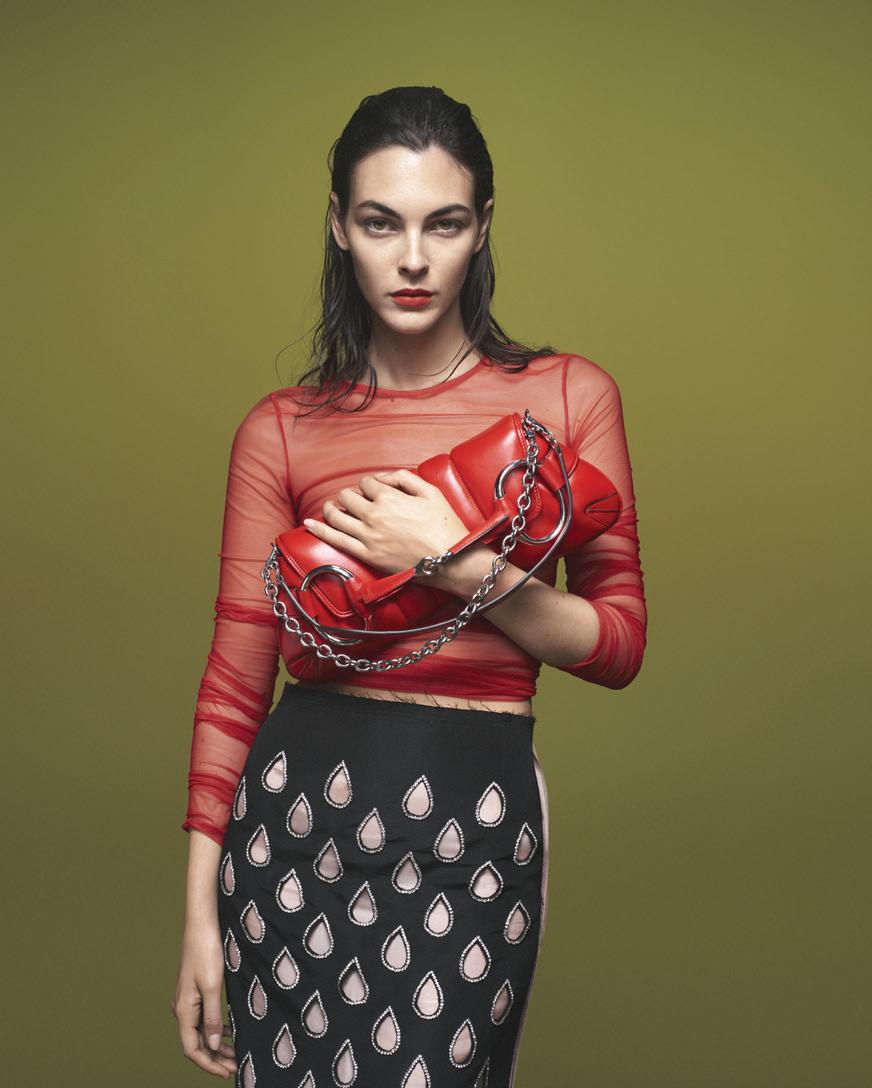
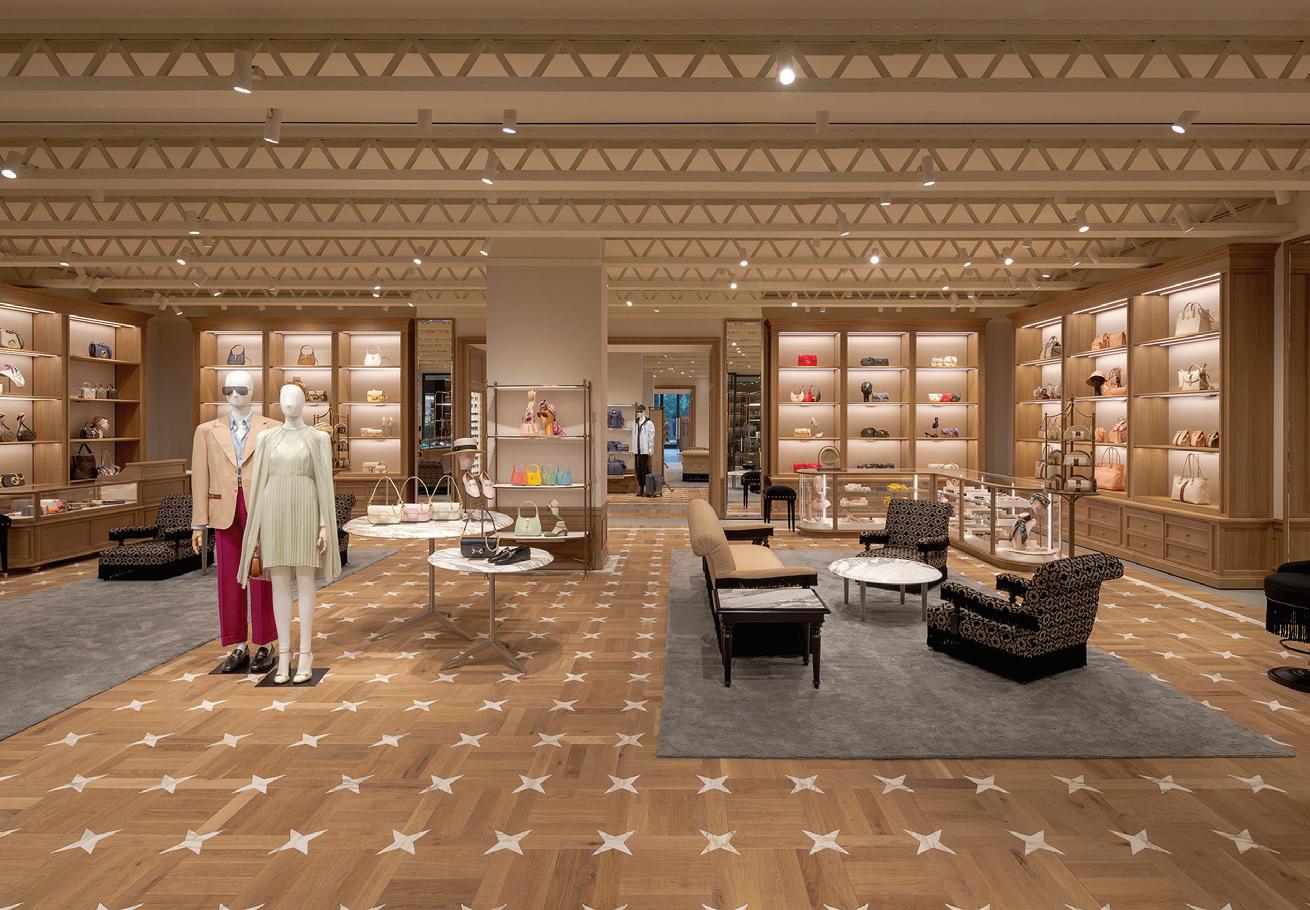
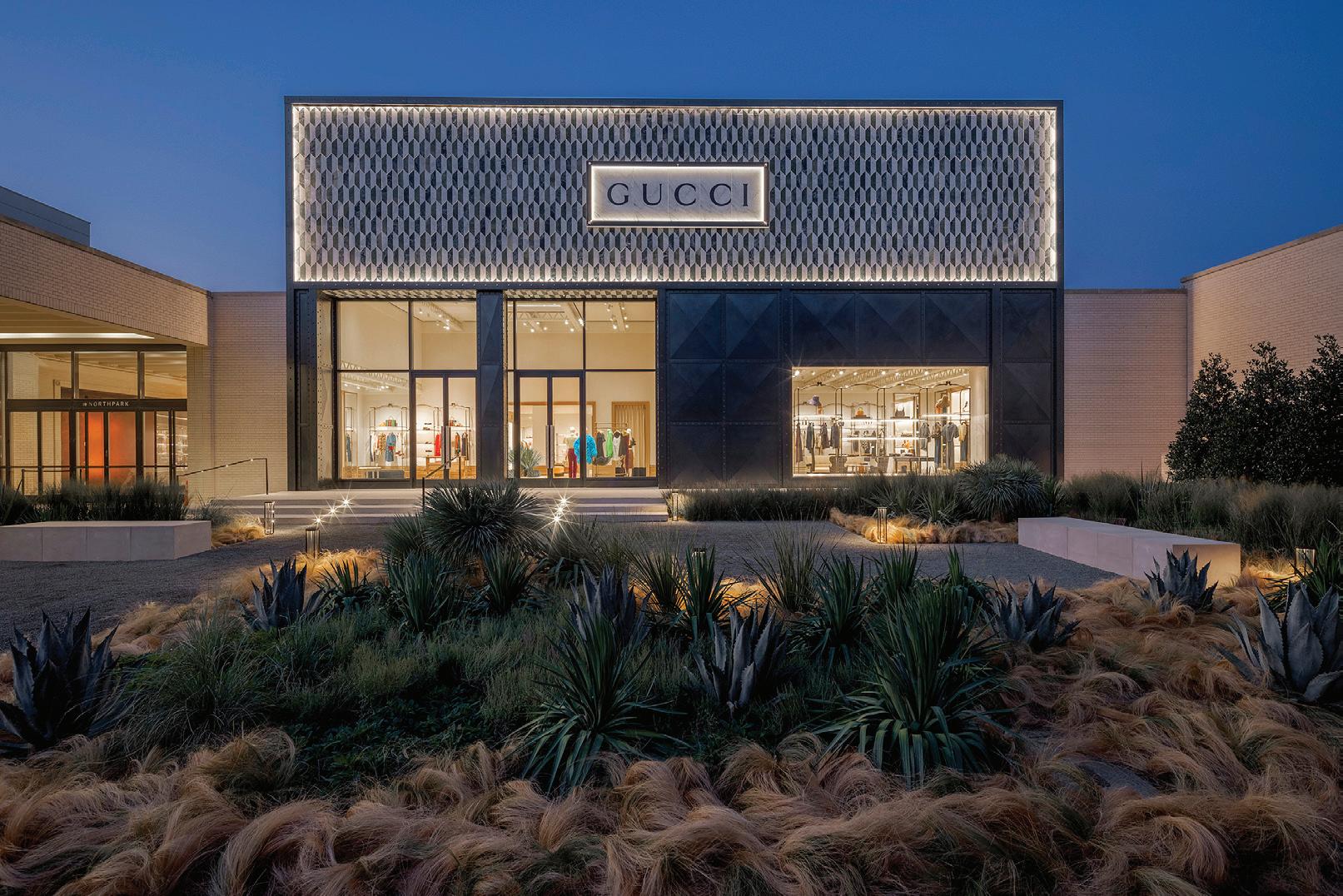 BY ELAINE RAFFEL
In the luxury fashion arena, few labels can match Gucci’s esteemed iconic status. The 100-plus year-old brand is an industry stalwart, producing covetable collections as dynamic as the men and women who wear them. Last month, the beloved Italian house added another notch to its proverbial GG belt: the opening of its highly anticipated new 12,000-square-foot boutique in NorthPark Center—one of the 10 largest nationwide.
Get ready to be wowed. For starters, there’s a swoon-worthy array of signature handbags. The forever-chic Horsebit, now celebrating its 70th anniversary, looks better than ever in padded leather, shearling, or crystal. Other reinterpretations include the 1961 Jackie, known for its half-moon shape and piston hardware,
and the fashion-defining 1947 bamboo-handled bag.
For brand devotees, there’s a robust assortment of Gucci mainstays: men’s and women’s shoes, luggage, leather accessories, eyewear, jewelry, and watches. Must-haves include satin belts with crystal double-G buckles, logo-branded earrings, studded, micro G bra tops, and archive-inspired geometric sunglasses. A showstopping women’s ready-to-wear collection features sophisticated knits, sumptuous silk dresses, and shearling-trimmed outerwear.
Of special note is the 800-square-foot, star-studded Gucci Kids Collection boutique. A mecca for budding fashionistas—not to mention indulgent grandparents—the pint-sized merchandise mix sports logo-embellished sneakers, caps, and backpacks, plus ubercute tees, denim, and outerwear.
Store décor is synonymous with the brand—think plush velvet chairs and sofas, spacious displays, custom fireplace, and luxe oak floors with marble star inlays. VIP shoppers have their own private lounge, a light-filled space adjacent to NorthPark’s 1.4-acre interior courtyard. In addition to the mall entrance, there’s access from the park side—an impressive façade flanked by lush, Southwestern-style landscaping.
The opening of the new store isn’t the only September milestone for the powerhouse fashion house. Last month, Gucci’s new creative director, Sabarto De Sarno, debuted his inaugural collection at Milan Fashion Week. The 39-year-old Italian designer honed his craft at Valentino, where he served as fashion director overseeing both the men’s and women’s divisions. A pedigree CV also includes stints with Prada and Dolce & Gabbana.
The brand’s storied history began in 1921 with the opening of the original flagship on Florence’s Via della Vigna Nuova. A shop on Milan’s Via Montenapoleone followed in 1951, around the same time the green-red-green web became a hallmark of the company. Two years later, Gucci expanded stateside, its first boutique in New York City’s Savoy-Plaza Hotel on East 58th Street. Currently, 528 boutiques in over 50 countries owned by luxury French conglomerate Kering generate more than $10 billion in annual revenue. P
124 PATRONMAGAZINE.COM
ATELIER
The new and expanded Gucci boutique at NorthPark Center is now the largest in Texas. Photograph by Pablo Ennriquez. Courtesy of Gucci.
Gucci’s exterior entrance at NorthPark Center. Photograph by Pablo Ennriquez. Courtesy of Gucci.
Italian Vittoria Ceretti stars in Gucci fall-winter 2023 campaign, with the Horsebit Chain bag. Photograph by David Sims.
2023 OBELISK AWARDS
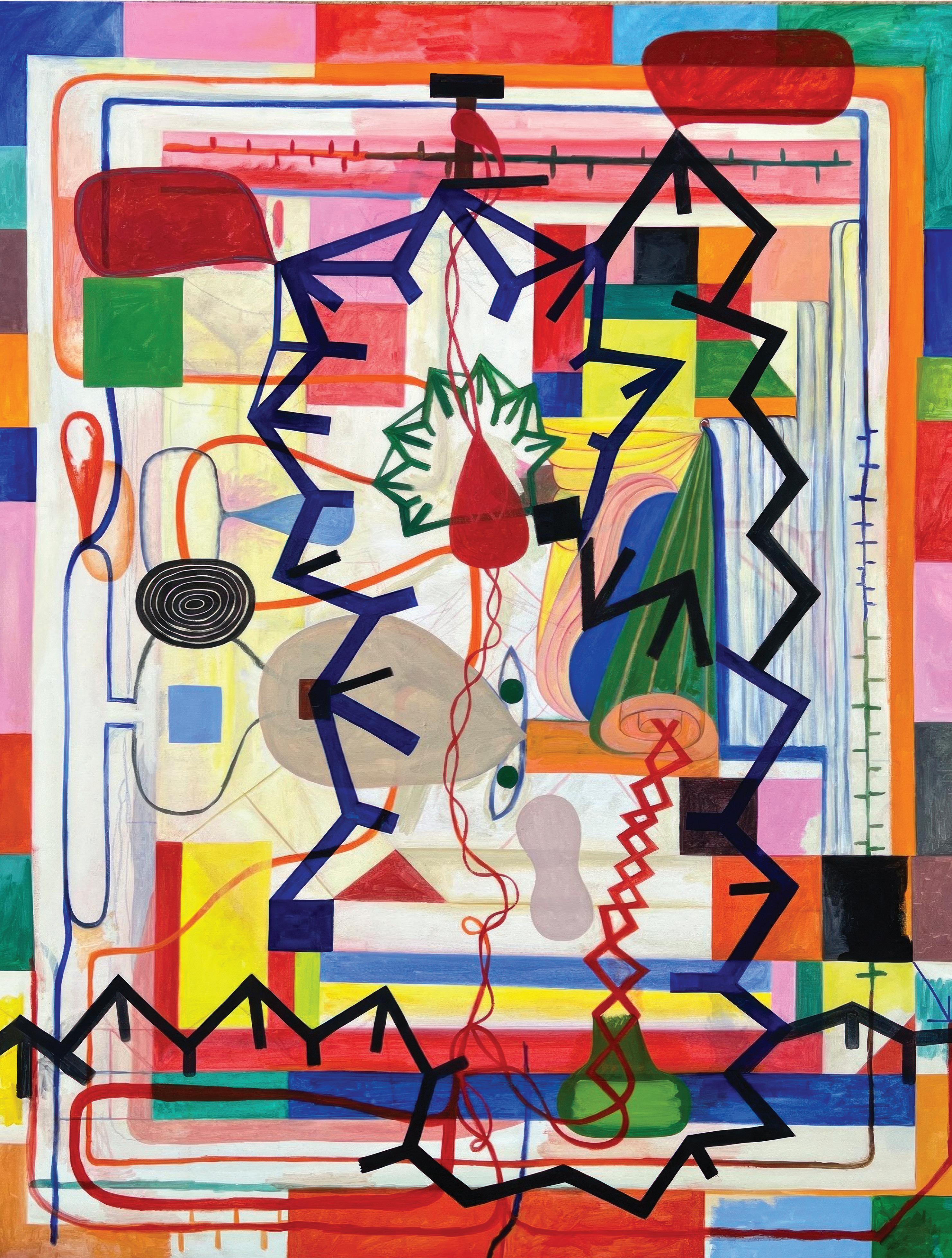
The Obelisk Awards honors regional businesses, municipalities, nonprofit organizations, and individuals for their extraordinary support of arts and culture in North Texas.
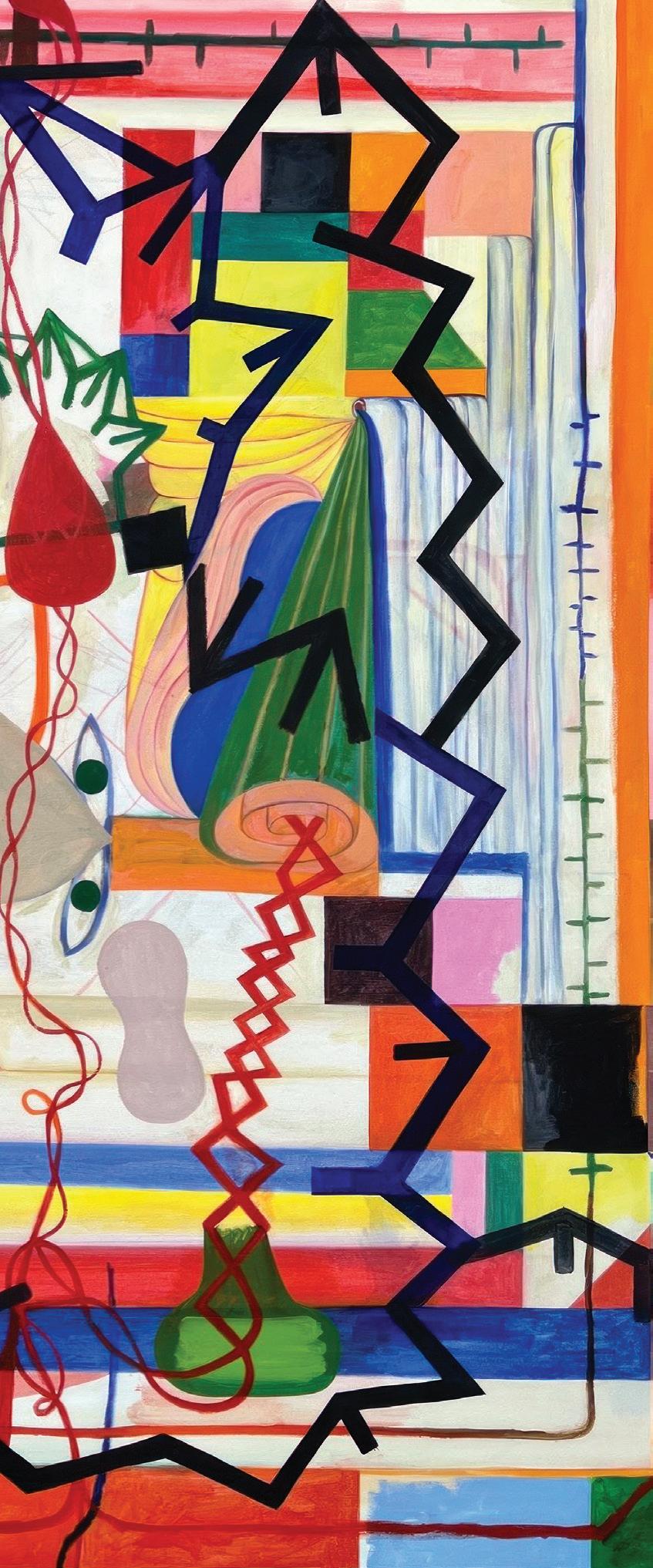
WHEN THURSDAY NOVEMBER 9, 2023
CHECK IN 11:00AM — 12:00PM LUNCHEON 12:00 — 1:30PM
2 0 2 3 O B E L I S K AWA R D H O N O R E E C AT E G O R I E S Lifetime Achievement Award Business Champion for the Arts Visionary Nonprofit Arts Leader Arts Partnerships | Large Arts Partnerships | Small Distinguished Cultural Organization New Initiatives | Large New Initiatives | Small Outstanding Leadership Arts Alumnus Juror’s Award
Contact
ART
BY
CHONG KEUN CHU / BETHEL #2, 2022 LIVES, WORKS, AND TEACHES IN DALLAS, TEXAS.
QUESTIONS?
bca@ntbca.org
WHERE AT THE NEW DALLAS ARTS DISTRICT JW MARRIOTT 800 N HARWOOD ST, DALLAS, TX 75201 2 0 2 3 O B E L I S K AWA R D S C O - C H A I R S Rachael and Evan Singer 2 0 2 3 O B E L I S K AWA R D S H O N O R A R Y C H A I R S Nancy A. Nasher & David J. Haemisegger
COLLECTOR SPONSORS HOSPITALITY SPONSOR
CONNOISSEUR SPONSORS
PATRON MAGAZINE 2023 ART INFLUENCERS CELEBRATION AT JW MARRIOTT DALLAS ARTS DISTRICT
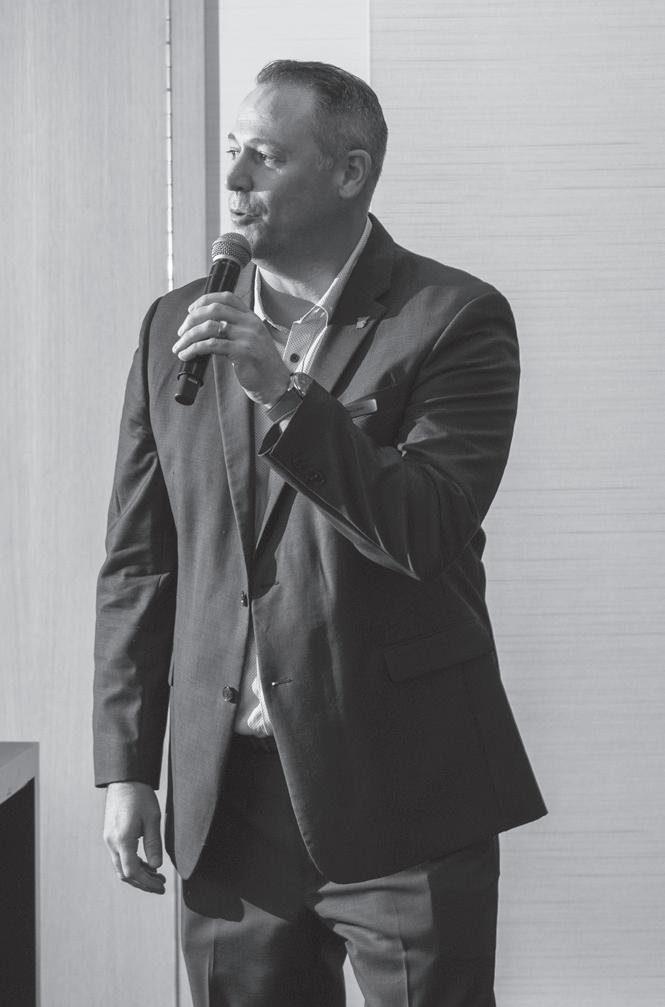
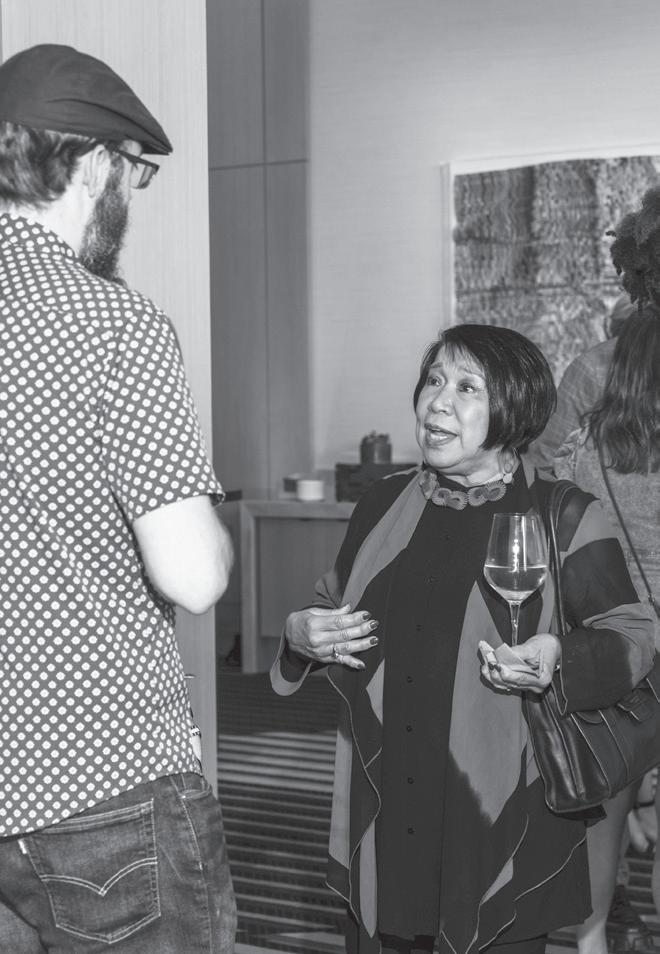
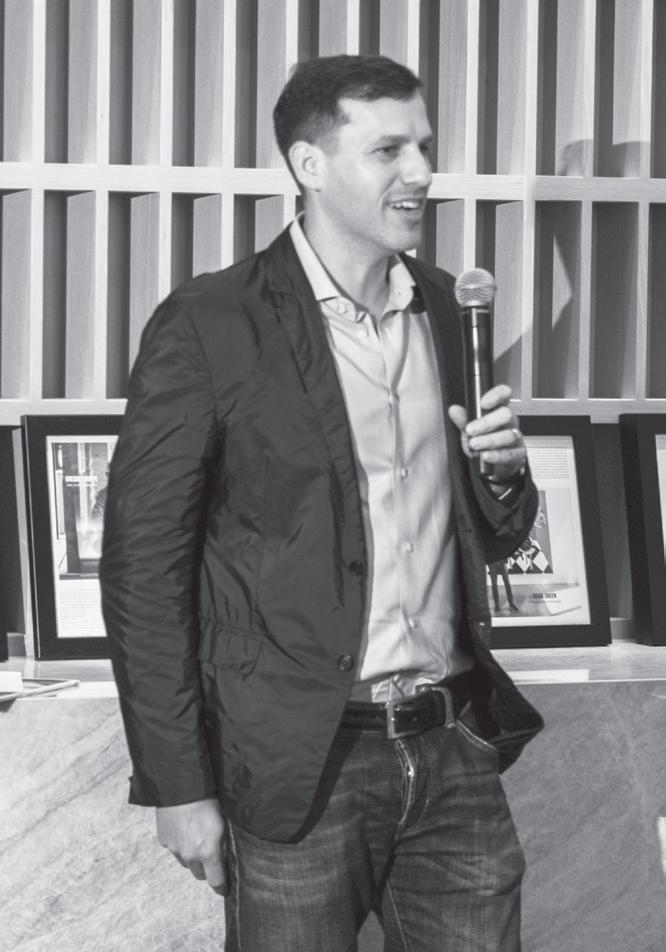
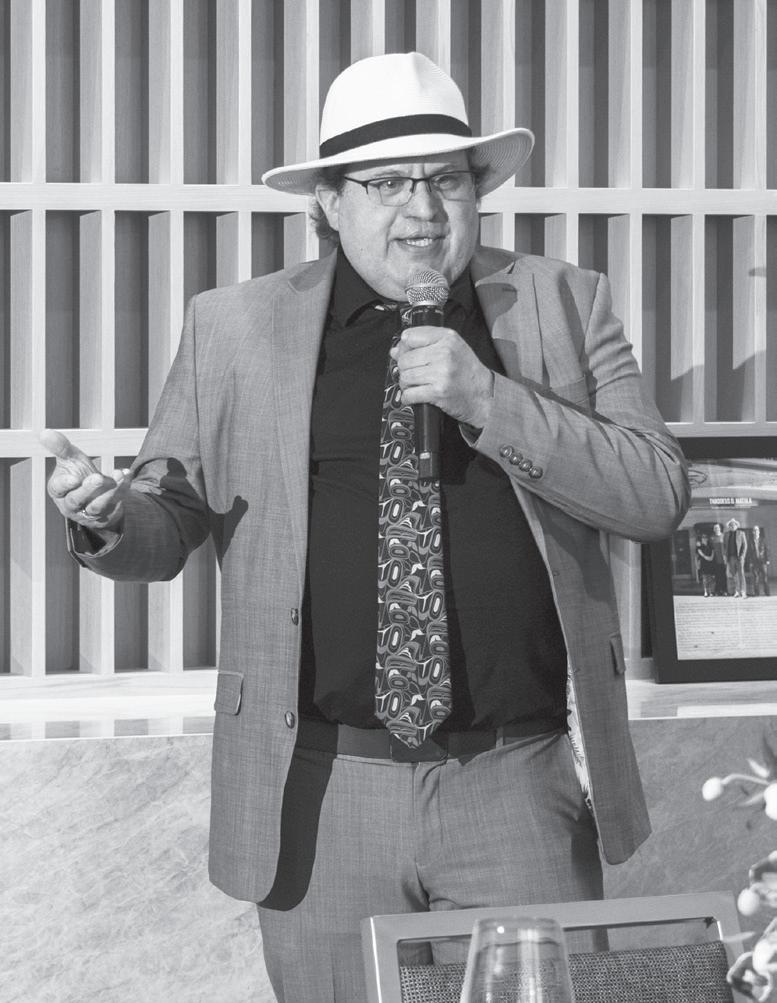
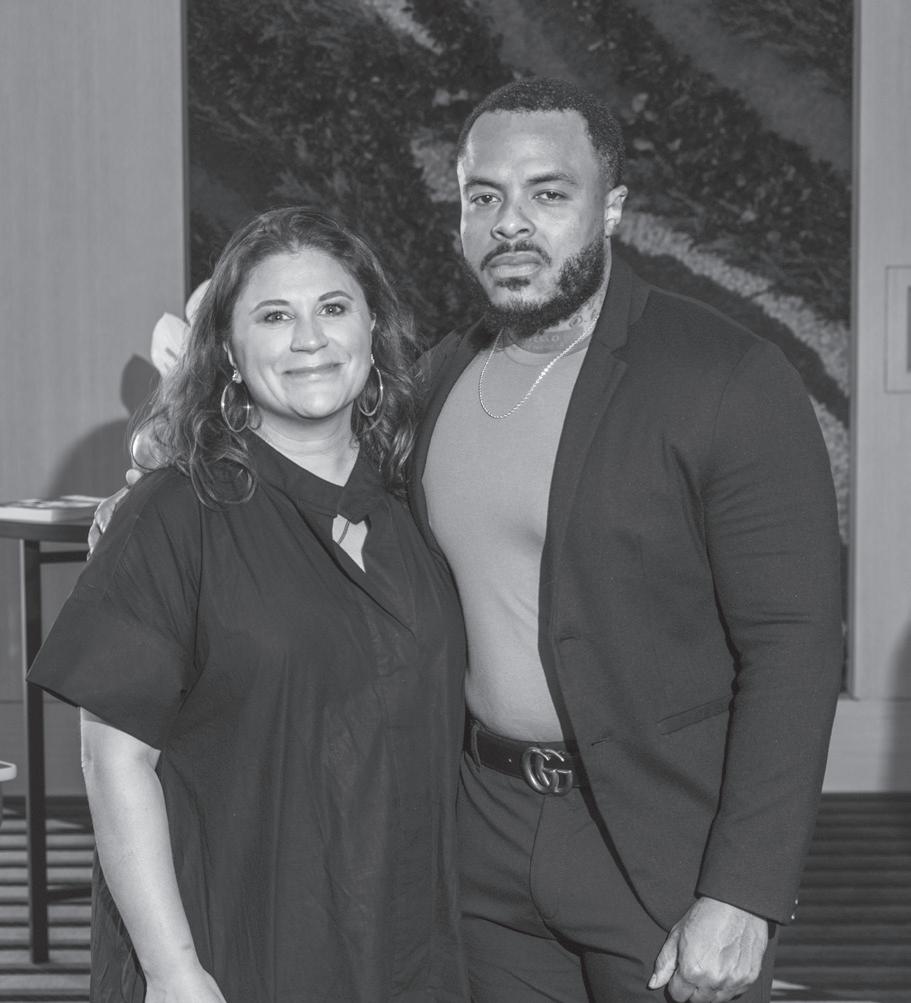
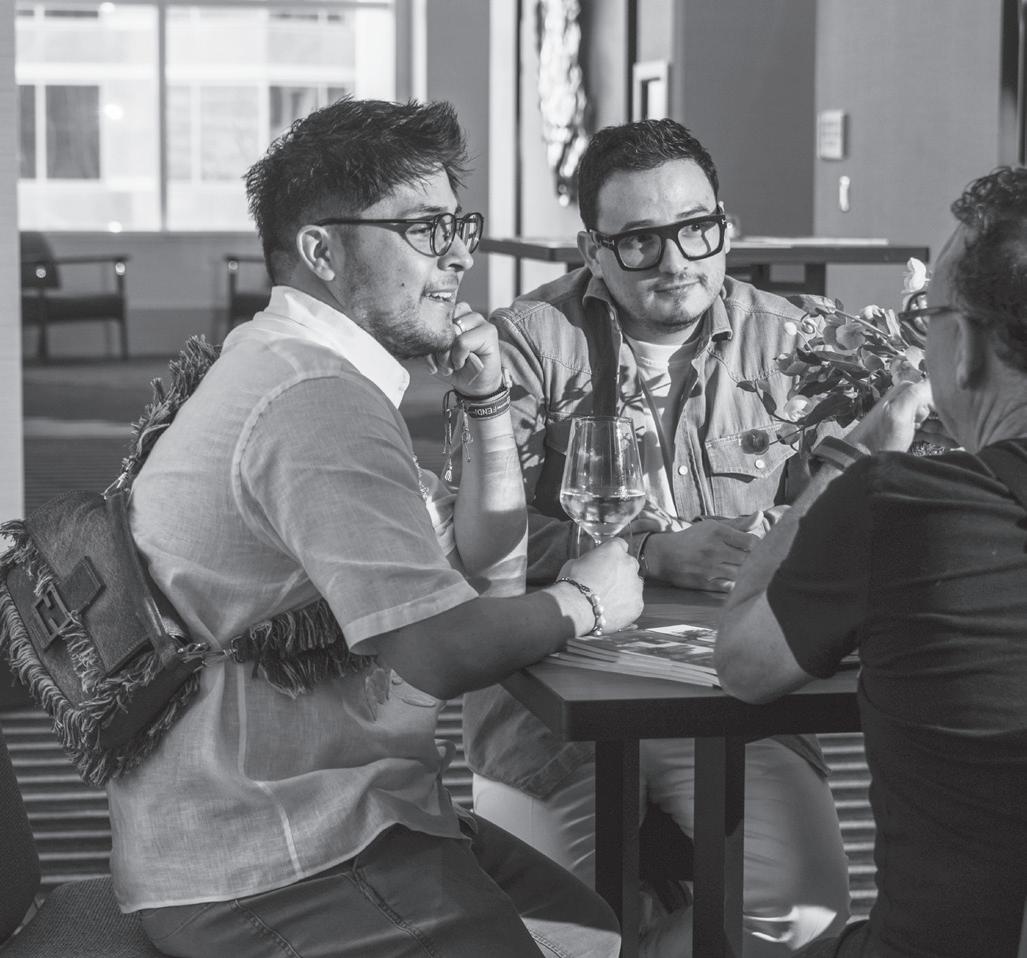
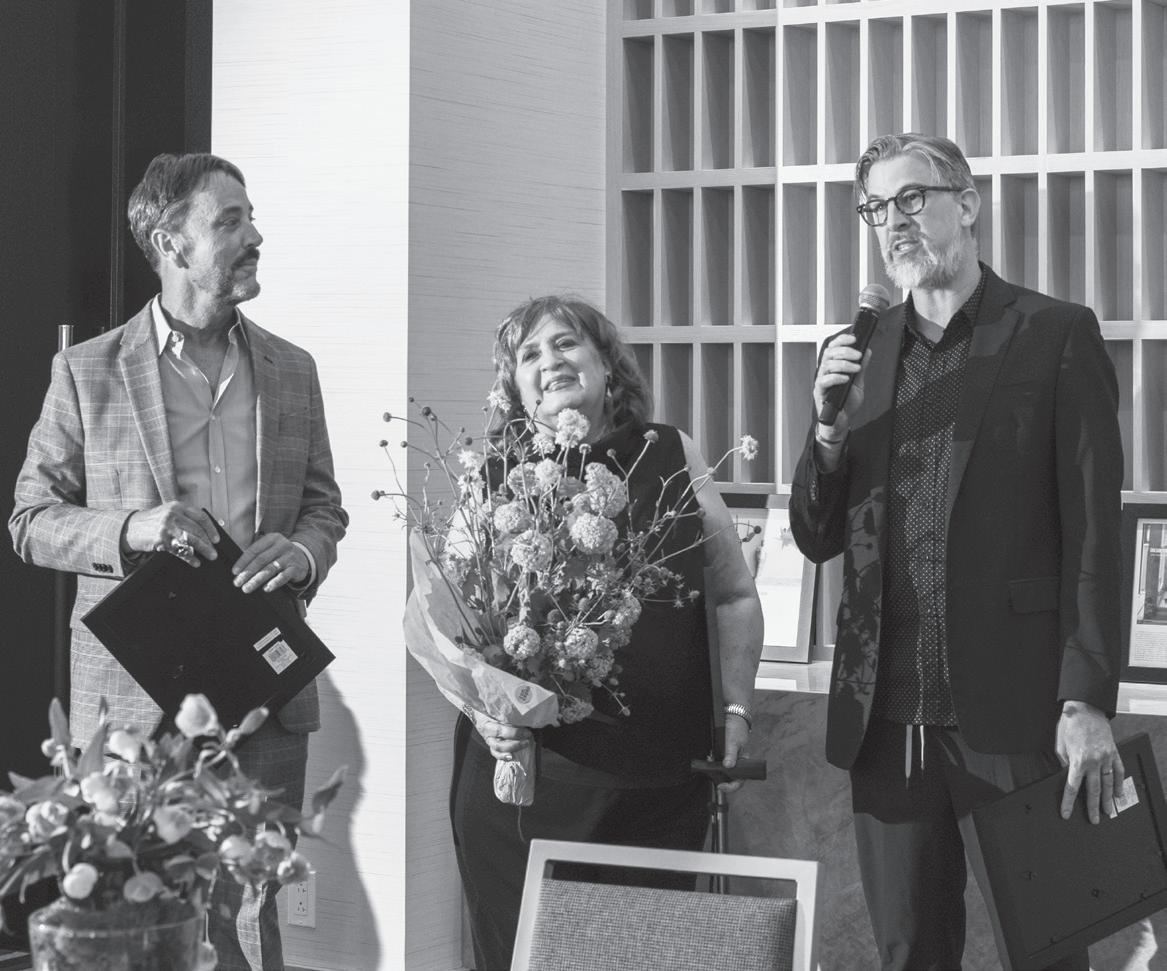
PATRONMAGAZINE.COM 126 THERE
PHOTOGRAPHY BY AJ BOLING
Dr. Amanda Dotseth
Shane Pennington, Veletta Lill, Joshua King
Pablo Arellano, Ramiro Garcia, Barry Waranch
Ayvaunn Pann
Jenni Cannon, David-Jeremiah
Adam Green
Thaddeus Matula
Ryan Kover, Lily Cabutu Weiss
Mike Culver
FGI DALLAS FALL FORUM AT HIGHLAND PARK VILLAGE
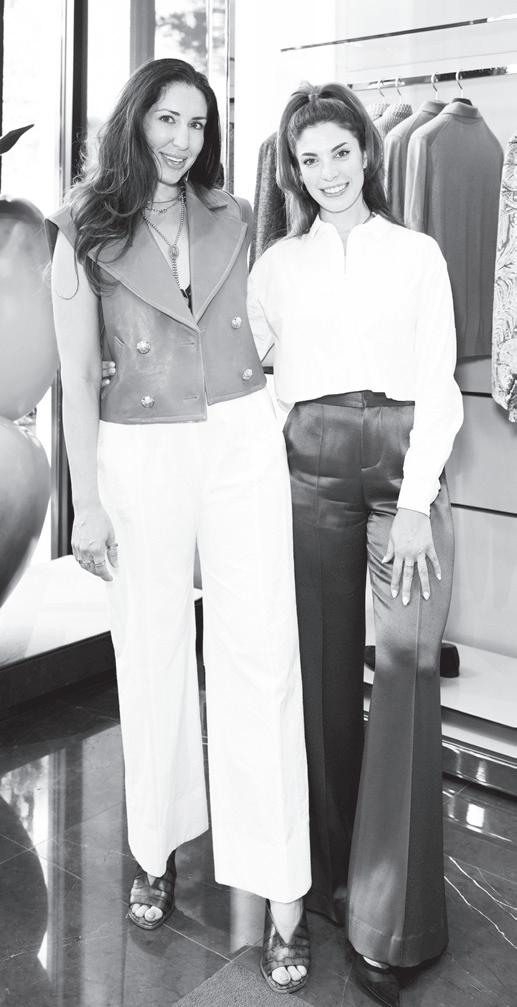
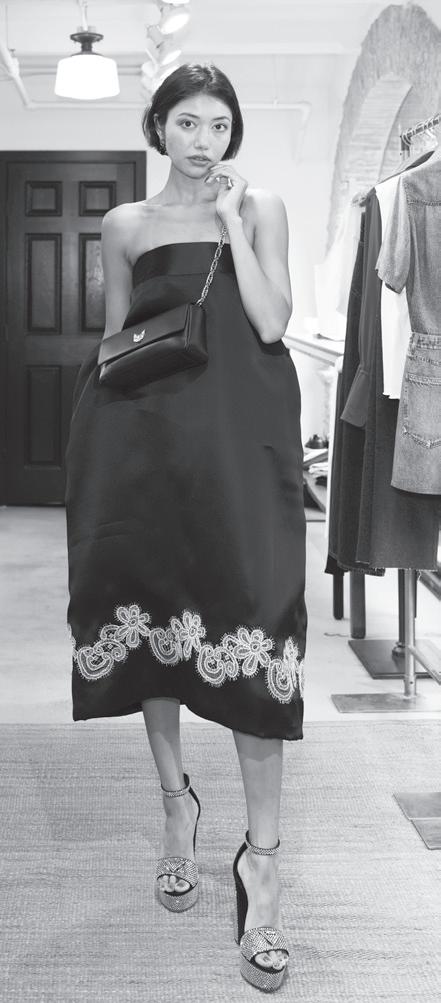
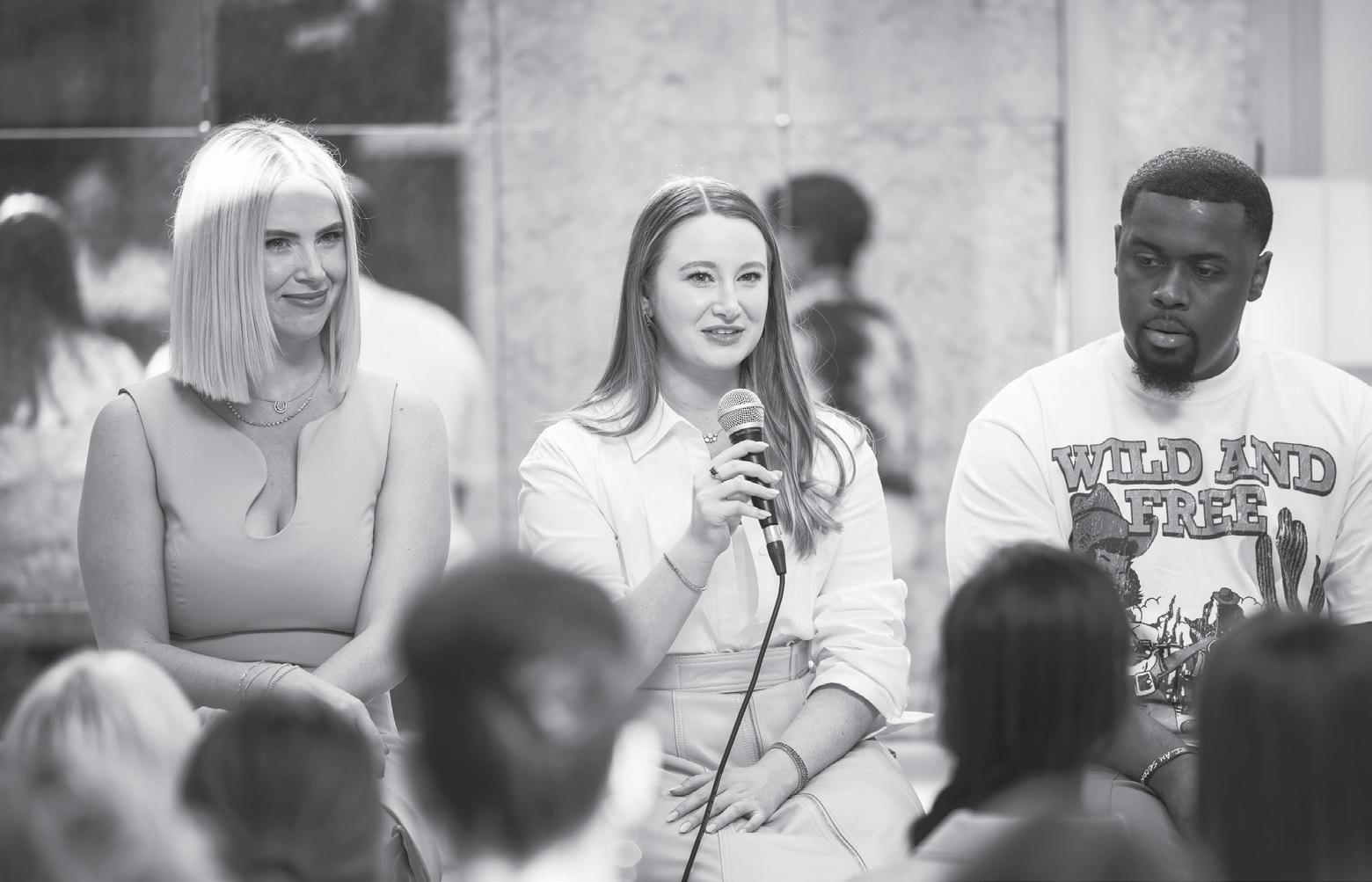
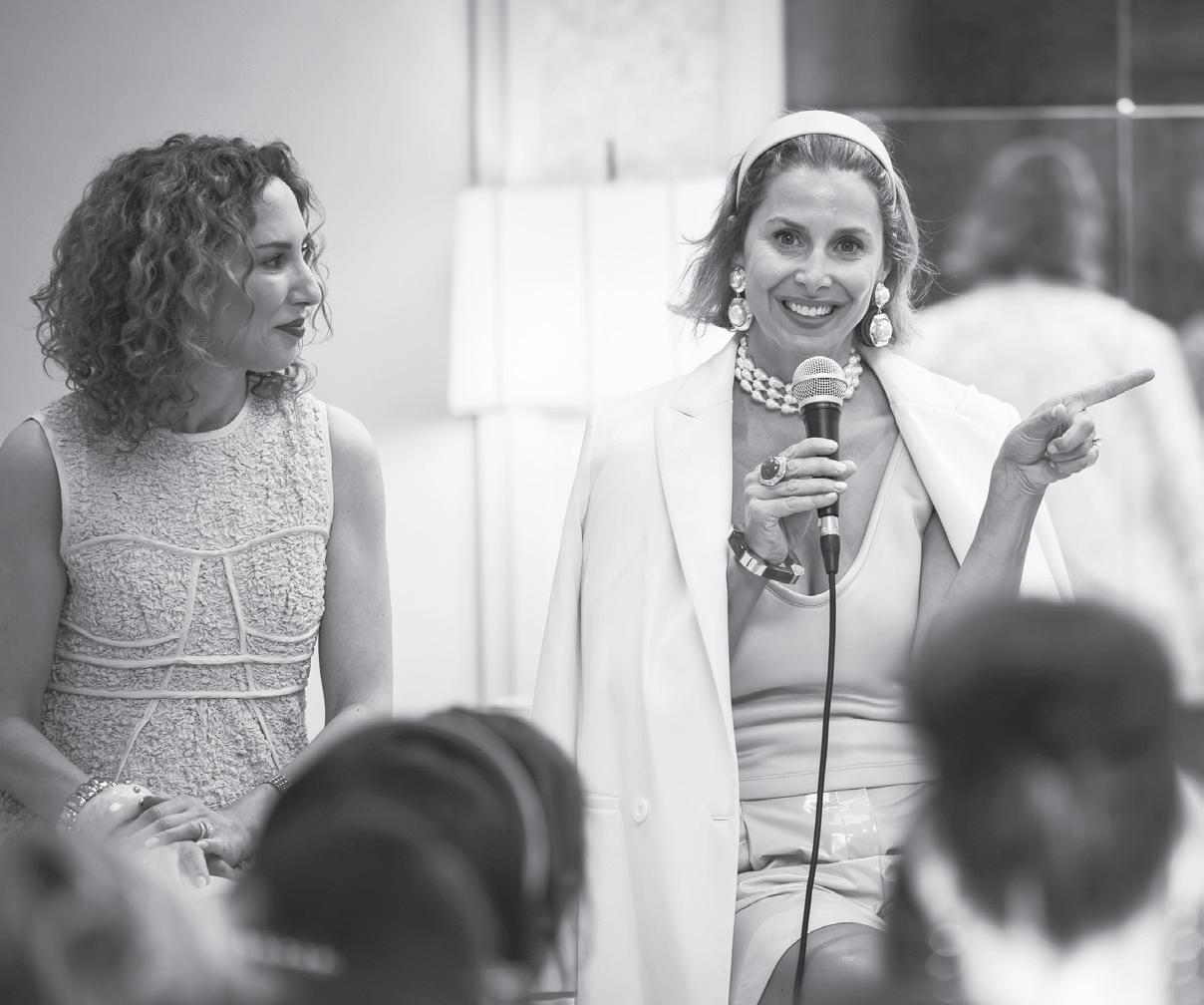
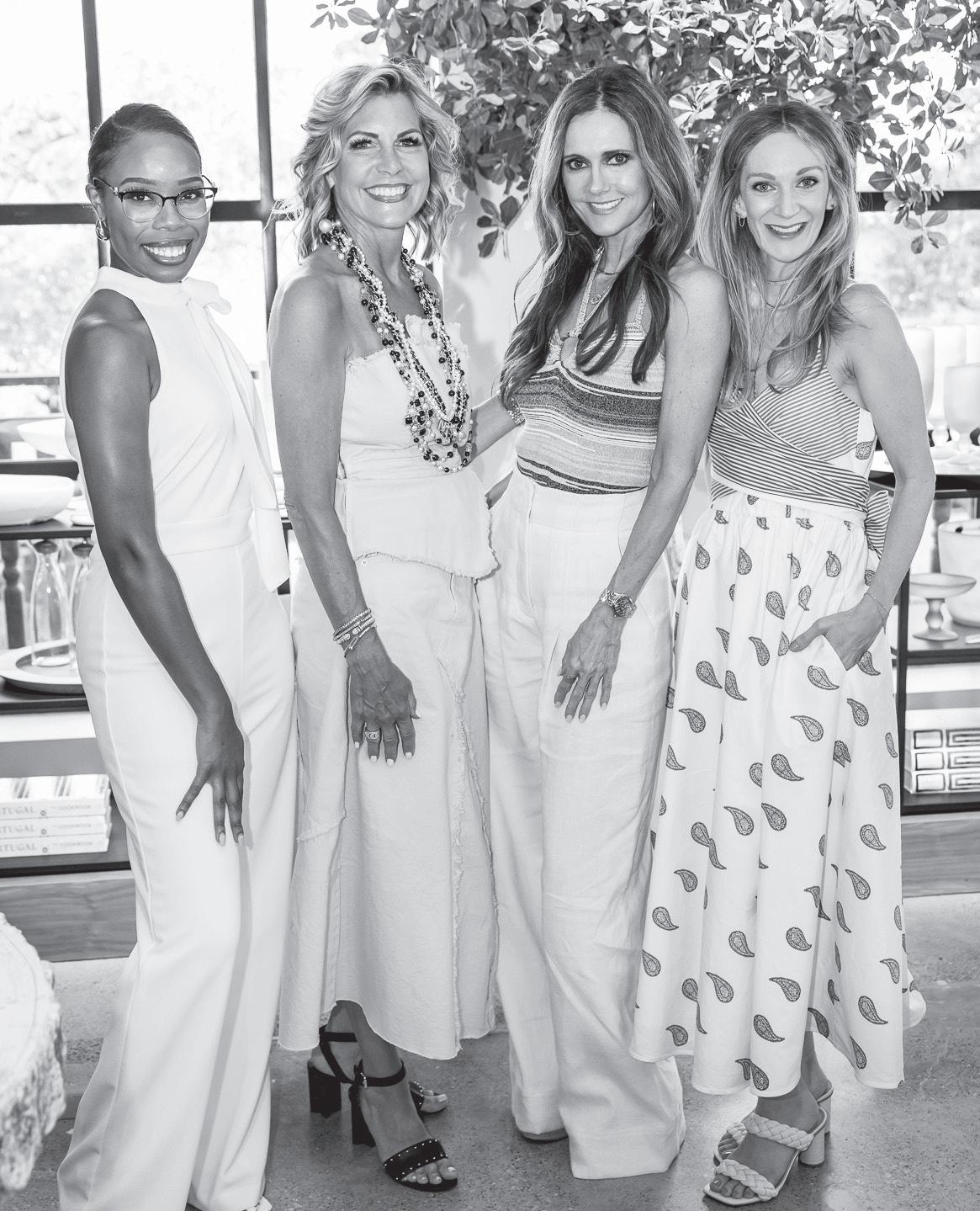 PHOTOGRAPHY BY DANNY CAMPBELL AND THOMAS GARZA
OCTOBER / NOVEMBER 2023 127
Victoria Sommerville, Dawn Mellon, Gail Good, Jenn Hill
Stella Helpenstill, Nerissa Helpenstill
Sam Lao, Janet Gridley, Melissa Ellis
Roxanne Carne, Jenn Hill, Dr. Keith Harley
Munisa Khuramova Carla Rockmore, Lele Sadoughi
Alex Cohen, Alexis Karis
Lizzy Chestnut Bentley, Fallon Bock, Hance Taplin
Dexter James
ENDPAPER
mirrored passion with her late son is remembered in SITE131’s …to see is a gift: Seth Davidow collection.
BY JOAN DAVIDOW PHOTOGRAPHS BY STEPHANIE DELAY
Collections evolve from people who engage with art— each in their own magical way. This one began in the family room, the one spot in our small, suburban North Florida home that was for the artwork we checked out of the library monthly. Other artworks we painted in the garage. The boys, Seth and Malcolm, visited Daddy’s auto parts shop on Saturdays and made drawings there. What a simple life it was.
When that thriving business sold, we moved to Dallas. Seth graduated high school and the University of Texas and started his own business, combing service stations for used auto parts to resell and recycle. It was a tough, dirty business, and Seth was no longer interested in family museum visits. “Count me out!” he insisted.
Years later, he learned that a Florida bank was selling its art collection. “Mom, help me review the art collection. I want to buy some art.” That was a turnaround that initiated Seth as a collector. About the same time, he met his future wife, Marni, and they began building their architect-designed house together.
Seth then engaged the highly respected area art consultant Michael Thomas, taking international trips to purchase major artworks that knock your socks off. He never showed off his art, bragged about it, or invited people to see it. It was simply part of his life. The new works adorned their dramatic living space.
As disparate as the Seth Davidow collection appears, every piece
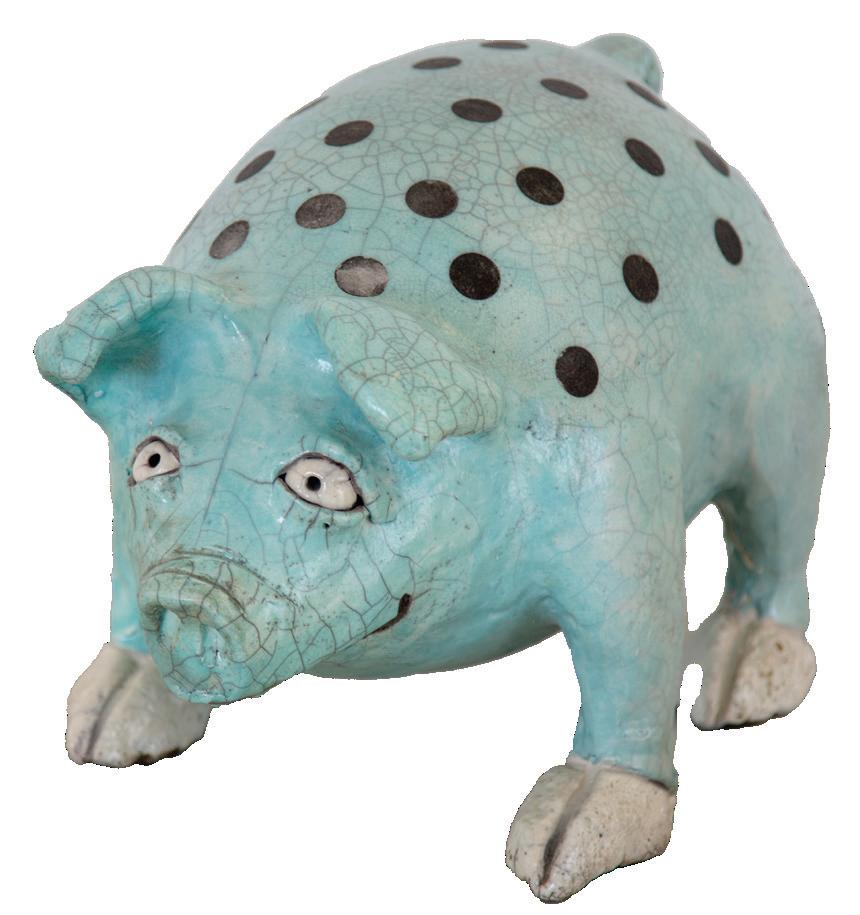
has a reason. His eyes and mind engaged art the way he engaged life—by becoming captivated by the imagery and the concept. He was a private guy who probably would have hesitated to share his collection with a larger audience. I would have begged him to reconsider.
Seth passed away this summer from a grueling disease, but his assembled bright, colorful, and commanding collection over a 30year period lives on. Thirty artworks hugging the SITE131 walls display the exuberance of someone wrapped in the dynamism of today’s art. “I grew up in a home [that] lived and breathed contemporary art,” he had said of his attachment to the form. For Seth to gather his own assemblage of new art was a natural extension of the way he witnessed the world every day.
It was my pleasure to curate the presentation to see is a gift: Seth Davidow collection ; it’s warm, charming, and extremely personal.
Little piggy by Billy Ray Mangham at the entrance was an early purchase of Seth’s that “lived in” the master bedroom. Charming and welcoming stands Scooter by Aaron Young. The innocent little fella makes sure you know this is a place where young people dwell. Dallas artist Linda Ridgway’s bronze arc, Eye Line, also welcomes guests. This, her first-ever bronze piece, is simple, elegant, and engaging, a gift to Seth and Marni from Mom when they moved into their new home. The 1984 color woodblock print entitled Ochre set the stage for all the art that followed.
In the main gallery hangs a most dramatic artwork, by British artist Thomas Ruff, entitled m.a.r.s.01, that could be the landscape on Mars or a huge desertscape. Commanding the viewers’ attention is Jacqueline Humphries’ large, dynamic painting of strong calligraphic markings over a silver field. Nearby is Callum Innes’ Untitled No 32: two side-by-side simple masses in two distinct colors: purple and silver.
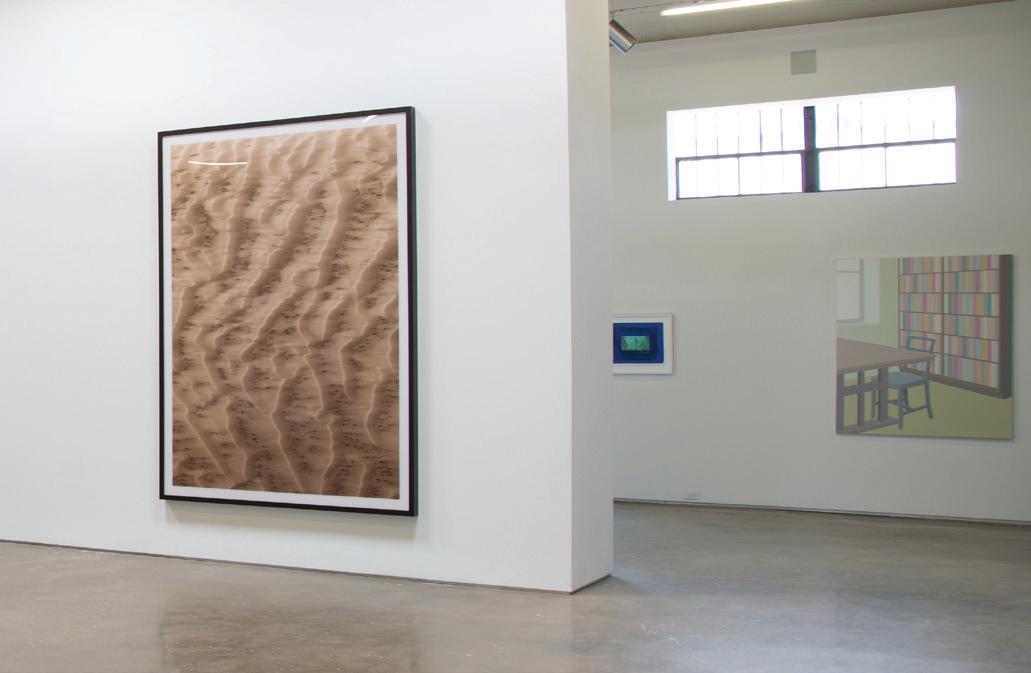
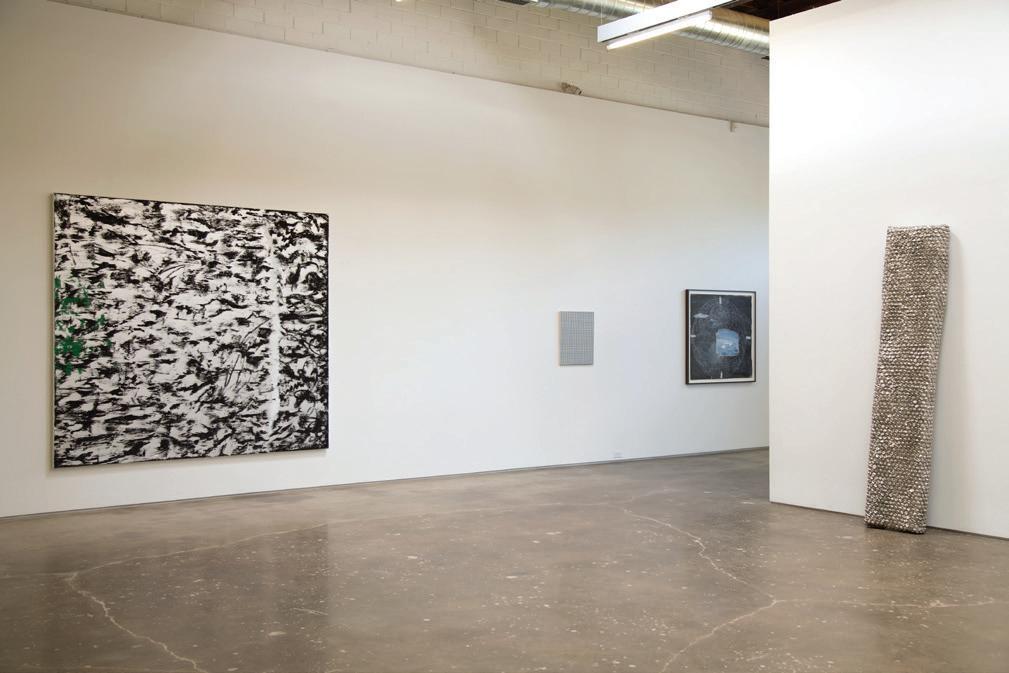
SITE131 presents a cherished private art collection that Seth was proud of, making this especially fitting to remember him. P
ABOUT JOAN DAVIDOW
In her first job as an art resource teacher, Joan Davidow says, “I hauled art supplies in my car.” Reporting on the arts for KERA radio for years catapulted her to founding director of the Arlington Museum of Art; she then led a capital campaign for Dallas Contemporary’s new quarters. Founding SITE131 with her son Seth “brings me continuing joy to guide audiences to know and love contemporary art.”
128 PATRONMAGAZINE.COM FURTHERMORE
A mother’s
Clockwise from top left: Installation view shows off Jacqueline Humphries dramatic painting; Little piggy by Billy Ray Mangham happily welcomes guests to SITE131; Seth and Joan Davidow at the opening of SITE131; Installation view with Thomas Ruff's m.a.r.s.01, in the foreground.
The Luxury Market Leader Across All of North Texas
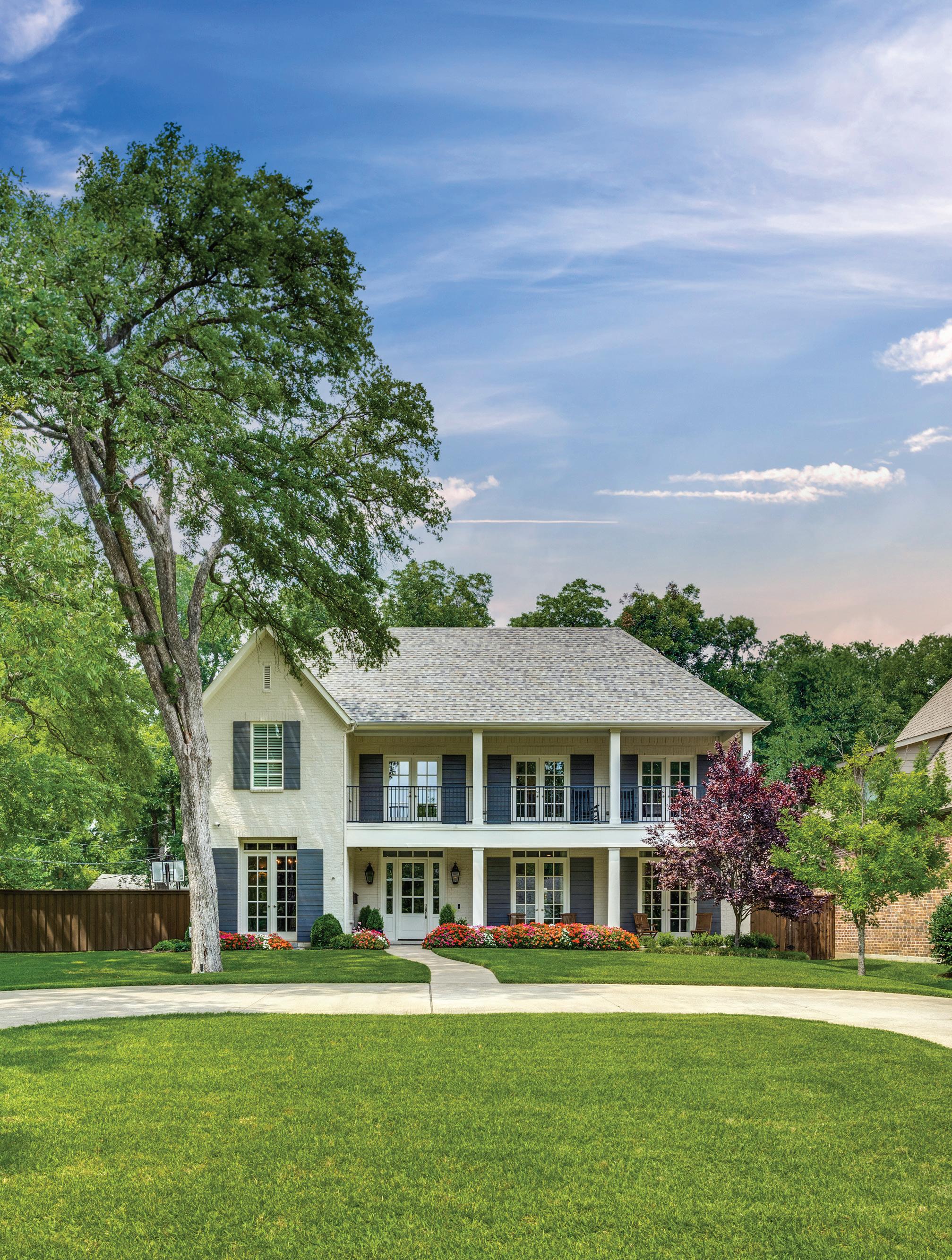
The Ebby Halliday Companies are proud to be the luxury market leader in not just a single area, but in all of North Texas. Through our exclusive partnerships with Leading Real Estate Companies of the World®, Luxury Portfolio International® and Mayfair International Realty, we work to best position a property and effectively reach today’s affluent consumers. A sound marketing plan requires knowing your buyers, and we know them better than any other broker in North Texas. How may we assist you?
This picture-perfect newer construction home in one of the country’s most-desired neighborhoods is situated on an almost half-acre lot, complete with a pool and spa, cabana and ample yard space. 10025 ESTATE LANE | OFFERED FOR $3,050,000 Learn more at 10025estate.ebby.com
Start your move at ebby.com