DALLAS ART FAIR’S 15TH EDITION

NASHER PRIZE LAUREATE
Senga Nengudi
Cerámica Suro at
DALLAS CONTEMPORARY
TACA’S TOP HONORS

FEATURING: HUMA BHABHA JONATHAN BOROFSKY ANTHONY CARO TONY CRAGG MICHAEL CRAIG-MARTIN MARK DI SUVERO JIM DINE LEONARDO DREW BARRY FLANAGAN TOM FRIEDMAN LIAM GILLICK ANTONY GORMLEY KATHARINA GROSSE SIOBH Á N HAPASKA THOMAS HOUSEAGO ANISH KAPOOR KAWS ALAIN KIRILI ROY LICHTENSTEIN HENRY MOORE IVÁ N NAVARRO PAMELA NELSON AND ROBERT A. WILSON MIMMO PALADINO JOEL SHAPIRO FRANK STELLA LEO VILLAREAL HE XIANGYU


JOEL SHAPIRO, 20 ELEMENTS , 2004-2005, NANCY A. NASHER AND DAVID J. HAEMISEGGER COLLECTION.

RENAISSANCE ® – STAX – PAVÉFLEX NORTHPARK CENTER 469 232 4500

DAVIDYURMAN.COM


ERIN
“WITH OVER $2 BILLION IN CAREER SALES IN DALLAS LUXURY REAL ESTATE, ERIN MATHEWS IS THE TOP-PERFORMING AGENT WITH THE EXPERIENCE, CONNECTIONS, AND WORK ETHIC TO OPEN DOORS AND CLOSE DEALS FOR HER CLIENTS. HER TRACK RECORD AND REPUTATION FOR RESULTS ARE UNMATCHED.”

DALLAS’ ORIGINAL REAL
TM TM 214.520.8300 ERINHOME.COM
ESTATE INFLUENCER


RECENT WORK
Great spaces begin with architecture. Bernbaum/Magadini Architects, Dallas’s premier architecture firm, matches innovation with detail.
PLUG IN TO ONE AGENT. LIGHT A NETWORK OF 24. They bring this city to life like no other group. In a spirit of collaboration that has propelled some of Dallas’ most legendary real estate transactions, this premier networking group continues to do what it does best—connect people and properties. What does that mean for you? A more expertly facilitated sale of your prized property. A more perfectly matched home for your next move. Twenty-four of the most admired and knowledgeable real estate professionals in Dallas come together to put their resources and their vast experience to work for you. Insider information, off-market properties, Dallas’ most exquisite estates—all leveraged for your benefit. Thinking of a change? Put the Masters of Residential Real Estate to work for you.

FRONT ROW : JACKIE MCGUIRE , Compass SUSAN BALDWIN , Allie Beth Allman and Assoc. MICHELLE WOOD , Compass AMY DETWILER , Compass MADELINE JOBST, Briggs
Freeman Sotheby’s FAISAL HALUM , Briggs Freeman Sotheby’s EMILY RAY-PORTER , Dave Perry-Miller Real Estate JOAN ELEAZER , Briggs Freeman Sotheby’s BURTON
RHODES , Compass DORIS JACOBS , Allie Beth Allman and Assoc. EMILY PRICE CARRIGAN , Emily Price Carrigan Properties FRANK PURCELL , Allie Beth Allman and Assoc. SUSAN MARCUS , Briggs Freeman Sotheby’s BACK ROW : CHAD BARRETT, Allie Beth Allman and Assoc. BECKY FREY, Compass JONATHAN ROSEN , Compass
RALPH RANDALL , Briggs Freeman Sotheby’s KYLE CREWS , Allie Beth Allman and Assoc. ERIN MATHEWS , Allie Beth Allman and Assoc. TOM HUGHES , Compass
STEWART LEE , Dave Perry-Miller Real Estate PENNY RIVENBARK PATTON , Ebby Halliday Realtors MARK CAIN , Compass RYAN STREIFF, Dave Perry-Miller Real Estate
X V DA LL A S A R T F A I R
APRIL 20 - 23, 2023 w w w .d a l l as a r t f a i r .c o m
PHOTOGRAPHS
April 4 | HA.com/8128
PRINTS & MULTIPLES
April 18 | HA.com/8120
ILLUSTRATION ART
April 25 | HA.com/8114
AMERICAN ART
May 12 | HA.com/8113
MODERN & CONTEMPORARY ART

May 18 | HA.com/8132
1.6
SPRING AUCTIONS X
Heritage Auctions is a Proud Sponsor of The Dallas Art Fair
April 20 – 23 | Fashion Industry Gallery
Inquiries: Frank Hettig | 214.409.1157 | FrankH@HA.com 2801 W. Airport Freeway, Dallas, Texas 75261-4127 (Northwest corner of W. Airport Freeway [HWY-183] & Valley View Lane)
DALLAS | NEW YORK | BEVERLY HILLS |
|
BEACH LONDON | PARIS | GENEVA | BRUSSELS | AMSTERDAM | HONG KONG
Accepting Quality Consignments in 50+ Categories
CHICAGO
PALM
Always
Million+ Online Bidder-Members
Joan Mitchell (1925-1992) | Sunflowers I, diptych, 1992 | Color lithograph on Rives BFK paper 57 x 41-1/2 inches (sheet, each) | Estimate: $40,000 - $60,000
Paul R. Minshull #16591. BP 12-25%; see HA.com. Licensed by the City of New York #1364738/9-DCA 72221
HA.com/Auctions for a Complete Calendar
Visit
© Estate of Joan Mitchell
EDITOR’S NOTE
April / May 2023
Everything, Everywhere, All at Once aptly describes the glorious month of April. Welcome to Dallas Arts Month, when a brisk pace and comfortable shoes are the order of the day. This month’s programming promises to be a headspinning experience stemming from an entirely collaborative effort. Here we give you a sneak peek at some of our favorites.
Dallas Art Fair returns for its 15th edition. In honor of the anniversary, we check in with 15 international artists and their galleries. On the cover, Yu-Wen Wu’s Accumulation of Dreams VI, 2023, at Praise Shadows Art Gallery seemed destined to honor this triumph. Darryl Ratcliff, Nancy Cohen Israel, and Steve Carter join me in highlighting this diverse group in Fifteen for 15
Nasher Prize has begun their peak celebrations by the time this issue drops, and the crowning achievement that is the decades-long practice of Senga Nengudi is in mid-fête. Seemingly summing up the spirit of the season, Nengudi tells arts writer Lyndsay Knecht, “I accept [the Nasher Prize] almost like a group thing, you know, because none of us have gotten this far by ourselves.” The laureate’s work is on view at Nasher Sculpture Center through April 30.
The team at Dallas Contemporary has been busy readying their spring shows. You cannot be part of the art cognoscenti without knowing of José Noé Suro and hearing about his Cerámica Suro based in Guadalajara. It’s a magical place, attracting artists from around the world to work and team up in his studio. One such artist is Eduardo Sarabia, whose solo show, This Must Be the Place, will be on view alongside Cerámica Suro’s own exhibition. Eve Hill-Agnus gives readers an enthusiastic account in The Manufactory of Desires and the House of Dreams.
Ever wonder where the art lands after the Dallas Art Fair? We bring you two homes teeming with art. John Smith photographed the home and collection of David Liu and Michael Fountas, in Embracing Identity. Next, John’s son Archer came along to assist in capturing the essence of Erin Mathews’ pleasingly detailed pied-à-terre in Layered Elegance . The journeys of these collectors are described by Nancy Cohen Israel.
Sara Hignite takes a look at our thriving auction scene and the talent running the modern, contemporary, and decorative divisions in Premium Buyers. Get to know Ed Beardsley and Frank Hettig of Heritage Auctions, Capera Ryan of Christies, Charlie Caulkins of Sotheby’s, Brandon Kennedy of Bonhams, and, newly appointed for Phillips, Joyce Goss. Brendan Blaney handsomely captures their personas.

In May, TACA (The Arts Community Alliance), led by the Donna Wilhelm Family President and Director Maura Scheffler, honors two arts patrons of distinction whose volunteerism and commitment to the arts is undeterred. Lee Cullum shares the unique stories of Gene Jones and Joe Hubach in Cultured Bellwethers
Fashion was photographed by Luis Martinez on location at {neighborhood}, which is in the midst of opening their adjacent Lone Gallery. Giant windows overlooking the Trinity River added lightness to gossamer looks in On a Sheer Day
In our departments, we check out solo shows for Giangiacomo Rossetti at The Power Station and Yifan Jiang at Meliksetian|Briggs. Concurrently at The Power Station, artist Gregory Ruppe, with Alden Pinnell’s commitment to the endeavor, has turned his attention to Picnic Surf Shapes and Picnic Curatorial Projects; Danielle Avram illuminates. Chris Byrne speaks with artist Joe Minter, who has a work on view at Nasher Sculpture Center that was selected by Mark di Suvero to exhibit within his own Steel Like Paper exhibition.
Lastly, Matters of the Moment takes in the Talk of the Town exhibition on view at NorthPark Center. The show highlights work acquired for the Dallas Museum of Art through the Dallas Art Fair Foundation Acquisition Fund. It’s further evidence of this resolute pursuit across North Texas to bring rigorous programming to the community. Let’s applaud them all through participation. Enjoy the season. – Terri Provencal
12 PATRONMAGAZINE.COM
TERRI PROVENCAL Publisher /
in
terri@patronmagazine.com Instagram terri_provencal and patronmag
Editor
Chief
Portrait Tim Boole, Styling Jeanna Doyle, Stanley Korshak
SILVIA TCHERASSI

TOOTSIES.COM ATLANTA DALLAS HOUSTON
FEATURES
74 FIFTEEN FOR 15
Dallas Art Fair, connecting galleries worldwide with the arts community and collectors, marks its anniversary.
By Steve Carter, Nancy Cohen Israel, Terri Provencal, and Darryl Ratcliff

84 ELEMENTS OF INFLUENCE
Senga Nengudi’s Nasher Prize follows a constellation of artists who supported one another as they challenged perceived limits of sculpture and performance. By Lyndsay Knecht


90 THE MANUFACTORY OF DESIRES AND THE HOUSE OF DREAMS
Cerámica Suro and Eduardo Sarabia bring a Guadalajaran treasure to the Dallas Contemporary. By Eve Hill-Agnus
96 EMBRACING IDENTITY
Collectors David Liu and Michael Fountas forge deep relationships with gallerists and artists. By Nancy Cohen Israel
102 LAYERED ELEGANCE
Contemporary art and European antiques create a graceful home for Erin Mathews. By Nancy Cohen Israel
108 PREMIUM BUYERS
The world’s foremost auction houses invest in North Texas.
By Sara Hignite
114 CULTURED BELLWETHERS
In the arts, TACA Silver Cup Award recipients Gene Jones and Joe Hubach lead the charge. By Lee Cullum
118 ON A SHEER DAY
In the season’s diaphanous looks, tulle and organza rise to the fore. Photography by Luis Martinez; Creative Direction by Elaine Raffel; On location at {neighborhood}.

14 PATRONMAGAZINE.COM 118 74
CONTENTS 1
84
On the cover: Yu-Wen Wu, Accumulation of Dreams VI, 2023, graphite, gold ink, 18 carat gold leaf on Arches paper, 22.5 x 45 in. unframed. 30 x 50 in. framed. Courtesy of the artist and Praise Shadows Art Gallery.

Highland Park Village | www.akris.com
DEPARTMENTS
12 Editor’s Note
18 Contributors
36 Noted Of Note
40 FOLLY IN FLANDERS
Saints, Sinners, Lovers, and Fools: 300 Years of Flemish Masterworks at the DMA.
Fair Trade
56 IMMATERIAL PHENOMENA

Jorinde Voight mines complexity and velocity of her environment through abstract configurations. Interview by David Nolan
Openings
58 THE MAGICAL REALISM OF YIFAN JIANG

An emerging Chinese Canadian artist articulates feelings of fleeting moments at Meliksetian|Briggs. By Terri Provencal
60 SPRING FORWARD BEYOND THE LIGHT OF TOMORROW
Giangiacomo Rossetti’s languid gestures in waiting at The Power Station. By Brandon Kennedy
Contemporaries
62 THE DISAPPEARANCE AND REAPPEARANCE OF GREGORY RUPPE
Picnic Surf Shapes and Picnic Curatorial Projects unfold at The Power Station. By Danielle Avram
64 THE WAY OUT
Joe Minter's African Village in America brims with the artist ’s sculpture. Interview by Chris Byrne
Studio
66 A (WILD) WOMAN’S WORLD
Long overdue, Kaleta Doolin’s survey exhibition unites more than three decades of her feminist art. By Eve Hill-Agnus
Space
68 UOVO MOVES IN
An ultramodern art storage and shipping solution has made its way to Dallas. By Terri Provencal

70 AL FRESCO FABULOUS
The Molteni&C Outdoor Collection brings refined nuance to the natural elements. By Terri Provencal
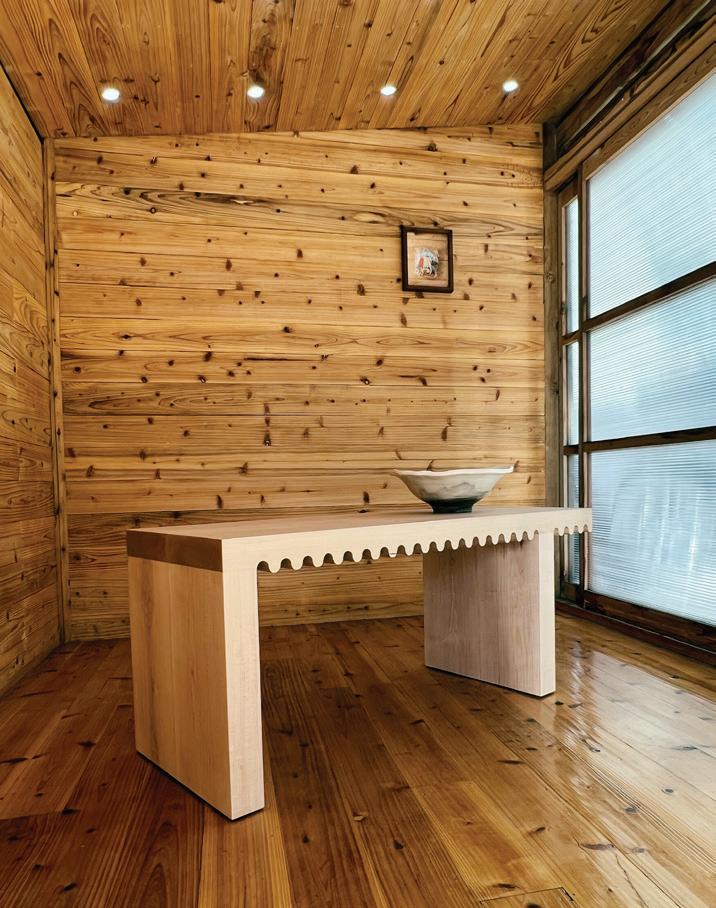
72 FUTURE SHOWCASE
Patricia Urquiola for Cassina’s environmentally conscious approach. By Elaine
Raffel
There
124 CAMERAS COVERING CULTURAL EVENTS
Furthermore
128 MATTER OF THE MOMENT
Through Dallas Art Fair acquisitions, the DMA explores womanhood. By Anthony
Falcon
16 PATRONMAGAZINE.COM
56 58 62
66
CONTENTS 2

MOLTENI&C DALLAS FLAGSHIP STORE 1617 HI LINE DRIVE SUITE 460, TX 75207 T (+) 1 214-224-0903 DALLAS.MOLTENIGROUP.COM BY ABITARE 18 DALLAS — SHOP.MOLTENI.IT moltenigroup.com
CONTRIBUTORS
DANIELLE AVRAM
is director of the School of Arts and Humanities’ SP/N Gallery at the University of Texas at Dallas. She has an MFA from the School of The Museum of Fine Arts and Tufts University, and a BA from UT Dallas. For April, she visited The Power Station in The Disappearance and Reappearance of Gregory Ruppe, whose Picnic Surf Shapes and Picnic Curatorial Projects is underway.
BRENDAN BLANEY

is a Dallas-based photographer specializing in portraiture and directorial modes of photography. Brendan received his BFA in photography from Parson’s School of Design. He has since created work for prominent fashion houses, design firms, and publications across New York, London, and Dallas. Influenced by the Dutch Golden Age and Baroque era, Brendan brings a painterly quality to his portraits.
CHRIS BYRNE is the coeditor (with Keith Mayerson) of Frank Johnson, Pioneer of American Comics Vol. 1: Wally’s Gang Early Years (1928-1949) and the Bowser Boys (19461950), published by Fantagraphics in 2023. He is the curator of Peter Halley: Paintings and Drawings 198081, opening at Karma and Craig F. Starr Gallery in NYC later this month and wrote an essay for the accompanying catalogue.
STEVE CARTER has been a Denton-based freelance arts writer for 25 years and a musician, bandleader, songwriter, painter, amateur chef, and factotum for even longer—a “professional hat-changer and multitasker more by default than design.” In this issue he profiles four of the galleries showing at Dallas Art Fair 2023: New York’s Alexander Berggruen and Hollis Taggart, Taos’ The Valley, and Accra/ London’s Gallery 1957.

LAUREN
CHRISTENSEN has over two decades of experience in advertising and marketing. As a principal with L+S Creative Group, she consults with a wide variety of nonprofit organizations and businesses in many sectors, including retail, real estate, and hospitality. Lauren is a Dallas native and a graduate of SMU with a BA in advertising. Her clean, contemporary aesthetic and generous spirit make Lauren the perfect choice to art direct Patron


NANCY

COHEN ISRAEL is a Dallasbased writer, art historian and educator at the Meadows Museum, where she manages the docent program. For Patron, she enjoyed writing about Erin Mathews’ serene home as well as the thoughtfully growing collection of David Liu and Michael Fountas. She was also delighted to get a sneak peek at work that will be coming to this year’s Dallas Art Fair.
LEE CULLUM is a Dallas journalist and a senior fellow at the John G. Tower Center for Public Policy and International Affairs at SMU, though she has turned passion for the arts into a vocation. For several years she has profiled TACA Silver Cup winners for Patron and this time is delighted to profile Joe Hubach, devoted to music and the Dallas Symphony, and Gene Jones, who heads the superb Dallas Cowboys Collection.
SARA HIGNITE has worked at the DMA, Meadows Museum, Goss-Michael Foundation, and Mildred Lane Kemper Art Museum, St. Louis. From 2020 to 2022, overseeing the Karpidas Collection, Hignite curated the Richard Prince exhibition and edited the accompanying catalogue. Hignite Projects offers curatorial and strategic services to art organizations, collectors, and artists.


EVE HILL-AGNUS


is a writer, editor, and translator with roots in France and California. She has been a teacher of literature and journalism; an award-winning dining critic who also covers art and dance; and a freelance writer/editor of nonfiction, fiction, and poetry. For Patron she previewed Dallas Contemporary’s spring shows and investigated Kaleta Doolin’s art practice.
BRANDON
KENNEDY is an occasional artist, book scout/collector, and freelance curator and writer currently based in Dallas, Texas. Brandon also serves as the Texas Regional Representative for Bonhams auction house. In this issue he previewed the work of Giangiacomo Rossetti, who opens a show this month at The Power Station.


LINDSAY KNECHT is a writer and artist working between Los Angeles and Texas. Her arts reporting and criticism focus on collective healing and communal memory. She studies writing and performance as an MFA student at CalArts. For Patron, she investigated the body of work of this year’s Nasher Prize Laureate Senga Nengudi, in Elements of Influence
ELAINE RAFFEL is a creative director and stylist. Elaine’s fashion prowess and years as a creative working for Stanley Korshak, Neiman Marcus, and Mary Kay bring an elevated edge to Patron. For On a Sheer Day, she teamed up with photographer Luis Martinez at the fabulous furnishing store {neighborhood}, where West Texas modern lives, to bring the transparent looks of the season.
DARRYL RATCLIFF is an artist and poet with a writing and curatorial practice whose work engages communities and mobilizes social issues. He builds collaborative, durational cultural projects that help tell community narratives, promote civic engagement, and increase community health. He is a Yerba Buena Center for the Arts 10 Fellow and founder of Gossypion Investments.
JOHN SMITH is a Dallas-based photographer who flexes his degree in architecture to photograph homes of distinction. In the current issue, he photographed the European antiques and contemporary art collection in Erin Mathews’ home with his son Archer. In Embracing Identity, find his interiors photography of the home of David Liu and Michael Fountas.

18 PATRONMAGAZINE.COM
On View Through June 25, 2023


Organized by the Denver Art Museum in collaboration with The Phoebus Foundation, Saints and Sinners explores the artistic styles and subjects that flourished between the 1400s and 1600s in Flanders—better known today as the Southern Netherlands. Flanders was home to revolutionary artists, including Hans Memling, Jan Gossaert, Peter Paul Rubens, Jacob Jordaens, and Anthony van Dyck, who found new ways to depict reality, portray humanity, and tell stories that continue to resonate with viewers today. Featuring roughly 140 extraordinary works of art in a variety of media, from paintings to manuscripts, the exhibition opens a doorway into the past, telling the story of enterprising townspeople, prosperous cities, and an ever-developing society. These stunning artworks also detail stories about dreams and ambitions, fears and desires, and what it means to be human.
Learn more and get tickets at saintsandsinners.dma.org
 Image: Festival of Monkeys (detail), 1633. David Teniers II. Oil paint on copper; 19 3/4 × 23 3/8 in. © The Phoebus Foundation, Antwerp.
FREEMAN FAMILY EXHIBITION FUND MARGUERITE HOFFMAN AND THOMAS WOODWARD LENTZ
The exhibition is co–presented by Texas Instruments and PNC Bank and is supported by an indemnity from the Federal Council on the Arts and the Humanities. The Dallas Museum of Art is supported, in part, by the generosity of DMA Members and donors, the National Endowment for the Arts, the Texas Commission on the Arts, and the citizens of Dallas through the City of Dallas Office of Arts and Culture.
Saints, Sinners, Lovers, and Fools: 300 Years of Flemish Masterworks is co-organized by the Denver Art Museum and The Phoebus Foundation, Antwerp (Belgium).
Image: Festival of Monkeys (detail), 1633. David Teniers II. Oil paint on copper; 19 3/4 × 23 3/8 in. © The Phoebus Foundation, Antwerp.
FREEMAN FAMILY EXHIBITION FUND MARGUERITE HOFFMAN AND THOMAS WOODWARD LENTZ
The exhibition is co–presented by Texas Instruments and PNC Bank and is supported by an indemnity from the Federal Council on the Arts and the Humanities. The Dallas Museum of Art is supported, in part, by the generosity of DMA Members and donors, the National Endowment for the Arts, the Texas Commission on the Arts, and the citizens of Dallas through the City of Dallas Office of Arts and Culture.
Saints, Sinners, Lovers, and Fools: 300 Years of Flemish Masterworks is co-organized by the Denver Art Museum and The Phoebus Foundation, Antwerp (Belgium).
PUBLISHER | EDITOR-IN-CHIEF
Terri Provencal terri@patronmagazine.com
ART DIRECTION
Lauren Christensen
DIGITAL MANAGER/PUBLISHING COORDINATOR
Anthony Falcon
COPY EDITOR
Sophia Dembling
PRODUCTION
Michele Rodriguez
CONTRIBUTING WRITERS
Chris Byrne
Steve Carter
Nancy Cohen Israel
Lee Cullum
Sara Hignite
Eve Hill-Agnus
Brandon Kennedy
Lyndsay Knecht
Darryl Ratcliff
CONTRIBUTING PHOTOGRAPHERS
Matt Arnett
Paul Arturo Torres
Brendan Blaney
Dario Calmese
Nan Coulter
Roy Cox
Jeremy Daniel Exploredinary
Victoria Gomez
Amanda Holmes
Sheryl Lanzel
Pierre Le Hors
Brad Linton
Joan Marcus
John Smith
Kevin Todora
Evan Zimmerman
STYLISTS/ASSISTANTS
Jessica Maitre
Lisa Martensen
Elaine Raffel
Archer Smith
ADVERTISING info@patronmagazine.com or by calling (214)642-1124
PATRONMAGAZINE.COM
View Patron online @ patronmagazine.com
REACH US info@patronmagazine.com


SUBSCRIPTIONS amazon.com/patronmagazine
One year $48/6 issues, two years $60/12 issues
For international subscriptions add $15 for postage
For subscription inquiries email info@patronmagazine.com
SOCIAL @patronmag
1019 Dragon Street | Design District
sminkinc.com TORII BY MINOTTI Introducing
|
is published 6X per year by Patron, P.O. Box 12121, Dallas, Texas 75225. Copyright 2023, Patron. All rights reserved. Reproduction in whole or in part without express written permission of the Publisher is strictly prohibited. Opinions expressed in editorial copy are those of experts consulted and do not necessarily reflect the opinions of the editors, publisher or the policy of Patron. Unsolicited manuscripts and photographs should be sent to the address above and accompanied by a self-addressed stamped envelope for return. Publisher will take reasonable precaution with such materials but assumes no responsibility for their safety. Please allow up to two months for return of such materials. 20 PATRONMAGAZINE.COM

1019 Dragon Street, Dallas, Texas 75207 www.sminkinc.com SMINK HORIZONTE SEATING SYSTEM | MARCIO KOGAN / STUDIO MK27 DESIGN YOKO ARMCHAIRS | INODA+SVEJE DESIGN DISCOVER MORE AT MINOTTI.COM/HORIZONTE
THE DIGITAL SCREEN
ART
Examining the screen’s vast impact on art from 1969 to the present, this exhibition includes the work of fifty artists in a broad range of media including paintings, sculpture, video games, digital art, augmented reality, and video. These artists demonstrate the screen as a powerful and valuable artistic and social tool.

Through April 30 MODERN ART MUSEUM OF FORT WORTH 3200 Darnell Street Fort Worth, TX 76107 www.themodern.org I’ll Be Your Mirror: Art and the Digital Screen is made possible through the generous support of the Texas Commission on the Arts, the Carl & Marilynn Thoma Foundation, and the Fort Worth Tourism Public Improvement District, with additional support from the Fort Worth Promotion and Development Fund. Pictured: Nam June Paik, TV Buddha, 1992. Buddha, monitor, CCT camera. 53 × 83 × 22 inches. Nicola Erni Collection I'LL
YOUR
AND
BE
MIRROR


crystal case STUDIO ORNARE Ornare Dallas Design District 1617 Hi Line Dr,190A, Dallas, TX, 75207 | (214) 377.1212 ornaredallas | ornare.com CLOSETS • KITCHENS • SYSTEMS


Never easy to catch – and soon impossible. 12 cylinders, one of a kind. Bentley’s iconic W12 engine will cease production soon, but there’s still time to discover Bentley’s extraordinary W12-powered range before this iconic engine is retired. Visit us online at BentleyDallas.com to secure one of the final Continental GTs, Continental GT Convertibles, Flying Spurs, and Bentayga to feature the legendary W12 engine. The name ‘Bentley’ and the ‘B’ in wings device are registered trademarks. © 2023 Bentley Motors Inc. Model shown: Bentayga Speed W12. BENTLEY DALLAS
Exceptional means a bespoke client experience. That’s what we strive for at every level of design, build and client engagement. Our team’s aim is to make a difference in your family’s life by crafting a home that exceeds expectations. It is your home and we want everyday to be exceptional.
 Personal I Exceptional I Craftsmanship I MHMLIVING.COM
IN THE HE ART OF IT ALL


At HALL Arts Hotel experience a diverse art collection by emerging and established artists—from a few blocks away to across the globe. Everything you’ll see and experience has been handpicked to inspire and engage in surprising ways. To pay homage to our dynamic arts community, every guest room and hallway features Dallas Arts District photography taken by local photographers.


HALLARTSHOTEL.COM ELLIESDALLAS.COM


COMMAND PERFORMANCE May 06 2023 Winspear Opera House BALLET BC June 09 2023 Winspear Opera House 3 Performances April 22.23 2023 Music Hall at Fair Park 214.880.0202 | attpac.org/titas | titas.org North American Tour Sponsor
May 11 - 14 Dallas Market Hall


Art Reframed
Scan To Learn More
Artwork by Samuel Ryde
SAVE THE
DATE
• TWO X TWO FOR AIDS AND ART
October 21, 2023
To date, TWO x TWO has raised over $113 million for amfAR and the Dallas Museum of Art.
twoxtwo.org
 Photo credit: © María Berrío. Courtesy the artist and Victoria Miro. Photo Kyle Dorosz.
María Berrío
Presenting Sponsor
Honoree Artist
Photo credit: © María Berrío. Courtesy the artist and Victoria Miro. Photo Kyle Dorosz.
María Berrío
Presenting Sponsor
Honoree Artist
SAENGER


GALERfA is a contemporary ar t space, located in the neighborhood of Tacubaya in Mexico City.
Mark Hagen Transparecy, HH0673, 2022.
Haruna Shinagawa Peel off the paint #739, 2022.
GALE RIA
Robert Janitz La condesa electrica, 2023.
Mexico City saengergaleria.com
Yoab Vera Circadian Memories #Amanecr Otra Vez (Bolero), 2023.

David Dike Fine Art | 4887 Alpha Rd, Suite 210 | Farmers Branch, TX 75244 (214)720-4044 info@daviddike.com daviddike.com 2613 Fairmount Dallas, Texas 75201 Phone: 214-720-4044 Fax: 214-720-4469 Email: info@daviddike.com Website: www.daviddike.com Hours: Monday – Friday 10:00 AM – 5:00 PM Saturday by appointment Please Contact the Gallery for More Information AUCTIONEER: LOUIS MURAD OF MURAD AUCTIONEERS LOUIS MURAD TXS 13362 A uction Preview Open Daily Monday-Friday, October 11 – October 29, 2021, 10am-5pm Wildman Art Framing Auction Date and Location Saturday, October 30, 2021 Doors open at 9:30 am; Bidding starts promptly at 10:30am, CST Wildman Art Framing Bidding Options Bidding options available via LiveAuctioneers.com Absentee and live phone bidding available. For the absentee/phone bid form and online internet bidding access, please visit: www.daviddike.com DAVID DIKE FINE ART TEXAS ART AUCTION A Tradition In Texas Art Since 1996 Fall Auction: Saturday, October 30, 2021 at 10:30 AM CST Wildman Art Framing: 1715 Market Center Boulevard, Dallas, Texas 75207 A Surrealistic Flow
Works by JUDITH SEAY Opening Reception May 18th, 2023 6-8 pm JUDITH SEAY, Pieces of Dreams , 2022 oil and metal leaf on wood panel 36 x 48 in.
New
David Webb
Coral and Yellow Gold
Elephant Bangle

Circa 1980’s
WE BUY AND SELL FINE JEWELRY AND TIMEPIECES.

Assisting individuals with gem and timepiece liquidation for nearly 60 years. By appointment, in your home, your bank, or our salon at NorthPark Center.
For more information please contact Michael Johnson at 214.369.6100.
Eiseman Jewels will feature one-of-a-kind estate pieces from its impressive Estate Jewelry collection, along with a curated presentation of a contemporary collection of artistic expressions of gold, diamond and colored stone designs by exclusive designers at the Dallas Art Fair on April 20-23.


Explore premium storage options at our new 85,000 SF facility designed to preserve art collections of any type. UOVO Dallas UOVO.ART • +1 212 265 3111 • INFO@UOVO.ART Now Open
Unlike most other significant life purchases we make, buying or selling a home is a process. It’s imperative you have confidence in that process not only at the outset and the outcome, but at every point in between. Seeing buyers and sellers through is something every one of our professional, educated, client-centric associates knows how to do.


4231lawther.dpmre.com 4231 W. Lawther Drive 5 BED | 5.3 BATH | 9,140 SQ. FT. | $15,795,000 LAKEWOOD 4033lawther.dpmre.com 4033 W. Lawther Drive 5 BED | 6.3 BATH | 10,034 SQ. FT. | $11,995,000 LAKEWOOD 2300wolf16a.dpmre.com Sharon S. Quist 214.695.9595 sharonquist@dpmre.com Stoneleigh #16A 2 BED | 2.1 BATH | 3,948 SQ. FT. | $4,150,000 UPTOWN | 2300 WOLF STREET 4215beechwood.dpmre.com Joelle Mayer 214.893.3580 joellemayer@dpmre.com 4215 Beechwood Lane 6 BED | 6.1 BATH | 6,868 SQ. FT. | $3,800,000 PRESTON HOLLOW PENDING Sharon Quist 214.695.9595 sharonquist@dpmre.com The Mayfair #1403 2 BED | 2.1 BATH | 4,620 SQ. FT. | $1,995,000 TURTLE CREEK | 3401 LEE PARKWAY
End End
Experience to daveperrymiller.com Price and availability subject to change. Information deemed reliable, but not guaranteed. A Berkshire Hathaway Affiliate 11453ricks.dpmre.com Tiffany Lawson 214.460.0279 tiffanylawson@dpmre.com 11453 W. Ricks Circle 5 BED | 5.3 BATH | 10,239 SQ. FT. | $7,895,000 PRESTON HOLLOW Frada Sandler 214.616.6476 frada@dpmre.com Sharon Redd 469.835.5363 sharon@dpmre.com Ryan Streiff 469.371.3008 ryan@dpmre.com Michele Balady Beach 214.384.5958 michelebeach@dpmre.com Stacy Baucum 203.829.9052 stacybaucum@dpmre.com
An
Luxury
NOTED
THE LATEST CULTURAL NEWS COVERING ALL ASPECTS OF THE ARTS IN NORTH TEXAS: NEW EXHIBITS, NEW PERFORMANCES, GALLERY OPENINGS, AND MORE.
01 AFRICAN AMERICAN MUSEUM
Black Cowboys: An American Story, sees more than 50 artifacts, photographs, documents, and films exploring the lives and work of the numerous Black men, women, and children—enslaved and free—who labored on the ranches of Texas and participated in cattle drives from before the Civil War through the turn of the 20th century; through Apr. 15. aamdallas.org
02 AMON CARTER MUSEUM OF AMERICAN ART
Darryl Lauster’s Testament remains on view through May Charles Truett Williams: The Art of the Scene examines mid-century Fort Worth through the artist’s works, through May 7. Morning Light: The Photographs of David H. Gibson takes viewers to Cypress Creek in Wimberley, Texas, and Eagle Nest Lake in the mountains east of Taos, New Mexico; through May 21. With the 160th anniversary of the Emancipation Proclamation, Emancipation: The Unfinished Project of Liberation explores what freedom looks like today for Black Americans. Christina Fernandez: Multiple Exposures invites viewers to reconsider history, borders, and the lives that cross and inhabit both, through Jul. 9. Spring 2023 marks the 100th anniversary of the birth of Richard Avedon. As part of a national celebration led by The Richard Avedon Foundation, 13 works from the project In the American West, commissioned by the Carter in 1979 and premiered in 1985, will be on view Apr. 1–Oct. 1 in Avedon’s West. Elizabeth Turk’s The Tipping Point: Echoes of Extinction will be on view May 1–May 1, 2024. Arthur Dove: Miniature Laboratories examines work from the last years of Dove’s life (1940–46), May 13–Aug. 27. Image: Richard Avedon, Ruby Mercer, publicist, Frontier Days, Cheyenne, Wyoming, 7/31/82, 1982, gelatin silver print, Amon Carter Museum of American Art, Fort Worth, Texas. cartermuseum.org
03 CROW MUSEUM OF ASIAN ART OF THE UNIVERSITY OF TEXAS AT DALLAS
Opening Apr 15, the Crow Museum will present a landmark exhibition taking over the entire museum based on the collection of Jeffrey Montgomery. Japan, Form & Function: The Montgomery Collection will feature more than 240 works, subdivided into themes and categories; through April 14, 2024. Image: Lidded urn (ossuary) for second burials ( jiishigami ) used as part of funerary ritual (senkotsu). Ryūkyū Kingdom, 19th century. Okinawa. Stoneware with bright colored glazes. Courtesy of the collector. Photo credit: Chadwick Redmon. crowmuseum.org

04 DALLAS CONTEMPORARY

Cerámica Suro: a story of collaboration, production, and collecting in the contemporary arts is the first comprehensive American presentation of the studio’s influence on contemporary art vis-à-vis the collection amassed by José Noé Suro and his wife, Marcela. Selections from this collection are curated by executive director/chief curator of Guadalajara’s Museo de Arte de Zapopan (MAZ), Viviana Kuri. The exhibition features three thematic elements: pieces produced in the Cerámica Suro workshop by artists who have used high-fired ceramic or other techniques or materials; productions aimed at the fields of industrial design and architecture; and a representative survey of the history of contemporary art from the late 20th century to the present day, with pieces by artists across the globe who have been associated with the workshop through collaborative efforts and exchanges; Apr. 20–Dec. 21. In This Must Be the Place, Eduardo Sarabia’s multidisciplinary work is expressed in the setting of a home. Visitors are invited to walk through and witness the varied elements of the artist’s practice: hand-painted blue-and-white Talavera-style ceramics made in collaboration with Cerámica Suro; paintings that serve as metaphorical windows; handmade ceramic kitchenware; and a site-specific mural of vine motifs. dallascontemporary.org
05 DALLAS HOLOCAUST AND HUMAN RIGHTS MUSEUM
Rise Up: Stonewall and the LGBTQ Rights Movement, created to mark the 50th anniversary of a June 1969 police raid of the Stonewall Inn in New York’s Greenwich Village, explores the modern LGBTQ rights movement in the US; through Jun 18. dhhrm.org
06 DALLAS MUSEUM OF ART
Octavio Medellín: Spirit and Form continues through May 15 Movement: The Legacy of Kineticism showcases the work of artists from three historical eras who use optical effects or mechanical or manipulable parts; through Jul. 16. Saint, Sinners, Lovers, and Fools: 300 Years of Flemish Masterworks explores a rich repertoire of themes reflecting the societal changes of the time while also mirroring contemporary circumstances surrounding the human condition; through Jun. 25. Concentrations 64: Ja’Tovia Gary, I KNOW IT WAS THE BLOOD brings together five artworks and related ephemera created by the Dallas-native filmmaker and visual artist. Displaying glowing neon script, a newly commissioned sculpture, film sourced from the artist’s family archives, and paintings, this multimedia installation is an evocative memoir celebrating the power of ancestral knowledge.

36 PATRONMAGAZINE.COM
03 10 13

welcharchitecture.com
Freedom Matters uses rare artifacts and historical documents, interactive activities, and personal perspectives to examine the concept of freedom: where it comes from, what it means, what free societies look like, and the role of the individual in protecting and spreading freedom around the world; through Dec. 31. georgewbushlibrary.gov
08 KIMBELL ART MUSEUM
The Kimbell at 50, through Oct. 4, invites visitors to learn more about the history of the museum and includes dedicated events throughout the year Lives of the Gods: Divinity in Maya Art depicts episodes in the life cycle of the gods, from the moment of their birth to resplendent transformations as blossoming flowers or fearsome creatures of the night. Created by masters of the Classic period (A.D. 250–900) in the spectacular royal cities in the tropical forests of what is now Guatemala, Honduras, and Mexico, these landmark works evoke a world in which the divine, human, and natural realms are interrelated and intertwined; May 7–Sep 3.
Image: Whistle with the Maize God Emerging from a Flower Maya , Mexico Late Classic period, 600–900, ceramic with pigment, 8.12 x 2 in. The Metropolitan Museum of Art, New York, The Michael C. Rockefeller Memorial Collection, bequest of Nelson A. Rockefeller, 1979. kimbellart.org

09 LATINO CULTURAL CENTER
The LCC welcomes artist Giovanni Valderas in his first solo exhibition, Marginal Universe, at Latino Cultural Center’s NPR and Main galleries on Apr. 15 with an artist reception. On view through Jun. 17, the exhibition spans Valderas’ practice from 2012 through 2023. lcc.dallasculture.org
10 MEADOWS MUSEUM
In the Shadow of Dictatorship: Creating the Museum of Spanish Abstract Art sees more than 40 highlights from the Museo de Arte Abstracto Español’s remarkable collection. They tell the story of this pioneering artists’ museum and explore the rich panorama of abstract Spanish art during the middle of the 20th century and under the Francoist regime; through Jun. 18. Image: Sarah Grilo (Buenos Aires, 1919–Madrid, 2007), Announcement (Aviso), 1971, oil on canvas, 90 x 57.50 in. Colleción Fundación Juan March, Museu Fundación Juan March, Palma. meadowsmuseumdallas.org
11 MODERN ART MUSEUM OF FORT
WORTH
I’ll Be Your Mirror: Art and the Digital Screen is a group exhibition that examines the screen’s vast impact on art from 1969 to the present. This exhibition surveys more than 60 works by 50 artists over the past five decades who examine screen culture through a broad range of media such as paintings, sculpture, video games, digital art, augmented reality, and video; through Apr. 30. Permanent Collection with New Acquisitions sees conversations between new acquisitions and permanent collection favorites through Jun. 4. themodern.org
12
MUSEUM OF BIBLICAL ART
Side by Side: George Tobolowsky and James Surls remains on view through the summer. biblicalarts.org
13

NASHER SCULPTURE CENTER
Mark di Suvero is one of the most significant sculptors of the past 60 years, renowned for monumental, abstract, steel constructions that grace urban plazas, bucolic sculpture parks, and public spaces. From his industrial studios in Long Island City, New York, and Petaluma, California, the exhibition focuses on the artist’s studio practice over the course of his career. Featuring 30 sculptures ranging in size from handheld to monumental and more than 40 drawings and paintings spanning the artist’s career, Mark di Suvero: Steel Like Paper reveals the power of the artist’s monumental vision; through Aug. 27. In celebration of the 2023 Nasher Prize Laureate Senga Nengudi, the Nasher presents four works that speak to essential elements of her versatile, innovative artistic practice, through Apr. 30. Image: Installation view Mark di Suvero: Steel Like Paper, Nasher Sculpture Center, Dallas, Jan. 28–Aug 27, 2023. Photograph by Kevin Todora. Courtesy Nasher Sculpture Center. © Mark di Suvero. nashersculpturecenter.org
14 PEROT MUSEUM
Discover The Science Behind Pixar, through Sep. 4. Immerse yourself in the exhibition’s eight sections featuring more than 50 interactive elements. perotmuseum.org
15 SIXTH FLOOR MUSEUM
John F. Kennedy and the Memory of a Nation examines the life, legacy, and assassination of JFK within the events of November 22, 1963, and their aftermath. The multimedia experience advocates for cross-generational dialogue to foster interest and understanding in a historical context. jfk.org
16 TYLER MUSEUM OF ART
Childhood Shenanigans: Works by Lee N. Smith III features works drawn from collections across Texas; through Apr. 23. tylermuseum.org

38 PATRONMAGAZINE.COM NOTED: VISUAL ARTS
Image: Installation view of Ja’Tovia Gary Precious Memories, Paula Cooper Gallery, New York, 2020. Photograph by Steven Probert. Courtesy of the artist and Paula Cooper Gallery, New York. dma.org
07 GEORGE W. BUSH PRESIDENTAL LIBRARY AND MUSEUM
06 08 02

Interior Design & Architecture bodronfruit.com
FOLLY IN FLANDERS
Saints, Sinners, Lovers, and Fools: 300 Years of Flemish Masterworks at the DMA takes


Fun, flippant, and educational, the Dallas Museum of Art is making the medieval, Renaissance and Baroque periods of Flanders hip. Saints, Sinners, Lovers, and Fools: 300 Years of Flemish Masterworks, organized by the Denver Art Museum in collaboration with The Phoebes Foundation, was curated by Dr. Katharina Van Cauteren, the foundation’s witty and whip-smart chief of staff.
Engaging with masterworks of Flanders from the 1400s to the 1600s, enter a world of folly, sin, and greed while learning some art history along the way. “These paintings are a gateway into the past. And so they show us what the world was like 300, 400 years ago at the same time as they show us how little has changed,” muses Van Cauteren. “In the end, each and every painting in the exhibition is about very human concerns, and desires, and fears, and dreams; it’s about statism, prestige, and showing off. It’s about you and me.”
Van Cauteren, who did her PhD on Hendrick de Clerck, points to the The Garden of Eden with Four Elements by de Clerck and Denijs van Alsloot as one such example. “It’s pure political propaganda for the archdukes, for claiming that they will restore paradise in the Netherlands—which they didn’t, but we ended up with an interesting painting anyhow.”

In this the final stop on the traveling exhibition’s tour, on view through June 25, six themed sections—God is in the Details; From God to the Individual; Exploring the World; The Fool and the Mirror; The Triumph of Emotion; and The Pursuit of Wonder—feature masterworks by Hans Memling, Jan Gossaert, Peter Paul Rubens, Jacob Jordaens, and Anthony van Dyck, among others, and offer a unique perspective on the societal changes of the time along with a thoughtful reflection on the human condition of today.
“Stepping into this exhibition truly feels like you’re embarking on a journey through time,” avers Dr. Nicole R. Myers, DMA’s interim chief curator and The Barbara Thomas Lemmon senior curator of European Art.
“We’re excited for visitors to peer through this window to the past while also seeing reflections of their own everchanging world,” says Myers. And the exhibition invites viewers to find their persona through a Buzzfeed Quiz that results in an online curated playlist for each guise.
Van Cauteren concludes, “These paintings are easily compared to what films do today because they all tell a story in one image. If Rubens had lived today, he would be a Steven Spielberg.” –By Terri Provencal
40 PATRONMAGAZINE.COM
OF NOTE
a humorous look at art from the 15th–17th centuries.
Hendrick de Clerck and Denijs van Alsloot, The Garden of Eden with the Four Elements, 1613, oil on copper, 32.25 x 38.50 in. © The Phoebus Foundation, Antwerp; David Teniers II, Festival of Monkeys, 1633, oil on copper, 19.75 x 23.37 in. © The Phoebus Foundation, Antwerp; Jacob Jordaens, Serenade, about 1640-1645, oil on canvas, 54.12 x 70.50 in. © The Phoebus Foundation, Antwerp.


LANDSCAPE DESIGN | CONSTRUCTION | GARDEN CARE POOL CONSTRUCTION | POOL CARE AND SERVICE COLLABORATIVE PROJECTS 972.243.9673 | BONICKLANDSCAPING.COM CREATING PERSONAL SANCTUARIES 40 YEARS OF REDEFINING OUTDOOR SPACES
01 AMPHIBIAN
Baba follows the complex relationship between a newly immigrated father and his US-born daughter; Apr. 27–May 7. With Erin Doherty and Brendan Cowell, the National Theatre Live series presents Arthur Miller’s The Crucible ; Apr. 26–29. Sara Schaefer will perform on May 16–18 for her Stand-Up Comedy Residency. amphibianstage.com
02 AT&T PERFORMING ARTS CENTER
See Neil deGrasse Tyson on Apr. 4. PNC Patio Sessions presents Nathan Mongol Wells on Apr. 6. The new musical Anastasia will journey to Dallas Apr. 6–8. Hits! The Musical brings 90 minutes of pure joy, Apr. 28. The Eldert Lofts, May 4–6, is a movementbased work made in collaboration with local artists that explores community living in a small apartment building. On May 5, Cinco de Mayo Silent Disco Fiesta will bring Latin music jams. Bartlett Sher brings his fresh take to Fiddler on the Roof May 11–13. #Filtered explores perfectionism between the digital and real self; May 11–13. See Rodrigo y Gabriela: In Between Thoughts…A New World Tour 2023 featuring Krooked Kings on May 21. Theresa Caputo brings her messages of peace on May 24. Luminescence features Jess Garland on a laser-harp created by collaborator Eric Trich, May 26–28. The Moth Mainstage celebrates personal storytelling to illuminate the diversity and commonality of the human experience, May 31. Image: Kyla Stone (Anya) in the National Tour of Anastasia
Photograph by Jeremy Daniel. attpac.org
03 BASS PERFORMANCE HALL
Annie is back Mar. 28–Apr. 2. Lewis Black: Off the Rails takes the stage Apr. 15. Tootsie tells the story of Michael Dorsey, who struggles to find work until one desperate act lands him the role of a lifetime, May 9–14. Image: The cast of the National Tour of Tootsie
Photograph by Evan Zimmerman for MurphyMade. basshall.com
04 BROADWAY DALLAS
Bohemians and aristocrats rub elbows and revel in electrifying enchantment in Moulin Rouge! The Musical! Baz Luhrmann’s revolutionary film comes to life onstage, remixed in a new musical mash-up; through Apr. 2. Tootsie the musical tells the story of Michael Dorsey who lands a job on a soap opera by disguising himself as a woman , Apr.18–30. Aaron Sorkin’s adaptation of Harper Lee’s masterwork, To Kill a Mockingbird, takes the stage May 16–28. broadwaydallas.org
05 CASA MAÑANA
Junie B. Jones is Not a Crook follows Junie B. as she learns what it means to be truthful and fair, through Apr. 9. Disney’s High School Musical! joins the students of East High as they deal with issues of first love, friends, and family while balancing their classes, Apr.
22–May 7. casamanana.org
06 DALLAS BLACK DANCE THEATRE

The DBDT: Encore! Rising Excellence performance, Apr. 21–22, draws on the heritage and memories of Japanese and Polish choreographers. Choreographer Takehiro Ueyama created Heroes to honor the citizens who played a crucial role in Japan’s recovery after World War II. Katarzyna Skarpetowska’s Snow Playground is inspired by a peaceful image of swirling snow across a children’s playground. Spring Celebration sees the world premiere of Chanel DaSilva’s TABERNACLE, which pays homage to the complexities of Black culture. Furtherance is the expression of overcoming anguish to find bliss created by Kirven Douthit-Boyd. DBDT dancer McKinley Willis choreographs her first mainstage work with SMILE , May 19–20. dbdt.com
07 DALLAS CHILDREN’S THEATER
Charlotte’s Web shares the true meaning of friendship and everyday miracles; through May 27. dct.org
08 THE DALLAS OPERA

Women have the last laugh when the men they plan to marry produce a bad idea: Egged on by a cynical old bachelor, the guys decide to put their fiancées to the “fidelity test.” Big mistake—as the resulting debacle demonstrates Mozart’s glorious music fuels comedy that cuddles up to a calamity just waiting to happen. Così fan tutte is TDO’s season finale on Apr. 1. dallasopera.org
09 DALLAS SYMPHONY ORCHESTRA
Gemma New conducts The Rite of Spring on Apr. 20–22; Jukka -Pekka Saraste conducts Shostakovich Symphony No. 4 on Apr. 27–30; Fabio Luisi conducts Beethoven and Brahms on May 4–7, and Carmina Burana on May 11–14; and Jaime Martín conducts Liszt and Ligeti on May 26–28. For contemporary nostalgia, see Decades: Back to the ’80s on Apr. 14–16; and E.T. the Extra-Terrestrial in Concert, May 19–21. Image: Gemma New, photograph by Roy Cox. mydso.com

10 DALLAS THEATER CENTER
Into the Woods follows a baker and his wife longing for a child; Cinderella, who wishes to attend the King’s Festival; and Jack, who wishes his cow would give milk. As their adventures overlap and their wishes are granted, they learn that no one is alone, Apr. 7–30. dallastheatercenter.org
11 DALLAS WIND SYMPHONY
In Storm and Sunshine , on Apr. 25, sees the artistry of percussionist Jacob Nissly and presents a feast for your ears from Arlington native Kevin Day. dallaswinds.org
42 PATRONMAGAZINE.COM NOTED: PERFORMING ARTS
19 09 15


Houston’s acclaimed Lancaster Hotel rede nes modern hospitality. From its collection of over 200 works by noted contemporary Texas artists to its prime location in the heart of Houston’s award-winning Theater District, The Lancaster Hotel is the perfect escape for a patron of the Arts.


12
EISEMANN CENTER
The Sinatra Experience, starring Dave Halston, takes the stage Apr. 8. RSO’s season finale features works by Hector Berlioz, Maurice Ravel, and Richard Strauss. Joyce Yang, 2005 Van Cliburn Silver Medalist, returns to perform Brahms’ First Piano Concerto. Plano Symphony Orchestra’s 40th Anniversary Season wraps up with guest artists: mezzo soprano Angela Wilson; soprano Erin Roth Thomas; and the Plano Civic Chorus and the Irving Chorale for a performance of Mahler’s Symphony No. 2, Resurrection, Apr. 29. Tuzer Dance School’s Here, There and Everywhere performs May 13. The Lone Star Youth Winds will perform the music of Frank Ticheli May 14. eisemanncenter.com
13 FORT WORTH SYMPHONY ORCHESTRA
A Night at the Ballet: Brian Raphael Nabors, Humperdinck, Griffes, Ravel, and Stravinsky kicks off on Apr. 21–23. Pink Martini is a globetrotting musical ambassador for America; see them live Apr. 28–30. Music Director Laureate Miguel Harth-Bedoya will lead FWSO in Elgar’s Enigma Variations: Strauss, Saint-Säens, and Elgar on May 5–7. See Three American Tenors on May 13— an exciting program of classic opera arias, Broadway favorites, and American standards. Three Chamber Music Masters: Mozart, Poulenc, and Lutosławski comes to the Kimbell Art Museum May 14. fwsymphony.org
14 LYRIC

STAGE
Tarzan is raised by gorillas in the jungles of West Africa. When a human expedition treks into his tribe’s territory, he encounters creatures like himself for the first time, including Jane; May 17–21. lyricstage.org
15
MAJESTIC THEATRE


Sarah Millican with special guest Bobby Dazzler perform on Apr. 7, followed by Lyle Lovett and his Acoustic Group Apr. 13–15. Former Phantom of the Opera stars will present A Look Behind the Curtain: Songs and Stories from Broadway Apr. 20. Join Hannah Berner and Paige Desorbo for The Giggly Squad on Apr. 22. Nimesh Patel: The Lucky Lefty Tour stops in Apr. 23. On Apr. 27, Brian Culbertson: The Trilogy Tour takes the stage. Jamie Cullum performs on Apr. 28. The sounds of Jonathan McReynolds will fill the air on Apr. 29. Spend An Intimate Evening with David Foster & Katharine Mcphee on May 12. Chelcie Lynn brings her 2 Fingers and a 12 Pack Tour May 14. Image: Ron Bohmer and Sandra Joseph in Phantom of the Opera . Photograph by Joan Marcus. majestic.dallasculture.org
16 TACA
The 45th TACA Silver Cup Award Luncheon, May 3, serves
44 PATRONMAGAZINE.COM NOTED: PERFORMING ARTS
03
Where hospitality is a ne art. Book your stay at www.thelancaster.com Plan your next trip to Houston at www.visithoustontexas.com
as a unique opportunity to honor two individuals for their outstanding volunteer leadership and contributions to the arts in North Texas. Gathering the region’s civic and cultural leaders, patrons, and volunteers, Gene Jones and Joe Hubach will be honored as this year’s recipients. taca-arts.org
17 TEXAS BALLET THEATER
Go down the rabbit hole with Alice in Wonderland, a familyfriendly ballet displaying a fantastical journey narrated by Alice herself, May 19–28. texasballettheater.org
18 THEATRE THREE
In a whimsical world of beetles, scorpions, and bugs of all sorts, a beetle falls in love with an injured butterfly. The Butterfly’s Evil Spell is a story about unrequited love in a humble meadow covered in dewdrops and dripping in poetry, Apr. 6–30. theatre3dallas.com

19 TITAS/DANCE UNBOUND
CION: Requiem of Ravel’s Bolero is a hauntingly beautiful exploration of grief, struggle, and relief using South African voices in a cappella for the score, Apr. 7–8. See Alvin Ailey American Dance Theater live Apr. 22–23. Command Performance delivers the pyrotechnics of dance—the most innovative and beautiful works being performed today—and features TITAScommissioned works created by some of the world’s leading choreographers, May 6. Image: Alvin Ailey American Dance Theater. Photograph by Dario Calmese. titas.org
20
TURTLE CREEK CHORALE
TCC ensembles—Chamber Chorus, Coloratura, and TerraVox —will present a program inspired by the beauty of our planet and the challenges to protect it at East Dallas Christian Church on Apr 23 turtlecreekchorale.com
21 UNDERMAIN THEATRE
He’s Born, He’s Borne , a workshop production of a new play by David Rabe, explores a primitive, medieval world that exists outside of actual human history, Apr. 12–30. undermain.org
22 WATERTOWER THEATRE
Zack had his first psychotic break and was diagnosed with bipolar disorder in May 2017 while he was finishing his PhD at Stanford University. His then-girlfriend, Elisa, had no way of knowing whether the Zack she knew would resurface. Together they created a play based on true stories to disrupt the stigma around mental illness in The Manic Monologues. See the regional premiere Apr. 18–30. watertowertheatre.org

45 APRIL / MAY 2023
02
01 12.26
J.A Feng: Creature Cravings features new paintings by the Brooklynbased artist who skillfully weaves a series of interrelated narratives featuring simulated landscapes replete with food, flora , and fauna; through Apr. 15 Emily Furr: Extra Strength and a show by Fernanda Mello are in the back room from Apr. 19–Jun. 3 12.26 exhibits at Dallas Art Fair booth D9. gallery1226.com
02 500X GALLERY
Established in 1978, 500X provides one of the best exhibition spaces to up- and- coming artists in Dallas. 500x.org

03 ALAN BARNES FINE ART
The gallery’s exhibition Ninetieth and Twentieth Century Paintings is on view through May alanbarnesfineart.com
04 AND NOW
AND NOW’s solo show for Ben Horns, which displays their intimate interior landscapes, closes on Apr. 8. Next, the work of Coco Young fills the gallery Apr. 19–Jun. 10. andnow.biz
05 ARTSPACE111
Western Modernity: A Reflection on Western Pop Culture Through the Art of Ed and Linda Blackburn continues through Apr. 29. We Are Here, a group exhibition of Texas-based artists who depict the human form in their work, features paintings, photography, and mixedmedia works through Apr. 23. Artspace111 10th Annual Texas Juried Exhibition ’s call for entry ends May 2. artspace111.com
06 BARRY WHISTLER GALLERY
COLLAGE / ASSEMBLAGE featuring Reed Anderson, Joseph Glasco, Lawrence Lee, Michael Miller, Dan Rizzie, Jessica Sinks, Danny Williams, and others will be on view Apr. 19–May 27 and will feature an assorted approach to collage and assemblage. Three works by Joe Glasco will have a commanding presence in the Main Gallery, while an early large-scale assemblage work by Dan Rizzie will dominate the Hallway Gallery. barrywhistlergallery.com
07 BEATRICE M. HAGGERTY GALLERY
A Layered Space: Inside Out (v.4) remains on view through May 5. udallas.edu/gallery
08 CADD/CADD SPACE
Contemporary Art Dealers of Dallas is a nonprofit formed in 2007 to promote contemporary art in Dallas. caddallas.org
09 CHRISTOPHER MARTIN GALLERY
The gallery presents the reverse-glass paintings of Christopher Martin; the Rodeo series of photographer Steve Wrubel; the color-
field paintings of Jeff Muhs; Dutch image maker Isabelle van Zeijl; the acrylic constructions of Jean-Paul Khabbaz; California-based painter Chris Hayman; the organic paintings of Liz Barber; and rotating artists. christophermartingallery.com
10 CONDUIT GALLERY
From Apr. 1–May 6, Roberto Munguia and Robert Jessup showcase new work in the main gallery while the Project Room sees Jimi Kabela’s work. Susie Phillips and Carrie Marill will fill the main gallery from May 13–Jun. 25. Through the same dates, in collaboration with Webb Gallery, Waxahachie, Dan Phillips highlights the project room. Conduit exhibits at Dallas Art Fair in booth F3. Image: Jeff Gibbons, Ladder Nipples, 2023, wood, high-solids acrylic, tape, paper, acrylic paint, fabric, house paint, and steel, 156 x 60 x 31 inches. Courtesy of the artist and Conduit Gallery. conduitgallery.com
11 CRAIGHEAD GREEN GALLERY
Faith Scott Jessup: Caprice, Tracey Harris: One Epiphany Away from a Good Time, and Marty Ray: Ceramic Art: Three Decades will be on view Apr. 1–May 6. From May 20–Jul. 8, a group show will be held with rostered artists. CGG is accepting applications for the gallery’s annual New Texas Talent exhibition through May 27. craigheadgreen.com
12 CRIS WORLEY FINE ARTS
In addition to participating in the Dallas Art Fair, booth F17B, CWFA will display Celia Eberle’s The Flesh of Trees from Apr. 1–May 6, showing with Johnny DeFeo’s Standing Still in Fleeting Light Lauren Clay: Threshold Drawings and Adrian Esparza highlight the gallery space May 20–Jun. 24. Image: Johnny DeFeo, Spring , 2023, acrylic on canvas, 40 x 60 in. crisworley.com
13 CVAD, UNT COLLEGE OF ART AND DESIGN GALLERIES


CVAD Galleries’ Emmy Bright: It Gets Better or It Doesn’t continues through Jul . 8. The exhibition brings together over 35 of Bright’s works, including prints, drawings, sculptures, quilts, and videos. cvad.unt.edu
14 DAISHA BOARD GALLERY
Joy Reyes: In the Garden Where I grow ends on Apr. 8. Reyes is a self-taught multidisciplinary artist who uses spirituality, religious ideals, and her Jewish/Mexican culture throughout her artwork. Latrise Sheriff’s Unpublished Hues will be on view Apr. 15–May 27. daishaboardgallery.com

15 DAVID DIKE FINE ART
For spring, the gallery hosts a Spring Mini Sale online. Also, a solo show for Judith Seay will be on view May 18–Jul. 1. daviddike.com
46 PATRONMAGAZINE.COM
10 02 (EVENTS) NOTED: GALLERIES 23 18


Eva Armisén “Volar”, oil on canvas, 51 in. x 63 in. DALLAS | MIAMI | LAGUNA NIGUEL 1700 OAK LAWN AVENUE 200 | DALLAS@MARKOWICZFINEART.COM | 214.200.3288
Markowicz Fine Art is excited to welcome internationally acclaimed Spanish artist, Eva Armisén, for her first solo show in Dallas. “Aventura” offers us a walk-through art and life. Armisén invites us to discover the world with curious eyes, delving into the essence of the moment. Please join us for the opening reception of “Aventura” Thursday, April 13th from 5-8pm. The artist will be in attendance.
Eva Armisén “Aventura” Opening Reception • Thursday, April 13th • 5-8pm
16 ERIN CLULEY GALLERY/CLULEY PROJECTS

In Crazier than Crazy Quilts, three decades of Kaleta Doolin’s work, will be shown in both galleries, highlighting the feminist’s contributions to the arts, her artistic practice in sculpture, textiles, book arts, installation, and conceptual art. In Gary Goldberg’s photographs, Colonial Mexican architecture transforms into landscapes and mythologies he utilizes to create photorealistic textiles using a felting process at Taller Afelpado in San Agustin Etla, Oaxaca, Mexico. See Continental Drift from May 13–Jun.17. Dallas Art Fair exhibitor, booth F26. erincluley.com
17
FERRARI FINE ART GALLERY
Ferrari gallery is a contemporary fine art gallery with over twenty years of experience in the fine art world. Founded by artists and owners James and Debra Ferrari, the gallery represents a select group of established and emerging artists focused on painting, photography, metal , and ceramic sculptures. ferrarigallery.net
18 FORT WORKS ART
The Ruins of Burg Worth is a solo exhibition by Joshua Goode that features a collection of created artifacts and remnants of an “ancient” past while incorporating elements of performance art and an interactive installation, through Apr. 29. Ejuola: Lines of Descent is a retrospective with works spanning over four decades by artist Michele Tejuola Turner. An intimate display of around a dozen gourds, each one recounting personal and collective narratives, will conclude on Apr. 29. Image: Joshua Goode, Sarcophagus of a Rhoman King , 2019, mixed media. fortworksart.com
19 FWADA
Fort Worth Spring Gallery Night, Mar. 27, kicks off Spring Gallery Week, through Apr. 3. fwada.com

20 GALLERI URBANE
In Gail Peter Borden’s Dimensional Iterations, the artist and architect extends his ongoing exploration of spatial contexts, apprehension of form, and experiments in materiality. In Loring Taoka’s ‘vs’, the Pittsburgh-based artist’s work takes as its basis a pseudo-X shape, which the artist duplicates, layers, and takes apart until it dissolves, losing inherent meaning as a sequence of shapes while gaining abstract potential Dallas Art Fair exhibitor, booth B6. Image: Loring Taoka, Swearing its different this time #5, 2022, acrylic on panel, 18 x 18 in. galleriurbane.com
48 PATRONMAGAZINE.COM
NOTED: GALLERIES
38
21 GREEN FAMILY ART FOUNDATION
The Cabin LA Presents: A Curated Flashback!, an exhibition of 42 artworks made by former residents of the au courant The Cabin LA residency program that is managed by Danny First , and Considering Female Abstractions in the spotlight gallery continue through May 21. Image: Annan Affotey, Green Woods, 2021, oil on canvas, 73 x 61 in. © Annan Affotey and Danny First. Photograph by Gene Ogami. greenfamilyartfoundation.org
22 HOLLY JOHNSON GALLERY
James Lumsden: STRATA , a recent ensemble of paintings by the Scottish artist, will be on view Apr. 1–Jun. 17. Lumsden’s work is a building up of translucent glazes until an illusion of light and depth is achieved. Liz Ward’s The Grove will be on view May 13–Jul. 29. The exhibit of new works on paper is informed by her study of classical Chinese landscape painting and Tantric art. hollyjohnsongallery.com
23 KEIJSERS KONING
Work by Popel Coumou highlights the gallery from Apr. 1–May 6. Additionally, gallery artists will be showcased throughout the gallery’s booth, E2, in the Dallas Art Fair. Image: Popel Coumou, Untitled (PC109), 2019, C- print, edition of 2/5, 51 x 34.25 in. keijserskoning.com
24 KIRK HOPPER FINE ART

Shaun Roberts: Parables of Mayhem continues through Apr. 15 at the gallery. Next, the group show, ATM/DFW will be on view Apr. 22–Jun. 3. The exhibition will see work from Taro Waggoner, Xxavier Edward Carter, Brian Jones, Brian Scott, Keer Tanchak, Joshua Goode, Celia Álvarez Muñoz, Andrea Tosten, Celia Eberle, Tabatha Trolli, Heyd Fontenot, and Erin Stafford . Kirkhopperfineart.com
25 KITTRELL/RIFFKIND ART GLASS
Kelly O’Dell, A Solo Show, ends Apr. 8. Alexis Silk, A Solo Show, opens Apr. 15 and continues through May 13. David Patchen, A Solo Show, opens May 20 and will be on view through Jun. 17. Both opening nights will include artist talks. kittrellriffkind.com
26
LAURA RATHE FINE ART
Skywriting is a solo exhibition featuring Toronto-based painter Janna Watson. Painted in the countryside of northern Ontario, Skywriting showcases Watson’s newest body of works, each inspired by seductive sunsets and cloudscapes. Apr. 1–May 6. laurarathe.com
May 7–September 3

49 APRIL / MAY 2023
43
The exhibition is organized by The Metropolitan Museum of Art and the Kimbell Art Museum. It is supported in part by the William and Catherine Bryce Memorial Fund, the Texas Commission on the Arts, and the Fort Worth Tourism Public Improvement District. Promotional support provided by
NOTED: GALLERIES
K ittrell/Riffkind Art Glass Gallery


27 LILIANA BLOCH GALLERY
Ted Kincaid: Not in Another Place, But This Place will be on view at the gallery through May 18. Lilianablochgallery.com
28 LONE GALLERY
Cruz Ortiz: Danza De Los Cosmicos documents a celebration of an intergalactic moonlit garden where death intertwines with the living. This show transports the audience through painting, song, and puro San Antonio cultura through Apr. 29 with a reception Apr. 21. Also featuring new works by Kristin Moore, Layla Luna, Leslie Cottrill, and El Baker in the {neighborhood} space. Image: Cruz Ortiz, Olivia y Janie at the Hispanic Gala, oil and wax on canvas, 50 x 60 in. lonegallery.com
29 MARTIN LAWRENCE GALLERIES
Specializing in original paintings, sculpture, and limitededition graphics, the gallery is distinguished by works of art by Erté, Marc Chagall, Keith Haring, and many other artists. martinlawrence.com


30 MARKOWICZ FINE ART
Markowicz Fine Art showcases the work of international artists, including Italian artist Annalù, Colombian artist Santiago Montoya, French artist J. Leo, alongside American artists. From Apr. 3–May 9, the work of Eva Armisén will fill the gallery. Markowiczfineart.com
31 MELIKSETIAN | BRIGGS
A Line Has Two Sides, new work by Los Angeles–based artist Meg Cranston, continues her ongoing interest in themes of personal identity, the subjective, and their relationship to the broader culture by way of color theory, design, art history, shared cultural references , and formal experimentation. Bouquet of Senses, a solo show for multidisciplinary Chinese Canadian artist Yifan Jiang fills the gallery Apr. 15–May 20 and will feature new paintings and a two-channel animation. Dallas Art Fair exhibitor, booth F17A. meliksetianbriggs.com
32 PENCIL ON PAPER
Victoria Gonzales’ solo exhibition there we were and the gallery’s group show Mark Making: The Art of Storytelling continue through Apr. 22. pencilonpapergallery.com
50 PATRONMAGAZINE.COM 4500 Sigma Rd. Dallas, Texas 75244 972.239.7957
Offering Dallas’ finest selection of art glass! kittrellriffkind.com
David Patchen “Aqua Window Parabola”
28


S OUTHWEST G ALLERY 4500 Sigma Rd. Dallas 972.960.8935 SWGALLERY.COM Meet the Artist at her Solo Exhibition Opening in May. BETTE RIDGEWAY "A Great Day For Skiing" 62x50 Acrylic on Canvas
NOTED: GALLERIES
33 PETER AUGUSTUS
PA hosts Mari Tanimoto Apr. 1–May 13. Born in Hyogo in 1986, Tanimoto graduated from Kyoto City University of the Arts with a master’s in sculpture. Creating work filled with playfulness and coincidence, Tanimoto utilizes different techniques and media, including sculpture, ceramics, and painting. Dallas Art Fair exhibitor, booth F8. peteraugustusgallery.com
34 PHOTOGRAPHS DO NOT BEND
From Apr. 1–May 13, SHINE!, a traveling exhibition , comes home for its last hurrah. Gallery director Burt Finger’s collection of shoeshine boxes, stands, and related vintage photographs will be exhibited this spring. The opening reception, on Apr. 1, will include a performance art piece. From May 20–Jun 17, Nancy Baron’s The Good Life highlights the gallery. Palm Springs, California , stays frozen in time where mid-century modern has retired . Image: Nancy Baron, Backyard Morning , 2012. Courtesy PDNB Gallery pdnbgallery.com
35 THE POWER STATION
Disappearing Acts, a two-part exhibition at The Power Station’s garden annex and in Galveston at 2510 Market Street, features artists Reagan Kendall, Jessica Ninci, Dan Schmahl, Soup Ceramics (Summer E. Aquino and Jeff Gibbons), Specific Objects (Ryan Goolsby), closes Apr. 8. Picnic Surf Shop will open on the third floor of The Power Station through the Dallas Art Fair, offering artwork, artist goods, and items from Picnic Surf Shapes, including a quiver of handmade surfboards for purchase; Apr. 20–23. New work by Giangiacomo Rossetti and Amy Yao highlights the space from Apr. 19–Jun. 23. powerstationdallas.com
36 PRP PROJECT SPACE
Work by Jeff Gibbons will be shown May 13–Jun 10. prp.agency


37 RO2 ART


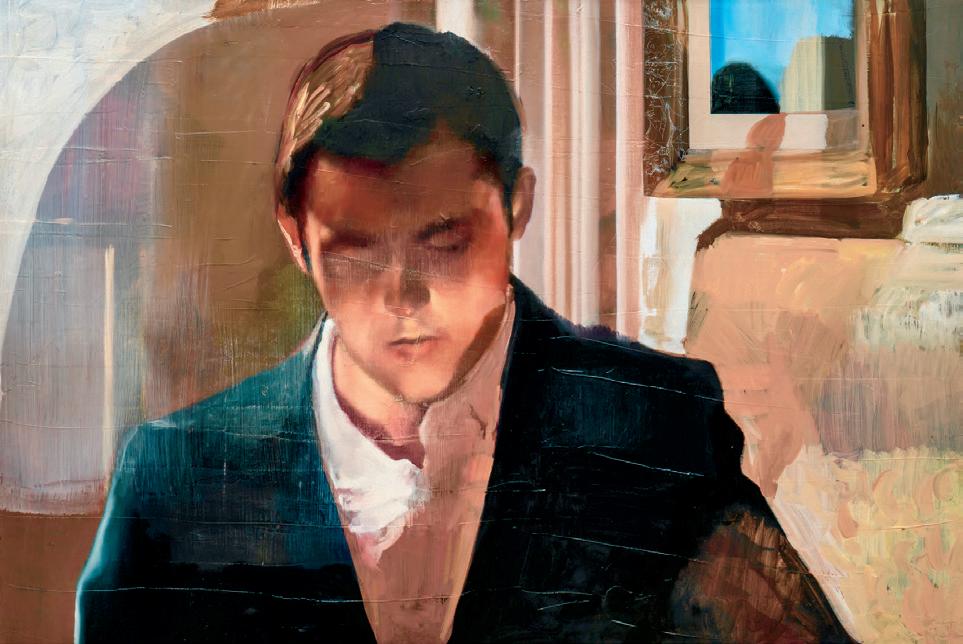
In Interior Motives, Sophia Anthony presents a series of figurative drawings and paintings that combine elements of cinema, art history, and narrative to consider questions of masculinity at Ro2 Art’s new location at 2606 Bataan through Apr. 29. She/ Her, an exhibition of work by women artists, also continues through Apr. 29. Additionally, the gallery will hold a 90thbirthday exhibition for gallery artist Gillian Bradshaw-Smith May 6–Jun. 10. ro2art.com
52 PATRONMAGAZINE.COM
S o p h i a A n t h o n y I n t e r i o r M o t i v e s
18 - April 29, 2023 Ro2 Art Gallery 2606 Bataan St. | Dallas, TX 75212 ro2art.com
March
20
View Sophia Anthony: Interior Motives on Artsy
38 SAENGER GALERÍA
Appearing at the Dallas Art Fair in booth F7, Saenger Galería, located in the Tacubaya neighborhood of Mexico City, will present work by Robert Janitz, Mark Hagen, Haruna Shinagawa, and Yoab Vera. Image: Eduardo Sarabia, Untitled , silkscreen, 25.20 x 16.14 in., edition of 60. saengergalería.com
39 SITE131
In in memoria: Linda + Ed Blackburn , Dallas’ SITE131 recalls the vivid lives and works of two highly respected North Texas artists who died in 2022. Opening on April 19 and showing through Jun. 17, the exhibition features 25 dynamic works of these two prolific and inventive artists. site131.com

40 SMINK
A showcase of fine design and furniture, SMINK is a purveyor of quality products for living. The showroom also hosts exhibitions featuring Robert Szot, Gary Faye, Richard Hogan, Dara Mark, and Paula Roland. sminkinc.com
41 SOUTHWEST GALLERY
Translating scenes of everyday life into nostalgic and blissfully peaceful visions of the world, Robert Hagan has become a premier western artist of our time. Meet Robert Hagan, with a collection of paintings featured in his new book, The Art and Adventures of Robert Hagan, Apr. 1, from 1 to 5 p.m. Bette Ridgeway is known for her large-scale, luminous poured canvases that push the boundaries of light, color, and design. Meet Ridgeway, at her solo show May 20 from 1 to 5 p.m. swgallery.com
42 SWEET PASS SCULPTURE PARK
The space reopens this spring; be sure to check social media for updates on programming. sweetpasssculpturepark.com
43 TALLEY DUNN GALLERY
Letitia Huckaby displays new work in the Main Gallery Apr. 29–Jul. 29, while Sarah Williams highlights the Project Gallery Apr. 15–May 27. Image: Sarah Williams, Florida Street, 2021, oil on panel, 11 x 14 in. Courtesy of the artist and Talley Dunn Gallery. 11 x 14 in. talleydunn.com

53 APRIL / MAY 2023
21
Through July 9, 2023
THE UNFINISHED PROJECT OF LIBERATION
Seven Black contemporary artists explore ideas of emancipation from 160 years ago to today.

44 VALLEY HOUSE GALLERY
From Apr. 8–May 13 an exhibition of paintings by Miles Cleveland Goodwin will be on view. Next, Birds of a Feather: Kathy Boortz and Cindi Holt combines Boortz’s sculpture and Holt’s paintings on May 20. Dallas Art Fair exhibitor, booth F14. valleyhouse.com
45 VARIOUS SMALL FIRES
VSF, newly added to the Dallas gallery landscape, will take part in the Dallas Art Fair, booth B1, Apr. 20–23. Caitlin Lonegan will open Apr. 21, during Dallas Art Fair, and run through May 27 at the gallery. vsf.la

46 WAAS GALLERY
Curated through a lens of sustainability, W.A.A.S. empowers artists to connect to their communities and facilitate societal change while offering an interstellar sanctuary to communicate artistic expression. waasgallery.com
47 WEBB GALLERY
On Apr. 2 Camp Bosworth, Martha Rich , and Uncle Pete Drgac will highlight the gallery space. At Fort Davis, Webb’s Fair & Square sees Jane Reichle and Heather Sundquist Hall on Apr. 8. Back at the main gallery, spiritualists Powell St. John and Helen Burkhart Mayfield will display their wares mid-May. On Memorial Day weekend, the Turquoise show can be seen at the Fort Davis location. webbartgallery.com
48 WILLIAM CAMPBELL CONTEMPORARY ART
A solo debut of Lee Albert Hill , remains on view through Apr. 26 and features a collection of Hill’s most recent series, Semioshphere, from which the exhibition derives its name. Lloyd Martin’s newest series of works will debut in the show Intonate Schemes at the gallery’s Foch Street location through Apr. 26. williamcampbellcontemporaryart.com
AUCTIONS AND EVENTS
01 DALLAS ART FAIR
Dallas Art Fair offers collectors, arts professionals, and the public the opportunity to engage with a rich selection of modern and contemporary artworks presented by leading national and international galleries. Thoughtfully curated exhibitions and innovative programming encourage lively conversations and close examination in a robust and rapidly growing arts community. From Apr. 20–23 see 89 galleries, representing 20 countries and 45 cities from around the globe. The local galleries include 12.26, Conduit Gallery,
54 PATRONMAGAZINE.COM NOTED: GALLERIES 12
Emancipation: The Unfinished Project of Liberation is organized by the Amon Carter Museum of American Art and Williams College Museum of Art. The exhibition is co-curated by Maggie Adler, Curator of Paintings, Sculpture, and Works on Paper at the Carter, and Maurita Poole, Executive Director of Newcomb Art Museum, Tulane University. John Quincy Adams Ward (1830-1910), The Freedman (detail), 1863, bronze, Amon Carter Museum of American Art, Fort Worth, Texas, 2000.15
Cris Worley Fine Art, Erin Cluley Gallery, Galleri Urbane, Keijsers Koning, Meliksetian|Briggs, Peter Augustus, Valley House Gallery, William Campbell Contemporary, as well as design store Sputnik Modern. dallasartfair.com
02 DALLAS INVITATIONAL ART FAIR
Organized by James Cope of And Now gallery, the Dallas Invitational is a new art fair grown out of conversations with galleries, collectors, and curators. It hopes to provide a platform for like-minded galleries to conduct business and meet new friends in an unexpectedly relaxed and intimate setting. The fair will be held at the Fairmont Hotel, Apr. 22–23. Beatriz Cortez, Chac-Mool, after Mayapan, 2022, steel, patina, approx. 54 x 72 x 20 in.; base: 24.25 x 77.75 x 18.25 in. Courtesy of the artist and Commonwealth and Council. dallasinvitational.com
03 HERITAGE AUCTIONS
HA slated auctions for the Apr/May begin with the Photographs Signature Auction on Apr. 4, Urban Art Showcase Auction on Apr. 5, The Franklin Mint Collection: Illustration Art Showcase Auction on Apr. 6, the Depth of Field: Photographs Showcase Auction on Apr. 12, Fine & Decorative Arts Showcase Auction on Apr. 13, Prints & Multiples: Featuring Works by Marc Chagall Showcase Auction on Apr. 19, the Illustration Art Signature Auction on Apr. 25, the Urban Art Showcase Auction on May 3, followed by The BIG Heritage X APPortfolio Urban Art Showcase Auction on May 5, Depth of Field: Photographs Showcase Auction on May 10, American Art Signature Auction on May 12, Prints & Multiples Showcase Auction: Featuring Works by Joan Miro on May 17, and the Pursuit of Beauty: Art Nouveau, Art Deco & Art Glass Signature Auction on May 25. ha.com
04 LONE STAR ART AUCTION
The Lone Star Art Auction is a Texas-sized auction event specializing in the best American, Western, wildlife, sporting, and Texas fine art of the 19th through 21st centuries. The next auction will be held Oct. 28. lsartauction.com

05 THE OTHER ART FAIR
Game-changing artists, original artworks, and more than a few surprises, early bird tickets are now on sale for the approachable programming of The Other Art Fair at Dallas Market Hall. See affordable and original artworks and 130 independent artists with immersive installations, performances, DJs, and a fully stocked bar, May 11–14. theotherartfair.com

55 APRIL / MAY 2023 Bring your Fine Art to Bonhams. We’ll sell it to the world. We are accepting consignments of single items and entire collections. Fine Art specialists are regularly in your area offering in-person complimentary auction estimates of single items and entire collections. Contact us Brandon Kennedy +1 469 361 5887 brandon.kennedy@bonhams.com sell.bonhams.com © 2023 Bonhams & Butterfields Auctioneers Corp. All rights reserved. Bond No. 57BSBGL0808
34
IMMATERIAL PHENOMENA
INTERVIEW BY DAVID NOLAN
orinde Voigt (b. 1977) is a German artist who lives and works in Berlin. She has exhibited extensively all over the world and has had many museum presentations in America.
Most recently, she was commissioned to create murals for the Menil Drawing Institute in Houston in 2019, and then for Soundwaves: Experimental Strategies in Art + Music at the Moody Center for the Arts at Rice University, Houston, in 2022.

Since her earliest years, through the medium of drawing, Voigt has devised a complex and highly developed system of articulating immaterial phenomena as visually engaging compositions. Suggesting the appearance of scientific diagrams or musical scores, these seemingly abstract arrangements encompass a very precise range of references.

Voigt’s intuitive and expressive works evolve from rigorous meditative and observational processes that seek to capture the complexity and velocity of her environment through abstract configurations and systems that depict the intersection of one’s inner world, emotions, and memory with external conditions. Constantly engaging questions of perception, sensation, and presence, the artist has progressively expanded her expression beyond the medium of drawing to experiment with painterly elements, collage, design, and music.
At present, Voigt has an exhibition of new sculptures and drawings at David Nolan Gallery in New York. She was recently interviewed about her relationship to Texas; her new works, which will be shown at Dallas Art Fair; and her vision.
David Nolan (DN): Jorinde, you have been to Texas several times and traveled around the state. What struck you as particularly interesting? The landscape, architecture, the culture?
Jorinde Voigt (JV): A vertical connection to the moon has historically passed through Houston, and communication with the International Space Station has continued from here to this day. At the same time, drilling is being carried out all around Texas under the earth’s surface towards its interior, and oil and water are being extracted from underground. Horizontally, you can see enormous road networks that connect Houston to the wider world: refineries, substations, pipelines, highways that go straight for hours, skunks that have been run over, crocodiles, and herons along the road. A breathtaking natural vastness, magical mangrove forests, and fantastic museums in Texas. Men and women in cowboy boots everywhere.
DN: Your work has been informed by your having played the cello and the piano, as well as having studied in science. I often wonder if the discipline of playing the cello influence the linear fluidity and energy of your drawing. Your father and grandfather were physicists, your mother an artist, and your interest in nature and natural phenomena seem to have influenced your notational and labeling of events such as movements of clouds or birds in flight, and human motion in time and space. You also have been inspired by surrounding nature in your use of color and form. Can you explain the decision-making in what the colored lines suggest, particularly the red and white lines?
JV: The red and white lines in recent drawings such as Potential are a performative imprint, a gestural notation, each from maximally delicate to maximally intense and back to the ephemeral. Drawing the lines is like a breath, a pulse, a rhythm…a rhythmic movement. On one hand, white on blue provides maximum contrasts, while red on blue is a kind of flickering because they have the same hue. Perhaps it is best read musically, as an expression, a communication about a specific simultaneity of delicacy and clarity, vibration and standing directness. Together the lines form a kind of flying structure, a high-level movement, like a swarm. It’s interesting how the detail of each movement translates into a single swarm of energy. The drawing makes this possible at the point that you can look at time from a different perspective.
56 PATRONMAGAZINE.COM
Jorinde Voigt mines complexity and velocity of her environment through abstract configurations.
J
Jorinde Voigt. Photograph by Amanda Holmes.
Jorinde Voigt, Potential I, 2020, India ink, gold leaf, pastel, oil pastel, and graphite on paper in artist’s frame, 55.12 x 82.25 in., framed: 59.37 x 87 x 3.75 in. © Jorinde Voigt. Courtesy of the artist and David Nolan Gallery.
DN: The celestial exploration of the heavens is suggested by the recent work, where sheets of paper were dipped in huge vats of ink, with the natural effect the water has on the paper as you lift the paper out of the colored water. You then draw over the colored sheets with crayon and the donut-like forms are very threedimensional. Are these forms of a specific object or from your imagination?


JV: For me, the donut shape is an archetype: a shape that has a multitude of formulations in the world. Topographically, it is particularly interesting because the inside is simultaneously the outside that seamlessly merge into each other. I see it as a model for our perception: We take external influences into us and translate them seamlessly into chemical, electrical, psychological processes (which change us at the same time) in ourselves. The perception
takes place in our body, and we constantly give impulses into our environment, caused by gravity in the form of contact acoustically, chemically, technically, biologically, through movement. We take in the environment through food, through breathing. We cannot be thought of separately from the environment. The earth’s magnetic field has the shape of a donut, and possibly galaxies. Among other things, the psychoanalyst Jacques Lacan also drew. To illustrate his investigations into desire, he chose the form of interlocking rings. A hole always has a great attraction; something always wants to be in the middle.
I look forward to my exhibition in Texas later this year with Sicardi Ayers Bacino gallery in Houston. P


57 APRIL / MAY 2023 FAIR TRADE
NOW OPEN SATURDAYS Other Days by Appointment 3440 East FM 2147 Marble Falls, Texas USA 78654 MuseoBenini.com | Benini.com 830-693-2147 | 830-385-1471
From left: Jorinde Voigt, Immersion IV (7), 2018, ink, India ink, copper leaf, pastel, oil pastel, pencil on paper, 40.12 x 26 in, framed 44.87 x 29.12 x 3.50 in. © Jorinde Voigt. Courtesy of the artist and Sicardi Ayers Bacino; Jorinde Voigt, Ludwig van Beethoven /Sonate Nr. 16 (Opus 31, Nr. 1), #6, 2012, lithography with graphite and ink, 31.87 x 49.37 in. © Jorinde Voigt. Courtesy of the artist and David Nolan.
THE MAGICAL REALISM OF YIFAN JIANG


An emerging Chinese Canadian artist articulates feelings of fleeting moments at Meliksetian|Briggs.

 BY TERRI PROVENCAL
A difficult relation to conceive—since one eye, one hand, are capable of vision, of touch, and since what has to be comprehended is that these visions, these touches, these little subjectivities, these “consciousnesses of …,” could be assembled like flowers into a bouquet, when each being “consciousness of,” being For Itself, reduces the others into objects. Excerpted from The Intertwining The Chiasm by Maurice Jean Jacques Merleau-Ponty
58 PATRONMAGAZINE.COM
Yifan Jiang in the studio
Clockwise from left: Yifan Jiang, Pelican, 2023, oil on canvas, 60 x 72 in.; Yifan Jiang, Pool, 2023, oil on canvas, 60 x 72 in.; Yifan Jiang, Fall, 2023, oil on canvas 38 x 38 in. All courtesy of the artist and Meliksetian|Briggs.
Drawing from the essay by the French philosopher and existentialist Merleau-Ponty, artist Yifan Jiang examines “one’s relation with themselves and their own thoughts” in a new exhibition, A bouquet of senses. On view at Meliksetian|Briggs April 15–May 20, the solo exhibition includes new paintings and a new animation work, for which she is known.
“In retrospect, I realized [the excerpt] perfectly encapsulates the whole show. It addresses what both the animations and the paintings are getting at,” imparts Jiang, a Chinese Canadian artist who is a current fellow at the Core Residency at the Museum of Fine Arts Houston. Besides this, she says it’s also about, “one’s relationship with their body and how the body is the medium, the conduit through which one experiences the world.”
Jiang is a traditionally trained painter who learned calligraphy growing up in China, through which she discovered “the spirit, speed, and control.” She earned her BFA from Emily Carr University of Art + Design in Vancouver, the Canadian city her family immigrated to when she was 12. “The influence of Emily Carr is always there—the paintings will always look wet.” Painting to her is a performance. “The traces get left there.” But to her it’s also about exploring what is possible. “It’s not that different from science…the vanguard push on the possibilities being dreamed up.” She went on to earn an MFA from Columbia University, where she also taught drawing.
As a student of philosophy, she found it difficult to express concepts in one painting, so she taught herself animation to make the images move. “It’s possible to integrate digital means into painting,” says Jiang. Neighbors, a two-channel installation with a twist, will be on view alongside paintings in the gallery. In Neighbors, investigating the paradoxical structure of the mind, one video shows the view of an inhabitant in an apartment across the street, at the same time, in the other video, someone is watching them. “The voyeur will become the one that is being watched, and the one that is being watched will become the voyeur,” says Jiang. Played simultaneously on a loop, the two channels will be projected on facing walls in the gallery. She says it’s about grappling with your experience of yourself. “When you think to yourself in your inner voice, who’s the

one that’s listening?”
Her animations are a series of paintings that inform the cinematic quality of her oeuvre,” says Anna Meliksetian. Movement is vital too in her paintings, where a giant pink pelican swoops down from the night sky—a memory recalled from a lonely time during her Roswell Artist-in-Residence Program in New Mexico. “I had barely talked to anyone in three months, and you stop thinking to yourself. You stop hearing yourself. You become see-through, transparent, and the landscape becomes much more apparent.” She describes the landscape in Roswell as having a gravitational pull. “The more figurative pieces are trying to articulate those feelings.”
In creative isolation she says, “The highlight of my week while living in the desert was going to the mailbox. So I was sort of stuck in space. I was going to the mailbox one day and a gigantic truck zoomed by. The truck was almost pink. I kept on thinking about the pink truck. Why is it there? All the speed and motion. Power towers, pink dots…it’s not necessarily about what you’re seeing.” These unlikely characters in her practice recall a moment passed, that familiar feeling, memory.... The experience led to Pelican, a large-scale painting, which will be on view at the Dallas Art Fair at the Meliksetian|Briggs booth.
It was at Meliksetian|Briggs that Jiang held her first show in Los Angeles, where collectors were beguiled by her work. “You see reality in the work, but there are these fantastical elements in the everyday,” says Meliksetian. “Even a small painting of butterflies overtaking a landscape erases the banal and brings enriched elements to the ordinary world.”
Bouquet of the senses, Jiang says, is “a show about sensuality, about living in your own body,” where humanoid and animal forms grace the canvas. It’s this constant mining, fueled by her grasp of multidisciplinary channels, that makes this artist one of today’s top young talents. “I’d like to be on that edge of discovery. It doesn’t matter what discipline or which knowledge system you use to make that discovery. It’s more about that forward push, for me, that is curiosity.” P
59 APRIL / MAY 2023
OPENINGS
Yifan Jiang, Neighbors, 2023, two-channel video installation/animation. Courtesy of the artist and Meliksetian|Briggs.
SPRING FORWARD BEYOND THE LIGHT OF TOMORROW
Giangiacomo Rossetti’s languid gestures in waiting at The Power Station.
 BY BRANDON KENNEDY
Looking askance or with downcast eyes, faces in profile while glancing off-camera. A momentary pause built in between, before the next moment, the awaited reply, a shared tenderness, an eventual departure.
Details accumulate from one composition to the next: glinting rings in nose, ear, or on fingers; the rhythm of tulips and matching cardinal against a picket fence; stemmed flora on forearms or tabletop lampshades; an eyed, poised housefly; receding animal tracks in the snow, the notes of bare tree trunks stepping up the beat just ahead.
The artist declined to be interviewed for this article “[as he] often uses himself as the subject in his work…he prefers to keep his voice removed,” says exhibition curator Rob Teeters. Nevertheless, we soon encounter Giangiacomo Rossetti, the painter as subject, navigating a slim architectural passage from darkness into light in Through a Thin Wall (2021). Muted octagonal tiles are cast in shadow as the figure traverses the opening, searching for sure footing, splayed hands outstretched for balance, transitioning into the newness of cast shadows alerting us to form.

Exacting postures and blank expressions befit the muted silences

60 PATRONMAGAZINE.COM
Clockwise from top left: Giangiacomo Rossetti, Untitled after Balla’s Scena spirituale, uomo e donna nel fluido compenetrato di luce, 2018, gouache on panel, 14.5 x 17.5 in. (framed). Courtesy of the artist and Mendes Wood DM; Giangiacomo Rossetti, I cinesi guardano l’ora negli occhi dei gatti, 2016, oil on panel, 25 x 19 in. (framed). Courtesy of the artist and Mendes Wood DM; Giangiacomo Rossetti. Courtesy of the artist and Mendes Wood DM.
that often lie within the compressed filmic compositions of Rossetti’s paintings. Within the appointed environs of an upscale cocktail bar, our gaze meanders across the seeming unease of a young, possibly disconsolate couple loosely tending to their martinis. Just above, an abstracted elongation of colorful skaters on a frozen woodside pond does little to quell their spirits. A perfect screen of cartoon snow counters the somber darkness falling from the table’s edge and below the leather banquette. Everyone has their own strange ideas (2022) is a subtle yet absurd summation of the disparate reads of body language and its crystallization of form as sometimes seen in fashion photography. The protraction of desire as wrung by the lens of disinterested voyeurism. Check, please.

Thrown into the transitory, the tension beginning to sense its own reasoning, making us complicit in its revealing all the while. Perhaps no painting of Rossetti’s (and its carved, vibratory frame) better exemplifies this state of causal transition like the shadowed figure of Orpheus glancing backwards as he reenters the Earthly realm, losing unseen Eurydice unto Hades for eternity.
The third stanza of Sonnet XVI, Book Two of Rilke’s paean to the fateful couple, speaks “… of the spring which is heard here, from which only the dead man drinks, God silently winks, the dead” (my summary translation). The complete stanza in its original German serves as the painting’s title, as fortune’s gatekeeper. The irrevocable moment marked by a loving pause, forever altering the future.

Rossetti also mines art history for iconography and compositional strategies. El Greco’s moody skies and atmospheric landscapes cast a pall over a standing male nude and artist self-portrait suited and attendant below. This painting has a quizzical title in Italian regarding how “The Chinese tell time by the cat’s eyes” (my poetic translation). Again, I think we all can agree that everything is always in flux and yet still all connected here. Clocks and watches are hereby put on notice or should stop altogether.
Rossetti’s figural gestures can also evoke Picasso’s early Family of Saltimbanques or Harlequins or even the tortured poses of Rodin’s The Burghers of Calais in his couples or groupings of figures. Though—in fact, just as often—subjects can alter the picture plane altogether, forcing The American Friend (2022) and his flag shirt face-first before receding trees; or implore our eyes to visually unfold a spooky, pyramidal montage of the gathering of seasonal beans in Crepuscular Harvest (2019).
We are witnesses to the tensions residing in a romantic or situational coupling, whether attitudinal, withholding, or disarming in stature. The possibilities can be furthered by geography, longing suppressed by an austerity in the retelling, or a complexity exaggerated by memory. There’s a compression or an expanse at hand, or—at best— even an opportunity for both to occur.
In more than a nod to the Italian futurist Giacomo Balla, Rossetti deftly reinterprets his Spiritual Scene (1925-30) by re-placing his artist profile self-portrait amidst the spectral waves of light and motion, set aglow by his disembodied hands and intense visionary trance. His gaze is focused beyond, into the cosmic abyss of “man and woman in the fluid penetrated by light”—the subtitle of both Balla’s and Rossetti’s transcendental artworks.
There is a consistent grasping at in-between states here, traversing the chthonic threshold that stands between the known and beyond. We gaze straight into one and back unto the other; it does the same with us. The Milanese painter now living in Brooklyn, the future unto the past. Paintings pausing briefly before speaking to the ether, yet again, forever.
61 APRIL / MAY 2023 OPENINGS
Giangiacomo Rossetti, Everyone has their own strange ideas, 2022, oil on panel, 39.37 x 27.50 in. Photography by Bruno Leão. Courtesy of the artist and Mendes Wood DM, São Paulo, Brussels and New York. Collection Mendes Wood DM; Giangiacomo Rossetti, Mysteries of America, 2022. oil on panel, 39.37 x 27.50 in. Photography by Bruno Leão. Courtesy of the artist and Mendes Wood DM, São Paulo, Brussels and New York. Collection of Mendes Wood DM.
P
The Disappearance and Reappearance of GREGORY RUPPE
Picnic Surf Shapes and Picnic Curatorial Projects unfold at The Power Station.
 BY DANIELLE AVRAM
What need to become immortal through art or culture? Disappearance is erasing the record, off track, no trail, no history. One is in the disappearance already. All one needs is to lose track, to stop recording, to turn off the tape machine, to disappear, it’s all right… It’s OK to disappear.
— Wildflowers: A Bouquet of Theses
John Landau, 1998
62 PATRONMAGAZINE.COM
Disappearing Acts in The Power Station’s garden annex features a solar-powered “tea house” by Gregory Ruppe. A hand-drawn T-shirt by Reagan Kendall flags the space filled with work by Texas-based artists. Photograph courtesy of Picnic Curatorial Projects.
What does it mean to disappear?
Why does the act of disappearing simultaneously fascinate and terrify; one a solace-finding method of mindful disconnection, the other a deep-rooted fear of being lost or forgotten?
Magicians perform calculated acts of prestidigitation designed to astound willing audiences. Countless people go missing each year, seeming to simply dissolve into the ether. Others, such as artist Bas Jan Ader, vanish while performing feats that skirt the edge of madness, forever frozen in time. Toil through the mundanity of daily life and one day realize you’ve aged into another form. Survive a sudden shift, a world-altering change—say, a pandemic—and the life you used to know, the person you once were, is suddenly gone.
Like so many others, the pandemic forced artist Gregory Ruppe into an unintentional state of disappearing, a reflective stasis that had the potential for radical change.
Prior to Covid, Ruppe found himself contending with growing disillusionment about his place within the art world. Over the years he’d worn many hats and tried many things: studying printmaking and sculpture at the University of North Texas and Texas Christian University, respectively; forming the Fort Worth-based art collective, Homecoming!; joining a seven-member psyche-doom band called Solar Lice; creating the space Culture Hole with longtime collaborator Jeff Gibbons, and the brief, but impactful, Swim Club 수영 클럽 with SooMi Han.
“Collaborating, for me has been a means to challenge concepts of authorship, the institution, and one’s own ego, a way to disappear into others to get outside of self,” explains Ruppe. “Over the years and nevertheless, I found these challenges to persist no matter how hard I tried to conceptualize them away. I was leading up to finding ways of (and being okay with) dropping out completely, professionally speaking—at least in my approach to art life.”
Ruppe has also served as the director of exhibitions for The Power Station since 2013, a role that, like many in the arts, has a degree of excitement oriented around collaborative project-hopping. Yet these behind-the-scenes positions possess an inherent sense of institutional cyclicality bolstered by affluence, excess, and an unsettling combination of preserving sanctity through disposability. The art machine is an egregious polluter, one that seems to be making very few strides towards rectifying the need for using an entire home’s worth of construction materials for a single exhibition. Needless to say, Ruppe had grown weary of building and tearing down the same wall over and over again. Beginning a few years ago Ruppe led a change in practices, reducing the carbon footprint of The Power Station’s exhibitions, which today use recycled materials exclusively.
With art programming on pause during the 2020 lockdown, Ruppe leaned into disappearing, ecology, and simply getting back to making for the sheer joy of it. Utilizing the space around The Power Station, he designed and built a hydroponic gardening system, a greenhouse, and a solar-powered building that melded a traditional wooden Japanese teahouse with a corrugated metal shack inspired by Texas parks and recreation buildings.

Then he began to think about surfing.
Ruppe grew up in Houston and started surfing in high school, primarily along the coast of Galveston. He also grew up woodworking and supported himself by working in construction for many years. He employed this skill set to start handcrafting hollow-core stand-up paddleboards (SUPs) and surfboards, overlaying them with custom doodles of trippy characters and imagery rooted in his early years of playing in punk bands. He named the project PICNIC, after a conversation with a friend that heralded the idea of a “picnic for one” as a radical act of self-care.
“When I first saw some of the earliest prototypes,” says Pinnell, “I was struck by the intricate detail and stunning beauty of the boards. They seemed highly personal to me. I wanted to get involved in bringing these designs to a larger audience.”


PICNIC has since expanded to become Picnic Surf Shapes, a functioning surf shop, and Picnic Curatorial Projects, an endeavor that allows Ruppe to continue a conceptually rigorous, collaborative program. Ruppe and Pinnell celebrated the brand’s launch in early March with an exhibition of works by artists who also produce custom pieces ancillary to their primary artistic practices. Works by SOUP [ceramics], Specific Objects, Squiggle and Dash, Super Hit Press, and Reagan Kendall mingled alongside limited-edition PICNIC offerings including a zine, T-shirts, and koozies made from repurposed wetsuits.
Ruppe’s project is reminiscent of the humble beginnings of Yvon Chouinard, the founder of Patagonia. A former billionaire who dedicated his fortune to fighting climate change and centered his company around the motto Let my people go surfing also declared, “If you want to understand the entrepreneur, study the juvenile delinquent. The delinquent is saying with his actions, ‘This sucks. I’m going to go do my own thing. ’” P
63 APRIL / MAY 2023
The Power Station owner Alden Pinnell was quick to jump on board.
CONTEMPORARIES
Installation views feature a handcrafted surfboard by Gregory Ruppe, a bench by Specific Objects (Ryan Goolsby), work by Jessica Ninci, and Soup Ceramics (Summer E. Aquino and Jeff Gibbons). Photograph courtesy of Picnic Curatorial Projects.
THE WAY OUT
Joe Minter's African Village in America is filled with his sculpture sourced from scrap metal, flea markets, and street castaways.
BY CHRIS BYRNE
Born and based in Birmingham, Alabama, Joe Minter is the son of a caretaker of a white cemetery. Drawn to art at a young age, his African Village in America, conceived in 1980, pays homage to African American history through sculpture, from the time of the first arrival of enslaved Africans to the present.
Spurred by a work on view at the Nasher Sculpture Center, Chris Byrne interviews the artist here:
Chris Byrne (CB): The Nasher Sculpture Center recently installed Working Our Way Out of the Ghetto (2008) in the museum’s Foundations gallery, to accompany the current Mark di Suvero: Steel Like Paper exhibition— can you tell us about your piece?
Joe Minter (JM): You know, for us living in the inner city, one formula for us to work our way out was sports. We could take an old rim off of a bicycle tire and nail it to a wall or telegram post. A lot of us saw sports as a way out. There weren’t a lot of ways out.
You see the hands and the prison bars; the prison system was the way so many made it out. The chains and plow show the system of Jim Crow sharecropping. Our ghettos weren’t always in the city.
CB: Your sculptures are typically assembled with found materials...

JM: My materials come from flea markets and the street and anywhere people have used materials and don’t want them anymore. There is so much waste in Birmingham [Alabama]. They call it the magic city because of the steel, and that’s the material I work with. We had all the raw materials here to make steel. We were the industrial capital of the South.
CB: In 2016 you visited Dallas to participate in a panel discussion with your lifelong friend, the art patron Bill Arnett—what was your impression of the city?
JM: Dallas to me was a rich city because of the black gold. That was the first time I went to Dallas, and I didn’t think I’d ever make it there. But I remember I came across the old TV show called Dallas, but I don’t watch TV unless it’s the news or PBS. I didn’t pay
64 PATRONMAGAZINE.COM
Joe Minter, Working Our Way Out of the Ghetto, 2008, sports equipment (tennis rackets; boxing gloves; baseball glove; football, baseball, and equestrian helmets; masks; basketball goals; baseball bat), trumpet valves, rubber gloves, pipe hangers, chains, plowshare, and found metal, 76 x 96 x 32 in. Collection of Brett and Lester Levy, Jr., Dallas. Photograph courtesy of Pierre Le Hors.
attention to the show. I’m interested in current events. So I didn’t know much about Dallas. What I saw of Dallas seemed like a place I could get lost in. The people were nice. I was like a grain of lost sand there. A fish out of water. It was so much different than what I was used to.
CB: When did you first meet Bill?
JM: I met Bill in the mid-1990s.
CB: Prior to your meeting, Bill had been collecting art from ancient Mediterranean cultures, dynastic China, India, pre-Columbian Americas—in the late 1970s, he began to focus almost exclusively on sub-Saharan Africa, later establishing the Souls Grown Deep Foundation to secure the legacy of Black artists from the South and their cultural movement...
JM: It was just like the bird that fed Elijah. God had a mission for Elijah, one of his favorite prophets. So he set him under a tree. God sent the bird to nourish Elijah. God stopped sending the bird so that Elijah would begin his journey. I call Bill the Trailblazer. The Trailblazer who went all over the world studying all the different art forms only to come back home to his backyard, the Southeastern states, to discover, just like Elijah, his mission. And that mission was to come upon the African American culture and be able to understand the rich history that could be found in the rural and urban areas of the black belt. When he made it to me, he told me that he had just about completed his journey, and this would be his last effort to get the African American experience recognized in
our home country. He went and banged on the doors of museums and everywhere trying to get them to pay attention to us. He was the Trailblazer. He was like Muhammad Ali. He took a beating from the top museums to the bottom. From the front doors to the side doors to the back doors. But like Ali, he floated like a butterfly and stung like a bee. He never gave up. Thank God for him. Without him I wouldn’t be here. Lonnie Holley wouldn’t be here. No Thornton Dial. No Gee’s Bend quilts.
CB: Can you provide an update about your yard environment in Birmingham entitled African Village in America?
JM: Out of my heart and out of my soul as being a father… Matt Arnett, one of Bill’s sons, has faithfully given all of his heart and soul to helping me preserve my African Village. A lot is still to come, but there are many people now working on this effort thanks to him. And hopefully this will be available for generations to come. I’m thankful for all who are involved.
CB: What upcoming projects can we look forward to?
JM: My friend Lonnie Holley created a show in Los Angeles and is showing my work. It’s also going to be in Miami at MoCA / North Miami in a show with Lonnie. I’ve been painting more. My thing about paint is I had to find another way to tell a story. And painting was that way. They say a picture is worth a thousand words. A painting is worth a lot more words. We go through phases in our arts, and painting has always been a phase for me. P

65 APRIL / MAY 2023
CONTEMPORARIES
Joe Minter. Photograph by Matt Arnett.
A( WILD) WOMAN’S WORLD
Long overdue, Kaleta Doolin’s survey exhibition unites more than three decades of her feminist art.
BY EVE HILL-AGNUS PHOTOGRAPHY BY KEVIN TODORA
When I arrive at the artist and philanthropist Kaleta Doolin’s studio in East Dallas on a Wednesday afternoon, I find her in the space with her cat, Hey Baby. Within what feels like five minutes, she has shown me T-shirts printed with the words “Eve and Adam,” her reworking of assumptions about Genesis. These will be part of her upcoming survey exhibition, Crazier Than Crazy Quilts, at Erin Cluley Gallery and Cluley Projects. It has been years now that she has been taking on the patriarchy.

Doolin is the daughter of a father who famously invented Fritos and Cheetos and founded the current Frito-Lay Company, and a mother who introduced her to crafts. One of four siblings, Doolin yoked their conceptualism and fabrication, melded art and physical matter. What she loves in her work is achieving what she calls alchemy. Rigid becomes malleable or soft like skin—in filigreed steel handkerchiefs or smooth, alabaster carvings. She makes steel waterfalls and metal afghans looped from tire chains carefully sewn and crocheted into imposing lattices.
Doolin has never shied away from controversy or speaking her

66 PATRONMAGAZINE.COM
Kaleta Doolin in her East Dallas studio.
Kaleta Doolin, Steel Hankie #1, 2023, patinated, cut, and collaged zinc-plated steel, 8 x 8.50 x 6 in.
mind, from paradox or dichotomy. We pull out one of her series, called Dirty Dozen, which features men’s neckties slyly embroidered with slang words for male genitalia. Sculptural, they are textile books, their tongues like pages. She has forayed into a dozen or so films. (The first featured her nursing her son, because, she says, she was so fascinated and smitten.)
But I am moved to turn the pages of one of six editions of her seminal work that takes on male hegemony. In completing a feminist studies class while earning her MFA at Southern Methodist University, Doolin realized that the canonical textbook, H. W. Janson’s History of Art, excluded female artists. Horrified, she cut a neat, vulvar shape down through its pages and threaded a red ribbon through it, like menstrual blood. She titled it Improved Janson: A Woman on Every Page. It was time to be vocal.
When we cross busy Columbia Avenue to her metal shop, which resides in a historic fire station, I discover her plasma cutter, bronze polisher, and forge. “This is where I’m happy,” she tells me, pointing to a photo on her phone of herself wearing a leather welding apron at the foundry where her metal sculptures are cast. This is how her now-husband, Alan Govenar, first met her, looking like Rosie the Riveter in a kerchief and work clothes. Once, she poured molten steel down the tongue of her boot. But her love of metalworking has not waned.

People have come to know Doolin for the eponymous Kaleta A. Doolin Foundation, the feminist nonprofit organization that brings works by female artists to museum collections and advances the causes of women and girls. But she calls her inheritance, in 2015, an “accident of fortune”: “…the accident of my birth. I didn’t choose that, but it’s available to me,” she says. “So the way I’ve weaponized it is part of my creativity.”
Already, however, she had had a lengthy social art practice. In 1990, she bought the fire station to house the 5501 Columbia Art Center, which she co-directed from 1992 to 2001. Wanting students to have shows with openings, she welcomed them into the fire station twice a year for a weekend. Hence “The Frame Project” was born. A Sunday afternoon circle allowed female artists to talk shop, air their frustrations, and process. “There are so many obstacles for women,” she says. “One at a time, I can help them over a hurdle.”
Throughout the ’90s, Doolin acquired a total of six neighboring lots, some with buildings on them, for $6,000 or $25,000, applying for grants and leading her social programs on shoestring budgets. It was, she says, “exhilarating.”
Now the renovated fire station holds the metal shop where she punches steel into perforated doilies, like industrial valentines, and cuts rusted steel into oversize lace, domesticity taking on new
valences. Other pieces riff on the auger shape she first saw as a child in her father’s factory.


Since the foundation hired an executive director, Doolin has been able to spend most days in the studio. “I’m trying to correct it,” she says—“it” meaning the entire misogynistic apparatus. Her mind teeming with images and ideas, she employs her diverse media to assail the system through originality and her wry, witty, trenchant social critique. “I want to deny anyone from pigeonholing me,” she says. She will not be confined to a box. Not as a philanthropist. Not as a feminist. Certainly not as an artist.
As we stand surrounded by pieces for the upcoming show, she mentions the workshops of artists Phyllida Barlow and Nicole Eisenman, which she has visited, witnessing their teams. This is what she would like to move toward, a model where she might have assistance to go bigger, bolder. It’s simple, she says: “I want to keep doing it.”
She now has a studio in Brooklyn as well, with duplicates of all her metalworking tools. Otherwise, she lives a modest life. P
67 APRIL / MAY 2023
Kaleta Doolin, Steel Afghan, 2005, chain, dyed wool, and commercial yarn, approximately 60 x 40 in.
STUDIO
Kaleta Doolin, Steel Lace, 1987-1988, rusted steel, 28 x 34 x 11 in. chain links, chain, patina, paint, and found objects, 91.50 x 91 x 2 in.
UOVO MOVES IN
BY TERRI PROVENCAL
A
rt shipping, installation, and storage aren’t sexy, but finding and using the best of these services is crucial. At Dallas Art Fair, director Kelly Cornell says, “We must get asked a dozen times a day during Dallas Art Fair for reasonably priced shipping services. To protect their new investment, we always tell our collectors to do it right the first time. We’ve all heard those horror stories.”
“A key part of my responsibility as an art advisor is to safely ship, store, and hire skilled installers,” says John Runyon of Runyon Arts. “The demand for quality art handling and storage has continued to grow. Simply put, there are more collectors and more art than ten years ago in DFW. The amount of quality climate-controlled space worthy of storing valuable collectibles has decreased because some companies are at capacity.”
Howard Rachofsky concurs. “Art is high value and requires a lot of tender loving care.” The Warehouse and Unified take good care of collectors in that regard, but he is pleased to welcome and partner with a newcomer called UOVO, which he had a hand in recruiting to North Texas. “Dallas has a shortage of high-quality art storage, so it was natural to invite them to consider opening a facility here.”

UOVO was founded by art collectors for collectors, which makes the company uniquely poised to anticipate the needs of both collectors and galleries. Rachofsky says he uses UOVO storage in New York because it is the best, state-of-the-art facility. “I got to know the owners socially and went to see one of their New York facilities and was very impressed.”
“Touring their facilities in New York was all in the interest of creating new archival storage space opportunities for my clients and the DFW collecting community,” says Runyon, who urged them to open here. “I am especially interested in accurate humidity control, security, and pristine viewing rooms. Not to mention their interactive inventory portal is state of the art, a unique software free perk for UOVO clients.”
“We have always looked to take an innovative approach to meeting our clients’ needs—most recently adding a client portal that allows clients access to their inventory in storage and the ability to view important documents and make service requests,” says Caroline Page-Katz, UOVO’s president and COO.
Real estate executive and art collector Steven Guttman envisaged UOVO; its first home was in Long Island City. “Since its founding, UOVO has been committed to providing best-in-class solutions to our clients, who include private collectors, museums, galleries, artist estates and foundations, fashion houses, archives, and global institutions,” says Page-Katz.
With a climate-controlled 85,000-square-foot facility in Las Colinas, UOVO Dallas has everything their distinguished clientele needs in storage solutions. “A unique offering UOVO is bringing to the Dallas market is private storage,” says Page-Katz. “These are private rooms that can be accessed by the client and are custom designed for the collections’ specific needs—including bespoke racking, workspace, viewing walls, and more.”

In additions she says, “The facility has 22-foot ceilings, multiple loading docks to accommodate tractor trailers, and two viewing galleries ideal for private showings, photography projects, and conservation work, amongst other things.” The facility has a dedicated section for monumental outdoor sculpture storage. Lastly, she says, “We always strive to create a space where clients feel comfortable working. The facility has an inviting reception area, a fully stocked client café, and plenty of on-site parking.” P

68 PATRONMAGAZINE.COM
CONTEMPORARIES
An ultramodern art storage and shipping solution has made its way to Dallas.
All images courtesy of UOVO. Photographs by Halkin/Mason Photography.
When you have melanoma, you need comprehensive care from renowned physicians, advanced treatment options, leading edge technology, and clinical trials. But you also need to keep being Mom. With more than 280 locations across the state, Texas Oncology provides expert skin cancer care and keeps you close to friends and family. Because sometimes the best choice is both.
1.888.864.4226

TEXAS ONCOLOGY .COM EXPERT SKIN CANCER CARE RIGHT WHERE YOU LIVE.
AL FRESCO
The Molteni&C Outdoor Collection brings refined nuance to the natural elements.


fabulous
BY TERRI PROVENCAL
Since 2016, Belgian polymath Vincent Van Duysen has continued to bring his architecture, interiors, and product design prowess to Italian luxury as the creative director of Molteni&C and Dada. Designing three collections to choose from, Van Duysen reimagined the esteemed brand’s indoor collection for outdoor living spaces through original designs by select Molteni&C partners.
Luca Meda’s classic Palinfrasca Sofa of the ’70s, for example, was reissued in solid teak and recycled waterproof polyester fiber upholstery for the Landmark Collection. Van Duysen’s Timeout Collection takes its graceful form-follows-function cue from modernist architecture. Fans of Gio Ponti’s midcentury D.154.2 armchair are in luck with an al fresco reissue of the curvaceous wraparound for the Heritage Collection. Seeking sun- or shade-soaked relaxation? Ponti’s handsome D.150.5 solid wood chaise longue, designed for the cruise ship Andrea Doria in 1952, is just as at home poolside.
For distinctive outdoor spaces, interior designers look to Molteni&C’s fine Italian craftsmanship, according to Ramon Longoria, the director of the Dallas flagship showroom. “Our clients come to us for sumptuous clean-lined furnishings that will stay relevant over time and age gracefully.”
New rugs by Van Duysen, Nicola Gallizia, and Marta Ferri, who also curated an outdoor textile collection, consummate picture-perfect en plein air. “Designers often work for families and couples with more than one residence, and while they want to maintain that elevated consistency and signature style, they look to add a unique element here and there,” says Longoria. Foster + Partners’ Arc table in a cement finish and Ron Gilad’s Panna Cotta coffee table in two sizes offer two excellent options. P
70 PATRONMAGAZINE.COM
SPACE
Clockwise from top left: Molteni&C’s Palinfrasca chaise longue adds outdoor elegance combined with the D.150.5 lounge chair by Gio Ponti; Foster + Partners Arc sculpture table; Vincent Van Duysen pays tribute to Luca Meda’s 1994 imagining with the Palinfrasca sofa.

Christopher McGuire Luxury Real Estate Advisor christopher.mcguire@compass.com m 214.454.1128 Experience. Service. Results. Experience matters when it comes to luxury real estate, and with over 20+ years of advising clients in the market, I have the expertise you need to make your next move a success. So if you’re ready, reach out, and I’ll work with you to find the best solutions for today’s market! All material presented herein is intended for informational purposes only. Information is compiled from sources deemed reliable but is subject to errors, omissions, changes in price, condition, sale, or withdrawal without notice. All measurements and square footages are approximate, but not guaranteed and should be independently verified. This is not intended to solicit property already listed. Nothing herein shall be construed as legal, accounting or other professional advice outside the realm of real estate brokerage. Compass is a licensed real estate broker. Equal Housing Opportunity.
FUTURE SHOWCASE
Patricia Urquiola upholds a more socially and environmentally conscious approach for Cassina.
BY ELAINE RAFFEL
For almost a century, Italian luxury brand Cassina has been designing the future of interiors.

Credit a pioneering attitude combined with a commitment to research and innovation. That sort of forward thinking comes naturally to company art director and architect/designer Patricia Urquiola, who joined Cassina just shy of its 90th birthday. “When you become 90 years old, you have to decide whether you want to rebegin and get a new youth or you want to take all your past with you,” she says.
Today, Urquiola and Cassina CEO Luca Fuso are leading the company down an exciting path that includes major expansion into the US market. Following a splashy launch at this year’s Miami Art and Design Week in December, the pair were in Dallas to open a 2,100-square-foot space inside Scott + Cooner’s showroom. The result is a covetable assortment of the brand’s furniture, carpeting, art, and décor. “For seven years this has been an evolving concept,” says Urquiola. “From the beginning there have been very interesting dialogues. Working with Luca and the whole team was a collaborative effort; there was a lot of interaction. We believe in this kind of continuous accumulation of energy.”
Merging the best of all worlds, The Cassina Perspective
showcases a curated mix of new products and iconic pieces from both the masters and up-and-coming designers—eclectic yet complementary, historically significant but unequivocally forward thinking. “I think a company with as long a story as Cassina you want to drive in different ways. A lot of points of view get crossed,” says Urquiola.
Consider, for instance, a swoon-worthy Philippe Starckdesigned bed. More than a supremely stylish piece of furniture, the headboard can be fitted for reading lamps, sound-absorbing panels help reduce noise, and a purifying fabric encourages the natural circulation of air. As Cassina continues to renew its commitment to a more socially and environmentally conscious approach, Urquiola says seeking out new materials is essential. “For me, it’s regenerated, upcycled materials that have beautiful comfort, and there are many new ways to do this.”
Other A-list designers and architects who have joined forces with Cassina include Gio Ponti, Vico Magistretti, Gaetano Pesce, Piero Lissoni, Tobia Scarpa, and Mario Bellini. “You have to always be open to new partnerships—not just in design but in production and other areas. It’s about real conversations and the serendipity that comes with working with different teams. Then, in the end, things work,” says Urquiola. P
72 PATRONMAGAZINE.COM
SPACE
Cassina Sengu Sofa designed by Patricia Urquiola. Photograph by Valentina Sommariva.
Honoring Joseph Hubach & Gene Jones


Presented by

Join
May 3, 2023 | 12:00 PM
To purchase tickets, please call 214.520.3930 or visit at taca-arts.org/silvercup
 Elaine Agather and Andy Smith, Co-Chairs
us as the North Texas arts community gathers to celebrate the outstanding contributions of Joseph Hubach and Gene Jones.
FIFTEEN FOR 15
DALLAS ART FAIR, CONNECTING GALLERIES WORLDWIDE WITH THE ARTS COMMUNITY AND COLLECTORS, MARKS ITS ANNIVERSARY.
BY STEVE CARTER, NANCY COHEN ISRAEL, TERRI PROVENCAL, AND DARRYL RATCLIFF
Make way for Dallas Art Fair’s 15th installment, which promises to be a spectacular showing of 88 galleries from 28 countries and 48 cities. Patron’s coverage of 15 galleries representing 15 artists of note pays homage to the anniversary.


LAUST HØJGAARD at GALERIE DROSTE, Düsseldorf and
Paris
Intending to open up new perspectives, Galerie Droste’s program illustrates cultural and social trends. A delightful example is the oeuvre of Danish artist Laust Højgaard (b. 1989), who lets his exaggerated and distorted band of misfits determine his process of creation to carry a surreal version of reality. Working straight from his imagination, Højgaard paints spontaneously, direct to canvas, and allows his contorted characters, most with writhing muscles and tiny heads, to determine the textures and brushstrokes. Mythology, gigantism, pop, and urban culture play roles here.
“He starts out with very rough canvases containing a lot of linen fibers, inherent in structure,” says Galerie Droste manager Friederike Meyer. “He then goes and creates layers with paint, his brushes, as well as spraying techniques, never completely hiding the layers beneath. Thus they get a painterly feel to them that combines a fable for street art and the brushstrokes of classical paintings.”
Højgaard is known for working on several paintings simultaneously, which brings fluidity to his work, which he describes as portraiture. The artist enjoys “a predilection for everything mystical combined with a cubistic sense of aesthetics,” says Meyer.
The artist’s paintings will be available at Galerie Droste’s Dallas Art Fair booth. Look for finely wrought details coupled with humorous titles like Vulture Princezz Luvs Trouble, and Sad Girls Luv Protein. His show, What We Did When the Sun Turned Green, is on view at the gallery’s Paris outpost through May 6. –Terri Provencal

74 PATRONMAGAZINE.COM
Clockwise from left: Laust Højgaard, Sad Girls Luv Protein, 2022, acrylic on linen, 23.50 x 16 in. Courtesy of the artist and Galerie Droste; Laust Højgaard, Vulture Princezz Luvs Trouble, 2022, acrylic on linen, 47 x 59 in. Courtesy of the artist and Galerie Droste; Laust Højgaard. Courtesy of the artist.
YURI YUAN at ALEXANDER BERGGRUEN, New York City
New York’s Alexander Berggruen is relatively new to the city’s art horizon, but their inaugural visit to the Dallas Art Fair this year won’t be the first for the eponymous gallery’s namesake. Owner Alexander (Alex) Berggruen has bona fide art gallery DNA, with his parents’ legendary Berggruen Gallery a San Francisco go-to since 1970. Alex came to Dallas Art Fair in 2019 to help work their booth and assesses, “It was a great crowd, a positive environment…there’s a good energy to it.” Alexander Berggruen will be featuring six artists for its premiere: Freya Douglas-Morris, Nicasio Fernandez, Emma Fineman, Cara Nahaul, Ross Taylor, and Yuri Yuan. It should prove to be an auspicious debut.
Yuri Yuan, one of the gallery’s represented artists, has so far had two solo shows there: 2022’s Dark Dreams and 2021’s River Flows in You. Alex Berggruen has admired Yuan’s work since her graduate school days at Columbia, and his enthusiasm is palpable. “Yuri is someone we’re fortunate to represent…it’s been a pleasure to work with her,” he says. “Something that was apparent to me from first getting to know her work, and something I’ve really enjoyed following, is that she has a keen understanding and eye toward art history, an appreciation for that, and a desire to make her own mark within that realm. And I really appreciate the look into the human psyche that Yuri makes with her work.”
 Alexander
Berggruen will be bringing two of her recent paintings. –Steve

 Carter
HUGO MCCLOUD at LUCE GALLERY, Turin, Italy
Luce Gallery, based in Turin, Italy and founded in 2009 by Nikola Cernetic, is exhibiting work by Hugo McCloud, an artist known for his innovative use of materials and textures in his figurative and abstract compositions, which have included tar, aluminum sheeting, and oxidized steel plates. Recently, McCloud is most known for his manipulation of the single-use plastic bags that he gathers from the streets and then gives new use as the materials of his canvases. It seems almost impossible that the plastic bags many of us have used and discarded could become material for stunningly beautiful paintings, yet McCloud renders compelling scenes in vibrant colors over and over again.
McCloud’s figures are less about individuals than archetypes, namely the often-unseen class of laborers and street vendors who are essential to the urban fabric. There is often the feeling of transit, mobility, and a sort of burden. People are carrying things, holding things, often at the same scale or larger than the figures themselves. His works contain commentaries of societies, identities, environments, exploitations, and labor, and his ability to tackle this complex subject matter and create something beautiful is laudatory.
–Darryl Ratcliff
75 APRIL / MAY 2023
Top: Yuri Yuan in the studio, New York, NY, 2022. ©2022 Photograph by Johnny Le. All rights reserved. Courtesy of the artist and Alexander Berggruen, NY; Left: Yuri Yuan, Night Walk, 2023, oil on linen, 48 x 36 in. Photograph by Philipp Hoffmann. © Yuri Yuan. Courtesy of the artist and Alexander Berggruen, NY.
Hugo McCloud, Carb Loaded, 2021, plastic merchandise bags on wood panel, 71 x 61 in. Courtesy of the artist and Luce Gallery, Turin Italy.
SAM GILLIAM at HOLLIS TAGGART, New York City

Hollis Taggart has been a force to be reckoned with on the New York gallery scene since 1979; their current location in Chelsea includes both street-level and 2nd-floor exhibition spaces. Currently the gallery represents 17 artists, reps the estates of eight more, and offers works from scores of others, many of them blue-chip giants. Hollis Taggart is a seasoned veteran of several Dallas Art Fairs; last year they spread their wings across two booths, one contemporary and one postwar. And what to expect for 2023? “It’ll be a group show of postwar artists,” says Lydia Furuta, the gallery’s associate sales director. While the selection of artists wasn’t quite finalized at press time, works by Michael (Corinne) West, Dusti Bongé, Grace Hartigan, Adolph Gottlieb, Alexander Calder, Norman Carton, Albert Kotin, Pablo Atchugarry, Theodoros Stamos, Chloë Lamb, and Sam Gilliam are expected, a similar lineup to last year’s. Sam Gilliam, who passed away in June 2022, is well-known to Dallas cognoscenti, no doubt familiar with the Dallas Museum of Art’s 2016 acquisition, Leaf, an epic-scale example of his Drape paintings. Furuta comments, “We do have good clients for his pieces, and we do try to get his works in the gallery; we never have more than a handful, and they tend not to stay very long.” Untitled, a Gilliam watercolor on paper from 1971, is a standout. “It’s a beautiful piece,” Furuta continues. “If you imagine it larger it would look just like one of his draped canvases—it’s a very nice example.” –Steve Carter
AMELIA LOCKWOOD at THE VALLEY, Taos
Taos, New Mexico’s The Valley is making its sophomore appearance at the Dallas Art Fair this year, presenting four artists: Travis Boyer, Sophia Heymans, Fernanda Mello, and Amelia Lockwood. Any takeaways from last year’s visit? “It was wonderful,” enthuses owner/curator Arielle (Ari) Myers. “I think the part that was most exciting for us was that we met a number of Dallas-based collectors who’ve continued to be really supportive of our program and have gotten interested in the artists that we show.” Currently representing five artists and offering works from another 14, The Valley’s focus is on early career artists, local and national, with a particular embrace of “magic and mysticism, craft practices, and connection to place,” according to its mission statement, as well as a commitment to honoring the region’s indigenous populations.
Sculptor and ceramicist Amelia Lockwood has been with The Valley from early on; indeed, Ari Myers has known her and her work since they were grad students together, and she witnessed Lockwood’s evolution. “The work she’s doing now is very different than anything else that’s out there—she’s one of one,” Myers observes. “I really appreciate how her work is full of mystery but simultaneously full of a kind of a playful quality as well.” The Valley plans to bring six new medium-scale Lockwood pieces—“medium” being the best fit for the booth, since her large-scale works can be human size. “Amelia’s visual language is so unique to her, and I think it’ll be something that will really resonate with folks in Dallas,” Myers predicts –Steve Carter


76 PATRONMAGAZINE.COM
Sam Gilliam, (1933-2022), Untitled, 1971, watercolor on paper, 23.25 x 35 in., signed, dated, and inscribed lower right: “Sam Gilliam ’71 - 7/16.” Courtesy of Hollis Taggert.
From left: Amelia Lockwood, rotating twins, 2022, stoneware and glaze, 30 x 23 x 23 in. Courtesy of the artist and The Valley; Amelia Lockwood, purple pleione, 2022, stoneware and glaze, 27 x 24 x 15 in. Courtesy of the artist and The Valley.
YU-WEN WU at PRAISE SHADOWS ART GALLERY, Boston


Founded in 2020 by Yng-Ru Chen, contemporary, Boston-based Praise Shadows Art Gallery is presenting work by an interesting multidisciplinary artist, Yu-Wen Wu, who was born in Taiwan and is also based in Boston. Wu’s work includes site-specific video installations, large-scale drawings, community-engaged practices, and public art. Her work takes on the issues of global migration, environmental displacement, and the immigration experience.
Jerry Saltz named Yu-Wen Wu’s Walking to Taipei as one of the top ten shows in New York in 2022. This work, a monumental collage scroll of Google walking directions she received in 2010 to visit her sick grandmother when she couldn’t afford the flight to Taipei, is emblematic of the deep poetics in Wu’s work.

Wu’s drawing The Moon Has Been Observing the Earth is a beautifully detailed drawing of the moon in blue ink that feels like it might scatter away if you breathed too hard in its direction. The lovingly written script reads “the moon has been observing the earth close up longer than anyone. It must have witnessed all the phenomenon occurring—and all of the acts carried out on this earth. But the moon remained silent…” With that the viewer can be launched conceptually a thousand different ways, and even the blue of the moon takes on additional meaning beyond the obvious pun. –Darryl

77 APRIL / MAY 2023
Ratcliff Yu-Wen Wu. Photograph by Edward Boches.
From top left: Yu-Wen Wu, Accumulation of Dreams VI, 2023, graphite, gold ink, 18 carat gold leaf on Arches paper, 22.50 x 45 in. unframed, 30 x 50 in. framed. Signed on recto; Yu-Wen Wu, The Moon Has Been Observing the Earth, 2022, graphite and blue ink on Dura-Lar, 43 x 43.50 in. Photograph by Will Howcroft. Courtesy of the artist and Praise Shadows; Yu-Wen Wu, Nocturne, 2010, graphite and acrylic on Bristol, dimensions variable. Photograph by Will Howcroft. Courtesy of the artist and Praise Shadows.
MADELINE DONAHUE at HESSE FLATOW, New York City
From snuggling with a toddler to the nightly challenge of making dinner, Madeline Donahue’s work strikes a universal chord. While parenting is a constantly evolving experience, bouncing from triumph to trial and everything in between, rarely do these quotidian events find their way into contemporary art. For Donahue, however, they provide an endless supply of inspiration for her drawings, paintings, and ceramics.
The Houston-born Donahue currently lives in Brooklyn. At this year’s Dallas Art Fair, she is the featured artist of New York–based Hesse Flatow. “Drawings are the core of her practice,” explains gallery manager Rana Saner, adding that it is a medium that Donahue can balance with the responsibilities of motherhood.
The effects of the pandemic, with everyone at home and parents juggling childcare with their own work, puts this into sharp focus. “People feel so seen and represented in her images,” Saner says.
Children respond to this work as much as their parents. Whether it is Donahue’s vibrant use of color in the paintings, the familiar medium of colored pencil in the drawings, or the pure joy in the ceramics, her work is immediately accessible.


For Saner, the fact that Donahue brings herself to the canvas in myriad ways, between enjoying time spent with her children, doing household chores but also actively making art, makes her work especially poignant. “People open up when they see her work,” she says, adding, “That level of connection is so strong.” –Nancy Cohen Israel
TIFFANIE DELUNE at GALLERY 1957, Accra, London
It’s just over seven years ago now since Marwan Zakhem opened Gallery 1957 in Accra, Ghana. The gallery has now expanded to three locations in its city of origin, and in October of 2020 a London branch joined the ranks. Founder/ director Zakhem is a Lebanese-born British businessman who launched Gallery 1957 as a haven for his own contemporary art collection, but more significantly it’s the realization of his vision for championing acclaimed West African artists; the roster today numbers 25, with another 28 exhibited artists. Gallery 1957’s endeavors include an artist residency program and The Yaa Asantewaa Art Prize, an award that recognizes and celebrates female African artists. This year marks the gallery’s maiden voyage to the Dallas Art Fair, and it’s a great opportunity to get acquainted with Accra’s first internationally operating contemporary art gallery.
Gallery 1957 expects to feature four artists at the fair: Arthur Timothy, Gideon Appah, Cornelius Annor, and Tiffanie Delune, who signed with the gallery late last year. She’s currently doing a residency there, and her first solo exhibition with Gallery 1957 (Accra) opened on March 29. Angelica Litta Modignani, Accra’s gallery manager, says they were introduced to Delune’s work by a collector in Paris in 2021 and enthuses, “Her visual language is very powerful, with strong symbolism. I was impressed with the dreamlike and unique use of textile.” Delune, of French and Belgo-Congolese heritage, is a magician, a visual storyteller, whose work hasn’t been shown in Dallas before. –Steve Carter
78 PATRONMAGAZINE.COM
From left: Madeline Donahue, Nail polish, 2023, oil on canvas, 46 x 36 in. Courtesy of the artist and Hesse Flatow; Madeline Donahue, Dining Table, 2023, colored pencil on paper, 17 x 14 in. Courtesy of the artist and Hesse Flatow.
LILIANA PORTER at POLÍGRAFA OBRA GRÀFICA, Barcelona,
Spain
From left: Liliana Porter. Courtesy of the artist and Polígrafa Obra Gràfica; Liliana Porter, Triángulo, 2021, etching with collage, 19.88 x 15.15 in. Edition of 20. Courtesy of the artist and Polígrafa Obra Gràfica

“In 1964, we started printing and publishing contemporary editions with international artists, especially focused on Latin America,” says José Aloy, managing partner of the Barcelona-based Polígrafa Obra Gràfica. For their inaugural Dallas Art Fair, they are bringing a selection of work by these artists, including the Argentine-born Liliana Porter.
Porter’s small, playful works on paper invite us into their world in an intimate way. This current body is the culmination of decades of experimentation. She studied in Buenos Aires and Mexico City before moving to New York in the mid-1960s, where she co-founded The New York Graphic Workshop with fellow South American artists. Their aim was to unshackle themselves from moribund concepts of printmaking, rooted in centuries of tradition, and focus on the concept rather than the process.
As leaders of the conceptual art movement, the group explored novel techniques and incorporated new media. Porter moved into photography and photomontage. Her practice ultimately included paintings, drawings, collage, and video. In more recent years she has returned to printmaking, weaving her work with humor, political critique, and other elements from her long, illustrious career.


In Dallas, audiences will get a taste of this work, which revisits traditional printmaking techniques such as etching and lithography. Now in her 80s, Porter continues to experiment with media such as lithograph-collage with sound, photolithography, collage, and embossing, which the gallery looks forward to introducing to local audiences. As Aloy states, “We are willing to know the Texas art scene and to meet collectors from the area.” –Nancy
Cohen Israel
Tiffanie Delune, There’s A Place For People Like Us, 2022, mixed media on loose linen, 58.25 x 35.37. Courtesy of the artist and Gallery 1957; Tiffanie Delune, There’s Gasoline In My Heart, 2022, mixed media on cotton canvas, 78.75 x 59 in. Courtesy of the artist and Gallery 1957; Tiffanie Delune. Courtesy of Gallery 1957.
79 APRIL / MAY 2023
GUIDO YANNITTO
New York
at ULTERIOR GALLERY,
Founded in 2016 by Takako Tanabe, a gallerist originally from Tokyo, Ulterior is committed to the exhibition of works by an array of intergenerational artists from diverse cultures and backgrounds. True to the mission, one of the artists featured in this year’s Dallas Art Fair will be Argentinian artist Guido Yannitto. Yannitto’s work will feature several geometric-style weavings that feel like deconstructed Mondrians mixed with glitch art.


Yannitto, who has exhibited extensively across South America, North America, and Europe, is inspired by the pre-Hispanic communities of South America. He collaborates with weavers, taking traditional loom techniques and casting them into experimental formats. Some of his tapestries, such as Grada, use llama wool, while others, such as Falla II, use sheep wool.


Yannitto gathers much inspiration from the natural world, and these patterns, waterways, and topographies become the influences for shapes and compositions in his work. However, he is also responding to the pace and disconnect of the digital age and finds resistance in the slow, material, and time-honored tradition of weaving. –Darryl
Ratcliff
80 PATRONMAGAZINE.COM
Clockwise from top left: Guido Yanitto. Courtesy of the artist and Ulterior Gallery; Guido Yanitto, Lawhò II, 2022, sheep wool tapestry made on Creole loom and plastic bottle caps 47.25 x 39.37 in. Courtesy of the artist and Ulterior Gallery; Guido Yanitto, Grada, 2022. llama wool tapestry made on a Creole loom, 55 x 39.87 in. Courtesy of the artist and Ulterior Gallery.
Above: Emily Furr, Extra Strength, 2023, oil and acrylic on board, 12 x 12 in. Courtesy the artist and 12.26; Emily Furr. Courtesy of the artist and 12.26.
SHEROANAWE
HAKIHIIWE
at CECILIA BRUNSON PROJECTS, London
Deep within the Amazon rainforest, from the headwaters of the Orinoco River in Mahekoto-Teri (Platanal), lives the spiritual Venezuelan artist Sheroanawe Hakihiiwe, who was born there. Working between drawing, painting, and printmaking, the indigenous artist mines his ancestors and the daily life of his tribe.

“What is striking about Hakihiiwe’s work is the impression we get of how Yanomami people live in harmony with their natural environment,” says Dominic Christie of Cecilia Brunson Projects, “There are lessons to be learned when it comes to the mutual respect between Yanomami people and the forest. It’s a symbiotic relationship—one that has been threatened greatly by mining, logging, etc.”

Using symbolism and imagery, Hakihiiwe looks to his forest home for source material and inspiration, often using plant fibers to make his own paper. “All the symbolism we see relates to something specific, whether that’s a plant, animal, or image of a body piercing/adornment.”
Hakihiiwe’s monoprints on mulberry paper were part of last year’s 59th International Art Exhibition of Venice Biennale, The Milk of Dreams, curated by Cecilia Alemani. “His Venice presentation was obviously a vital moment in his career. He presented works which featured plant, animal, and spiritual imagery. As with all of his work, it contributed to the building of an archive of Yanomami visual memory.”
An acrylic on cotton mosquito net will be a highlight at this year’s fair. “Wanathau (Río Bambú / Bamboo river), 2022, represents a new stylistic approach for the artist,” says Christie. “For the first time we get a greater sense of perspective in a figurative work. This piece shows the river and forest from a kind-of bird’s-eye view; a zoomed-out snapshot of his home, perhaps.” –Terri Provencal
EMILY FURR at 12.26, Dallas and Los Angeles
In the early part of the 20th century, the machine age augured a spirit of endless possibility. Avant-garde artists such as Francis Picabia responded by presenting the clean-edged precision of a mechanical aesthetic. A century later, Emily Furr picks up where these artists left off. Her work, however, strikes a balance between hard edge and celestial infinity. “I’m comparing mechanical, man-made objects with something natural and cosmic and the incongruity it presents,” she says.
While Russian constructivism and pop art may be seemingly disparate, she draws inspiration from both. At first glance, objects in her work appear to be feats of engineering. But a closer look suggests a tongue here, flesh there, and even procreation, imbuing these images with a humanizing presence. She also sees parallels with the potentially sentient qualities of AI and ChatGPT. “I’m observing this new world, comparing it to the past and looking at the future,” she explains.
This spring, concurrent with the Dallas Art Fair, the Brooklyn-based Furr will have a solo exhibition of her paintings and works on paper at 12.26. The gallery also plans to show her work at the fair. Furr moved to New York over 20 years ago to pursue a career in graphic art. She was in her mid-30s when she began painting. Of our present circumstances, she says, “I think we’re in for a whole new world. With my art, I’m not taking sides; I’m capturing our moment in time.” –Nancy Cohen Israel

81 APRIL / MAY 2023
Emily Furr. Sharp Tongue, 2023, gouache on watercolor paper, 10.5 x14 in. Courtesy of the artist and 12.26.
Sheroanawe Hakihiiwe, Wanathau (Río Bambú / Bamboo river), 2022, acrylic on cotton (mosquito net), 50.62 x 77.37 in. Courtesy of the artist and Cecilia Brunson Projects; Sheroanawe Hakihiiwe. Courtesy of the artist and Cecilia Brunson Projects.
DANIEL GIBSON at SHULAMIT NAZARIAN, Los Angeles
Daniel Gibson’s paintings are a riot of color, bursting with flowers, butterflies, and desert landscapes. But, just as in the desert, closer looking brings a different ecosystem into sharp relief. Gibson’s work is rooted in memory. He incorporates a visual vocabulary honed from childhood to tell the stories of those making their way to a new life.
Gibson, who is Mexican American, was raised in a small community in California. His family’s home was the first that migrants would reach as they crossed the border into the US. Knowing the difficulties that lay ahead as they made their way across the desert terrain, he captured in his work the treachery of this journey while bringing empathy to those who make it. In his storytelling, the largely self-taught artist incorporates a rich symbolism. One recurring motif reflects Gibson’s childhood hope that butterflies could lift the migrants to safety. Faces, legs, and hands also hide within the work, representing those trying to remain unseen.
At this year’s fair, Gibson will be the featured artist for the Los Angeles–based gallery Shulamit Nazarian. Local art patrons may remember his work from last fall’s TWO x TWO for AIDS and Art. According to Seth Curcio, a partner in the gallery, Gibson’s work gives voice to untold stories of migration. And far from relying solely on childhood memories, Gibson’s involvement with nonprofit organizations that advocate on behalf of people making their way into this country informs his work while keeping their stories alive. As Curcio notes, “The works speak to resilience and transformation. They’re hopeful paintings.” –Nancy
Cohen Israel
ANNA VALDEZ at OCHI, Los Angeles
Anna Valdez lives in a colorful world of her own making. Raised in California, she embraced the cultural backdrop that surrounded her growing up. With a playful edge and a sense of community, she developed a visual vocabulary that is uniquely her own.

Valdez came to artmaking in an unlikely way: She was on an archeological dig in Ireland when she first learned she had a proclivity for drawing. Keeping a sketchbook, she reinterpreted and catalogued the abandoned sites with scale drawings and maps. Thus, with an academic background in sociocultural anthropology, the beginnings of an art practice took shape. Valdez received her MFA in painting from Boston University in 2013, and her BA in Anthropology and Art from University of California, Davis in 2009. Her work has been shown at the Crystal Bridges Museum of American Art in Bentonville among other institutions.
The work celebrates the joy of painting densely populated with objects found in domestic spaces and a few she dreamed up. Painterly vases with plants seem a nod to Jonas Wood, the celebrated artist and former TWO x TWO for AIDS and Art honoree who also hails from California, though Valdez is engaged in the intersection of cultural identities, observation, and fictionalization.
The epic tableaux Taxidermy with Birds Landscape Vase, 2023, will be available at Dallas Art Fair in OCHI’s booth. Today Valdez’s practice is multidisciplinary, and we hope to see her ceramic work in the booth as well. –Terri Provencal

82 PATRONMAGAZINE.COM
Left: Daniel Gibson, Two Lovers, 2021, oil on linen, 72 x 72 in. Courtesy of the artist and Shulamit Nazarian. Above: Daniel Gibson, On the Yaqui Shoreline, 2021, oil on linen, 64 x 73 in. Courtesy of the artist and Shulamit Nazarian.
RAELIS VASQUEZ at PM/AM, London

PM/AM is a London based contemporary art gallery, residency program, and incubator founded by Patrick Barstow. One of the many exciting artists they will be presenting at the Dallas Art Fair is Raelis Vasquez, an Afro-Latinx painter and US immigrant from the Dominican Republic. Vasquez is drawn towards intimate scenes of daily life from communities in New Jersey and the Dominican Republic. The lack of artifice in his pieces becomes powerful because of the specificity of the people he is capturing. These are everyday scenes rooted in African, Hispanic, and Caribbean cultures and diasporas, a rich mixing and complexity that is often experienced but rarely depicted.
A young boy and girl sitting on a sidewalk in front of a blue building, their feet turned inwards as the boy holds a lollipop, gazing intently at the girl, who more shyly looks at him. There is a sweetness to this work, of letting Black and Brown people simply be themselves and depict the beauty of human existence. Among the highlights at PM/AM will be his painting Somewhere Along the Line, 2023, which depicts four teens sitting on a bench, with a partial view of another behind them.–
 Darryl Ratcliff

83 APRIL / MAY 2023
Raelis Vasquez, Somewhere Along the Line, 2023, oil and acrylic on canvas, 60 x 48 in. Courtesy of the artist and PM/AM.
From left: Anna Valdez, Taxidermy Birds with Landscape, 2023, oil on canvas, 89 x 69 in. Courtesy of the artist and OCHI; Anna Valdez in her studio. Courtesy of the artist and OCHI.
Elements of Influence
SENGA NENGUDI’S NASHER PRIZE FOLLOWS A CONSTELLATION OF ARTISTS WHO SUPPORTED ONE ANOTHER AS THEY CHALLENGED PERCEIVED LIMITS OF SCULPTURE AND PERFORMANCE.
 BY LYNDSAY KNECHT PHOTOGRAPHY BY NAN COULTER
Installation view: Senga Nengudi, R.S.V.P., 1976/2014, nylon mesh and sand, 72 x 24 in. Private collection, Connecticut. Courtesy of Sprüth Magers. Photograph by Kevin Todora. Courtesy of Nasher Sculpture Center.
BY LYNDSAY KNECHT PHOTOGRAPHY BY NAN COULTER
Installation view: Senga Nengudi, R.S.V.P., 1976/2014, nylon mesh and sand, 72 x 24 in. Private collection, Connecticut. Courtesy of Sprüth Magers. Photograph by Kevin Todora. Courtesy of Nasher Sculpture Center.
The year was 1974.
David Hammons had already shifted the weather with his first body prints in Los Angeles. The improvisational quality of these experiments—which needed only self or model, oily substance, the ability to press one’s coated body to paper, and enforcing pigment—magnetized young artists like Senga Nengudi to his studio, its past life a dance hall.
Linda Goode Bryant was the director of education at the Studio Museum in Harlem. She wanted to see Hammons’ embodied records of African American life shown in New York City. I don’t show in white galleries, he told her. So Goode Bryant opened Just Above Midtown that same year at 50 West 57th Street. Movable roots grew from the care of artists and volunteers who funded and ran JAM themselves, transcending the gallery’s 700 square feet.
Senga Nengudi’s first solo exhibition at Just Above Midtown three years later was titled R.S.V.P., an invitation to wonder with the artist at the body’s ability to stretch and contain so much on the brink of creation.

85 APRIL / MAY 2023
Senga Nengudi. Water Composition I, 1969–70/2019, heat-sealed vinyl, colored water, 58 x 80 x 71 in. Dallas Museum of Art, TWO x TWO for AIDS and Art Fund; Maren Hassinger, Ulysses Jenkins, Senga Nengudi. Photograph by Kevin Todora. Courtesy of Nasher Sculpture Center
The year was 1974.
Heiner Friedrich’s gallery programs were now settled in New York City. Together with the oil heiress Philippa de Menil and art historian Helen Winkler, Friedrich started Dia Art Foundation to “help artists achieve visionary projects that might not otherwise be realized because of scale or scope.”

The count of galleries and sites in the United States owned by DAF is 11 as of this writing. Dia Beacon opened in 2003 with almost 300,000 square feet of possibility. You can reach this sprawling fantasy of outsized sculptures and installation art protected from weather about 60 miles north of New York City via the Metro train.
Before Dia Beacon opened in the factory, Linda Goode Bryant, also an artist, broke into the building with filmmaker Laura Poitras, imagining what it might be like if the artists of JAM took over a space like that. An excerpt of the film would be shown at the Modern Museum of Art’s exhibition Just Above Midtown: Changing Spaces in 2023. The title of the video: Are we really that different?
The year was 1974.
Sue Irons saw an exhibition at UCLA entitled African Art in Motion: Icon and Act. The show’s vision of movement and sculpture reached the artist, who loved partnering with objects as a dancer and creating visceral impressions of kinesis with her Water Compositions series. Inversions of motion and stillness were alive in African history and alive in art and alive in her.
That year, Irons adopted her African name, Senga Nengudi. “Senga” is “listen” in Duala, and “Nengudi” means “a woman who comes to power as a traditional healer.”
86 PATRONMAGAZINE.COM
>
Left to right: Maren Hassinger, Ulysses Jenkins, Senga Nengudi, and Franklin Parker. Flying, 1982/2014, 9 C-prints, dimensions variable. Photograph by Adam Avila. Courtesy of Sprüth Magers and Thomas Erben Gallery, New York; Senga Nengudi. Rapunzel, 1981. Silver gelatin print, 41 x 31 in. Photograph by Barbara McCullough. Courtesy of Sprüth Magers and Thomas Erben Gallery, New York. Courtesy of Nasher Sculpture Center.

87 APRIL / MAY 2023
“I must say that I feel like starting at a certain point,” Nengudi says by phone, pausing from travel preparations in late January. “Right now, like many people—and I do mean many people—I’m grieving, grieving my husband of 45 years. That’s all my heart right now. But I am no different. Everybody, I know, has suffered outrageous losses, and that has to be a part of the makeup of who I am right now. So kind of that’s where it is, as I’m preparing to do one of the biggest things of my life,” she says.
Before historic exhibitions of her work, like the one she’s soon to help install at Dia Beacon, Nengudi’s husband, Elliott Fittz, made sure the artist had a plane ticket and $100 to make it through a week or two in New York City. The couple met when the artist was clearing out her garage for space to make art. “Wherever I went, I had to have a studio,” she says. Nengudi asked a friend for some help. He brought Fittz to assist.

“I accept [the Nasher Prize] almost like a group thing, you know, because none of us have gotten this far by ourselves,” Nengudi says. “I’m a combination of all these extraordinary people that I’ve known throughout the years that, you know, we’ve interacted together and created, co-created together.”
Materials Nengudi uses with repetition are imbued with people. The nylons she filled with sand for R.S.V.P. and many works afterward often belonged to friends, “and somehow had the energy of the person that used it,” she says. “You know, these weren’t just brand new, they had experience of their own.”
> New signs of Nengudi’s influence bloom in the work of emerging artists who found her via larger surveys at the Hammer and California African American Museum, and retrospectives of her work over the last ten years.

Breeana N. Thorne is the curator of a forthcoming virtual tribute show titled Senga Taught Me. Born and raised in Los Angeles, she prefers the phrase “art caretaker” to describe her role in the world.
“Art is an extension of someone—someone’s spirit, someone’s essence, someone’s feeling, someone’s thoughts. It should be treated with a certain amount of care because it really is an extension of that person,” she says.
Ciarra K. Walters, a devoted artist who moves gracefully between
mediums like Nengudi, will show work in Senga Taught Me. Nylons flecked with cracked eggshells like glitter are pinned to the walls of her graduate studio at the Maryland Institute College of Art, which she pressed against in a performance while wearing the shelled pantyhose—the first experiment in a series about vulnerability, grief, and the cycles of destruction and creation.
At home in Maryland, where Walters runs a household of three younger sisters, she’s printed out six copies of Nengudi’s black-andwhite 1981 photograph Rapunzel. Nengudi leans out the window of an abandoned school building in Los Angeles, the length of her headdress made of stretched nylons reaching down like an escape.

“ The humor in it, the seriousness of it,” Walters marvels, her voice a full bell.
For almost a year this image has reminded her of what’s possible. A woman’s use of her body to revive space. An artist’s use of available materials to make a symbol that keeps the moment and lives long after it passes. A pure truth embodied, indivisible as an atom and connected to everything.
“It was the model Senga put forth that helped people understand how far they could push their practice,” says Thomas Lax, curator of Just Above Midtown: Changing Spaces at MoMA. That includes Lax, whose exuberant homage to JAM makes physical the dream Goode Bryant had on the Dia Beacon campus—the dream where JAM artists occupy a major institution.
The sound of Senga Nengudi’s breath in the performance Air Propo presses from a video through the folding rooms at MoMA, a guiding rhythm like the interludes in red earth pigment from Colorado Springs on the walls of her show at Dia Beacon, which swirl like curves of breeze that lead viewers from one ecstatic vision to the next. Somehow this landmark exhibition opens right as Just Above Midtown: Changing Spaces closes to the public.
Days after the JAM show comes down, the Museum of Modern Art will announce the acquisition of the gallery’s archives. And every one of the works in Senga Nengudi’s exhibition at Dia Beacon will remain in the institution’s permanent collection—including a piece directly on the wall at the center of the show, a grid of points yet to be named. P
88 PATRONMAGAZINE.COM
>
Views of Senga Nengudi’s Colorado Springs studio. Photographs by Nan Coulter.
 This spot on Senga Nengudi’s property is a favorite of hers.
Photograph by Nan Coulter.
This spot on Senga Nengudi’s property is a favorite of hers.
Photograph by Nan Coulter.
the MANUFACTORY of DESIRES and the HOUSE of DREAMS
CERÁMICA SURO AND EDUARDO SARABIA BRING
A GUADALAJARAN TREASURE TO THE DALLAS CONTEMPORARY.
BY EVE HILL-AGNUS
It will not be the first time that José Noé Suro comes to Dallas. But before this, on an ordinary street in the zona industrial of Guadalajara, a ceramic factory’s facade rises, composed of colorful handmade tiles designed by Jorge Pardo in sunset shades. Inside, off to one side in the warren of productivity that proliferates glazes and forms, a visiting artist comes for a weekor month-long residency. Suro, a mastermind of generosity and connection, took over the family factory from his father and, beginning in 1994, added artist collaborations to the roster of luxury hotel ceramic ware. Now, it is, in many ways, a place of dreams. A ten-minute walk away, Los Angeles-born Eduardo Sarabia, who first came to the city for a residency, creates in a several-story studio big enough to hold his large-scale work.
If Guadalajara has been on the ascendency in the art world for the last several years, if it hosts an intimate and transcendent art fair the week before Mexico City’s, it is largely due to the efforts of Suro, who, along with his wife, Marcela, is himself a collector.
The show that will run at the Dallas Contemporary April to December, Cerámica Suro: A Story of Collaboration, Production, and Collecting in the Contemporary Arts, represents 20 to 25 percent of Suro’s personal collection, alongside a solo, immersive exhibition by Sarabia titled This Is the Place. Between the two, the institution delivers a rare gem.
Viviana Kuri, director of the Museo de Arte Zapopan (MAZ) only a few miles outside Guadalajara, had wanted to hold a solo show of Suro’s collection—which he began in his early 20s with few funds

90 PATRONMAGAZINE.COM
Cerámica Suro: A Story of Collaboration, Production, and Collecting in the Contemporary Arts, 20 April–31 December 2023. Image courtesy of Museo de Arte Zapopan.
Cerámica Suro: A Story of Collaboration, Production, and Collecting in the Contemporary Arts, 20 April–31 December 2023. Image courtesy of Museo de Arte Zapopan.
Cerámica Suro: A Story of Collaboration, Production, and Collecting in the Contemporary Arts, 20 April–31 December 2023. Image courtesy of Museo de Arte

 Zapopan.
Both images: Cerámica Suro: A Story of Collaboration, Production, and Collecting in the Contemporary Arts, 20 April–31 December 2023. Image courtesy of Museo de Arte Zapopan.


and expanded with the factory—for 15 years when she brought it to MAZ in May 2022. This show and the Dallas Contemporary’s will vary in minor ways.

There, in the land of jacaranda trees, a courtyard held the molds that had created some of the work, and shelves mimicked the racks that hold unfired ceramics at the factory. In Dallas, where the Suro and Sarabia shows are Carolina Alvarez Mathies’ first exhibitions as director of Dallas Contemporary, a room in the back will display design pieces not exhibited at MAZ, such as lamps and the numerous table settings Suro has developed for acclaimed restaurants, while pedestals wrap around in sinuous shapes.
What is special in the Suro collection is the way it has grown around a symbiotic model and works that are often the offshoots of residencies and relationships, each unique as the rapport, born of the fizz around the possibilities of the medium.
“It’s a very special place that makes all these liaisons with the artists. He’s an accomplice with [them], and that’s extraordinary,” Kuri says of Suro. “Whenever an artist comes, they obviously do something in ceramic, and they can do it in an incredible way. That is why it is so special a collection—because it is made of this solidarity. So it’s a collection that’s not made out of money.”

93 APRIL / MAY 2023
Eduardo Sarabia, El Toro y Otros Relatos, 2019, Museo Universitario del Chopo UNAM. Mexico City, Mexico.
Eduardo Sarabia, Ceiba con aves I, 2022, fiberglass, metal, leather, clay, ceramic, resin, enamel, acrylic paint, 60.62 x 39.37 x 25.62 in.
This gathering that infuses a traditional medium with contemporary ideas and explores its idiosyncratic possibilities is a chance to see artists working in ceramics who might not usually.

You will see the platinum-luster fornicating dogs of artist and filmmaker Miguel Calderón. The juicy, delectable red tomato of Jorge Pardo. The jubilant, dancing geometric forms of Marcel Dzama. There is also photography, painting, and works on paper.

“It’s possible that there’s another way to collect,” Suro says. “I think a collection entails a story, and my collection is a story of friendship and collaboration. I love that 90 percent of the artists in my collection are my friends. It’s not the narrative of the white big painters. There are many universes.”
Meanwhile, in an unprecedented and yet wholly representative show, Sarabia spins other tales. The Mexican American artist with roots in the Chicano neighborhood of Boyle Heights in East Los Angeles is famous for taking traditional crafts like ceramics and glassblowing and harnessing them for cross-border, geopolitical, and social commentary. The decorative whorls of blue-and-white Talavera vases prominently display pinup girls and marijuana leaves. Hand-painted packing boxes emblazoned with images of Mexican goods make wry visual comments on migration and the economics of exchange.
“My medium is narrative. It’s storytelling,” Sarabia says. Here, he’s dreamed up a hacienda and filled it with projects of a more personal nature, unsuited to non-oneiric, tightly thematic shows. A home full of “things that exist in my world that I don’t get to show.”
94 PATRONMAGAZINE.COM
Eduardo Sarabia, Serpiente emplumada y otros festejos Museo Tamayo, 2016. Ciudad de México. Image courtesy of Museo Tamayo.
Eduardo Sarabia. Courtesy of the artist.
“Every hacienda has a courtyard,” he says. His boasts ceramic birds, a massive fountain, and leaves sprawled in a curling vegetal cursive across the walls. In Mexico, on visits to his parents’ Sinaloan families during summers, “I loved the richness of this culture,” he says, while in the Chicano murals of Boyle Heights, “everything had these secret symbols.” Find the motifs of coins or chess—all are meaningful to him.


Every hacienda has a kitchen, hence this one’s table for the 18-place dinnerware set Sarabia has been making to entertain friends. In the bar, hand-blown glass tequila jugs, whimsically lettered with enamel paint like retro signs. In the living room, paintings based on personal portraits and travel photos. In the chapel, stainedglass windows telling of shaman quests in the Yucatan, quetzal bird reveries, and other magical worlds.
It is a treasure trove of craft, a palimpsest of references, a menagerie of memories, like a personal lexicon writ large. Or, as he says, like pressing life “through my filter of this East LA, cholo, baseball fan, ceramicist, painter…and see what happens: It becomes its own myth.”
Sarabia’s show is titled This Must Be the Place. The name is fitting. This is true of Guadalajara; true of Dallas. “Part of my work is dreaming,” Sarabia says to me as we sit on the rooftop terrace of his studio in Guadalajara. Alvarez Mathies also suggests that to have this Mexican collector and Mexican American artist here, to, “give this space to Latin America,” is itself a coup of daydreams. Which is how the Dallas Contemporary, too, became a place of dreams. P

95 APRIL / MAY 2023
Eduardo Sarabia, Contrabando y Traición, 2021, oil on linen 72.87 x 100.37 in.
Eduardo Sarabia, Untitled (Berenjenas de Culiacán), 2022, handpainted ceramic vase and wooden box. Vase: 12.25 x 7.50 x 7.50 in. Box: 10.25 x 14.62 x 9.87 in.
EMBRACING

IDENTITY
COLLECTORS
DAVID LIU AND MICHAEL FOUNTAS FORGE DEEP RELATIONSHIPS WITH GALLERISTS AND ARTISTS.
BY NANCY COHEN ISRAEL PHOTOGRAPHS BY JOHN SMITH
At its best, art collecting is a journey of continuous discovery. For David Liu and Michael Fountas, this exploration is enriched by the relationships formed with galleries and artists. They credit the Dallas Art Fair as a significant entry point on this path. “It made buying art feel accessible. That opened some doors, making us feel confident talking to gallerists and artists,” Liu explains.
Ironically, the pandemic gave them additional opportunities to reach out. Fountas notes that as people craved connection, avenues such as social media provided the opportunity to engage with more artists. With the world now reconnecting physically, they have enjoyed spending part of their travels resuming studio visits to the artists they have met through the years.
Accessibility to this world was a major revelation as they began
collecting. “We didn’t feel like we were supposed to be able to collect art. There was this perception that this isn’t for us,” Liu says. After beginning with a few acquisitions, largely based on aesthetics, their sizable collection now primarily explores issues of identity, with a particular focus on queer artists as well as artists of the Asian diaspora. They especially enjoy the constant learning that collecting offers.
The couple met when both lived in Washington, DC. Prior to returning to Liu’s hometown of Dallas, they lived in New York City and London, in much smaller domiciles. Now settled in a Dallas home, they have plenty of wall space for their growing collection. Notably, a large work on paper by Willehad Eilers makes a striking focal point in the breakfast room. It is among their earliest Dallas Art Fair acquisitions.

97 APRIL / MAY 2023
This page: Above from left: In the library, Lila de Magalhaes, Sewing Accident 2, 2022, dyed bedsheets/fabric, chalk pastel, and thread, from Deli Gallery; Douglas Rieger, Component, 2021, wood, upholstery foam, vinyl, paint, rubber bands, from Helena Anrather; in the bookcase: Lily Wong, Butterfly, 2022, acrylic on paper, from VSF. Opposite: Michael Fountas and David Liu in their library; to the left hangs Widline Cadet, Èske w Kòmanse Kote Mwen Fini? (Do You Begin Where I End?), 2020, inkjet print on Hahnemühle paper, from Deli Gallery.

In the living
room above the mantle, Aglaé Bassens, Decisions 2021, oil on canvas, from 12.26.

 Above the bar cart, Travis Boyer, Feel and Triple, 2022, dye on silk velvet on panel, from The Valley.
Below: Livien Yin, Thirsty No. 1, 2022, oil on linen, from Micki Meng acquired from TWO x TWO for AIDS and Art.
Above the bar cart, Travis Boyer, Feel and Triple, 2022, dye on silk velvet on panel, from The Valley.
Below: Livien Yin, Thirsty No. 1, 2022, oil on linen, from Micki Meng acquired from TWO x TWO for AIDS and Art.
A formalist tondo by Sam Friedman is another early acquisition. Its ethereal meditation on the tonalities of red and yellow continues to inspire them. As Fountas posits, “We loved this in the round. Parts of it feel celestial or alien, or maybe it’s a sunset over Mars. It’s really beautiful.”
Currently, Liu says, “We gravitate more towards figurative work.” They have several small gems that engage through their intricacy and intimacy. A ballpoint figure drawing by Louis Fratino, for example, is exquisite in its simplicity of material and subject matter.
In a beautifully rendered work on paper by Timothy Lai, Liu is also drawn to the smudge marks left behind, evidence of the artist’s hand in the work. As with many of the artists in the collection, Lai lives a hyphenated, biracial identity. Born in Malaysia, his mother is Mexican American while his father is Chinese. Oscar yi Hou is a British-born, New York-based Chinese artist and writer whose work focuses on music and identity. Similarly, Lily Wong and Livien Yin use their work as a vehicle for exploring their Asian American identity. Drawing inspiration from old photographs of early Chinese Americans and Chinatown communities, Yin recontextualizes and reimagines the lives of immigrant women from Asia.

Immigrants, and most notably their children, often live between two cultures though can sometimes feel excluded from both. Several other artists in the collection, many from Africa, delve into this part of their story. For Ludovic Nkoth, who was born in Cameroon and moved to the United States as a young teenager, this dual identity is part of his narrative. With roots in Madagascar and France, Alexis Ralaivao explores issues of being a French artist of mixed ethnicity.

100 PATRONMAGAZINE.COM
John Brooks, Out of Despair, 2022, graphite, colored pencil, pastel on paper, from MARCH, hangs above a chair.
Above the breakfast table, Willehad Eilers, Here comes the weekend, 2018, acrylic on canvas, from Harlan Levey Projects.
The work of Mozambican Cassi Namoda addresses post-colonialism in Africa.

The couple collects with an open mind and is willing to take chances, often acquiring work by rising artists or those telling a previously untold story. Jenna Gribbon, whose documentary work belies her vulnerability, is one such artist. Other artists in their collection include Louisville-based John Brooks. His larger-thanlife, up-close gaze of German expressionist painter Ernst Ludwig Kirchner commands a corner in the primary bedroom. In the library, a mixed-media wall sculpture by Douglas Rieger, crafted in vinyl upholstery and wood, is a striking conversation piece.
Nontraditional materials, such as fabric, are the basis for work by others, including Lila de Magalhaes and Travis Boyer. North Texas native and New York–based Boyer uses crushed velvet to create textural lushness. His manipulation of this rich material, Fountas explains, gives the work its depth.

The couple also supports the local gallery scene. They have a special fondness for Gallery 12.26, from which they have acquired work by Algaé Bassens and Julia Maiuri.
The Dallas Art Fair offers them the opportunity to engage with like-minded attendees while also discovering new galleries. This year, they especially look forward to the programs at Grimm Gallery, Micki Meng, Lyles & King, 12.26, and Various Small Fires. As Liu shares, “We go on opening day, but we always end up going back. We’ve become friends with artists and galleries. These relationships are fun and rewarding. There is a community aspect to this fair that doesn’t happen at all fairs.” P
 Jenna Gribbon, Sweatpants, Child, 2020, oil on linen, from Taymour Grahne Projects.
Ludovic Nkoth, On The Fence, 2021, acrylic on canvas, from REGULARNORMAL.
Alexis Relatival, Mathis à la Guitare, 2020, oil on canvas, from ATM Gallery NYC, hangs above a table; to the left, small paintings by Julia Maiuri, Mirror, 2022, oil on canvas, and Blinds, 2022, oil on canvas, from 12.26.
Jenna Gribbon, Sweatpants, Child, 2020, oil on linen, from Taymour Grahne Projects.
Ludovic Nkoth, On The Fence, 2021, acrylic on canvas, from REGULARNORMAL.
Alexis Relatival, Mathis à la Guitare, 2020, oil on canvas, from ATM Gallery NYC, hangs above a table; to the left, small paintings by Julia Maiuri, Mirror, 2022, oil on canvas, and Blinds, 2022, oil on canvas, from 12.26.
LAYERED ELEGANCE
CONTEMPORARY ART AND EUROPEAN ANTIQUES CREATE A GRACEFUL HOME FOR ERIN MATHEWS.
 BY NANCY COHEN ISRAEL PHOTOGRAPHY BY JOHN SMITH
The vestibule is a chinoiserie-filled embrace. This elegant space, where black geometric-patterned wallpaper contrasts with Asian-inspired antiques, immediately suggests unconventionality. Erin Mathews’ interest in antique furnishings may come as a surprise to those who know the queen of Dallas luxury real estate. “People think my house would be stone-cold modern,” she says, adding, “I love European antiques.” Still, Mathews’ pursuit of contemporary art is immediately evident with John-Paul Philippe’s Riff 1, an emulsified gouache on linen mounted on panel, situated beneath an antique mirror. It’s a find from Barry Whistler Gallery.
In addition to magnificent, rare finds—many from Nick Brock Antiques—Mathews’ home is also filled with contemporary
art. It is from this vantage point that interior designers Pierce Barry and Shelby Owens, of Shelby Owens Interiors, drew the most inspiration. “The art is the basis of the whole residence,” Barry explains. The home was primed for art. The previous owner, Helga Feldman, widow of Samuel Feldman, was a prominent art collector. Jean-Michel Basquiat’s Sam F, commissioned for the Feldmans, was recently gifted to the Dallas Museum of Art.
In the newly updated space, the dining area comes alive with a joyous work by Dan Rizzie, acquired at the Dallas Art Fair. Its ebullience provides the palette for the open living area. Echoes of Rizzie’s layered, mixed-media surface are reflected in the dining chairs, with their Dedar Milano upholstery, as well as in the antique Turkish Oushak rug upon which the table stands.
102 PATRONMAGAZINE.COM
In the living room: Otis Jones, Untitled Blue with Three Red Lines , 2006, mixed media on Arches paper, John Adelman Inventory (Artist’s Studio Corner), 2006, gel ink on paper; Otis Jones, Untitled (White with One Yellow Line), 2006, mixed media on Arches paper; All from Holly Johnson Gallery; 18thcentury fireplace mantle in breccia marble from Wolf Hall; 1950s coffee table; 20th-century French recliners; 1960s X-Form bronze bench, ebonized in Élitis upholstery; antique Turkish Oushak rug; custom Cuellar swivel chairs in Kerry Joyce fabric; French Bergère chair in Creation Metaphors fabric; custom sofa with Casamance fabric and Fortuny pillows from David Sutherland; on the far wall hangs Frank Stella, Going Aboard, 1989, silkscreen, lithography, linoleum block with collage.


103 APRIL / MAY 2023
Erin Mathews surrounded by vintage brass and black-glass tables; banquette from Wolf Hall; Manheim Ruseau art deco leather club chair; Élitis and Travers pillows; zebra stools; James Sullivan, Two Figures, 2007, plaster, steel, straw, and pigment; Lance Letscher, Self Portrait, 2021, graphite on paper, both from Conduit Gallery.
 A chinoiserie cabinet with Italian Bagues sconces, and Louis XVI giltwood mirror from Wolf Hall; 18th-century Chinese porcelain platters and gilt bronze crane candlesticks from Nick Brock Antiques; French chairs in Dedar upholstery; John-Paul Philippe, Riff 1, 2013, emulsified gouache on linen mounted on panel from Barry Whistler Gallery; 1920s Moroccan rug. Floral throughout the home by Avant Garden.
This color scheme spills over into the adjacent sitting area, where the designers incorporated solid-colored textiles into most of the living room’s furnishings, providing a platform against which the art can shine. As Owens notes, “Erin’s art really inspired the color palette of the textiles.”

The works on paper enveloping this space find balance between the warmth of Frank Stella, a rare Santa Fe find from Mills Contemporary, and the coolness of Otis Jones and John Adelman. Much of Mathews’ art collection has been acquired locally, including the works by Adelman and Jones from Holly Johnson Gallery. “Holly took me under her wing and didn’t let me make mistakes,” Mathews confides.
In one corner of the living room, Barry and Owens created a cozy nook framed by amber-trimmed pink curtains that hang as a continuous ribbon along a wall of windows. Their softness is the perfect foil to a self-portrait by Lance Letscher. By suspending this work, the designers gave the space the feel of a European salon. A pedestal with James Sullivan’s sculpture Two Figures bookends it. “I go to the Dallas Art Fair every year. It gives me a chance to see local, national, and international galleries. I like to see what they choose to bring.” says Mathews.
This area also marks a transition point towards the Gaggenauequipped kitchen, with its black-and-white simplicity. The focal point here is Night Vision, a large work on paper by James Surls. It has its own prestigious provenance, having come from the estate of the late gallerist and arts advocate June Mattingly. Stone and Sky, a geometric work by Grant Hayunga, provides a contrast to Surls’ organic forms. A Vaughan Wyvern wall sculpture provides illumination as well as a playful element to the space. Nearby, the
The dining room enjoys a punch of color with Dan Rizzie’s Islandia, Yellow, Flashe, collage, and aqua leaf on canvas from Gerald Peters Gallery, New York, above an art deco sideboard of zebra wood, amboyna, and ebony inlaid striping; custom table of ebonized wood with brass inlay; David Bates, Venus I, 2010, oil on paper, from Talley Dunn Gallery, antique Turkish Oushak rug with Italian armchairs, circa 1900, in Dedar fabric.

105 APRIL / MAY 2023
James Surls, Nightvision, work on paper; Grant Hayunga, Stone and Sky, 1991, mixed media on paper.
 Susan Barnett, Topkapi Maze, 2015, gouache on paper from Conduit Gallery hangs above an art deco sofa with channel back and scallop motif in Donjhia Dahlia/Lingering Snow from Mecox; 1950s pale gold lamps; coaching table.
monochromatic Venus I, by David Bates and acquired from Talley Dunn Gallery, links the kitchen to the dining area.
The hallway leading to the bedrooms is complemented on one side by a view of Turtle Creek. A glass-enclosed guest bedroom takes extra advantage of this view while providing a glimpse into additional works in the collection. Here, a sumptuous antique silk robe serves as a focal point between Silence XVI, a gold-toned monoprint by Joan Winter, and the patterned burst of color in Topkapi Maze by Susan Barnett, acquired from Holly Johnson and Conduit galleries, respectively.


The primary bedroom is a confection of all that Mathews adores. Salmon-hued walls provide an oasis of serenity where antique and contemporary are equally complemented. A tree of life tapestry from Ann Schooler’s Wolf Hall Antique Collective dominates the space. It is juxtaposed with Ghost for…people stealing…are computers? by Todd Camplin. Rendered in ink, Camplin’s work has a floral quality that echoes the textile’s stylized pomegranate tree. The calming palette continues through the adjoining bath, which is punctuated with work by Ellen Tuchman and Susan Sales.
Mathews, who bought her home about two years ago, credits Owens and Barry with creating a fresh, comfortable look. “It helped solidify my thinking of what I liked. I love all kinds of art. As you combine it with interior design, you can see it evolve. It helps you zero in on a look you love,” she says. The result blends her seemingly disparate tastes into a cohesive whole. Barry sums it up best, saying, “The unit, the layout, and the flow are tailored for her. The home is so beautiful but also so livable.” P
19th-century giltwood mirrors; 1920s Parisian beaded couture jacket; Joan Winter, Silence XVI, 2006, multi-plate etching, varied edition monoprint, from Holly Johnson Gallery; antique Turkish Oushak rug; 18th-century burl wood chest from Nick Brock Antiques.
The primary bedroom is a century-melding visual feast with a bronze from a Venetian palazzo; Todd Camplin, Ghost for…people stealing…are computers?, 2010, ink on paper from Holly Johnson Gallery; headboard and dust ruffle in Scalamandré Sami Ikat in cream on coral; D. Porthault linens; hand-embroidered Scalamandré pillow; Jay McVicker, Untitled, oil on canvas, from Peyton Wright Gallery, Santa Fe; 18th-century French walnut table; tree of life tapestry from Wolf Hall.
PREMIUM BUYERS
The world’s foremost auction houses invest in North Texas.
BY SARA HIGNITE PHOTOGRAPHY BY BRENDAN BLANEY
With the appointment of Joyce Goss as Phillips’ regional director of Texas late last year, Dallas is now home to representatives from five of the top auction houses in the world. Phillips joins Christie’s, Sotheby’s, and Bonhams—all of which have positioned highly respected experts in the Dallas area—as well as Heritage Auctions, which has been headquartered in Dallas since its founding nearly 50 years ago.
The importance of Texas to these companies is evidenced by their investment in North Texas and across the state. Since the pandemic, an influx of new residents moving to Texas from New York, California, and elsewhere has given rise to even larger art audiences. This includes a significant uptick in influential millennials, who are actively acquiring artwork on the primary and secondary markets in increasing numbers.
The Dallas representatives of these auction powerhouses unanimously attribute success in the area to the top-tier collectors, institutions, curators, gallerists, advisors, and artists who live and work in this rapidly growing metropolis.
HERITAGE AUCTIONS
ED BEARDSLEY, Vice President & Managing Director, Fine & Decorative Arts

Heritage Auctions, the only major auction house headquartered in Dallas, opened for business in 1976 and has grown exponentially toward its current position as the largest auction house founded in America and the third largest in the world. Notably, Heritage was an early adopter of, and has invested deeply in, an online auction platform, which now boasts more than 1.5 million clients. Today, Heritage sells across over 50 auction categories ranging from fine art to luxury handbags, wine, comic books, and video games. “There is something for everyone,” says Frank Hettig, Vice President Modern & Contemporary Art.
One of the company’s largest expansions has occurred within the fine art department. In 2009, Heritage hired Ed Beardsley, a veteran auction professional, and Hettig, a respected art historian, curator, and critic, to drive that development. The couple, who relocated to Dallas from Los Angeles, immediately rolled up their sleeves and got to work. Hettig launched the company’s dedicated department for modern and
contemporary art, and with Beardsley at the helm, the fine art division has significantly expanded its staff, global footprint, and range of offerings.
“Fine art at Heritage has grown tenfold in the last decade,” says Beardsley. “We continue to expand in modern and contemporary as well as in American and Texas art and are well positioned to build on this exponential growth in the coming years.”
Thanks to its ongoing success across categories, Heritage is also in a position to give back to the community, regularly donating auctioneering services as well as maintaining long-term sponsorships of Dallas Art Fair and Fort Worth Gallery Night.
It’s no surprise to Beardsley that Dallas has become a hub for major auction houses focusing on art. The city’s “passionate residents, openmindedness, creativity, and support” of the arts all contribute to a healthy art ecosystem in North Texas.
HERITAGE AUCTIONS
Frank Hettig Vice President, Modern & Contemporary Art

Capera Ryan has been in the auction business since the late 1990s. While she cut her auction teeth at Sotheby’s, Ryan—a seventh-generation Texan—has now worked for over 20 years at Christie’s, the first auction house based elsewhere to establish a presence in the state, starting in the 1980s. “There is a longstanding and deep commitment to the arts in Texas,” she says, and the state has consistently been an important market for Christie’s. The company has sold numerous major Texas collections, including the holdings of T. Boone Pickens, Edwin L. Cox, and the Bass family, and strives to honor the unique legacy of Texas collecting stories.
While Ryan grew up in Dallas (across the street from legendary art collector Ray Nasher), her family also has deep roots in Fort Worth, which makes her the ideal person to represent Christie’s in both cities. “You can’t talk about Dallas without talking about Fort Worth,” Ryan says. “Patronage of the arts in both cities is so strong.”

The support Christie’s gives to the arts in Dallas-Fort Worth is equally significant, touching nearly every visual and performing arts institution. Ryan points out that this commitment goes beyond just financial. She sits on boards, hosts events, giving time, energy, and resources. “We support the people,” explains Ryan. “You are only as strong as the community you are in.”
Capera Ryan Deputy Chairman, Americas
CHRISTIE’S
Charlie Caulkins joined Sotheby’s Dallas in 2018 after twelve years at Christie’s, bringing a unique combination of regional experience and a specialist acumen that has set apart her tenure. Caulkins credits the innovative approach Sotheby’s takes with much of the auction house’s success across the globe, which she says complements the Texas entrepreneurial spirit embodied by many trailblazing collectors, gallerists, and artists: “Texans like to go big or go home.”
The company, which has maintained a presence in Dallas for 40 years, invests in the arts community through its long-standing support of TWO x TWO for AIDS and Art as well as local institutions. Caulkins stays deeply involved in the community in a hands-on way, maintaining institutional memberships, sourcing loans for curators, and serving as an approachable resource for a wide range of collectors.
This spring, Caulkins is looking forward to Dallas Contemporary’s Ceramica Suro exhibition, as well as the Modern Art Museum of Fort Worth’s solo exhibition of Dallas-based artist Jammie Holmes in the fall. She credits in part the strong and diverse gallery community with making the region a world-class art destination.

This month Sotheby’s will host its own exhibition at Park House, offering collectors the opportunity to purchase prints and multiples directly from Sotheby’s Buy Now platform. “Nothing replaces seeing artwork in person,” says Caulkins.
SOTHEBY’S
Charlie Caulkins Vice President, Head of Office Dallas
Bonhams has been focused on Texas for some time says the company’s regional representative, Brandon Kennedy, who grew up in the state. “[Texas] continues to have a strong collector base, increasing numbers of new collectors, a strong economy, and world-class institutions.”
Kennedy, who served as director of exhibitor relations at Dallas Art Fair from 2017 to 2020, credits the fair with growing and fostering the arts community and expanding accessibility to art, resulting in significant growth of engagement with the arts in a meaningful and sustained way. “The Dallas art community is much more visible now and also much larger and more diverse.”

Kennedy started with Bonhams in early 2022 and shares regional duties with colleagues in Fort Worth and Houston. The Texas team invests in the arts by sponsoring exhibitions, such as the recent Nairy Baghramian show at the Nasher Sculpture Center and the Modern Art Museum of Fort Worth’s much-lauded Women Painting Women Bonhams also organizes events to engage the art community. “It’s about personal relationships. Our engagement with clients is never just purely transactional,” says Kennedy.
Bonhams stands out in the field for its bespoke, thoughtfully organized auctions as well as the company’s intentional focus on approachability. Kennedy explains, “Bonhams curates a selection of items in each auction that tell a story and give you a sense of the larger context of the artworks.”
BONHAMS
Brandon Kennedy Regional Representative, Texas
“Dallas is home to the largest urban arts district in the nation,” says Joyce Goss, a lifelong Texan, and the newest auction kid on the block. “We are fortunate to have internationally recognized art museums, a thriving art scene that continues to attract new galleries and artists, and a group of highly influential art collectors who open their collections to the public.”
Goss, a leading philanthropist and collector who served as executive director of The Goss-Michael Foundation for 15 years and sits on numerous boards, was hired as regional director of Phillips in November 2022 in order to grow the company’s presence in Texas, where the boutique auction house has nurtured a growing collector base for some time. Like its competitors, the company is increasingly prioritizing outreach to young collectors.
Phillips differentiates itself in the field by concentrating on only six categories: design, jewelry, watches, contemporary art, photographs, and editions. This tight focus has served the company well: Phillips is currently the top auction house in the world for watches, and the company reported record sales in 2022.

Like its competitors, Phillips meaningfully supports the arts in Dallas by underwriting local institutions like the Nasher and the DMA. Goss is particularly excited for April, “a great month for the arts, with Nasher Prize, Art Ball, and Dallas Art Fair.” As Dallas’ art scene continues to grow, the city increasingly buzzes with energy and events throughout the year.
PHILLIPS
Joyce Goss Regional Director, Texas
 Gene Jones serves on the board of directors of AT&T Performing Arts Center, Dallas Museum of Art, and the Texas Cultural Trust. Courtesy of the Dallas Cowboys.
CULTURED BELLWETHERS
BY LEE CULLUM
hose who are happiest are those who do the most for others,” said Booker T. Washington. The celebrated orator could have been speaking to the collective philanthropy that raised up the Dallas Arts District, where the arts magnet high school named after him resides. Decreed the largest arts district in the nation, TACA (The Arts Community Alliance) also resides here on Flora Street, the pathway where the creative and businessminded come together to keep arts and culture thriving and evolving. Two such heroes are this year’s TACA Silver Cup Award honorees: Gene Jones and Joe Hubach.
Maura Sheffler, TACA’s Donna Wilhelm Family President and Executive Director emphasizes, “I’m thrilled to honor two dedicated Dallas arts philanthropists at this year’s 45th TACA Silver Cup on May 3. Joe Hubach and Gene Jones have significantly enriched Dallas’ arts and culture landscape. Their advocacy and support through their time, talents, and treasure make our city a vibrant magnet for audiences, patrons, and artists.”
Gene Jones has been called the “Mother of the Dallas Cowboys.” Indeed, her husband, Jerry Jones, owner of America’s Team, has called her the “backbone” of their family, the matriarch who holds everything together, including three children—all of whom work at the company—nine grandchildren, and, as one observer has noted, team members themselves. The Jones family plus their spouses, partners, and offspring, as well as the extensive staff undergirding this demanding and intricate operation, are joined in a larger setting of loyalty and mutual commitment. Gene Jones is integral to keeping the Good Ship Cowboys afloat and on course.
It all began in Danville, Arkansas, where she grew up, the daughter of a banker and granddaughter of a county judge. She moved into high gear, never to decelerate, at the University of Arkansas, where she met a promising young lineman playing offensive guard for the Razorbacks. His name was Jerry Jones, and the chronicle of a life foretold appears in a photograph of the two of them at homecoming, Jerry in a red jersey, number 61, and Gene beside him, looking elegant and carrying a bouquet of red roses.
Their life then was in Little Rock, with a stint in Springfield, Missouri, where Jerry worked for a while in his father’s life insurance business. Next came oil and gas, with ventures so successful that by 1989 Jerry was in a position to buy the Dallas Cowboys. The
couple rolled into town on a wave of controversy. Some fans were teed off that Jerry fired coach Tom Landry and general manager Tex Schramm. The animosity evaporated quickly, however, when the team won three Super Bowls in the 1990s. Nobody ever was mad at Gene, though. She was immediately welcomed everywhere, joining several boards, including that of the Salvation Army, to which she and the Cowboys have been characteristically generous. Currently she serves on the boards of SMU’s Meadows School of the Arts and the Dallas Museum of Art, among others.
Indeed, it is in the arts that Gene Jones has made her most lasting impact on Dallas and the world. Her life is lived in stadiums, as she told KERA’s Art & Seek. She is in one every weekend, she said, watching the Cowboys game or some other teams. What she grasped was this: A stadium could mean more than an arena for gladiators of the gridiron to justify the money they make, the discipline they practice, and the punishment they take to excel at a hard and unsparing sport. A stadium could elevate and educate as well as exhilarate. It could bring beauty where there was none before.
Her husband agreed with her, and together they decided to create a work of architecture worthy of the collection of art that would grow there. This stadium one day would be to Dallas and its satellite cities what the Coliseum was to Rome: a repository of the essential culture of the era, since it was “the art of our time,” as Gene said to another interviewer, that she and Jerry and their happy band set out to collect. It was the spirit of their own ineffable moment that they sought to capture. “Every area of our stadium is touched with contemporary art,” she wrote in an email. “As you enter the front door…or any of the main entrances…if you are walking the ramps to the upper deck seats, if you are on escalators at the monumental staircases or if you are in any of the private clubs… you experience the art.”
Of course, there is the Ellsworth Kelly done three years before he died. White Form, shaped like incipient life, seems to signify the beginning of the world in its purest manifestation, just as his world was ending. And Sky Mirror is Anish Kapoor’s radiant invitation to the heavens to reflect the peoples of the Earth to themselves and teach them that they all are one. Here too is Olafur Eliasson’s Moving Stars, like spinning planets in a solar system that is solitary, a universe unto itself, friendly as we once considered it to be.
115 APRIL / MAY 2023
In the arts, TACA Silver Cup Award recipients Gene Jones and Joe Hubach lead the charge.
“T
 Joe Hubach is a longtime supporter and executive board member of the Dallas Symphony as well as SMU’s Meadows School of the Arts.
Photograph by John Smith.
Joe Hubach is a longtime supporter and executive board member of the Dallas Symphony as well as SMU’s Meadows School of the Arts.
Photograph by John Smith.
The Joneses themselves have been changed by the Cowboys Collection. “Since building AT&T Stadium, we have become very interested in contemporary art,” writes Gene. “All our children, grandchildren, and nieces have started collecting contemporary art. … Ironically, the art in our home is football art. … We have collected most of the Saturday Evening Post ‘football’ covers by J.C. Leyendecker and many by Norman Rockwell.” Now she and Jerry make a point of going to Art Basel, the world’s foremost fair in Switzerland, and its sister fair in Miami.
“Art is the style of an age,” said Ada Louise Huxtable, at one time the architecture critic of the New York Times and the Wall Street Journal. “Art never lies. It tells us exactly what we are.” That’s what Gene Jones, spearheading a remarkable effort, has accomplished at the home of the Dallas Cowboys and now The Star in Frisco as well. That’s one reason why, when Jerry and his family bought a 357-foot yacht, they named it the Bravo Eugenia.
“The lines have fallen for me in pleasant places.” Surely the psalmist, in writing this, had in mind someone like Joe Hubach, one-time general counsel of Texas Instruments, devotee of the Dallas Symphony, and winner of this year’s TACA Silver Cup. Or so it seemed when he came out to greet me on a sumptuously sunny afternoon. Long, lean, lanky, moving with disarming ease, he told to me to pull around to the back of the house so no cars in front would block the view of White Rock Lake.
Joe makes a strenuous effort to shape the world around him in a way that both stimulates and soothes his sensibilities. That aesthetic begins with the house, thoughtfully restored by Frank Welch. A raised-seam metal roof lives happily with skylights and dormer windows, touches of whimsy that tell us architecture should be enchanting. That same metal roof appears again, barely visible, down the slightly sloping hill, where a guest house designed by Arch Swank hugs the landscape, endowed with good lines but not wanting to intrude on the main show up above. Joe and his wife, Colleen O’Connor, bought the cottage to protect their world from intruders, developers, and sights they wanted never to see.
Inside, Joe and Colleen have distilled the best of Frank Welch: stick ceilings for which the architect is famous; A-frame ceilings in beautiful wood, proving that texture pleases the eye as well as the touch; a long sightline from the back door—now the front door— that promises those pleasant places, one after another. They now seem less biblical, more attuned to the special delights of daily living.
One of those delights is Joe’s office. It is spacious and full of light, something very important to Joe and Colleen, who moved here from a ranch house in Lake Highlands that eschewed the sun for shade. Clearly this is a room that values creativity along with order.
There are file folders in a holder on the desk, proclaiming that not all of life is digital. A substantial collection of vinyl records (Bob Dylan on the end) makes the same declaration. So do CDs. Joe has two guitars and a cello, which he took up about eight years ago, learning mainly Saint-Saëns, Fauré, and suites by Bach.
A splendid grand piano belonging to Colleen dominates the living room. Do they ever play together? No, says Joe, I’m not good enough to play with her. Colleen is indeed well known as an accomplished pianist. In her office she has a second piano, an old upright from which she cannot bear to be parted. Above it hang Japanese prints, reminiscent of the years they spent in Tokyo, where Joe oversaw legal work for TI in Taiwan, Hong Kong, Singapore, and South Korea, as well as Japan.
It was TI that asked Joe to represent the company on the board of the Dallas Symphony, a happy marriage of obligation to a passion for music. He readily ticks off the numbers that consume many working hours at the DSO: Operating costs are covered by ticket sales, endowment income, and annual gifts from donors, but never are these enough. Hence the “structural deficit” for which funds must be found, year after year. It has fallen to $4 million from over $10 million, however, thanks, he says, to the spectacular work of CEO Kim Noltemy. The endowment is $130 million but DSO could use another million. It’s a tough job keeping high culture alive, he observes. “I wouldn’t want to take this challenge on in any city other than Dallas.”
None of this, however, conveys the real love Joe feels for music. Certainly, it was anything but evident when he was growing up in Cleveland, the seventh of eight children. Educated by Jesuits, he went to John Carroll University, a small liberal arts campus named for the first Catholic bishop and archbishop in the United States, who created another university: Georgetown in Washington. Joe majored in political science and minored in history, and much of his reading today centers on the founding era of America as well as the Civil War. Indeed, a book on Reconstruction occupies him at the moment. Joe knew all along he wanted to go to law school, and it was at Case Western Reserve that he met Colleen.
For all his achievement, Joe Hubach is a remarkably modest man. Tall enough to play basketball, you would think but, no, “I was not good enough.” What about practicing law in five East Asian nations? Don’t paint me as an expert in international law, he urges. The contracts were under US law and in English. His cello playing not up to his wife’s skill on the piano; we already know about that. One thing he does concede, however: Joe plays a lot of golf, obviously well, since his handicap is seven. Even so, as I am leaving, he calls out, “Just don’t make me look too good.” P
117 APRIL / MAY 2023
It’s a tough job keeping high culture alive, he observes. “I wouldn’t want to take this challenge on in any city other than Dallas.”
–Joe Hubach
 Alexander McQueen semi-sheer handkerchief gown with corset bodice, Neiman Marcus, NorthPark Center; transparent sandal with methacrylate heel, Zara, NorthPark Center.
ON A SHEER DAY
IN THE SEASON'S DIAPHANOUS LOOKS, TULLE AND ORGANZA RISE TO THE FORE.
 PHOTOGRAPHY BY LUIS MARTINEZ CREATIVE DIRECTION BY ELAINE RAFFEL ON LOCATION AT {neighborhood}
STAUD high-neck tiered organza gown, Loeffler Randall pleatedknot platform sandal, Tootsie’s, The Plaza at Preston Center; Nan Fusco diamond-and-emerald duster earrings, Carefully Curated Luxury. Hair and makeup, Lisa Martensen, Kim Dawson Agency; model Christen K, Kim Dawson Agency.
PHOTOGRAPHY BY LUIS MARTINEZ CREATIVE DIRECTION BY ELAINE RAFFEL ON LOCATION AT {neighborhood}
STAUD high-neck tiered organza gown, Loeffler Randall pleatedknot platform sandal, Tootsie’s, The Plaza at Preston Center; Nan Fusco diamond-and-emerald duster earrings, Carefully Curated Luxury. Hair and makeup, Lisa Martensen, Kim Dawson Agency; model Christen K, Kim Dawson Agency.
Philosophy di Lorenzo
Serafini black tulle strapless top, LaPointe sheer Cupro drawstring pants, Anabela Chan 18K white gold vermeil multi-stone earrings, The Conservatory, Highland Park Village; flexible diamond and 14K white gold bangle, diamond bangle with round brilliant-cut diamonds, and single-row diamond and 18K gold bangle, Skibell Fine Jewelry, Preston Financial Center; Nan Fusco intersecting diamond oval cuff, Carefully Curated Luxury.

Akris blouse in an all-over lace with ruffle details at the collar and shoulders, Fidelia pants in floral techno lace with pleats, belt with gold-tone trapezoid buckle, Akris, Highland Park Village; Nan Fusco 450-millionyear-old fossil palm-and-rose gold earring, Carefully Curated Luxury; embellished transparent sandal with methacrylate heel, Zara, NorthPark Center.

Dolce & Gabbana sheer corset maxi dress with flounce hem and trumpet silhouette, stiletto stretch bootie, semi-rigid D&G multi-chain choker, Dolce & Gabbana, NorthPark Center.

UNTTLD asymmetric front-button-closure

ruffle maxi dress, Aquazzura Illusions
metallic wedge sandal, Tootsies, The Plaza at Preston Center; 14K white gold-and-diamond chandelier earring, Skibell Fine Jewelry, Preston Financial Center.
DALLAS CONTEMPORARY SPRING EXHIBITIONS BENEFIT AT JOSÉ


PATRONMAGAZINE.COM 124 THERE
Eduardo Sarabia, Kelly Cornell José Noé Suro, Carolina Alvarez-Mathies
Lance Raney, Brady Wood
Maxime Larquier, Simon Kendall
Lucia Simek, Paul Judelson Catalina Gonzalez-Jorba
Tomás Bermúdez and Anastacia Quiñonez-Pittman
PHOTOGRAPHY BY SHERYL LANZEL, PAUL ARTURO TORRES
Jordan Jones Munoz
Janelle, Alden, and Jake Pinnell
PATRON DINNER CELEBRATING THE EXHIBITION OPENING OF MARK DI SUVERO: STEEL LIKE PAPER AT NASHER SCULPTURE CENTER





APRIL / MAY 2023 125
Nancy Nasher, David Haemisegger
Joel Shapiro, Mark di Suvero
Richard Stevenson, Alice Stevenson
Jeremy Strick, Wendy Strick
PHOTOGRAPHY BY EXPLOREDINARY
Jed Morse
Fanchon and Howard Hallam, Kay Moran
Janelle Pinnell, Alden Pinnell
Sharon Young, Lizzie Routman
Sarah Cotton Nelson, Donna Wilhelm, Maura Sheffler
MOLTENI&C GRAND OPENING AT ABITARE18 WITH BOARDWALK AUTO GROUP


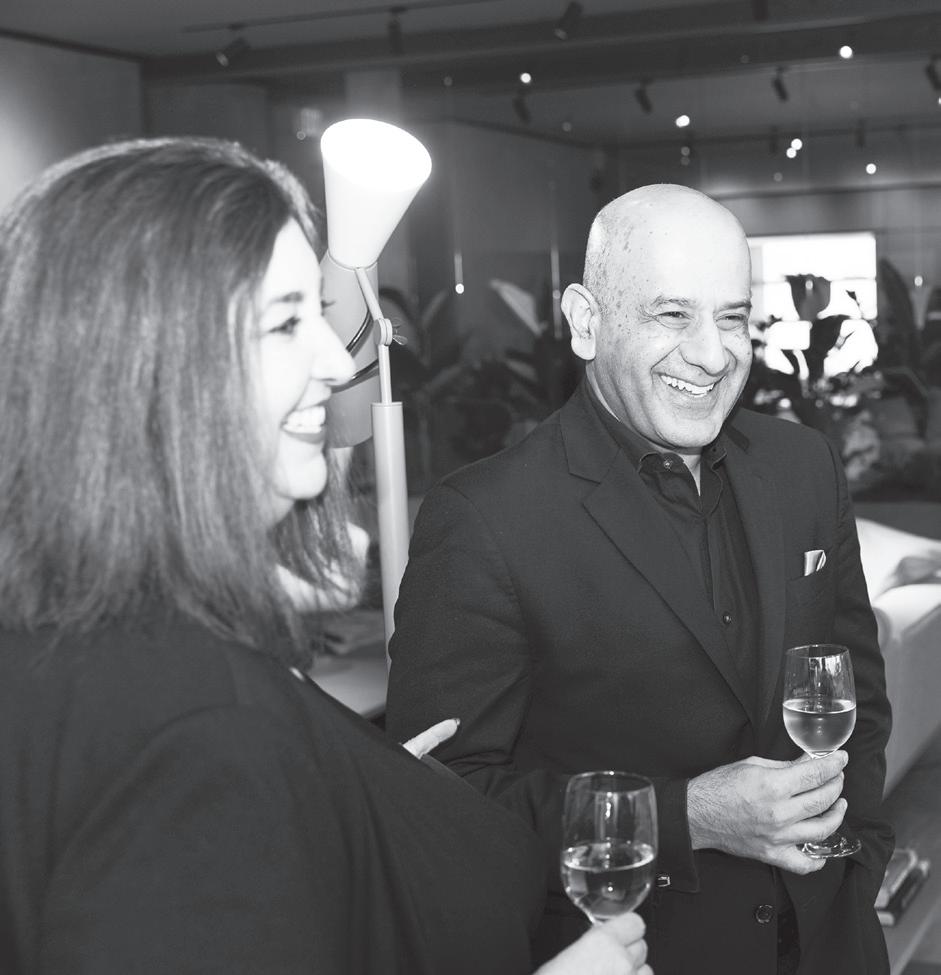


PATRONMAGAZINE.COM 126 THERE
Ramon Longoria
Shane Orr, Teresa Nguyen
Erik Bohdan, Elgin Meredith
Teresa Moeller, Davida Cremese, Melissa Rose Heer-Ahmed, Brendan Blaney
Eugeni Quitlett, David Sutherland Angela Carreles, Kamal Kahn
PHOTOGRAPHY BY BRAD LINTON
Hamilton Sneed
Marlena Lazo, Liselda Sprague, Irma Palma Ferrari from Boardwalk Auto Group
MHM LIVING LUNCHEON AT THOMPSON DALLAS HOTEL


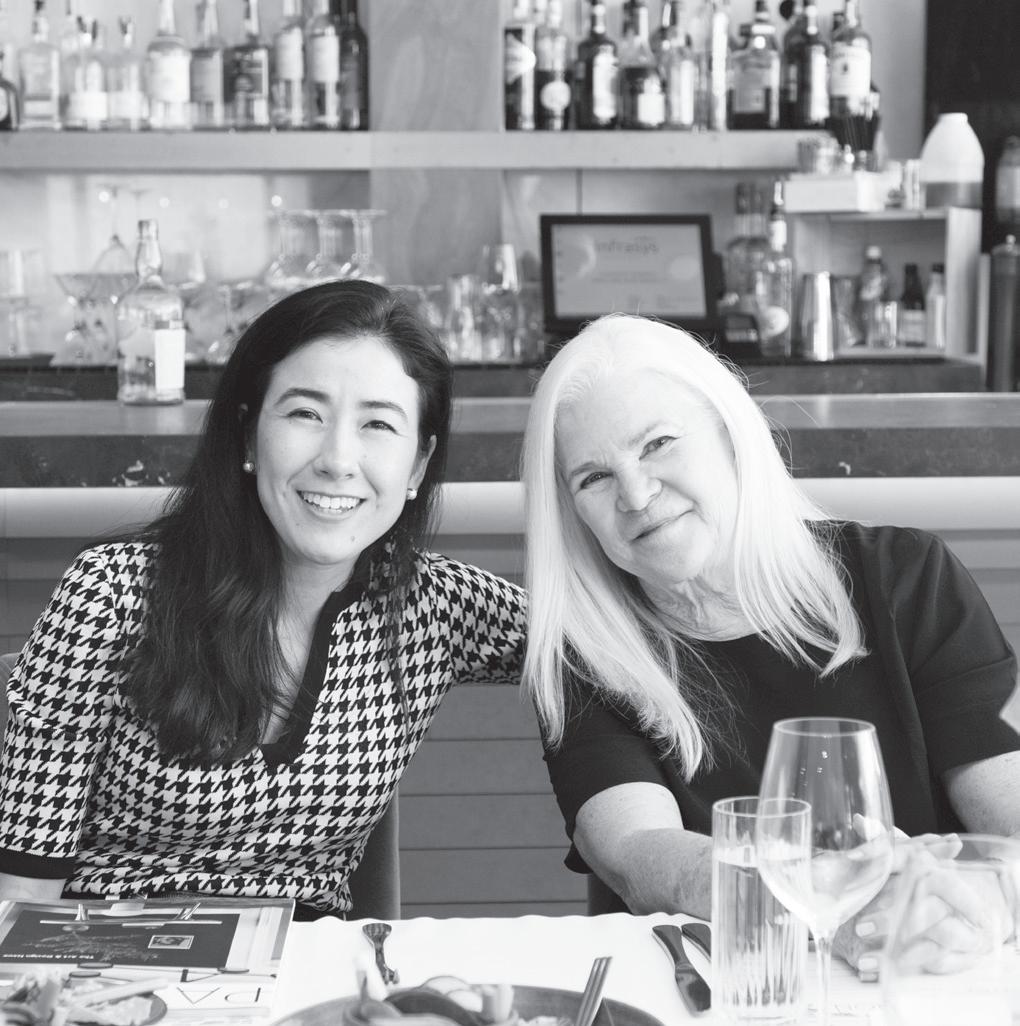


APRIL / MAY 2023 127
Nate Eudaly, Janet Kafka
Signe Smith
Ike Isenhour, Linda Fritschy
Axton Reilly, Lloyd Princeton, Gonzalo Bueno
Angela Gonzalez, Ramon Longoria John Marrs Jin Crimmins, Patricia Magadini
Richard Davis, Bruce Bernbaum Botond Laszlo
PHOTOGRAPHY BY VICTORIA GOMEZ
Matter of the Moment
Through work acquired via Dallas Art Fair Foundation Acquisition Fund, the DMA explores womanhood at NorthPark.
 BY ANTHONY FALCON
What’s the talk of the town? For thousands of years, people have asked this question in their villages, cities, and communities. Historian Yuval Noah Harari cited gossip as one of the central pillars of Homo sapiens’ connection and growth. Gathering in town centers and speaking to one another allows us to form bonds and seek collective goals. In that same tradition, to coincide with the 15th edition of the Dallas Art Fair, the Dallas Museum of Art, Dallas Art Fair, and NorthPark Center have gathered, led by Dr. Anna Katherine Brodbeck, DMA’s Hoffman Family Senior Curator of Contemporary Art, to present a show embracing the diversity of womanhood through a wide range of artistic perspectives.
Talk of the Town: A Dallas Museum of Art Pop-Up Exhibition, through April 30, assembles recent works by Sarah Awad, Sarah Cain, Johnny Floyd, Danielle McKinney, Arcmanoro Niles, Maja Ruznic, Keer Tanchak, Evita Tezeno, and Summer Wheat—all of which were acquired by the DMA in the last six years through the Dallas Art Fair Foundation Acquisition Fund. The work by these artists, informed through the curation of Dr. Brodbeck, are engaged in an unforeseen dialogue in the same vein as human civilizations have for centuries.
The exhibition takes its name from a striking portrait by Danielle McKinney, purchased in 2021 as part of the fifth annual acquisition program. The painting depicts a young black woman smoking a cigarette in a robe, nestled in a red chair before a window looking out on a sleeping city. She stares directly at you, waiting, hung up on a word or thought. She is already in conversation with you, with the works of art that surround her.

However, the works and artists don’t come solely from the
hearts and minds of women. Dr. Brodbeck says the exhibition, “Celebrate(s) the diverse experiences of womanhood through the gender identities on both the side of the artist and their subjects.” For instance, a painting by Arcmanoro Niles shows a young Black girl in a red dress sitting on pink steps at the entrance of a building, perhaps her home. Niles, a Black man known for his intimate portraits set in pink undertones, includes his signature in When You Give Your Love Away. Additionally, we see other signifiers of his work: a line drawing of a woman painted in red sits at the bottom of the painting. She holds a spear, arm arched back, preparing to strike. Niles’ and McKinney’s paintings are just two examples of what Dr. Brodbeck believes this exhibition does: “Upturn traditional notions of femininity and invite the viewer to join the conversation of what it means to be a woman today.”
NorthPark Center is the ultimate location for chatter and community, and Nancy Nasher, owner of NorthPark Center with her husband David Haemisegger, is no stranger to showcasing vanguard and intriguing art. “[As part of] our steadfast commitment to bringing accessible museum-quality art and cultural experiences to the public, NorthPark is honored to host this dynamic exhibition for the enjoyment of our many visitors,” she says. Kelly Cornell, director of Dallas Art Fair, follows, “NorthPark Center is the perfect venue for this exhibition due to its unparalleled art collection and public accessibility.” The sentiment is echoed by the DMA’s Eugene McDermott Director, Dr. Agustín Arteaga: “The Dallas Museum of Art could not be more thrilled to meet our community where they are, to experience the power of art and its ability to bring us together.” P

128 PATRONMAGAZINE.COM FURTHERMORE
Arcmanoro Niles, When You Give Your Love Away, 2018, oil, acrylic, and glitter on canvas, 68 x 36 x 1.50 in. Dallas Museum of Art, Dallas Art Fair Foundation Acquisition Fund, 2019; Johnny Floyd, Upon Reflection, I am Aphrodite's Pearls Strung Across the Firmament, 2021, oil, acrylic, and gold leaf on canvas, 24 x 35.75 x 1.25 in. Dallas Museum of Art, Dallas Art Fair Foundation Acquisition Fund, 2022; Danielle McKinney, Talk of the Town, 2021, acrylic on canvas, 20 x 16.12 x 1.62 in.
Dallas Museum of Art, Dallas Art Fair Foundation Acquisition Fund, 2022.
The Luxury Market Leader Across All of North Texas
The Ebby Halliday Companies are proud to be the luxury market leader in not just a single area, but in all of North Texas. As the region’s largest brokerage, we cover a lot of territory resulting in an extensive reach. We have 25 local offices and 1,600 associates, all connected and working with each other – and for you. Let us elevate your real estate experience.

ebby.com 1 LAKESIDE PARK | CARUTH HOMEPLACE | $3,250,000 Learn more at 1lakeside.ebby.com
This extraordinary, one-story Dallas home is sited on three lots within sought-after Caruth Homeplace. The design is ageless, the updates extensive.


