News
passivehouse+ | Issue 17
Two new low energy schemes built with Amvic ICF the developer commissioned the company again for phase two.
The 2007-built houses featured Amvic ICF walls with a U-value of 0.25, but reports from some residents suggest they are using just 200 litres of oil a year each at a current cost of €130.
Amvic Ireland, the Kildare-based manufacturer of insulated concrete formwork (ICF) systems for low energy and airtight buildings, is currently on site with two new ICF developments in the west of Ireland.
The 1900 square foot units are now nearing completion, with all of the houses now sold. Meanwhile, Amvic is also working on an A3 rated scheme in Sixemilebridge, Co Clare, for Glencore Construction.
The first is a small scheme of five houses in Knocknacarra, Galway, by Sawgrass Developments. The houses are targeting an A2 BER rating with airtightness of less than 2.0 air changes per hour at 50 Pascals — though Amvic’s Pat Martin told Passive House Plus that the company’s ICF system typically delivers less than 1.0 as standard anyway.
This project marks the second phase of a development that began in 2007. The first phase featured 22 units, while the second will have 30. Pat Martin told Passive House Plus that the first phase of the scheme, which was also built with Amvic ICF, performed so well that
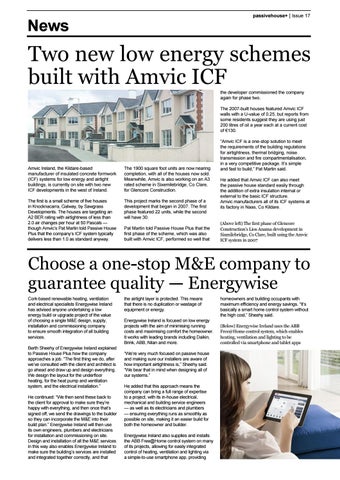
“Amvic ICF is a one-stop solution to meet the requirements of the building regulations for airtightness, thermal bridging, noise transmission and fire compartmentalisation, in a very competitive package. It’s simple and fast to build,” Pat Martin said. He added that Amvic ICF can also meet the passive house standard easily through the addition of extra insulation internal or external to the basic ICF structure. Amvic manufacturers all of its ICF systems at its factory in Naas, Co Kildare. (Above left) The first phase of Glencore Construction’s Lios Anama development in Sixmilebridge, Co Clare, built using the Amvic ICF system in 2007
Choose a one-stop M&E company to guarantee quality — Energywise Cork-based renewable heating, ventilation and electrical specialists Energywise Ireland has advised anyone undertaking a low energy build or upgrade project of the value of choosing a single M&E design, supply, installation and commissioning company to ensure smooth integration of all building services. Berth Sheehy of Energywise Ireland explained to Passive House Plus how the company approaches a job. “The first thing we do, after we’ve consulted with the client and architect is go ahead and draw up and design everything. We design the layout for the underfloor heating, for the heat pump and ventilation system, and the electrical installation.” He continued: “We then send these back to the client for approval to make sure they’re happy with everything, and then once that’s signed off, we send the drawings to the builder so they can incorporate the M&E into their build plan.” Energywise Ireland will then use its own engineers, plumbers and electricians for installation and commissioning on site. Design and installation of all the M&E services in this way also enables Energywise Ireland to make sure the building’s services are installed and integrated together correctly, and that
the airtight layer is protected. This means that there is no duplication or wastage of equipment or energy. Energywise Ireland is focused on low energy projects with the aim of minimising running costs and maximising comfort the homeowner. It works with leading brands including Daikin, Brink, ABB, Nilan and more. “We’re very much focused on passive house and making sure our installers are aware of how important airtightness is,” Sheehy said. “We bear that in mind when designing all of our systems.” He added that this approach means the company can bring a full range of expertise to a project, with its in-house electrical, mechanical and building service engineers — as well as its electricians and plumbers — ensuring everything runs as smoothly as possible on site, making it an easier build for both the homeowner and builder. Energywise Ireland also supplies and installs the ABB Free@Home control system on many of its projects, allowing for easily integrated control of heating, ventilation and lighting via a simple-to-use smartphone app, providing
homeowners and building occupants with maximum efficiency and energy savings. “It’s basically a smart home control system without the high cost,” Sheehy said. (Below) Energywise Ireland uses the ABB Free@Home control system, which enables heating, ventilation and lighting to be controlled via smartphone and tablet apps