News
passivehouse+ | Issue 16
Keystone: lintels key to tackling thermal bridging insulation with a continuous piece of highly conductive steel. The default or accredited Psi-value for a typical steel lintel is between 0.3 W/mK and 0.5 W/mK thus accounting for more than a third of the total heat loss through non repeating thermal bridges [in a typical case].”
Lintels may be the most important thermal bridge to tackle in a building, a leading lintel supplier has claimed. According to Keystone Lintels Ltd: “Lintels are in most cases the most significant non-repeat thermal bridge in a dwelling, as traditional style cavity wall lintels interrupt the line of
The company said the award-winning Keystone Hi-therm lintel virtually eliminates thermal bridging across the lintel. The Hitherm lintel utilizes a two piece construction, with a galvanized steel component supporting the inner blockwork connected to a GRP component supporting the outer brickwork. The GRP component has much lower thermal conductivity therefore reducing total heat loss substantially, resulting with a very low Psi-value of 0.05W/m.K or lower depending on block/ insulation conductivities. The Hitherm lintel can provide in excess of an 80% improvement over the default or accredited lintel Psi-value, offering a significant advantage within Sap or Deap calculations. Thermal bridging is factored into building regulations compliance in both the UK and
Ireland, with the industry given various options, such as the use of punitive default values or inputting calculated values. A common alternative to using default values is to source calculated psi-values created by a person with suitable experience and expertise or a third party accredited assessor. Many leading building product suppliers such as Keystone Lintels now produce these bespoke Psi-values for their customers at no charge. The accredited assessor will use specialist thermal modelling software to draw the construction detail in the software package and then add in the material conductivities. This software then calculates the heat loss at the junction, subsequently producing an accurate Psi-value. The bespoke Psi-value can often be significantly better than the default or accredited value, thus having a dramatic improvement within the SAP/ Deap calculations. (Above left) The Keystone Hi-therm lintel can achieve over an 80% improvement relative to default Psi-values, leading to significant calculated energy savings
Build airtight to protect your building’s structure — Encraft Building airtight isn’t just about reducing energy demand, but more importantly, it’s about protecting the fabric of your building, leading passive house and building physics consultancy Encraft has advised.
“The primary reason for requiring airtightness in buildings has nothing to do with energy efficiency or occupant comfort. In fact it is for the protection of the building fabric,” Helen Brown, head of building physics at Encraft, has written in a blog post on airtightness published at www.passivehouseplus.co.uk. “Indoor air is more humid than outside air, and in a cold climate, indoor air is cooled as it flows out through the building fabric.”
forever, and adds that airtightness is important for occupant comfort too. “Airtightness is relevant for occupant comfort through the elimination of cold draughts. It is ideally combined with mechanical heat recovery ventilation to always ensure superior indoor air quality. But it is possible to have a naturally ventilated building which is also airtight – the occupants just need to remember to open their windows or operate vents at the appropriate times to suit their needs.”
She continues: “As it cools, condensation will occur at a certain place within the construction and this may lead to serious damage to the building fabric. Air and wind tightness keeps your building healthy by preventing the flow of air through the fabric. Just a 1mm gap in the air barrier can transmit 360ml of water per day into the construction.”
“Testing for compliance should be carried out as close to practical completion as possible. This is so that the building can be tested in its in-use condition,” she writes. “Site teams would do well to consider the use of leakchecker fans. These can be uncalibrated fans which aren’t designed to give a test result, but do enable a comprehensive search for leaks which can be easily detected using smoke pens when a building is depressurised. Leakchecker fans can be hired but purchase may be more cost effective for large projects.”
She says that without moisture problems, building components can theoretically last
To read the full blog post, visit www.passivehouseplus.co.uk
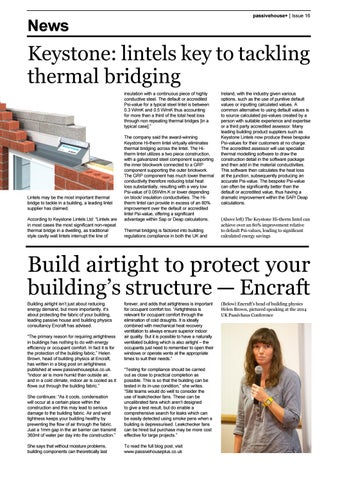
(Below) Encraft’s head of building physics Helen Brown, pictured speaking at the 2014 UK Passivhaus Conference