new build PROJECT OVERVIEW: Building type: 1,250 sqm new two-storey classroom extension built to the passive house standard as part of the expansion and refurbishment of an existing primary school. Refurb included internal remodelling and upgrade of parts of the building fabric to Part L standard. Location: Stebon Primary School, Poplar, London Borough of Tower Hamlets Budget: undisclosed Space heating demand (PHPP): 10 kWh/m2/yr Heat load (PHPP): 8.1 W/m2 Primary energy demand (PHPP): 119 kWh/m2/yr Passive house certification: Pending Energy performance certificate (EPC): A 23 Measured energy consumption: Not yet available Airtightness (at 50 Pascals): 0.52 air changes per hour
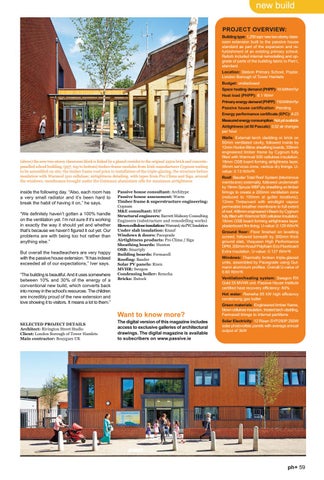
(above) the new two-storey classroom block is linked by a glazed corridor to the original 1950s brick and concretepanelled school building; (p57, top to bottom) timber-frame modules from Irish manufacturer Cygnum waiting to be assembled on site; the timber frame roof prior to installation of the triple-glazing; the structure before insulation with Warmcel 500 cellulose; airtightness detailing, with tapes from Pro Clima and Siga, around the windows; membranes brought under the Gutmann aluminium sills for maximum airtightness
inside the following day. “Also, each room has a very small radiator and it’s been hard to break the habit of having it on,” he says. “We definitely haven’t gotten a 100% handle on the ventilation yet. I’m not sure if it’s working in exactly the way it should yet and whether that’s because we haven’t figured it out yet. Our problems are with being too hot rather than anything else.” But overall the headteachers are very happy with the passive house extension. “It has indeed exceeded all of our expectations,” Iver says. “The building is beautiful. And it uses somewhere between 10% and 30% of the energy of a conventional new build, which converts back into money in the school’s resources. The children are incredibly proud of the new extension and love showing it to visitors. It means a lot to them.”
Passive house consultant: Architype Passive house assessment: Warm Timber frame & superstructure engineering: Cygnum M&E consultant: BDP Structural engineers: Barrett Mahony Consulting Engineers (substructure and remodelling works) Blown cellulose insulation:Warmcel, via PYC Insulation Under slab insulation: Knauf Windows & doors: Pacegrade Airtightness products: Pro Clima / Siga Sheathing boards: Hunton OSB: Smartply Building boards: Fermacell Roofing: Bauder Solar PV panels: Risen MVHR: Swegon Condensing boiler: Remeha Bricks: Ibstock
Roof: Bauder Total Roof System (bituminous membrane) externally, followed underneath by 18mm Spruce WBP ply sheathing on timber firrings to create a 200mm ventilation zone (reduced to 100mm at gutter locations), 12mm Timbervent with windtight vapour permeable breather membrane to full extent of roof, 406mm engineered I-Beam by Cygnum fully filled with Warmcel 500 cellulose insulation, 18mm OSB board forming airtightness layer, plasterboard fire lining. U-value: 0.129 W/m2K Ground floor: Floor finished on levelling screed, followed beneath by 300mm thick ground slab, Visqueen High Performance DPM, 200mm Knauf Polyfoam Eco Floorboard Extra insulation. U-value: 0.127 W/m2K Windows: Thermally broken triple-glazed units, assembled by Pacegrade using Gutmann aluminium profiles. Overall U-value of 0.60 W/m2K Ventilation/heating system: Swegon RX Gold 35 MVHR unit. Passive House Institute certified heat recovery efficiency: 84% Hot water: Remeha 65 kW high efficiency condensing gas boiler
Want to know more? SELECTED PROJECT DETAILS Architect: Rivington Street Studio Client: London Borough of Tower Hamlets Main contractor: Bouygues UK
Walls: External larch cladding or brick on 50mm ventilated cavity, followed inside by 12mm Hunton Bitroc sheathing boards, 339mm engineered timber frame by Cygnum fully filled with Warmcel 500 cellulose insulation, 18mm OSB board forming airtightness layer, 38mm services zone, various dry linings. Uvalue: 0.13 W/m2K
The digital version of this magazine includes access to exclusive galleries of architectural drawings. The digital magazine is available to subscribers on www.passive.ie
Green materials: Engineered timber frame, blown cellulose insulation, treated larch cladding, Fermacell linings to internal partitions Solar Electricity: 12 Risen SYP250P 250W solar photovoltaic panels with average annual output of 3kW
ph+ 59