Bhau Kakhuri: Meher Babac Lion, a Must-Have Film Caroline McDonald New York r those new to Meher Baba, as well as those who have followed His teaching for years, the DVD, Bhau Kaichuri: Meher Babac Lion, an interview with Bhau Kal churi, is a staple for any collection. The DVD includes an interview of Bhau by Alexandra Marks, and as a bo nus, there’s a past interview as well. In both, Bhau discusses the question that invariably comes up: Baba’s message in regard to three-quarters of the world being destroyed. Bhau discusses the nu ances of the topic in both interviews and he offers pieces for the puzzle. Putting these pieces together can hopeftilly give a clearer picture. Bhau addresses many other topics as well. He also answers audience questions, such as how to avoid worry—certainly an important topic in these busy, job-intense times. As a Baba follower for 20 years, I
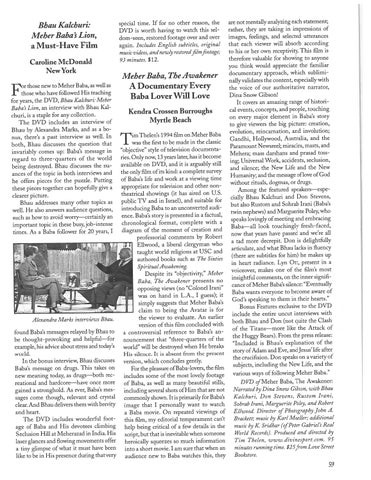
Alexandra Marks interviews Bhau.
found Baba’s messages relayed by Bhau to be thought-provoking and helpful—for example, his advice about stress and today’s world. In the bonus interview, Bhau discusses Baba’s message on drugs. This takes on new meaning today, as drugs—both rec reational and hardcore—have once more gained a stronghold. As ever, Baba’s mes sages come though, relevant and crystal clear. And Bhau delivers them with brevity and heart. The DVD includes wonderflil footage of Baba and His devotees climbing Seclusion Hill at Meherazad in India. His laser glances and flowing movements offer a tiny glimpse ofwhat it must have been like to be in His presence during that very
special time. If for no other reason, the DVD is worth having to watch this sel dom-seen, restored footage over and over again. Includes English subtitles, original music videos, and newly restoredfilmfootage; 93 minutes. $12.
Meher Baba, The Awakener A Documentary Every Baba Lover Will Love Kendra Crossen Burroughs Myrtle Beach Thelen’s 1994 film on Meher Baba
was the first to be made in the classic ‘Jim
“objective” style of television documenta ries. Only now 13 years later, has it become available on DVD, and it is arguably still the only film ofits kind: a complete survey of Baba’s life and work at a viewing time appropriate for television and other nontheatrical showings (it has aired on U.S. public TV and in Israel), and suitable for introducing Baba to an unconverted audience. Baba’s story is presented in a factual, chronological format, complete with a diagram of the moment of creation and professorial comments by Robert Eliwood, a liberal clergyman who taught world religions at USC and authored books such as The Sixties SpiritualAwakening. Despite its “objectivity,” Meher Baba, The Awakener presents no opposing views (no “Colonel Irani” was on hand in L.A., I guess); it simply suggests that Meher Baba’s claim to being the Avatar is for the viewer to evaluate. An earlier version ofthis film concluded with a controversial reference to Baba’s announcement that “three-quarters of the world” will be destroyed when He breaks His silence. It is absent from the present version, which concludes gently. For the pleasure ofBaba-lovers, the film includes some of the most lovely footage of Baba, as well as many beautiful stills, including several shots ofHim that are not commonly shown. It is primarily for Baba’s image that I personally want to watch a Baba movie. On repeated viewings of this film, my editorial temperament can’t help being critical of a few details in the script, but that is inevitable when someone heroically squeezes so much information into a short movie. I am sure that when an audience new to Baba watches this, they
are not mentally analyzing each statement; rather, they are taking in impressions of images, feelings, and selected utterances that each viewer will absorb according to his or her own receptivity. This film is therefore valuable for showing to anyone you think would appreciate the familiar documentary approach, which sublimi nallyvalidates the content, especially with the voice of our authoritative narrator, Dma Snow Gibson! It covers an amazing range of histori cal events, concepts, and people, touching on every major element in Baba’s story to give viewers the big picture: creation, evolution, reincarnation, and involution; Gandhi, Hollywood, Australia, and the Paramount Newsreel; miracles, masts, and Mehera; mass darshans and prasad tossing; Universal Work, accidents, seclusion, and silence; the New Life and the New Humanity; and the message oflove ofGod without rituals, dogmas, or drugs. Among the featured speakers—espe cially Bhau Kaichuri and Don Stevens, but also Rustom and Sohrab Irani (Baba’s twin nephews) and Marguerite Poley, who speaks lovingly ofmeeting and embracing Baba—all look touchingly fresh-faced, now that years have passed and we’re all a tad more decrepit. Don is delightfully articulate, and what Bhau lacks in fluency (there are subtitles for him) he makes up in heart radiance. Lyn Ott, present in a voiceover, makes one of the film’s most insightful comments, on the inner signifi cance ofMeher Baba’s silence: “Eventually Baba wants everyone to become aware of God’s speaking to them in their hearts.” Bonus Features exclusive to the DVD include the entire uncut interviews with both Bhau and Don (not quite the Clash of the Titans—more like the Attack of the Huggy Bears). From the press release: “Included is Bhau’s explanation of the story ofAdam and Eve, andJesus’ life after the crucifixion. Don speaks on a variety of subjects, including the New Life, and the various ways of following Meher Baba.” DVD ofMeher Baba, The Awakener: Narratedby Dma Snow Gibson, with Bhau Kalchuri, Don Stevens, Rustom Irani, Sohrab Irani, Marguerite Poley, and Robert Ellwood. Director ofPhotographyJohn A. Brackett; music by Karl Moeller; additional music by K Sridhar (‘ofPeter Gabrielc Real World Records,). Produced and directed by Tim Thelen, www.divinesport.com. 95 minutes running time. $25from Love Street Bookstore.
59