12
FEATURE.
Friday 22.01.2016 to Sunday 24.01.2016 | Dubbo Weekender
Cracking the code The new club for creative kids BY YVETTE AUBUSSON-FOLEY “PROGRAM or be programmed” is the message from Code Club Australia, which will officially launch in Dubbo in early February at the Western Plains Cultural Centre (WPCC). Free Code Club classes, for 9 to 14 year olds, will be held once a week during Terms 1 and 2 with a possible extension depending on popularity. “The WPCC Code Club will have a visual arts/heritage focus but the students will be learning highly desirable skills including the ability to think computationally and problem solve, that they can transfer to a wide range of disciplines including scientific research, engineering and medicine,” says WPCC education officer, Karen Hagan, and who will be facilitating Dubbo’s first Code Club. Coding is defined by Code Club Australia as the art of telling a computer how to perform complex tasks. Students use Scratch, a programming language and online community where children can program and share interactive media such as stories, games and animation with people worldwide using creative thinking, collaboration and mer UK Secretary of State for Education said of the introduction of coding into systematic reasoning. the UK curriculum for students as young Scratch is designed and maintained as five and six: “ICT used to focus pureby the Lifelong Kindergarten group at ly on computer literacy. Teaching pupils, the Massachusetts Institute of Technolover and over again, how to word-proogy (MIT) Media Lab in the USA. cess, how to work a spread sheet, how to While education pedagogy in Aususe programs already creaking into obtralia lags behind many countries in solescence; about as much use as teachthe world (15 in Europe alone), which ing children to send a telex or travel in already include coding as part of their a zeppelin. school curriculum, programs like Code “Our new curriculum teaches chilClub address a broader issue of employdren computer science, information ment ICT shortages predicted in the technology and digital literacy: teachfuture. ing them how to code, and how to creEstimates are that by 2020 there will ate their own programs; not just how to be a shortage of 800,000 programmers work a computer, but how a computer in Europe, and in Australia 100,000. works and how to make it work for you.” Like code.org in the USA, Code Club According to Hagan, the ability to Australia which is a spin off from Code code allows artists and designers to Club UK, is driven to see their program push frontiers and pursue their own viintroduced nationally, run by teachers sions rather than be restricted by the viand volunteers, at the very least, as an sions and inevitable compromises made after school activity. by others to produce saleable computer “It’s important because the number of interfaces and software packages. jobs that require this skill are only going The WPCC is hostto increase and we ing a 3D printed art don’t want kids to exhibition called be left behind with Shapeshifters 3D, it. As a coder you’re featuring works for no longer just a conwhich code was cresumer of technolated by the artists ogy and it’s a very in order to produce empowering tool to their works. have,” says James Lana Dess, a O’Hanlon, outreach Stage One teacher and events manfrom Dubbo Pubager, Code Club lic School who parAustralia. ticipated in a pilot “We don’t want of the Code Club in kids to be conDubbo, agrees the suming things, future of educawe want them to tion needs to inbe creating and clude coding. shape the world ` around them. It’s important because the “From a learnThat’s what these number of jobs that require ing perspective young entrepre- this skill are only going to coding helps them neurs are doing, to problem solve using technology increase and we don’t want and organise their to fill gaps they’ve kids to be left behind with it.” ideas because as I identified.” found out with the – James O’Hanlon, outreach “We also want it and events manager, Code coding, you have to be free; open to to have a sequence everyone, not just Club Australia. to make certain be available for things happen, people with money,” O’Hanlon says. so I think it’s great for helping kids organise their thoughts,” she told Dubbo In January 2015, Michael Grove, for-
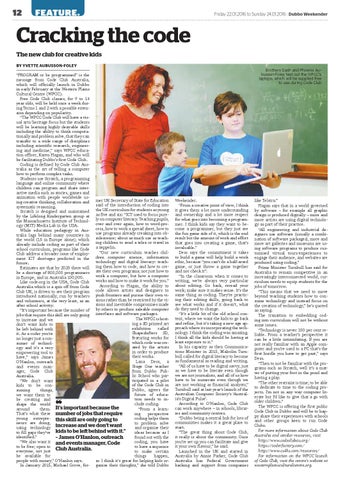
Brothers Dash and Phoenix Aubusson-Foley test out the WPCC’s laptops, which will be supplied free to use during Code Club
Weekender. “From a creative point of view, I think it gives them a lot more understanding and ownership and a lot more respect for what goes into becoming a programmer. I think kids say they want to become a programmer, but they just see the fun game side of it, which is the end result but the amount of work and effort that goes into creating a game, that’s invaluable.” Dess says the commitment it takes to build a game will help build a work ethic, because “you can’t do a half-arsed game, or just throw a game together and not check it”. “In the classroom when it comes to writing, we’re always very particular about editing. Go back, reread your work; make sure it makes sense. It’s the same thing as coding. They’re practicing their editing skills, going back to see what works and if it doesn’t, what do they need to change. “It’s a little bit of the old school content, where we want the kids to go back and refine, but it’s taking a new age approach where its incorporating the technology. I think the coding was amazing. I think all the kids should be having at least exposure to it.” In his capacity as then Communications Minister in 2015, Malcolm Turnbull called for digital literacy to become as fundamental as reading and writing. “All of us have to be digital savvy, just as we have to be literate even though we are not journalists, and all of us how have to be numerate even though we are not working as financial analysts,” Turnbull said at last year’s launch of the Australian Computer Society’s ‘Australia’s Digital Pulse’. According to O’Hanlon, Code Club can work anywhere – in schools, libraries and community centres. “Dubbo being a central hub for lots of communities makes it a great place to start. “The great thing about Code Club, it really is about the community. Once you’re set up you can facilitate and give it your own flavour,” he said. Launched in the UK and started in Australia by Annie Parker, Code Club Australia has Federal Government backing and support from companies
like Telstra.” Hagan says that in a world governed by software – for example all graphic design is produced digitally – more and more artists are using digital technology as part of their practice. “All engineering and industrial designers use software (usually a combination of software packages), more and more art galleries and museums are using software programs to produce customised virtual tours/experiences to engage their audience, and websites are produced using coding.” Prime Minister Turnbull has said for Australia to remain competitive in an increasingly interconnected world, curriculum needs to equip students for the jobs of tomorrow. “This means that we need to move beyond teaching students how to consume technology and instead focus on the creation of technology,” he’s quoted as saying. The transition to embedding coding into curriculum will not be without some issues. “Technology is never 100 per cent reliable. From a teacher’s perspective it can be a little intimidating. If you are not really familiar with an Apple computer and you’re used to a PC that’s the first hurdle you have to get past,” says Dess. “Then to not be familiar with the programs such as Scratch, well it’s a matter of putting your foot in the pond and having a play. “The other restraint is time; to be able to dedicate to time to the coding projects. I’m not in any way computer literate but I’d like to give that a go with older children.” The WPCC is offering the first public Code Club in Dubbo and will be to happy share their experiences with schools and other groups keen to run Code Clubs. For more information about Code Club Australia and similar resources, visit http://www.codeclubau.org/ https://coderfactory.com/ http://www.cs4hs.com/resources/ For information on the WPCC launch of Code Club, visit the centre’s website at westernplainsculturalcentre.org.