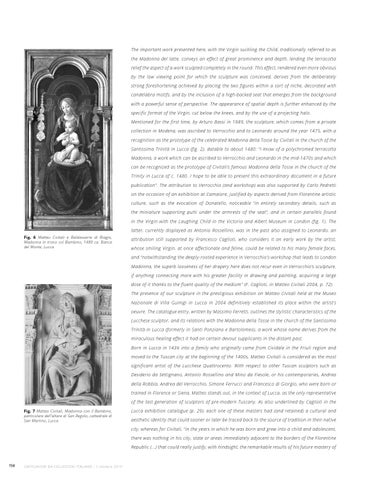
The important work presented here, with the Virgin suckling the Child, traditionally referred to as the Madonna del latte, conveys an effect of great prominence and depth, lending the terracotta relief the aspect of a work sculpted completely in the round. This effect, rendered even more obvious by the low viewing point for which the sculpture was conceived, derives from the deliberately strong foreshortening achieved by placing the two figures within a sort of niche, decorated with candelabra motifs, and by the inclusion of a high-backed seat that emerges from the background with a powerful sense of perspective. The appearance of spatial depth is further enhanced by the specific format of the Virgin, cut below the knees, and by the use of a projecting halo. Mentioned for the first time, by Arturo Bassi in 1989, the sculpture, which comes from a private collection in Modena, was ascribed to Verrocchio and to Leonardo around the year 1475, with a recognition as the prototype of the celebrated Madonna della Tosse by Civitali in the church of the Santissima Trinità in Lucca (fig. 2), datable to about 1480: “I know of a polychromed terracotta Madonna, a work which can be ascribed to Verrocchio and Leonardo in the mid-1470s and which can be recognized as the prototype of Civitali’s famous Madonna della Tosse in the church of the Trinity in Lucca of c. 1480. I hope to be able to present this extraordinary document in a future publication”. The attribution to Verrocchio (and workshop) was also supported by Carlo Pedretti on the occasion of an exhibition at Camaiore, justified by aspects derived from Florentine artistic culture, such as the evocation of Donatello, noticeable “in entirely secondary details, such as the miniature supporting putti under the armrests of the seat”, and in certain parallels found in the Virgin with the Laughing Child in the Victoria and Albert Museum in London (fig. 1). The latter, currently displayed as Antonio Rossellino, was in the past also assigned to Leonardo, an Fig. 6 Matteo Civitali e Baldassarre di Biagio, Madonna in trono col Bambino, 1480 ca. Banca del Monte, Lucca
attribution still supported by Francesco Caglioti, who considers it an early work by the artist, whose smiling Virgin, at once affectionate and feline, could be related to his many female faces, and “notwithstanding the deeply-rooted experience in Verrocchio’s workshop that leads to London Madonna, the superb looseness of her drapery here does not recur even in Verrocchio’s sculpture, if anything connecting more with his greater facility in drawing and painting, acquiring a large dose of it thanks to the fluent quality of the medium” (F. Caglioti, in Matteo Civitali 2004, p. 72). The presence of our sculpture in the prestigious exhibition on Matteo Civitali held at the Museo Nazionale di Villa Guinigi in Lucca in 2004 definitively established its place within the artist’s oeuvre. The catalogue entry, written by Massimo Ferretti, outlines the stylistic characteristics of the Lucchese sculptor, and its relations with the Madonna della Tosse in the church of the Santissima Trinità in Lucca (formerly in Santi Ponziano e Bartolomeo), a work whose name derives from the miraculous healing effect it had on certain devout supplicants in the distant past. Born in Lucca in 1436 into a family who originally came from Cividale in the Friuli region and moved to the Tuscan city at the beginning of the 1400s, Matteo Civitali is considered as the most significant artist of the Lucchese Quattrocento. With respect to other Tuscan sculptors such as Desiderio da Settignano, Antonio Rossellino and Mino da Fiesole, or his contemporaries, Andrea
Fig. 7 Matteo Civitali, Madonna con il Bambino, particolare dell’altare di San Regolo, cattedrale di San Martino, Lucca Fig. 7 Matteo Civitali, Madonna con il Bambino, particolare dell’altare di San Regolo, cattedrale di San Martino, Lucca
della Robbia, Andrea del Verrocchio, Simone Ferrucci and Francesco di Giorgio, who were born or trained in Florence or Siena, Matteo stands out, in the context of Lucca, as the only representative of the last generation of sculptors of pre-modern Tuscany. As also underlined by Caglioti in the Lucca exhibition catalogue (p. 29), each one of these masters had (and retained) a cultural and aesthetic identity that could sooner or later be traced back to the source of tradition in their native city, whereas for Civitali, “in the years in which he was born and grew into a child and adolescent, there was nothing in his city, state or areas immediately adjacent to the borders of the Florentine Republic (...) that could really justify, with hindsight, the remarkable results of his future mastery of
158
CAPOLAVORI DA COLLEZIONI ITALIANE - 1 ottobre 2015