7
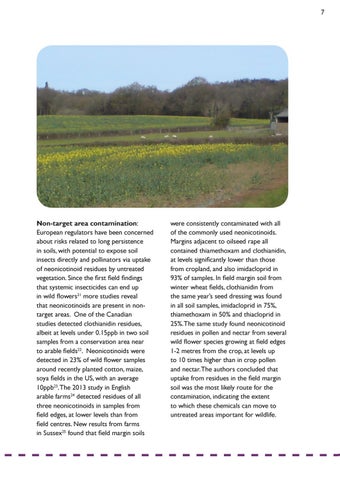
Non-target area contamination: European regulators have been concerned about risks related to long persistence in soils, with potential to expose soil insects directly and pollinators via uptake of neonicotinoid residues by untreated vegetation. Since the first field findings that systemic insecticides can end up in wild flowers21 more studies reveal that neonicotinoids are present in nontarget areas. One of the Canadian studies detected clothianidin residues, albeit at levels under 0.15ppb in two soil samples from a conservation area near to arable fields22. Neonicotinoids were detected in 23% of wild flower samples around recently planted cotton, maize, soya fields in the US, with an average 10ppb23. The 2013 study in English arable farms24 detected residues of all three neonicotinoids in samples from field edges, at lower levels than from field centres. New results from farms in Sussex25 found that field margin soils
were consistently contaminated with all of the commonly used neonicotinoids. Margins adjacent to oilseed rape all contained thiamethoxam and clothianidin, at levels significantly lower than those from cropland, and also imidacloprid in 93% of samples. In field margin soil from winter wheat fields, clothianidin from the same year’s seed dressing was found in all soil samples, imidacloprid in 75%, thiamethoxam in 50% and thiacloprid in 25%. The same study found neonicotinoid residues in pollen and nectar from several wild flower species growing at field edges 1-2 metres from the crop, at levels up to 10 times higher than in crop pollen and nectar. The authors concluded that uptake from residues in the field margin soil was the most likely route for the contamination, indicating the extent to which these chemicals can move to untreated areas important for wildlife.