film. tv. entertainment.
SERVING GEORGIA’S FILM PRODUCTIONS
SINCE
1979
Lightnin Production Innovative. Quality. Service. Rentals
(770) 963-1234
www.lightnin.net
info@lightnin.net
ENVIRONMENTAL MEDIA ASSOCIATION
www.hollywoodtrucksllc.com
NVIRONMENTAL MEDIA ASSOCIATION
www.hollywoodtrucksllc.com
MAGAZINE
STAFF Publishers: Tia Powell (Group Publisher) Gary Powell Michael Garland (Assistant to Publisher)
CONTRIBUTORS
JANUARY / FEBRUARY 2016
CHRISTINE BUNISH Christine Bunish has been a writer and editor covering the professional film, video, broadcast and advertising industries for more than 25 years. She was a writer at Broadcast Management/Engineering and World Broadcast News and an editor at Millimeter before going freelance. cbunish@gmail.com (The View From Above, p.44)
Publishing Coordinator: Hilary Cadigan
Editorial: Gary Powell
Sales: Monique McGlockton Kris Thimmesch Martha Ronske Kristina Foster
Contributors: Christine Bunish Fran Burst-Terranella Andrew Duncan Jack English
Creative Director: Kelvin Lee
FRAN BURST-TERRANELLA Fran Burst-Terranella is an EMMY-winning independent film and television director and producer whos work spans four decades and totals more than 700 productions. Her documentaries have aired nationally on ABC, TBS and PBS and her work has garnered more than 100 honors including Tellys, CINE Golden Eagles and recognition at film festivals from Chicago, New York, Los Angeles, Houston and Atlanta to Australia, Scotland, Spain and Canada. A multi-faceted director with the ability to quickly build rapport with everyone who appears in front of her camera, her newest project is “The 12 Lives of Sissy Carlyle” – a darkly comic indie feature film. (Getting it Right, p.38)
HILARY CADIGAN Hilary Cadigan is Oz’s publishing coordinator and associate editor. She recently returned to Atlanta after three years living and working in Chiang Mai, Thailand as managing editor of local magazine Citylife. Hilary holds a BA in English and Creative Writing from Emory University. Her work has appeared in numerous publications including Salon, The Huffington Post and Tricycle. www.hilarycadigan.com, hilary@ozonline.tv (Eyes in The Sky, p.30)
Production and Design: Kelvin Lee Ted Fabella (Oz Logo Design)
Cover Image: Alea Hurst
ANDREW DUNCAN Andrew Duncan, known in the motion picture industry as “Drewprops,” has been writing about the craft of filmmaking from the inside out since the mid-1990s. His confusing and often embarrassing stories from behind the scenes provide a unique insight into the craft of filmmaking from the perspective of the shooting crew, artists and designers who bring your favorite films to life on the big screen. (Drewprops, p.50)
JACK ENGLISH
film. tv. entertainment.
www.ozmagazine.com www.facebook.com/ozpublishing
Jack English is a television producer and co-owner of Broadcast Solutions in Atlanta. He served as production manager on A&E’s First Flights with Neil Armstrong and was executive producer of the award-winning documentary, The South Takes Flight: 100 Years of Aviation in Georgia. The former president of Atlanta Producers Association, Jack now licenses high definition aerial stock footage for movies and television, and recently won an Emmy for his work with Ambassador Andrew Young. www.broadcastsolutions.tv, jack@broadcastsolutions.tv (Voices, p.26)
www.twitter.com/ozpublishing (404) 633-1779 Oz Magazine is published bi-monthly by Oz Publishing, Inc. 2566 Shallowford Road Suite 104, #302 Atlanta, GA 30345 Copyright © 2016 Oz Publishing Incorporated, all rights reserved. Reproductions in whole or in part without express written permission of the publisher is strictly prohibited. This magazine is printed on recyclable paper.
6
OZ MAGAZINE
ALEA HURST Born in Atlanta, Alea Hurst began her journey into drawing and painting eight years ago. She produces two-dimensional works, particularly drawings and paintings, which range from traditional to experimental and mixed media approaches. She is currently working towards earning her Master of Fine Art degree in Painting from the Savannah College of Art and Design in Atlanta. Her current work focuses on the roles of masks and reversing those roles to comment on the evolution of society. www.aleahurst.com (Cover design)
CONTENTS
OZCETERA BRONZELENS FILM FESTIVAL
HORROR HOTEL
COVER STORY
08 OZCETERA 26 VOICES 28 HOW I GOT INTO THE BUSINESS 30 COVER STORY Eyes in The Sky
38 FEATURE STORIES
38 Getting it Right 44 The View From Above
FEATURE STORY
50 BEHIND THE CAMERA WITH DREWPROPS 52 OZ SCENE
52 BronzeLens Film Festival 54 Horror Hotel
56 LET ME GIVE YOU MY CARD 58 NEXT GENERATION
FEATURE STORY
JANUARY / FEBRUARY 2016
7
OZCETERA
Atlanta Technical College’s Cory Way (left) and Michael Harris placed second in the Digital Cinema Production competition at the National SkillsUSA Championships
ATLANTA TECH STUDENTS PLACE IN NATIONAL COMPETITION
C
ongratulations to The Atlanta Technical College (ATC) team of Cor y Way and Michael Harris for placing second in the Digital Cinema Production competition at the National SkillsUSA Championships held in Louisville, Kentucky. The competition was part of the SkillsUSA 51st Annual National Leadership and Skills Conference (NLSC), a showcase of career and technical education students. More than 6,000 outstanding career and technical education students, all state contest winners, competed in 100 different trade, technical and leadership fields. Way and Harris represented Georgia in the highly s p e cialize d Digit al Cine ma Pro d uc tio n competition against 22 other state champion teams.
“
”
Cory and Michael are well on their way to becoming accomplished filmmakers...
“Cory and Michael are well on their way to becoming accomplished filmmakers,” said Britt Pitre, Chair of the ATC Design and Media Production Department. “Earlier this year both students competed in the Atlanta Technical College Film Festival. Cory won Best Animation and Best of Fest. Michael d ir e c te d a n o u t s t a n d i ng d o c u m e nt ar y that has impressed many in the Atlanta film community. I am extremely proud of their accomplishments and look forward to watching them excel on the national level.”
SkillsUSA is the national organization for students in trade, industrial, technical and health occupations education. It sponsors the SkillsUSA Championships annually to recognize the achievements of career and technical education students and to encourage them to strive for excellence and pride in their chosen occupations. The Digital Cinema Production c o m p e t i t i o n e v a l u a t e s a c o m p e t i t o r ’s preparation for employment and recognizes outstanding students for excellence and professionalism in cinematography and short film production. The contest includes a written exam, a storyboard assignment, an interview and a short video that is filmed and edited on site.
ON THE WAWA PEDAL
S
treetLevel Sound composer/producer Greg Shearer won a double from the Richards Group of Dallas, Texas. First up was a 12-spot radio and TV package for internet provider Charter Spectrum. The spots began running nationally in late 2015. Also from the Richards Group was a TV spot for east coast convenience store chain, Wawa. These spots began running in late 2015 as well to
8
OZ MAGAZINE
promote their holiday specials. SLS producer Greg Shearer also recently completed music and post work for two new radio spots for Duquesne University. In other SLS news, composer/producer Kyle Shearer is just put ting the finishing touches on production for the debut release f rom singer Phoebe R yan on Columbia Records. Being touted as the “next Katy
Perry,” Ryan’s album is expected to drop in the spring of 2016. Producer Paul Shearer took some time off from production to go on a world tour with singer Julio Iglesias. Stops on the tour included Lisbon, Madrid, Morocco and Cairo.
OZCETERA
JANUARY / FEBRUARY 2016
9
OZCETERA
GOVERNOR NATHAN DEAL EXPRESSES SUPPORT FOR GEORGIA’S GROWING FILM INDUSTRY
Georgia Governor Nathan Deal
I
n a recent op-ed for the Atlanta Business Chronicle, Georgia Governor Nathan Deal expressed his deep continuing support for the Georgia Film Incentive, and discussed the positive impacts that Georgia’s ever-growing film industry is having on both the economy and the community. According to the Motion Pic ture Association of America, Georgia is now the countr y’s third busiest film and television production center. As Governor Deal points out, local Georgia businesses and workers are reaping the benefits of industry growth. Over 24,000 jobs in the state are directly credited to the film industry, and there are now close to 3,000 film and television businesses here,
including over 1,950 production-related companies. “Georgia’s growth in this industry is a result of the concentrated efforts we’ve made to build a pro-business climate in Georgia, with stable and consistent production tax credits playing a key role,” wrote Governor Deal, citing the production industry’s $1.7 billion spent in fiscal year 2015, and the average $660 million that MPAA members alone have paid annually to local business since 2009. “Georgia is already well suited for production due to our diverse locations, temperate climate, robust infrastructure and the ease of access of having the world’s busiest airport, so it certainly made sense to enact policies that present Georgia as a viable option for hosting film productions,” he added. In just a few short years, Fayetteville, Georgia has transformed into a bustling production hub thanks to Pinewood Studios Atlanta, known for their recent multi-picture deal with Marvel Cinematic Universe. Today, a mixed-use development featuring over 1,200 residences, office spaces, restaurants and a boutique hotel is in the works in order to meet the demands of what Governor Deal refers to as the “economic engine that is Pinewood Atlanta.” Addressing the common criticism that the film industry brings in out-of-town workers, takes advantage of local incentives and then hits the road, Governor Deal cited a surprising statistic. According to Georgia’s own International Alliance of Theatrical and Stage Employees (IATSE) Local 479, when productions come to Georgia, local workers account for 85 percent of industry hires.
The crew of top-rated T V series The Walking Dead is over 90 percent local, and Governor Deal notes that even when highly-skilled positions are filled by out-of-towners, these industry professionals are providing valuable skills training to local Georgians. What’s more, about ten percent of these visiting professionals stay behind and become Peach St ate resident s t hemselves. The Walking Dead’s costume designer, construction coordinator, foreman, dolly grip, stunt coordinator and more have moved permanently to Georgia, and several cast members and producers have also bought homes here. The city of Senoia, Georgia, home of The Walking Dead, has grown as well. Downtown Senoia once boasted only a handful of businesses; today, there are 50, with a larger downtown expansion on the way. “Film and television productions leave a footprint across a wide array of industries and local vendors,” Governor Deal pointed out, noting the huge economic impacts of recent films shot in Georgia, from Selma to 42 to Furious 7. “In addition to the benefit of the direct spend of these projects, the long-term effects of film tourism are also well-substantiated.” In order to keep up with the growing demands for industry workers in Georgia, Governor Deal has established a partnership between the University System of Georgia and the Technical College System. In January, the Georgia Film Academy will begin offering classes to provide the necessary skills and resources to fast-track workers from around the state into the film and television industry, thereby providing even more job opportunities for local residents.
props, airplane seats and airplane interiors. They added more elevator panels that can light up and work. Additionally, RJR now provides working tactical electronics, communications gear and surveillance gear for police,
military, and SWAT, including surveillance vans. RJR also made a pallet of realistic prop money for a huge west coast show.
RJR TAKES FLIGHT
R
JR stays busy in Q4 and into 2016. When the feature Sully needed cockpit and control tower gear to light up and look real, RJR took care of it, re-engineering all the avionics gear to light up and work. RJR also has airport
10
OZ MAGAZINE
OZCETERA
圀圀圀⸀䄀一䤀䴀䄀䰀䌀䄀匀吀䤀一䜀䄀吀䰀䄀一吀䄀⸀䌀伀䴀
䌀伀一吀䄀䌀吀
䌀刀䔀䐀䤀吀匀 䤀渀猀甀爀最攀渀琀 䰀愀眀氀攀猀猀 吀攀攀渀 圀漀氀昀 娀漀洀戀椀攀氀愀渀搀
刀攀猀甀爀爀攀挀琀椀漀渀 吀栀攀 伀爀椀最椀渀愀氀猀 䠀甀渀最攀爀 䜀愀洀攀猀 ㈀Ⰰ ㌀ ☀ 㐀 吀栀攀 圀愀氀欀椀渀最 䐀攀愀搀 匀攀愀猀漀渀猀 ⴀ 㔀
䐀甀洀戀 愀渀搀 䐀甀洀戀攀爀 吀漀 䤀搀攀渀琀椀琀礀 吀栀椀攀昀 吀栀攀 吀栀爀攀攀 匀琀漀漀最攀猀 倀爀椀猀漀渀攀爀猀 嘀愀挀愀琀椀漀渀
䜀爀攀最 吀爀攀猀愀渀 搀漀最眀漀爀欀猀䀀愀漀氀⸀挀漀洀 ⠀㐀 㐀⤀ 㜀㠀㘀ⴀ㘀㐀 䌀愀爀漀氀 吀爀攀猀愀渀 栀愀瀀瀀礀开栀漀爀猀攀猀䀀栀漀琀洀愀椀氀⸀挀漀洀 ⠀㐀 㐀⤀ 㜀㠀㘀ⴀ㐀㈀㌀㈀ JANUARY / FEBRUARY 2016
11
OZCETERA
12
OZ MAGAZINE
OZCETERA
JANUARY / FEBRUARY 2016
13
OZCETERA
BISCARDI FINDS SESAME STREET
I
3511 Church Street, Suite F Atlanta (Clarkston), GA 30021 josh@bluemediasupply.com (o) (404) 622-6709 (() (866) 717-6334
and NOW OPEN...
365 14th Street Atlanta, GA 30318 (404) 941-2345
interested in
3D prinnng?
special projects, 3D modeling print and scan services, & printer supplies
14
OZ MAGAZINE
t was a dream come true for Biscardi Creative Media founder, Walter Biscardi, Jr., when he was approached by the Children’s Television Workshop to create an original animated segment for the iconic children’s series, Sesame Street. “I’m one of the original Sesame Street generation, having been born in 1966,” said Biscardi, “so the opportunity to actually CREATE something for that series is one of those ‘pinch me’ moments.” Biscardi, who developed dozens of animations for the series Good Eats with Alton Brown, developed the concept, wrote the script and performed creative design and animation. He teamed up with artist Stefani Mullen who drew the original bat characters, renowned voice artist Debi Derryberry and composer Jayne Olderman to create the original 60 second animation. “I’m a huge fan of mixed media in animations so you’ll see a blend of real photographs and cartoony, drawn elements in the finished piece,” noted Biscardi. “Stefani’s bats were just so doggone cute. She gave me three primary designs and then three angles for each of the bats so I could have them turn their heads, blink their eyes and change flight angles throughout the piece.” The artwork was all prepped in Adobe Photoshop and then fully animated in Adobe After Effects. All the 2D elements were placed into 3D space allowing Biscardi to use creative lighting techniques as well as depth in the final animation. Landing Derryberry to perform the voiceover was the icing on the cake for Biscardi. “Debi is a friend of a friend and when she found out what I was doing, approached me to offer her services. She was just as excited as I was to be working for Sesame Street.”
OZCETERA
Our people make the difference.
We are PC&E
• Cameras • Lighting • Grip Trucks • Sound Stages • Generators • Expendables
PC&E - an employee owned company Atlanta’s most comprehensive production equipment supplier for over 30 years. www.pce-atlanta.com 800-537-4021 404-609-9001 2235 DeFoor Hills Road, Atlanta, GA 30318
JANUARY / FEBRUARY 2016
15
OZCETERA www.alphaprops.com
STOCKING UP AT PC&E
A
LEXA Minis have arrived at PC&E. Compact, lightweight and self-contained, the ARRI ALEXA Mini is a versatile additional tool in the ALEXA camera range. Crews will find that the ALE X A Mini per fec tly complements their A LE X A s ho oting k it, eliminating the complications of working with third-party cameras for specialized shots and keeping ever y thing within a single system that is trusted all over the world. Also now at PC&E: the EOS C300 Mark II Digital Cinema Camera i s a 2n d g e n e r a t i o n Cinema EOS 4K camCanon’s EOS C300 Mark II Digital era system with a wide Cinema Camera is now part of range of new and improved PC&E’s inventory features including 4K /2K / Full HD internal and external recording (including 4K RAW output) and a new 10-bit Canon Log 2 Gamma. This new camera also features an expanded dynamic range of 15 stops, improved Dual Pixel CMOS Autofocus, innovative focus assist engineering and CFast recording technology. The new PC&E camera truck is proving to be a popular item with customers. It is a gas powered 2015 Isuzu NPR HD automatic that has been outfitted to make it the ideal camera truck for any commercial. The package includes a Honda 2K genny, two 25’ stingers, two 50’ stingers, camera cart, a portable work light, traffic cones and a small crate of camera expendables billed as used. And finally, Kino Flo has released an updated version of the popular Celeb 400 and 400Q and PC&E has added them to their inventory. The new lamps come equipped with DMX wireless capability and work perfectly alongside the original 400 and 400Q.
A YEAR IN REVIEW
C
ongrats to ARRI Rental Atlanta on their one year anniversary. The home of the ALEXA 65 has in that short time provided units to Captain America: Civil War and Allegiant, supported Sully and now has the main and second units on Passengers and Live By Night. In addition, ARRI Rental Atlanta has serviced the anamorphic features Insurgent, Selma, Allegiant and Gifted. Among other projects are Dirty Grandpa, Mena and the TNT TV series Detour.
16
OZ MAGAZINE
OZCETERA
3 May Day Event
13 –15
Your chance to get up close and personal with some of the most skilled film and television professionals in the industry.
SCHEDULE OF EVENTS 8:00am - 9:00am
LEARN MORE & PURCHASE
Registration
9:00am - 11:45am Classes 11:45am - 1:15pm Lunch (Food Trucks!)
1:15pm - 4:00pm
Classes
4:00pm - 4:30pm
Cocktails & Refreshments
4:30pm - 5:00pm
Keynote Speaker
5:00pm - 7:00pm
Closing Panel
7:00pm - 8:00pm
Networking Hour
LOCATION Atlanta Technical College 1560 Metropolitan Pkwy SW Atlanta, GA 30310
JANUARY / FEBRUARY 2016
17
OZCETERA
An aerial shot of the newly rebranded Resolution Media offices and stage
THE EVOLUTION OF A BRAND
A
new name in Atlanta’s post production scene: Resolution Media & Entertainment. The company is not a newcomer, though. The name change comes after 30 years of great work as Magick Lantern. “Magick Lantern was named after an early type image projector and Resolution represents our evolution into the modern media world,” says Chris Fogg, CEO of Resolution. “We’ve been focused on change, growth and moving forward in the current landscape of content creation and we felt it was time our name represented that better.” Fogg purchased Magick Lantern two year s ago, which began the proces s of change. That change, which started with a
18
OZ MAGAZINE
top down renovation of the facility, continues today with new staff additions and new business directions. “When you are working with a brand as established as Magick Lantern was in the marketplace, a change in name is almost required to establish yourself as a new entity,” said Jim Bowhall, VP/creative director of Resolution. “Magick Lantern was a post house, a production company and studio, with its own evolutionary track, but Resolution Media & Entertainment is the beginning of something completely different, while keeping the heart and soul of the people that defined this company for more than three decades.” “We are a service-based company and a content maker, one of many hybrids focused
on making great media pieces for ourselves and others,” Fogg continued. “There are some truly great things ahead for Resolution and Old Fourth Ward. We are excited about the new direction and will be rolling out new ser vice lines and new business models in 2016.” The name change occurs among a flurry of other changes, including several new team members. Earlier this year the staff expanded with the addition of Dan Reichard as creative services manager, Rod Munoz as senior motion graphics designer and Bowhall as VP/ creative director.
OZCETERA
ARKETI’S AWARD SEASON
A
Writing – Technical Writing – Trade/Business Media for Arketi’s trade bylined article for Aptean, a global leader in enterprise software solutions. Webcasts for a live 30-minute webinar for Recall, a provider of digital and physical information management services.
CINEMA + DSLR VIDEO PRO LIGHTING + GRIP STUDIO RENTAL SET IMAGE PRINTING
Writing – Bylined Trade/Business Article for Arketi’s bylined article for Cox Media, the advertising solutions division of Cox Communications.
Over 25 years of experience providing Atlanta with photographic equipment rental and sales
Editorials/Op-Ed Columns for NCR’s opinion piece in the Atlanta Journal Constitution for NCR Silver, a subsidiary of NCR Corporation, a mobile point-of-sale platform.
PROFESSIONAL PHOTO RESOURCES
w w w . p p r a t l a n t a . c o m
PROFESSIONAL PHOTO RESOURCES
rketi Group was honored as a Silver Winner in the 2015 W3 Awards for website design. Arketi’s new site was launched in January 2015 and embodies the latest best practices in web development including responsive design, a clear visual path, and interactive components. Winning entries for the W3 Awards were selected by the Academy of Interactive and Visual Arts (AIVA), an invitation-only body consisting of top-tier professionals from a “Who’s Who” of acclaimed media, interactive, advertising and marketing firms. Arketi has also been named to the 2016 B2B Top Shops, a listing of the top 50 U.S. B2B marketing agencies selected by Chief Marketer Magazine. Compiled by the editors at Chief Marketer, the B2B Top Shops list features the best and brightest business-to-business marketing agencies – both big and small. The list provides a glimpse into each agency’s services, clients and recent campaigns. B2B Top Shops is an essential resource for B2B brands and agencies seeking experienced partners in their marketing efforts. “Making Chief Marketer’s list of B2B Top Shops for the second year since the inaugural list is a testimony to our team’s ability to consistently deliver results and creative work that drive revenue,” said Rory Carlton, principal at Arketi Group. “Without our dedicated team and innovative tech clients, garnering a spot on industry lists like the B2B Top Shops wouldn’t be possible.” Arketi earned four awards at the 2015 Georgia Chapter of the Public Relations Society of America (PRSA) Georgia Phoenix Awards Celebration. Arketi walked away with Phoenix Awards for the following:
CINEMA + DSLR VIDEO PRO LIGHTING + GRIP STUDIO RENTAL SET IMAGE PRINTING Over 25 years of experience providing Atlanta with photographic equipment rental and sales w w w . p p r a t l a n t a . c o m
JANUARY / FEBRUARY 2016
19
OZCETERA
NORTH CREATIVE GETS FIRST FLAME FOR MAC
N
orth Creative is the first facility in the U.S. to reach a purchase agreement for Flame on Mac. Autodesk Flare and Autodesk Flame Assist was integrated into the post production workflow immediately with Flame follow-
ing in November. “The announcement from Autodesk to support Flame on Mac will significantly increase our capabilities and allow our talented artists to provide a higher level of creativity,” said Andrew Satinoff, owner of
North Creative. “This announcement is something we have been hoping for since being the first facility in the U.S. to bring Smoke on Mac to our infrastructure in 2009.”
KITTY SNYDER JOINS DELUXE
Kitty Snyder joins Deluxe Creative Services in Atlanta as director of creative partnerships
P
ost production veteran Kitty Snyder has become director of creative partnerships for the Atlanta branches of Beast, Company 3 and Method Studios, co-located Deluxe Creative Ser vices companies. A longtime local, Snyder will cultivate existing client relationships, establish new ones, and match projects with the right artists and solutions. Well-versed in all aspects of production and post, she is equipped to readily address the challenges of varied projects. “The talent at Beast, Company 3 and Method is incredible, and it’s remarkable how the companies collaborate as a group and elevate a project at each stage of the process. Beyond their impressive portfolio, I’ve also worked there as a client, and I know I’ll always be happy when I walk through those doors,” said Snyder.
20
OZ MAGAZINE
“Kitty is a really creative person who also understands the nuts and bolts of our operation. She’s the perfect person to talk to the community about the services we offer and the benefit those combined services can provide,” shared Billy Gabor, managing director of Deluxe Creative Services Atlanta. Added Beast VP and senior creative editor Eddie Kessler, “We’re excited to have Kitty on board representing our brands in the Southeast, and strengthening the bonds we’ve already formed with the creative community here.” Kitty comes to Deluxe Creative Services Atlanta from ad agency Huge Inc., where she served as a commercial producer for clients like Airheads Candy and often brought her projects to Beast, Company 3 and Method for post. She also spent more than a decade at post facility Crawford Media Services collaborating with a large team of artists and the production company now known as Chorus Films. Kitty got her start in the post industry as a coordinating producer and writer for HGTV and GPTV shows and various freelance producers. She is also a singer-songwriter with her band, The Heart Wants What the Heart Wants, and can be seen playing in clubs around Atlanta. Beast also added award-winning editor Jason Painter to its Atlanta roster. Painter’s career spans 20 years in top markets throughout the U.S., working with top clients from Toyota to Nike, and earning awards from Cannes Lions, AICE and CLIO, along with an Emmy nomination. At Beast’s Atlanta studio, he will work with co-located outposts of Company 3 and Method Studios to service clients nationwide. He will also be available in the six other markets where Beast has offices. “I’ve known Jason for over 15 years and he is not only an incredible editor but a fun collaborator who treats both clients and colleagues as family,” said Gabor. “With Jason
Jason Painter joins the edit team at Beast Atlanta
joining the Beast roster, the strength of Company 3 and Method under the same roof, plus the nationwide resources of Deluxe at our disposal, we’ve built an exceptional team here in Atlanta to support our clients in a way that no other local shop can.” Painter stated, “The expertise and connection across Beast, Company 3, and Method is unbelievable. It’s great to be able to take a project from start to finish with no compromises. I love how this facility has a boutique feel but the national resources to scale up for projects of any size. Plus with the seven Beast studios located in key cities across the country, it means that I can work seamlessly with my longtime clients who are spread out from coast to coast.”
TURNER FIELD
MIXING BUSINESS WITH PLEASURE
The perfect venue for your next meeting, reception or special event. 755 Club • Braves Museum & Hall of Fame / Tours • SunTrust Club On-Field Events / Concerts • Braves Vision LED Boards Superior Plumbing Club • Georgia’s Own Credit Union Club
FOR MORE INFORMATION: CALL US VISIT US
Turner Field 404.614.2363 755 Club 404.614.2177 turnerfieldspecialevents.com braves.com/specialevents
JANUARY / FEBRUARY 2016
21
OZCETERA
HIRING FRENZY AT CTG
M
any new additions mar k grow th at Comprehensive Technical Group (CTG), particularly in the IT managed services department. Kevin Scott joins CTG’s IT managed services department as its new hosting systems engineer and will be responsible for current client operations as well as new operations. He brings 15 years of overall IT experience and five years of technical project management experience in a variety of industries. He is an MCSA Windows Server 2008 and a VMware Certified Associate. In his most recent role at JP Morgan Chase, Scott served as a Technical Operations Analyst. In that role, he was a member of the team responsible for the maintenance of over 10,000 physical/ virtual servers, as well as the high level escalation point person for the desktop and help desk teams. Prior to working at JP Morgan Chase, Scott served as Systems Administrator/ Project Coordinator for Sunguard Availability Systems, Philadelphia, PA. In this position, he was responsible for the configuration, tes ting, design, and implementation of Disaster Recovery Procedures, with a focus on Netbackup, Windows and VMware platforms for over 300 of Sunguard’s customers. Scott also served as the team lead and escalation point person for ten other administrators, providing leadership, guidance and support as needed. Account manager Tyler Davis joins CTG’s IT Managed Services department and will be responsible for all of CTG’s existing and future IT clients. In addition, Davis will work closely with CTG’s support and operational groups to ensure clients receive the best service and support for their organizational needs. Davis brings three years of IT experience and five years of client management experience. In her most recent role at Oracle, Davis served as inside sales representative, advanced customer support where she handled transactional suppor t and business development for the central and southeast regions in the United States. Prior to working in inside sales, Davis served as implementation consultant for Oracle’s Fusion Human Capital Management applications suite, where she was the lead for talent management. Zach Winset t joins the IT Managed Services Department and will be responsible for all corporate IT and engineering functions, as well as CTG’s client hosting environments in their co-location hosting data centers. In addition, he will work closely with the sales department. Winsett brings over ten years’ IT experience leading IT support teams in spearheading projects, developing and implementing enterprise-wide system network solutions, and measuring the success of implemented systems. In his most recent role at Clearleap, Inc. in Duluth, Georgia, Winsett served as information technology manager. His responsibilities included managing the entire internal
22
OZ MAGAZINE
From l to r: Patrick Webber, Senior Sales Representative; Tyler Davis, IT Account Manager; John Pirtle, Senior Network Manager; Misty Kelly-Thomas, Technical & Proposal Writer; Kristin Ferguson, Director of Services
infrastructure and all technical projects. He also served as the project manager for the corporate and data center relocation. Prior to joining Clearleap, Inc., Winsett was the IT manager of PowerPlan, Inc. in Atlanta. During his eight-year tenure, he was responsible for aligning the technical infrastructure to meet the exponential growth of the company. He grew the infrastructure and the help desk teams to support a 250-employee company. Winsett also served as the project manager for two corporate relocations. Winsett graduated with honors from Middle Georgia State University in Macon with a Bachelor’s degree in Information Technology. John Pirtle will be responsible for managing all network operations for corporate and client functions. In addition, he will work closely with the sales department to develop CTG’s network service offerings. Pirtle brings over 15 years’ experience as a hands on professional in technical management with progressive experience in network service delivery. In his most recent role at E*TRADE Financial in Alpharetta, Georgia, Pirtle served as manager of network administration. His responsibilities included managing a 24 x 7 staff that handled all network operations for multiple high-transaction data centers, offices and various call centers throughout the United States and overseas. Prior to E*TRADE, Pirtle was network manager for TMX Finance (the parent company for the Titlemax chain) where he and his staff managed the data center, office and retail store networks. During his tenure, the data centers were redesigned to provide increased capacity and hardened security. Additionally, he oversaw technical and cost refinements to the wide area network allowing for rapid store growth, an increase from 800 to over 1,400 locations within two years. He is a graduate of Vanderbilt University and has many technical certifications in both network hardware and monitoring tools. As engineering manager, Tim Sloan will be responsible for overseeing systems design, documentation and commissioning for the company’s integration projects. He brings 15+ years of broadcast engineering, design, integration and project management. Sloan has held leadership roles at TI Broadcast Solutions Group as well as CNN. He holds a Bachelor of Science in Broadcast Engineering from Western Kentucky University and received the highest GPA in his graduating class. Most
New CTG engineering manager, Tim Sloan
recently at ION Media Networks, Sloan served as director of engineering, responsible for implementing a digital workflow, multiple master control playout, and satellite uplinks to 60 ION TV stations. In addition, his staff was responsible for 24/7 maintenance and upgrades to the entire facility that included production and post-production suppor t. Prior to working at ION Media Networks, Sloan served as senior director of engineering for NorthStar Studios. In this position, he was responsible for multiple master control playouts for various TV networks, as well as designing and managing a major technology rebuild worth $2.7 million. Jim Wile, CEO and Managing Principle for CTG said, “Tim’s years of industry experience and leadership will help build a better CTG.” Sloan added: “I am honored and pleased to join the CTG team. In addition, I’m very excited about the future CTG is embarking on. Finally, Patrick Webber has joined the sales department as senior sales representative. Webber will be focusing on the Atlanta market. He brings 20 years’ experience as a seasoned sales and account manager with a successful track record in new business development and sales across a wide array of B2B markets. In addition, he has significant technical sales experience and has sold a broad range of high-tech products and services. In his most recent role at Crawford Media Services in Atlanta, Webber served as sales manager. There, he successfully handled expanding the business base by developing new accounts and reviving dormant relationships throughout the southeast region. In addition, he increased penetration into television, entertainment and government sectors based on pre-existing relationships. He has worked with accounts such as The NFL Network, The Golf Channel and Univision. Prior to working at Crawford Media Services, Webber worked for Encompass Digital Media in Atlanta. CTG’s Jim Lee, sales manager, says, “Pat’s experience in our industry will make a great addition to the CTG team and will enable us to improve and expand our customer relationships in the Atlanta market.” Webber added: “With the ongoing convergence of broadcast and IT, CTG is well positioned for the future and I am excited to be part of the team.”
OZCETERA
(770) 475-5880 stanmedic@mindspring.com
JANUARY / FEBRUARY 2016
23
OZCETERA
Band Pro’s APO Macro FF lenses will be available in the summer of 2016
BAND PRO UNVEILS LENSES
I
B/E Optics president, Klaus Eckerl, and Band Pro president and CEO, Amnon Band, unveiled a new line of professional APO Macro FF lenses at Band Pro’s One World Open House event in December. The new macro lenses are designed to address the industry-wide movement toward larger format sensors, including RED Weapon 6K and 8K, Sony A7 and ARRI ALEXA 65 cameras. These larger sensors deliver a convincing film look and interesting bokeh due to their very shallow depth of field and require lenses that can cover their larger camera sensor sizes.
24
OZ MAGAZINE
The new APO Macro FF lens family consists of three focal lengths: 100mm, 150mm, and 180mm. The lenses feature full frame (24mm x 36mm) coverage, 1:1 magnification, consistent T-stop T2.9, as well as robust and durable cine mechanics. Based in Germany, IB/E is a globally respected optics manufacturer known for cutting edge expanders, adapters, and lenses, including the new ARRI 65 lenses. APO Macro FF lenses will be available in summer 2016. Band Pro’s open house featured over 30 of the top broadcast and cinema equip-
ment manufacturers under an outside tent. The tent exhibition space featured a dynamic, interactive camera, recording and workflow environment where products were displayed as they are actually used on set, together with dedicated exhibitor tables. Attendees could see a 4K short film, En Vino Veritas, shot on location at Francis Ford Coppola’s Inglenook Winery, new 4K footage from Sony, Canon and RED, and loads of additional exclusive 4K content.
OZCETERA
JANUARY / FEBRUARY 2016
25
VOICES
VOICES
IN THE BIZ, THE LIGHTS ARE ALWAYS ON By Jack English
W
hen you work in film and television, as I have for the past 25 years, ideally you learn a few things. Over these years, my life has taken the natural course of marriage and children, and along the way there were inevitable discussions with my two children about their
“MANY ARE CALLED BUT FEW ARE CHOSEN...” career choices. My daughters, Corri and Katie, grew up working in media. I discouraged them from professionally following that path, especially in front of the camera, because I know it is a tough business. “Many are called but few are chosen,” as the old adage goes. On the bright side, for all who do venture in—for however long they stay—the life lessons are priceless. Those “career talks” eventually earned a 50 percent success rate. Corri chose to stay in “the business.” Fortunately, she has found noteworthy success. Her path through the industry has not been a glassy-eyed search for
26
OZ MAGAZINE
stardom, but rather, she says, “it’s about being able to make a living doing something you love.” To do this in “the biz” Corri has had to cast herself as a utility infielder: acting and doing voiceover work as well as both writing and performing music for television shows and feature films. On this journey, she and her husband, Ty Bentli (Cumulus Radio), are also raising and loving Radley, their rambunctious twoyear-old. Corri started in musical theater at age five, and by seven she was in a national Wrigley’s chewing gum commercial. By nine she was working with Turner Broadcasting as an on-air talent with Kids Beat. Through high school and college, she traveled the world, co-hosting the TBS show Feed Your Mind. By the time she was graduating college, she was cast as a juror in the feature film Runaway Jury. The day-to-day life of a professional actor is a life of preparation, prayer, and waiting. The payoff is often rejection. When opportunities do come, they are often trials by fire. First impressions matter. I always lectured my daughters to start meetings with a firm handshake and a confident look. Corri, however, reminds me that in
CASTING CALLS ARE FIERCE COMPETITIONS FOR WHO GETS THE GIG AND WHO GOES BACK TO A “RESTAURANT” JOB. the acting business there are often signs posted that say “please do not shake our hand” because casting directors see a lot of people during flu season (makes sense). Corri says she is also usually walking into a casting call not as herself, but pretending to be someone else—the character she’s expected to perform, who might not be a confident person. Still, some of my advice was useful. Corri embraced my mantras of always being punctual, having the right attitude, being prepared and able to instantly step in and out of character, delivering a characterization with a distinctive look, voice and mannerisms, while remaining directable and adaptable.
But, every casting call ends with the inevitable wait. Sadly, in most cases, that wait ends with: “You’re just not right for the part.” In their rawest form, casting calls are fierce competitions for who gets the gig and who goes back to a “restaurant” job. With a pool of hopefuls often in the hundreds for a role, rejection is naturally the most frequent result. In Vegas, those would be long odds. People with a passion for acting, however, do this day after day. For these actors, that means to survive requires a thick skin and a mindset where “no” simply means “not this time.”
Realistically, when you are looking to pay your rent, cover your power bill, and buy groceries, that can often be very scary. But, in their minds, the potential reward trumps the risk. There is a work ethic that comes with the business. The reality for successful actors is they are constantly taking good care of themselves, eating right, exercising and a maintaining a presence that portrays “the lights are always on.” They must nurture their voices, speak clearly and eliminate as many “ums” and “ahs” as possible. And they must carefully manage their day-to-day routines, finances and
relationships, all the while working for only good press and avoiding the bad. So what’s the lesson for the rest of us? Perhaps, we should all approach our own life’s role in a similar way. What if those of us—not in front of the camera—just acted like we had a major casting call for that “big break.” We’d work on looking better, sounding better, carrying ourselves like someone we’d like to admire, someone who could be either on the big screen or in the real stories—the stories in which we act every day.
CORRI ENGLISH Corri English has been working as a professional actress since the age of five. She has featured in countless feature films and television shows, from Dawson’s Creek to One Tree Hill to CSI: Miami, as well as many independent films, including Unrest, for which she won multiple Best Actress awards. Her latest work includes a supporting role in Disney’s animated Planes: Fire and Rescue, and the starring role in horror film Devil May Call. Corri’s most recent television work includes a guest-star appearance on House, and a series regular role on Holliston, which recently received a third season pick-up, with the new season premiering in the summer of 2016. In addition to her acting career, Corri records and tours with her band, Brokedown Cadillac. The country music outfit has released an album and many singles, and has had dozens of placements in television and film such as Desperate Housewives and The Mentalist, and was featured in the film and soundtrack of Disney’s Race to Witch Mountain. The band are also huge supporters of the military, and have done several tours overseas to Kuwait and Iraq to perform for US troops. They recently performed for a TV audience of millions on the MDA Labor Day Telethon, alongside Celine Dion, Lady Antebellum and Martina McBride. Last but not least, you can hear Corri’s voice across many major television ads, radio campaigns and video games.
JANUARY / FEBRUARY 2016
27
HOW I GOT INTO THE BUSINESS
CHUCK ARMBRUST Prop Maker
How did you get into the business? I was working in the exhibit business and kept running into people who were in the film industry and they were telling me that I needed to be in it too. I kept putting it off though, until it really blew up, and then I decided to join. My first project was Keeping Up with the Joneses. Another person from the exhibit business was going to start it and got me on. Basically the same thing you always hear is what worked for me: word of mouth and networking.
you’ve got to start the hunt for work, and the better you are and the more people who know that, the more work you’ll get. I haven’t missed a day of work unless I wanted to.
What did you do on that first project? It was all stuff I had done before, just a little different. It’s the same principles and tolerances with your measurement so I pretty much came in with the knowledge.
What do you love about your job now? When it comes to work, I’m infamous for only being good for about a year. But with this it’s something new every time. New locations, new people, new crews, it’s like I’m starting a whole new job. Right when I’m starting to get sick of everything something new comes along.
Was anything different about the film industry? In this industry, your work is your resume. The job you’re doing now is what’s going to get you your next job. There’s nobody calling you saying, “This is where you’re going next.” When you get laid off from a movie
How did you get into the business? A movie came to the town I grew up in. My sister started doing locations for them and told me the craft service guy needed help and that’s pretty much how I got in. Next I got a call to work in North Carolina and things started snowballing. I went to Wilmington with my sister and ended up working on a commercial with 28 locations. I went back home to Florida afterwards and ended up getting another call and it kept happening, so I just moved to North Carolina.
JENNIFER DIQUOLLO Craft Service Key
jennifer.diquollo@gmail.com
How were you able to make a career for yourself in craft services? I worked in restaurants when I was younger and I always enjoyed cooking so it made sense. I also don’t have kids so I was able to spend more time working. What’s the best advice you can offer to someone wanting to get into the industry? Be prepared to work hard, show up on time, take initiative, and be responsible. I’m always trying to get
How did you get into the business? I went to the Art Institute of Atlanta and took work on projects that came to the school looking for crew, so I had experience. When I graduated I had a friend whose dad worked on commercials and offered me a position on one. That was the first paid job I had and it was a 22-hour day!
RODRIGUE GOMES
Second Assistant Camera
28
OZ MAGAZINE
What’s the best advice you can offer to young people in your profession? Get into the independent world or the commercial world so you can meet people and figure out what you want to do and more importantly what you don’t want to do, because they’ll give you work in every department. When I was in college I always thought I wanted to work with the camera, but it wasn’t until I actually worked with one on set that I knew that was what I wanted to do. A lot of people think they want to work in camera and when they try it out they find they aren’t cut out for it. Just being a commercial PA was
To what do you attribute your success? I keep my head down and my mouth shut. If there’s any negativity, I just stay away and I always introduce myself and shake hands with producers and supervisors. A lot of it is that.
What are your three most recent projects? Guardians of the Galaxy 2, Passengers, Bastards
ahead of the game. I prep as much as possible so I’m not running around later. It’s the same with my help - I need you here on time. My thing is I try to stay ahead of everybody. So at lunchtime I’m prepping food for after lunch; I’d rather be ahead than scrambling to keep up. Do what you’re asked and keep everything full and you’ll be doing the right things. What do you love about your job? I love cooking and I’ve always been a nurturer who likes taking care of people. Cooking is one way to show that. I’m Italian and the way we show we care is with food. I think that was instilled in me by my grandmother. What have you worked on recently? Neighbors 2, Sleepless Nights, Table 19
huge because you get to interact with all the different departments at different levels. It’s kind of like working on an indie every week. How did you get involved in the indie world? At the Atlanta Film Festival they were holding panels and workshops and I went to those. I would listen and take notes and afterwards I would go introduce myself to the speakers. I now work with most of those same people. One of the ACs I talked to, we worked on a commercial together. Then the next week she remembered I wanted to work with camera and told me about an opportunity on an indie as a video assist PA. I took the job and met the camera crew and ended up doing the next project with the same camera crew and building my network. What projects have you worked on recently? Keeping Up with the Joneses, The 5th Wave, A Walk in the Woods
CHAD MARVIN
Production Secretery
JOEY SISSON
Set Decoration Lead Man Action Artwork Rental, LLC joeysisson@gmail.com
How did you get into the business? I was working in radio and they said they needed a video person so I told them I would do everything I could to figure it out. They got me a camera and a computer and told me to go wild. I did ads, update videos and live event shooting to learn the equipment. I ended up leaving the radio industry and worked on some shorts and indie projects while going to the Art Institute. To step up to the big screen, I started making connections and doing extra work, and then worked my way into the PA world from there. I was lucky enough to end up in a good position here at The Vampire Diaries. What advice would you give to others trying to get into the industry? Honestly, one of the best things I’ve heard, and I’m not sure if this is useable but it’s “show up and shut up.” Show up, work hard and outwork everybody else. I’m quiet about my business but I always work extremely hard. I have a say now in some of the part-time PAs that
How did you get into the business? I was going to school pursuing a degree in forestry and I started having doubts about whether or not that was realistic for me. So I started talking to a friend of mine who was a production assistant on commercials, and who had grown up in the industry with his father, Gary Holmes. He suggested I give it a try because of the variety and see if I could handle the pace. So through that I was able to get my first job on a Weather Channel commercial. I was paid a $200 flat rate for the day and that blew my mind. I just paid attention, listened, and asked as many questions I could that first day, and gave everyone I could my number. I wanted to know what everyone did and not assume too much. Through that I met more people and began day playing to fill in gaps with my PA work. How did you find yourself in a regular role for set decoration? My same friend who suggested I PA introduced me to Ellen Kerr. She’s passed away now, but at the time was a well-known buyer. She was doing a low budget
How did you get into the business? I started in still photography in the Air Force in the middle of my college career. When I went back to college they had opened a film department and I joined it. When I came to Atlanta after college, the original job I had was at a camera rental house. I ended up getting a job as assistant camera based on the knowledge I had gained at the rental house and my connections. Most of my early work was on industrials and commercials.
JOE THOMAS
First Assistant Camera josephthomas.info
What’s the best advice you can offer to someone trying to join the industry? I think for every person there is a different story. For camera people I’ve always suggested they work at a rental house because they can learn the equipment well and also will make contacts with people who use the equipment. What do you love about your job? I love being part of the creative process. I also enjoy the camaraderie of the people. To me, the most important
come in. The ones who come in and ask questions and then do what we tell them are the ones I always want back. The ones that come in and are loud and brash and do things their own way really tend to hinder and slow us down. I try not to bring those people back. What do you love about your job now? The people. The people here are fantastic and we’re a big family. There’s often a misconception that people in the industry are jerks and egocentric, but you can really tell that the higher-up people here care about us and take everyone into consideration. Do you have any long term goals? I would love to be running my own show, directing and having a real creative influence on a project. What are your three most recent projects? The Vampire Diaries (seasons 5, 6, 7), A Walk in the Woods, Furious 7
film and hired me as an art production assistant. We hit it off and through her I got work at her scenic shop, Special Projects, where we would do smaller projects for big productions when they needed sets built, painted, etc. I met more and more decorators and buyers while working there and kept giving out my name. I never turned down work but didn’t see myself in every position for 20 years. The variety of the art department and set decoration grabbed me. What is the best advice you would offer to someone trying to get into the industry? Start as a PA and learn what the departments do and what they have to go through every day. Don’t be afraid to ask questions and then apply that answer; be authentic about improving yourself and people will see that. What are your three most recent projects? The Originals (seasons 1, 2, 3), The Rickey Smiley Show (seasons 2, 3), The Game (season 6)
thing about any project is the people you are working with and for. One of the most precious things to look back on has been watching the people that I trained grow. Some of the people who have worked for me are now directors of photography, camera operators and camera first assistants. I was the first person a lot of those people worked with. How do you stay up to date with new equipment? Mostly by being thrown into the fire. The digital world has changed a lot of the ways we make movies and often the first time I see the camera I’m going to be working with is when I get to set. So I just read as much as I can and get help from the people who are more familiar with it and learn as I go. What are your most recent projects? Alvin and the Chipmunks: The Road Chip, The Phenom, A Walk in the Woods
JANUARY / FEBRUARY 2016
29
“
T
he way you can tell how a drone pilot is feeling is to look at his feet,” says Tim Foster, as the eight propellers of his CineStar–8 Quadrocopter chirp like a chorus of birds and start to spin. “If he’s relaxed and still, like this, it means everything’s okay. If he’s shuffling around, like this, it means something might be off. And if he starts running…RUN!” Foster gives a hearty laugh as he maneuvers the drone off the hands of his media consultant, Dave Warner, who is serving today as a human launch pad. The Quadrocopter ascends quickly over our heads and toward the
30
OZ MAGAZINE
setting sun, glinting through the bare branches of trees on a crisp Atlanta day in December. Foster is calm; his feet are planted firmly. Encouraged, I tap gingerly at the controls of the camera control unit hooked over my shoulders. The camera, a pretty standard–looking DSLR affixed beneath the propellers, pans (rather jerkily, I’m afraid—I’m still getting used to this kind of power) over the parking lot where we stand, over the red brick church beside it, over the cemetery and street beyond, then around 180 degrees so that I can see myself, standing ant– like on the asphalt. The ultimate selfie.
Aerigon
JANUARY / FEBRUARY 2016
31
Tim Foster with his CineStar8 Quadrocopter
"Almost all drones can fly beyond your range of sight. That's what the government is concerned about right now." 32
OZ MAGAZINE
Copterworks AF25B
Foster is a licensed pilot and president and CEO of SkyFly Cinema, an aerial video production company based in Peachtree Corners, Georgia. For him, aerials began as a passion project eight or nine years ago. “We just started strapping cameras onto things,” he recalls. “Back then the technology was very rudimentary. I was playing around with it as a hobby…but I soon realized there was a need, a growing demand for this kind of stuff.” At 61, Foster has spent most of his adult life working for financial services behemoth Primerica, for which he runs a television production company based in Georgia. SkyFly Cinema was born from a lifelong fascination with all things airborne. “This is my retirement, my 401K,” he tells me. “This is where my passion lies. I can’t think of anything I’d rather do.”
Right now, Foster operates out of a small trailer affectionately named Gertrude, which he usually stores in a church parking lot near his home. A tour of Gertrude’s interior reveals a mini kitchen, a small office and lounge space with heating and A/C, and a storage area that houses his five drones. “This is Robbie and this is Louie,” Foster says, gesturing toward two multi–colored mini helicopters. “My daughters love naming things…” Robbie and Louie are Copterworks AF25B, highly powerful remote– controlled helicopter airframes with pitch–adjustable blades and over five years of proven reliability in the sky. Foster gets them going with a handheld starter much like those used on Formula One cars, and their twin cylinder gas powered engines can carry 35 pounds of camera and payload for up to an hour on one gallon of gasoline. Unlike the CineStar–8, these guys are almost purely mechanical, and Foster likes the fact that he can open up their tops and tinker around if anything seems off. “These are industrial machines,” he says. “The engines are really reliable.” I ask Foster how high Robbie and Louie can fly. “A mile or so, easily,” he replies. “Almost all drones can fly beyond your range of sight. That’s what the government is concerned about right now.”
Will Wheeler (left) and William Lovett of Phoenix Air Unmanned with their collection of UAS
Flying Between the Lines The Federal Aviation Administration (FAA), the government agency that regulates and oversees all civil aviation in America, is struggling to keep up with the rapid rise of drone technology. While the commercial use of drones has been technically banned since 2007, legal gray areas and lack of enforcement have allowed many drone operators to do business anyway—often quite brazenly. Take for example the 2013 Oscar–nominated Martin Scorsese film Wolf of Wall Street, which used a drone to capture aerial footage of a rowdy pool party in Long Island, New York. This happened right in the middle of the FAA’s outright ban on commercial drones, yet there were no legal consequences. In 2012, the FAA Modernization and Reform Act introduced Section 333, which allows drone operators to file for exemption from the FAA’s general ban on commercial drones. The first company to receive an exemption was oil giant BP, granted permission to survey an Alaskan oil field with an unmanned aircraft in June of 2014. A few months later, seven more exemptions were granted, all of them for television and film production companies in California. The Hollywood exemptions were a huge win for the motion picture industry, and opened the door for thousands more drone operators to apply for— and successfully receive—permission to operate drones legally and for pay.
Roughly nine percent of the first 1,000 exemptions granted nationwide were for the film and television Aerigon aircraft industry, and 84 to 94.5 percent were for small businesses. To date, the FAA has granted nearly 3,000 petitions for exemption. Meanwhile, for drone hobbyists— any old Joe who heads to Best Buy and picks up a flying machine—regulations had been all but nonexistent until December 14, 2015, when after years of deliberation the FAA announced a new registration rule for all small unmanned aircrafts weighing more than half a pound. “Make no mistake: unmanned aircraft enthusiast are aviators, and with that title comes a great deal of responsibility,” said U.S. Transportation Secretary Anthony Foxx in an official press release. “Registration gives us an opportunity to work with these users to operate their unmanned aircraft safely. I’m excited to welcome these new aviators into the culture of safety and responsibility that defines American innovation.” Going forward, registered hobbyists will still be required to follow the FAA’s basic safety parameters, which the agency has been pushing through a new education campaign called Know Before You Fly. The campaign is a joint effort
with the Association for Unmanned Vehicle Systems International (AUVSI) and the Academy of Model Aeronautics (AMA), and asks recreational drone users to fly no higher than 400 feet, to keep their drones in eyesight at all times and to avoid flying over or near groups of people, stadiums, sporting events, emergency response efforts, airports or other aircraft. Recreational devices should not weigh more than 55 pounds, and flying at night or under the influence of drugs and alcohol is prohibited. The campaign’s new “I Fly Safe” checklist was released just in time for the holiday season, during which the FAA expects to see up to a million drones sold. With such high numbers in the sky and so few ways of policing them, officials are understandably concerned, particularly when it comes to the potential for drones to interfere with commercial airlines. So far, there have been no actual incidents in which drones have, say, gotten sucked into a jet engine, but close calls are common, and as the number of drones grows, so does the fear. As a result, the FAA has vowed
JANUARY / FEBRUARY 2016
33
to develop impact testing for collisions between manned and unmanned aerial vehicles, which are expected to commence in 2016. Of course, there have been plenty of smaller catastrophes involving drones. A quick Google search of “drone fails” brings up a slew of incidents, from the infamous wedding video in which a drone crashes into the groom’s head to the time Enrique Iglesias sliced his finger open trying to grab at a drone in the middle of his own concert. Privacy issues are another concern directly linked to the growing prevalence of drones. This past summer, a Kentucky man named William Merideth was arrested for shooting down a drone in his own backyard after he found it hovering over his teenage daughter as she sunbathed on the deck. In April, the Electronic Privacy Information Center (EPIC) filed a lawsuit against the FAA over the lack of privacy protections proposed in its initial set of drone regulations, noting that drones can be “equipped with highly sophisticated surveillance technology that threatens personal privacy.” In their first draft of proposed drone regulations, released in February 2015, the FAA alleged that questions of privacy were “beyond the scope of the rulemaking.” Whether the agency will address the issue in new legislation, expected to arrive in 2016, is unclear. The court of public opinion, when it comes to drones, is decidedly undecided. But for the film industry, new drone technology is seen as almost entirely positive, not to mention really exciting. And for a whole crop of Georgia–based business owners like Tim Foster, looking to fuel their aerial passions and cash in on the demand for footage, creating a more positive reputation for the little flying machines is paramount. According to some operators, this means calling the drones, well, something other than drones. “Drones usually make people think of the military, and the first word that comes after is ‘strike,’” says William Lovett, managing director of Georgia–based airline Phoenix Air’s unmanned services department. Lovett prefers to call them “UAS,” an acronym for unmanned aerial
34
OZ MAGAZINE
system. Foster prefers “aerial platforms.” But nothing quite rolls off the tongue like drone, and operators have pretty much resigned themselves to this fact. A more realistic hope is simply for a chance to show people the positive aspects of drones, to illuminate their exciting potential rather than their reputation as unmanned death machines or creepy little robots that can look into our bedroom windows at night.
Drones Over Georgia Lovett has a long history of aerial experience under his belt. For 24 years, Lovett flew helicopters and airplanes for the US Army. Now the managing director of Phoenix Air’s unmanned services, Lovett helped the company become the first airline in the nation to receive a Section 333 exemption in early 2015. While Phoenix Air specializes in all manner of aircraft, from executive charter planes to air ambulances to military jets, their newly acquired fleet of five drones has brought unprecedentedly speedy growth. “We’ve done a lot more work in the past four or five months than we expected,” says Lovett. “We bought five aircraft, hired six people, leased a facility to help test and train our crews. It’s all moving at a great pace. We’re really excited about the development.” With their highly professional approach and decades of experience (Phoenix Air has been in operation since the 1970s), moving into unmanned aerial systems was a smooth transition for Lovett and his team. Will Wheeler, one of the company’s certified UAS pilots and leader of their aerial cinematography department, has shot for some of the top cinematic projects in Georgia, including Dumb and Dumber To, Project Almanac, The Revised Fundamentals of Caregiving and Dirty Grandpa, starring Robert De Niro and Zac Efron. “The public perception of UAS is that anyone who operates them is up to no good,” says Lovett. He hopes to turn the tide of public opinion by showing how useful drones can be. He is a proponent of using drones not just in the film industry but also as a tool
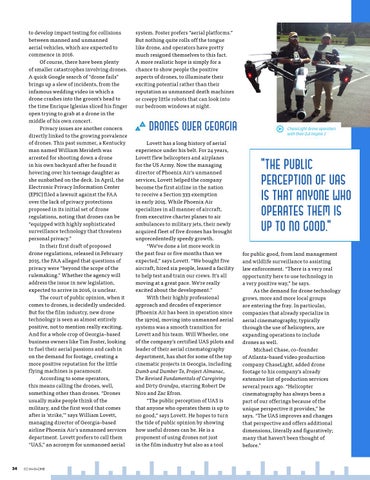
ChaseLight drone operators with their DJI Inspire 1
"The public perception of UAS is that anyone who operates them is up to no good." for public good, from land management and wildlife surveillance to assisting law enforcement. “There is a very real opportunity here to use technology in a very positive way,” he says. As the demand for drone technology grows, more and more local groups are entering the fray. In particular, companies that already specialize in aerial cinematography, typically through the use of helicopters, are expanding operations to include drones as well. Michael Chase, co–founder of Atlanta–based video production company ChaseLight, added drone footage to his company’s already extensive list of production services several years ago. “Helicopter cinematography has always been a part of our offerings because of the unique perspective it provides,” he says. “The UAS improves and changes that perspective and offers additional dimensions, literally and figuratively; many that haven’t been thought of before.”
Michael Hofstein and his team on set.
Chase does not expect drones to replace helicopters altogether in the industry - helicopters are still able to fly higher, faster and further - but he does recognize the clear advantages of drones. “Our clients are trending towards UAS not only for price but for convenience,” he says. “Helicopters require that you travel to an airport, participate in all the pre–flight checklists and install special mounts for the camera, then fly to location and shoot. This could also involve trips back to refuel. A UAS eliminates the need for an airport, and pre–flight inspections and camera prep are more efficient.” ChaseLight has seen a significant increase in client requests for drone videography from corporate, documentary, educational and real estate/development clients. A recent gig took them to the Louisiana bayou, where they used their DJI Inspire 1 Professional X5 to capture aerial footage of wetlands, crawfish farms and marinas for a documentary for Ambassador Andrew Young, the former mayor of Atlanta. “By shooting with UAS, we were able to access areas that may have never before been photographed, certainly not from the angles we shot from, and the footage is simply stunning,” says Chase. Carelton Holt, president of Atlanta– based video production, photography and marketing firm Granite Digital Imaging, bought his first drone, a Yuneec Typhoon 4K, just recently after using one on a shoot. With years of aerial cinematography experience using helicopters (GDI has approximately a hundred helicopter shoots under their
belts), Holt’s approach to drones has been one of cautious optimism. “We hope to be upgrading to a higher end drone in the future if the use of our current drone grows and the demand for a higher quality is there,” he says, but adds that “it is a bit of a confusing time in the aerial film landscape where the demand for aerial shots is high, but the quality of imagery is all over the place.” Holt notes that while clients are certainly very interested in aerial images for their projects, many are concerned about “the dramatic difference in the quality of much of the drone footage out there,” as he puts it. “It definitely can stand out from the ground footage if high quality cameras and lighting are used. The cost of drones that can actually fly a camera like a RED is very expensive (not to mention the value of the camera on board) and there is still considerable crash risk.” While Holt recognizes the value of drone capabilities, he is still not eager to trade in his helicopters. “As far as the footage goes, I am heavily partial to helicopter footage where we are able to use our RED Epic Dragon and shoot stunning 6K RAW footage,” he tells me. “Most drones are using cameras with far less resolution, dynamic range and data rate. There is considerable difference in the look, even to the untrained eye.” Michael Hofstein, director of photography for Atlanta–based production company EuroPacific Films, is another cautious adopter of drone technology. As a veteran in the industry with an impressive 35 years of experience in production, direction and
Michael Chase with his DJI Inspire 1 Pro
cinematography, Hofstein’s credits range from M.A.S.H. to The Mask of Zorro. Hofstein bought his first drone, an early model DJI, four years ago, but has since backed away from personal engagement with the technology. “I would rather work with a qualified pilot whose main concentration is on the aircraft while I can concentrate on the story and the cinematography,” he says. “I so enjoy working with drones, but aerial cinematography covers a wide range of image–taking platforms, from use of Lear jets to helicopters and more recently, the use of drones. Each has a unique place in the world of storytelling. It’s up to the director of photography, the director, and the producer to understand the capabilities of each and to use the right platform when telling the story, dependent on location and budget.”
NOVEMBER / DECEMBER 2015
35
From the Fire to the Sky One Atlanta–based drone operator who has fully embraced drones in both practice and name is Jamie Hamlin, owner and lead pilot for aerial cinematography and full–service production company Drones of Prey. Like William Lovett, Hamlin expresses deep support for the FAA’s new legislation. “It’s such a breath of fresh air to get approval and finally be doing it legally,” he says of receiving his FAA exemption this past spring. The majority of commercial drone pilots use lawyers to file their Section 333 paperwork (Foster recommends SkyGen Aviation, well–regarded in the industry as the authors of the first seven Section 333 exemptions) but Hamlin and his team decided to do it all on their own. “We wrote our own exemptions, our own operator’s manuals, all out of our own heads,” he says. “We literally had to sit there and write down everything we do from the moment we take the aircraft out of the box.” As a result, Drones of Prey applied for and received the broadest exemption possible. They are now officially approved for aerial photography, videography, cinematography (including motion picture and closed set television production), and even search and rescue operations. As their website proudly proclaims, this means their customers are guaranteed no legal hassles, a high standard of safety, and years of aviation experience. The FAA also requires commercial drones to be controlled by a licensed aircraft pilot, so Hamlin’s lead pilot Doug Bell is licensed. For Hamlin, FAA approval is a significant step in a journey that began 15 years ago, when he first started flying remote controlled helicopters. “There weren’t’t any drones back then,” he tells me. “I started flying just because I had an interest in helicopters. As I got into it, I noticed people doing aerial photos, and thought, that’s interesting, because it gives you a really unique perspective. Think of a Google Earth view of your home, looking down at the top of your house like a map from 400 feet.”
36
OZ MAGAZINE
"I didn't know anybody in the industry and so I was just cold calling production people. We were inventing our own equipment and methods at the time, so there was no rulebook to follow, no website to send them to for reference."
Hamlin was even more impressed when he saw people starting to do aerial video, and he soon began experimenting with RC helicopter videography on his own. “I wouldn’t say I was the pioneer, but there were just a handful of us around the world who saw what this could bring to the production world,” he recalls. “We all kind of worked together on how to make it happen. A lot of the early days were just us learning what we could and couldn’t do and how to do it, and educating production companies, because at the time they’d never even heard of drones.” Hamlin says he approached producers not with the intention of replacing other camera methods on set, but simply to accentuate them. “It was taking them six hours to set up a crane shot that we could do in a matter of minutes,” he notes. Interestingly, Hamlin’s professional background has little to do with aviation. For many years, he worked as a firefighter. “Coming from a background of public safety and breaking into the entertainment business was very
Jamie Hamlin and Doug Bell of Drones of Prey early days, flying a large single rotor in Aspen Colorado
Drones of Prey pilot and owner Jamie Hamlin setting up for another flight on a beach in Costa Rica
challenging for me,” he says. “I didn’t know anybody in the industry and so I was just cold calling production people. We were inventing our own equipment and methods at the time, so there was no rulebook to follow, no website to send them to for reference.” Despite the challenges, Hamlin’s business took off. He landed his first television show in 2010, a Discovery Channel program called Howe and Howe Tech about an eccentric pair of twin brothers who invent military vehicles. From there, the Drones of Prey team traveled the world, shooting everything from urban downhill bicycle races in Chile to HGTV’s Beach Front Bargain Hunt show. Prior to speaking with Oz, Hamlin had just wrapped a month of back–to–back projects that took his team from North Carolina’s Outer Banks to the cliffs of coastal Oregon to the jungles of Costa Rica. Crazily enough, until two weeks prior to this story, Hamlin was still juggling full–time firefighter work in addition to running Drones of Prey. He’d grind out 24–hour shifts at the firehouse
to earn 48 hours off, during which he focused on his growing business. “I used my time off to go to the shoots,” he says. “If I didn’t have time off, I would have to swap with somebody and do a 36 hour shift.” The schedule was grueling, but Hamlin says quitting his day job seemed too risky prior to receiving his exemption; he never knew if he’d get another gig or a cease–and–desist letter from the FAA. Once the exemption finally got approved, he was ready to go all in: “Now that we’re legit, I said, let’s do this. Let’s make this a full time business…and quit running into burning houses.” That said, Hamlin is still deeply interested in public safety, and hopes to be on the forefront of getting drones into emergency and disaster scenes. While he wasn’t able to convince his superiors at the fire station to embrace the use of drone technology in fighting fires locally, he is committed to pioneering new ways of integrating drones into public safety efforts on a national level. From assessing dangerous
Doug Bell (Drones of Prey) takes direction framing a highly technical shot for Sandals in St. Lucia
situations to search and rescue, the possibilities are endless. “It would be so advantageous to use drones this way,” he says. “But the standard operating procedures haven’t even been written yet.” Like any new technology, drones have equal capacities for good and for bad, depending on the intentions of their human operators. But for every drone mishap or unwanted invasion of privacy, there is a whole host of fascinating new ways in which drone technology is being used to help all over the world, from training falcons to maintaining cities to building bridges to bringing aid to war–torn countries. As technology rockets forward at a breakneck pace, the government will always be one step behind, but industry professionals are hopeful. Every drone operator I spoke with expressed unanimous support for the FAA’s attempts to better enforce and regulate drones. “We see it as a good thing because we follow the rules,” says Lovett. “We want to keep the skies safe for everyone.”
JANUARY / FEBRUARY 2016
37
On Set, in Post and On the Screen: An Interview with Drew Sawyer
Heavy Water production still
38
OZ MAGAZINE
W
hether he’s on the set of an indie Sundance horror film dressed only in a pair of bloody boxers or working with a talented post production team on an episodic television series, Drew Sawyer loves telling stories. His company, Moonshine Post–Production, has a rapidly expanding portfolio of start–to– finish post production projects, from feature films and broadcast episodics to commercial spot work. With strong roots in the Atlanta film and indie community, Sawyer and his company recognize the importance of both cultivating talent and collaborating on independent projects to become better storytellers. When the folks at Moonshine are not cutting someone else’s show, they’re shooting and posting their own. Drew Sawyer is dedicated to distilling Georgia’s creative projects into finely tuned stories that capture audiences worldwide. Here, he talks about the burgeoning indie film scene in Georgia, what it’s like to wear so many different hats within the industry, and how to trade in the “currency of favors.”
Drew Sawyer How did you get started as a filmmaker? I started, just like a lot of folks, by making my own stuff. And when you do that, you have to wear all the hats and you have to do everything. When I directed my first narrative, it happened to be a feature and I was 21 and that was ridiculous! But I ended up finding out that I was pretty good at editing. So basically, I started a business of inheriting other people’s problems.
How did you realize your post production experience could help filmmakers avoid making costly mistakes in production? I kept seeing the same kinds of problems over and over again. Whether it was broadcast TV or independents that my friends were making, I kept getting a little box of garbage and being asked to sift through it and make gold – like I had this magical editing garbage–sieve. Editing is the final frontier before the world sees your movie, your show.
So after fixing my own story problems and then fixing other people’s story problems, I realized that a lot of these mistakes can be avoided in the field, but you need solid, upfront pre–production planning. If I took what I learned from seeing all these boxes of crap pile up, I could probably give some good advice based on what I’m seeing on the back end to help production. So I started helping others produce. My friends would be making their own things and I’d advise, “Hey, listen. You’re going to run into these technical problems. You’re not going to have these types of story elements. Your scenes are going to fall flat. You’re going to wish you had done this or I promise you, it’s not going to work in the edit.”
What kind of response do you get when you give this advice? It’s pretty polarizing. I say, “I’ve watched it. I can give you notes as it is. But I feel like you’re going to need some re–shoots unless you have these scenes.” And usually they go “Well, we’re done. We can’t go back. We’re out of money.”
JANUARY / FEBRUARY 2016
39
“
”
You’re going to have to beg, borrow and steal just like the rest of us and find a way.”
Pepper’s Place behind the scenes
And it’s not really my place to rub salt in the wound and say, “Well you’re supposed to budget for that” or “You’re going to have to beg, borrow and steal just like the rest of us and find a way.” Half of the people just say, “Shut up. Deal with what you’ve got.” And I say, “I can make it work with whatever you’ve got, but if you have the opportunity to re–budget and go pick up a few scenes, please shoot these types of scenes. And I’ll show you where these scenes should be in your narrative flow.” I always want the work to be the best it can be, so when we’re in the editing room, I tell everyone up front, “These scenes have value; these scenes don’t.” You know what to look for when you are trying to cut things together to make a story. If I tell them, “This scene falls flat for these reasons,” the director will usually get it because that’s their job. That’s how they work. I worked with Molly Coffee on one of her early short films and she was willing to follow my advice and get the extra shots she needed. Then her film had a better flow and better pacing and the audience could really get into the story a lot easier.
So you’re working with Molly again?
Pepper’s Place production stills
I executive produced Molly’s TV pilot Pepper’s Place and Molly is digitally astounding at creating everything that is in the frame. She’s cast strong local talent and she’s built beautiful sets where humans and puppets interact in the world she’s created.
You know the whole cycle, from pre–production through post. How does that make you a valuable asset on set? I pre–produce the hell out of everything because I know that if I don’t, I’m going to hate it on the back end. I know every pitfall we’re going to encounter on set that’s going to haunt us all the way through post. So I can see the future in a lot of respects, because I know where the ship’s heading, where this film’s problems will be later. I can usually see it on set and I feel like I’ve
40
OZ MAGAZINE
Treehouse production stills
accrued enough experience on the back end to benefit filmmakers on the front end.
“ ” getting people to believe in your project.
Despite being a post–pro guy, you keep getting producer credits. How did this happen on Treehouse? Treehouse is a neat horror film that the director, Michael Bartlett, put together under some hilariously hard constraints in the Ozark Mountains. The film was pre–sold at a film market for distribution through Redbox. They were shooting out of town, using the RED camera, shooting in a big format, and they’d only have a limited number of computers. So I came in as post–producer at the beginning of the project and designed their workflow. In the film, it’s ice cold; it’s night. You punish people to get these types of shots. It was a small, short shoot and they knew they weren’t going to get a lot of takes. When we watched the footage, I told Michael, “Hey, you’re a horror film director. You know these scenes have to have a certain tonality or else it’s not going to be scary. Let’s just say it straight. I can get as much out of these scenes as you have here, but you really
are missing these key elements. You don’t want to go to the film market guys that brokered your film and say ‘Oh, here’s my not so scary film.’” Michael saw exactly what I was talking about; I was preaching to the choir. He went back to the Ozarks, did some additional shooting and he pulled it off. I threw all the talent I could at his film with little to low budget and Michael offered me a producer credit. I really appreciated it. And that is part of producing: getting people to believe in your project. Not twisting their arms, but finding the right people for the right jobs at the right time to get the best film.
You use the term “currency of favors” to describe how Atlanta indie filmmakers are getting their projects made now. Can you explain that? Favors are a commodity and currently in the Atlanta market, the indie field is trading this “currency of favors.” Outside of all the paid broadcast and bigger film stuff, in the indie zone you’re allowed to practice and do things you wouldn’t normally get to do. And that’s the exciting part of it. To convince certain people to do certain projects, to rope ‘em in, one of the things you can offer someone is the opportunity to practice a skill set they don’t normally get to use. They get to move up a position. And then they get that experience with that skill set. It
sounds pretty straightforward, but then how else are you going to get any better?
Some people tell me, “I don’t need to do that; I’ve already paid my dues.” You can pay a lot of dues, but you can’t pay all of them. It’s constant. If you want to make an independent film you better have one of two things. One, a lot of money. Then you can buy your way into anything, who cares? But you probably don’t have that because you weren’t able to convince investors that they should lose five million dollars on your idea. Or two, you can trade on your name, your work ethic, your skill, your talents. Right now to get films made, you have to make the deals with favors. You have to barter; you have to trade. Like, “I’m going to post your film for nothing because you’re going to art direct my film for nothing.” And you do it. You have those favors stored up and then you call them in.
What are you looking for when you decide to collaborate on an indie project? I’m attracted to creatives that know what they want up front, but are willing to listen and not rush in to green light their own projects. It takes more than just someone “telling” me a story. I have to recognize that storytelling talent and
JANUARY / FEBRUARY 2016
41
“
”
There’s no shortage of writing talent here in Georgia.
their willingness to collaborate. I have to see what they value in their images. I’m an editor and I value things on a scene– by–scene basis, and the weight of scenes. If they have samples of their style, it’s a lot easier, and if they have a body of good work prior, I can see, “Okay, you’re not a crappy director.” But if it’s their first time, it takes more than desire. You can’t put your finger on the X factor – either they have it or they don’t. Unfortunately that’s not absolute. And I’ve been wrong. I’ve produced things that I thought would be great and they weren’t. The problem was not the production value. The problem was the story. I see a lot of things that shouldn’t be made, but the exciting thing about the indie world is that you’re allowed to make mistakes.
Okay, but let’s say that we as an indie community want to have a higher batting average. How can we be more discriminating in terms of story and have more Georgia projects reach larger audiences? There’s no shortage of writing talent here in Georgia. The problem I see is people treating their scripts as if they’re too precious and they don’t workshop them. It’s basic 101: if you don’t workshop your script, then you’re going to green light a piece of crap. So take the script, workshop the hell out of it and spend a little money on rewrites. It all starts with discerning what’s a good or a bad idea, and the only way we can do that here is peer review because we don’t have a lot of access to writers’ rooms. We don’t have a Hollywood machine behind us optioning all the ideas on the planet, ranking them and then picking out the right idea for the right marketing zeitgeist.
42
OZ MAGAZINE
The one resource we do have here is good storytellers working with other good storytellers, and they’re good because they’ve honed their skills by practicing in the industry.
How does Georgia’s phenomenal production growth benefit indie filmmakers here who have some chops and are ready to make long format projects? When I did my first film, I had to do everything because I didn’t have a choice. I trained people in the back of a restaurant how to hold booms and run cables. That was exciting, and I think filmmakers should do everything at first so they can realize what they should and what they shouldn’t do. But now we’re better than that. We’re all more practiced. And I think we can have faith in our specialized technicians and story makers.
“
We don’t need to do everything ourselves, and we shouldn’t.
”
I was told early on, you ought to go to New York or to LA. But I was learning my craft here and I believed that Atlanta was going to be a place with a lot of opportunity, and now it is. If you’re going to make an indie film or show right now in Atlanta (and that’s what I’m planning to do), we need to ask “the
no shortage of experienced Georgia professionals out there” to work with us and let them do their jobs. That’s why departments exist. We don’t need to do everything ourselves, and we shouldn’t. It’s just about our willingness to cooperate and collaborate on the up– front and design the right pipeline to get our film made from beginning to end. Don’t just say “we’ll just figure it out on set.” I’m not going to lie, you do have to be a cowboy sometimes, but if we want polished products that compete, we’re going to have to play by the rules. And you can trade your favors because you don’t have a lot of money, and when we’re willing to contribute, it’s possible to actually get these good films made. A good idea doesn’t just jump out of your head and onto the page; it has to be refined. And now it’s time to actually undergo painful peer review, workshop the script and make the best screenplay possible and then work with an experienced team. And there’s no shortage of production technicians and collaborators in Atlanta right now that can make an amazing film.
What’s your hope for three years from now, for Georgia as a production center that originates and produces creative content? Everyone is getting so good at their jobs. Good ideas are surfacing and I think we’re going to start picking and choosing those ideas. I think the machine exists now to put these ideas forth and deliver them to an audience and monetize these projects. And I want to be a part of that. I want to help that grow and I want to get better because of it.
SOCIETY FOR CINEMA & MEDIA STUDIES
the world’s largest organization devoted to the scholarly study of film and media
SCMS 2016 Make plans to attend the
57TH ANNUAL CONFERENCE OF THE SOCIETY FOR CINEMA & MEDIA STUDIES Hilton Atlanta March 30–April 3, 2016 Atlanta, Georgia
cmstudies.org office@cmstudies.org 405.325.8075 facebook.com/SCMStudies @SCMStudies
For information on how to register, please visit our website
JANUARY / FEBRUARY 2016
43
ish
e Bun
ristin By Ch
44
OZ MAGAZINE
t we s t ha e v i era l daily s and cam r u o t in ter ilo erials by able p and disas eping a r e t news e swe elicop anned ing h ranted. M breaking ey captur d place. e e s ed to s. Th orts, for g me an ustom ye views traffic rep s network ows in ti ling for c c a e o h e’re s ese bird’s rs deliver tional new orite T V s ultimate b e a v t e h a n t p h f t o e d r c u li as an tak ideo rs, he stations at orient o nd serve o t and v a r a m V h l t i s T ope f r s l a ving scape r loca eek c for gi to ou nsive city elp sell sl e l e b g i a s spon cover and expa illains, h v als re s n c e i i o i v n s e o s m sc ofe chase ed pr They p artists. he dedicat t o hip–h t a few of e POV. e Me uniqu ion a t c u d pro
W
Helicopters West Innovates John Sarviss, CEO of Helicopters West, headquartered in Muscle Shoals, Alabama and with a base of operations in Woodstock, Georgia, has accumulated more than 20,000 flight hours since he started flying helicopters in 1971. He began specializing in aerial cinematography in the late 1970s and spent 30 years in Los Angeles before moving east about two years ago. Sarviss holds all FAA licenses and credentials, including a Low Level Waiver. He skimmed just a few feet above the Las Vegas Strip – a feat not repeated since – to capture footage for Paramount’s Star Trek Adventure interactive ride two decades ago. Sarviss accesses the best aircraft for a given job and is known for developing innovative camera systems. “I’ve designed and built over 35 different camera systems for helicopters,” he says. “It’s rare to customize; I’m probably the only company in the world that can do it. I have a fabrication facility and can modify camera systems to do what I need them to do.” When director James Cameron’s VFX studio, Digital Domain, was shooting a Lexus commercial for Japan, it wanted to
do a moving 360 degree shot around the vehicle. “They wanted to see the front, side and back of the car, and as they moved around the car the background of seasons would change,” Sarviss explains. “To accomplish that the camera system had to be below the level of the helicopter, and there was no system to do that. I modified a SpaceCam system so the mounting bracket dropped below the level of the landing gear. I also made a special platform to land on.” For another Lexus spot, Sarviss helped the automaker live up to truth in advertising. “The Lexus headlight lenses are made of the same material as an F–16 canopy, which they wanted to show on camera doing a barrel roll 20 feet off the ground. So I made an F–16 canopy, mounted it on the side of the helicopter and made it roll.” Sarviss has shot hundreds of commercials worldwide, including spots for Mazda, Toyota and Cadillac. An upcoming car spot will air during the Super Bowl. “I shoot traditional aerials, running footage and scenics, both generic and specific,” he says. He has been flying remote controlled aircraft since the ’80s so when
JANUARY / FEBRUARY 2016
45
Unmanned Aerial Systems, known as drones, started to emerge for film and video production, Sarviss opted to embrace them. “I knew we’d either have to offer drones or be in direct competition with them,” he says. “So now we offer both. To my knowledge we’re the only company in the southeast with both full–size aircraft and drones.” Helicopters West has an Aeronavics SkyJib 4XL drone, which Sarviss says can carry any Red or Blackmagic Design camera or an ARRI ALEXA Mini. He has already put it to work shooting car spots. Also on hand is a DJI Inspire 1, which is typically used for scouting and blocking. “We’ll use a drone for budgetary reasons, for the ability to get into smaller areas where full–size aircraft can’t fit or when there are insurance concerns because it carries no passenger seat liability,” he explains. Sarviss says that a drone could replace what would have been a simple crane shot in the past – flying through a doorway or window, for example. A drone could also carry thermal imaging gear to capture a predator drone’s POV. “It’s illegal to fly them at night but you can use a thermal camera to shoot day– for–night,” he explains.
Sarviss has applied for an FAA waiver that would allow him to control drones from a moving platform instead of a stationary position and expects to receive approval soon. He has also applied for copyright and patents on the technology. “It will be a game changer,” he declares. “It will offer the same creative outlet that Steadicam did for moving subject matter. I noticed early on that maintaining perspective on a moving vehicle got more difficult with a drone as you got away from the central control point. But when you move with it, you never lose that perspective.” He believes his new drone control methodology “could potentially augment or even replace camera cars, which have booms attached that take up two or three lanes of traffic. With a drone you can use one lane of traffic or less; you can operate it from boats, trains, tractor/trailers. It would eliminate setting up scaffolding and mounting camera positions. It will change everything.”
Helivision Adds Atlanta Base With more than 30 years of production experience, Helivision, LLC
“It will be a game changer...” –John Sarviss
46
OZ MAGAZINE
has expanded from its main base of operations in Charlotte, North Carolina to add an Atlanta office at Atlanta Regional Airport this year. “Over the past 10 years production in North Carolina was really good, but when they replaced the tax incentive with a limited grant program it drove Homeland and Banshee, among other productions, out of the state,” notes Helivision COO and SAG pilot, Kevin Knotts. “Since Georgia is so strong with its incentives, we decided to open an office there, and we’re starting to get some calls,” he reports. Helivision can easily turnkey productions with its own Emmy Award– winning pilots and camera operators. Knotts’s father, Buddy, founded the company and is still an active participant in it. Helivision offers Bell 206B Jet Ranger III, Bell 206L Long Ranger and Robinson R44 Raven II helicopters as well as a Cessna 206 plane with camera platform. The company owns two Cineflex gyro–stabilized camera systems: the V14 with Sony 1500 and Fujinon 42x9.7 lens and the Premier with Red Epic Dragon and Canon 30–300 lenses. It has access to the Cineflex ELITE for the ARRI ALEXA.
CCI’s TwinStar on set dressed as SWAT helicopter
“The Cineflex systems can carry payloads of 75–100 pounds; they’re much smaller and lighter than the Wescam and SpaceCam systems,” says Knotts, “so we can increase our fuel load or customers can carry more equipment. We’re seeing people move to the UHD market, especially with Red Epic Dragon and ARRI ALEXA. We can offer more cost– effective options than helicopter services that aren’t set up for production and have to rent camera systems and camera mounts at an increased cost.” Helivision works nationwide but finds a considerable number of projects close to home. Knotts served as pilot and Helivision’s Korey Owens as aerial camera operator on the upcoming feature Megan Leavey, about the U.S. Marine and her combat dog, Rex. Knotts and Owens teamed with director Gabriela Cowperthwaite and DP Pete Shilaimon on aerials and tracking shots at Paris Island, South Carolina. The shoot employed Red Epic Dragon. The feature The Longest Ride, released last summer, called on Helivision to capture aerial tracking shots of vintage automobiles along the Virginia–North Carolina border. The shoot required Helivision to obtain
a Cineflex ELITE from a vendor partner to accommodate the ARRI ALEXA XT camera. Knotts regards drones as “a complement to what we do, another tool in our toolkit.” Helivision has already invested in a DJI Inspire 1 drone with camera gimbal and is awaiting FAA approval for its operation. “Drones excel at pulling off unique shots – moving through trees and going close, tight and low where helicopters can’t,” he says. “We can shoot 4K with Inspire 1, and it has 360º pan and tilt; we’re really happy with what it can do. But it’s important for customers to know the regulations and hire people with an FAA exemption to operate drones legally.”
Everything Aerial at Camera Copters Camera Copters, Inc. occupies a singular niche in the business. It offers a full range of aerial support services for film and video production as well as a 53–foot custom transport/production trailer that carries a helicopter and serves as a self–contained mobile base of operations once on site. Owner Paul H. Barth, a commercial pilot for more than
30 years, holds an FAA Motion Picture Manual and FAA Waiver for Low Level and Non–Standard flight operations for aerial filming and stunts with both airplanes and helicopters. Although Camera Copters has a travel range across North America, Barth finds that state production tax incentives now “drive everything” when it comes to where productions are shot. His Florida home base has experienced “an exodus of production to Georgia.” The half–dozen feature films he’s worked on in Florida this past year required only establishing shots for productions otherwise based in Georgia. So, just as he did in Louisiana, Barth has incorporated Camera Copters–GA, LLC in Atlanta with fellow film pilot J.R. “Skip” Lam. They have also formed an alliance with Atlanta–based Helicopter Express to better accommodate increased Georgia projects. Camera Copters owns and operates two Hughes/MD–500s and an Airbus AS355F–1 TwinStar helicopter dedicated to aerial production work; when needed, the company has access to additional aircraft via industry partners. Through associate Active Camera Systems, Camera Copters has access to aerial
“a complement to what we do, another tool in out toolkit.” –Kevin Knotts Herb Kossover (right) with his Bell Long Ranger and Will Areu, executive producer at Tyler Perry Studios
Paul Barth on set with the cast of NBC’s Blindspot
JANUARY / FEBRUARY 2016
47
CCI’s MD500 & Transporter in Aspen, CO. for “Tour of Colorado”
Kevin Knotts
“Aerials are often the stepchild of the industry...” –Herb Kossover
cameras, mounts and systems such as the Cineflex ELITE, GSS–C520 and Tyler Middle Mount plus all of the other aerial camera mounts and systems currently available, including SHOTOVER, Pictorvision Eclipse, FSI and Gyron. Since Camera Copters sometimes plays a role on camera as a picture/story aircraft, it also has a large array of stunt and paramilitary gear, such as the Tyler Special Operations Platform, exterior personnel benches for snipers, Tyler fast rope/rappel equipment, searchlights and even mock up guns and rockets. “We have all the toys – well, tools,” says Barth. Recent work has taken Barth to New York City for the Netflix series Daredevil and NBC’s new hit series Blindspot; he is aerial coordinator and pilot on both. In Savannah, he appeared on camera flying one of his MD500s as a police copter chasing Adam Sandler in the upcoming feature, The Do Over. Barth also shot aerials for the new Oxygen series Preachers of Atlanta, Bravo’s Real Housewives of Atlanta and a number of TV pilots, such as Line of Sight. Subscribing to the adage ‘if you can’t beat ‘em, join ’em,’ Barth now holds an FAA Part 333 exemption for the operation of drones. “We had to offer that equipment and technology as another tool in our aerial toolbox,” he says. “At the outset, it was the Wild Wild West for drones in general: There was no control, no oversight, basically a free for all. I had a real problem with them in the beginning. Drone people were spouting off they could do anything a real helicopter could do and cheaper, which is just not the case. But I finally felt that
48
OZ MAGAZINE
so many producers, directors and DPs wanted to play with these new toys that I had to be in the game. I had to embrace this new technology and make it my ally, not my enemy. Interestingly, two out of three of our initial drone requests ended up turning into manned helicopter jobs.” Barth invested in a DJI S1000 drone and a second customized unit to carry a heavier camera payload, usually a RED or ALEXA Mini; it sports a MoVI remote control gimbal and a Paralinx HD downlink. “Drones excel at certain close–in and confined area shots – inside stadiums, tunnels, warehouses, basically places where you can’t get a real helicopter,” he explains. “But shooting at night, over populated areas, near an airport or from a moving vehicle are just some of the things that are not authorized under the current FAA licensing parameters. Not to mention that these vehicles have a very short flight duration and cannot loiter over a scene for extended periods of time or move across a city from location to location.” For these reasons Barth says, “As far as I’m concerned a real helicopter with a real camera package, experienced film pilot and aerial DP sitting side by side, operating in real time will never be replaced. People still need a well–oiled professional team with enough insight and creativity to think ahead of a shot. A remotely–controlled drone will never have the opportunity to sit next to a camera operator and drag into frame a developing element that a film pilot can see in his peripheral. That is why I say manned helicopter filming is here to stay!”
Kossover Flies High for TV and Films Director and aerial DP Herb Kossover heads production company Kossover & Company in Atlanta where he and a partner own a Bell Long Ranger helicopter. FAA–approved for motion picture and television flight operations, Kossover has been shooting aerials for more than 25 years. He began with a 35mm Wescam system and today offers a pair of Cineflex ELITE camera mounts designed for ARRI ALEXA and Red 4K cameras. He maintains a large, high– end aerial stock footage library featuring more than a dozen cities, including Atlanta, New York, Los Angeles, San Francisco and Chicago. “Aerials are often the stepchild of the industry – they’re not thought about at the beginning of production,” says Kossover. “But I’m doing more aerials now, many of them scripted. Aerials are also an editor’s dream as transitional elements.” Kossover was aerial DP for the pilot and first season of the upcoming CW series, Containment, in which an epidemic breaks out and Atlanta is quarantined. “People affected by the virus are cordoned off,” he explains. “They used Google maps to show the walled off area but hired us to capture wide shots of the cordon. They relied on us to tell them if and how we could get the shot: We couldn’t fly higher than 3,200 feet or we’d be in the airport flight paths.” He did air–to–air shots for ABC affiliate WSB–TV/Atlanta showing the station’s own helicopter at work and
Paul Barth w/ MD500 on location in the Colorado Rockies
“There’s no stopping drones. The only issue is regulating them...” –Herb Kossover
documented the new One World Trade Center (Freedom Tower) in Manhattan for WABC–TV. “We were there shooting the new trade tower soon after its completion along with surrounding buildings and the boroughs,” he says. “In New York it’s sometimes hard to tell when a new building goes up, but in this case the station needed updated footage of downtown.” Other top credits include a number of Tyler Perry projects, the open for the comedy feature Big Mommas: Like Father, Like Son, the Lifetime series Army Wives and Food Network’s Jamie Oliver. Kossover also worked on an AT&T spot that featured his helicopter and a high–end CineStar 8HL drone. “For one four–second shot of a car coming around a corner in downtown Atlanta it would have been dangerous to bring a helicopter down that low even if it had been allowed,” he explains. “So we used a professional drone.” Kossover was recently named a Professor of Practice at Georgia State University where he recently shot aerials for a capital campaign. It’s likely that Kossover will invest in a few drones in 2016 to supplement his helicopter aerials. “I don’t see them as a threat like some pilots do,” he says. “There’s no stopping drones. The only issue is regulating them – we’re all for safety.”
Prestige Helicopters Corners Music Market Family–owned Prestige Helicopters, Inc. has been in business for 30 years in Atlanta where it operates two locations: the Fulton County Airport
and the Peachtree–DeKalb Airport, plus a separate maintenance facility. The company has seen production work grow in recent years, especially after treasurer/director of marketing Andy Whitaker earned a degree in cinematography and screenwriting from Chapman University in Orange, California and returned to Atlanta to help build the business. Prestige operates a fleet of cost– effective Robinson helicopters: an R22 two–seater for still photo shoots and two R44 four–seat models, with a gyro– stabilized platform mount that can hold up to an 80–lb camera rig, for video shoots. A Robinson R66 five–seater is also on hand for charter service. Two GoPro 4 cameras are available for Prestige’s use or for customers if a DP needs a back–up option for his own equipment. Otherwise, “so many production companies in Atlanta have great gear so we focus on being a service provider and customers bring their own gear,” says Whitaker. “We eventually expect to add a nose mount, however.” In the past three years Prestige has taken the music business by storm, turning that market segment into “the biggest slice” of the company’s production work. Prestige shoots aerials and offers its helicopters as on–screen props for a number of rap artists, including T.I., Young Jeezy and Future. “Almost every rap video wants a helicopter in the video as a prop – the artist getting on and off the helicopter or sitting in it – and they want aerial views of the city,” Whitaker explains. “We combine both for a package price.” Prestige has also covered area
music festivals, transporting artists to venues and capturing expansive crowd shots at CounterPoint Music Festival, TomorrowWorld, Imagine and Bonnaroo. Prestige worked on two recent commercial shoots as well. A spot for the Georgia Lottery showcased company owner Mike Russell as both actor and pilot flying over the heart of Atlanta. For a MetLife commercial Prestige captured air–to–air footage of the MetLife blimp flying over a golf course. The company maintains a stock library of aerial footage, which it regularly supplements as the Atlanta cityscape continues to change. The library also features seasonal and time–of–day clips plus scenics of Stone Mountain and Lake Lanier, all in “professional formats, including some 4K,” Whitaker notes. The library can be a good solution for clients who “need a shot that’s not in their budget to capture – we can offer a clip we’ve pre–recorded instead.” Whitaker says he’s “not worried about the drone revolution. We haven’t lost any business to them. They have their niche for smaller–scale shoots or flying down narrow streets where helicopters can’t go. But they can’t fly at 5,000 feet to capture a wide–angle cityscape. “Our business model has managed to make helicopter aerials accessible to a broader demographic than before,” he emphasizes. “It’s not any more expensive to use our helicopters than to use a drone, which requires a flight fee and a fee for an operator who’s on set whether the drone is flying or not.”
JANUARY / FEBRUARY 2016
49
BEHIND THE CAMERA WITH DREWPROPS
Chasing The Celebrity
Working with famous people is weird. Nothing prepares you for it. Nobody teaches you about it in school. Most people on this planet go through their entire lives without meeting a single famous person.
50
OZ MAGAZINE
On the other hand, people who work in the movie industry meet and work with famous people as part of their job. However, those people don’t receive any sort of formal training on how to work with celebrities – they have to learn it on the job. It’s been my experience that the vast majority of film crews handle working around famous people quite well – usually because the shooting schedule is so tight that nobody has time to slow down and actually consider the strange sociological behaviors caused by celebrity and proximity to celebrity. The first famous person that I recall meeting was Guy Sharpe, a local Atlanta meteorologist. My parents
By Andrew Duncan
had brought me to see the circus and in the midst of the festivities the spotlight washed across our section of the bleachers, stopping to reveal that a locally famous television personality was less than 15 feet from where we sat. I still remember my amazement at seeing someone from inside our television standing there in person. My next celebrity sighting was Gunther Gebel–Williams, a big cat trainer whose important sounding name had become famous to me and my friend Danny due to a flashy television ad campaign for the Ringling Brothers and Barnum & Bailey Circus that peppered commercial breaks during Gilligan’s Island, Space Giants and The
Flintstones on Ted Turner’s Superstation 17. I still remember how Danny and I flipped our lids when Gunther Gebel–Williams waved in our general direction whilst riding a lumbering elephant with a live leopard draped casually around his neck like a scarf. That dude was the most famous thing we had ever seen. My next encounter was with an even bigger celebrity. It wasn’t at a circus, but it did involve a clown – specifically Jack Nicholson dressed as the Joker on the back lot of Pinewood Studios outside of London. It was 1988, during the filming of Tim Burton’s first Batman film. The writing on the wall had been telling me for years to run away and join the circus, and I had unwittingly been preparing for this destiny by spending my summers at a science fiction convention that predated Atlanta’s now–supreme Dragon Con. In the 1980s, the Dixie Trek convention was big enough to afford name brand television and movie actors, but small enough that you were forever running into them in the lobby and the hotel bar. After listening to these actors’ tales from set, I began to realize that their celebrity didn’t place them out of my reach; they were in fact interesting and approachable people. What I had yet to learn was that actors meeting fans at a convention are very different from actors who are at work on set. My first two or three movies were a fantastic blur, which is the typical experience to someone new to the business, but over time I began to understand the flow of activity on set and I quickly grew to love the clever banter that crews engaged in during new setups. There’s a special kind of magic that permeates the area around camera, and as a young crew member it’s especially easy to be seduced into the feeling that you’re a big part of that magic. And you are (to a degree), but it’s important to remember that you are not the star of the show. I still remember the day that longtime sound mixer Mary Ellis
pulled me aside after one of our particularly hilarious crew performances on set. With a big sisterly tone she quietly suggested that we should take our antics down a notch. I know that I was surprised by this advice (and probably initially offended), but I’m pretty certain that I had no idea what she actually meant at the time. However, I have thought about what she said that day from time to time over the years, and as I matured, I came to understand her point. It’s okay, even important for a crew to have fun with each other on set, but it’s equally important to remember that the crew’s prime goal is to get the shot and to support the director and the actors.
“
Working with celebrities does not make you a celebrity.”
A lot of people outside of the business can’t understand the consequences of celebrity, like not being able to appear in public without a never–ending river of well–meaning fans approaching you for conversation or an autograph. That’s why a movie set should be a safe place for actors; a place where they can relax and be themselves, a place to let their guard down and have normal conversations with their work colleagues without the artifice of celebrity getting in the way. Most experienced crew members know that this is a special part of their relationship with celebrities and many make the attempt to afford those celebs both private space and the opportunity
for engagement. No two actors are the same, no two crew members are the same, and so the relationship changes from project to project, but magic happens from time to time for some casts and crews. It’s entirely possible for cast members and crew members to be friends, yet there does exist an unspoken caste system between actors and crew. While the dividing line between the two is typically left unexplored, there are occasions where it is called into sharp relief, most often by younger crew members who attempt to establish a relationship with older, more established actors and other people above the line. I’ll be the first to admit that I’d wouldn’t mind having a few friends with power and influence, but those relationships have to happen organically, as with any other real friendship. The key to working in the Celebrity Circus is this: don’t be a star–chaser. Don’t confuse fun experiences with celebrities as actual friendships and, just like in real life, don’t try to force a friendship (with anyone) because that’s just plain weird. Hanging out for drinks can happen from time to time, which is a cool part of the business. But hanging out for drinks… or more… won’t make you a celebrity, and if it does it’s for the wrong reasons. It can only stand to diminish your reputation among those whose opinions matter the most. Live, love, have fun and make magic, just don’t neglect your relationships with the people who aren’t celebrities, because those are going to be the people you’ll need the most after the celebrities have moved their circus tent to the next town.
JANUARY / FEBRUARY 2016
51
OZ SCENE: BRONZELENS FILM FESTIVAL 2015 BronzeLens Producers Roundtable featured Shelby Stone (Bessie, Lackawanna Blues), Tommy Oliver (The Perfect Guy), Paul Garnes (Selma), and Brett Dismuke (A Baby for Christmas).
BronzeLens Film Festival T
he 6th Annual BronzeLens Film Festival took place in venues throughout Atlanta from November 5th – 8th. Headlining the festival were legendary filmmakers Abderrahmane Sissako and Suzanne de Passe who shared their creative journey. Festival producers put together a stellar slate of BronzeLens expert master classes like Reuben Cannon’s Producers Roundtable and Roger Bobb’s BronzeLens Conversation with Rob Hardy and Karyn Parsons, workshops, domestic and international film screenings and signature events. Industry insiders, corporations and the local community came together and celebrated during the star–studded BronzeLens Women SuperStars Awards Luncheon. Film, music and television industry icon, Suzanne de Passe, received the coveted BronzeLens Women Superstars 2015 Legendary Behind the Lens Award. Ms. de Passe also participated in an intimate, thought–provoking conversation sponsored by Macy’s, highlighting the awards program. Other 2015 honorees included producer Shelby Stone, actress and producer Terri J. Vaughn and actress, singer and comedienne Brély Evans. This festival favorite has become a coveted signature event for inspiring and informing women from all walks of life while serving as a platform for interactive networking. Of the 55 films selected to be screened at the festival, representing the United States, Africa, Europe and South America, seven received top honors during the BronzeLens Awards Show at SCADshow in Atlanta. The Swirl Group’s sponsored $5,000 Best Feature Award and Best Overall Film went to In The Morning, written and directed by Nefertite Nguvu. The Bravest, The Boldest, directed by Moon Molson, received BET Network’s $5,000 Best Short Award, and the ASPiRE Best Student Film Award was given to My Girl Rose, directed by Jordan Matthew Lewis. Other top
52
OZ MAGAZINE
November 5th – 8th honors include Best Documentary: The Flying Stars, directed by Ngardy Conteh George and Allan Tong; Best International Feature, Can Big Losers Win: Safe Bet, directed by Bonginhlanhla “Mr. B” Ncube; Best Short Documentary, Indigo Tongues, directed by Mojisola Sonoiki; and Best Web Series, Truth Lies Here, directed by Dana Moore. 2015 award–winning actors were Best Actress Sameerah Luqmaan–Harris in The Bravest, The Boldest and Best Actor Brad James in Skinned. Ambassador Andrew Young received the BronzeLens Chairman’s Award for his contributions to the film industry to educate and inform audiences about the history of the Civil Rights Movement in the United States and his work as a global ambassador. Atlanta Convention and Visitor’s Bureau president and chief executive officer, William Pate, received the Founder’s Award for championing the BronzeLens Film Festival and his commitment to support the growth and development of the film and television industry in Atlanta. Sponsors of the 6th Annual BronzeLens Film Festival were Atlanta Convention and Visitors Bureau, BET Networks, City of Atlanta Mayor’s Office of Film and Entertainment, City of Atlanta Mayor’s Office Bureau of Cultural Affairs, Delta Airlines, SCADshow, Macy’s and Georgia–Pacific. www.bronzelens.com
My Girl Rose, director Jordan Matthew Lewis
Kathleen Bertrand
All 2015 BronzeLens Award Winners are joined on stage with their awards by host Palmer Williams, Jr. (Love Thy Neighbor) along with Deidre Mc Donald and Kathleen Bertrand The Mayor’s Office of FIlm and Entertainment and its staff shared the latest information on “Atlanta Permitting” in the Film and Entertainment Lounge
Actress Tasha Smith (Empire and For Better or Worse) on the Bronze Carpet with Emerging SuperStar award honoree, actress Brély Evans
Atlanta City Council President Ceasar Mitchell with BronzeLens founder/executive Producer Kathleen Bertrand
Best Actor Brad James for Skinned
Kathleen Bertrand, Tina Thompson, Jordan Matthew Lewis, Anneka Jenkins , Deidre McDonald
Ambassador Andrew Young
Atlanta Convention and Visitor’s Bureau president and chief executive officer, William Pate
Filmmaker Nefertite Nguvu receives a $5,000 check from The Swirl Group production company for her Best Feature film, In the Morning
Two legends meet: Trumpet Awards producer Xernona Clayton, and BronzeLens Legendary Behind the Lens award winner, producer Suzanne de Passe
JANUARY / FEBRUARY 2016
53
OZ SCENE: HORROR HOTEL: THE WEBSERIES SEASON 2 PREMIERE
From left to right, RC Sayyah, Jeremy Michael Grey, Ricky Hess (Creator/Director), Troy Halverson, Michael Gladden, Austin Freeman, Baby Norman, Stephanie Stevens, Anastasia Pekhtereva.
Horror Hotel: The Webseries Season 2 Premiere I
n December, locally produced web series Horror Hotel unveiled their second season at the Plaza Theatre in Atlanta. Series creator and director Ricky Hess introduced his new cast and crew, who regaled the packed theater with tales from the set before settling down to watch six brand new episodes of the popular web series. Styled after horror classics from Hitchcock to The Twilight Zone, the anthology series features 15 –30 minute webisodes that combine horror, suspense, mystery, sci–fi, humor and plenty of camp. For Ricky Hess, the series is a family affair and a labor of love. His father, Al Hess, wrote many of the episodes and his mother, Debbie Hess, is the show’s pro-
54
OZ MAGAZINE
ducer. Horror Hotel’s Atlanta–based cast and crew includes both long–time industry professionals and fresh–from–the–classroom film students. The web series won a 2014 Production Grant Award from ATL Webfest, and has been nominated for multiple awards from other regional outfits, including the Georgia Entertainment Gala, FilmQuest and Miami Web Fest. The first season is currently available to watch on Hulu and Amazon, and the second season is being pitched to these and other new platforms as well. www.horrorhotelwebseries.com Photo Credit: Doug T. Mills
Philip Spartis and Tera Buerkle from “Brain Robbers In Love”
RC Sayyah and Baby Norman from “The Problem With Clones”
Anastasia Pekhtereva, Austin Freeman and Stephanie Stevens from “Aliens Stole My Boyfriend”
Baby Norman, Erin Ownbey and Jordan Demers from “Life After Men”
Jeremy Michael Grey and Michael Gladden from “Four Eyes”
JANUARY / FEBRUARY 2016
55
gettaxcredits.com
LET ME GIVE YOU MY CARD
56
Steve Rothschild srothschild@gettaxcredits.com 404.596.8019 - Ext.1010 d 404.350.4159 o 404.312.2414 c 3414 Peachtree Road Suite 825 Atlanta, GA 30326
OZ MAGAZINE
Multimedia Production Makeup Artists Stylists & Designers Office/Studio (877-HelpMe2) 877-435-7632 Mobile/Text (404-HelpMe2) 404-435-7632 Rhonda@HelpMeRhonda.com Rhonda Barrymore, Founder
www.HelpMeRhonda.com
THE SOUTH’S LARGEST IN-STOCK SELECTION! ALL TYPES OF DECORATIVE FABRICS AND FRINGE! BUDGET FRIENDLY
(770) 794-8106 WWW.FABRICSANDFRINGE.COM
䴀 䄀刀䌀䔀䰀 䌀 䠀刀䤀匀䴀䄀一
2440 CANTON RD MARIETTA, GA 30066
䌀攀氀氀㨀 㜀㜀 ⸀㜀㐀⸀㈀㌀㘀 伀ϻ挀攀㨀 㜀㜀 ⸀㐀㜀㜀⸀ 㔀㐀㘀
䨀愀渀椀琀漀爀椀愀氀 匀攀爀瘀椀挀攀猀 倀爀漀搀甀挀琀椀漀渀 匀甀瀀瀀漀爀琀
Technology-infused furniture for gaming, film professionals, and props
䄀䴀䄀刀䄀䌀伀 ㈀ ⬀ 礀攀愀爀猀 漀昀 攀砀瀀攀爀椀攀渀挀攀 椀渀 搀攀琀愀椀氀攀搀 愀渀搀 瀀攀爀猀漀渀愀氀椀稀攀搀 挀氀攀愀渀椀渀最 猀攀爀瘀椀挀攀猀 昀漀爀 瀀爀漀搀甀挀琀椀漀渀 漀ϻ挀攀猀Ⰰ 氀漀挀愀琀椀漀渀猀Ⰰ ⠀瀀爀攀 氀洀 愀渀搀 瀀漀猀琀 氀洀⤀Ⰰ 愀渀搀 挀愀猀琀 ☀ 挀爀攀眀 愀挀挀漀洀洀漀搀愀琀椀漀渀猀 椀渀挀氀甀搀椀渀最 䄀ⴀ氀椀猀琀攀爀猀Ⰰ 眀椀琀栀 琀栀攀 甀琀洀漀猀琀 愀琀琀攀渀琀椀漀渀 琀漀 瀀爀椀瘀愀挀礀⸀ 䘀愀洀椀氀礀ⴀ漀眀渀攀搀 ☀ 椀渀猀甀爀攀搀⸀
믠攀 䄀挀挀漀甀渀琀愀渀琀㬀 䜀漀漀猀攀戀甀洀瀀猀㬀 䘀甀爀椀漀甀猀 㜀㬀 匀愀戀漀琀愀最攀㬀 믠攀 䠀甀渀最攀爀 䜀愀洀攀猀㨀 䴀漀挀欀椀渀最䨀愀礀Ⰰ 倀愀爀琀 ㈀㬀 믠攀 䠀甀渀最攀爀 䜀愀洀攀猀㨀 䴀漀挀欀椀渀最䨀愀礀Ⰰ 倀愀爀琀 㬀 䤀渀猀甀爀最攀渀琀㬀 嘀愀挀愀琀椀漀渀㬀 䄀渀挀栀漀爀洀愀渀 ㈀㨀 믠攀 䰀攀最攀渀搀 䌀漀渀琀椀渀甀攀猀㬀 刀攀猀甀爀爀攀挀琀椀漀渀⸀ 䄀搀搀椀琀椀漀渀愀氀 挀爀攀搀椀琀猀 愀瘀愀椀氀愀戀氀攀 甀瀀漀渀 爀攀焀甀攀猀琀⸀
Featuring: - remote controlled LEDs - cable management system - smartphone & tablet stands - leather wrist protection
www.tekiture.com
JANUARY / FEBRUARY 2016
57
NEXT GENERATION
DANIETTÉ A. THOMAS Danietté A. Thomas is a fashion designer based out of Savannah, Georgia who creates custom designed garments for women of all sizes. She discovered her passion at age 11, when a teacher found her notebook full of elegant designs. “I fell in love with fashion discovering my illustrations could come to life,” she says. Danietté specializes in custom evening wear, and has been sewing for over ten years. She graduated from Savannah College of Art and Design (SCAD) with a BFA in fashion design, along with a minor in accessories. Her senior thesis, “Bulletproof,” was selected as a feature in the annual SCAD fashion show, and caught the attention of former American editor–at–large for Vogue magazine, André Leon Talley. Danietté is now pursuing a SCAD master’s degree in luxury and fashion management. www.daniette.com
ROB ROYALL Rob Royall is a graphic designer and illustrator who specializes in map design for parks and festivals. Born and raised in Charleston, SC, he has called Atlanta home since 2005 when he began studying at the Art Institute of Atlanta. His love for maps began at a young age, but he first got involved in creating them in 2012 when asked to design the site map for Governors Ball Music Festival in New York. He’s worked with that festival every year since, and recently worked with Sweetwater 420 Fest here in Atlanta, Wonderfruit Festival in Chonburi, Thailand, and Skånes Djurpark Zoo in Höör, Sweden. www.robroyalldesign.com
58
OZ MAGAZINE
LuLu’s Cleaning Service 17 years of experience has taught us to pay attention to detail. We treat our clients homes as our own, we supply organic, chemical free cleaning solutions safe for children and pets. Language: English & Spanish Background Checked/References Bonded & Insured Green Supplies Licensed
Call Lulu Felix-Aguilar 404-747-3662
JANUARY / FEBRUARY 2016
59
™
GA
G E O R G I A TA X C R E D I T Q U A L I F I E D YOUR ONE-STOP FOR EVERYTHING AERIAL
NEW! SERVICES:
FEATURE CREDITS:
TELEVISION CREDITS:
Single & Twin Engine Helicopters
Ride Along 2 The 5th Wave The Do Over Sisters Paper Towns Selfless Wolf of Wall Street American Heist Entourage Why Did I Get Married Too Superman The Amazing Spider Man
Blindspot (NBC) Daredevil (Netflix) Ballers Bloodline Detour Amazing Race
(UAS) Unmanned Aerial Systems Film, Video, & Print Photography Location Scouting & Pre-Production SAG/AFTRA Aerial Coordinators & Pilots FAA Motion Picture & TV Manual New
DRONES
COMMERCIALS: Visa, Nike, Mercedes, Mini Cooper, BMW, Cadillac, Dodge (Hellcat) & Many More...
Use your aerial budget for great shots ... not shipping and ferry charges. Our custom “BIG RIGS” deliver helicopter, camera systems, crew, even jet fuel anywhere in Georgia and the USA! CALL FOR DETAILS!
TOLL FREE
888-463-7953
or visit us anytime online at
NEW LOCATIO
w w w.cameracopters.com
N IN GEORGIA