Dec_148_British NH Breeding_Owner Breeder 18/11/2016 17:37 Page 68
B R I T I S H N AT I O N A L H U N T B R E E D I N G
BREEDER VIEW
Dominic and Valda Burke enjoyed early success as the breeders of the diminutive Champion Hurdler Katchit. At their former Gloucestershire base of Whitley Stud they developed a broodmare band of Flat and National Hunt mares but have recently sold both the farm and all Flat mares, except two owned in partnership with the Duke of Roxburghe. “I’ve always loved both disciplines but it’s simply the fact that unless you’re playing in the very top end of the Flat world, you just can’t compete,” says Dominic Burke, who now keeps his mares at Richard and Sally Aston’s Goldford Stud and continues to breed under the Whitley Stud banner. “I’ve spent my life trying to do things as well as I can but getting access to the best stallions on the Flat is difficult unless you have almost a Group 1-winning mare these days. We want to try to make economic sense of it; you have to have half an eye on the commercial world even though I breed to race some, but I try to balance the equation.” Burke has made a major contribution to racing in recent years as Chairman of Newbury racecourse, as well as no doubt being instrumental in JLT Group, of which he is Group Chief Executive, becoming a major sponsor at both Cheltenham and Newbury. His personal commitment to National Hunt racing goes further still in the financial backing of the Whitley Stud Mares’ Novices’ Hurdle at Newbury on November 3, a two-mile contest won by the Alan Kingtrained Dusky Legend. “I’ve been keen to support the mares’ racing programme and we still need to do more about novice chases for mares,” he says. “I’m working with [TBA National Hunt Committee Chairman and Cheltenham racecourse Chairman] Robert Waley-Cohen to try to make it happen.” With Burke’s broodmare band including Katchit’s winning halfsister Miracle Maid, who is in foal to Martaline, the former Lucy Wadham-trained seven-time winner Baby Shine, and Vroum Vroum Mag’s half-sister Brise Vendeenne, it’s clear his emphasis is on quality.
EMMA BERRY
Dominic Burke, Whitley Stud
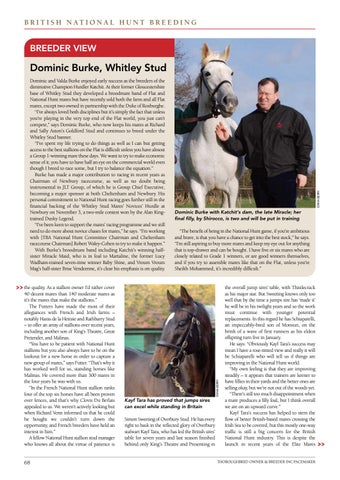
Dominic Burke with Katchit’s dam, the late Miracle; her final filly, by Shirocco, is two and will be put in training
“The benefit of being in the National Hunt game, if you’re ambitious and brave, is that you have a chance to get into the best stock,” he says. “I’m still aspiring to buy more mares and keep my eye out for anything that is top-drawer and can be bought. I have five or six mares who are closely related to Grade 1 winners, or are good winners themselves, and if you try to assemble mares like that on the Flat, unless you’re Sheikh Mohammed, it’s incredibly difficult.”
40 decent mares than 140 moderate mares as it’s the mares that make the stallions.” The Futters have made the most of their allegiances with French and Irish farms – notably Haras de la Hetraie and Rathbarry Stud – to offer an array of stallions over recent years, including another son of King’s Theatre, Great Pretender, and Malinas. “You have to be patient with National Hunt stallions but you also always have to be on the lookout for a new horse in order to capture a new group of mares,” says Futter. “That’s why it has worked well for us, standing horses like Malinas. He covered more than 300 mares in the four years he was with us. “In the French National Hunt stallion ranks four of the top six horses have all been proven over fences, and that’s why Clovis Du Berlais appealed to us. We weren’t actively looking but when Richard Venn informed us that he could be bought we couldn’t turn down the opportunity, and French breeders have held an interest in him.” A fellow National Hunt stallion stud manager who knows all about the virtue of patience is
68
EMMA BERRY
>> the quality. As a stallion owner I’d rather cover
Kayf Tara has proved that jumps sires can excel while standing in Britain
Simon Sweeting of Overbury Stud. He has every right to bask in the reflected glory of Overbury stalwart Kayf Tara, who has led the British sires’ table for seven years and last season finished behind only King’s Theatre and Presenting in
the overall jump sires’ table, with Thistlecrack as his major star. But Sweeting knows only too well that by the time a jumps sire has ‘made it’ he will be in his twilight years and so the work must continue with younger potential replacements. In this regard he has Schiaparelli, an impeccably-bred son of Monsun, on the brink of a wave of first runners as his eldest offspring turn five in January. He says: “Obviously Kayf Tara’s success may mean I have a rose-tinted view and really it will be Schiaparelli who will tell us if things are improving in the National Hunt world. “My own feeling is that they are improving steadily – it appears that trainers are keener to have fillies in their yards and the better ones are selling okay, but we’re not out of the woods yet. “There’s still too much disappointment when a mare produces a filly foal, but I think overall we are on an upward curve.” Kayf Tara’s success has helped to stem the flow of better British-based mares crossing the Irish Sea to be covered, but this mostly one-way traffic is still a big concern for the British National Hunt industry. This is despite the launch in recent years of the Elite Mares
THOROUGHBRED OWNER & BREEDER INC PACEMAKER
>>