Mar_91_TBA_Forum_Owner 16/02/2012 17:19 Page 82
TBA FORUM
Introducing the Bloodstock Taxation Group The TBA Bloodstock Taxation Group is responsible for monitoring fiscal and related issues affecting British thoroughbred breeders and the bloodstock industry. Through liaison with HMRC and taxation advisers the group aims to ensure that the bloodstock industry’s interests are safeguarded and protected, and advice on correct practice disseminated. In the short time since the group was formed the members have reviewed and updated the Bloodstock Industry Taxation Guide, which can be found on the TBA
website along with further taxation advice. The group has successfully defended the industry against the HMRC proposals to introduce a duty on imported yearlings from outside the EU. This small Bloodstock Taxation Group continues to monitor threats and opportunities for the industry and is made up of just six industry professionals, all highly respected leaders in their field:
has been advising clients in the bloodstock industry for over 20 years. He currently also chairs the industry VAT group that oversees the operation of the Owners VAT Scheme.
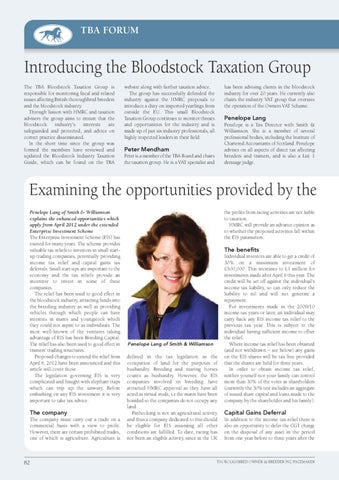
Penelope Lang Penelope is a Tax Director with Smith & Williamson. She is a member of several professional bodies, including the Institute of Chartered Accountants of Scotland. Penelope advises on all aspects of direct tax affecting breeders and trainers, and is also a List 1 dressage judge.
Peter Mendham Peter is a member of the TBA Board and chairs the taxation group. He is a VAT specialist and
Examining the opportunities provided by the Penelope Lang of Smith & Williamson explains the enhanced opportunities which apply from April 2012 under the extended Enterprise Investment Scheme The Enterprise Investment Scheme (EIS) has existed for many years. The scheme provides valuable tax reliefs to investors in small startup trading companies, potentially providing income tax relief and capital gains tax deferrals. Small start-ups are important to the economy and the tax reliefs provide an incentive to invest in some of these companies. The relief has been used to good effect in the bloodstock industry, attracting funds into the breeding industry as well as providing vehicles through which people can have interests in mares and youngstock which they could not aspire to as individuals. The most well-known of the ventures taking advantage of EIS has been Breeding Capital. The relief has also been used to good effect in trainers’ trading structures. Proposed changes to extend the relief from April 6, 2012 have been announced and this article will cover those. The legislation governing EIS is very complicated and fraught with elephant traps which can trip up the unwary. Before embarking on any EIS investment it is very important to take tax advice.
The company The company must carry out a trade on a commercial basis with a view to profit. However, there are certain prohibited trades, one of which is agriculture. Agriculture is
82
the profits from racing activities are not liable to taxation. HMRC will provide an advance opinion as to whether the proposed activities fall within the EIS parameters.
The benefits
Penelope Lang of Smith & Williamson
defined in the tax legislation as the occupation of land for the purposes of husbandry. Breeding and rearing horses counts as husbandry. However, the EIS companies involved in breeding have attracted HMRC approval as they have all acted as virtual studs, i.e the mares have been boarded so the companies do not occupy any land. Pinhooking is not an agricultural activity and thus a company dedicated to this should be eligible for EIS assuming all other conditions are fulfilled. To date, racing has not been an eligible activity, since in the UK
Individual investors are able to get a credit of 30% on a maximum investment of £500,000. This increases to £1 million for investments made after April 6 this year. The credit will be set off against the individual’s income tax liability, so can only reduce the liability to nil and will not generate a repayment. For investments made in the 2009/10 income tax years or later, an individual may carry back any EIS income tax relief to the previous tax year. This is subject to the individual having sufficient income to offset the relief. Where income tax relief has been obtained (and not withdrawn – see below) any gains on the EIS shares will be tax free provided that the shares are held for three years. In order to obtain income tax relief, neither yourself nor your family can control more than 30% of the votes as shareholders (currently the 30% test includes an aggregate of issued share capital and loans made to the company by the shareholder and his family).
Capital Gains Deferral In addition to the income tax relief there is also an opportunity to defer the CGT charge on the disposal of any asset in the period from one year before to three years after the
THOROUGHBRED OWNER & BREEDER INC PACEMAKER