RESEARCH SPOTLIGHT
implants in a broad number of clinical scenarios to replace current treatments. “The actual act of 3-D printing is the easy part. Anybody can print something,” says zur Linden. “Like all care plans, it is the process of knowing how to identify appropriate cases, understanding which patient will be the most likely to benefit, ensuring patient safety and having the right team in place to carry out the plan – that’s the challenging part.” Zur Linden is currently examining the sterility of a variety of materials that could be used to create 3-D implants, specifically in the case of skull tumour removal, based on the smoothness and roughness of the materials. Researchers say there is currently no published literature on bacterial biofilm growth on 3-D printed implants. The project aims to culture 3-D printed materials in the laboratory and evaluate bacteria growth adhering to different
implants, which could have an implication on the development of infection in the body postoperatively.
the educational experience. It is much more interactive than a textbook,” says zur Linden.
There are limited reported cases of a 3-D printed metal implant in human medicine. “We have the potential to provide a lot of insight,” zur Linden says.
The consensus remains that 3-D printed implants will undoubtedly have a positive impact on the future of veterinary medicine.
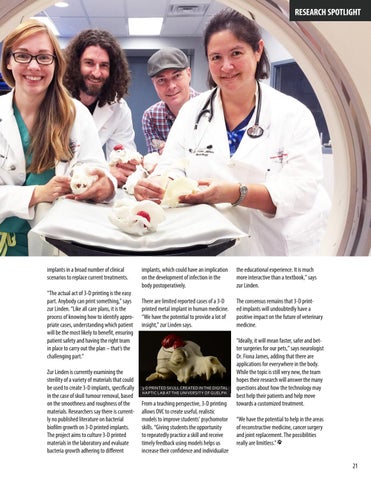
From a teaching perspective, 3-D printing allows OVC to create useful, realistic models to improve students’ psychomotor skills. “Giving students the opportunity to repeatedly practice a skill and receive timely feedback using models helps us increase their confidence and individualize
“Ideally, it will mean faster, safer and better surgeries for our pets,” says neurologist Dr. Fiona James, adding that there are applications for everywhere in the body. While the topic is still very new, the team hopes their research will answer the many questions about how the technology may best help their patients and help move towards a customized treatment. “We have the potential to help in the areas of reconstructive medicine, cancer surgery and joint replacement. The possibilities really are limitless.”
21