Learn how OVC’s Anesthesia and Pain Management Unit plays a critical role for pets in need of advanced care and what a difference a new $1.5-million gift to OVC Pet Trust will do to help the pets we love.
4
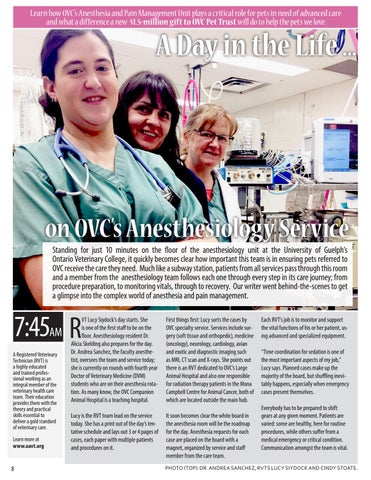
Standing for just 10 minutes on the floor of the anesthesiology unit at the University of Guelph’s Ontario Veterinary College, it quickly becomes clear how important this team is in ensuring pets referred to OVC receive the care they need. Much like a subway station, patients from all services pass through this room and a member from the anesthesiology team follows each one through every step in its care journey; from procedure preparation, to monitoring vitals, through to recovery. Our writer went behind-the-scenes to get a glimpse into the complex world of anesthesia and pain management.
R A Registered Veterinary Technician (RVT) is a highly educated and trained professional working as an integral member of the veterinary health care team. Their education provides them with the theory and practical skills essential to deliver a gold standard of veterinary care. Learn more at www.oavt.org
8
VT Lucy Siydock’s day starts. She is one of the first staff to be on the floor. Anesthesiology resident Dr. Alicia Skelding also prepares for the day. Dr. Andrea Sanchez, the faculty anesthetist, oversees the team and service today; she is currently on rounds with fourth year Doctor of Veterinary Medicine (DVM) students who are on their anesthesia rotation. As many know, the OVC Companion Animal Hospital is a teaching hospital.
First things first: Lucy sorts the cases by OVC specialty service. Services include surgery (soft tissue and orthopedic), medicine (oncology), neurology, cardiology, avian and exotic and diagnostic imaging such as MRI, CT scan and X-rays. She points out there is an RVT dedicated to OVC’s Large Animal Hospital and also one responsible for radiation therapy patients in the Mona Campbell Centre for Animal Cancer, both of which are located outside the main hub.
Lucy is the RVT team lead on the service today. She has a print out of the day’s tentative schedule and lays out 3 or 4 pages of cases, each paper with multiple patients and procedures on it.
It soon becomes clear the white board in the anesthesia room will be the roadmap for the day. Anesthesia requests for each case are placed on the board with a magnet, organized by service and staff member from the care team.
Each RVT’s job is to monitor and support the vital functions of his or her patient, using advanced and specialized equipment. “Time coordination for sedation is one of the most important aspects of my job,” Lucy says. Planned cases make up the majority of the board, but shuffling inevitably happens, especially when emergency cases present themselves. Everybody has to be prepared to shift gears at any given moment. Patients are varied: some are healthy, here for routine procedures, while others suffer from a medical emergency or critical condition. Communication amongst the team is vital.
PHOTO (TOP): DR. ANDREA SANCHEZ, RVTS LUCY SIYDOCK AND CINDY STOATE.