ON THE
feat u re
Bronze Horse Foundry in Pawhuska by Sue Moss Sullivan
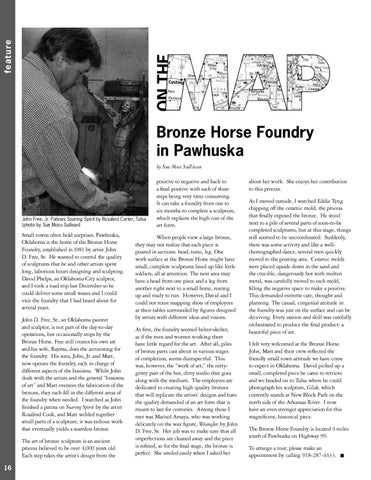
John Free, Jr. Patinas Soaring Spirit by Rosalind Carter, Tulsa (photo by Sue Moss Sullivan)
Small towns often hold surprises. Pawhuska, Oklahoma is the home of the Bronze Horse Foundry, established in l981 by artist John D. Free, Sr. He wanted to control the quality of sculptures that he and other artists spent long, laborious hours designing and sculpting. David Phelps, an Oklahoma City sculptor, and I took a road trip last December so he could deliver some small waxes and I could visit the foundry that I had heard about for several years. John D. Free, Sr., an Oklahoma painter and sculptor, is not part of the day-to-day operations, but occasionally stops by the Bronze Horse. Free still creates his own art and his wife, Rayma, does the accounting for the foundry. His sons, John, Jr. and Matt, now operate the foundry, each in charge of different aspects of the business. While John deals with the artists and the general “business of art” and Matt oversees the fabrication of the bronzes, they each fill in the different areas of the foundry when needed. I watched as John finished a patina on Soaring Spirit by the artist Rosalind Cook, and Matt welded together small parts of a sculpture; it was tedious work that eventually yields a seamless bronze. The art of bronze sculpture is an ancient process believed to be over 4,000 years old. Each step takes the artist’s design from the 16
positive to negative and back to a final positive with each of these steps being very time consuming. It can take a foundry from one to six months to complete a sculpture, which explains the high cost of the art form.
When people view a large bronze, they may not realize that each piece is poured in sections: head, torso, leg. One work surface at the Bronze Horse might have small, complete sculptures lined up like little soldiers, all at attention. The next area may have a head from one piece and a leg from another right next to a small horse, rearing up and ready to run. However, David and I could not resist snapping shots of employees at their tables surrounded by figures designed by artists with different ideas and visions. At first, the foundry seemed helter-skelter, as if the men and women working there have little regard for the art. After all, piles of bronze parts cast about in various stages of completion, seems disrespectful. This was, however, the “work of art,” the nittygritty part of the hot, dirty studio that goes along with the medium. The employees are dedicated to creating high quality bronzes that will replicate the artists’ designs and have the quality demanded of an art form that is meant to last for centuries. Among those I met was Marisol Amaya, who was working delicately on the wax figure, Wrangler, by John D. Free, Sr. Her job was to make sure that all imperfections are cleaned away and the piece is refined, so for the final stage, the bronze is perfect. She smiled easily when I asked her
about her work. She enjoys her contribution to this process. As I moved outside, I watched Eddie Tyng chipping off the ceramic mold, the process that finally exposed the bronze. He stood next to a pile of several parts of soon-to-be completed sculptures, but at this stage, things still seemed to be uncoordinated. Suddenly, there was some activity and like a wellchoreographed dance, several men quickly moved to the pouring area. Ceramic molds were placed upside down in the sand and the crucible, dangerously hot with molten metal, was carefully moved to each mold, filling the negative space to make a positive. This demanded extreme care, thought and planning. The casual, congenial attitude in the foundry was just on the surface and can be deceiving. Every station and skill was carefully orchestrated to produce the final product: a beautiful piece of art. I felt very welcomed at the Bronze Horse. John, Matt and their crew reflected the friendly small town attitude we have come to expect in Oklahoma. David picked up a small, completed piece he came to retrieve and we headed on to Tulsa where he could photograph his sculpture, Glide, which currently stands at New Block Park on the north side of the Arkansas River. I now have an even stronger appreciation for this magnificent, historical piece. The Bronze Horse Foundry is located 4 miles south of Pawhuska on Highway 99. To arrange a tour, please make an appointment by calling 918-287-4433.