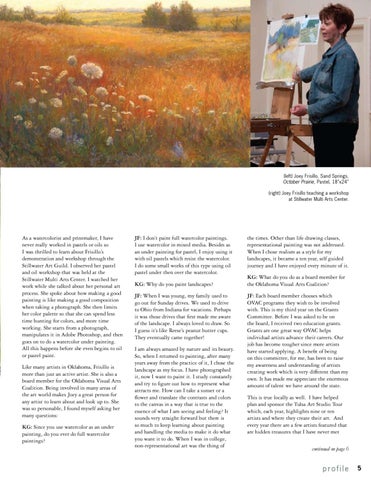
(left) Joey Frisillo, Sand Springs, October Prairie, Pastel, 18”x24” (right) Joey Frisillo teaching a workshop at Stillwater Multi Arts Center.
As a watercolorist and printmaker, I have never really worked in pastels or oils so I was thrilled to learn about Frisillo’s demonstration and workshop through the Stillwater Art Guild. I observed her pastel and oil workshop that was held at the Stillwater Multi Arts Center. I watched her work while she talked about her personal art process. She spoke about how making a good painting is like making a good composition when taking a photograph. She then limits her color palette so that she can spend less time hunting for colors, and more time working. She starts from a photograph, manipulates it in Adobe Photoshop, and then goes on to do a watercolor under painting. All this happens before she even begins to oil or pastel paint. Like many artists in Oklahoma, Frisillo is more than just an active artist. She is also a board member for the Oklahoma Visual Arts Coalition. Being involved in many areas of the art world makes Joey a great person for any artist to learn about and look up to. She was so personable, I found myself asking her many questions: KG: Since you use watercolor as an under painting, do you ever do full watercolor paintings?
JF: I don’t paint full watercolor paintings. I use watercolor in mixed media. Besides as an under painting for pastel, I enjoy using it with oil pastels which resist the watercolor. I do some small works of this type using oil pastel under then over the watercolor. KG: Why do you paint landscapes? JF: When I was young, my family used to go out for Sunday drives. We used to drive to Ohio from Indiana for vacations. Perhaps it was those drives that first made me aware of the landscape. I always loved to draw. So I guess it’s like Reese’s peanut butter cups. They eventually came together! I am always amazed by nature and its beauty. So, when I returned to painting, after many years away from the practice of it, I chose the landscape as my focus. I have photographed it, now I want to paint it. I study constantly and try to figure out how to represent what attracts me. How can I take a sunset or a flower and translate the contrasts and colors to the canvas in a way that is true to the essence of what I am seeing and feeling? It sounds very straight forward but there is so much to keep learning about painting and handling the media to make it do what you want it to do. When I was in college, non-representational art was the thing of
the times. Other than life drawing classes, representational painting was not addressed. When I chose realism as a style for my landscapes, it became a ten year, self guided journey and I have enjoyed every minute of it. KG: What do you do as a board member for the Oklahoma Visual Arts Coalition? JF: Each board member chooses which OVAC programs they wish to be involved with. This is my third year on the Grants Committee. Before I was asked to be on the board, I received two education grants. Grants are one great way OVAC helps individual artists advance their careers. Our job has become tougher since more artists have started applying. A benefit of being on this committee, for me, has been to raise my awareness and understanding of artists creating work which is very different than my own. It has made me appreciate the enormous amount of talent we have around the state. This is true locally as well. I have helped plan and sponsor the Tulsa Art Studio Tour which, each year, highlights nine or ten artists and where they create their art. And every year there are a few artists featured that are hidden treasures that I have never met continued on page 6
p ro f i l e
5