title pays homage to the cult classic Dazed and Confused, a film that glimpses into small-town American high school traditions of hazing and initiation. Of course, such rites cannot be effective without indulgence in a few liquid wrecking balls. Asprey explains, “My love for beer, like many an American, was born between the ages of 18-23, which coincided with college. My undergraduate alma mater, Humbolt State University, is conveniently nestled between five microbreweries, which only helped with my upbringing. I remember the days of academia when many an instructor would preach about the crucial necessity of making art about what you know. I feel I’ve enjoyed enough beer to be a self-proclaimed expert on the subject.” At first glance, Asprey’s Tatonka Brown Ale bottle’s Russel-esque composition appears to be a tribute to Oklahoma’s artistic heritage. In actuality, this bottle references a quote from armchair intellectual Cliff Clavin, character of the popular ‘80s and ‘90s sitcom Cheers. Asprey treats his porcelain objects as three-dimensional canvases, perfect forms for covertly tucking hints of the piece’s content into all available nooks and crannies. In the case of Tatonka Brown Ale, a portrait of Cliff Clavin is hidden underneath the bottle’s base. In one episode, Clavin compares drinking beer and its effects on the brain to natural selection weeding out the slowest and weakest members of a buffalo herd. Just as natural selection strengthens a buffalo herd overall, Clavin reasons that alcohol consumption destroys an individual’s least efficient brain cells, therefore making the drinker smarter. Clavin concludes this grain of barstool wisdom with “and that, Norm, is why you always feel smarter after a few beers.” Asprey’s newfound practice of inoculating ale into ceramic art stems beyond his nostalgia of college parties or interest in popular culture. He is currently investigating the many functions of alcohol in society, with his customarily humorous content often melding with history and mythology. Asprey’s research on subjects such as Prohibition-era bootlegging, the London Beer Flood of 1814, and the fabled libations of Valhalla, is as meticulous as his attention paid to his vessels’
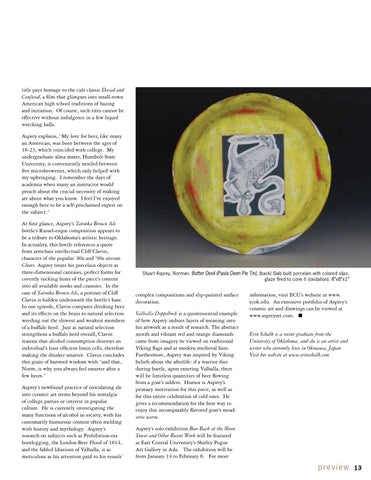
Stuart Asprey, Norman, Butter Devil (Paula Deen Pie Tin), (back) Slab built porcelain with colored slips, glaze fired to cone 6 (oxidation), 8”x8”x1”
complex compositions and slip-painted surface decoration. Valhalla Doppelbock is a quintessential example of how Asprey imbues layers of meaning into his artwork as a result of research. The abstract motifs and vibrant red and orange diamonds came from imagery he viewed on traditional Viking flags and at modern medieval fairs. Furthermore, Asprey was inspired by Viking beliefs about the afterlife: if a warrior dies during battle, upon entering Valhalla, there will be limitless quantities of beer flowing from a goat’s udders. Humor is Asprey’s primary motivation for this piece, as well as for this entire celebration of cold ones. He gives a recommendation for the best way to enjoy this incomparably flavored goat’s mead: serve warm.
information, visit ECU’s website at www. ecok.edu. An extensive portfolio of Asprey’s ceramic art and drawings can be viewed at www.aspreyart.com. n Erin Schalk is a recent graduate from the University of Oklahoma, and she is an artist and writer who currently lives in Okinawa, Japan. Visit her website at www.erinschalk.com.
Asprey’s solo exhibition Beer Bash at the Moon Tower and Other Recent Work will be featured at East Central University’s Shirley Pogue Art Gallery in Ada. The exhibition will be from January 14 to February 8. For more
p re v i e w
13