GEELHOED DIPLOMACY SHOT DOWN
10
NEW BOOKS SPRING/SUMMER 2020
A behind-the-scenes look at the unmaking of history in the early Cold War
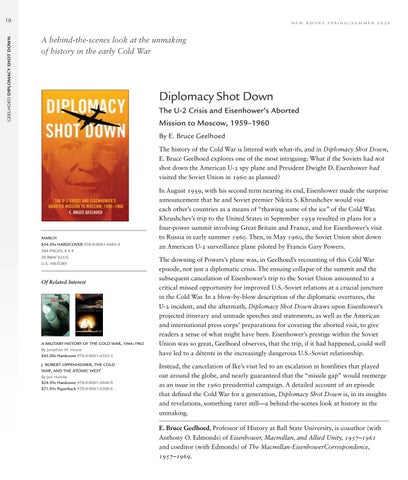
Diplomacy Shot Down The U-2 Crisis and Eisenhower’s Aborted Mission to Moscow, 1959–1960 By E. Bruce Geelhoed The history of the Cold War is littered with what-ifs, and in Diplomacy Shot Down, E. Bruce Geelhoed explores one of the most intriguing: What if the Soviets had not shot down the American U-2 spy plane and President Dwight D. Eisenhower had visited the Soviet Union in 1960 as planned?
MARCH $34.95s HARDCOVER 978-0-8061-6485-4 304 PAGES, 6 X 9 20 B&W ILLUS. U.S. HISTORY
Of Related Interest
A MILITARY HISTORY OF THE COLD WAR, 1944–1962 By Jonathan M. House $45.00x Hardcover 978-0-8061-4262-3 J. ROBERT OPPENHEIMER, THE COLD WAR, AND THE ATOMIC WEST By Jon Hunner $24.95s Hardcover 978-0-8061-4046-9 $21.95x Paperback 978-0-8061-6308-6
In August 1959, with his second term nearing its end, Eisenhower made the surprise announcement that he and Soviet premier Nikita S. Khrushchev would visit each other’s countries as a means of “thawing some of the ice” of the Cold War. Khrushchev’s trip to the United States in September 1959 resulted in plans for a four-power summit involving Great Britain and France, and for Eisenhower’s visit to Russia in early summer 1960. Then, in May 1960, the Soviet Union shot down an American U-2 surveillance plane piloted by Francis Gary Powers. The downing of Powers’s plane was, in Geelhoed’s recounting of this Cold War episode, not just a diplomatic crisis. The ensuing collapse of the summit and the subsequent cancelation of Eisenhower’s trip to the Soviet Union amounted to a critical missed opportunity for improved U.S.-Soviet relations at a crucial juncture in the Cold War. In a blow-by-blow description of the diplomatic overtures, the U-2 incident, and the aftermath, Diplomacy Shot Down draws upon Eisenhower’s projected itinerary and unmade speeches and statements, as well as the American and international press corps’ preparations for covering the aborted visit, to give readers a sense of what might have been. Eisenhower’s prestige within the Soviet Union was so great, Geelhoed observes, that the trip, if it had happened, could well have led to a détente in the increasingly dangerous U.S.-Soviet relationship. Instead, the cancelation of Ike’s visit led to an escalation in hostilities that played out around the globe, and nearly guaranteed that the “missile gap” would reemerge as an issue in the 1960 presidential campaign. A detailed account of an episode that defined the Cold War for a generation, Diplomacy Shot Down is, in its insights and revelations, something rarer still—a behind-the-scenes look at history in the unmaking. E. Bruce Geelhoed, Professor of History at Ball State University, is coauthor (with Anthony O. Edmonds) of Eisenhower, Macmillan, and Allied Unity, 1957–1961 and coeditor (with Edmonds) of The Macmillan-EisenhowerCorrespondence, 1957–1969.