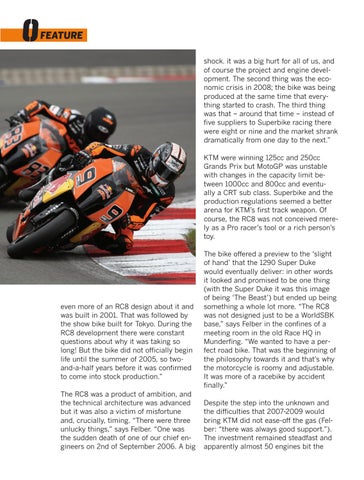
FEATURE shock. it was a big hurt for all of us, and of course the project and engine development. The second thing was the economic crisis in 2008; the bike was being produced at the same time that everything started to crash. The third thing was that – around that time – instead of five suppliers to Superbike racing there were eight or nine and the market shrank dramatically from one day to the next.” KTM were winning 125cc and 250cc Grands Prix but MotoGP was unstable with changes in the capacity limit between 1000cc and 800cc and eventually a CRT sub class. Superbike and the production regulations seemed a better arena for KTM’s first track weapon. Of course, the RC8 was not conceived merely as a Pro racer’s tool or a rich person’s toy.
even more of an RC8 design about it and was built in 2001. That was followed by the show bike built for Tokyo. During the RC8 development there were constant questions about why it was taking so long! But the bike did not officially begin life until the summer of 2005, so twoand-a-half years before it was confirmed to come into stock production.” The RC8 was a product of ambition, and the technical architecture was advanced but it was also a victim of misfortune and, crucially, timing. “There were three unlucky things,” says Felber. “One was the sudden death of one of our chief engineers on 2nd of September 2006. A big
The bike offered a preview to the ‘slight of hand’ that the 1290 Super Duke would eventually deliver: in other words it looked and promised to be one thing (with the Super Duke it was this image of being ‘The Beast’) but ended up being something a whole lot more. “The RC8 was not designed just to be a WorldSBK base,” says Felber in the confines of a meeting room in the old Race HQ in Munderfing. “We wanted to have a perfect road bike. That was the beginning of the philosophy towards it and that’s why the motorcycle is roomy and adjustable. It was more of a racebike by accident finally.” Despite the step into the unknown and the difficulties that 2007-2009 would bring KTM did not ease-off the gas (Felber: “there was always good support.”). The investment remained steadfast and apparently almost 50 engines bit the