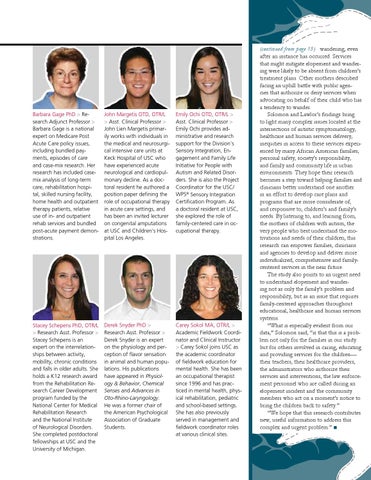
Barbara Gage PhD > Research Adjunct Professor > Barbara Gage is a national expert on Medicare Post Acute Care policy issues, including bundled payments, episodes of care and case-mix research. Her research has included casemix analysis of long-term care, rehabilitation hospital, skilled nursing facility, home health and outpatient therapy patients, relative use of in- and outpatient rehab services and bundled post-acute payment demonstrations.
John Margetis OTD, OTR/L > Asst. Clinical Professor > John Lien Margetis primarily works with individuals in the medical and neurosurgical intensive care units at Keck Hospital of USC who have experienced acute neurological and cardiopulmonary decline. As a doctoral resident he authored a position paper defining the role of occupational therapy in acute care settings, and has been an invited lecturer on congenital amputations at USC and Children’s Hospital Los Angeles.
Emily Ochi OTD, OTR/L > Asst. Clinical Professor > Emily Ochi provides administrative and research support for the Division’s Sensory Integration, Engagement and Family Life Initiative for People with Autism and Related Disorders. She is also the Project Coordinator for the USC/ WPS® Sensory Integration Certification Program. As a doctoral resident at USC, she explored the role of family-centered care in occupational therapy.
Stacey Schepens PhD, OTR/L > Research Asst. Professor > Stacey Schepens is an expert on the interrelationships between activity, mobility, chronic conditions and falls in older adults. She holds a K12 research award from the Rehabilitation Research Career Development program funded by the National Center for Medical Rehabilitation Research and the National Institute of Neurological Disorders. She completed postdoctoral fellowships at USC and the University of Michigan.
Derek Snyder PhD > Research Asst. Professor > Derek Snyder is an expert on the physiology and perception of flavor sensation in animal and human populations. His publications have appeared in Physiology & Behavior, Chemical Senses and Advances in Oto-Rhino-Laryngology. He was a former chair of the American Psychological Association of Graduate Students.
Carey Sokol MA, OTR/L > Academic Fieldwork Coordinator and Clinical Instructor > Carey Sokol joins USC as the academic coordinator of fieldwork education for mental health. She has been an occupational therapist since 1996 and has practiced in mental health, physical rehabilitation, pediatric and school-based settings. She has also previously served in management and fieldwork coordinator roles at various clinical sites.
(continued from page 15) wandering, even after an instance has occurred. Services that might mitigate elopement and wandering were likely to be absent from children’s treatment plans. Other mothers described facing an uphill battle with public agencies that authorize or deny services when advocating on behalf of their child who has a tendency to wander. Solomon and Lawlor’s findings bring to light many complex issues located at the intersections of autistic symptomatology, healthcare and human services delivery, inequities in access to these services experienced by many African American families, personal safety, society’s responsibility, and family and community life in urban environments. They hope their research becomes a step toward helping families and clinicians better understand one another in an effort to develop care plans and programs that are more considerate of, and responsive to, children’s and family’s needs. By listening to, and learning from, the mothers of children with autism, the very people who best understand the motivations and needs of their children, this research can empower families, clinicians and agencies to develop and deliver more individualized, comprehensive and familycentered services in the near future. The study also points to an urgent need to understand elopement and wandering not as only the family’s problem and responsibility, but as an issue that requires family-centered approaches throughout educational, healthcare and human services systems. “What is especially evident from our data,” Solomon said, “is that this is a problem not only for the families in our study but for others involved in caring, educating and providing services for the children— their teachers, their healthcare providers, the administrators who authorize their services and interventions, the law enforcement personnel who are called during an elopement incident and the community members who act on a moment’s notice to bring the children back to safety.” “We hope that this research contributes new, useful information to address this complex and urgent problem.” ■
and ilook downand heisgone
25