sultant for the OU, while composing the guide. “Even when the biggest posekim come up with kulot [leniencies], they are not creating them; they are extrapolating what was already there and applying it to the current situation.” Drawing on Rambam’s position on the laws of negiah, Rabbi Taub explains that, under very limited circumstances, touching may be permitted where there is no intent for physical pleasure. However, Rabbi Taub stresses that when a deaf-blind individual seeks to hire an SSP (a trained paraprofessional who, via tactile signing, fosters interaction between the deaf-blind individual and his surroundings, e.g., informs him who is in the room, who is speaking, when to sit down for lunch, et cetera), he or she should make every effort to find someone of the same gender. The leniency only applies when there is no other option. “The point is to try to find heterim within halachah,” says Rabbi Taub. “The average person doesn’t have to rely on kulot. But
when dealing with people who have no other form of communication, there are kulot that one would be permitted to rely on.” Our Way plans to e-mail copies of the guide to their deaf-blind members, as well as send hard copies to OU shuls and community leaders across the country. Braille editions will also be available. “We’re trying to create an awareness that this population exists,” says Rabbi Lederfeind. To further that goal, he included a section in the guide describing how a shul can make itself accessible to deaf-blind mitpallelim. “It’s a small and scattered population,” says Rabbi Lederfeind. “[Consequently], it has been greatly underserved by the Jewish community.” He hopes this groundbreaking book, which is expected to be published later this summer, will help change that. To obtain the book, contact ourway@ou.org or 212-613-8234.g
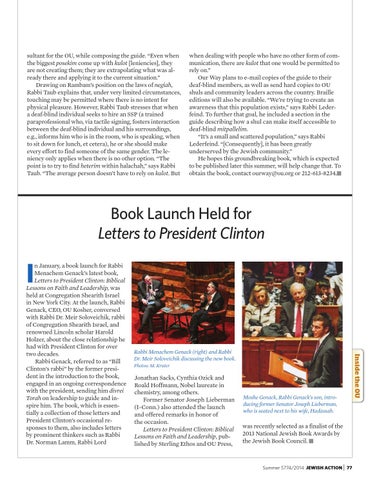
Book Launch Held for Letters to President Clinton n January, a book launch for Rabbi Menachem Genack’s latest book, Letters to President Clinton: Biblical Lessons on Faith and Leadership, was held at Congregation Shearith Israel in New York City. At the launch, Rabbi Genack, CEO, OU Kosher, conversed with Rabbi Dr. Meir Soloveichik, rabbi of Congregation Shearith Israel, and renowned Lincoln scholar Harold Holzer, about the close relationship he had with President Clinton for over two decades. Rabbi Genack, referred to as “Bill Clinton’s rabbi” by the former president in the introduction to the book, engaged in an ongoing correspondence with the president, sending him divrei Torah on leadership to guide and inspire him. The book, which is essentially a collection of those letters and President Clinton’s occasional responses to them, also includes letters by prominent thinkers such as Rabbi Dr. Norman Lamm, Rabbi Lord
I
Inside the OU
Rabbi Menachem Genack (right) and Rabbi Dr. Meir Soloveichik discussing the new book. Photos: M. Kruter
Jonathan Sacks, Cynthia Ozick and Roald Hoffmann, Nobel laureate in chemistry, among others. Former Senator Joseph Lieberman (I-Conn.) also attended the launch and offered remarks in honor of the occasion. Letters to President Clinton: Biblical Lessons on Faith and Leadership, published by Sterling Ethos and OU Press,
Moshe Genack, Rabbi Genack’s son, introducing former Senator Joseph Lieberman, who is seated next to his wife, Hadassah.
was recently selected as a finalist of the 2013 National Jewish Book Awards by the Jewish Book Council. g
I
Summer 5774/2014 JEWISH ACTION 77