quired to import stock,” Kevin explains. ‘We have someone here who is growing root stock and for our last three plantings, we have been able to grow our own trees.” George had stopped growing corn and Kevin planted an initial two acres. When his sister Karin returned to the farm, he was able to expand that to 10 acres. “I had gone to culinary school in Toronto and was working there as a chef for 18 years. My husband had passed away and I did not want to raise my son alone in the big city,” Karin explains. “I came back to the farm and thought I would continue to cook, but Kevin asked me to take over the farm stand.”
since added 6,000 sq feet of controlled atmosphere storage. “You find a way to make it work if you want to continue to farm,” says Karin. ”In my opinion we are not doing anything radical or new, we are just having more control and efficiency.” That efficiency brought Days Century Growers 8-10 cents a pound premium over what they had been getting at the Coop. Marketing is handled by Kelowna’s Consolidated Fruit Packers, and Star Produce out of Calgary. “We had hoped the packing house would break even and we did better than that the first year,” says Karin.
At 87 George still keeps about 50 beef cattle that he ranges in the hills above West Kelowna and feeds down on the farm through the winter. “He doesn’t like us planting trees on his hay land,” Kevin chuckles. “He still owns the farm and has the final say on any changes that we make.”
Forward 20 years, and the brother and sister team were at a cross roads. Pears are a minor crop in the valley and they didn’t feel they were getting the attention they needed from the BC Tree Fruits Coop. “Each year we were adding to our long term debt, and it looked like we were going to have to sell some property,” says Karin, who also manages the books for the business. “Finally I went to Karin and said I am going to run the numbers on building our own packing house,” says Kevin. Those numbers were big, over $300,000 to construct the first packing line housed in a 10,000 sq foot building in 2010. They’ve
Photo by Andrew Barton
Photo by Andrew Barton
It’s been good for cash flow, as Kevin points out. “The returns come in earlier in the year and it now represents about 20% of the total farm income,” he says. “We farm 150 acres including lease land and 35 of those are planted in pears.
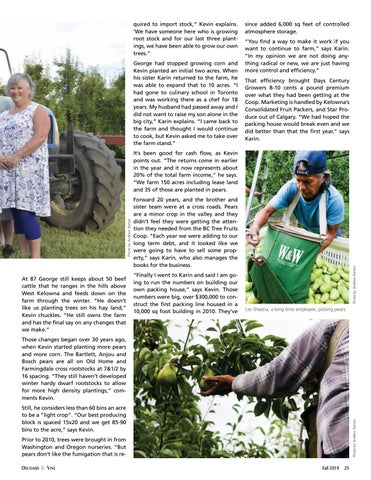
Les Sheena, a long time employee, picking pears.
Those changes began over 30 years ago, when Kevin started planting more pears and more corn. The Bartlett, Anjou and Bosch pears are all on Old Home and Farmingdale cross rootstocks at 7&1/2 by 16 spacing. “They still haven’t developed winter hardy dwarf rootstocks to allow for more high density plantings,” comments Kevin.
Photo by Andrew Barton
Still, he considers less than 60 bins an acre to be a “light crop”. “Our best producing block is spaced 15x20 and we get 85-90 bins to the acre,” says Kevin. Prior to 2010, trees were brought in from Washington and Oregon nurseries. “But pears don’t like the fumigation that is re
Fall 2019
25