Society of Mobility Engineers Australasia
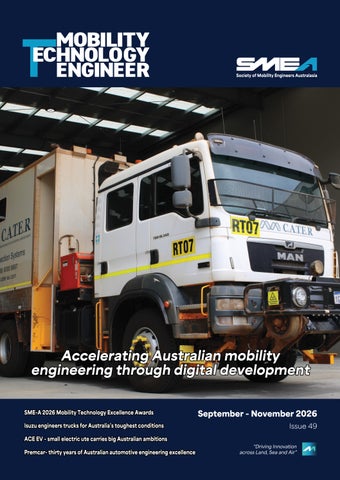
Accelerating Australian mobility engineering through digital development SME-A 2026 Mobility Technology Excellence Awards Isuzu engineers trucks for Australia’s toughest conditions ACE EV - small electric ute carries big Australian ambitions Premcar- thirty years of Australian automotive engineering excellence
September - November 2026 Issue 49 “Driving Innovation across Land, Sea and Air”
Contents
Mobility Technology Engineer
Issue 49 - Sept-Nov 2026
PUBLISHED BY Society of Mobility Engineers - Australasia ABN: 95 004 248 604
Regular Features ADDRESS Bernie Quinn Industry Column............................................4
VACC House
Martha Oplopiadis President Report................................5
650 Victoria Street North Melbourne VIC 3051
Australian News........................................................................10
E: info@sme-a.org
International News.................................................................. 12
P: 0403 267 166
Uni Research News.................................................................14
W: www.sme-a.org
General Manager Angela Krepcik
Special Features
E: angela@sme-a.org
SME-A 2026 Mobility Technology Excellence Awards....................................................................6
MAGAZINE PRODUCTION:
Segula - Accelerating Australian mobility engineering through digital development...................16
Editor
Isuzu engineers trucks for Australia’s toughest conditions................................................................18
E: editor@sme-a.org
Premcar- thirty years of Australian automotive engineering excellence............................... 22
Design
ACE EV - small electric ute carries big Australian ambitions..............................................................24
E: fraseram@optusnet.com.au
Allan Edwards P: 0409 570 643
Brigid Fraser P: 0413 009 122
Boeing deepens its engineering footprint across Australia........................................................................29
Follow SME-Australasia:
Volvo pushes electric trucks into heavier territory........................................................................30
About SME-A
About the cover
SEGULA Technologies Australia uses concurrent engineering to reduce development time, resolve integration challenges earlier and deliver a complex Special Purpose Vehicle in just 16 weeks.
SME-A was founded in 1927 to address the need for further education and professional development for all facets surrounding mobility engineering, and today the organisation encompasses innovations across land, sea and air across Australasia. SME-A is a nonprofit entity that works to serve the needs of its members and industry to promote the relevance of the mobility engineering sector and emerging technologies to governments, industry and the community in general.
DISCLAIMER: The editor, publisher, printer, the Society of Mobility Engineers – Australasia (SME-A) and their employees, directors, agents and associated or related entities (Publishing Entities) are not responsible for the accuracy or correctness of the text, pictures or other material comprising the contributions and advertisements contained in this publication or for the consequences of any use made of the products, services and other information referred to in this publication. The Publishing Entities expressly disclaim all liability of whatsoever nature for any consequences arising from the use or reliance on material contained in this publication whether caused to a reader of this publication or otherwise. The views expressed in this publication do not necessarily reflect the views of the Publishing Entities. The responsibility for the accuracy or correctness of information and other material is that of the individual contributors and the Publishing Entities do not accept responsibility for the accuracy or correctness of information or other material supplied by others. To the extent permissible by law, the Publishing Entities exclude all liability pursuant to the Competition and Consumer Act 2010 (Cth) or other applicable laws arising from statute or common law. Readers should make their own inquiries prior to the use of, or reliance on, any information or other material contained in this publication, and where necessary seek professional advice. All rights reserved. Reproduction in whole or part without the written permission of SME-A is strictly prohibited.
MTE | 3
Industry | Column
Curves ahead In the first edition of Mobility Technology Engineer magazine’s industry insider column, Premcar CEO Bernie Quinn examines uncertainty, disruption and why automakers must embrace agility.
Any car lover who has built their career in our industry will agree there’s nothing more satisfying than a set of curves, especially when you’re tackling them in an agile sports car. But our industry is navigating a different set of curves at the moment, and they don’t all inspire excitement. Many of them stem from the fundamental product changes we’ve witnessed in the local new-vehicle market over the last five to ten years. Electric vehicle (EVs) have gone from niche curiosities to mainstream offerings in a short time. Their arrival, and the advent of new-to-Australasia vehicle brands like BYD and Zeekr, have upended the long-established market order. They have forced longstanding automakers and their official distributors to change course – simply to remain competitive. These course changes have had big effects, many of them positive. But the biggest established carmakers have faced the most painful redirections. Developing and integrating zero-emissions powertrains and EV models alongside existing offerings powered by internal combustion engines (ICE) has been a difficult transition for many brands. Ford, for example, declared a US$19.5 billion write-down following its cancellation of several EV models due to changing US government policies and weakened market demand. But the size of this change – and its consequent cost – aren’t the real stories here. The real story is the underlying uncertainty that largely caused them. Committing to 10-year spending forecasts for
new-vehicle engineering, development and manufacturing programs is more difficult than ever. Nobody knows exactly what cars buyers will want to own – and what major new-car markets will look like – in a decade. Australia is a great example. It’s a risky idea to draw a straight-ish line on the current growth trajectory for EV sales and assume this will be correct in the future. A change of government here or in the USA could easily bend its arc (up or down). Global market conditions could also change it. A change in the supply (and price) of oil could grow or slow EV sales. You simply can’t rely on linear ideas at the moment. For automakers, this is where cost, value and flexibility come in. Big car brands, both new and established, should apply a model of low cost, high value and high flexibility wherever they can. New-car development absorbs time and resources, even if you’re relying heavily on AI and using the general public to ‘beta test’ your products to cut costs. Looking for every opportunity to apply low cost / high value / high flexibility can help accelerate new products into showrooms – especially products that have more of what buyers specifically want. It sounds obvious, but the key is to identify every place it can be applied – and then applying it. For example, where is a car brand’s white spaces in Australasia’s dual-cab 4x4 pickup segments? Can their ute offering be inexpensively and easily altered with the right equipment and performance to capture more buyers who are currently overlooking them? This low cost / high value / high flexibility model can be applied across regions and individual markets. It makes automakers agile. It can boost business benefits for everyone in the new-car equation, including dealerships, whose own curves have been trending down, with local net profits for some big groups wobbling from around three percent into the twos. Agility is the whole point of this model. For automakers, gone are the days of confidently knowing what the next ten years look like. The car making world is watching Australia to understand the magnitude of change that’s possible with new technologies, and consumers who quickly embrace new ideas and new brands.
Bernie Quinn, CEO of Premcar 4 | September - November 2026
Right now, all car brands need to adapt to this rate of change. The important curves are getting tighter and there’s uncertainty about what lies beyond them. It means every automaker needs to find ways to create agility.
President | Report
Engineering the future of mobility Martha Oplopiadis reflects on SME-A’s evolving role, the launch of Mobility Technology Engineer, recent Excellence Awards and opportunities to connect Australasia’s growing mobility engineering community. This is an exciting time for our Society and for the mobility engineering profession across Australasia. Our name change to the Society of Mobility Engineers – Australasia (SME-A) reflects an industry that now extends well beyond traditional automotive engineering. Across road, rail, maritime and emerging transport, new technologies and new thinking are reshaping how people and goods move. That evolution is also reflected in the magazine you are reading today. Vehicle Technology Engineer has become Mobility Technology Engineer, a name that better represents both the breadth of our membership and the rapidly changing engineering landscape we serve.
across land, sea and air, encourages collaboration and creates opportunities for established and emerging engineers to learn from each other. As SME-A moves forward, our role is to bring this broader mobility community together while maintaining the engineering excellence and technical expertise that have always been at the heart of our Society. Another important part of that future is Formula SAE-A, and preparations are well underway for our flagship student engineering event to be held in Adelaide.
Martha Oplopiadis Society of Mobility Engineers – Australasia
Formula SAE-A remains one of the best examples of what our Society stands for. It challenges the next generation of engineers to turn theory into practice while developing the technical, teamwork and problem-solving skills that will serve them throughout their careers. There is considerable change ahead, but also enormous opportunity. Through SME-A, Mobility Technology Engineer, Formula SAE-A and our growing program of events and activities, we have an opportunity to connect the people who will engineer the future of mobility.
Importantly, this is much more than a change of names. It represents an opportunity to bring together engineers, researchers, students and organisations working across an increasingly interconnected mobility sector. Our recent Excellence Awards brought that future to life. The diversity of our finalists, representing a broad range of industries, technologies and engineering disciplines, demonstrated both the strength of the mobility sector and the opportunity ahead for SME-A. The Awards were more than a celebration of achievement. They provided a glimpse of the Society we are building – one that connects people and industries
MTE | 5
MTE | Awards
Awards showcase Australia’s expanding mobility engineering talent SME-A’s 2026 Mobility Technology Excellence Awards celebrated engineers, innovators and Australiandeveloped technologies while marking a defining year of change for the century-old professional society.
The breadth of Australia’s changing mobility engineering sector was on display when the Society of Mobility Engineers Australasia (SME-A) held its 2026 Mobility Technology Excellence Awards at Leonda by The Yarra in Hawthorn on September 10. Bringing together engineers, academics, technology businesses and industry leaders, the awards recognised achievements spanning automotive electronics, rail, motorsport, trailer safety and accessible public transport. It was also a significant evening for SME-A itself. The awards were the first held since the former Society of Automotive Engineers Australasia changed its name to the Society of Mobility Engineers Australasia, reflecting a broader remit encompassing mobility across land, sea, air and rail. SME-A General Manager Angela Krepcik said the change followed consultation with members and was designed to ensure the Society continued to represent the industries in which its members now worked. “We have been able to expand and diversify mobility, being all modes of transport across land, sea and air, which is now relevant to who we represent.” The name change was one of several milestones highlighted during the evening. SME-A has relocated from North Melbourne to the National Transport Research Organisation (NTRO) in Port Melbourne, while Formula SAE-A will move to The Bend in South Australia in December after 26 years in Victoria. The awards themselves attracted over 30 entries across seven categories. Judge Dr Paul Nation said the overall standard was exceptionally high, with particularly strong competition in the Small Business and Woman Mobility Engineer categories. Nation said the judging panel considered the novelty and uniqueness of the work, potential breadth of application, supporting evidence and prospects for future market application. “Australian mobility engineering is broad, innovative and increasingly diverse,” Nation said.
Adrian Feeney, Chair Formula SAE-A Organising Committee and Associate Professor Scott Wordley, Monash University. 6 | September - November 2026
Awards | MTE
2026 Mobility Technology Excellence Award Winners Leader in Innovation – Under-graduate Winner: Harrison Croft, Monash University Design, verification and test system development for automotive ECUs at Robert Bosch Australia Marc Alexander, Managing Director of Savic Motorcycles.
“We have a genuinely world-class local engineering capability, supported by organisations and individuals willing to tackle difficult, emerging and niche challenges.” He said Australian engineers were increasingly not simply adopting global technologies, but adapting, improving and creating solutions capable of competing internationally. That capability was evident among the winners. Monash University undergraduate Harrison Croft received the Leader in Innovation – Undergraduate award for his work at Robert Bosch Australia on design, verification and test system development for automotive electronic control units.
Metro Trains’ Tanzila Momin Dix was named Young Mobility Engineer of the Year. Her work involved developing a computerbased interlocking and automatic train supervision system for the Sunshine Signal Control Centre, supporting train movements including services operating through the Metro Tunnel. Segula Technologies Australia engineer Stella Butzkueven received the Woman Mobility Engineer of the Year award for her contribution to supporting women in industry. Butzkueven used her acceptance speech to encourage the engineering community to continue opening the profession to a broader range of people.
Young Mobility Engineer of the Year Winner: Tanzila Momin Dix, Metro Trains Leading change through engineering, including work on the Sunshine Signal Control Centre Woman Mobility Engineer of the Year Winner: Stella Butzkueven, Segula Technologies Australia Outstanding contribution to supporting women in industry Significant Services to the Mobility Engineering Sector Winner: Chris Murphy, Relativity Engineering Group Safety-critical systems engineering, autonomous-systems leadership and Australian test instrumentation capability Leader in Innovation – Small Business Winner: LockElec Rolling Stock Mobility Access Lift Leader in Innovation – Medium Business Winner: MoTeC STW 195 motorsport steering wheel Leader in Innovation – Large Business Winner: Robert Bosch Australia Trailer Safety Control – Hydraulic Special Recognition
Stella Butzkueven of Segula Technologies.
Stuart Lord, Managing Director, Lockelec Rolling Stock with Brett Longhurst, Managing Director, Bremar.
Associate Professor Scott Wordley Long-standing contribution to Formula SAE-A and engineering education MTE | 7
MTE | Awards
Team at Robert Bosch Australia.
“I love engineering, and I want every single person out there who has a passion for this industry to get to pursue it,” she said. Chris Murphy of Relativity Engineering Group received the Significant Services to the Mobility Engineering Sector award, recognising a career encompassing safety-critical systems, autonomous systems leadership and the establishment of an independent Australian test instrumentation capability. Murphy began his career with Robert Bosch Australia before working at Bosch’s chassis systems global headquarters in Germany and returning to Australia to establish Relativity Engineering Group. “Keep your standards high, believe in what you do, and understand that what you do keeps people safe if you do it right,” Murphy told fellow engineers.
Mark Jackman, Managing Director of MoTeC.
Ben Felton, Managing Director of Blind Speed.
Three Leader in Innovation business awards demonstrated the diversity of Australian-developed technology. Lockelec Rolling Stock won the small business category for its Mobility Access Lift, developed to provide safe and independent access to modern low-floor trams for wheelchair users and passengers with mobility challenges. Managing Director Stuart Lord said the award came on the same day the system was fitted to a Melbourne G Class tram. “All engineering feats in the room always start with a complex problem, something a bit too audacious, but we’ll always have a go at it,” Lord said. MoTeC won the medium business award for its STW 195, an FIA8 | September - November 2026
Leon Wesley of iMotiv and Chris Murphy of Relatively Engineering Group.
Awards | MTE
homologated motorsport steering wheel engineered for high-performance electric and hybrid racing vehicles. Robert Bosch Australia completed the business categories by winning the large business award for Trailer Safety Control – Hydraulic, an electro-hydraulic discbrake safety system designed to reduce caravan and trailer sway, jackknifing and loss of control. A Bosch representative said the project demonstrated that products could be engineered in Australia not only for local roads, but for international customers. The evening also recognised Associate Professor Scott Wordley for his contribution to Formula SAE-A since the Australian competition began in 2000. Leon Wesley of iMotiv and Tanzila Momin Dix of Metro Trains.
Wordley first participated as a student before becoming a Monash University faculty advisor, organising committee member and SME-A board member. Presenting the recognition, Adrian Feeney, Chair of the Formula SAE-A Organising Committee credited Wordley with structuring student teams in a way that mirrored professional companies and helping prepare generations of graduates for engineering careers. With SME-A preparing to celebrate its centenary in 2027, the awards provided both a snapshot of Australian engineering achievement and an indication of where the organisation is heading.
Associate Professor Scott Wordley Monash University.
Sajani Siriwardene Deakin University.
After almost 67 years with “Automotive” in its name, the Society’s transition to “Mobility” could hardly have been better illustrated than by an awards field stretching from motorsport steering wheels and automotive electronics to railway systems and accessible public transport.
The team at Lockelec Rolling Stock. MTE | 9
NEWS | Australia
Ford Transit City targets urban fleets Ford’s new electric Transit City combines practical payload, fast charging and simplified specifications for Australian urban operators.
Ford Australia (Ford) has revealed the all-new Transit City, a fully electric commercial van designed specifically for urban fleets and delivery operators. Scheduled to reach Australian customers from November, the Transit City will be offered in a single specification, with a recommended driveaway price starting from $50,000. Ford has taken a data-driven approach to the vehicle’s development, analysing telematics information from more than 2,000 Transit Custom vans operating in real-world conditions. The research found typical urban daily trips averaged 76km, while 90 per cent of routes covered 200km or less. That helped determine the Transit City’s 56kWh lithium-iron phosphate battery,
which is paired with a 110kW front-wheeldrive electric motor. The van offers up to 254km of WLTP combined range or up to 380km under the WLTP City cycle. Despite its compact dimensions, the Transit City provides 6.4 cubic metres of cargo capacity, sufficient for three Euro pallets, and a maximum payload of 1085kg. Charging at up to 87kW DC can take the battery from 10 to 80 per cent in approximately 33 minutes, while an 11kW AC charge from 10 to 100 per cent takes around 5.5 hours. Standard driver assistance technology
includes automatic emergency braking, front and rear parking sensors, a rear-view camera, adaptive cruise control with stopand-go and lane departure warning. Ford Australia and New Zealand president and CEO Fadi Mawal said the Transit City was intended to make the transition to electric commercial vehicles straightforward for businesses. “Transit City represents a new way of thinking about commercial vehicles for Australian and Kiwi businesses,” Mawal said. “We know urban operators need a van that’s affordable, capable, and ready to work from day one.”
JAC Hunter engineered for Australian conditions A multi-million-dollar local engineering program has tailored the JAC Hunter’s dynamics specifically for demanding Australian roads.
JAC Motors has placed Australian engineering at the centre of its new Hunter PHEV, investing millions of dollars in local testing and development to ensure the ute is suited to Australian roads and driving conditions. Every production Hunter destined for Australia will feature a complete vehicle dynamics tune developed following local evaluation by Australian engineer Michael Barber of Multimatic. Barber initially evaluated and tested the Hunter in Australia before travelling to JAC’s facilities in China, where he worked directly with the manufacturer’s engineering team to implement his recommendations in the production vehicle. Importantly, JAC says every recommendation was incorporated before the first Hunter reached Australian customers. JAC has committed a multi-million-dollar investment to engineering and developing the Hunter for Australia, beyond the standard costs associated with introducing an existing global vehicle into a new market. The program included local testing, engineering, validation and vehicle 10 | September - November 2026
dynamics development, with the aim of preparing the Hunter for Australian roads, conditions and customer expectations. “JAC’s multi-million-dollar engineering and development investment in the Hunter goes well beyond what would ordinarily be expected for a new-market vehicle launch,” JAC Motors Australia managing director Ahmed Mahmoud said. “We have invested in understanding this market, testing the Hunter locally and making the engineering changes required to deliver the right vehicle for Australian drivers.” Barber’s work focused on improving the Hunter’s steering response, high-speed stability and body control, particularly through corners and across uneven surfaces. The development program also targeted a more composed ride, greater predictability across changing road conditions and a better compromise
between everyday comfort and loadcarrying capability. The intention was to produce a vehicle capable of performing consistently across the variety of surfaces encountered by Australian motorists, ranging from urban roads and regional highways to more challenging conditions. The Australian engineering work will also have an impact beyond the local market. New Zealand will be the first additional country to receive the Hunter with Barber’s complete dynamics tune, while JAC plans to introduce it into other international markets. Mahmoud said the Hunter represented the beginning of a broader commitment to Australian engineering. “Our ambition is for every future JAC vehicle launch to demonstrate this same level of Australian testing, engineering rigour and responsiveness,” he said.
Australia | NEWS
TRACK Program drives rail freight shift New TRACK incentives lead broader rail initiatives targeting freight efficiency, resilience, infrastructure investment and emissions reductions. The Australasian Railway Association (ARA) has welcomed the new $52 million Transport Resilience and Capacity Kickstart (TRACK) Program as an important step towards shifting more Australian freight from road to rail. The program is designed to improve the productivity, resilience and reliability of Australia’s freight network, with funding available to encourage additional containerised and contestable bulk freight onto rail. Under the program, $52 million is available for incentive payments, with up to $26 million allocated to the first round. Diesel savings, productivity improvements, mode shift and rail resilience will form part of the assessment process. ARA CEO Caroline Wilkie said recent fuel supply concerns had reinforced the case for increasing rail freight. “Moving more freight by rail is one of the practical measures Australia can take now to reduce transport emissions while
improving the efficiency and resilience of our national supply chains,” Wilkie said. She said incentives should be accompanied by longer-term measures addressing rail competitiveness, network capacity and technology as Australia’s freight task continues to grow. The TRACK announcement follows several developments welcomed by the ARA as governments seek to expand the role of rail. In Victoria, the association has backed the Victorian Rail Freight Plan 2026–2036, which includes a 10-year maintenance and upgrade plan for the regional network and improved coordination and reporting. Victoria’s freight task is forecast to exceed 900 million tonnes annually by 2050.
Meanwhile, Australia’s high-speed rail program has progressed with three construction consortia shortlisted to develop plans for tunnelling and construction between Berowra and Ourimbah on the proposed NewcastleSydney route. Three global rail proponents have also been shortlisted for trains, rail systems and system integration.
The ARA has called for a target of 30 per cent of contestable Victorian freight volumes to be carried by rail, arguing a measurable target would provide a benchmark for future reforms and investment.
Wilkie said high-speed rail also presented opportunities for Australian manufacturing, engineering, suppliers and workforce development, building on expertise developed through major infrastructure projects.
EV work vehicles demand smarter fitouts Jaram Australia says electric work vehicles require specialised fitouts to manage weight, batteries and mounting safely. Western Australian commercial vehicle fitout specialist Jaram Australia has launched dedicated electric vehicle fitout services as more tradies and fleet operators consider switching to electric vans and utes. The company says electric work vehicles can require a different approach to traditional diesel vehicles because of their battery location, payload limitations, weight distribution and available mounting points. For tradespeople, vehicle fit outs can include shelving, drawers, toolboxes, ladder systems and other equipment that must withstand everyday commercial use. However, adding this equipment to an EV can create additional engineering considerations. Jaram Australia marketing manager Alexander Andrew said the company began adapting its approach after electric vans started arriving at its workshop. “With EVs, the weight considerations are different, the floor structures where the battery sits are different, and you have to be acutely aware of where you can
and cannot drill when fitting drawers or shelving to an EV vehicle,” Andrew said. Jaram’s EV service uses weight-conscious equipment including aluminium shelving, drawer systems and toolboxes, while taking account of EV-specific underfloor and structural components. Payload is one of the major considerations. A complete shelving and drawer system can consume a significant proportion of a vehicle’s carrying capacity before tools, materials and occupants are added. Battery placement also changes installation requirements. With battery packs commonly positioned beneath the floor, installers need to understand where equipment can be safely mounted. Jaram said it works around factory mounting points wherever possible rather than drilling into floors close to battery compartments. “We mount everything to the factory mounting points where possible, so the system is secure, practical and removable when it is no longer needed,” Andrew said. Interest is coming from electricians, solar
installers, plumbers, mining contractors and larger fleet operators, although Jaram acknowledges electric vehicles will not yet suit every business. Long-distance operation, towing requirements, regional charging availability, purchase prices and charging infrastructure remain considerations for operators assessing whether an EV can meet their requirements. Fleet operators must also consider charging schedules and vehicle rotation to ensure vehicles are ready for work across multiple sites and shifts. Jaram, which has operated in Perth’s commercial vehicle fit out industry since 1975, said its aim was not to convince every tradie to switch to an EV, but to provide appropriate fit out advice for businesses already considering electric work vehicles. MTE | 11
NEWS | International
XCMG hydrogen truck completes durability marathon XCMG’s hydrogen-powered heavy truck has completed extensive durability testing while demonstrating a 500-kilometre driving range.
Chinese manufacturer XCMG has completed a major durability verification program for its hydrogen-powered heavy truck as it continues developing low-carbon alternatives for heavy transport. The truck completed China’s first full-industry-chain durability verification program for hydrogen products, known as the “Hydrogen Marathon”, conducted by the New Energy Testing Center of the China Automotive Technology and Research Center (CATARC). XCMG was the first vehicle manufacturer to participate, with its truck achieving a pure hydrogen driving range of at least 500km. XCMG was also the only original equipment manufacturer to pass the latest verification round. Launched in September 2025, the Hydrogen Marathon is designed as an independent industry benchmark assessing areas including durability and driving range under standardised conditions. Testing extends beyond conventional short-cycle evaluation, with fuel-cell stacks required to complete 2000 hours of dynamic cycle testing while restricting voltage degradation to within three per cent. The XCMG truck uses a company-developed 300kW fuel-cell
system paired with a 510kW drive motor. Type IV hydrogen storage cylinders are also used, reducing cylinder weight by more than 20 per cent. XCMG said its new-energy commercial vehicle fleet has accumulated 4.43 billion kilometres of operational mileage. The manufacturer is also expanding hydrogen technology beyond highway trucks, developing hydrogen-powered mining dump trucks and loaders. Its hydrogen portfolio already includes a 260-tonne hydrogenpowered mining dump truck intended for applications including mining operations and chemical industrial parks. XCMG plans to continue developing battery-electric and hydrogen technologies in parallel, with further work focusing on fuel cells, hydrogen storage and intelligent control systems.
Weichai hydrogen engine passes emissions testing
Weichai’s hydrogen combustion engine has passed China VI certification, targeting zerocarbon power for heavy-duty applications globally. Weichai Power has announced that its independently developed WP15 hydrogen direct-injection engine has passed China VI vehicle emissions certification testing, marking a milestone for hydrogen-powered heavy-duty transport. According to Weichai, the WP15 is the first heavy-duty hydrogen internal combustion engine in China and internationally to comply with the China VI emissions standard. Certification testing was completed at the CATARC Automotive Test Center in Tianjin and covered the complete operating cycle required under China’s national heavy-duty engine emissions standards. Tests included cold starts, low-speed idling, high-speed fullload operation and transient variable-load conditions to assess emissions performance, reliability and stability. Designed for heavy-duty transport, the 14.6-litre WP15 uses hydrogen direct injection and spark ignition. It produces up to 600hp and 2800Nm of torque, while Weichai claims maximum brake thermal efficiency of 46.8 per cent. The manufacturer says more than 90 per cent of the engine’s 12 | September - November 2026
components are shared with conventional engine platforms, potentially reducing manufacturing, conversion and maintenance costs. Weichai also says the engine has greater tolerance for variations in hydrogen purity, potentially helping reduce fuel costs. Potential applications extend beyond highway transport, with the WP15 designed for long-haul trucks, mining dump trucks, port equipment, steel mill vehicles and large hydrogen-powered generators. Weichai said it plans to accelerate mass production of the hydrogen engine while supporting hydrogen demonstration projects. The company will also continue development of hydrogen powertrain technology as it targets applications where heavy loads, long operating periods and demanding working environments can present challenges for alternative zero-carbon powertrain technologies.
International | NEWS
Waterproof hybrid engine targets extreme off-road use Horse Powertrain’s new B20 engine combines hybrid efficiency with waterproofing designed for demanding off-road conditions. Horse Powertrain has revealed a new waterproof hybrid engine designed to bring electrified powertrain technology to SUVs, pick-up trucks and other vehicles operating in extreme off-road conditions. The HORSE B20 is a four-cylinder, 2.0-litre turbocharged petrol engine developed for hybrid electric vehicle (HEV), plug-in hybrid electric vehicle (PHEV) and range-extended electric vehicle (REEV) applications. A key feature is its IPX8 waterproof rating, with Horse Powertrain saying the engine can operate at water depths of up to 1.1 metres. The engine has been engineered for demanding off-road use, including deep-water wading and sustained high-load operation. It is also designed to maintain stable power output during conditions including 100 per cent grade climbing. Weighing 130kg, the B20 uses turbocharging and direct injection and produces between 140kW and 185kW, with torque ranging from 300Nm to 380Nm. Horse Powertrain said the engine operates on the Miller cycle and achieves brake thermal efficiency of 48.4 per cent. A range of combustion technologies has been incorporated to improve efficiency, fuel economy and vehicle range. These include high-pressure fuel injectors and high-tumble intake ports designed to improve air-fuel mixing. Specially designed pistons also use the “squish” effect to promote air-fuel mixing at the peak of the compression cycle, helping produce a faster and cleaner combustion event. Other engineering features include an aluminium block with an integrated exhaust manifold, a simplified balance shaft system and a variable displacement oil pump. A fully active dual-cooling system has also been developed to maintain the engine within its optimum operating temperature during demanding situations such as sustained climbing and extended operation in high-temperature environments.
Achieving the IPX8 rating required a fully sealed waterproof structure, including dedicated engine-transmission sealing and IPX8-rated electrical components and sensors. The system continuously monitors the engine’s operating environment. When the powertrain is submerged, its control system can automatically respond to sensor information by limiting power or adjusting throttle response to maintain stable operation. Horse Powertrain deputy chief technology officer Ingo Scholten said the B20 demonstrated the company’s approach to developing powertrain solutions for a range of applications. “Supporting HEV, PHEV and REEV platforms, the HORSE B20 enables new opportunities across a range of vehicle categories – particularly off-road applications, due to the engine’s waterproofing and climbing capabilities,” Scholten said. The HORSE B20 was first showcased at the 2026 Beijing Auto Show and has since been used as part of a PHEV powertrain in the China-only Geely Galaxy Cruiser 700 off-road vehicle. In that application, it is paired with Horse Powertrain’s 3DHT230 three-speed intelligent hybrid transmission.
MTE | 13
NEWS | Uni Research
Floating turbine design targets cheaper energy University of Queensland engineers have developed a floating wind turbine design promising lower costs and durability. University of Queensland engineers have developed a new floating wind turbine design aimed at reducing the cost of accessing powerful and consistent winds in deep offshore waters. Associate Professor Wenhua Zhao has tested a scale model capable of supporting a 3.6MW turbine with an 87metre tower and blades spanning 120 metres in diameter, while operating in water up to 200 metres deep. Floating turbines potentially allow offshore wind generation to move beyond the water-depth limitations faced by conventional fixed turbines, opening additional areas with strong wind resources. However, Zhao said cost remained a significant obstacle to wider adoption, with floating turbines currently about twice as expensive as turbines fixed in shallow water and almost four times the cost of land-based turbines. To address the problem, Zhao and colleagues from UQ’s School of Civil Engineering used relatively simple geometry based on offshore hydrodynamic principles to develop their structure.
UQ said the resulting design could be built and installed at a 40 per cent lower cost than comparable floating wind turbine structures, while potentially delivering longer service life and reduced maintenance requirements. “This design uses conventional marine construction materials in a cost-conscious configuration [that] allowed us to significantly reduce costs,” Zhao said. Internal stabilisation features lower the structure’s centre of gravity, improving stability and helping keep the turbine tower vertical during strong winds, which can improve power generation efficiency. Deep-ocean and extreme-weather simulations indicated the design could withstand a one-in-100-year storm. The structure can also be moored in water up to 200 metres deep, compared with around 50 to 60 metres for fixed offshore turbines. Further testing at Shanghai Jiao Tong University’s wave basin facility in China provided additional validation of the design. Zhao expects the technology could be ready for commercial adoption or
implementation within two years and is working with industry partners on smallerscale applications. Potential Australian uses include supplying energy to offshore operations, decommissioning ageing offshore platforms, aquaculture and future deepsea data centres. “We see tremendous potential for this technology to be adopted across Australian offshore industries,” Zhao said.
Hydrogen could chart greener aviation future Adelaide University research identifies opportunities and challenges facing green hydrogen’s transition into commercial aviation fuel. An Adelaide University-led study has mapped a potential pathway for green hydrogen to help commercial aviation move towards net-zero emissions. The research, conducted with Hong Kong Polytechnic University, analysed 138 international studies published between 2015 and 2025 to assess progress in green hydrogen production and identify what is required for it to become commercially viable as an aviation fuel. Aviation accounts for around 14 per cent of transport emissions and remains one of the most difficult sectors to decarbonise. Hydrogen produces no direct carbon dioxide emissions during operation and could offer greater environmental benefits when produced using renewable energy. 14 | September - November 2026
Lead author and Adelaide University PhD candidate Zahra Jaffary said green hydrogen was a viable technology, but significant uncertainties remained around its deployment and broader implications. The researchers identified a need for airport-specific studies examining hydrogen infrastructure, onsite and offsite supply options, future fuel demand and refuelling systems. Safety requirements, including revised design standards, leak detection and operational procedures, also require further investigation. Jaffary said long lead times associated with major infrastructure meant planning
needed to begin well before widespread hydrogen-powered aviation became commercially viable. Co-researcher Professor Shane Zhang said government policy would also be critical, with airports having limited commercial incentive to invest in expensive hydrogen infrastructure without clear signals from governments and airlines. Zhang said Australia’s renewable energy resources and green hydrogen ambitions could provide an opportunity to play a significant role in a future hydrogen aviation economy.
Uni Research | NEWS
Muscle radar advances future robotic limbs University of Queensland researchers have developed non-invasive muscle sensors that could improve future robotic mobility devices.
University of Queensland researchers have developed new non-invasive sensors capable of measuring muscle forces, potentially opening the way for robotic and prosthetic devices that respond more precisely to their users. The technology uses ultra-wideband radar sensors to measure electromagnetic changes occurring within muscles as they contract, providing researchers with information previously difficult to obtain without invasive procedures. PhD candidate Christopher Bird, who led the research, said accurately understanding the forces generated by muscles could be particularly important when developing robotic mobility devices. “When we use a robotic or prosthetic device to help people move, say in motor neuron disease or ageing, we want to know when that device should give the person assistance and how much it should give,” Bird said. Current exoskeletons typically rely on external measurements to determine when assistance should be provided. The new system instead uses ultrawideband radar antennas positioned on the skin. These transmit electromagnetic
pulses into the muscles and record changes in the transmitted and reflected signals as muscles contract. UQ School of Biomedical Sciences Associate Professor Taylor Dick said accurate muscle-force measurements could have applications extending beyond robotic devices into rehabilitation, injury prevention, recovery and aged care. One potential application involves rehabilitation treatments in which electrical currents stimulate muscles in people who have lost voluntary control. Dick said muscles can fatigue quickly during such treatment, potentially resulting in tissue damage, but clinicians have lacked a tool capable of determining when that damage could occur. The technology could also help injured athletes determine when they are ready
to resume training, potentially reducing the risk of reinjury, while providing clinicians and patients with additional information before rehabilitation or surgical decisions. Researchers now aim to develop the technology so muscle forces can be measured in real time. Such capability could ultimately allow muscle-force information to become a direct input for assistive devices, enabling robotic or prosthetic systems to determine when assistance is required and how much support should be provided. “Having a real-time sensor calculating the forces being produced under the skin, telling a device when it should be providing assistance, that’s an exciting development,” Bird said.
Factory emissions could become useful fuels Researchers develop technology converting industrial carbon dioxide directly into useful fuel components without costly purification.
International researchers have developed technology capable of converting carbon dioxide directly from industrial exhaust gases into a material used to produce fuels and chemicals. The research, led by Université de Montpellier and Adelaide University, could remove the need to separate and purify carbon dioxide before it is converted into useful products – a process that can be costly and energy intensive. The system uses a specially developed organic liquid to convert carbon dioxide from industrial emissions into carbon monoxide, an important building block for manufacturing fuels and chemicals. Adelaide University chemical engineering dean Professor Yan Jiao said the organic solvent mixture weakened hydrogen bonding, suppressing unwanted chemical
reactions while favouring carbon dioxide conversion. “Our work shows it is possible to use CO2 directly from industrial exhaust streams without extensive purification, making carbon utilisation much more practical and potentially more economical,” Jiao said. He said the technology could potentially assist industries including steel, alumina refining, cement, chemicals and energy production. Testing using simulated industrial flue gas containing 15 per cent carbon dioxide and eight per cent oxygen achieved almost 100 per cent conversion selectivity to carbon monoxide. The technology also operated continuously for more than 100 hours while maintaining high performance.
Researchers also combined the system with a high-efficiency solar cell, achieving solar-to-fuel efficiency of approximately 5.5 per cent. Dr Damien Voiry from Université de Montpellier said the findings could provide a new direction for carbon utilisation technology while supporting more sustainable fuel and chemical production powered by renewable energy. MTE | 15
FEATURE | Segula
Accelerating Australian stralian mobility engineering ering through digital development How concurrent engineering helped SEGULA Technologies Australia reduce development time, resolve integration challenges earlier and deliver a complex Special Purpose Vehicle in just 16 weeks. Australia’s mobility and industrial sectors are under increasing pressure to deliver sophisticated engineering programs faster, while simultaneously managing skills shortages, supply-chain complexity, regulatory requirements and the need for greater sovereign industrial capability. For engineering organisations, speed alone is not the objective. Accelerating a program only creates value when engineering risk, quality and cost remain under control. The more important question is therefore: how can complex vehicles and mobility systems be developed faster without compromising engineering assurance? A recent Special Purpose Vehicle (SPV) program delivered by SEGULA Technologies Australia provides a practical example of how digital engineering and concurrent development can address this challenge. The project involved the rapid design and prototyping of a specialised vehicle for a Tier 1 organisation operating within the Australian mining sector. The program required coordination between four separate stakeholder organisations, spanning manufacturers, suppliers and regulatory interests. Under a conventional sequential engineering process, alignment of requirements, design development, approvals and regulatory compliance was expected to take approximately six to twelve months. Instead, the program progressed from development through to design and prototype delivery in 16 weeks, representing a reduction of more than 50 per cent compared with the expected conventional engineering cycle.
Moving beyond the traditional engineering waterfall One of the principal challenges was the fragmented nature of traditional vehicle development.
In a conventional “waterfall” model, requirement definitions, detailed design, engineering validation, supplier engagement and physical prototyping frequently occur as sequential activities. Information is transferred between organisations through drawings, files, emails and formal review gates. While this approach can provide structure, it can also introduce significant latency. Integration problems may remain hidden until physical components are manufactured or assembled. In the case of a special-purpose vehicle, an interface conflict between a chassis and its payload, for example, can become an expensive engineering change if discovered during physical prototype assembly rather than during digital development program. Pressure compounds this problem. Late design corrections consume engineering hours, disrupt suppliers, affect budgets and introduce additional quality and assurance requirements. SEGULA Technologies Australia approached the SPV program differently by implementing a structured “Concurrent Engineering” methodology supported by Siemens digital engineering environment. Rather than treating design, validation, stakeholder coordination and manufacturability as separate phases, these activities were progressively integrated within a common digital development process.
Establishing a single source of engineering truth
Central to the program was the creation of a shared digital environment using Siemens Teamcenter, providing the four participating organisations with a common source of engineering information. This reduced dependence on static file transfers and disconnected email exchanges and allowed engineering information, decisions and approvals to remain connected to the developing product definition. Siemens NX was then used for detailed design and digital integration, allowing potential interference between vehicle components, including chassis and payload interfaces, to be identified before they became physical manufacturing problems. 16 | September - November 2026
Segula | FEATURE
technical stakeholders, demanding compliance environments and pressure to introduce new capabilities faster. Digital engineering provides an opportunity to respond to those pressures by creating continuity between requirements, design, analysis, manufacturing and stakeholder decision-making. The objective is not simply to digitise an existing process. Moving drawings and documents into a digital platform without changing the underlying engineering workflow will deliver limited benefit.
Digital validation extended beyond geometric integration. CAE analysis and manufacturability reviews were undertaken virtually, allowing structural, integration and production issues to be investigated while the design remained relatively inexpensive to change.
physical build commenced, the program reduced the probability of late engineering changes and the associated risk of introducing further errors through rework. This created a more controlled pathway toward compliance, manufacturing readiness and operational performance.
Weekly collaborative design reviews brought stakeholders into the same development environment, allowing decisions and feedback to occur while engineering work was progressing rather than waiting for sequential review cycles.
The measurable outcomes were significant. Design and prototype delivery was achieved in 16 weeks rather than the anticipated six to twelve months, representing more than a 50 per cent reduction in development time. Four organisations were synchronised through a common digital environment, while initial design errors were identified and resolved digitally by Week 4, without requiring physical prototypes for their discovery.
Speed through earlier engineering assurance Accelerated engineering is sometimes interpreted as reducing analysis, eliminating development stages or accepting greater program risk in exchange for shorter schedules. The SPV program demonstrated the opposite. The program accelerated because validation, coordination and issue resolution were moved earlier in the engineering lifecycle. Interfaces could be evaluated before fabrication. Requirements could be reviewed while the design was developing. Manufacturability considerations could influence design decisions before drawings reached suppliers. By improving design maturity before
This early resolution of integration issues also generated cost benefits by avoiding expensive late-stage modifications and reducing unnecessary prototype iterations.
The larger opportunity is to use digital tools to enable concurrent engineering, allowing disciplines and stakeholders to work together earlier, identify integration risks sooner and progressively increase confidence in the product before committing to physical manufacture. For Australia’s mobility engineering community, this approach also has implications for sovereign capability. In an environment where specialist engineering resources are limited, reducing avoidable rework and improving collaboration allows existing technical capability to be deployed more effectively. The SPV program demonstrates that accelerated development does not need to mean reduced engineering rigour. Instead, the most effective programs can move faster precisely because they establish stronger digital continuity, expose problems earlier and provide engineers and stakeholders with better information on which to make decisions.
Although developed for a mining application, the lessons extend well beyond a single SVP.
For the next generation of Australian mobility programs, speed and engineering assurance should not be competing objectives. With the right digital engineering architecture and governance, they can become mutually reinforcing.
Australian organisations working across automotive, transport, defence, rail, mining and other regulated mobility sectors increasingly face similar engineering conditions: complex supply chains, multiple
That is ultimately the value of concurrent digital development: not simply getting to prototype faster, but reaching build readiness with greater confidence, precision and lower program risk.
Implications for Australia’s mobility sector
MTE | 17
FEATURE | Isuzu Trucks
ISUZU ENGINEERS TRUCKS FOR AUSTRALIA’S TOUGHEST CONDITIONS From Melbourne engineering to Pilbara worksites and the Stuart Highway, Isuzu is tailoring trucks to withstand Australia’s extraordinary distances, demanding applications and harsh operating environments. Australia presents truck manufacturers with a combination of challenges few other markets can match. Extreme heat, enormous distances, rough roads, remote worksites and demanding payloads sit alongside increasingly sophisticated safety requirements and applications ranging from metropolitan waste collection to mining, emergency response, construction and interstate freight. For Isuzu Australia Limited (IAL), meeting those demands has increasingly meant more than importing trucks developed for international markets. It has required local engineering, product planning and second-stage manufacturing to create vehicles specifically suited to Australian operators. That philosophy can be seen across Isuzu’s range, but perhaps nowhere more clearly than in trucks working in some of the country’s harshest environments. Western Australia’s Pilbara provides one such proving ground. LGC Rail Services operates across the region providing signaling, civil construction and track maintenance services to major customers including BHP, John Holland, DT Infrastructure and Wabtec. Its fleet includes a range of Isuzu models selected and configured for specialised tasks, from NPS 75155 4x4 Crew Cabs through to FTS 150-260, FVZ 240-300 and FYH 300-350 models. Reliability is particularly important when trucks are operating a long way from conventional support infrastructure. LGC Rail Services director Max Line said the company’s relationship with Isuzu stretched back to a Giga prime mover that proved itself on remote railway projects. “It comes down to reliability more than anything; we absolutely rely on a product line-up that other companies will want to hire,” Line said. Today, the company’s trucks demonstrate the level of specialisation required for Australian applications. An FTS 150-260 Auto carries a 3000-litre Ditch Witch FX50 vacuum excavation unit, with the installation designed to maintain groundlevel access to controls while keeping weight appropriately centred. 18 | September - November 2026
Isuzu Trucks | FEATURE
NPS 75-155 4x4 Crew Cabs provide offroad crew transport, while an FVZ 240300 Auto tipper has been configured to haul 14-tonne machinery. Trucks are also modified with equipment such as rollover protection frames and emergency stops to satisfy mining-site requirements. The Pilbara application illustrates the broader thinking behind Isuzu’s Australian product development. IAL says Australia’s diverse transport industry requires different solutions for remote operators, emergency services, urban fleets, freight businesses and construction customers. Its response has been to build local capability encompassing engineering, specification development, product planning and second-stage manufacturing at its headquarters in Melbourne’s west. One of the longest-running examples is the NPS 4x4. Originally developed by Isuzu Motors specifically for Australia, the model has become widely used by fire services, State Emergency Service organisations, disaster recovery teams and regional utilities. MTE | 19
FEATURE | Isuzu Trucks
It has continued to evolve as Australian requirements have changed, including transmission developments intended to make the vehicle more accessible to multi-driver fleets and volunteer organisations. The newer NQS has expanded that off-road offering further, targeting mining, remote field service and specialist government applications. Local development is not restricted to off-road vehicles. Isuzu’s twin-steer FY range arrived in Australia in 2012 after operating in Hong Kong and Thailand, but subsequent Australian engineering resulted in increasingly specialised configurations.
configurations, with each developed around particular applications rather than offering customers simply a generic cab-chassis. Isuzu’s Dual Control range takes specialisation further again, providing vehicles developed for Australian waste and recycling operators that require control from either side of the cabin during repetitive urban collection work. But engineering a truck for Australian conditions is only part of the equation. Putting vehicles into those conditions provides another test. Isuzu’s 2026 National Roadshow offered an unusually extensive opportunity to do just that.
IAL identified an opportunity to optimise the chassis for concrete agitator applications, initially launching a locally developed solution in 2014.
The seven-month, 15,000-kilometre tour took the MY25 range around Australia, including a particularly demanding run of more than 3000 kilometres from Adelaide to Darwin.
Further development ultimately produced a dedicated agitator model released in 2021, incorporating targeted features including body outrigger mounts, control panel, transmission and safety componentry.
The route passed through Port Augusta, Coober Pedy, Uluru, Alice Springs, Tennant Creek and Katherine before
The FY 10x4 is another locally developed model designed around applications requiring high payload capacity and flexible body installation. The same philosophy extends down the weight range. Isuzu pioneered its Ready-to-Work program more than two decades ago, creating pre-bodied trucks aimed at allowing Australian businesses to put vehicles into operation quickly. The range has expanded to include Tradepack, Traypack, Servicepack, Vanpack, Freightpack and Tipper 20 | September - November 2026
Isuzu Trucks | FEATURE
reaching Darwin, putting the trucks through more than 40 hours of driving across highways and outback transport routes. Among the trucks undertaking the journey were new FYJ and FXD heavyduty models. IAL head of marketing and customer experience John Walker said the journey demonstrated the value of taking trucks beyond a conventional showroom launch. “It’s one thing to launch a new model range in a showroom but taking these trucks across the centre of Australia and putting them to work in some of the toughest real-world conditions, is where this new range really shines,” Walker said. The journey also placed considerable emphasis on driver comfort, an increasingly important engineering consideration in a country where operators can spend many hours behind the wheel. IAL sales product trainer and National Roadshow lead driver Tim Richardson said the FYJ and FXD completed the leg without missing a beat, highlighting the value of their cabin refinements over long distances. He also pointed to the performance of the 6UZ1 engines, Allison transmissions and Hendrickson airbag rear suspension across the changing road conditions. Together, the local engineering program, Pilbara experience and transcontinental road testing demonstrate why Australia cannot simply be treated as another destination for globally developed trucks. A vehicle that might spend its working life collecting waste in Melbourne has fundamentally different requirements from one carrying a maintenance crew into the Pilbara, delivering concrete to an infrastructure project or travelling thousands of kilometres through central Australia. IAL’s approach has therefore increasingly centred on understanding the application first and configuring the truck around it. As safety technology, environmental requirements and operator expectations continue to change, that local engineering capability is likely to become even more important. For Isuzu, engineering for Australia ultimately means recognising that there is no single Australian operating environment. It means developing trucks for many of them. MTE | 21
FEATURE | Premcar
Thirty years of Australian automotive engineering excellence From Tickford and FPV to Warrior, Raider and electrification, Premcar’s 30-year journey reflects the evolution and resilience of Australian automotive engineering expertise. Australian automotive engineering and manufacturing company Premcar has marked 30 years in business, celebrating a history that stretches from some of the country’s best-known performance Fords to today’s locally engineered Nissan Warrior and Mitsubishi Triton Raider programs. The Melbourne-based company began operations on September 11, 1996 as Tickford, initially producing special-edition vehicles for Ford Australia. Three decades later, Premcar has been involved in more than 200,000 new vehicles and 55,000 performance engines, while expanding
its engineering capabilities into electric vehicles, defence and aerospace. For Premcar CEO Bernie Quinn, the anniversary represents both a significant milestone and another point in the evolution of an Australian engineering operation that has repeatedly adapted to major changes in the local automotive industry. “Today marks 30 years of Australian knowhow delivering world-class cars,” Quinn said. “Since 1996, this Australian operation has been the go-to for carmakers looking to create exciting new cars for passionate customers. “After 30 years, Premcar is busier than ever – and we have big future plans.”
From Tickford to FPV Premcar’s origins are closely connected with Ford’s Australian manufacturing era. Operating as Tickford, the business produced performance-enhanced
versions of the AU-series Ford Falcon as well as re-engineered, right-hand-drive Ford Mustangs. The business subsequently became Prodrive Automotive Technologies following Prodrive’s acquisition of Tickford internationally. Another major chapter followed with the establishment of Ford Performance Vehicles (FPV), a joint venture with Ford Australia that produced a succession of high-performance Australian vehicles. Many of those cars remain highly regarded by enthusiasts and collectors, while the engineering knowledge developed through those programs became an important foundation for the business that followed. The operation underwent another major transformation in 2012 when a management buyout resulted in the creation of Premcar under owners Bernie Quinn and Jim Jovanovski. Rather than disappearing with the gradual contraction of Australian vehicle manufacturing, Premcar began applying its engineering expertise more broadly. It has since undertaken new-vehicle development work for automotive manufacturers from Japan, the United States, China and Europe, building a business around engineering, vehicle enhancement and low-volume manufacturing.
Engineering beyond the Falcon Premcar’s portfolio provides an indication of how widely its engineering capabilities have developed. Its powertrain engineering contributed to the 2014 FPV GT F and later the Ford Falcon XR8 Sprint and XR6 Turbo Sprint launched in 2016. 22 | September - November 2026
Premcar | FEATURE
The Warrior concept subsequently moved beyond the Navara when Premcar launched the Nissan Patrol Warrior in 2023. By 2024, Premcar had produced its 10,000th Warrior vehicle. The significance of these programs is that they have allowed substantial vehicle engineering and manufacturing work to continue in Australia despite the end of local mass-market vehicle production.
In 2015, the company also undertook a helicopter development program for a major Japanese original equipment manufacturer, demonstrating how automotive engineering expertise could be applied outside traditional passenger vehicle programs. The company returned to its Australian performance-car roots in 2018 with the Holy Grail package for final-build Ford Falcons. That same year brought a development that would become increasingly important to Premcar’s future: its first engagement with Nissan to develop the Navara Warrior program. A year later Premcar opened its manufacturing and engineering centre of excellence at Epping in Melbourne and launched the Nissan Navara N-Trek Warrior by Premcar. The relationship expanded with the Navara PRO-4X Warrior in 2021 and Navara SL Warrior in 2022.
Rather than building an Australiandesigned vehicle from the ground up, Premcar has developed a model based on taking global production vehicles and engineering specialised variants for particular markets and customers.
New technology, new opportunities Premcar’s activities have also moved increasingly into emerging technologies. In 2020, the company co-developed an electric vehicle platform for a large Chinese OEM, reflecting the growing importance of electrification to its engineering operations. Premcar describes its capabilities as extending from complete niche-model design and engineering through to fullscale vehicle development programs, EV conversions and manufacturing. Its expansion has also required additional manufacturing capacity. In 2023, Premcar opened a second engineering and manufacturing facility at Epping. That same year the company unveiled a Bronco restomod at Monterey Car Week in the United States, providing another example of its ability to apply Australian
engineering expertise to specialist international projects. In 2025, Premcar received the SAE-A Australia Leader in Innovation – Overall Award, recognising its engineering and innovation capabilities.
Raider opens another chapter
Premcar’s latest publicly visible OEM program is the Mitsubishi Triton Raider, launched in 2026. The program represents another significant development for the company because it extends the engineering and manufacturing model established through its Nissan relationship to another major vehicle manufacturer. Alongside the Raider, Premcar continues to be associated with Nissan’s Warrior range, giving the company two prominent examples of Australian-developed derivatives of globally produced vehicles. Behind those programs sits a broader engineering operation covering automotive, defence and aerospace projects. Over its 30-year history, Premcar says its work has encompassed more than 200,000 new vehicles and 55,000 newvehicle engines, with projects undertaken for major automotive brands from Australia, Europe, Japan, China and the United States. That history has taken the company through several distinct periods of Australian automotive manufacturing: from locally built Falcons and performance engines, through FPV, the end of domestic mass manufacturing and into an era of specialist vehicle engineering and secondary manufacturing. Premcar’s progression also demonstrates that Australian automotive engineering did not disappear when the country’s major vehicle assembly plants closed. Instead, the nature of the work changed. Today, the company’s engineers and manufacturing teams are modifying and developing vehicles produced on global platforms, while its expertise has expanded into electrification and industries beyond conventional automotive manufacturing. And despite reaching its 30-year milestone, Quinn indicated the company does not regard the anniversary as the end of the story. “Much more is planned and already underway,” he said. MTE | 23
FEATURE | ACE EV
SMALL ELECTRIC UTE CARRIES BIG AUSTRALIAN AMBITIONS A short drive in ACE EV’s compact electric ute reveals a surprisingly capable commercial vehicle backed by much bigger ambitions for Australian manufacturing, energy and technology. Sometimes a short drive tells you quite a lot. The ACE EV ute is certainly not an imposing vehicle. Small, narrow and unmistakably designed for utility rather than prestige, it looks more at home darting through city streets, industrial estates or delivery routes than sitting alongside the oversized dual-cab utes increasingly populating Australian roads. But climb aboard and drive it and the thinking behind the little electric commercial vehicle starts to make considerably more sense. Acceleration is responsive, visibility is good and its compact dimensions make it extremely easy to place on the road. There is an appealing simplicity about the whole package. Nobody is pretending this is an electric alternative to a Ford Ranger or Toyota HiLux. It isn’t designed to tow a large caravan across Australia or tackle remote tracks with a tray full of camping equipment. Instead, ACE EV sees an opportunity at almost the opposite end of the commercial vehicle spectrum – particularly last-mile delivery and businesses requiring an inexpensive vehicle to move relatively modest loads around metropolitan areas. And behind this little ute sits an ambition considerably larger than the vehicle itself. ACE EV wants to help rebuild automotive manufacturing in Australia. The company’s journey towards that goal has been anything but conventional. ACE’s roots are actually in energy management rather than automotive manufacturing. The company’s driving force, Greg McGarvie, and his business partner Will Quinan, have worked together for more than 20 years, initially through an energy management business called Get Green. Their work included reducing energy 24 | September - November 2026
consumption in high-rise buildings before moving into solar energy and eventually electric vehicles. The transition began with an idea that today sounds considerably less radical than it did at the time – an electric vehicle capable not simply of accepting electricity, but supplying it back to a home or electricity network. “I said, I want an EV that you can plug into a normal power point that you can use to run the house, and maybe one day trade energy,” McGarvie said. That interest ultimately led the team into bidirectional charging technology, working with power electronics expertise in France and Melbourne.
ACE EV | FEATURE
ACE subsequently moved into vehicles, assembling its first EV in Brisbane in March 2019. Seven years later, the company is pursuing a different manufacturing model. Its current vehicles are produced through manufacturing partners in China, including a facility in Weifang where vehicles are finished for the Australian market. ACE holds Australian whole vehicle type approval and regards itself as the OEM responsible to Australian customers. The long-term intention, however, is to progressively bring more of that work to Australia. ACE argues there is little realistic alternative to initially relying on established overseas manufacturing capacity while building sufficient Australian sales volume. The strategy is to establish niche markets, increase volume, attract Australian component suppliers and progressively expand local assembly. “It is, but it’s a long, slow plan,” McGarvie said when asked whether Australian production was the objective. “If we get volume in this vehicle, we know there are people around now that want to supply us. But until we’ve got volume, there’s no point to it. And then when they start supplying, we start more assembly here, and then we start growing.” That makes the compact ute particularly important. The Japanese-designed K-car-based vehicle weighs around 1000kg but offers a 450kg payload. Its electric motor produces
30kW and McGarvie says it can reach 110km/h. Battery capacity is 30kWh. While a range of around 230km may theoretically be achievable, ACE nominates approximately 180km as a more realistic figure. Those numbers help explain the intended application. A tradesperson travelling hundreds of kilometres while towing equipment is unlikely to be the natural customer. A business conducting dozens of short daily trips, however, could be. ACE also argues that charging from rooftop solar could dramatically reduce operating costs, claiming energy costs as low as around 40 cents per 100km under the right circumstances. Mobility Technology Engineer magazine’s brief drive suggested the concept deserves consideration. The 30kW output might look modest on paper, but the vehicle’s low weight means performance around town does not feel as compromised as the figure might suggest. More importantly, its small footprint is an asset rather than a limitation in the environment for which it has been conceived. The project also demonstrates ACE’s interest in highly specialised vehicles. One early example came when supermarket chain Woolworths approached the company about developing a trolley collection vehicle. McGarvie says its advanced composite
moulding technology-enabled designers to move from concept development to two road-going prototypes in a remarkably short period. According McGarvie, Woolworths requested changes in November 2021, approved the revised proposal in February 2022 and ACE had two prototypes driving in Brisbane by July. The company believes rapid development of specialised low-volume vehicles could become an important part of an Australian automotive industry rebuilt around very different economics from the massmanufacturing model that disappeared with the closure of the country’s major passenger vehicle plants. The next significant project is called Gecko. McGarvie describes it as a light commercial electric platform rather than simply another conventional vehicle. The intention is to create an adaptable architecture capable of accepting different bodies for applications ranging from ambulances to camper vans. The company is targeting a range of around 600km and expects Gecko to arrive next year. But even that does not fully explain ACE’s ambition. The company sees vehicles as part of a much larger technology and energy ecosystem. Modern EVs are effectively computers on wheels, and McGarvie envisages software becoming an increasingly important part of ACE’s operation. It is also considering MTE | 25
FEATURE | Volvo Trucks
robotics, including a proposed “trade assistant” capable of supporting tradespeople by performing relatively simple tasks such as moving tools, holding items and taking photographs or recording work. Then there is bidirectional charging. ACE’s interest in vehicle-to-grid technology predates much of the current excitement surrounding it. The basic principle transforms the EV battery from something that simply consumes electricity into an energy resource capable of interacting with homes and the wider electricity network. McGarvie believes common standards will be crucial if the technology is to reach its potential, allowing vehicles sold into different markets to communicate with electricity grids and provide services without a patchwork of incompatible systems. He pointed to an early bidirectional charging project in Copenhagen as evidence of the potential, saying vehicles involved had been able to earn revenue from grid services while experiencing little battery degradation. All of this makes the ACE ute itself only part of the story. The company operates with a virtual headquarters in Hervey Bay, a contract factory in western Sydney and a developing network of what it calls experience directors. Its retail strategy is deliberately lean, borrowing from Tesla’s direct-sales approach by moving vehicle ordering, finance and insurance processes online.
The challenge is turning that model into sufficient volume to justify the next stage of localisation. McGarvie believes government policy could play an important role, particularly by supporting smaller Australian companies attempting to establish themselves in emerging EV technologies. His argument is that rebuilding automotive manufacturing does not necessarily require recreating the industry Australia once had. Instead of immediately pursuing hundreds of thousands of locally manufactured passenger cars, smaller companies could establish expertise in specialist vehicles, software, energy systems, composites
and other technologies before gradually building scale. McGarvie believes there are several Australian SMEs already operating in different areas of the EV industry that could contribute to such an ecosystem with greater support. “From little things, big things grow,” he said. That might also be the most appropriate description of ACE itself. The little ute is unlikely to transform Australian manufacturing by itself. What it does provide; however, is a tangible starting point. It is a lightweight electric commercial vehicle aimed at a specific job, using relatively little battery capacity and promising extremely low operating costs where owners can take advantage of solar charging. Behind it sits a plan encompassing local assembly, specialist vehicle development, software, robotics, energy management and bidirectional charging. There is a considerable distance between that vision and establishing sustainable automotive production in Australia, something McGarvie readily acknowledges. Volume must come first. Suppliers need commercial justification to participate. Investment needs to follow, and customers ultimately need to decide whether vehicles such as the initial compact ute solve a genuine business problem. But after a short drive, the most interesting thing about the ACE EV may not be the vehicle itself. It is what this small electric ute is intended to start.
26 | September - November 2026
Boeing | FEATURE
Boeing deepens its engineering footprint across Australia From advanced Defence communications to billiondollar export opportunities, Boeing’s Australian operations are strengthening sovereign capability while connecting local engineers and manufacturers with global aerospace programs. Boeing’s importance to Australia extends well beyond the aircraft carrying its name, with the aerospace giant building an increasingly substantial presence across Defence, engineering, advanced technology and local manufacturing.
integrator for the LAND 4140 Battlefield Management System. Together, the two capabilities are intended to improve the processing of command and control, situational awareness and targeting information.
Two recent milestones demonstrate the breadth of that relationship, spanning next-generation communications for the Australian Defence Force (ADF) and more than $1 billion in export contracts awarded to Australian suppliers.
The Defence work represents one side of Boeing’s Australian footprint.
Boeing Defence Australia (BDA) is preparing to deliver enhanced Beyond Line-of-Sight (BLOS) Satellite Communications under the LAND 4140 program, providing the ADF with nextgeneration Class Two SATCOM ground terminals. The technology is designed to deliver faster and more reliable connectivity in complex and contested operational environments, improving interoperability and allowing information to move across the ADF’s Integrated Force. BDA director of Joint Systems Matt Buckle said the capability drew on the company’s experience delivering enterprise-wide communications systems for Defence. “Underpinned by high-speed, wideband SATCOM links, the advanced BLOS system will ensure uninterrupted data flow that allows the Australian Defence Force to connect when needed and operate with confidence when it matters most,” Buckle said. BDA has also been appointed systems
Its influence also reaches deep into the local aerospace manufacturing supply chain, with Boeing recently surpassing $1 billion in export contracts awarded to Australian suppliers since joining the Australian Government’s Global Supply Chain Program in 2007. During those 19 years, more than 1,200 export contracts have been awarded to more than 110 Australian suppliers across commercial aircraft, Defence and research and development programs. Those companies include AW Bell, which produces castings supporting Boeing 737 and 777 programs; Axiom Precision Manufacturing, which supplies components for CH-47 Chinook and AH-64 Apache programs; and Ferra Engineering, whose work encompasses JDAM systems, Australia’s future Apache fleet and Boeing Phantom Works programs. Significantly, the supply-chain relationship provides Australian engineering and manufacturing businesses with access to programs extending far beyond the domestic market. Boeing Australia, New Zealand and South Pacific president Steve Roberton said
many participating suppliers were small and medium-sized enterprises spread across every Australian state and the ACT. “Suppliers are critical to our significant Australian operations which today include more than 5,000 employees supporting commercial and defence platforms and services across the country,” Roberton said. Boeing also provides participating companies with marketing, training and mentoring designed to help them compete internationally. The milestones come as Boeing approaches an important anniversary. In 2027, the company will mark 100 years since its legacy operations were established in Australia, alongside 20 years of participation in the Global Supply Chain Program. That longevity, combined with current Defence programs and the growing involvement of Australian companies in Boeing’s international supply chain, illustrates a relationship that has evolved considerably. For Australia, Boeing is increasingly not simply an overseas aerospace manufacturer selling products into the local market. Its Australian operations now encompass thousands of jobs, advanced Defence capability and a pathway for local engineering and manufacturing expertise to participate in some of the world’s largest aerospace programs. MTE | 29
FEATURE | Volvo Trucks
Volvo pushes electric trucks into heavier territory Volvo’s new 80-tonne electric truck combines extended range, rapid charging and heavy payload capability as the manufacturer expands zero-emission technology into tougher transport applications. Volvo Trucks is pushing battery-electric transport further into traditional heavyduty territory with a new electric truck capable of operating at gross combination weights of up to 80 tonnes. Designed for rigid truck and trailer combinations, the new FH Electric and FH Aero Electric configuration combines high payload capacity with extended range, potentially opening battery-electric operation to transport tasks previously considered difficult to electrify. At a gross combination weight of 64 tonnes, Volvo says the truck can travel up to 450 kilometres on a single charge, while at 76 tonnes it can achieve up to 420 kilometres, depending on operating conditions. The truck uses 640kWh of usable battery capacity and can accept Megawatt Charging System (MCS) or CCS2 charging. Using 680kW MCS charging, Volvo says the battery can be replenished from 20 to 80 per cent in approximately 36 minutes. Volvo Trucks senior vice president product management Jan Hjelmgren said the combination was developed specifically for demanding loads and longer-distance operation.
“We are proud to introduce yet another fantastic zero tailpipe emission truck, tailormade for really heavy loads and long distances,” Hjelmgren said. The introduction also includes hubreduction axles, providing improved ground clearance and startability at higher gross combination weights. Volvo sees applications including on-road timber transport and lighter construction work, alongside long-haul and regional freight requiring high payload capacity. The 80-tonne truck represents another step in a broader expansion of Volvo’s battery-electric portfolio. Its latest heavy-duty electric range, encompassing the FH, FM, FMX Electric and FH Aero Electric, offers driving ranges of up to 700 kilometres in appropriate configurations and was recently named International Truck of the Year 2027. The award jury highlighted Volvo’s move beyond developing electric trucks for
individual applications towards providing a broader range of configurations capable of handling regional and long-haul transport, city distribution, construction and utility work. Volvo now offers eight electric truck models and says around 7000 of its electric trucks have collectively covered 500 million kilometres since 2019, with almost 2000 customers across more than 50 countries using them in daily operations. At the same time, the manufacturer is continuing to develop highly specialised conventional heavy-duty applications. Recent projects include a Volvo FMX 540 10x4 fitted with an Erkin World Power ER400 L-8 crane, creating Singapore’s first road-legal 200-tonne crane truck. Volvo has also introduced the first FH Aero 500 into ASEAN and delivered 12 FM units for prime mover applications. Those projects reinforce a strategy built around matching vehicle technology and specifications to individual operating requirements. As transport tasks become more complex, Volvo says its development focus is increasingly combining engineering expertise with customer input to improve productivity, safety, uptime and operational efficiency. The new 80-tonne electric truck takes that philosophy into particularly demanding territory, demonstrating how quickly battery-electric technology is moving beyond urban and short-haul applications towards some of road transport’s heaviest workloads.
30 | September - November 2026