SELF AWARENESS - VULNERABILITY
FROM THE COUNSELLOR’S DESK:
The Vulnerability Cycle (Sheinkman & Fishbane, 2004)
BY SHAWN MATTHEWS NOTE - the characters in this article are fictional and the scenario is based on collective events from real experiences.
Feeling Unprotected and overburdened
Acting Defensive and withdrawn
RABILIT LNE Y VU
CORE BELIEF: “I am not good enough”
S Feeling Inadequate and abandoned
RABILIT LNE Y VU
AL STRATE VIV GY UR
Dave
THE VULNERABILITY CYCLE
AL STRATE VIV GY R U
S
Sheila CORE BELIEF: “I am not valued”
Acting Critical, angry and withdrawn
ARTICLE ADAPTED FROM THE VULNERABILITY CYCLE: WORKING WITH IMPASSES IN COUPLE THERAPY
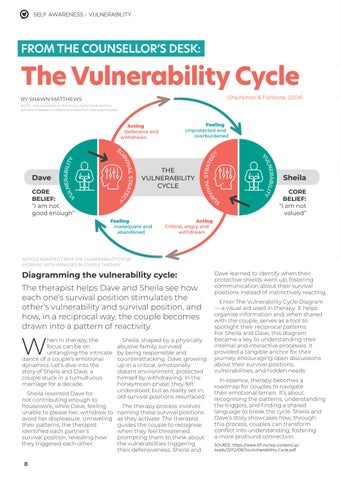
Diagramming the vulnerability cycle: The therapist helps Dave and Sheila see how each one’s survival position stimulates the other’s vulnerability and survival position, and how, in a reciprocal way, the couple becomes drawn into a pattern of reactivity.
W
hen in therapy, the focus can be on untangling the intricate dance of a couple’s emotional dynamics. Let’s dive into the story of Sheila and Dave, a couple stuck in a tumultuous marriage for a decade. Sheila resented Dave for not contributing enough to housework, while Dave, feeling unable to please her, withdrew to avoid her displeasure. Unraveling their patterns, the therapist identified each partner’s survival position, revealing how they triggered each other. 8
Sheila, shaped by a physically abusive family, survived by being responsible and counterattacking. Dave, growing up in a critical, emotionally distant environment, protected himself by withdrawing. In the honeymoon phase, they felt understood, but as reality set in, old survival positions resurfaced. The therapy process involves naming these survival positions as they activate. The therapist guides the couple to recognise when they feel threatened, prompting them to think about the vulnerabilities triggering their defensiveness. Sheila and
Dave learned to identify when their protective shields went up, fostering communication about their survival positions instead of instinctively reacting. Enter The Vulnerability Cycle Diagram — a visual aid used in therapy. It helps organise information and, when shared with the couple, serves as a tool to spotlight their reciprocal patterns. For Sheila and Dave, this diagram became a key to understanding their internal and interactive processes. It provided a tangible anchor for their journey, encouraging open discussions about their survival positions, vulnerabilities, and hidden needs. In essence, therapy becomes a roadmap for couples to navigate their emotional terrain. It’s about recognising the patterns, understanding the triggers, and finding a shared language to break the cycle. Sheila and Dave’s story showcases how, through this process, couples can transform conflict into understanding, fostering a more profound connection. SOURCE: https://www.kfr.nu/wp-content/uploads/2012/08/SouVulnerablility-Cycle.pdf