06
A RT S & CU LTU R E |
N OVEM B ER 2, 2017
TH E O NTA R I O N
Food into flesh
and paint into porcelain
GUELPH ARTIST AMBERA WELLMANN WINS RBC PAINTING PRIZE W I L L W E L L I N G TO N
A
mbera Wellmann’s art is all about alchemy, transforming one thing into another. In her paintings, the U of G MFA graduate, who now works in Germany, uses oils to create eerily lifelike depictions of porcelain figures, beneath which ghostly under-images can be glimpsed. Wellmann recently won the prestigious RBC Painting Competition for one such work. On her irreverent Instagram account, she juxtaposes foods and body parts to gross and hilarious effect. I asked Wellmann about her Instagram habits and interest in porcelain. Will Wellington: I asked a friend of mine, who studied art at Guelph, what she thought she might have to do to make a go of it as an artist in Toronto, and one thing she said was that she’d have to have a really good Instagram. What do you think is the role of Instagram in an artist’s career today? Ambera Wellmann: I don’t think you have to have a good Instagram and I don’t think you have to have social media at all. I think that it’s important nowadays for artists to have websites, but in terms of social media, it’s up to everyone. I think certain artists are using it in a very clever way, but that doesn’t mean that it’s essential. In fact, I think artists have a bit of a responsibility to think about how they want to present themselves outside of their practice, outside of their studio, if at all. I think it’s essential to connect with people in dialogue and conversation, but social media doesn’t actually support that in all cases. WW: What’s your daily schedule like and how much of your day does Instagram take up? AW: I get to the studio in the afternoon and I stay there very late into the night. I really take photographs for Instagram if I’m in the mood to, basically, or if I have an idea. Sometimes making a photograph or creating a video for Instagram will take anywhere between an hour to a couple of
hours if I do decide to post, but that’s maybe one every two or three days. And I try not to spend too much time on there, because it has a time zone of its own. You get vacuumed in, but it’s not time spent critically, it’s really just time observing and ingesting likes and comments without any real sense of development. Once I post something, I try and leave my phone alone for the rest of the day, and then maybe come back to it in the morning. It takes up very little of my time. Some people think I must spend all the time on my phone, but I’m one of those people — if I’m in the studio, the phone is away, and if I’m with people, the phone is away. WW: So what is most of your time in the studio spent on then? AW: Painting and drawing. I paint for between six and eight hours a day. WW: One big motif in your Instagram work is food blending with the body. How did the relationship with food come into your work and has it changed the way you relate to food? AW: I s t a r t e d u si ng fo o d because it was just readily available. I started using my Instagram as a way to embrace my sense of humour and sense of visual irony or cliché in a way that I avoid in my paintings. Allowing myself the freedom to make a bad joke. The platform itself, the delivery and the reception, is so speedy that it’s hardwired for one-liners. Food is always kind of funny to me. It was a quick and easy way to manipulate and alter the surface of the body in a way that was funny and cheeky — being grotesque and abject, but not taking itself too seriously. It hasn’t changed my relationship to food. I mean, when I look at it I’m always sort of wondering what I can do with it. It’s a way to freestyle. It’s a way to keep things fresh, and to experiment and improvise. It’s an exercise to keep my mind moving and to keep
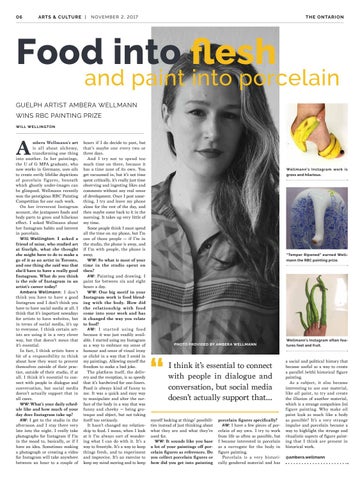
Wellmann’s Instagram work is gross and hilarious.
“Temper Ripened” earned Wellmann the RBC painting prize.
PHOTO PROVIDED BY AMBERA WELLMANN
I think it’s essential to connect with people in dialogue and conversation, but social media doesn’t actually support that... myself looking at things’ possibilities instead of just thinking about what they are and what they’re used for. WW: It sounds like you base a lot of your paintings off porcelain figures as references. Do you collect porcelain figures or how did you get into painting
porcelain figures specifically? AW: I have a few pieces of porcelain of my own. I try to work from life as often as possible, but I became interested in porcelain as a surrogate for the body in figure painting. Porcelain is a very historically gendered material and has
Wellmann’s Instagram often features feet and fruit.
a social and political history that became useful as a way to create a parallel [with] historical figure painting. As a subject, it also became interesting to use one material, like oil paint, to try and create the illusion of another material, which is a strange compulsion [in] figure painting. Why make oil paint look as much like a body as possible? It’s a very strange impulse and porcelain became a way to highlight the strange and ritualistic aspects of figure painting that I think are present in historical work. @ambera.wellmann