10
A RT S & CU LTU R E
|
N OVEM B ER 0 9, 2017
TH E O NTA R I O N
O PI N I O N
Three movie facts to make you a hit at any party FACTS AS FUN AS FILMS THEMSELVES A R I A N A LO N G L E Y
MOVIE WORLDS are
fun and fantastical places. However, people often forget that movie trivia can be just as interesting as the movies themselves. Here are three noteworthy movie facts that are just as enticing as a full-length feature film.
1
PH OTO E D ITE D BY ALO R A G RI FFITH S
Tom Cruise was supposed to play Iron Man
One of the best superhero movies of all time according to my personal top 10 list, Iron Man marked the birth of the iconic Marvel Cinematic Universe. This witty and adventure-filled film was originally slated to have Tom Cruise produce and star in the movie. Cruise was arguably one the biggest actors in the world at the time, so it made sense to have him play the lead role in the first film of the Marvel Cinematic Universe. I understand Tom Cruise is a good actor, but his mere presence in films ruins them for me. The only film he didn’t destroy for me was Tropic Thunder — because
I didn’t realise he was in it. The rumour is that Cruise had one make or break requirement that needed to be fulfilled if he was to dawn the metal suit: he needed his face to be visible at all times. The Iron Man costume either needed to lose the mask or have a transparent visor. Imagine Iron Man flying around, shooting bombs from his hands and creepy looks from his eyes. Thankfully the studio didn’t give in to his demands. Much of the charm in the 2008 hit came from Robert Downey Jr. Tom Cruise being in the establishing movie of Universal’s Dark Universe, The Mummy, may have already tarnished their world. What would the Marvel Cinematic Universe be today if Tom Cruise played the beloved hero and not the charismatic Robert Downey Jr. we know and love today?
2
PG-13 films can only use the F-word once
Have you ever watched a PG-13 movie and felt like something was off ? For some reason, the characters don’t react like real people. In general, folks swear if the situation calls for it, but not in these movies. The Motion Picture Association of America (MPAA) is responsible
for determining movie ratings (i.e., G, PG, PG-13, R, NC-17). They follow a strict list of criteria to decide at which level a movie belongs. PG-13 movies are allowed to use the F-word once, as long as it’s not used in the verb form. I remembered this fact as I revisited the movie 1408, a hotel horror starring John Cusack and Samuel L . Jackson. It puzzled me how Mike Enslin, played by Cusack, keeps his vocabulary subdued while being attacked by ghosts and traversing the elements. And that’s when I realised that they gave that verbal privilege to Jackson, who appeared for only 15 minutes at the beginning, leaving the rest of the film fairly tame in the language department.
3
Jackson has over 70 films to his name. Jackson has appeared in some of the biggest movies of all time:
• • • •
Jurassic Park Die Hard with a Vengeance Do the Right Thing The Avengers Samuel L. Jackson is like the Nicolas Cage of good movies, each one contributing to his box office success. Jackson was knocked off his throne in January 2016 by Harrison Ford after the release of Star Wars: The Force Awakens. However, he was able to reign again after Kong: Skull Island and The Hitman’s Bodyguard hit the screens.
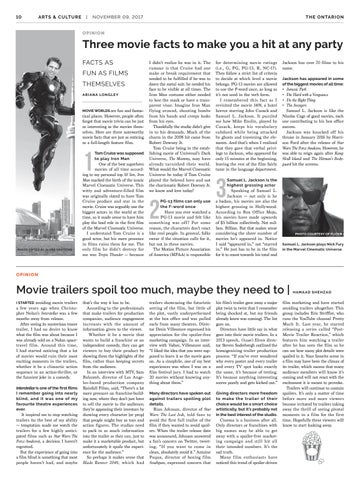
Samuel L. Jackson is the highest grossing actor
Speaking of Samuel L. Jackson — not only is he a badass, his movies are also the highest grossing in Hollywood. According to Box Office Mojo, his movies have made upwards of $5 billion collectively. Not million. Billion. But that makes sense considering the sheer number of movies he’s appeared in. Notice I said “appeared in,” not “starred in.” He just has to be in the film for it to count towards his total and
Samuel L. Jackson plays Nick Fury in the Marvel Cinematic Universe.
O PI N I O N
Movie trailers spoil too much, maybe they need to | avoiding movie trailers a few years ago when Christopher Nolan’s Interstellar was a few months away from release. After seeing its mysterious teaser trailer, I had no desire to know what the film was about because I was already sold on a Nolan spacetravel film. Around this time, I had started noticing that a lot of movies would ruin their most exciting moments in the trailers, whether it be a climactic action sequence in an action-thriller, or the funniest joke in a comedy.
I STARTED
Interstellar is one of the first films I remember going into nearly blind, and it was one of my favourite theatre experiences ever.
It inspired me to stop watching trailers (to the best of my ability — temptation made me watch the trailers for a few highly anticipated films such as Star Wars: The Force Awakens), a decision I haven’t regretted. But the experience of going into a film blind is something that most people haven’t had, and maybe
that’s the way it has to be. According to the professionals that make trailers for production companies, audience engagement increases with the amount of information given to the viewer. Whether it be a movie that wants to build a franchise or an independent comedy, they can get viewers to buy their product by showing them the highlights of the film, rather than keeping secrets from the audience. In an interview with MTV, Sam Balcomb, director of Los Angeles-based production company Rainfall Films, said, “There’s a lot more pressure on franchise-building now, where they don’t just have to sell the movie to the audience; they’re appeasing their investors by showing every character [or prop] that people might buy as toys and action figures. The studios need to pack in as much information into the trailer as they can, just to make it a marketable product, but unfortunately it spoils the experience for the audience.” So perhaps it makes sense that Blade Runner 2049, which had
trailers showcasing the futuristic setting of the film, but little of the plot, vastly underperformed at the box office and was pulled early from many theatres. Director Denis Villeneuve expressed his appreciation for the spoiler-free marketing campaign. In an interview with Vulture, Villeneuve said, “I liked the idea that you were supposed to learn it as the movie goes on. As a cinephile, one of my best experiences was when I was on a film festival jury. I had to watch 20 movies without knowing anything about them.”
his film’s trailer gave away a major plot twist (a twist that I remember being shocked at, but my friends already knew was coming). The list goes on. Directors have little say in what goes into their movie trailers. In a 2013 speech, Ocean’s Eleven director Steven Soderbergh outlined the homogenizing trailer production process: “If you’ve ever wondered why every poster and every trailer and every TV spot looks exactly the same, it’s because of testing. It’s because anything interesting scores poorly and gets kicked out.”
Many directors have spoken out against trailers spoiling plot details.
Giving directors more freedom to make the trailer of their choice would be a smart choice artistically, but it’s probably not in the best interest of the studio.
Rian Johnson, director of Star Wars: The Last Jedi, told fans to avoid the first full trailer of the film if they wanted to avoid spoilers. When the trailer release date was announced, Johnson answered a fan’s concern on Twitter, tweeting, “If you want to come in clean, absolutely avoid it.” Antoine Fuqua, director of boxing film Southpaw, expressed concern that
Cinema is a business after all. Only directors or franchises with big names may be able to get away with a spoiler-free marketing campaign and still hit all their intended numbers. It’s the sad truth. Many film enthusiasts have noticed this trend of spoiler-driven
HAMA AD SHEHZAD
film marketing and have started avoiding trailers altogether. This group includes Eric Striffler, who runs the YouTube channel Pretty Much It. Last year, he started releasing a series called “PostMovie Trailer Reaction,” which features him watching a trailer after he has seen the film so he can see how many plot details were spoiled in it. Your favorite scene in a film may have been the climax of its trailer, which means that many audience members will know it’s coming and will not react with the excitement it is meant to provoke. Trailers will continue to contain spoilers. It’s only a matter of time before more and more viewers become irritated by trailers taking away the thrill of seeing pivotal moments in a film for the first time. Hopefully these viewers will know to start looking away.