Land
Land and Environmental Art Jeffrey Kastner and Brian Wallis, editors. London: Phaidon, 1998.
Stephanie White
l
and art was, is, a form of mark making that started in the 1960s as an art that stepped away from the making of objects for collectors and galleries (commodities in the international art market) and moved instead into the world at large, especially large un-ownable landscapes where a drawing might be several miles across. Most of us were introduced to land art by Rosalind Krauss’s essay ‘Sculpture in an Expanded Field’ because it came after Kenneth Frampton’s ‘Six Points for an Architecture of Resistance. Towards an Architecture of Critical Regionalism’ in Hal Foster’s 1983 book, The Anti-Aesthetic. Photocopy ‘6 Points’ and you get the provocative first page of ‘Expanded Field’. Other books followed: Lucy Lippard’s Overlay and Alan Sonfist’s Art in the Land provided a powerful antithesis to the excessive use of historicist signs in 1980s architecture. Land art illustrated systems of land registration and brought home the recognition that architecture, even more than art, renders land as landscape, politicised and marked by a colonising imperative. It is a cornerstone of Canadian identity, our historic relationship with the land, and here was an art that combined intimate detail with enormous abstraction, offering much direction to a Canadian architecture. Many projects in this issue of On Site illustrate this sensibility, from accommodating the entropic processes of weathering, to Brown+Storey’s reclamation of Toronto’s culverted streams, to the increased privileging of land forms over buildings — a matter of some urgency in the north. When land is conceptualised as cultural space, as in Toronto’s Danforth, we can look to Foucault’s 1984 statement, included in the ‘Documents’ section of Land and Environmental Art: “Space is fundamental in any form of communal life; space is fundamental in any exercise of power”, for a linkage between land, urbanism, politics and spatial engagement. The preoccupation with social meaning drummed into us through the postmodern 1980s has emerged in the early 2000s as a preoccupation with social accommodation within a fragile environment: concern that the rebuilding of New Orleans will be as a ‘white’ city thanks to the ‘cleansing’ power of the environmental disaster that was hurricane Rita, links cultural and spatial politics in a way that also owes much to Foucault, and is foreshadowed by the early 1970s American land art of Helen Mayer, Newton Harrison and Gordon Matta Clark. Land and Environmental Art is a most valuable collection of projects and texts that confirm to us that land is at once sublime and humble. The marks and inscriptions we make upon it with our work, indeed with our occupation, have graphically written our attitudes to the environment, to the culture of architecture and to technology. Land art reminds us of the speed with which these c marks can be made and the permanence of their embeddedness. Stephanie White once wrote a PhD dissertation on the relationship between land and Canadian architecture in the 1950s.
56
on|site 14
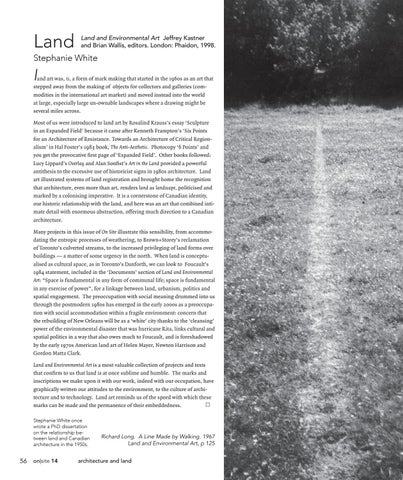
Richard Long. A Line Made by Walking. 1967 Land and Environmental Art, p 125
architecture and land