“Students never realize the kinds of things they can do until they take an art class,” Wertheimer said. “It opens up a whole world to them of who they are.” Rowe agrees. “You don’t have to be an art major to reap the benefits of art,” he said. “There’s a huge amount of literature that says art uses other parts of the brain to serve numbers, writing and all kinds of other mental functioning.” Olivet has always recognized the importance of visual art as part of a broader liberal arts curriculum. The college first began offering art courses in 1847, making it one of the oldest majors on campus. One hundred sixty-two years later, the program has encountered many milestones, but Rowe and Wertheimer say little has changed within the discipline. “The curriculum has changed – it’s gotten better – but the content doesn’t change,” Rowe said. “We are traditional in the way we teach.” Taking Olivet’s history in the arts into account, it’s a tradition worth keeping.
From Authors to Artists, Olivet Forges a Reputation in the Arts In the 1930s, Olivet earned a reputation for hosting renowned writers and artists. Under the administration of President Joseph Brewer, the college soon became a centerpiece for social and cultural interaction, as well as academic excellence. “Brewer was trained at Oxford Joseph Brewer and University, so Katherine Ann Porter he put the college on the Oxford model,” Rowe said. “People didn’t go to class, per se, they studied with tutors.”
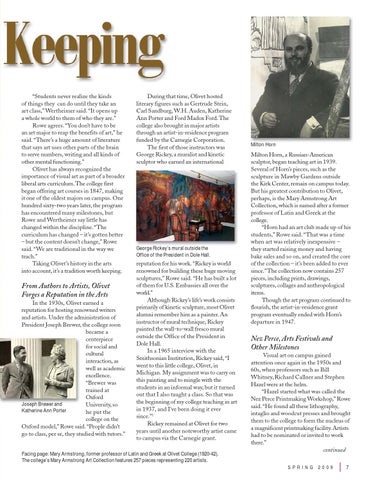
During that time, Olivet hosted literary figures such as Gertrude Stein, Carl Sandburg, W.H. Auden, Katherine Ann Porter and Ford Madox Ford. The college also brought in major artists through an artist-in-residence program funded by the Carnegie Corporation. The first of those instructors was George Rickey, a muralist and kinetic sculptor who earned an international
George Rickey’s mural outside the Office of the President in Dole Hall.
reputation for his work. “Rickey is world renowned for building these huge moving sculptures,” Rowe said. “He has built a lot of them for U.S. Embassies all over the world.” Although Rickey’s life’s work consists primarily of kinetic sculpture, most Olivet alumni remember him as a painter. An instructor of mural technique, Rickey painted the wall-to-wall fresco mural outside the Office of the President in Dole Hall. In a 1965 interview with the Smithsonian Institution, Rickey said, “I went to this little college, Olivet, in Michigan. My assignment was to carry on this painting and to mingle with the students in an informal way, but it turned out that I also taught a class. So that was the beginning of my college teaching in art in 1937, and I’ve been doing it ever since.”1 Rickey remained at Olivet for two years until another noteworthy artist came to campus via the Carnegie grant.
Facing page: Mary Armstrong, former professor of Latin and Greek at Olivet College (1920-42). The college’s Mary Armstrong Art Collection features 257 pieces representing 220 artists.
Milton Horn
Milton Horn, a Russian-American sculptor, began teaching art in 1939. Several of Horn’s pieces, such as the sculpture in Mawby Gardens outside the Kirk Center, remain on campus today. But his greatest contribution to Olivet, perhaps, is the Mary Armstrong Art Collection, which is named after a former professor of Latin and Greek at the college. “Horn had an art club made up of his students,” Rowe said. “That was a time when art was relatively inexpensive – they started raising money and having bake sales and so on, and created the core of the collection – it’s been added to ever since.” The collection now contains 257 pieces, including prints, drawings, sculptures, collages and anthropological items. Though the art program continued to flourish, the artist-in-residence grant program eventually ended with Horn’s departure in 1947.
Nez Perce, Arts Festivals and Other Milestones Visual art on campus gained attention once again in the 1950s and 60s, when professors such as Bill Whitney, Richard Callner and Stephen Hazel were at the helm. “Hazel started what was called the Nez Perce Printmaking Workshop,” Rowe said. “He found all these lithography, intaglio and woodcut presses and brought them to the college to form the nucleus of a magnificent printmaking facility. Artists had to be nominated or invited to work there.” continued S PRING
2009
7