When a Mayan housewife broke her favorite pot, it
was no great loss. She simply tossed the pieces on the midden heap and started rolling out pieces of clay to make herself a new one. Perhaps this time she would try something new; an incised design or maybe a different color slip. She, and the thousands like her over a period of three and a half milennia, had no way of knowing that, in so doing, they were helping future generations write the history of their times. To archaeologists, every potsherd is a veritable treasure trove of information. Everything about it, from the chemical composition of the basic clay to the shape, size, color and style of decoration of the piece itself, has a story to tell. Given enough such shards, scholars can establish a pottery sequence that answers many questions. Where and when they were made? Who made them? Did that particular site have trade relations with other cultures? Painted pots are even more informative. What gods did they worship? Who were their rulers? How did they dress? Make war? Amuse themselves? Mayan ceramics have been divided into seven major periods, each with a number of subdivisions. Their technology changes very little throughout all that time but styles vary dra matically from the simple Mamon to the highly ornate Tepeu and beyond.
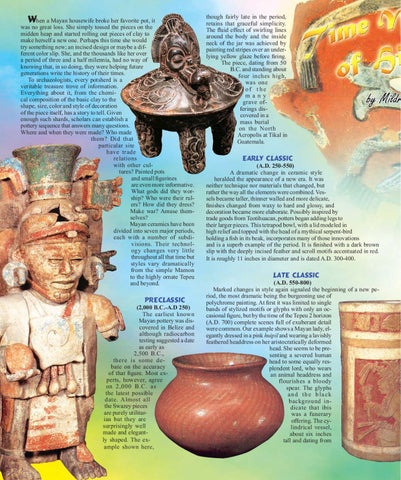
Preclassic (2,000 B.C.-A.D 250) The earliest known Mayan pottery was discovered in Belize and although radiocarbon testing suggested a date as early as 2,500 B.C., there is some debate on the accuracy perts, however, agree on 2,000 B.C. as the latest possible date. Almost all the Swazey pieces are purely utilitarian but they are surprisingly well made and elegantly shaped. ample shown here,
38
El Ojo del Lago / June 2012
though fairly late in the period, retains that graceful simplicity. around the body and the inside neck of the jar was achieved by painting red stripes over an under The piece, dating from 50 B.C. and standing about four inches high, was one of the many grave offerings discovered in a mass burial on the North Acropolis at Tikal in Guatemala.
Early Classic (A.D. 250-550) A dramatic change in ceramic style heralded the appearance of a new era. It was neither technique nor materials that changed, but rather the way all the elements were combined. Vessels became taller, thinner walled and more delicate, decoration became more elaborate. Possibly inspired by trade goods from Teotihuacan, potters began adding legs to their larger pieces. This tetrapod bowl, with a lid modeled in high relief and topped with the head of a mythical serpent-bird ! " slip with the deeply incised feather and scroll motifs accentuated in red. It is roughly 11 inches in diameter and is dated A.D. 300-400.
Late Classic (A.D. 550-800) Marked changes in style again signaled the beginning of a new period, the most dramatic being the burgeoning use of # bands of stylized motifs or glyphs with only an oc $ %# & '(() * egantly dressed in a pink huipil and wearing a lavishly feathered headdress on her aristocratically deformed head. She seems to be presenting a severed human head to some equally resplendent lord, who wears an animal headdress and flourishes a bloody spear. The glyphs and the black background indicate that ibis was a funerary offering. The cylindrical vessel, tall and dating from