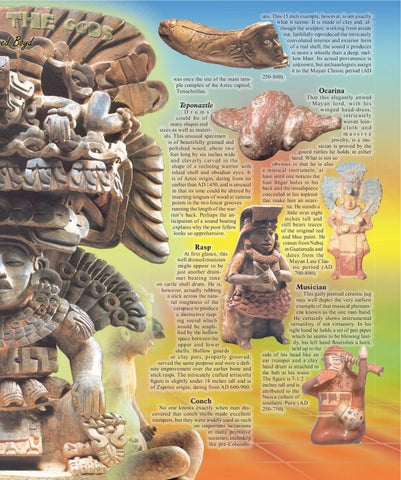
was once the site of the main temple complex of the Aztec capitol, Tenochtitlan.
Teponaztle
D r u m s could be of many shapes and sizes as well as materials. This unusual specimen is of beautifully grained and polished wood, about two feet long by six inches wide and cleverly carved in the shape of a reclining warrior with inlaid shell and obsidian eyes. It is of Aztec origin, dating from no earlier than AD 1450, and is unusual in that its tone could be altered by inserting tongues of wood at various points in the two linear grooves running the length of the warrior’s back. Perhaps the anticipation of a sound beating explains why the poor fellow looks so apprehensive.
Rasp
well dressed musician might appear to be just another drummer beating time on turtle shell drum. He is, however, actually rubbing a stick across the natural roughness of the carapace to produce a distinctive rasping sound which would be ampli
space between the upper and lower shells. Hollow gourds or clay pots, properly grooved, nite improvement over the earlier bone and stick rasps. The intricately crafted terracotta "#
of Zapotec origin, dating from AD 600-900.
Conch
No one knows exactly when man discovered that conch shells made excellent trumpets, but they were widely used as such on important occasions in many primitive societies, including the pre-Columbi-
ans. This 15 inch example, however, is not exactly what it seems. It is made of clay and, although the sculptor, working from inside out, faithfully reproduced the intricately convoluted interior and exterior form of a real shell, the sound it produces is more a whistle than a deep, mellow blast. Its actual provenance is unknown, but archaeologists assign it to the Mayan Classic period (AD 250-800).
Ocarina
That this elegantly attired Mayan lord, with his winged head-dress, intricately woven loincloth and massive jewelry, is a musician is proved by the gourd rattles he holds in either hand. What is not so obvious is that he is also a musical instrument, at least until one notices the back and the mouthpiece concealed in his topknot that make him an ocarina. He stands a little over eight inches tall and still bears traces of the original red and blue paint. He comes from Nebaj in Guatemala and dates from the Mayan Late Classic period (AD 700-800).
Musician
This gaily painted ceramic jug may well depict the very earliest example of that musical phenomena known as the one man band. He certainly shows instrumental versatility, if not virtuosity. In his right hand he holds a set of pan pipes which he seems to be blowing lust held up to the side of his head like an ear trumpet and a clay hand drum is attached to the belt at his waist. $%"&' inches tall and is attributed to the Nazca culture of southern Peru (AD 250-750).
Saw you in the Ojo 37