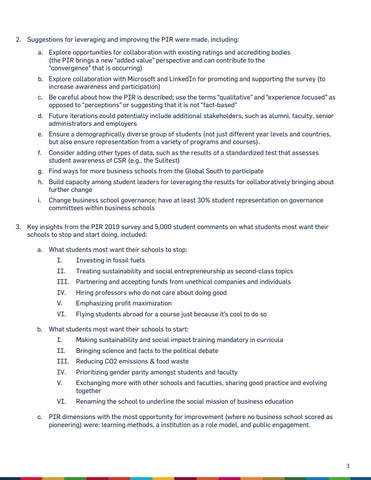
2. Suggestions for leveraging and improving the PIR were made, including: a. Explore opportunities for collaboration with existing ratings and accrediting bodies (the PIR brings a new “added value” perspective and can contribute to the “convergence” that is occurring) b. Explore collaboration with Microsoft and LinkedIn for promoting and supporting the survey (to increase awareness and participation) c. Be careful about how the PIR is described; use the terms “qualitative” and “experience focused” as opposed to “perceptions” or suggesting that it is not “fact-based” d. Future iterations could potentially include additional stakeholders, such as alumni, faculty, senior administrators and employers e. Ensure a demographically diverse group of students (not just different year levels and countries, but also ensure representation from a variety of programs and courses). f.
Consider adding other types of data, such as the results of a standardized test that assesses student awareness of CSR (e.g., the Sulitest)
g. Find ways for more business schools from the Global South to participate h. Build capacity among student leaders for leveraging the results for collaboratively bringing about further change i.
Change business school governance; have at least 30% student representation on governance committees within business schools
3. Key insights from the PIR 2019 survey and 5,000 student comments on what students most want their schools to stop and start doing, included: a. What students most want their schools to stop: I.
Investing in fossil fuels
II.
Treating sustainability and social entrepreneurship as second-class topics
III.
Partnering and accepting funds from unethical companies and individuals
IV.
Hiring professors who do not care about doing good
V.
Emphasizing profit maximization
VI.
Flying students abroad for a course just because it’s cool to do so
b. What students most want their schools to start: I.
Making sustainability and social impact training mandatory in curricula
II.
Bringing science and facts to the political debate
III.
Reducing CO2 emissions & food waste
IV.
Prioritizing gender parity amongst students and faculty
V.
Exchanging more with other schools and faculties, sharing good practice and evolving together
VI.
Renaming the school to underline the social mission of business education
c. PIR dimensions with the most opportunity for improvement (where no business school scored as pioneering) were: learning methods, a institution as a role model, and public engagement.
3