Haven for Hope THE HATTIE LARLHAM FOUNDATION BY ERIN ESMONT
H
attie Gadd Larlham had witnessed countless births in her 25 years as a nurse. Most were joyous occasions, producing healthy, thriving babies. But others were not.
At that time—1961—babies with profound intellectual and developmental disabilities were considered “non-salvageable.” Doctors had few answers for heartbroken parents. No facilities or services existed for those younger than six. Some families hid their children in attics and basements, out of view. It was against this backdrop that Hattie Larlham answered her farmhouse door in Mantua, Portage County, to find her friend and neighbor, Jennie, had just delivered her fourth baby, Alice, and there were complications.
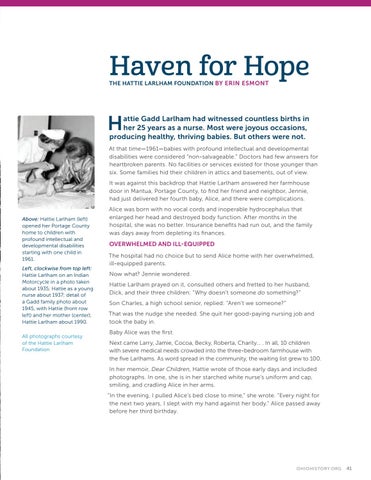
Above: Hattie Larlham (left) opened her Portage County home to children with profound intellectual and developmental disabilities starting with one child in 1961. Left, clockwise from top left: Hattie Larlham on an Indian Motorcycle in a photo taken about 1935; Hattie as a young nurse about 1937; detail of a Gadd family photo about 1945, with Hattie (front row left) and her mother (center); Hattie Larlham about 1990. All photographs courtesy of the Hattie Larlham Foundation
Alice was born with no vocal cords and inoperable hydrocephalus that enlarged her head and destroyed body function. After months in the hospital, she was no better. Insurance benefits had run out, and the family was days away from depleting its finances.
OVERWHELMED AND ILL-EQUIPPED The hospital had no choice but to send Alice home with her overwhelmed, ill-equipped parents. Now what? Jennie wondered. Hattie Larlham prayed on it, consulted others and fretted to her husband, Dick, and their three children: “Why doesn’t someone do something?” Son Charles, a high school senior, replied: “Aren’t we someone?” That was the nudge she needed. She quit her good-paying nursing job and took the baby in. Baby Alice was the first. Next came Larry, Jamie, Cocoa, Becky, Roberta, Charity... . In all, 10 children with severe medical needs crowded into the three-bedroom farmhouse with the five Larlhams. As word spread in the community, the waiting list grew to 100. In her memoir, Dear Children, Hattie wrote of those early days and included photographs. In one, she is in her starched white nurse’s uniform and cap, smiling, and cradling Alice in her arms. “In the evening, I pulled Alice’s bed close to mine,” she wrote. “Every night for the next two years, I slept with my hand against her body.” Alice passed away before her third birthday.
OHIOHIS TORY.ORG
41