VIEWPOINT
MUCH ADO ABOUT By Anthony Carabache
The English language is beautiful, but complex. Its nuances take a lifetime to understand, and its mechanics a lifetime to master. If we learn to look at coding as language, we begin to see its beauty as well. It is much like language in many ways, except nuances become dependencies, and mechanics become patterns that unfold right in front of our eyes. A code is simply a set of instructions (input) that can cause a multitude of outcomes (output). Each line of code – or instruction – is completely dependent on the preceding line. Code is the imaginary army of little tech-mites that make a font green, make a Mario jump, place a picture on a blog, make a robot say hello, or turn the TV volume higher or lower. We have become so accustomed to experiencing the output that the mechanics of the input is completely out of our minds. The input can be simple – three steps forward, jump, turn, repeat – but it can also be as complex as launching a rocket, jettisoning its non-essential modules, landing it, and releasing a vehicle for exploration, all while collecting data.
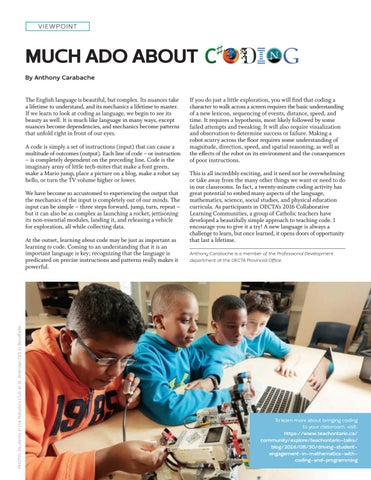
PHOTO: Students in the Robotics Club at St. Brendan CES in Stouffville.
At the outset, learning about code may be just as important as learning to code. Coming to an understanding that it is an important language is key; recognizing that the language is predicated on precise instructions and patterns really makes it powerful.
If you do just a little exploration, you will find that coding a character to walk across a screen requires the basic understanding of a new lexicon, sequencing of events, distance, speed, and time. It requires a hypothesis, most likely followed by some failed attempts and tweaking. It will also require visualization and observation to determine success or failure. Making a robot scurry across the floor requires some understanding of magnitude, direction, speed, and spatial reasoning, as well as the effects of the robot on its environment and the consequences of poor instructions. This is all incredibly exciting, and it need not be overwhelming or take away from the many other things we want or need to do in our classrooms. In fact, a twenty-minute coding activity has great potential to embed many aspects of the language, mathematics, science, social studies, and physical education curricula. As participants in OECTA’s 2016 Collaborative Learning Communities, a group of Catholic teachers have developed a beautifully simple approach to teaching code. I encourage you to give it a try! A new language is always a challenge to learn, but once learned, it opens doors of opportunity that last a lifetime. Anthony Carabache is a member of the Professional Development department at the OECTA Provincial Office.
To learn more about bringing coding to your classroom, visit: https://www.teachontario.ca/ community/explore/teachontario-talks/ blog/2016/08/30/driving-studentengagement-in-mathematics-withcoding-and-programming