PEOPLE WORTH WATCHING
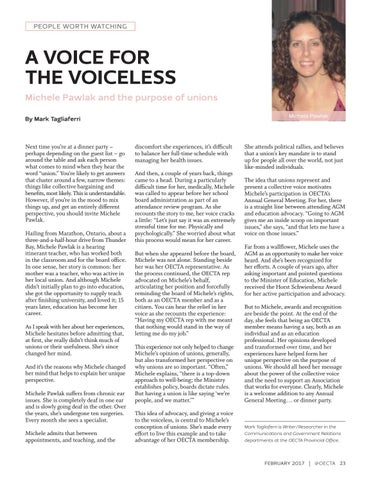
A VOICE FOR THE VOICELESS Michele Pawlak and the purpose of unions Michele Pawlak
By Mark Tagliaferri
Next time you’re at a dinner party – perhaps depending on the guest list – go around the table and ask each person what comes to mind when they hear the word “union.” You’re likely to get answers that cluster around a few, narrow themes: things like collective bargaining and benefits, most likely. This is understandable. However, if you’re in the mood to mix things up, and get an entirely different perspective, you should invite Michele Pawlak. Hailing from Marathon, Ontario, about a three-and-a-half-hour drive from Thunder Bay, Michele Pawlak is a hearing itinerant teacher, who has worked both in the classroom and for the board office. In one sense, her story is common: her mother was a teacher, who was active in her local union. And although Michele didn’t initially plan to go into education, she got the opportunity to supply teach after finishing university, and loved it; 15 years later, education has become her career. As I speak with her about her experiences, Michele hesitates before admitting that, at first, she really didn’t think much of unions or their usefulness. She’s since changed her mind. And it’s the reasons why Michele changed her mind that helps to explain her unique perspective. Michele Pawlak suffers from chronic ear issues. She is completely deaf in one ear and is slowly going deaf in the other. Over the years, she’s undergone ten surgeries. Every month she sees a specialist. Michele admits that between appointments, and teaching, and the
discomfort she experiences, it’s difficult to balance her full-time schedule with managing her health issues. And then, a couple of years back, things came to a head. During a particularly difficult time for her, medically, Michele was called to appear before her school board administration as part of an attendance review program. As she recounts the story to me, her voice cracks a little: “Let’s just say it was an extremely stressful time for me. Physically and psychologically.” She worried about what this process would mean for her career. But when she appeared before the board, Michele was not alone. Standing beside her was her OECTA representative. As the process continued, the OECTA rep advocated on Michele’s behalf, articulating her position and forcefully reminding the board of Michele’s rights, both as an OECTA member and as a citizen. You can hear the relief in her voice as she recounts the experience: “Having my OECTA rep with me meant that nothing would stand in the way of letting me do my job.”
She attends political rallies, and believes that a union’s key mandate is to stand up for people all over the world, not just like-minded individuals. The idea that unions represent and present a collective voice motivates Michele’s participation in OECTA’s Annual General Meeting. For her, there is a straight line between attending AGM and education advocacy. “Going to AGM gives me an inside scoop on important issues,” she says, “and that lets me have a voice on those issues.” Far from a wallflower, Michele uses the AGM as an opportunity to make her voice heard. And she’s been recognized for her efforts. A couple of years ago, after asking important and pointed questions to the Minister of Education, Michele received the Horst Schwienbenz Award for her active participation and advocacy.
This experience not only helped to change Michele’s opinion of unions, generally, but also transformed her perspective on why unions are so important. “Often,” Michele explains, “there is a top-down approach to well-being; the Ministry establishes policy, boards dictate rules. But having a union is like saying ‘we’re people, and we matter.’”
But to Michele, awards and recognition are beside the point. At the end of the day, she feels that being an OECTA member means having a say, both as an individual and as an education professional. Her opinions developed and transformed over time, and her experiences have helped form her unique perspective on the purpose of unions. We should all heed her message about the power of the collective voice and the need to support an Association that works for everyone. Clearly, Michele is a welcome addition to any Annual General Meeting… or dinner party.
This idea of advocacy, and giving a voice to the voiceless, is central to Michele’s conception of unions. She’s made every effort to live this example and to take advantage of her OECTA membership.
Mark Tagliaferri is Writer/Researcher in the Communications and Government Relations departments at the OECTA Provincial Office.
FEBRUARY 2017 |
@ OECTA
23