PEOPLE WORTH WATCHING
COMMON HEROES By Dan de Souza
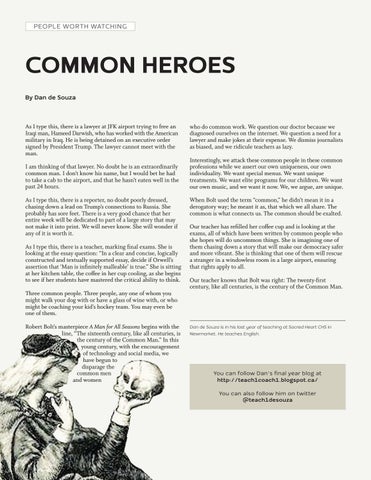
As I type this, there is a lawyer at JFK airport trying to free an Iraqi man, Hameed Darwish, who has worked with the American military in Iraq. He is being detained on an executive order signed by President Trump. The lawyer cannot meet with the man. I am thinking of that lawyer. No doubt he is an extraordinarily common man. I don’t know his name, but I would bet he had to take a cab to the airport, and that he hasn’t eaten well in the past 24 hours. As I type this, there is a reporter, no doubt poorly dressed, chasing down a lead on Trump’s connections to Russia. She probably has sore feet. There is a very good chance that her entire week will be dedicated to part of a large story that may not make it into print. We will never know. She will wonder if any of it is worth it. As I type this, there is a teacher, marking final exams. She is looking at the essay question: “In a clear and concise, logically constructed and textually supported essay, decide if Orwell’s assertion that ‘Man is infinitely malleable’ is true.” She is sitting at her kitchen table, the coffee in her cup cooling, as she begins to see if her students have mastered the critical ability to think. Three common people. Three people, any one of whom you might walk your dog with or have a glass of wine with, or who might be coaching your kid’s hockey team. You may even be one of them. Robert Bolt’s masterpiece A Man for All Seasons begins with the line, “The sixteenth century, like all centuries, is the century of the Common Man.” In this young century, with the encouragement of technology and social media, we have begun to disparage the common men and women
who do common work. We question our doctor because we diagnosed ourselves on the internet. We question a need for a lawyer and make jokes at their expense. We dismiss journalists as biased, and we ridicule teachers as lazy. Interestingly, we attack these common people in these common professions while we assert our own uniqueness, our own individuality. We want special menus. We want unique treatments. We want elite programs for our children. We want our own music, and we want it now. We, we argue, are unique. When Bolt used the term “common,” he didn’t mean it in a derogatory way; he meant it as, that which we all share. The common is what connects us. The common should be exalted. Our teacher has refilled her coffee cup and is looking at the exams, all of which have been written by common people who she hopes will do uncommon things. She is imagining one of them chasing down a story that will make our democracy safer and more vibrant. She is thinking that one of them will rescue a stranger in a windowless room in a large airport, ensuring that rights apply to all. Our teacher knows that Bolt was right: The twenty-first century, like all centuries, is the century of the Common Man.
Dan de Souza is in his last year of teaching at Sacred Heart CHS in Newmarket. He teaches English.
You can follow Dan’s final year blog at http://teach1coach1.blogspot.ca/ You can also follow him on twitter @teach1desouza