LEGAL BRIEF
TEACHERS AID
JUSTICE AT LAST
BC teachers score a resounding victory at the Supreme Court By Charlene Theodore
Christmas came early last year for members of the British Columbia Teachers’ Federation (BCTF). The union, which represents 41,000 public school teachers in BC, was on the winning side of a landmark Supreme Court decision on class size, an issue that affects teachers and students across the country. The decision had not been expected until spring of 2017, but it was delivered by the Supreme Court justices in November of last year. What is the decision about?
In 2002, the BC government passed Bill 28. This law invalidated the sections of the existing collective agreement that allowed for negotiating class size, and imposed a restriction on future negotiations on class size. Given the dramatic impact on the collective bargaining process and teachers’ working conditions, the BCTF sued the government, setting off a lengthy court process. In 2011, the BC Supreme Court deemed Bill 28 unconstitutional, as it violated the teachers’ right to freedom of association. To put it plainly, the court said a party cannot enter into good faith negotiations, reach an agreement, and then legislate away provisions of that agreement. The court gave the government one year to remedy the problem.
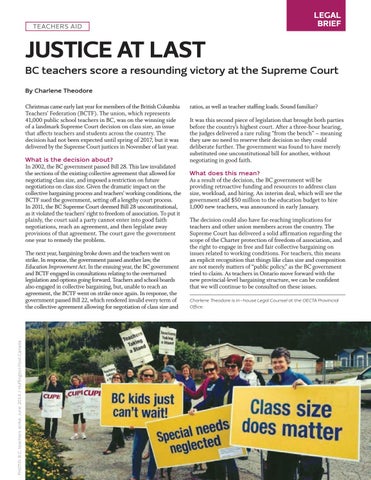
PHOTO: B.C. teachers strike, June 2014 / Huffington Post Canada
The next year, bargaining broke down and the teachers went on strike. In response, the government passed another law, the Education Improvement Act. In the ensuing year, the BC government and BCTF engaged in consultations relating to the overturned legislation and options going forward. Teachers and school boards also engaged in collective bargaining, but, unable to reach an agreement, the BCTF went on strike once again. In response, the government passed Bill 22, which rendered invalid every term of the collective agreement allowing for negotiation of class size and
ratios, as well as teacher staffing loads. Sound familiar? It was this second piece of legislation that brought both parties before the country’s highest court. After a three-hour hearing, the judges delivered a rare ruling “from the bench” – meaning they saw no need to reserve their decision so they could deliberate further. The government was found to have merely substituted one unconstitutional bill for another, without negotiating in good faith. What does this mean?
As a result of the decision, the BC government will be providing retroactive funding and resources to address class size, workload, and hiring. An interim deal, which will see the government add $50 million to the education budget to hire 1,000 new teachers, was announced in early January. The decision could also have far-reaching implications for teachers and other union members across the country. The Supreme Court has delivered a solid affirmation regarding the scope of the Charter protection of freedom of association, and the right to engage in free and fair collective bargaining on issues related to working conditions. For teachers, this means an explicit recognition that things like class size and composition are not merely matters of “public policy,” as the BC government tried to claim. As teachers in Ontario move forward with the new provincial-level bargaining structure, we can be confident that we will continue to be consulted on these issues. Charlene Theodore is in-house Legal Counsel at the OECTA Provincial Office.