“Decades of cutbacks on social programs have left… [Ontario] with the lowest levels of public service spending per capita in the entire country.” Advocates have pointed out the detrimental effects of “intergenerational trauma” on FMNI students. If we are to truly confront this issue, we must also deal with its corollary: intergenerational apathy amongst non-Indigenous populations. One of the more successful ways to promote cultural understanding is through “indigenizing” curriculum. Doing so has quantifiable benefits for FNMI students, but also contributes to broadening knowledge among the non-Indigenous student population. Part of this is about ensuring that FNMI students have the proper supports, but it also requires substantial investment into the professional development of certified teachers. Although PD learning opportunities can take many forms, they all serve to build teachers’ capacity to integrate FNMI education in an ageand grade-appropriate manner.
government must ensure accessible, affordable, high quality child care and early learning opportunities for all children. This will not be achieved if “bottom-line” economics is the driving force. For-profit child care is associated with a lower quality of early childhood education and care, and lower wages for staff. If the government is serious about its promise to invest in Ontario’s future, it will invest in a publicly funded model, led by qualified and well-compensated professionals.
The role of teachers in supporting student learning calls to mind the broader importance of focusing on the classroom. The tendency in recent years toward administrative bloat, the hiring of thirdparties to address issues such as attendance management, and the overreliance on mass standardized testing is reflective of an unhelpful, top-down approach to education. Teachers must be at the centre of students’ learning experience. To ensure this, funding must be allocated to teacher-directed and teacher-led initiatives. This is the best way to ensure that students and teachers receive the support they need.
The multifaceted role that Catholic teachers play overlaps with a number of issues that will likely feature prominently in the budget. Issues such as fighting poverty and inequality, empowering youth, and ensuring a prosperous society can all be traced back to robust investments in education. That is why, on January 18, OECTA President Ann Hawkins presented a series of recommendations to the Standing Committee on Finance and Economic Affairs, as part of the government’s prebudget consultations. Our full pre-budget brief is available at catholicteachers.ca. Ultimately, if we as a society are to reach our full potential, we must make a concerted effort to break down the social and financial barriers that many citizens continue to face. Investing in education and other public goods will ensure that all Ontarians have the best chance to succeed in life. The provincial budget must honour the government’s promises, and make bold investments in Ontario’s future.
Finally, in these discussions, we must not forget our youngest learners. The government’s promise to add 100,000 child care spaces over the next five years is welcome. However, the
Mark Tagliaferri is Writer/Researcher in the Communications and Government Relations departments at the OECTA Provincial Office.
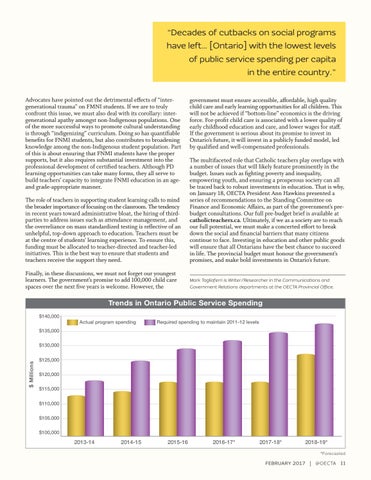
Trends in Ontario Public Service Spending $140,000
Actual program spending
Required spending to maintain 2011-12 levels
$135,000
$ Millions
$130,000 $125,000
$120,000 $115,000 $110,000 $105.000 $100,000
2013-14
2014-15
2015-16
2016-17*
2017-18*
2018-19* *Forecasted
FEBRUARY 2017 |
@ OECTA
11