FOR WHAT IT’S WORTH
VIEWPOINT
NOTHING OF VALUE IS ACHIEVED WITHOUT SACRIFICE The legacy of Ted Lindsay By Gian Marcon
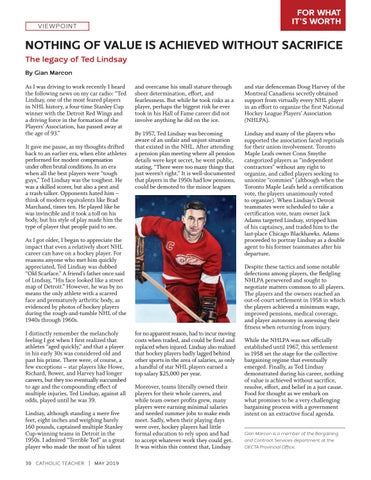
As I was driving to work recently I heard the following news on my car radio: “Ted Lindsay, one of the most feared players in NHL history, a four-time Stanley Cup winner with the Detroit Red Wings and a driving force in the formation of the Players’ Association, has passed away at the age of 93.” It gave me pause, as my thoughts drifted back to an earlier era, when elite athletes performed for modest compensation under often brutal conditions. In an era when all the best players were “tough guys,” Ted Lindsay was the toughest. He was a skilled scorer, but also a pest and a trash-talker. Opponents hated him – think of modern equivalents like Brad Marchand, times ten. He played like he was invincible and it took a toll on his body, but his style of play made him the type of player that people paid to see.
and overcame his small stature through sheer determination, effort, and fearlessness. But while he took risks as a player, perhaps the biggest risk he ever took in his Hall of Fame career did not involve anything he did on the ice.
and star defenceman Doug Harvey of the Montreal Canadiens secretly obtained support from virtually every NHL player in an effort to organize the first National Hockey League Players’ Association (NHLPA).
By 1957, Ted Lindsay was becoming aware of an unfair and unjust situation that existed in the NHL. After attending a pension plan meeting where all pension details were kept secret, he went public, stating, “There were too many things that just weren’t right.” It is well-documented that players in the 1950s had low pensions, could be demoted to the minor leagues
Lindsay and many of the players who supported the association faced reprisals for their union involvement. Toronto Maple Leafs owner Conn Smythe categorized players as “independent contractors” without any right to organize, and called players seeking to unionize “commies” (although when the Toronto Maple Leafs held a certification vote, the players unanimously voted to organize). When Lindsay’s Detroit teammates were scheduled to take a certification vote, team owner Jack Adams targeted Lindsay, stripped him of his captaincy, and traded him to the last-place Chicago Blackhawks. Adams proceeded to portray Lindsay as a double agent to his former teammates after his departure.
As I got older, I began to appreciate the impact that even a relatively short NHL career can have on a hockey player. For reasons anyone who met him quickly appreciated, Ted Lindsay was dubbed “Old Scarface.” A friend’s father once said of Lindsay, “His face looked like a street map of Detroit.” However, he was by no means the only athlete with a scarred face and prematurely arthritic body, as evidenced by photos of hockey players during the rough-and-tumble NHL of the 1940s through 1960s. I distinctly remember the melancholy feeling I got when I first realized that athletes “aged quickly,” and that a player in his early 30s was considered old and past his prime. There were, of course, a few exceptions – star players like Howe, Richard, Bower, and Harvey had longer careers, but they too eventually succumbed to age and the compounding effect of multiple injuries. Ted Lindsay, against all odds, played until he was 39. Lindsay, although standing a mere five feet, eight inches and weighing barely 160 pounds, captained multiple Stanley Cup-winning teams in Detroit in the 1950s. I admired “Terrible Ted” as a great player who made the most of his talent 30 CATHOLIC TEACHER | MAY 2019
for no apparent reason, had to incur moving costs when traded, and could be fired and replaced when injured. Lindsay also realized that hockey players badly lagged behind other sports in the area of salaries, as only a handful of star NHL players earned a top salary $25,000 per year. Moreover, teams literally owned their players for their whole careers, and while team owner profits grew, many players were earning minimal salaries and needed summer jobs to make ends meet. Sadly, when their playing days were over, hockey players had little formal education to rely upon and had to accept whatever work they could get. It was within this context that, Lindsay
Despite these tactics and some notable defections among players, the fledgling NHLPA persevered and sought to negotiate matters common to all players. The players and the owners reached an out-of-court settlement in 1958 in which the players achieved a minimum wage, improved pensions, medical coverage, and player autonomy in assessing their fitness when returning from injury. While the NHLPA was not officially established until 1967, this settlement in 1958 set the stage for the collective bargaining regime that eventually emerged. Finally, as Ted Lindsay demonstrated during his career, nothing of value is achieved without sacrifice, resolve, effort, and belief in a just cause. Food for thought as we embark on what promises to be a very challenging bargaining process with a government intent on an extractive fiscal agenda. Gian Marcon is a member of the Bargaining and Contract Services department at the OECTA Provincial Office.